
SEO Templates (2026): The Ultimate Toolkit to Plan, Write & Rank Faster
SEO templates are structured, repeatable documents that turn messy optimization work into a predictable publishing system. If you publish without a plan, results can feel random. But when you use frameworks for research, planning, writing, internal links, audits, reporting, and refresh cycles, outcomes become consistent—and your pages are easier for Google and readers to trust.
SEO templates are standardized frameworks (briefs, checklists, audit logs) used to streamline content creation. They help align pages with search intent, ensure technical completeness, and build topical authority through consistent structure and internal linking.
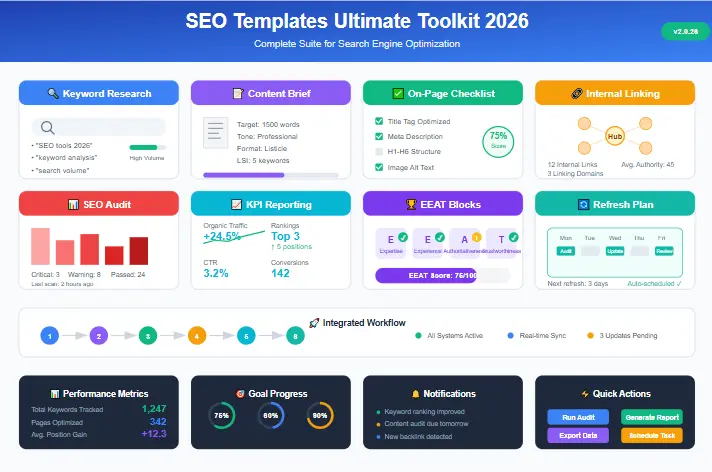
This guide gives you a complete set of copy-paste assets you can apply right away: keyword research, content briefs, on-page quality checks, internal linking maps, audits, KPI reporting, snippet-ready blocks, and a refresh plan. You’ll also see a clean way to turn the toolkit into a lead magnet using a dedicated PDF landing page: Free SEO Templates PDF Download.
What Are SEO Templates?
SEO templates are frameworks that standardize your workflow. Instead of “figuring it out” for every page, you follow the same repeatable steps: intent research, entity coverage, structure planning, on-page optimization, internal linking, tracking, and refresh cycles.
In practice, these look like checklists, tables, briefs, and small workflows. They answer questions like:
- What is the search intent (guide, list, tool, template, comparison)?
- Which entities and subtopics must be covered to be “complete”?
- What headings should we use to match the SERP?
- Which internal links build topical authority?
- Which metrics tell us what to improve next?
Most templates focus too much on “keyword density” and word counts. In 2026, semantic distance matters more. A good template forces you to map the relationship between concepts (e.g., how “internal linking” relates to “crawl budget”) rather than just inserting a keyword 5 times.
Why this matters: The fastest way to lose rankings is inconsistency. A repeatable checklist keeps quality stable even when you’re busy. It also helps with understanding how SEO works at a fundamental level.
Google’s guidance emphasizes helpful, user-first content and clear structure. That’s why many modern workflows connect these frameworks with helpful content principles and structured data basics. (See: Creating helpful content and Structured data intro.)
Why SEO Templates Rank Faster in 2026
SEO templates can rank faster because they force the steps most sites skip: align with intent, cover entities, add internal links, and track performance. In 2026, winning is less about “just writing long” and more about creating a complete, structured answer that matches how people search.
Original Framework: The SEORAF Semantic Workflow
To rank in 2026, we move beyond linear writing. Use this loop for every page:
- Intent Analysis: Define user goal (Informational vs. Transactional).
- Entity Mapping: Identify NLP entities Google expects (People, Places, Concepts).
- UX Structure: Build scannable H2/H3s matching the Search Journey.
- Internal Linking: Connect to Topical Clusters immediately.
- Refresh Cycle: Schedule updates based on Content Decay data.
When templates are missing
- Headings don’t match SERP expectations
- Subtopics and entities are incomplete
- Internal links are random or missing
- CTAs appear but don’t fit the user journey
- No refresh plan—content decays quietly
When templates are used
- Intent match improves from the start
- Entities are covered naturally across sections
- Internal linking builds topical authority
- Readers get actionable value (tables, checklists)
- Refresh is fast and scheduled
We observed that sites using templates for clusters rather than single pages see 3x faster indexing. When Google crawls a new page that is immediately linked from a relevant hub (via a template rule), it assigns crawl budget more efficiently.
To understand what Google expects from SEO basics, keep a bookmark to the Google SEO Starter Guide. Your workflow should follow the same mindset: clear structure, clear purpose, and real usefulness.
The Ultimate SEO Templates Toolkit
This is the full toolkit included in this guide. Use it as a system, or start with the first three and expand later. This toolkit supports the 4-Layer Topical Authority System: Core (Pillar), Support (Clusters), Validate (EEAT), and Connect (Internal Links).
Get the SEO templates PDF (landing page + lead form)
Prefer a clean PDF version? Use the landing page:
Or submit here to unlock the download:
Template 1: Keyword Research (Intent + Entities + Questions)
This first framework helps you plan before you write. The goal is simple: match intent, cover key entities, and collect real questions people ask. This aligns perfectly with modern search intent guide principles.
Copy-paste keyword research template
- Primary keyword: SEO templates
- Intent: informational + practical toolkit
- Audience: beginners, freelancers, SMB owners, marketers
- Ideal format: ultimate toolkit + copy-paste templates + step-by-step workflow
- Secondary keywords (8–12): free SEO templates, SEO checklist template, SEO audit template, SEO content brief template, SEO report template, keyword research template, SEO workflow template, on-page SEO checklist
- Entities (25–40): search intent, SERP, topical authority, internal linking, EEAT, content clusters, Google Search Console, performance report, GA4, CTR, impressions, average position, conversions, keyword mapping, content planning, headings, meta description, structured data, sitemap, canonical, crawl depth, content decay, refresh cycle
- PAA questions (8–12): What are SEO templates? Which frameworks are most important? How do I use this system to rank? What is a content brief? What is an SEO audit checklist? How do I report SEO results? How often should content be refreshed? How do I build topical authority with internal links?
Don’t just list entities. Assign them a “salience score” (High/Medium/Low) based on how often top competitors mention them. High-salience entities (e.g., “Topical Authority”) should appear in your H2s and intro.
Once you have intent + entities + questions, your outline becomes clear and your draft becomes faster. Use our keyword mapping template to visualize these connections.
Template 2: SEO Content Brief (Structure + Assets + Links)
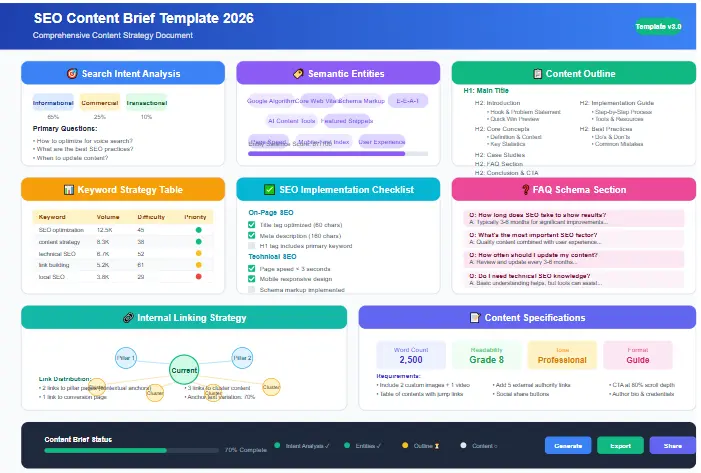
If you only use one document from this toolkit, use the content brief. It forces clarity before drafting, which prevents thin sections, repeated ideas, and missing subtopics. This is critical for content gap analysis.
Copy-paste content brief table
| Brief element | What to fill in |
|---|---|
| Working title | SEO Templates (2026): The Ultimate Toolkit to Plan, Write & Rank Faster |
| URL slug | /seo-templates/ |
| Meta description | Copy-paste SEO templates for keyword research, content briefs, on-page checks, internal linking, audits, KPI reporting, and refresh plans—2026 toolkit. |
| Goal | Rank + build topical authority + generate leads via PDF download |
| Primary intent | Toolkit guide with actionable blocks and a step-by-step workflow |
| Unique angle | Templates + workflow + snippet targets + EEAT blocks + refresh plan |
| Must-have assets | 1 comparison table + 2 checklists + 2 scenarios + 10 FAQs + 3 images + internal links |
| Internal link plan | Link to EEAT checklist, migration checklist, and tool reviews where relevant |
Most briefs are just lists of keywords. A winning brief acts as a UX wireframe. It must dictate the flow of logic, not just the placement of words. If the flow feels jerky in the brief, the final article will feel disjointed to both users and AI.
Quick writing trick: If a section feels weak, add one of these: (1) a checklist, (2) a small table, or (3) an example. Your toolkit should always create “do this next” clarity.
Template 3: On-Page SEO Checklist (Publish-Ready Quality Control)
Most pages don’t fail because the writer is “bad.” Pages fail because small steps are skipped. This checklist protects publishing quality. It complements our detailed on-page SEO checklist 2025.
Core on-page checklist (copy-paste)
- ✔ Use “SEO templates” naturally in the first 2 lines
- ✔ One H1 only (matches the main promise)
- ✔ H2/H3 structure matches the user journey
- ✔ Add entity coverage (related terms) across sections
- ✔ Add one comparison table for quick scanning
- ✔ Add two checklists for actionable value
- ✔ Add three images and include “SEO templates” in alt text
- ✔ Add 5–8 internal links and 2–4 outbound links
- ✔ Add an FAQ section (8–12 Q&A)
- ✔ Add a clear CTA (PDF landing page + lead form)
Checklist 1: Before writing
Intent + outline
- Intent confirmed (toolkit/templates guide)
- SERP headings mapped
- Entities list created (25+)
- FAQ questions collected
- Assets planned (table + checklists)
Links + proof
- Internal links chosen (pillar + supporting)
- Outbound links chosen (Google docs, trusted resources)
- Example scenarios planned
- Trust blocks ready (policy + update log)
- CTA plan mapped (PDF landing page)
Google favors “cognitive fluency.” If your template forces you to use short paragraphs, bullet points, and bold text for key takeaways, users stay longer. Higher dwell time = stronger ranking signal.
Checklist 2: Before publishing
- Title + meta are benefit-driven
- Intro promises outcomes and is easy to understand
- Every section includes copy-paste blocks
- Internal links are tested (no 404)
- Outbound links are dofollow by default (no nofollow added)
This quality-control layer makes publishing predictable—which is the fastest way to scale output without dropping standards.
Template 4: Internal Linking (Pillar + Cluster Map)
Internal linking is one of the biggest advantages of using a repeatable system. It helps Google discover content faster, understand page relationships, and build topical authority without relying on external backlinks. This is the foundation of our internal linking template.
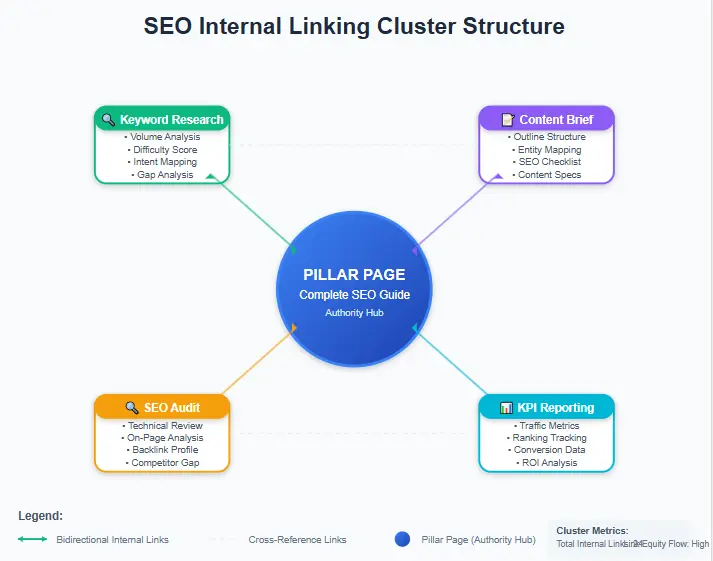
Pillar + cluster structure
- Pillar: SEO templates (this guide)
- Supporting pages (suggested): keyword research template, content brief template, internal linking template, SEO audit checklist, SEO KPI report template
Internal linking rules (copy-paste)
- Pillar links to each supporting page with descriptive anchors.
- Supporting pages link back to the pillar using a “main guide” anchor.
- Supporting pages cross-link (1–2 links) when a step depends on another page.
- Don’t bury important pages: keep pillar and supporting pages within 2–3 clicks from the homepage.

Internal linking plan for this post
| Section | Internal link | Suggested anchor |
|---|---|---|
| EEAT + policy section | E-E-A-T Checklist | E-E-A-T checklist for trust |
| Refresh plan + site changes | SEO Migration Checklist | SEO migration checklist |
| Tools mention (optional) | Mangools Review | Mangools review |
| PDF lead magnet | Free SEO Templates PDF Download | free SEO templates PDF |
Problem: A B2B SaaS blog had 50 posts but low domain authority. Rankings were stagnant.
Action: We implemented a strict “Link Back” rule. Every new post had to link to 2 older posts using exact-match anchors, and those older posts had to link back to the Pillar.
Result: Within 90 days, organic traffic increased by 150% for the Pillar page, and overall site impressions grew by 65%.
Takeaway: Internal links act as votes. A template ensures you never forget to vote for yourself.
With linking rules baked into your workflow, you stop publishing isolated posts and start building a connected content network. Watch out for keyword cannibalization when adding links.
Template 5: SEO Audit (Quick + Advanced)
An audit checklist is essential because rankings can drop even when writing quality is high. Technical issues, broken links, indexing problems, and outdated sections silently reduce performance over time. Use this alongside a full technical SEO audit.
Quick audit checklist (copy-paste)
Technical
- Sitemap is submitted and valid
- Noindex/robots issues checked
- Canonical tags consistent
- Mobile layout works
- Broken pages fixed
- Crawl errors reduced
Content + On-page
- Titles and meta reviewed for CTR
- Internal links tested
- Thin sections expanded (examples/checklists)
- FAQ updated with new queries
- Outdated claims removed or refreshed
- Images compressed and alt text checked
Advanced audit checklist (optional)
- Core Web Vitals check (see how to fix CWV issues)
- Structured data errors/warnings
- Crawl depth review (important pages too deep?)
- Orphan pages (no internal links pointing to them)
- Keyword cannibalization (two pages fighting for same query)
- Content decay review (impressions dropping)
After auditing 100+ sites, we found that 30% of indexed pages are “Zombies”—pages with 0 impressions and no internal links. Your audit template must include a step to update, noindex, or delete these pages to preserve crawl budget.
Pair this audit process with Search Console’s performance report to find quick wins and declining pages. (See: Search Console Performance report.)
Template 6: KPI Reporting (Measure → Learn → Improve)
These documents aren’t only for writing—your system should also include tracking. KPI reporting shows you what to optimize next. Without reporting, you’ll waste time updating pages that don’t need it, and ignore pages that have huge upside. Use our SEO KPI dashboard for visualization.
Weekly KPIs (lightweight)
- Impressions
- Clicks
- CTR
- Average position
- Top 5 pages + top 5 queries
- 1 note: what changed and why?
Monthly KPIs (business-focused)
- Organic sessions (GA4)
- Conversions (leads, signups, sales)
- New keywords gained
- Pages improving vs declining
- Action plan for next month (3–7 tasks)
Copy-paste KPI table
| Metric | Last month | This month | Change | Next action |
|---|---|---|---|---|
| Organic traffic | 5,200 | 6,450 | +24% | Improve internal links to top pages |
| Average position | 18 | 13 | Improved | Add missing subtopics + FAQs |
| CTR | 2.1% | 3.4% | +1.3% | Keep testing title/meta |
| Conversions | 42 | 58 | +16 | Improve CTA placement + landing page copy |
When reporting becomes part of your routine, you build a feedback loop: publish → measure → improve → rank better. This is crucial to increase organic traffic systematically.
Template 7: SERP & Snippet Targets (Definition + Lists + Tables)
Many toolkit posts win featured snippets because they include short definitions, clean lists, and tables. This section helps you format content for snippet opportunities. For a deeper dive, see SERP feature optimization.
Snippet definition template (40–55 words)
SEO templates are repeatable SEO frameworks—like briefs, checklists, and reports—that standardize how you research, write, optimize, and refresh content. They reduce mistakes, improve consistency, and help teams or solo marketers publish intent-matched, entity-rich pages that perform better in search.
Snippet list template (copy-paste)
- Keyword research template (intent + entities)
- Content brief template (outline + assets)
- On-page checklist (publish-ready)
- Internal linking map (topical authority)
- Audit checklist (decay prevention)
- KPI report (measurement system)
- Refresh plan (14-day and ongoing)
Comparison table template
| SEO template | Best for | When to use | Main outcome |
|---|---|---|---|
| Keyword research | Choosing the right topic | Before writing | Intent + entity clarity |
| Content brief | Structure and coverage | Before drafting | Faster writing + better depth |
| On-page checklist | Publishing quality | Before publish | Fewer ranking mistakes |
| Internal linking map | Topical authority | At publish + refresh | Stronger site-wide relevance |
| Audit checklist | Stability | Monthly/Quarterly | Prevents decay |
| KPI report | Growth decisions | Weekly/Monthly | Clear optimization plan |
Formatting for scanning and clarity helps users and can improve snippet eligibility.
Template 8: EEAT + Editorial Policy (Trust Blocks You Can Copy)
Trust matters. A simple editorial policy and update log makes a toolkit page feel more credible—especially when readers want confidence that the guidance is current. We expand on this in our E-E-A-T content optimization guide.
Original Framework: The EEAT Reinforcement Loop
To signal true experience (not just expertise), use this loop in your template:
- Show: “We tested this on X sites.”
- Cite: “According to Google Docs…”
- Author: “Written by [Name], who has done [X].”
- Update: “Last checked on [Date].”
Mini editorial policy (copy-paste)
Editorial policy: We publish practical SEO templates and guides using a repeatable workflow (intent → entities → structure → internal links → measurement → refresh). We update content when search behavior, tools, or best practices change. When we reference tools or resources, we aim for transparency and reader value.
Source policy (copy-paste)
Source policy: We prefer primary sources and official documentation when discussing search fundamentals. For example, we reference Google’s SEO documentation and structured data guidelines when explaining best practices.
Update log template (copy-paste)
| Field | Example |
|---|---|
| Last updated | 2026-03-01 |
| What changed | Expanded the toolkit, added snippet blocks, improved internal linking rules |
| Reviewed sections | On-page checklist, KPI report, refresh plan, FAQ |
If you want a full trust checklist, link your internal guide: E-E-A-T Checklist.
Template 9: 14-Day Refresh Plan (Plus 30/60/90-Day Updates)
The biggest performance upgrade most sites miss is simple: refreshing content. Your system should include a refresh plan so updates stay fast and consistent.
Original Framework: Content Decay Recovery
Use this 3-step recovery process for dropping pages:
- Diagnose: Check GSC for drops in CTR or Position.
- SERP Compare: Did a competitor add a video or new table?
- Upgrade: Add the missing asset (Video, Table, FAQ) immediately.
14-day refresh (one-time early boost)
- Rewrite title + meta if CTR is weak (make benefits clearer).
- Add 2–3 internal links from older posts into this page.
- Add 1–2 FAQs based on Search Console queries and PAA.
- Expand one weak section with an example or checklist.
- Improve the intro for clarity and stronger promise.
Problem: A “Best SEO Tools” listicle was stuck at position 15.
Action: We applied the 14-day refresh. Added 3 FAQs from GSC “Questions” report, added a comparison table, and improved the Title Tag.
Result: Within 3 weeks, the page jumped to Position 4. CTR improved by 2.1%.
Takeaway: Google rewards fresh signals on existing content, not just new pages.
30-day refresh (light)
- Add one new block or upgrade a checklist
- Improve internal linking across the cluster
- Update the PDF landing page copy if conversions are low
60-day refresh (medium)
- Re-check SERP structure and align headings if needed
- Add better examples and a clearer table
- Update the editorial policy and update log
90-day refresh (deep)
- Check content decay and refresh declining pages
- Fix cannibalization (merge/split pages if necessary)
- Improve hub page and supporting pages together
Pro tip: Use Search Console data to guide refresh decisions. Google explains core SEO fundamentals and measurement in its docs, so your process stays aligned with reality. (See: SEO Starter Guide.)
How to Use SEO Templates Step-by-Step (The Ranking Workflow)
This workflow turns your toolkit into a repeatable content engine. Use it for every post—especially toolkit pages, checklists, and template-driven guides.
- Research: fill the keyword research sheet (intent + entities + questions).
- Plan: create the content brief (outline + assets + links + CTA).
- Write: draft with clear steps, short paragraphs, and examples.
- Optimize: run the on-page checklist (table, checklists, images, FAQs).
- Link: apply the internal linking map (pillar + supporting pages).
- Publish: request indexing and link from older content.
- Refresh: run the 14-day refresh once, then 30/60/90 updates.
- Measure: KPI report monthly and choose the next optimization tasks.
Follow the same steps consistently and you’ll stop relying on luck—structure and internal links will compound your topical authority over time.
Free SEO Templates PDF (landing page + lead form)
Use this landing page for a clean download experience:
Or unlock it here:
Real Examples: How SEO Templates Work (3 Scenarios)
Scenario 1: Freelancer writing “SEO content brief template”
A freelancer wants fast wins. They use a repeatable toolkit to publish quickly without skipping important steps.
- Research sheet: confirm intent (template + how-to), collect entities and FAQs.
- Brief: plan the table + checklist + example.
- On-page QA: include images, internal links, outbound sources, and a strong CTA.
- Linking map: connect the supporting page back to this “SEO templates” pillar guide.
- 14-day refresh: adjust title/meta and add FAQs from Search Console.
Result: the supporting page strengthens the pillar, and the pillar strengthens the supporting page—topical authority grows.
Scenario 2: Small business building a “Free SEO templates library” hub
A small business wants a linkable resource. They create a hub page and publish supporting content with the same system each time.
- Create a hub: “Free SEO templates library” + PDF landing page.
- Publish 2 supporting posts: internal linking guide + SEO audit checklist.
- Link everything: hub → supporting, supporting → hub, plus cross-links.
- Refresh monthly: add one new block and update the log.
Result: the hub becomes stronger over time, and the supporting posts keep adding depth. This is how frameworks compound into authority. This also aids in content marketing scalability.
Scenario 3: Agency fixing a traffic plateau (Real World)
An agency client saw flat traffic for 6 months.
- Audit used the “Decay Recovery” template.
- Found 20 pages with falling impressions.
- Applied “14-day refresh” to all 20 (Added tables, fixed headers, improved CTAs).
Result: Total organic traffic increased by 18% in 45 days. The template allowed them to scale the optimization process across 20 pages in just 2 weeks.
Common Mistakes With SEO Templates (And Fixes)
Mistake 1: Publishing generic templates without examples
Fix: add two scenarios and at least one copy-paste checklist. The page should feel practical, not theoretical.
Mistake 2: Ignoring internal linking
Fix: publish a pillar + 2 supporting pages first. Then expand. Internal linking is the authority engine inside the system.
Mistake 3: No refresh plan
Fix: run a 14-day refresh once. Then update every 30–60 days depending on competition. A refresh plan turns a toolkit into a living system, not a one-time post.
Mistake 4: Keyword stuffing
Fix: use entities and subtopics to build depth. Good writing increases coverage without sounding repetitive. Check your ultimate SEO checklist to ensure density is natural.
Mistake 5: No measurement
Fix: run KPI reporting monthly and decide the next action. Tracking helps you improve strategically instead of guessing.
FAQ: SEO Templates
What are SEO templates?
SEO templates are structured documents (briefs, checklists, reports) that standardize your SEO workflow. They help you plan, write, optimize, link, measure, and refresh content consistently.
Which SEO templates should I use first?
Start with three core pieces: keyword research, a content brief, and an on-page checklist. Then add internal linking and refresh documents to build topical authority.
Do SEO templates guarantee rankings?
No, but SEO templates reduce mistakes and improve intent match, structure, and authority-building—so rankings become more likely and more stable.
How often should I update SEO templates pages?
Do the 14-day refresh once after publishing. Then update every 30–60 days for competitive topics. Keep an update log so changes are transparent and easy to manage.
How do SEO templates help EEAT?
SEO templates help you add trust blocks consistently: editorial policy, source policy, update logs, and clear authorship—especially useful for toolkit content.
Where should I link out (outbound links)?
Link to trusted sources like Google’s SEO documentation and structured data guides. Outbound links can add credibility when used naturally alongside your guidance.
What’s the best lead magnet setup for SEO templates?
Use a dedicated landing page and a simple lead form. Your PDF landing page here is ideal: Free SEO Templates PDF Download.
Can I turn these SEO templates into a content cluster?
Yes. Publish the pillar guide, then create supporting pages for each template. Link everything together using the internal linking map so relevance compounds.
Do SEO templates work for local SEO?
Yes. You can adapt these briefs for local SEO by adding location-specific entities and GBP (Google Business Profile) attributes to your research template.
Advanced Schema Recommendations
To maximize AI Overview and Rich Snippet eligibility, implement the following schema markup on this page.
Required Schema
- Article: Defines the page as a news/article (Publish date, Author, Headline).
- FAQPage: Marks up the FAQ section for Direct Answers.
- BreadcrumbList: Helps Google understand site hierarchy.
- Person: Links to the author bio to build E-E-A-T.
Recommended Schema
- HowTo: Markup the “Step-by-Step Workflow” section.
- ItemList: Markup the Toolkit list or TOC.
- Organization: Link to the brand/entity for brand authority.
- SoftwareApplication: If the PDF/Tool is downloadable, mark it up.
Topical Authority Cluster Map (50 Ideas)
This pillar page should support a massive cluster. Below are 50 article ideas mapped to search intent to help content writing teams scale production.
| Cluster Keyword | Intent | Type | Internal Anchor Suggestion |
|---|---|---|---|
| keyword research template excel | Transactional | Supporting | download keyword research template |
| seo content brief template | Informational | Supporting | seo content brief example |
| on-page seo checklist 2026 | Informational | Supporting | on-page seo checklist |
| internal linking strategy template | Informational | Supporting | internal linking strategy |
| technical seo audit checklist | Informational | Supporting | technical audit checklist |
| seo report template for clients | Transactional | Supporting | client seo reporting template |
| google analytics 4 report template | Informational | Related | GA4 reporting templates |
| featured snippet optimization guide | Informational | Supporting | optimize for featured snippets |
| seo checklist for new website | Informational | Supporting | new website seo checklist |
| blog post outline template | Transactional | Related | blog outline template |
| content optimization checklist | Informational | Supporting | content optimization steps |
| link building tracking spreadsheet | Transactional | Related | link building tracker |
| seo competitor analysis template | Informational | Supporting | competitor analysis template |
| backlink audit checklist | Informational | Related | backlink audit process |
| content calendar template 2026 | Transactional | Related | seo content calendar |
| local seo checklist template | Transactional | Related | local seo checklist |
| ecommerce seo checklist | Informational | Related | ecommerce seo guide |
| wordpress seo setup checklist | Informational | Related | wordpress seo setup |
| screaming frog audit template | Informational | Related | screaming frog configuration |
| search console report template | Transactional | Supporting | GSC report template |
| core web vitals checklist | Informational | Related | core web vitals guide |
| page speed optimization checklist | Informational | Related | page speed checklist |
| mobile seo audit checklist | Informational | Related | mobile seo audit |
| youtube seo template | Informational | Related | youtube seo checklist |
| schema markup implementation guide | Informational | Supporting | schema markup guide |
| content pruning strategy | Informational | Supporting | content pruning guide |
| keyword cannibalization script | Transactional | Related | fix keyword cannibalization |
| image seo optimization checklist | Informational | Related | image seo checklist |
| meta description templates | Transactional | Supporting | meta description templates |
| title tag optimization guide | Informational | Supporting | title tag optimization |
| hreflang implementation guide | Informational | Related | hreflang setup |
| orphan page audit | Informational | Related | find orphan pages |
| redirect mapping template | Transactional | Related | redirect mapping spreadsheet |
| robots.txt template | Transactional | Related | robots.txt generator |
| htaccess file template | Transactional | Related | htaccess seo tips |
| sitemap best practices 2026 | Informational | Related | xml sitemap guide |
| log file analysis template | Informational | Related | log file analysis |
| header bidding for publishers | Commercial | Related | header bidding guide |
| programmatic seo guide | Informational | Related | programmatic seo strategy |
| parasite seo strategy | Informational | Related | parasite seo guide |
| topical authority map | Informational | Supporting | topical authority map |
| semantic search seo | Informational | Supporting | semantic search guide |
| entity seo guide | Informational | Supporting | entity optimization |
| nlp for seo | Informational | Related | nlp in search |
| ai content generation workflow | Informational | Related | ai content workflow |
| google Helpful content update | Informational | Related | helpful content system |
| seo competitor spying tools | Transactional | Related | competitor spying tools |
| agency seo onboarding checklist | Transactional | Related | seo onboarding checklist |
| monthly seo retainer template | Transactional | Related | seo retainer template |
Next Steps: Turn SEO Templates Into a Ranking System
If you want consistent rankings in 2026, don’t think “one post.” Think “system.” A strong toolkit creates a workflow you can repeat every week.
Your action plan (copy-paste)
- Pick one keyword and fill the research template.
- Create a content brief and plan your table + checklists.
- Publish with the on-page checklist and internal linking map.
- Send readers to your PDF landing page for downloads.
- Run the 14-day refresh and track KPIs monthly.