
The Ultimate Keyword Research Checklist: Find Keywords That Actually Rank in 2026
Six months ago I met a blogger named Sarah — ambitious, talented, and completely burnt out. She followed every “SEO hack” from top marketing blogs: picked a profitable niche, bought a premium theme, published 50 in-depth articles, paid for fast hosting. Yet when we opened Google Analytics, the numbers were brutal: fewer than 30 organic visitors per day. Revenue? Zero.
The problem was immediate. Sarah had no keyword research checklist. She was targeting ultra-competitive terms like “best laptops” and “how to lose weight” — going head-to-head with Apple, WebMD, and Whole Foods. No focus on long-tail keywords, no analysis of search intent, nothing to guide her content decisions. She was trying to win a Formula 1 race with a bicycle.
What is a Keyword Research Checklist?
A keyword research checklist is a systematic, step-by-step framework used to identify, analyze, and prioritize the exact search terms your target audience is typing into Google. It removes guesswork from content creation. Instead of randomly picking topics, this framework forces you to rely on hard data — search volume, keyword difficulty, and user intent.
Think of it as an architect’s blueprint. You would never build a house by randomly nailing wood together; you need a precise plan. Similarly, a solid SEO strategy requires a structured approach to ensure every piece of content has a realistic chance of ranking on page one — not just chasing high-volume terms to boost your ego, but building an organized library that drives convertible traffic.
Without this blueprint, your content strategy is a shot in the dark. It guarantees every article serves a distinct purpose in your site architecture — attracting new readers at the top of the funnel, educating them in the middle, or converting them at the bottom.
Why Most Websites Fail Without It
Most website owners skip deep keyword research because they think it is too technical or time-consuming. Instead, they rely on “intuition” or copy competitors. This lazy approach leads to three catastrophic failures.
- The Traffic Illusion: You rank and get clicks, but make zero sales. The search intent was informational, not transactional — you attracted readers, not buyers.
- The Difficulty Trap: You spend three months on a 5,000-word pillar post, then realize the top ten results are all DR 80+ domains. A proper process would have flagged this before you wrote a word.
- The Zero-Volume Graveyard: You over-correct and optimize for hyper-specific terms nobody searches for. You rank number one overnight, but traffic stays at zero.
According to Backlinko, the number one result captures roughly 27% of all clicks. Without a strategic approach, you leave that traffic on the table. Modern SEO is about semantic relevance — a concept we explore in our Semantic SEO Guide.
Step-by-Step Keyword Research Checklist
To avoid Sarah’s fate, follow this exhaustive framework — designed to take you from a blank slate to a revenue-generating content calendar.
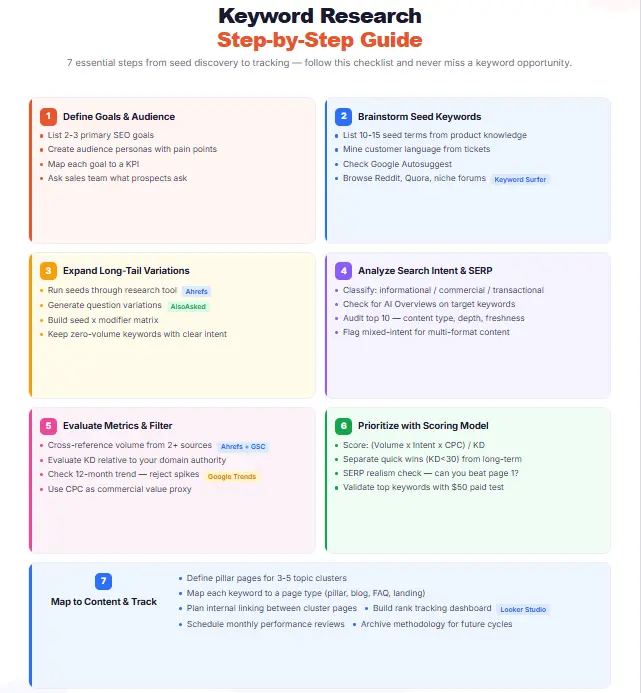
Complete keyword research checklist for SEO success in 2026
1Define Your Seed Keywords
Seed keywords are the foundational topics of your niche — short, broad terms that define what your business is about. If you sell organic dog food, your seeds might be “dog food,” “puppy nutrition,” and “grain-free dog treats.”
Do not overthink this. List five to ten core topics your business revolves around. These seeds will be planted into tools in the next step to grow a massive opportunity list. Talk to your customer service team, check product categories, or review popular email inquiries for real-world seed ideas.
- List 5–10 core topics your business covers
- Check product categories for natural seeds
- Review customer support emails for recurring phrases
- Scan competitor homepages for niche terminology
2Expand Into Long-Tail Keywords
This is where the magic happens. Long-tail keywords contain three or more words, have lower individual search volumes, but make up the vast majority of Google searches. They also have drastically lower competition and higher conversion rates because the searcher knows exactly what they want.
Using SEMrush Keyword Research, turn “dog food” into variations like “best organic dog food for golden retrievers with sensitive stomachs.” That searcher has their credit card ready — a near-guaranteed sale. Long-tail keywords are the lifeblood of profitable niche sites.
3Analyze Search Intent
Search intent is the most critical ranking factor — and the most commonly skipped step. Google’s goal is to satisfy the user’s underlying intent. If you mismatch it, you will not rank regardless of backlinks. There are four types you must identify before writing.
Before writing, look at the top five Google results for your target keyword. Are they blog posts? Product pages? Your content must match the format Google is already rewarding.
4Evaluate Keyword Difficulty (KD)
Keyword Difficulty (0–100) estimates how hard it is to crack the top ten. For newer sites with low authority, be extremely selective.
| KD Score | Competition | Action |
|---|---|---|
| 0 – 20 | Low | Prioritize aggressively. You can rank with decent content and minimal backlinks. |
| 21 – 50 | Moderate | Tag as “medium priority.” Needs excellent content, flawless on-page SEO, and a few quality backlinks. |
| 51 – 100 | High | Mark as “deferred.” Avoid initially unless you have high authority. Revisit in 12–18 months. |
5Master Keyword Clustering
Gone are the days of writing one post per keyword. Search engines use Natural Language Processing to understand topical depth. Clustering means grouping related keywords and targeting them with a single, comprehensive piece of content.
Instead of five separate articles for “SEO audit,” “how to do an SEO audit,” “SEO audit checklist,” and “site SEO analysis,” group them into one ultimate guide. This signals comprehensive authority, increasing your chances of ranking for all variations simultaneously. It also prevents keyword cannibalization.
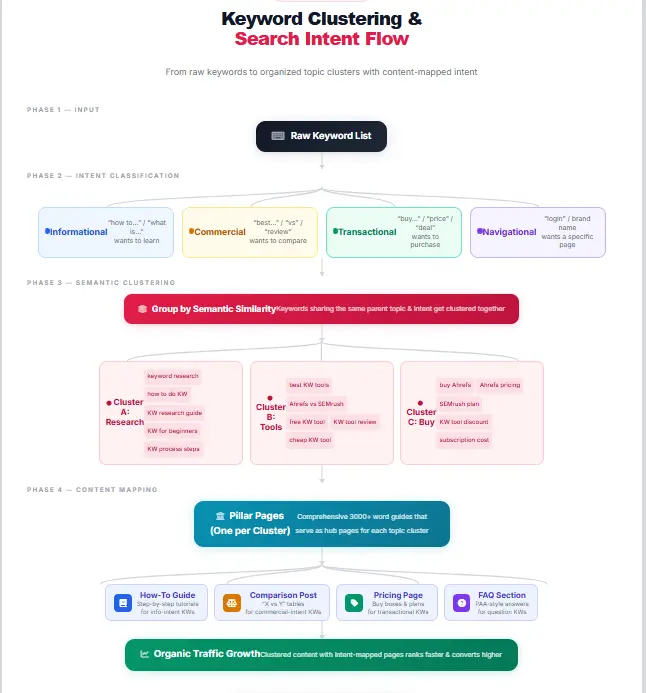
Example of keyword clustering and search intent grouping
6Analyze the SERP Landscape
Tool data is helpful, but the actual SERP never lies. Type your keyword into Google and observe what is present.
- Featured Snippets? Format your content to win them — use a clear list or definition near the top of your article.
- “People Also Ask” boxes? Use those exact questions as H2 or H3 subheadings.
- Reddit or Quora in the top results? Google wants genuine experiences, not corporate jargon. Adjust your tone.
As Google Search Central documents, SERP features directly impact click-through rates and dictate how you should structure your headers.
7Assess the Top 10 Competitors
If the top five are Amazon, Wikipedia, and Forbes, flag it as “high risk.” But if they are small blogs with poorly formatted content, thin word counts, and no updated dates — that is a massive green light.
Click through to their sites. Check domain authority, find the gaps they left open. If they missed a tutorial step, include it. If their site is slow, ensure yours is fast. For more analysis tactics, browse our SEO Guides.
8Calculate Content ROI and Business Value
Not all traffic is good traffic. A keyword with 10,000 monthly searches for “free movies online” will not help an accounting software business. Always ask: “If someone lands on my page from this term, will they eventually buy?”
It is better to rank number one for a keyword with 100 monthly searches that converts at 5% than rank fifth for a 10,000-search term that converts at 0%. You can find these high-value gems faster using the Best Keyword Research Tools.
9Map Keywords to the Buyer’s Journey
Your strategy must cover the entire funnel. Only transactional content? You miss awareness. Only informational? You get traffic but no sales. Map clustered keywords to specific funnel stages.
| Funnel Stage | Intent | Content Format | Tag |
|---|---|---|---|
| Top | Informational | Blog posts, guides, tutorials | “TOFU — Awareness” |
| Middle | Commercial | Comparisons, reviews, listicles | “MOFU — Consideration” |
| Bottom | Transactional | Product pages, category pages | “BOFU — Conversion” |
10Optimize On-Page Elements
The final step is tactical implementation. Ensure your primary keyword is in the title tag, H1, URL slug, first 100 words, and naturally throughout. Add LSI keywords to image alt text.
Use a plugin like Rank Math SEO Plugin to verify your on-page score is perfect before publishing. Check meta description length, compress images, and verify internal links point to relevant clusters.
- Primary keyword in title tag, H1, URL slug, first 100 words
- LSI keywords in alt text and body paragraphs
- Internal links to related clusters on your site
- Meta description under 160 characters with a CTA
- Images compressed and lazy-loaded
📥 Download the Complete Keyword Research Checklist (Free)
Get the exact framework we use at SEORAF to build topical authority and drive real, converting organic traffic. Skip the guesswork and start ranking.
Best Tools for Keyword Research
You cannot execute this effectively with free methods alone. Google Autocomplete is good for brainstorming, but you need dedicated software for accurate volume and difficulty data. The Ahrefs Blog frequently notes that raw Google data often misrepresents true traffic potential.
Keyword Research Strategy for 2026
The search landscape is evolving rapidly. With AI Overviews, ChatGPT, and voice search, users now ask questions in full, conversational sentences rather than typing fragmented keywords. Your approach must evolve accordingly.
Shift from “keyword targeting” to “entity targeting.” Search engines no longer match strings of text — they match concepts. If you write about “running shoes,” Google expects related entities like “pronation,” “heel drop,” “carbon plates,” and “arch support.” Your process should include an entity-mapping step alongside traditional research.
Zero-click searches are also rising. Google answers more questions directly on the SERP. To win in 2026, focus on keywords requiring deep dives, personal opinions, or complex tutorials — things AI cannot easily summarize. Build massive topical clusters instead of isolated posts. When Google sees thirty interlinked articles covering every angle, it rewards your entire cluster with higher rankings.
| Step | Action for 2026 |
|---|---|
| 1 | Find seed keywords and map related entities |
| 2 | Analyze difficulty, volume, and zero-click probability |
| 3 | Group by intent and conversational phrasing |
| 4 | Build topical clusters instead of isolated posts |
Common Mistakes to Avoid
Even with a detailed framework, human error can derail your efforts. Avoid these five fatal mistakes.
Beginners want to rank for “fitness” instead of “home workouts for bad knees.” Long-tail keywords are faster to rank, easier to convert, and build the authority needed for big terms. Enforce a 70% long-tail minimum ratio.
Using your exact match keyword twenty times in a 1,000-word article triggers Google’s spam filters. Use variations, synonyms, and LSI keywords naturally.
Ranking first means nothing if nobody clicks. Craft compelling title tags and meta descriptions with power words, numbers, and emotional triggers.
Two similar keywords should not become two separate articles — Google will force cannibalization. Merge them using proper clustering.
This is not a one-and-done task. Search volumes change, intent shifts, competitors publish new content. Include a quarterly audit step.
Frequently Asked Questions
What is a keyword research checklist?
A keyword research checklist is a structured, repeatable process used by SEO professionals to discover, analyze, and select search terms for content creation. It ensures no critical step — evaluating search intent, checking keyword difficulty, grouping related terms, or calculating content ROI — is skipped. By following it, marketers can systematically identify high-value, low-competition keywords with a realistic chance of driving organic traffic and converting visitors into customers. It turns chaotic brainstorming into a mathematical, data-driven workflow.
How to find low competition keywords?
Start by using tools like LowFruits, Ahrefs, or SEMrush to filter for keywords with a KD score under twenty. Then analyze the actual SERP — a keyword might show moderate difficulty but feature weak competitors like small blogs, outdated articles, or Reddit threads in the top five. If you can create significantly better content, it is a low-competition opportunity. Also focus on long-tail phrases containing words like “for,” “how,” “best,” and specific demographics to uncover hidden gems.
How long does keyword research take?
For a single targeted article, expect thirty minutes to one hour — finding the keyword, analyzing intent, checking the SERP, and grouping variations. For a complete content strategy or an entire topical cluster, it can take a few days to two weeks. Rushing this is the biggest mistake you can make. Spending extra time upfront saves hundreds of hours of wasted writing and link-building down the road.
What tools do I need?
At minimum, one premium tool — SEMrush, Ahrefs, or LowFruits. Free tools like Google Keyword Planner and Autocomplete help brainstorm seed keywords but lack accuracy for difficulty analysis, click data, and competitive gaps. An on-page plugin like Rank Math handles the final optimization step before publish.
Continue Learning
Now that you have a complete framework, take the next step with these in-depth guides from SEORAF.