
Competitor Analysis Guide: How to Spy on Competitors and Beat Them in 2026
It’s a gloomy Tuesday morning. You’ve just poured your heart and soul into what you believe is the definitive resource on the internet for your niche. You’ve spent weeks researching data points, interviewing experts, formatting tables, and polishing every paragraph. You hit “publish,” pour yourself a much-needed cup of coffee, and stare at your analytics dashboard, waiting for the traffic spike that you just know is coming.
Three days later? Nothing but crickets.
A week later? The analytics graph is as flat as the screen in front of you.
Frustrated, you open an Incognito window, type your primary keyword into Google, and hit enter. What you see makes your blood boil. There, sitting comfortably in the #1, #2, and #3 spots, are your competitors. You click on their links. Their design looks outdated. Their writing is average at best. Their content is significantly thinner than yours. Yet, they are stealing thousands of visitors that should have been yours.
Why? Because they know something you don’t. They aren’t just guessing; they are watching. They are using data to make calculated decisions. They have a competitor analysis guide.
If you are tired of shouting into the void while your competitors reap the rewards, this is the moment everything changes. In this comprehensive competitor analysis guide, we are going to stop guessing and start spying. We will reverse-engineer the success of your rivals, exploit their weaknesses, and steal their traffic—ethically and effectively. This is your roadmap to dominating the search results in 2026.
What is Competitor Analysis?
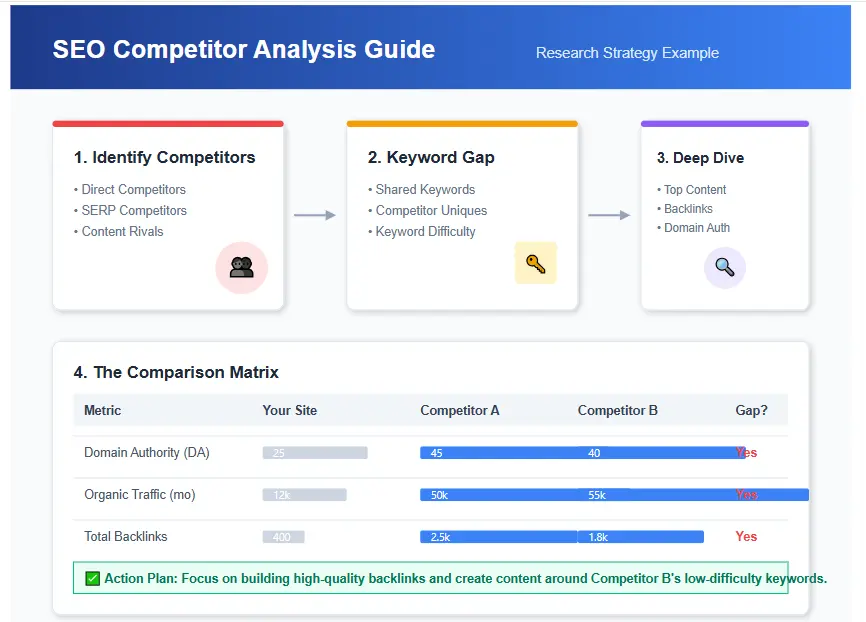
Before we can pick the lock, we need to know exactly what the house looks like. In the simplest terms, competitor analysis in SEO is the systematic process of identifying who your rivals are and evaluating their strategies to determine their strengths and weaknesses relative to your own business.
However, it is not enough to simply look at their homepage and judge their logo. A true competitor analysis guide requires you to look “under the hood.” It involves dissecting their keyword strategy, analyzing the quality and quantity of their backlinks, auditing their content structure, and checking their technical SEO health.
Think of it like professional sports. A football team would never dream of taking the field without watching hours of footage of their upcoming opponent. They need to know if the quarterback has a weak ankle, if the defense struggles against left-handed receivers, or if the special teams unit is slow. In SEO, your competitor analysis guide is that game footage. It tells you where to attack, where to defend, and exactly how to secure the win.
Read also: Keyword Research Guide
Why a Competitor Analysis Guide Is Important for Ranking
You might be asking yourself, “Can’t I just write great content and let Google figure it out?” In the landscape of 2026, the answer is a hard no. The internet is too crowded, the competition is too fierce, and the algorithms are too complex. Without a structured competitor analysis guide, you are essentially flying blind while your competitors are flying radar-equipped jets.
Here is why you need to make this a non-negotiable part of your routine:
1. It Reduces Trial and Error
Time is your most expensive and non-renewable asset. If you spend three months targeting a keyword that is impossible to rank for because the competition is too stiff, you have wasted a quarter of a year. Your competitors have already tested the waters. By using a competitor analysis guide, you can see what works for them and, more importantly, what doesn’t. You skip the failures and go straight for the wins. This competitor analysis guide emphasizes that analyzing competitors reveals the specific keywords driving their traffic, allowing you to bypass the testing phase.
2. It Uncovers “Low Hanging Fruit”
Often, competitors are ranking for keywords they aren’t even actively targeting. These are accidental rankings gained because of general domain authority. By finding these terms, you can create specific, optimized content and swoop in to steal the traffic with minimal effort compared to going after the “head” keywords.
3. It Reveals Link Opportunities
Backlinks are the fuel of SEO. If a high-authority site like Forbes or a major industry blog has linked to your competitor, there is a high probability they would be willing to link to you too—if you have something better to offer. This competitor analysis guide will show you exactly how to find those opportunities and replicate their success.
Types of SEO Competitor Analysis
To perform a thorough audit, you need to look at four distinct layers. Each layer gives you a different piece of the puzzle. A comprehensive competitor analysis guide will break these four layers down into actionable data points.
- Keyword Analysis: This is the foundation. You need to know what terms your competitors are targeting to bring in organic traffic. Are they going for broad, high-volume terms (head terms), or are they dominating the long-tail, specific questions?
- Content Analysis: Content is the vehicle for keywords. Here, you look at the type of content they create. Is it listicles? “Ultimate Guides”? Videos? How long are their articles on average? What is the user engagement like?
- Backlink Analysis: Backlinks are the “votes” of confidence in the SEO world. Analyzing a competitor’s backlink profile shows you who is vouching for them. If a site has 10,000 links from spammy directories, you know not to mimic them. If they have links from universities and news outlets, you know where to focus your outreach.
- Technical Analysis: Sometimes, a site loses not because of bad content, but because of bad code. Technical analysis checks for site speed, mobile-friendliness, and site architecture. If your competitor has a slow site, that is your golden opportunity to beat them on user experience.
Step-by-Step Competitor Analysis
Now, let’s get into the trenches. Here is the exact workflow you need to follow to execute a winning competitor analysis guide.
Step 1: Identify Your SEO Competitors
Forget who you think your rivals are in the physical world. Go to Google and type in your target keyword. Who appears in the top 10? Write down the top 5 domains. These are your true SEO competitors. If you sell “blue shoes” and Amazon and Zappos are ranking #1 and #2, they are your competitors now, whether you like it or not.
Step 2: Analyze Competitor Keywords
Plug those domains into an SEO tool. Look for two things:
- Keyword Overlap: What keywords do you both rank for?
- Keyword Gaps: What keywords do they rank for that you don’t?
Step 3: Analyze Competitor Content
Click on their top-performing pages. Read them critically. Is the formatting easy to scan? Are the images high quality? Is the content outdated from 2023? If you find a top-ranking article that is thin or outdated, create a “10x Content” piece. Make yours 10 times better, longer, and more updated.
Step 4: Analyze Competitor Backlinks
Dive into their link profile. Look for patterns. Are they doing guest posting? Are they getting links from directories? Did a specific piece of content go viral and earn links? If they earned a link from a guest post on a major tech blog, you can reach out to the same editor and pitch your own unique story.
Step 5: Analyze Competitor Traffic
While rankings are great, traffic volume is the reality check. A site might rank #1 for a keyword that gets zero searches. Use tools to estimate their actual organic traffic. This helps you prioritize which competitors are actually worth worrying about and which are just noise.
Competitor Keyword Research
Let’s zoom in on keyword research. This is the engine of your strategy. The competitor analysis guide approach to keywords is about finding the cracks in their armor.
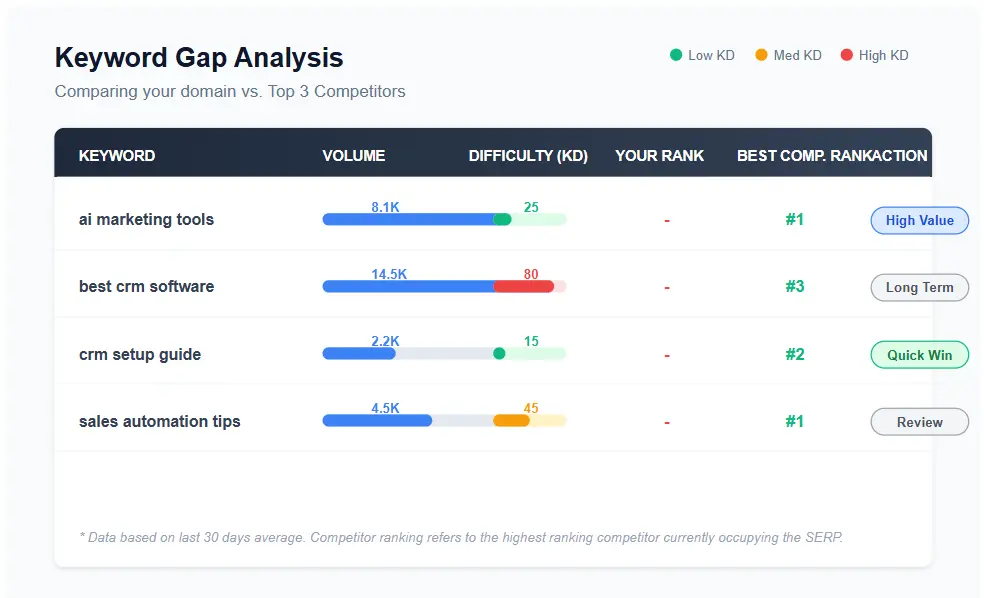
Start by taking your main product/service term (e.g., “organic dog food”). Plug it into a tool like SE Ranking or Ahrefs. Look at the “Also rank for” or “Related Keywords” section.
You are looking for keywords where your competitor ranks in positions 4–10. These are the easiest to steal. They have already done the hard work of proving the keyword has value; they just haven’t optimized well enough to hold the top spot.
Assess the Search Intent. Are these keywords “transactional” (ready to buy) or “informational” (just browsing)? If you are a business, you want to find the transactional keywords your competitors are neglecting. A good competitor analysis guide will help you distinguish between buyers and researchers.
You can use tools like SE Ranking, Moz Pro and Ubersuggest to analyze competitor keywords effectively.
Competitor Backlink Analysis
Backlinks are the hardest part of SEO, but competitor backlink analysis makes it easier. You don’t have to beg for links from scratch; you just have to find where your competitors got theirs.
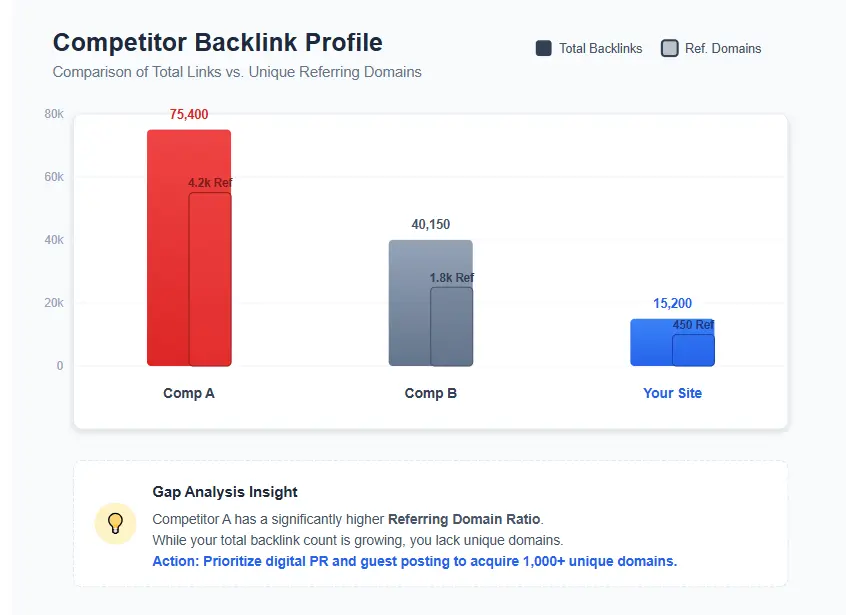
The Skyscraper Technique
This is a classic competitor analysis guide tactic.
- Find a competitor’s page with lots of backlinks.
- Look at who is linking to it.
- Create something significantly better than their page.
- Email everyone linking to them: “Hey, I saw you linked to [Competitor’s Article]. I just published an updated version that includes [X, Y, Z]. You might find it useful to swap the link.”
Read more: Backlink Strategy Guide
Best Competitor Analysis Tools
You cannot execute a modern competitor analysis guide with a spreadsheet and a prayer. You need professional-grade machinery. Below is a comparison of the top tools in the industry.
| Tool | Best For | Action |
|---|---|---|
| SE Ranking | Competitor research, accurate rank tracking & all-in-one value | Read Review | Official Site |
| Moz Pro | Domain Authority metrics & backlink analysis | Read Review | Official Site |
| Ubersuggest | Beginners, content ideas & site audits | Read Review | Official Site |
| Mangools | UX simplicity & KWFinder | Read Review | Official Site |
| SpyFu | Historical PPC & SEO data | Read Review | Official Site |
Competitor Content Gap Analysis
This is where you find the “blue ocean” waters—uncharted territory with high potential. A content gap analysis identifies keywords that your competitors rank for, but you have absolutely zero content for.
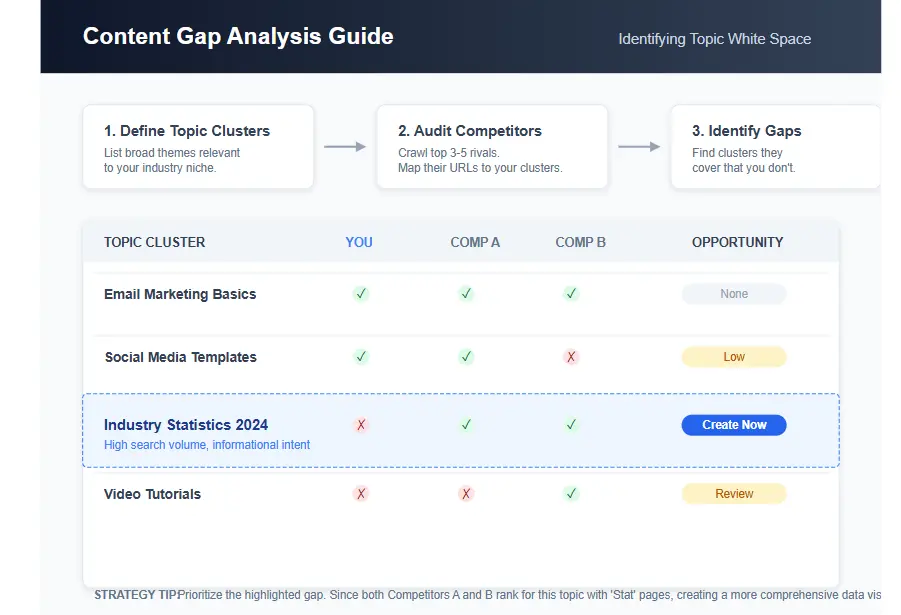
Example: You sell “Office Chairs.”
Competitor A ranks for “best office chairs for gaming.”
Competitor B ranks for “office chairs for lower back pain.”
You only have a generic page titled “Office Chairs.”
You have a massive gap! You need to create specific pages for gaming and back pain. By filling these gaps, you can capture traffic that your competitors are currently monopolizing. This competitor analysis guide strategy ensures you aren’t leaving money on the table. It is about fulfilling user needs that your rivals have ignored.
Real Example of Beating a Competitor
Let’s put this all together with a story to illustrate the power of a competitor analysis guide.
The Scenario: “Brand X” (a fictional SaaS company) was stuck on page 3 for the keyword “Project Management Software.” Their main competitor, “Brand Y,” was dominating #1, #2, and #3 with over 100,000 monthly visitors. Brand X was frustrated and ready to spend thousands on ads.
The Execution using the Competitor Analysis Guide:
- Keyword Spy: Brand X used this competitor analysis guide approach. They found that Brand Y was killing it for the keyword “free project management software for small teams,” but Brand X had ignored this long-tail phrase, focusing only on broad terms.
- Content Check: Brand X looked at Brand Y’s top article. It was a simple list of tools. Brand X decided to create a “Comparison Guide” with detailed screenshots, pricing breakdowns, and user reviews.
- Link Stealing: They noticed Brand Y had a guest post on *Entrepreneur.com*. Brand X pitched a fresh angle on “Remote Work Trends” to the same editor and got accepted.
- Technical Fix: Brand Y’s site took 4 seconds to load. Brand X optimized theirs to load in 1.5 seconds.
The Result: Within 6 months, Brand X outranked Brand Y for the long-tail keyword and stole 20% of their traffic. They didn’t outspend Brand Y; they outsmarted them using a competitor analysis guide. They stopped guessing and started using data.
Common Competitor Analysis Mistakes
Even with a competitor analysis guide, it’s easy to stumble. Avoid these pitfalls:
- Obsessing Over One Competitor: Don’t put blinders on. Analyze the top 3–5 players to get a holistic view of the SERP. If you only copy one, you might inherit their bad habits.
- Copying Blindly: Just because a competitor does something doesn’t mean it’s working. They might be ranking despite a bad strategy because of high domain authority. Always verify the data.
- Ignoring Search Intent: If you see a competitor ranking with a 500-word blog post, don’t write 50 words. Search intent is king. If the intent is “shopping,” make sure you have product pages, not just blog posts.
- Giving Up Too Soon: SEO is a marathon. You might not see results from your analysis for 3–6 months. Consistency is key.
Pro Tips to Beat Competitors Faster
- Refresh Old Content: Google loves fresh content. If you see a competitor ranking with an article from 2023, publish a version for 2026 and explicitly state “Updated for 2026” in the title and meta description.
- Video SEO: If your competitors are only writing text, dominate with video. Create a YouTube video summarizing the topic and embed it in your article. Google often favors “mixed media” results.
- Brand Searches: Monitor how often people search for your competitor’s brand name. If they have high brand search volume, you need to build your brand reputation, not just chase generic keywords.
- Use Wayback Machine: Look at your competitor’s site history to see what changes they made that caused traffic spikes or drops.
Free Competitor Analysis Checklist
Internal SEO Cluster
Explore more guides in our SEO cluster to master your strategy:
FAQ
What is competitor analysis in SEO?
Competitor analysis in SEO is the process of evaluating the strengths and weaknesses of current and potential competitors’ search engine optimization strategies. This competitor analysis guide covers how to examine keywords, backlinks, and content to improve your own rankings.
Which tool is best for competitor analysis?
SE Ranking and Moz Pro are top competitor analysis tools. This competitor analysis guide recommends SE Ranking for its balance of comprehensive data and affordability.
How do I find competitor keywords?
You can find competitor keywords by using SEO tools like SEMrush, Ahrefs, or SE Ranking. Enter your competitor’s domain into the tool, navigate to the “Organic Keywords” section, and it will list all the search terms they currently rank for. Using a competitor analysis guide allows you to automate much of this monitoring.
How often should I do competitor analysis?
Ideally, you should perform a comprehensive competitor analysis audit once a quarter, while monitoring keyword rankings and new backlinks on a monthly basis.
Final Verdict: Ultimately, this competitor analysis guide is your blueprint for sustainable organic growth in a competitive digital landscape. Stop guessing and start analyzing.