
Moz Pro Review: Features, Plan Limits, Free Trial & Who It Fits
Moz Pro is the paid SEO platform from Moz, the company that created the Domain Authority score. It combines keyword research, backlink analysis, site crawling, rank tracking, page optimization reports and, more recently, tools for tracking how brands appear in AI-generated answers. This Moz Pro review explains what each part does, how the plan limits work, what the free trial and cancellation rules look like, and which kinds of users are most likely to get value from it.
By Mousume Akter, Founder & Editor, SEORAF. Last verified: November 12, 2026. Prices, limits and trial terms change, so confirm them on Moz’s own pages before you buy.
Affiliate disclosure: Some links in this article are affiliate links, and SEORAF may earn a commission if you sign up through them. That does not decide what is written here. Affiliate links appear only in the clearly labeled calls to action near the free trial section, the buy-or-skip section and the final verdict; all other Moz links are plain citations. The assessments below rest on Moz’s published documentation and independent reports. Read the full affiliate disclosure and the editorial policy for details.
How this review was built: it is documentation-based. SEORAF has not run a hands-on test of Moz Pro, and nothing in this article is presented as test results. The section on how this review was done explains the evidence labels (official, independent, unverified) used throughout.
Quick Verdict: Is Moz Pro Worth It?
Moz Pro makes the most sense for people who want a focused SEO suite with guided workflows, a widely recognized authority metric, and quotas that are easy to read on a single pricing page. It is a weaker fit for anyone who needs very large data volumes or the broader marketing toolkits that some competitors bundle. Independent reviewers also point to missing traffic estimates and a US-centric data focus, and opinions on ease of use are mixed.
The short version, by reader type:
- Likely fit: small businesses, in-house marketers and consultants whose workload fits the published limits, who value Domain Authority reporting and a single SEO toolkit.
- Compare first: heavy keyword researchers, agencies with many clients, and anyone who needs traffic estimates or very deep backlink data.
- Probably not the right tool: anyone who needs refund flexibility, a configurable crawler for very large sites, or confirmed data coverage for a non-US market that they have not yet tested.
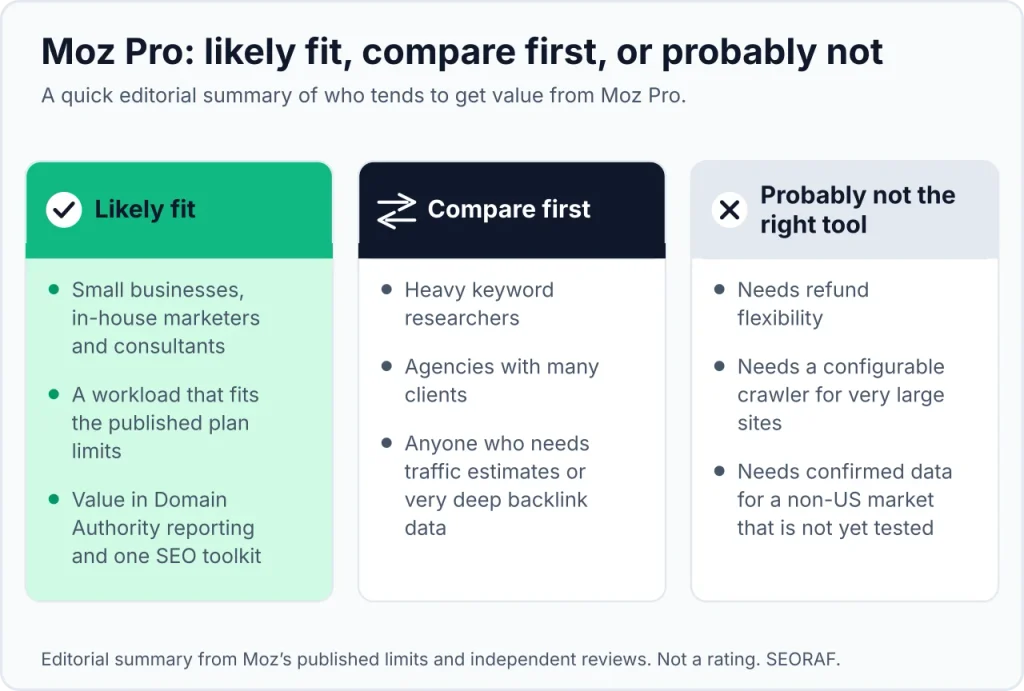
Three points shape the verdict:
- Plan limits matter more than plan names. Moz’s Standard plan allows 150 keyword queries per month, while Medium allows 5,000. Anyone who researches keywords heavily will notice that gap quickly.
- Refund flexibility is limited. Moz’s Terms of Use state that payments are non-refundable. Its cancellation guidance asks subscribers to cancel at least 24 hours before renewal to avoid a renewal charge.
- Some details need a live check before purchase. The trial duration, card requirement, Starter-plan quotas and renewal pricing are not fully stated in the main pricing comparison, so this review separates confirmed details from unknowns.
| Plan | Monthly billing | Yearly billing (monthly equivalent) | First-year total shown | Users | Tracked sites / campaigns | Tracked keywords | Pages crawled per week | Tracked AI prompts |
|---|---|---|---|---|---|---|---|---|
| Starter | $49 | Not listed | Not listed | Not listed | One website | Not listed | Not listed | Not listed |
| Standard | $99 | $79 | $950 | 1 | 3 | 300 | 100,000 | 150 |
| Medium | $179 | $143 | $1,719 | 2 | 10 | 1,500 | 500,000 | 300 |
| Large | $299 | $239 | $2,868 | 3 | 25 | 3,000 | 1,250,000 | 600 |
Source: Moz Pro pricing page, checked November 12, 2026. Prices are in US dollars. Moz describes Starter as a $49/month entry plan for one website but does not show its detailed quotas or annual price in the main plan comparison. Yearly figures are monthly equivalents; the first-year totals are the amounts Moz displays as billed for the first year. Enterprise pricing is custom.
What Is Moz Pro?
Moz Pro is a subscription SEO platform. According to Moz’s own pricing page, it covers keyword research, SERP analysis, rank tracking, domain overviews, site crawling, link research and AI-powered features. Moz is also the source of the Domain Authority (DA), Page Authority (PA) and Brand Authority metrics that appear throughout the product. Moz’s footer identifies SEOMoz, Inc. as a Ziff Davis company.
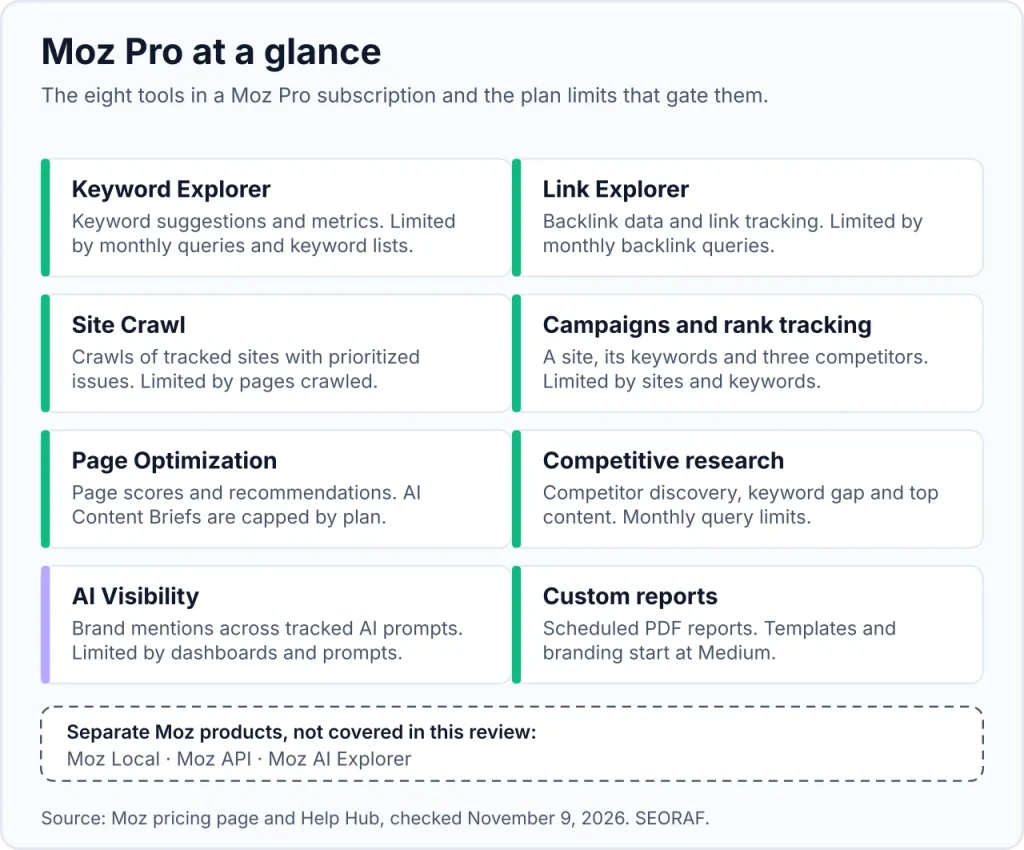
The table below maps the main tools to what they do and to the plan limits that gate them. Later sections evaluate each one.
| Tool | What it does | Where plan limits apply |
|---|---|---|
| Keyword Explorer | Keyword suggestions with volume, difficulty, organic click-through and priority metrics, plus keyword lists. | Monthly keyword queries, keyword lists, keywords per list. |
| Link Explorer | Backlink data: inbound links, linking domains, anchor text, discovered and lost links, Spam Score. | Monthly backlink queries, results per query, link tracking lists. |
| Site Crawl | Scheduled crawls of tracked sites with prioritized technical issues. | Pages crawled, on-demand crawls, re-crawls. |
| Campaigns and rank tracking | Tracks a site, its keywords and three competitors. | Tracked sites, tracked keywords, rank checker queries. |
| Page Optimization | Scores a page against a target keyword and lists recommendations. | AI Content Briefs are capped by plan; confirm other Page Optimization allowances on the pricing page. |
| Competitive research | Competitor discovery, keyword gap and top competing content views. | Monthly competitive research queries. |
| AI Visibility | Tracks brand mentions across prompts in AI answers. | Dashboards and tracked prompts. |
| Custom reports | Scheduled PDF reports from campaign data. | Templates and branded logos need Medium or higher. |
Sources: Moz Pro pricing page and Moz Help Hub navigation, checked November 12, 2026.
Moz Pro is not the same as Moz’s other products. Moz Local (local listings management), the Moz API and Moz AI Explorer are separate products with their own pricing. Moz’s pricing FAQ states that Moz Local is a separate product from Moz Pro and is purchased separately. This review covers Moz Pro only.
Who Moz Pro Is Designed For
Moz describes its plans in terms of business size, while independent reviewers frame the audience differently. Experte, for example, says Moz Pro is aimed primarily at in-house marketing teams and agencies that want established SEO metrics, and says it is better suited to experienced SEO users. Other reviewers position it for small businesses and beginners. The table below separates what Moz says from what to watch for. It describes positioning, not a verdict, which comes later.
| Reader | What Moz offers them | What to watch for |
|---|---|---|
| Beginners and site owners | Guided tools and a Help Hub, plus the educational resources that independent reviews associate with Moz. | Reviewers disagree on how intuitive the interface is, and quota limits on the lower plans can feel tight once research gets serious. |
| Small businesses | Moz describes the Standard plan as being for small businesses that need the basics of SEO. | Three tracked sites and 300 tracked keywords. |
| Growing businesses | Moz positions Medium for businesses that need both SEO and AI search tools. | Moz’s pricing page displays the trial option beside Medium; confirm eligibility and duration at signup. |
| Larger teams and agencies | Large offers 25 tracked sites, three seats and higher quotas. Branded reports start at Medium. | Extra seats and add-ons cost more. |
| Single-site owners on a budget | A $49 per month entry plan for one website. | Starter limits and the yearly price were not confirmed on the pages reviewed. |
Sources: Moz pricing page and Help Hub; Experte review (last updated April 29, 2026); other independent descriptions as noted in the text.
How This Review Was Done
This is an independent, documentation-based review. SEORAF is an SEO knowledge publication, not an agency, and does not sell rankings or SEO services through this article. Here is what the evidence consists of:
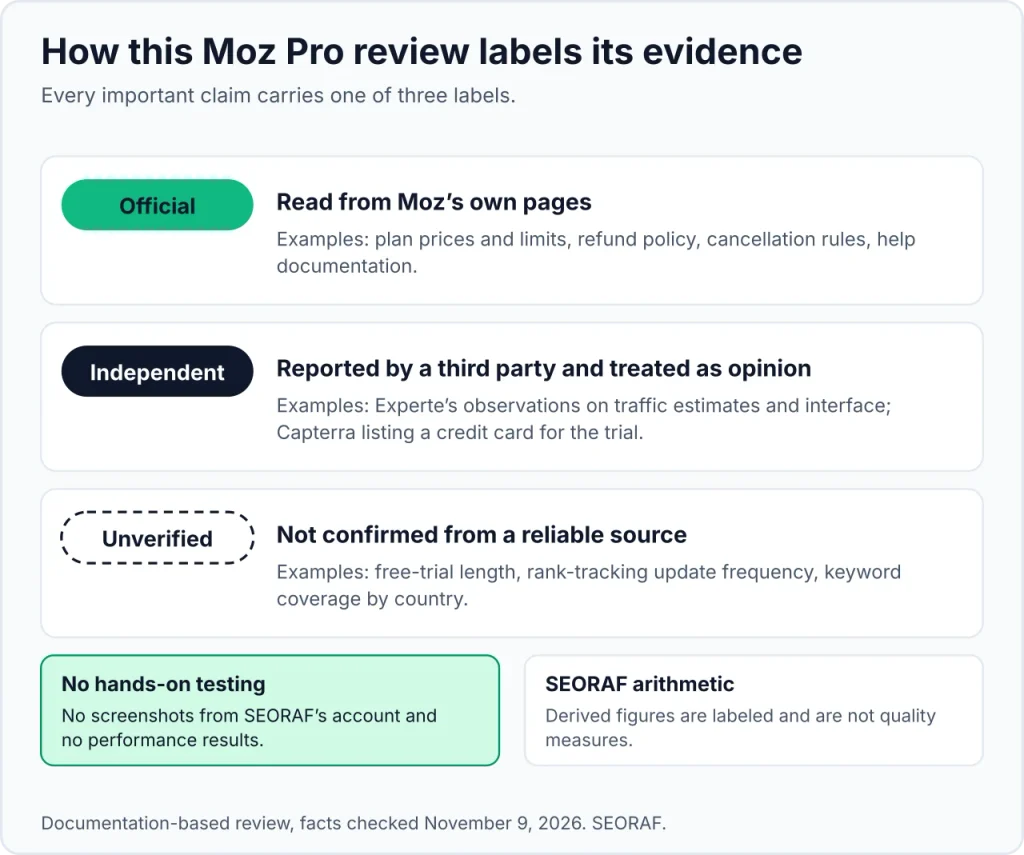
- Official sources: Moz’s pricing page, its cancellation help page, and the Help Hub pages for individual features, retrieved on November 12, 2026.
- Independent sources: published reviews and user-review platforms such as G2 and Capterra. These are treated as opinion, not measurement.
- Evidence labels: every claim that matters is marked official (read from Moz), independent (reported by a third party) or unverified (not confirmed from a reliable source).
- No hands-on testing: there are no screenshots from SEORAF’s own account, no performance results and no claims about how the tools behaved in practice.
- Derived figures: some numbers, such as cost per tracked keyword, are simple arithmetic on Moz’s published prices and limits. They are labeled “SEORAF arithmetic” and are not quality measures.
For the general approach, see the SEORAF review methodology.
Moz Pro Features, Evaluated
Each feature below follows the same pattern: what Moz documents, where plan limits apply, and an editorial assessment based on that documentation and on independent reports.
Keyword Explorer and Keyword Research
Keyword Explorer is Moz’s keyword research tool. Moz’s Help Hub documents four core metrics: Monthly Volume, Difficulty, Organic CTR and Priority. The tool also offers keyword suggestions by topic, keyword lists, and a view of the keywords a given site ranks for. On the pricing page, Moz advertises a keyword index of more than 1.25 billion keywords, which is a vendor figure.
Priority is the metric most specific to Moz. According to Moz’s help documentation, it is a score from 1 to 100 that combines Volume, Difficulty, Organic CTR and a user-adjustable “My Score.” It is not calculated from your site’s Domain Authority, a claim that appears on some review pages. Because it is an aggregate, it is most useful for sorting one keyword list. Comparing Priority scores across unrelated projects says less.
Plan limits for keyword work are:
- Keyword queries per month: 150 on Standard, 5,000 on Medium, 15,000 on Large.
- Keyword lists: 5, 30 and 60, holding 100, 500 and 750 keywords each.
- Keywords returned per site query: 10,000, 30,000 and 50,000.
Editorial assessment: the 150-query monthly allowance on Standard is the tightest number in Moz’s plan table for anyone who researches keywords regularly. A Moz community thread has also reported missing volume data for some countries until the US is selected. That report is unverified, but readers targeting other markets can test their own country with a free Moz account before paying. For broader context on keyword research, see the SEORAF keyword research guide and the roundup of best keyword research tools.
Link Explorer and Backlink Analysis
Link Explorer covers inbound links, linking domains, anchor text, top pages, discovered and lost links, link profile comparison, Link Intersect and Spam Score, according to Moz’s Help Hub navigation. Link tracking lists let you monitor specific links over time.
Moz’s help page on how it indexes the web says the index is constantly updating, that it uses a crawler called Dotbot, and that newly discovered links can appear in about three days. The same documentation is candid that the index is large but does not cover the whole web. Moz’s site cites a figure of over 40 trillion links in one place and over 44 trillion in another, so treat any single number as vendor-stated and approximate.
Plan limits for links are backlink queries per month (5,000, 20,000 and 70,000), results per backlink query (10,000, 40,000 and 50,000), and link tracking lists (1, 30 and 60).
Editorial assessment: Link Explorer fits link research that benefits from Moz’s own metrics, such as comparing a prospect’s Domain Authority and Spam Score. Because no link index covers every link, cross-check important findings with another source, such as the links report in Google Search Console. Spam Score is a Moz estimate and not a verdict from Google. For outreach and strategy, see the SEORAF link building guide.
Site Crawl and Technical SEO
Site Crawl scans tracked sites and groups problems into categories that Moz’s Help Hub lists as critical crawler issues, crawler warnings, redirect issues, metadata issues and content issues. Help pages also cover troubleshooting for pages that could not be crawled and for fluctuations in the number of pages crawled. The pricing page adds Performance Metrics for tracked and on-demand URLs.
Crawl capacity is stated per week and per month: 100,000 pages per week (about 400,000 per month) on Standard, 500,000 per week (2 million per month) on Medium, and 1.25 million per week (5 million per month) on Large. On-demand crawls are 5, 30 and 60 respectively, and site re-crawls are not offered on Standard but allow 10 on Medium and 25 on Large.
Editorial assessment: for small and mid-sized sites, the crawl allowances look generous on paper, and the absence of re-crawls on Standard is worth noting if you plan to verify fixes quickly. Sites with very large page counts, or technical audits that need deep configuration, are often better served by a dedicated crawler. The SEORAF comparison of Screaming Frog free and paid features and the technical SEO hub give more context, and the SEO audit tool page is a related SEORAF resource.
Rank Tracking and Campaigns
In Moz Pro, tracking is organized around campaigns. Moz’s pricing FAQ defines a campaign as tracking one site or URL plus three competitor websites, with data gathered across up to four search engines per tracked keyword. The plan table also lists mobile rankings, and the Help Hub covers local keyword tracking, SERP features, competitor rankings and search visibility.
Limits are 3, 10 and 25 campaigns, 300, 1,500 and 3,000 tracked keywords, and a Rank Checker allowance of 200 queries per day on Standard and Medium and 500 on Large.
Editorial assessment: if you split tracked keywords evenly across the allowed campaigns, the budget is about 100 per site on Standard, 150 on Medium and 120 on Large (SEORAF arithmetic). Agencies with many clients should check that figure against real needs. The update frequency of rank tracking was not stated on the Moz pages reviewed. One independent pricing explainer says updates are weekly by default, but that is unverified, so confirm the cadence if daily data matters to you.
Page Optimization and Content Briefs
Moz’s Page Optimization reports score a page out of 100 for a target keyword and provide prioritized recommendations. They also include Content Suggestions, which draw related terms from top-ranking pages for the keyword. Reports can be run from the Page Optimization section, from the tracked keywords overview, or through the MozBar extension. The On-Page Grader appears in the plan table as a separate research tool, and AI Content Briefs are capped at 2 per month on Standard, 10 on Medium and 50 on Large.
Editorial assessment: Moz’s own documentation says the tool reports suggestions based on SEO best practices and that the user decides what to fix. That is the right way to read the score. It is a checklist aid, not a prediction of ranking changes, and no tool can guarantee results.
Domain Authority, Page Authority and Brand Authority
Domain Authority is a Moz-developed score from 1 to 100. Moz describes it as based on factors such as linking root domains and total number of links, evaluated against Moz’s link data. Page Authority applies the same idea to individual pages, and Moz also provides a Brand Authority score and a free Brand Authority Checker.
Important: Domain Authority is not a Google metric. It is a third-party estimate built from Moz’s own link index. SEORAF has not found Google documentation that treats it as a ranking input, so it should not be presented as a ranking factor. It is most useful as a comparison tool, for example when judging link prospects or explaining relative site strength to a client.
Editorial assessment: DA’s main practical value is familiarity. Many SEO and outreach conversations use it, which makes reports easier to explain. Its main limit is that scores from different vendors, such as Ahrefs’ Domain Rating or Semrush’s Authority Score, come from different models and are not interchangeable.
AI Visibility and AI Search Tracking
Moz’s current pricing page lists AI Visibility dashboards, tracked prompts across AI models (it names GPT, Gemini and Google AI Mode), weekly prompt tracking, prompt suggestions, AI content briefs and AI Overviews by keyword. The plan table also lists rows for AI sentiment analysis and AI citations data, so confirm on the page which plans include them. Moz’s AI Visibility help describes a prompt performance table showing whether your brand and tracked competitors are mentioned, and charts for share of mentions over time.
Moz’s pricing page checked on November 12, 2026 lists 3, 6 and 12 dashboards and 150, 300 and 600 tracked prompts on Standard, Medium and Large, respectively. Extra dashboards cost $20 each and additional prompts cost $50 per 100. The page lists GPT, Gemini and Google AI Mode as the tracked models. Moz AI Explorer is a separate product.
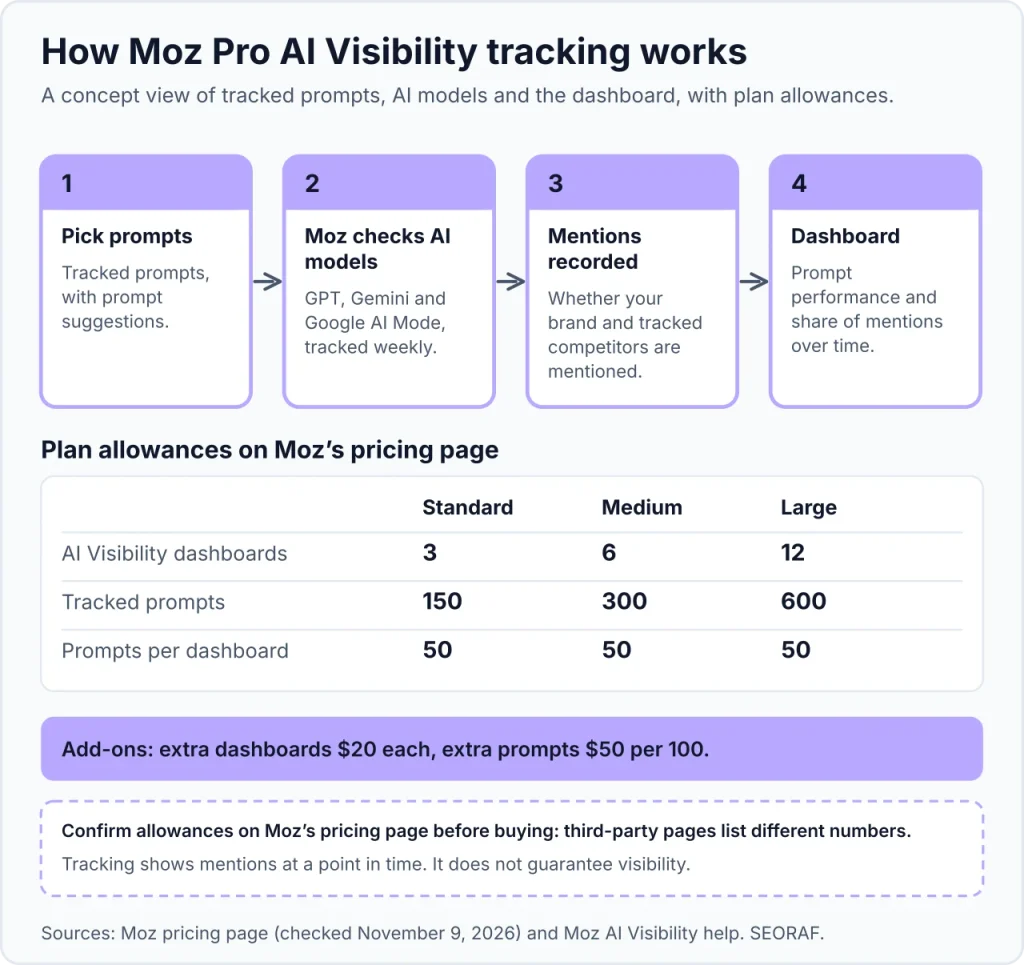
Editorial assessment: on those figures, the allowances work out to 50 tracked prompts per dashboard on every plan (SEORAF arithmetic), so more coverage means more dashboards or paid add-ons. Some third-party pages show older or different AI Visibility allowances. For this review, Moz’s own live pricing page is the primary reference: it lists the figures above. Because product packaging can change, recheck the AI rows on that page on the day you buy. Tracking prompts shows how AI answers mention a brand at a point in time. It does not guarantee visibility or control what an AI model says.
Reporting, Integrations and API
Moz’s custom reports let you build PDF reports from campaign data, including rankings and on-page reports, and schedule them to be emailed automatically. Report templates need a Medium plan or higher, and adding a branded logo also needs Medium or above, which matches the plan table where Standard shows no branded reports or templates.
For integrations, the Help Hub documents a Google Analytics connection and a transition guide for GA4. Moz’s pricing page lists MozBar Premium among the tools included with a subscription. The Moz API is a separate product with its own pricing, and the plan table does not list API access as a feature of Moz Pro. Claims elsewhere that a Moz Pro tier includes limited API access are therefore unsupported by Moz’s plan table.
Editorial assessment: the documented reporting covers scheduled PDF updates, with branding and templates starting at Medium, which is a concrete reason for consultants to look at that plan. How deep the reports go beyond that is not documented in the pages reviewed. Teams that need many data connections or custom dashboards should check integrations carefully, since only a Google Analytics connection appears in the Help Hub navigation reviewed here.
Moz Pro Plans and Limits: What You Actually Get
Moz currently lists three fully itemized plans in its main comparison (Standard, Medium and Large), a $49 per month entry-level option for individuals managing one website, and custom Enterprise pricing. The main comparison shows a 20% discount for yearly billing on Standard, Medium and Large. It does not publish the Starter plan’s detailed quotas or annual price in that comparison, so I have not filled those gaps with third-party estimates. A Premium tier mentioned in older articles is not shown in the current pricing table. Pricing and limits can change; confirm the live details on Moz’s official pricing page before subscribing.
| Item | Standard | Medium | Large |
|---|---|---|---|
| Monthly billing | $99 | $179 | $299 |
| Yearly billing (monthly equivalent) | $79 | $143 | $239 |
| Billed for the first year | $950 | $1,719 | $2,868 |
| User seats | 1 | 2 | 3 |
| Campaigns (tracked sites) | 3 | 10 | 25 |
| Tracked keywords | 300 | 1,500 | 3,000 |
| Pages crawled per week | 100,000 | 500,000 | 1,250,000 |
| On-demand crawls / site re-crawls | 5 / none | 30 / 10 | 60 / 25 |
| Keyword queries per month | 150 | 5,000 | 15,000 |
| Keyword lists (keywords per list) | 5 (100) | 30 (500) | 60 (750) |
| Competitive research queries | 50 | 75 | 100 |
| Backlink queries per month | 5,000 | 20,000 | 70,000 |
| Rank Checker queries per day | 200 | 200 | 500 |
| AI Visibility dashboards / tracked prompts | 3 / 150 | 6 / 300 | 12 / 600 |
| AI Content Briefs per month | 2 | 10 | 50 |
| Branded reports and report templates | Not included | Included | Included |
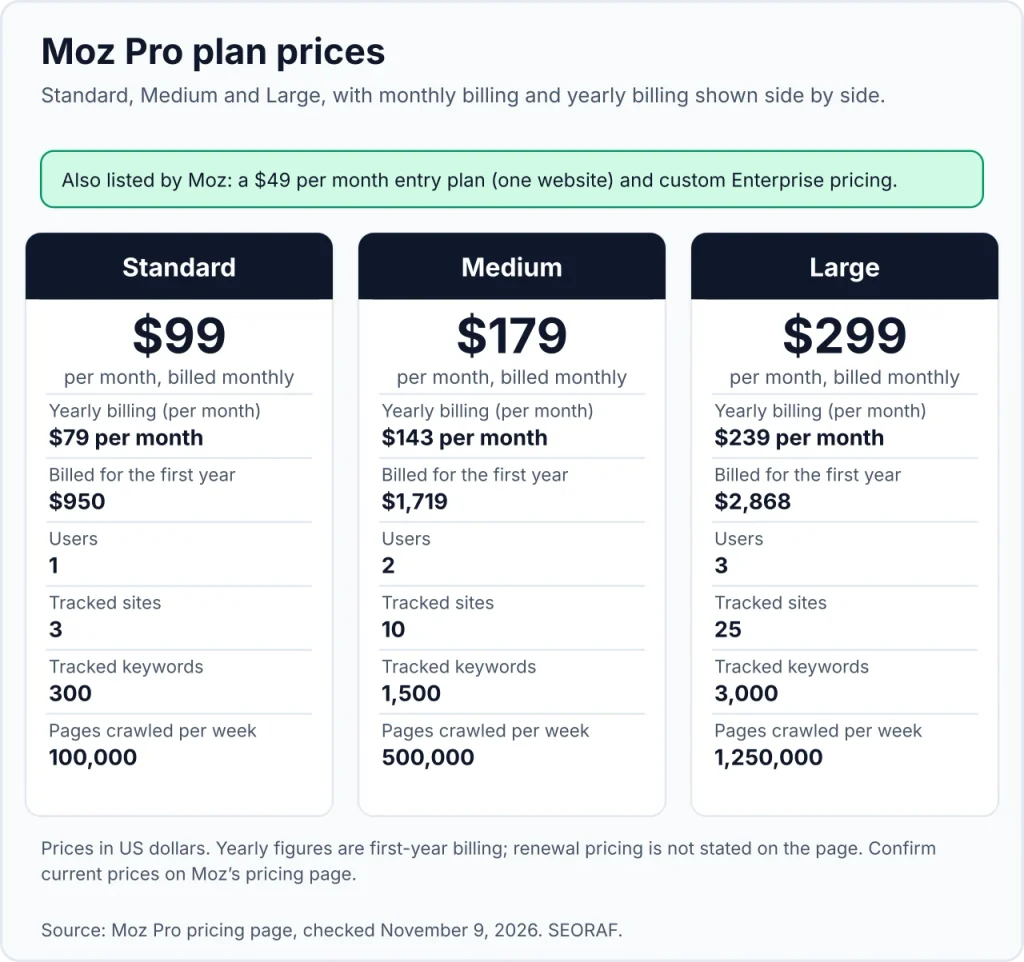
Source: Moz Pro pricing page, checked November 12, 2026. The page states that overages are not included. AI Visibility allowances differ in some third-party sources, so confirm them on Moz’s page.
Billing note: the yearly column is not a monthly payment option; it is the monthly equivalent of an annual commitment. Moz displays first-year totals of $950 for Standard, $1,719 for Medium and $2,868 for Large. Those totals should take precedence over multiplying the rounded monthly equivalents by 12. The pricing page does not state the renewal total for a later year, so confirm renewal pricing before choosing annual billing.
A few details from Moz’s pricing page and help pages are worth knowing:
- Add-ons exist. Examples listed by Moz include extra user seats at $49 per month each, additional campaigns at $10 per month, and 200 additional keywords at $20 per month. Check Moz’s subscription page for the full list.
- Discounts are limited. Moz states a 20% discount for yearly payment, no student discount, and a separate process for registered 501(c)(3) non-profits.
- Some details are not confirmed. Moz labels the yearly totals as amounts billed for the first year; the future renewal price is not stated in the main comparison. Starter’s detailed quotas and yearly price are also not itemized there. Tax treatment can depend on the billing location, so check the checkout total.
What the Limits Mean in Practice
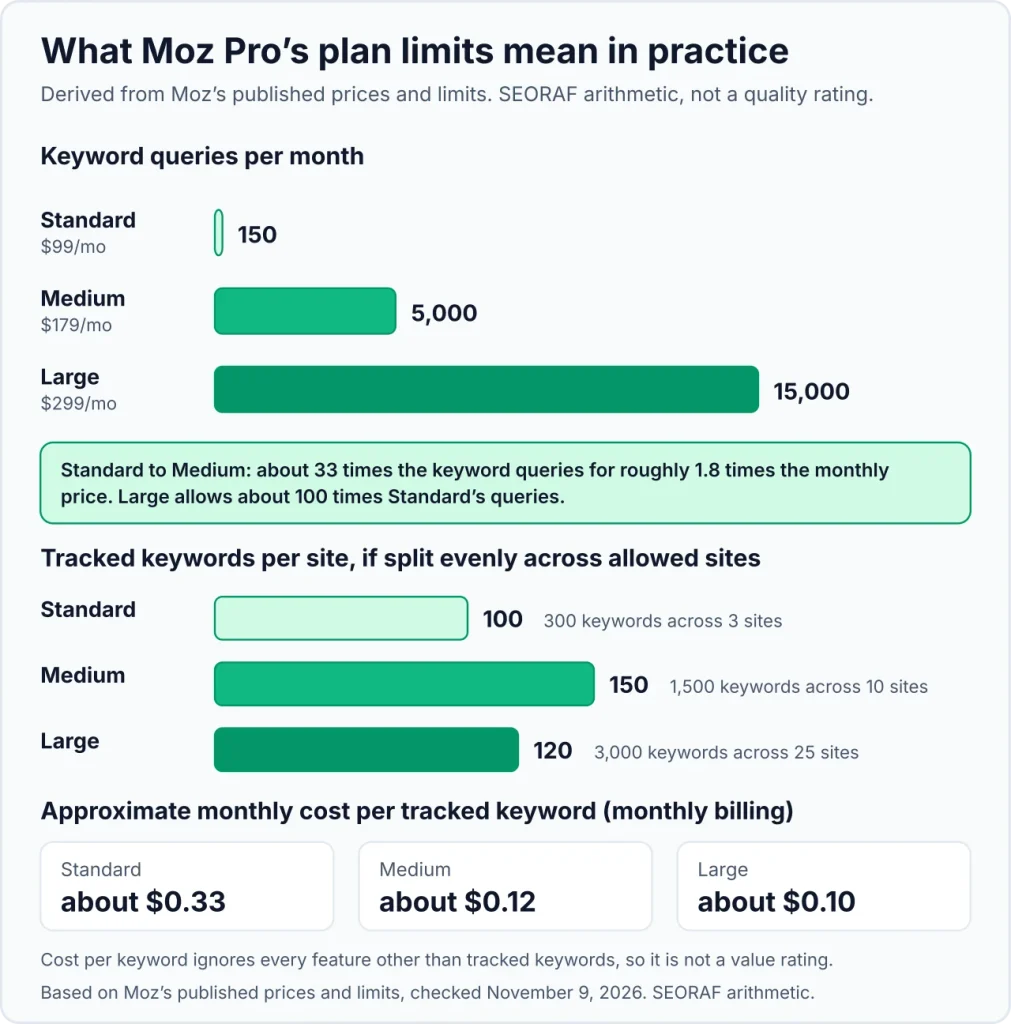
Plan names suggest a simple ladder, but the limits do not scale evenly. The table below converts Moz’s published numbers into a few comparable figures. It is SEORAF arithmetic, not a quality rating, because the plans differ in many other ways.
| Measure | Standard | Medium | Large |
|---|---|---|---|
| Tracked keywords per site, if split evenly | 100 | 150 | 120 |
| Approximate monthly cost per tracked keyword (monthly billing) | about $0.33 | about $0.12 | about $0.10 |
| Approximate monthly cost per tracked keyword (yearly billing equivalent) | about $0.26 | about $0.10 | about $0.08 |
| Tracked AI prompts per dashboard | 50 | 50 | 50 |
| Keyword queries relative to Standard | baseline (150) | about 33 times (5,000) | about 100 times (15,000) |
SEORAF arithmetic based on Moz’s published prices and limits, November 12, 2026. Cost per keyword ignores every feature other than tracked keywords.
Three practical scenarios show how the limits play out. They are illustrations built from the published numbers, not customer stories.
- A single site owner who mainly needs rank tracking and a periodic crawl may find the entry plan or Standard enough, but should check the 150 monthly keyword queries on Standard if they research new topics often.
- A small business with a few sites fits inside Standard’s three campaigns and 300 keywords, with roughly 100 keywords per site if split evenly. Missing re-crawls and branded reports are the main trade-offs.
- A consultant with several clients is where Medium becomes relevant: ten campaigns, two seats, re-crawls and branded reports. Eight to ten clients would leave 150 or fewer tracked keywords each, so confirm that is enough.
The largest single step is from Standard to Medium. The keyword query allowance rises about 33 times for roughly 1.8 times the monthly price, and branded reports and re-crawls start there. That is a limit-driven observation, not a recommendation to buy a larger plan than needed.
Moz Pro Free Trial and Free Account
Moz’s pricing page shows its free-trial option on the Medium plan, and Moz’s cancellation help describes free trials as giving Medium-level access. Several things about the trial are confirmed by Moz’s own pages:
- You can cancel renewal at any time during a free trial and still use Moz Pro until the trial ends.
- Moz’s cancellation guidance asks you to cancel at least 24 hours before renewal; cancelling on the renewal day can still result in a charge.
- Moz states that it does not offer refunds of any kind under its Terms of Use, and that subscriptions cannot be paused.
- When a paid plan or trial expires, campaigns are archived and no new data is collected. Moz says it keeps data for 12 update cycles and stores historical ranking and link data indefinitely, and you can undo a cancellation before the period ends.
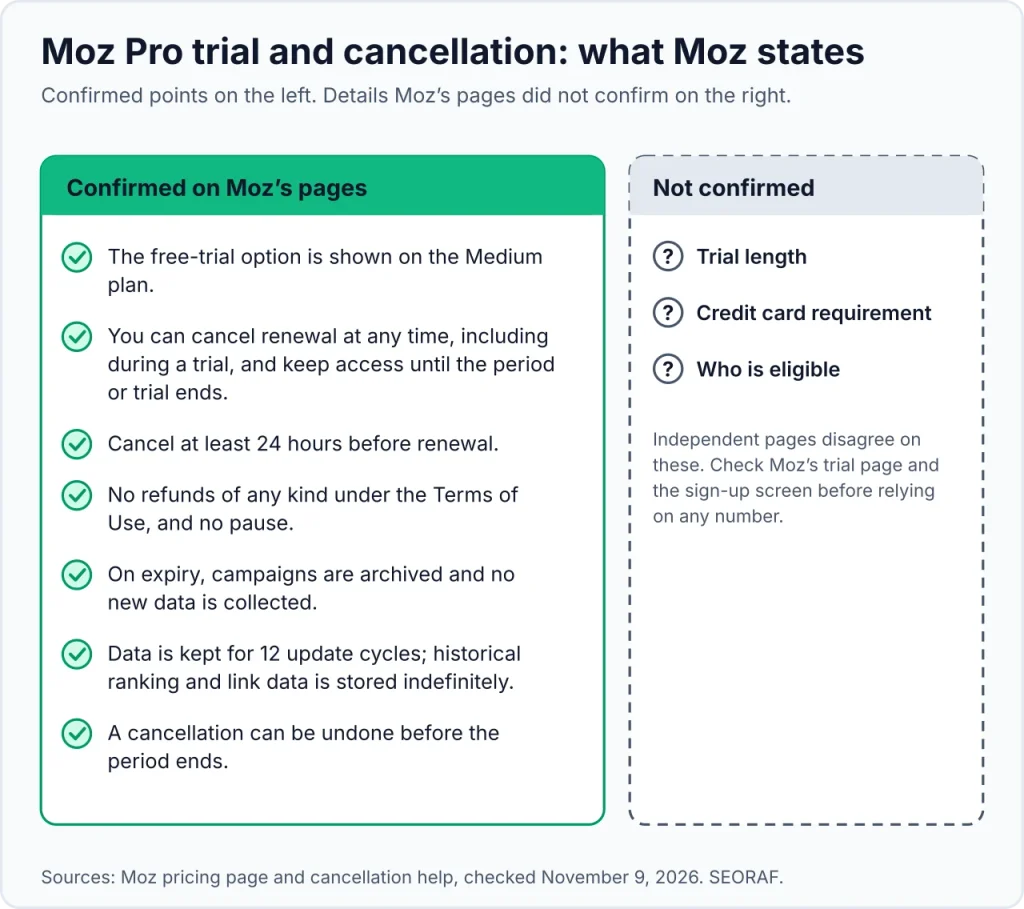
What is not confirmed: the length of the trial, whether a credit card is required, and who is eligible. SEORAF could not confirm these from Moz’s own pages on the verification date, so this article does not state a trial length. Independent pages mostly report a 7-day trial, some older or affiliate pages mention 30 days, and Capterra lists a credit card as required. Because those sources conflict, read Moz’s free trial help page and the sign-up screen before relying on any number, and note the date a trial would convert to a paid subscription.
Moz also offers a free Moz Community account. Moz’s cancellation help compares it with a Medium subscription:
| Feature | Free Community account | Moz Pro Medium (and trials) |
|---|---|---|
| Campaigns | 0 | 10 |
| Keyword queries per month | 10 | 5,000 |
| Keyword lists | 0 | 30 |
| Competitive research queries | 10 | 75 |
| Backlink queries per month | 10 | 20,000 |
| Link tracking lists | 0 | 30 |
| Rank Checker queries per day | 0 | 200 |
| Custom reports | No | Yes |
| User seats | 0 | 2 |
Source: Moz cancellation help page, checked November 12, 2026.
The free account is useful for sampling the data, for example to test whether Moz’s numbers cover your country. It does not replace a paid plan for ongoing work.
Before you start a trial, a short checklist:
- Read Moz’s trial and cancellation pages, and note the exact date a trial would convert to a paid subscription.
- Set a reminder for at least 24 hours before that date, since Moz asks for cancellation by then and does not offer refunds.
- Decide in advance what to test: a few domains you know well, a handful of seed keywords for your target country, a crawl of one site and a rank-tracking setup.
- Compare what you find with the plan limits above, especially keyword queries, tracked keywords and tracked sites.
Check Moz Pro’s current plans and trial terms
Affiliate link: SEORAF may earn a commission if you sign up. Pricing, trial length and terms are set by Moz and can change.
Ease of Use and Learning Curve
Independent opinions on ease of use are mixed, so it is worth reading both sides. Experte (last updated April 29, 2026) says the interface looks modern and clean but that the menu structure can feel cluttered and nested in longer sessions, that information is often buried in nested menus requiring several clicks, and that the tool is better suited to experienced SEO users. TechRadar lists a user-friendly interface among its pros, and Capterra reviewers include both praise for usability and comments that the interface could be better developed. Search Atlas, which is itself a competing SEO platform, publishes a review concluding that Moz suits beginners and small teams but not scale. None of these are usability measurements.
What Moz documents to shorten the learning curve is a Help Hub with troubleshooting and workflow guides, a community Q&A forum, and online support. Moz’s pricing page describes that support as “24-hour online support” in one place and “24/7 support” in another, so confirm the exact hours if they matter to you. Independent reviewers also mention guided tools and educational resources as a strength.
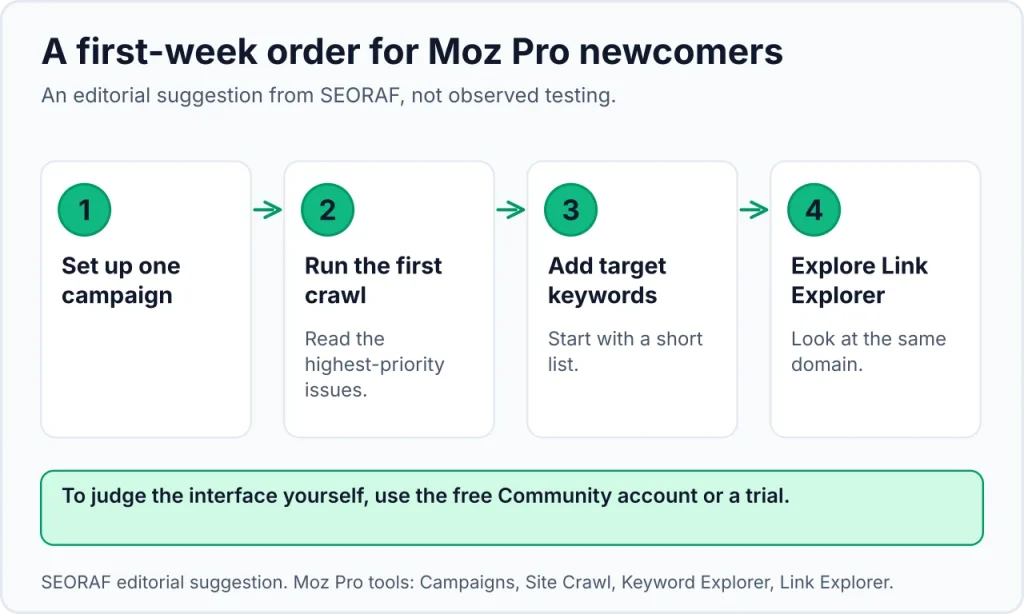
A sensible first-week order for a newcomer, offered as an editorial suggestion and not as something observed, is: set up one campaign, run the first crawl and read the highest-priority issues, add a short list of target keywords, then explore Link Explorer for the same domain. The free Community account and a trial are the practical ways to judge the interface for yourself. For general background first, see the SEORAF guide to SEO for beginners.
Data Accuracy and Limitations
No SEO tool provides exact data, and Moz is open about some of this. Its documentation says its link index does not cover the entire web, and that a link may not appear until the page that contains it has been crawled. Keyword volumes are estimates, Domain Authority is a modeled score, and Spam Score is Moz’s own estimate. These limits apply to the category, not only to Moz.
Limits specific to Moz Pro come from its own pages and from independent reviews. On Moz’s side, quotas are fixed on every plan and there are no refunds or pauses. On the independent side, Experte (last updated April 29, 2026) lists no traffic estimates, fewer keyword suggestions than modern all-in-one tools, a relatively limited feature set and a US-centric focus, and the German version of its review adds that the interface and support are English-only. Within Experte’s own rating rubric, backlink analysis scores highest (9.4 out of 10) while keyword research (6.4) and competitor analysis (5.6) score lower. Experte discloses that it may earn commissions from vendors, and its scores reflect its own weighting, so treat them as one opinion and not a benchmark. Another independent review also notes that Moz lacks the traffic estimates that several competing tools provide.
The table below separates what is confirmed from what is not, so you can see how much weight each claim deserves.
| Claim | Status | Basis |
|---|---|---|
| Plan prices and quotas in this article | Official | Moz pricing page, November 12, 2026 |
| Free trial option on Medium | Official | Moz pricing page and cancellation help |
| Trial length | Unverified | Not found on Moz pages reviewed; independent pages mostly say 7 days, some say 30 |
| Credit card required for trial | Independent | Capterra listing; confirm on Moz’s sign-up screen |
| No refunds; cancel 24 hours before renewal | Official | Moz cancellation help |
| Link index updates and coverage | Official | Moz help page on how it indexes the web |
| Link index size | Vendor-stated, inconsistent | Moz’s site cites over 40 trillion and over 44 trillion links in different places |
| Priority score calculation | Official | Moz Help Hub |
| Rank-tracking update frequency | Unverified | One independent source says weekly |
| AI Visibility allowances by plan | Official, with conflicting third-party reports | Moz’s current pricing page is the reference |
| Keyword data coverage outside the US | Unverified | Community report only |
| API access included in Moz Pro plans | Not supported | Not listed in Moz’s plan table |
| Domain Authority as a Google metric | Not accurate | DA is Moz’s own score |
Status labels follow the evidence labels explained in the methodology section. Checked November 12, 2026.
Moz Pro Pros and Cons
This summary draws only on points covered above, and the disadvantages are weighted as heavily as the advantages.
Advantages
- Published plan limits that make it possible to estimate fit before buying.
- Domain Authority, Page Authority and Brand Authority are widely used, which can make reports easier to explain.
- Reviewers cite guided tools and educational resources, alongside a documented Help Hub and community forum.
- A focused core toolkit in one subscription: keyword research, links, crawling, rank tracking, page optimization and reporting.
- Backlink analysis is the highest-scoring category in Experte’s rubric (an independent opinion).
- Moz’s pricing page lists AI Visibility tracking from the Standard plan upward, and Priority scoring and Page Optimization reports turn data into a prioritized to-do list.
Disadvantages
- Quotas are modest on Standard, especially 150 keyword queries per month.
- No refunds and no pause, and cancellation must be done at least 24 hours before renewal.
- Branded reports, templates and re-crawls start at Medium.
- Opinions on ease of use are mixed: some reviewers praise it, while Experte describes nested menus and says it suits experienced users better.
- Independent reviews cite fewer keyword suggestions than all-in-one suites, limited competitor-analysis depth, no traffic estimates and a US-centric data focus.
- Reviewers cite cost as a recurring complaint, and several details, including trial length and rank-tracking cadence, could not be confirmed from Moz’s pages.
Moz Pro vs Semrush and Ahrefs
Moz Pro is most often compared with Semrush and Ahrefs. A fair comparison here has limits. SEORAF has not benchmarked the three tools against each other, and this article does not quote Semrush or Ahrefs prices because they change often and were not verified from the vendors’ own pages for this review. The Moz column below uses documented facts and independent opinions. The Semrush and Ahrefs columns avoid claims that could not be sourced, which means the table lists Moz’s documented limits without implying that the other two lack similar ones. Verify them on each vendor’s site.
| Area | Moz Pro | Semrush | Ahrefs |
|---|---|---|---|
| Positioning | SEO platform covering keyword research, links, crawling, rank tracking, page optimization and AI visibility (Moz’s own pages). | Commonly described as a broader online marketing platform that includes SEO alongside other toolkits. Confirm on Semrush’s site. | Commonly described as an SEO platform known for backlink and keyword research. Confirm on Ahrefs’ site. |
| Authority metric | Domain Authority, Page Authority, Brand Authority | Authority Score | Domain Rating |
| Are the metrics Google metrics? | No. All three are vendor-defined scores built from each vendor’s own data, they are not interchangeable, and none is a Google metric. | ||
| Pricing in this article | Quoted from Moz’s pricing page, November 12, 2026 | Not quoted; check Semrush’s current pricing | Not quoted; check Ahrefs’ current pricing |
| What to compare on the pricing pages | Tracked keywords, tracked sites, keyword and backlink queries, crawl allowance, seats, AI prompts, report branding | The same list, for the same workload | The same list, for the same workload |
| AI visibility tracking | Tracked prompts on the current plans per Moz’s page; third-party reports on allowances differ | Independent reports describe AI-visibility features; packaging has changed in 2026, so confirm current availability | Independent reports describe AI-visibility features; confirm current availability and limits |
| Opinions on approachability | Mixed: praised by some reviewers, described by Experte as better for experienced users | Check independent reviews and a trial | Check independent reviews and a trial |
| Often-cited strengths | Familiar authority metrics and backlink analysis (Experte rates it highest of its categories) | Often described as the broadest of the three | Often described as strongest for backlink data |
| Documented or reported Moz limits | Quotas by plan, no refunds, no traffic estimates, fewer keyword suggestions and a US-centric focus per independent reviews | Not assessed here; verify on the vendor’s site | Not assessed here; verify on the vendor’s site |
The “often-cited strengths” and “approachability” rows summarize opinions in independent reviews and comparisons. They are not benchmarks. Checked November 12, 2026.
Both Semrush and Ahrefs publish their own index-size claims. This article does not compare vendor index-size figures because they are not measured on a common basis.
Because published comparisons cannot settle this for your situation, a short same-workload test is the fairest way to decide:
- Choose three domains you know well: your own and two competitors.
- Compare the linking domains and anchor text each tool reports for them, and note which tool shows links you can confirm elsewhere.
- Enter the same five seed keywords for your target country, and compare the suggestions and the volume data available.
- Count how many tracked keywords, sites and queries your real workload needs, and compare that with each plan’s limits.
- Check what each tool’s reports look like for the people who will read them.
Moz Pro vs Semrush
The main difference reviewers describe is scope. Semrush is generally presented as a wider marketing suite, while Moz Pro concentrates on SEO. Moz may fit better if you want an SEO-only toolkit, Domain Authority reporting and quotas that are easy to read. Semrush may fit better if your work extends beyond SEO and you want those toolkits in one place. If cost decides it, compare both plan tables against the same workload before paying. For more, see the SEORAF Semrush review and the comparison of SE Ranking vs Semrush.
Moz Pro vs Ahrefs
Ahrefs is frequently described as the stronger choice when backlink research is the main job, although Experte rates Moz’s backlink analysis as its best category, so test both on domains you know. Moz may fit better if you want familiar authority metrics and a simple plan table, and Ahrefs may fit better if deep link research is the core task. The SEORAF comparison of Semrush vs Ahrefs and the Mangools vs Ahrefs page add context, and the SEO tools comparison offers a wider view.
Moz Pro Alternatives Worth Checking
The list below is not a ranking. It shows which alternatives are worth checking for specific reasons. A dedicated page on the topic can go deeper, and the SEORAF SEO software alternatives hub and best SEO software pages cover the wider market.
| Alternative | Consider it if | Read next |
|---|---|---|
| Semrush | You want SEO plus other marketing toolkits in one platform. | Semrush review |
| Ahrefs | Backlink research is the core task and you want to compare link data. | Semrush vs Ahrefs |
| SE Ranking | You want another all-in-one platform to compare on quotas and price. | SE Ranking vs Semrush |
| Mangools | You prefer a set of focused tools centered on keyword research and rank tracking. | Mangools vs Ahrefs |
| A dedicated site crawler | Your main need is deep technical auditing of large or complex sites. | Screaming Frog free vs paid features |
These are options to evaluate, not recommendations or rankings. Compare current pricing and limits on each vendor’s own site.
For a broader shortlist of suites, see the SEORAF guide to the best all-in-one SEO tools.
Who Should Buy Moz Pro, and Who Should Skip It
Moz Pro Fits If…
- You want a focused SEO toolkit with guided workflows, and you have checked that the interface suits you.
- Your clients or stakeholders expect Domain Authority in reports, and you understand that it is a Moz metric and not a Google one.
- Your workload fits the published quotas, for example a few sites on Standard or up to ten on Medium.
- You want scheduled PDF reporting, and branded reports at Medium are worth the cost.
- You want to track brand mentions across AI prompts and are comfortable with the stated prompt limits, once confirmed on Moz’s page.
Look Elsewhere If…
- You research keywords at high volume and would hit the lower-plan query limits.
- You need traffic estimates, a broader marketing suite, or deeper backlink data than a smaller index can provide.
- You manage very large sites and need a configurable crawler.
- A no-refund policy and a 24-hour cancellation requirement are dealbreakers for your budget.
- Your target audience is outside the US and Moz’s data for your country has not been confirmed to be adequate.
A Quick Way to Decide
| If this describes you | What the published limits and reviews suggest |
|---|---|
| You expect far more than 150 keyword queries per month | Standard’s published allowance is 150 and Medium’s is 5,000. Consider Medium, or compare alternatives. |
| You track more than 3 sites or 300 keywords | Standard covers 3 campaigns and 300 keywords. Medium covers 10 and 1,500. |
| You need branded client reports or site re-crawls | Both start at Medium. |
| You need traffic estimates | Independent reviewers report that Moz Pro does not provide them. Compare tools that do. |
| Refund flexibility matters | Moz states it does not offer refunds. Read the cancellation page first. |
| Your audience is outside the US | Reviewers describe US-centric data. Test your country with a free Moz account. |
| Your main job is link research and outreach | Moz’s link tools and Domain Authority reporting fit this. Cross-check link coverage with another source. |
Based on the plan limits and independent reviews discussed above. It is a starting point for your own testing, not a recommendation.
If the answers point toward Moz, you can check Moz Pro’s current plans and trial terms on Moz’s site (affiliate link). If they do not, the SEO software alternatives hub is a better next step.
Moz Pro FAQs
Is Moz Pro worth it?
It can be, depending on fit. Moz Pro suits users who value guided workflows, familiar authority metrics and clear quotas. It is a weaker fit for high-volume keyword research or for those who need a broader marketing suite. See the quick verdict and the buy-or-skip section above.
Is Moz Pro good for beginners?
Opinions are mixed. Some reviewers call it approachable and cite guided tools and educational resources, while Experte says its nested menus make it better suited to experienced users. Moz documents a Help Hub and community forum, and the free Community account or a trial is the practical way to judge the interface yourself. Quotas on lower plans can also feel limiting as your work grows.
Does Moz Pro have a free trial or free plan?
Moz’s pricing page shows a free-trial option on the Medium plan, and Moz offers a limited free Community account. There is no permanent free plan with the full paid tools. Trial length and card requirements were not confirmed from Moz’s pages, so check them on Moz’s trial page before signing up.
Can I get a refund on Moz Pro?
Moz states that it does not offer refunds of any kind under its Terms of Use. You can cancel renewal, and Moz asks you to do so at least 24 hours before the renewal date.
Is Domain Authority a Google ranking factor?
No. Domain Authority is a Moz-developed score, not a Google metric, and SEORAF has not found Google documentation that treats it as a ranking input. Use it as a comparison tool and not as a goal in itself.
Does Moz Pro track AI search visibility?
Yes, according to Moz’s current pricing page: tracked prompts across GPT, Gemini and Google AI Mode with weekly tracking, within dashboard and prompt limits per plan. It shows mentions at a point in time and does not guarantee visibility. Moz AI Explorer is a separate product.
Is Moz Pro the same as Moz Local?
No. Moz states that Moz Local is a separate product from Moz Pro, with its own signup, and it is aimed at businesses managing physical locations.
Is Moz Pro better than Semrush or Ahrefs?
There is no universal winner. Independent opinions generally place Semrush ahead on breadth and Ahrefs ahead on backlink depth, while crediting Moz for approachability. Test the data you care about on each tool, and see the comparison section above.
Final Verdict
Moz Pro is a focused SEO platform with a clear set of core tools, familiar authority metrics, documented help resources and plan limits that are easy to read. Its main drawbacks are modest quotas on the lower plans, strict no-refund cancellation terms, a feature set that independent reviewers describe as narrower than all-in-one suites, mixed opinions on ease of use, and some details that are not fully itemized on Moz’s public pages, including Starter-plan quotas and future renewal pricing.
It is a reasonable choice for small businesses, in-house marketers and consultants whose workload fits the published limits and who value Domain Authority reporting. It is a questionable one for high-volume researchers, large-site auditors, anyone who needs traffic estimates, or anyone who cannot accept a no-refund policy. Before paying, run a short test on your own domains and keywords, compare against Semrush, Ahrefs or another alternative on the same workload, read the cancellation terms, and treat Domain Authority as Moz’s score and not as a Google measure. If Moz still looks like a fit, you can check Moz Pro’s current plans and trial terms (affiliate link).
Sources, Verification Log and Updates
Official Moz pages used for this review, checked on November 12, 2026:
- Moz Pro pricing page
- How to cancel your Moz Pro subscription
- Moz Pro free trial help page
- How Moz indexes the web for Link Explorer
- Keyword Explorer Priority metric
- Page Optimization overview
- Custom Reports
- Getting started with AI Visibility
- Moz API
- Moz Terms of Use
Independent sources referenced as opinion: the Experte Moz Pro review (last updated April 29, 2026; Experte discloses that it may earn commissions from vendors), the TechRadar Moz Pro review, the Search Atlas Moz review (published by a competing SEO platform), the Capterra Moz Pro pricing and reviews page and the G2 Moz Pro reviews page. Ratings, review counts and listings on those sites change.
Still unverified or not itemized on the verification date: free-trial duration and eligibility, whether a credit card is required, Starter-plan quotas and annual price, future renewal pricing, the final tax treatment for a specific billing address, rank-tracking update frequency, and keyword data coverage by country.
Update log: November 12, 2026. Pricing and AI Visibility allowances were rechecked against Moz’s live pricing page; the Starter-plan limits and annual price remain unlisted in the main comparison. The article was also reviewed against Moz’s cancellation, trial and feature documentation. Earlier claims about a Premium plan, a money-back guarantee and Priority Score being based on Domain Authority were removed because Moz’s pages do not support them.