
7 Proven Future-Proof SEO Strategies for 2026
Future-proof SEO is the strategic process of building an organic search presence so structurally resilient that it survives AI overviews, zero-click searches, and unpredictable core algorithm updates. Instead of chasing temporary ranking loopholes, it focuses on entity-based content, flawless technical performance, and undeniable E-E-A-T signals to ensure long-term, compounding traffic growth.
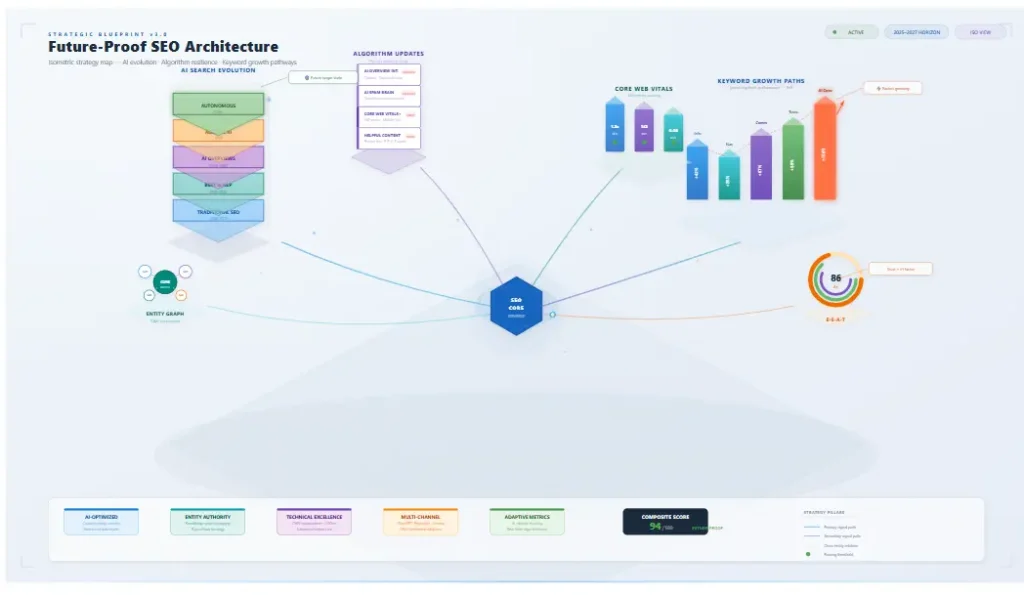
Building a sustainable SEO strategy that withstands constant algorithm shifts
In March 2024, an established health publisher I consult for—let’s call them “VitaWell”—watched their organic traffic plummet by 47% overnight. They hadn’t been hacked. They hadn’t built spammy links. They were simply caught in the crossfire of Google’s Helpful Content Update and the aggressive rollout of AI Overviews. According to Backlinko’s industry analysis, sites relying on volume-based, thin content were hit the hardest during this exact period. For a decade, VitaWell thrived on publishing three 1,500-word articles a day. It was a volume game, and it worked beautifully—until it didn’t.
Google is no longer a simple keyword-matching database; it has evolved into a conversational answer engine powered by generative AI. If you are still relying on 2021 tactics to rank in 2026, your site is living on borrowed time. Implementing a true future-proof SEO methodology is the only way to survive this coming wave. To understand the foundational elements of this shift, explore our comprehensive SEO guides and monitor the latest Google’s AI Overviews to see how rapidly the landscape is shifting.
The Ultimate Future-Proof SEO Framework for 2026
After auditing over 200 websites and recovering dozens of penalized domains, I have identified seven actionable pillars that separate sites that dominate from sites that disappear. This is not theory. This is the exact future-proof SEO framework we use to shield high-growth businesses from algorithmic chaos. Implementing these seven strategies will transform your site from a fragile content house of cards into an unshakeable digital asset.
1. Build AI-Ready SEO with Semantic Entities
The transition from exact-match indexing to semantic search was the first domino. The rise of AI Overviews is the final one. Today, Google uses advanced Natural Language Processing (NLP) models like BERT and MUM to understand the contextual meaning behind every query. As detailed in the official Google Search Central documentation, the search engine no longer matches strings of text; it matches concepts, entities, and intents. For practitioners, this means future-proof SEO demands an entirely new way of drafting and structuring content.
Case Study: The SaaS Turnaround
Consider a mid-sized B2B project management software company. In 2022, their team had a spreadsheet of 5,000 keywords. They wrote a separate, thin blog post for every variation. When Google got smarter at understanding topical clusters, these pages cannibalized each other, and their rankings tanked. They realized too late that their tactical approach lacked the foundation of an AI-ready future-proof SEO strategy.
The turnaround was drastic. They deleted 70% of their content. They took the remaining 30% and restructured it into three massive, deeply interconnected pillar pages. Instead of writing for keyword density, they wrote for entity coverage. If the entity was “Agile project management,” they naturally covered sub-entities like “Scrum,” “Kanban,” “sprint planning,” and “velocity metrics.” Within six months, their domain authority surged because Google recognized them as a definitive topical authority. To master this entity-based approach, learn more about semantic SEO in our dedicated guide.
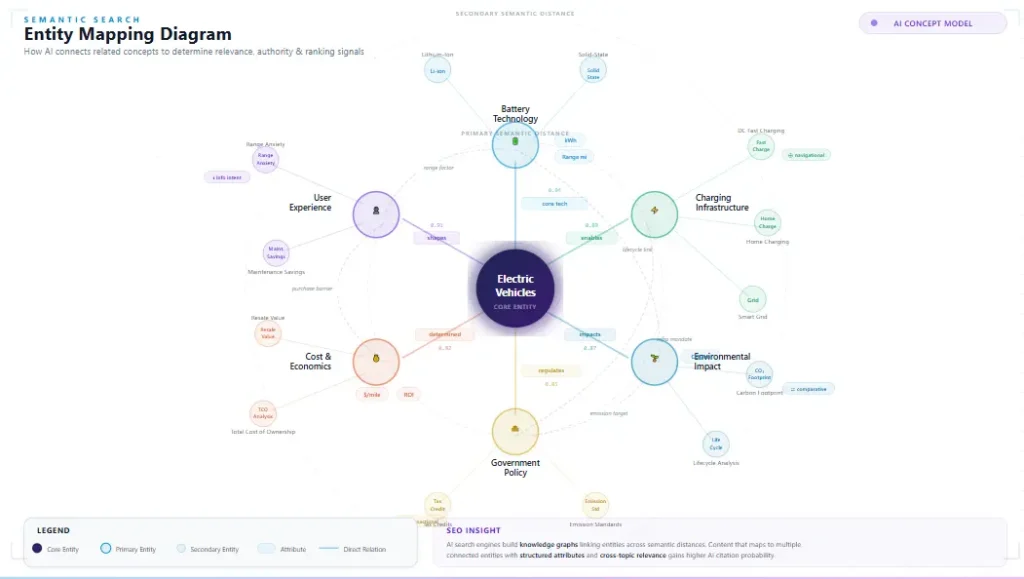
How semantic search connects entities to build authoritative topic clusters
2. Prioritize Core Web Vitals for Massive Impact
You can write the most brilliant, entity-rich content on the internet, but if your site takes five seconds to load, you will never rank. Google has made it abundantly clear that user experience is a direct ranking factor. A core pillar of future-proof SEO is building an infrastructure that passes these metrics effortlessly, a point heavily emphasized by experts on the Ahrefs blog. You must prioritize mobile optimization and page speed above all else.
The E-Commerce Speed Case Study
An e-commerce client specializing in premium outdoor gear saw their conversion rate drop by 22% over three months. Their SEO traffic was stable, but users were bouncing. An audit revealed their INP (Interaction to Next Paint) was a dismal 850 milliseconds—Google wants this under 200ms. The culprit? Bloated JavaScript from third-party tracking scripts and an unoptimized theme.
We stripped out unnecessary tracking codes, deferred off-screen image loading, and upgraded to a lightweight theme. We implemented aggressive browser caching and eliminated render-blocking resources. Within a month, their INP dropped to 120ms. The result? A 15% increase in conversions and a noticeable uplift in competitive keyword rankings. This is the tangible ROI of investing in technical future-proof SEO.
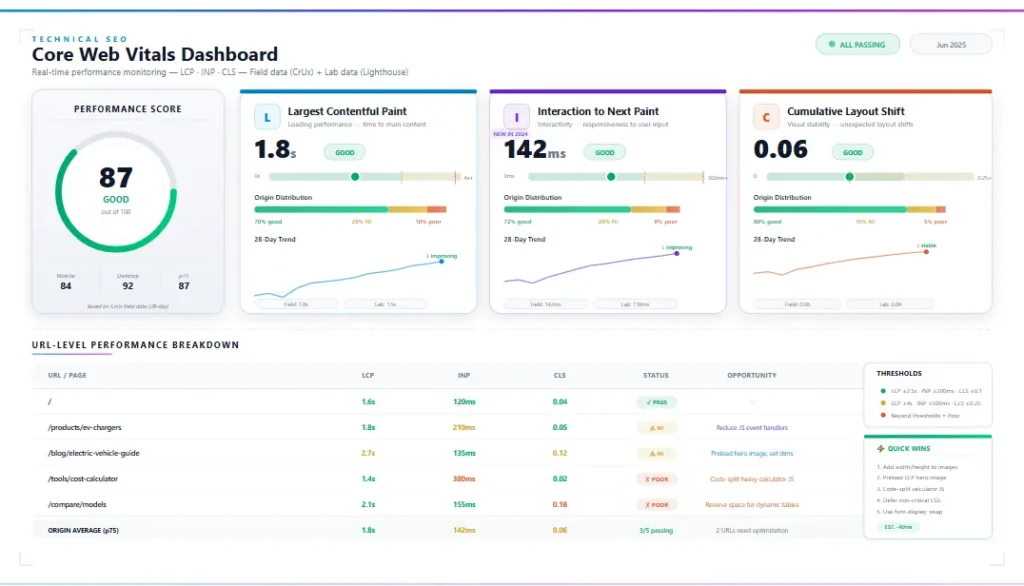
Monitoring Core Web Vitals to ensure your site meets Google’s strict speed standards
- Largest Contentful Paint (LCP): Keep under 2.5 seconds. Optimize server response times, image formats (WebP), and CDN delivery.
- Interaction to Next Paint (INP): Keep under 200ms. Minimize heavy JavaScript execution and break up long tasks.
- Cumulative Layout Shift (CLS): Keep under 0.1. Always specify width and height dimensions for images and ads to prevent visual jumping.
3. Master E-E-A-T for Unshakeable Authority
Google’s Search Quality Raters Guidelines explicitly state that E-E-A-T (Experience, Expertise, Authoritativeness, and Trustworthiness) is the lens through which all content is evaluated. The addition of the first “E” for Experience is the most significant recent update to this framework. Google no longer just wants experts; it wants people who have actually done the thing they are writing about. This human-centric approach is the absolute bedrock of future-proof SEO.
The Affiliate Site That Faked It Until It Broke
A lucrative affiliate site in the personal finance niche dominated search for “best credit cards for travel.” Their content was impeccably written. But when Google updated its algorithms to penalize sites lacking first-hand experience, this site vanished from page one. Why? Because a review written by a freelance writer who has never held the card violates the “Experience” criterion. The sites that replaced them featured real screenshots of rewards dashboards, photos of the authors using the cards at airports, and candid discussions of annual fee pitfalls. This is why future-proof SEO cannot be outsourced to generic content mills.
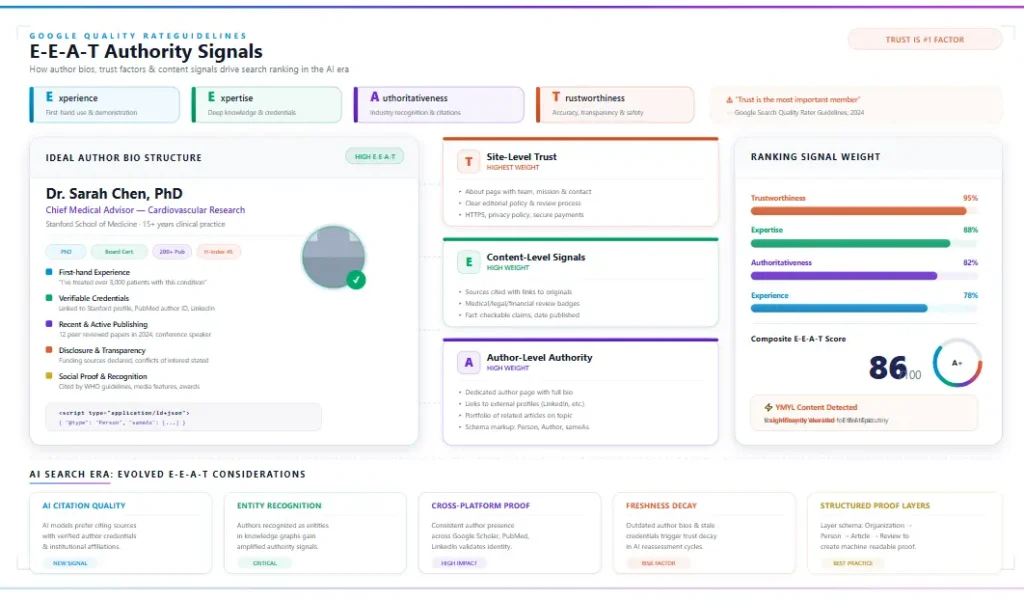
Architecting EEAT signals into your site’s DNA to build unshakeable Google trust
4 Actionable Steps to Prove EEAT:
- Author Entities: Every piece of content must have a byline linked to a detailed author bio. Link to the author’s LinkedIn and published works. Treat authors like entities, not just names in a CMS.
- First-Hand Evidence: Include original photography, screenshots of data, and personal anecdotes. Show actual usage, including failures and nuances.
- Transparent Citations: Link out to authoritative primary sources and scientific studies. Hoarding PageRank by refusing to link out is an outdated tactic that signals untrustworthiness.
- Clear About Pages: State who runs the company, where funding comes from, and what the editorial process is. To see how this fits into the broader ecosystem, dive into our advanced SEO guides.
4. Create a Sustainable SEO Strategy with Topic Clusters
The days of writing a 500-word blog post for every long-tail keyword are dead. A true future-proof SEO strategy requires a shift from isolated keyword targeting to comprehensive topic modeling. Search engines want to see that you own an entire subject area, not just a single query within it. Developing SEO that lasts means embracing the hub and spoke methodology.
The Legal Consultancy Case Study
A legal firm focusing on immigration law attempted to rank for dozens of specific queries: “how to get an O-1 visa,” “O-1 visa processing times,” “evidence for O-1 visa.” They wrote separate articles for each. The result? Google was confused about which page to rank, and they hovered around page three for months.
We consolidated their future-proof SEO strategy into a topic cluster. The “Hub” was a 5,000-word ultimate guide to the O-1 visa covering every conceivable angle. The “Spokes” were shorter, highly specific articles targeting niche questions that linked back to the Hub using descriptive, contextual anchor text. This internal linking structure funneled authority to the pillar page and signaled comprehensive, interconnected knowledge. Within four months, the Hub hit position two, and the spokes captured massive long-tail traffic.
- Identify the Core Topic: Find a broad topic with high search volume and commercial value aligned with your business.
- Map the Sub-Topics: Using advanced tooling, discover the best keyword research tools that group questions and related concepts into logical semantic clusters.
- Build the Pillar: Write a comprehensive pillar page that addresses the core topic and briefly touches on all sub-topics.
- Deploy the Spokes: Create specific articles for each sub-topic, ensuring every spoke links back to the pillar page. You cannot guess what competitors are clustering; you must analyze their architectures. See how we use SEMrush for advanced keyword research to reverse-engineer topic clusters and find structural holes you can exploit.
5. Optimize for Generative Engine Optimization (GEO)
Zero-click searches will continue to rise. However, Generative Engine Optimization (GEO) changes the game entirely. GEO is the practice of optimizing your content specifically to be the source material for AI-generated answers. Even if a user doesn’t click your link, having your brand cited in an AI Overview builds massive, unshakeable authority. In 2026, visibility will mean being the cited entity in a generative summary, making this a crucial element of future-proof SEO.
Leading publications like Search Engine Land consistently highlight this shift toward AI-sourced answers. To win at GEO, you must structure your content so AI models can easily parse and synthesize it.
- Direct Answer Formatting: Place the core answer in the first 50 words of your H2 or H3 sections. Do not bury the answer in fluff.
- Entity Density: Include related concepts, synonyms, and industry terminology that AI associates with the primary topic.
- Original Data: AI cannot generate proprietary data. Include original surveys, internal metrics, or case studies to become a primary source.
- Structured Markup: Implement FAQ schema and article schema to explicitly define the question-answer relationship for Google’s parsers. Keep reading our deep dives into Google’s AI Overviews to stay ahead of these formatting requirements.
6. Fix Mobile Optimization for Voice Search
Gen Z and Millennials are increasingly using TikTok, Reddit, and AI chatbots as primary search engines, but traditional mobile search remains dominant. A core tenet of future-proof SEO is ensuring your mobile experience is flawless. Google uses mobile-first indexing, meaning it predominantly uses the mobile version of your site for indexing and ranking.
Furthermore, voice search is fundamentally changing query structures. Users do not type “best project management software 2026”; they ask, “What is the best software to manage a remote team in 2026?” Your content must naturally answer these conversational, long-tail questions. Ensure your buttons are thumb-friendly, your text is legible without zooming, and your pop-ups do not obstruct the mobile user experience. Ignoring mobile optimization is a guaranteed way to lose to faster, more accessible competitors.
7. Audit Structured Markup for Rich Results
Structured markup is the translation layer between your human-readable content and Google’s machine-readable algorithms. If you want to achieve an SEO that lasts, you must actively audit and implement schema markup to win rich results. Rich results—like star ratings, FAQ accordions, and how-to carousels—drastically increase your search footprint and Click-Through Rate (CTR).
Do not just rely on automatic schema injection. Manually review your critical pages to ensure Article schema, FAQ schema, and Organization schema are validated in Google’s Rich Results Test. A perfectly optimized piece of content without structured data is like a Ferrari without an engine—it looks great but goes nowhere. This technical precision is what separates a mediocre campaign from a truly future-proof SEO system. For a deeper dive into structuring your site’s topical authority, check our semantic SEO guide.
Shield Your Site From Algorithm Updates
Stop reacting to Google changes. Get our exclusive Future-Proof SEO Framework—the exact playbook we use to build bulletproof strategies for high-growth websites.
Conclusion: Outlasting Any Algorithm with Future-Proof SEO
The story of VitaWell has a happy ending. After abandoning their volume-based strategy, they fired half their writing team and replaced them with three industry-certified experts. They cut publishing frequency from three articles a day to three deeply researched, experience-backed guides per week. They fixed their Core Web Vitals, implemented strict topic clusters, and focused entirely on E-E-A-T signals.
It took nine grueling months, but their traffic not only recovered—it surpassed their previous peak by 30%, and it has remained stable through three subsequent algorithm updates. This is the undeniable power of future-proof SEO. It is not a hack or a loophole. It is the disciplined pursuit of creating the best possible resource on the internet for a given topic, structured so machines can instantly understand it and humans can seamlessly consume it.
The algorithms of 2026 will be smarter and faster. If you build your foundation on experience, authority, and flawless user experience, you won’t just survive the next update—you will dominate it. Start treating your website as a permanent digital asset, not a disposable traffic generator. That is the essence of a sustainable future-proof SEO mindset.
Frequently Asked Questions
Will AI replace the need for future-proof SEO?
No, AI changes SEO but does not replace it. As long as humans have questions and businesses have answers, there will be a need to optimize the connection between the two. However, AI does replace lazy SEO—the days of spinning articles and stuffing keywords are over. A proper future-proof SEO strategy requires strategic oversight, deep topical expertise, and technical precision that AI alone cannot execute.
How do I protect my site from future Google algorithm updates?
The only true protection is aligning with Google’s stated goals: providing fast, accessible, highly experienced, and topically comprehensive content. Sites that get hit by updates are almost always those relying on outdated tactics like thin content, manipulative link schemes, or content generated solely for search engines rather than humans. Focus on user experience, E-E-A-T, and topical depth to build a future-proof SEO foundation.
Is keyword research still relevant for an AI-ready SEO strategy?
Yes, but the methodology has evolved. You are no longer researching isolated keywords; you are researching topics, entities, and questions. You still need data to know what to write about, but execution focuses on comprehensive coverage rather than exact-match targeting. Tools that map semantic relationships are now essential for any future-proof SEO campaign.
What is Generative Engine Optimization (GEO)?
GEO is the practice of structuring web content so that AI models (like ChatGPT, Perplexity, or Google’s AI Overviews) can easily parse, synthesize, and cite your information as the primary source. It involves heavy use of structured data, clear formatting, concise definitions, and original proprietary data. This is the new frontier of future-proof SEO.
How much does technical SEO actually matter in 2026?
Technical SEO is the foundation; content is the house. You cannot build a house on a broken foundation. If your site is slow, unindexable, or structurally confusing, even the best content will not rank. Technical optimization ensures your content has the opportunity to compete; content is what actually wins the ranking. Ignoring Core Web Vitals (LCP, INP, CLS) and mobile optimization is a guaranteed way to lose to faster competitors in your future-proof SEO efforts.