
Table of Contents
The Ultimate Link Building Guide: Strategies, Tactics, and Audits for 2026
If you’ve been in the SEO game for even a month, you’ve heard the mantra: “Content is King.” But here’s the uncomfortable truth that a lot of gurus don’t like to admit—content is nothing without a kingdom.
Backlinks are the roads that lead users to your kingdom. In 2026, link building isn’t just about getting random websites to link to you. It’s about building authority, trust, and semantic relevance. Google’s spam updates have gotten smarter, and the days of blasting 10,000 profile links to your site are long dead. This link building guide is designed to help you navigate this complex landscape.
Before you dive into strategies, ensure you have your data locked down. We recommend checking our keyword research checklist to ensure you are targeting terms that are actually worth building links for. A successful link building guide always starts with proper research.
Today, we’re going to dive deep into a world-class link building guide designed for the modern SEO landscape. We’re moving beyond the basics into the realm of semantic entities, topical authority, and genuine digital PR. If you are looking for a simple definition, look elsewhere. This is a strategic blueprint for dominance.
1. What Is Link Building?
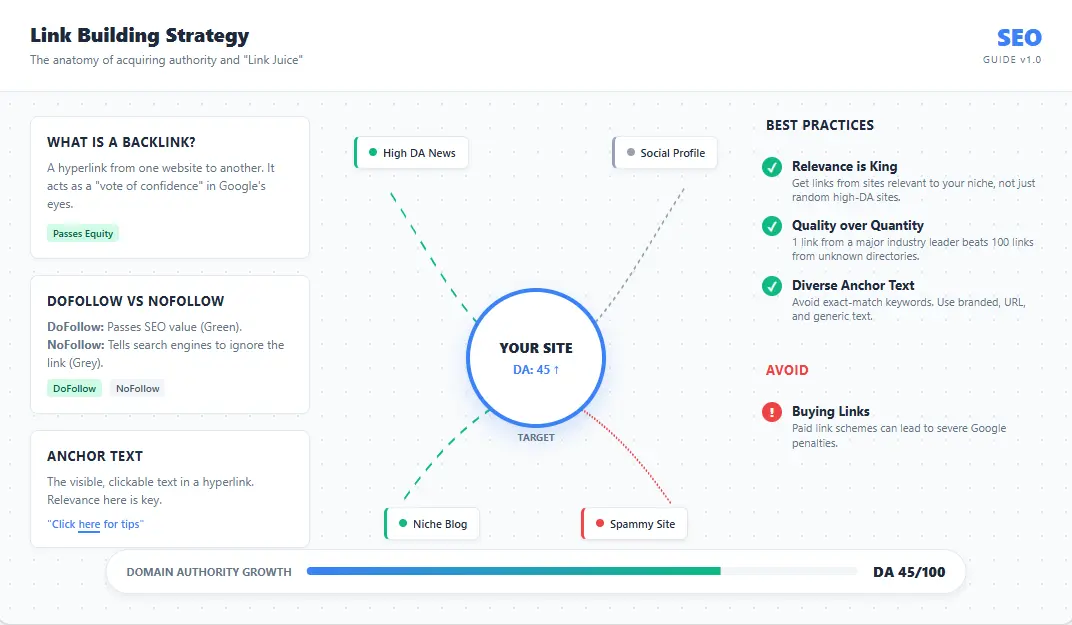
At its core, link building is the process of acquiring hyperlinks from other websites to your own. But that definition feels a bit dry, doesn’t it? Let’s spice it up. A hyperlink (usually just called a link) is a way for users to navigate between pages on the internet. When you build links, you’re essentially convincing other website owners that your content is valuable enough to cite as a source. You are asking them to vouch for you. This link building guide will teach you how to do that effectively.
Why Backlinks Matter (Even in 2026)
You might be asking, “With AI Overviews and ChatGPT answering queries, do backlinks still matter?” The answer is a resounding yes. Search engines like Google use backlinks as a “vote of confidence.” When a site with high authority links to you, it passes a portion of that “link equity” (or “link juice”) to your site. This boosts your own authority and helps you rank higher in search results. Our link building guide emphasizes this mechanism because it is the foundation of Google’s algorithm.
How Google Evaluates Backlinks
Google isn’t just counting links; it’s weighing them. They are looking at:
- Authority: How strong is the linking site? A link from The New York Times is worth exponentially more than a link from a brand-new, unknown blog.
- Relevance: Is the linking site topically related to yours? If you sell dog toys and get a link from a construction site, Google gets suspicious. If you get a link from a veterinary blog, that’s a gold star.
- Anchor Text: This is the clickable text in a hyperlink. If too many people link to you with the exact keyword “buy cheap shoes,” Google might think you’re trying to manipulate the results.
- Placement: A link in the main body of an article carries more weight than a link in the footer or a sidebar.
2. Types of Backlinks
Not all links are created equal. Understanding the anatomy of a backlink is crucial for your strategy. If you’re chasing the wrong types, you’re wasting time. This link building guide breaks down every attribute you need to know.
1. Dofollow Links: This is the default state of a link. It passes link equity and signals to Google, “Hey, I endorse this site.” This is what you want 90% of the time. A solid link building guide will prioritize these.
2. Nofollow Links: Introduced by Google in 2005, the rel="nofollow" attribute tells search engines, “I’m linking to this page, but I don’t want to pass my authority to it.” Originally designed to combat comment spam, Google now treats these as a “hint” rather than a direct command, but they generally don’t pass equity. However, a natural backlink profile *must* have nofollow links. A solid link building guide will tell you that 100% dofollow is a red flag.
3. Sponsored (Paid) Links: If you pay for a placement or an ad, you must use rel="sponsored". Failing to do this is a violation of Google’s guidelines. While it doesn’t pass equity, it drives referral traffic and keeps you out of the penalty box.
4. UGC (User Generated Content): This tag (rel="ugc") is for links in comments and forum posts. It tells Google the webmaster didn’t create the link; a user did.
5. Editorial Links: The holy grail. These are links naturally given by a writer or editor because they found your content valuable. No outreach, no payment—just pure merit. This is the ultimate goal of any link building guide.
6. Contextual Backlinks: Links found within the body text of a page. These are powerful because they are surrounded by relevant content, helping Google understand the context of your page.
7. Guest Post Links: Links you earn by writing an article for another website. Great for networking, but Google frowns upon “guest posting for SEO” if the content is low quality.
8. Local Citations: Mentions of your business name, address, and phone number (NAP) on local directories. Vital for local SEO.
9. HARO Links: Links acquired through Help a Reporter Out, where journalists request expert quotes.
Backlink Type Comparison Table
| Type | Passes Equity? | Primary Purpose | Best For… |
|---|---|---|---|
| Dofollow | Yes | SEO Ranking Power | Increasing search rankings |
| Nofollow | No (usually) | Natural Profile Diversity | Social media, comments, safety |
| Sponsored | No | Disclosure/Ads | Paid partnerships, avoiding penalties |
| UGC | No | Safety | Forum comments, blog comments |
| Editorial | Yes | Authority/Trust | Long-term brand growth |
3. White Hat vs. Black Hat Link Building
In the SEO world, you wear a hat. Well, metaphorically. Any comprehensive link building guide must distinguish between the safe path and the dangerous shortcut.
White Hat Link Building (The Safe SEO Practices)
White hat refers to tactics that strictly follow Google Search Central guidelines. It focuses on human value first, search engines second.
- Focus: Creating high-quality content.
- Focus: Building relationships.
- Tactics: Guest blogging, digital PR, creating infographics.
- Risk Level: Zero to low. This link building guide is entirely focused on White Hat tactics.
Black Hat Link Building (The Risky Tactics)
Black hat is the dark side. It exploits weaknesses in the algorithm to rank faster. It worked in 2010. Today, it will get you a manual penalty. A responsible link building guide will never recommend these.
- Focus: Manipulating rankings.
- Tactics: Buying links in bulk, private blog networks (PBNs), comment spam, hidden links.
- Risk Level: High. You could be removed from Google entirely.
The Grey Area: PBN Risks and Spam Backlinks
Private Blog Networks (PBNs) are a network of websites built solely to link to a “money site.” While some SEOs still use them successfully in the short term, they are a ticking time bomb. Google is getting better at identifying link footprints (same hosting, same themes, same whois data). If you rely on spam backlinks—like the thousands of “forum profile” links you can buy on Fiverr for $5—you are painting a target on your back. Google’s SpamBrain AI updates are designed specifically to devalue these links and ignore the sites that use them. This link building guide strongly advises against these methods.
4. Best Link Building Strategies in 2026
Alright, let’s get to the meat and potatoes. How do you actually get these links? This section of our link building guide covers the most effective tactics for the current year.
1. Guest Posting (The Right Way)
Don’t just write “5 Tips for SEO” and post it on a generic blog.
- The Strategy: Find sites that are relevant to your niche with decent traffic.
- The Twist: Pitch data-driven content. Instead of generic advice, offer them a case study or original research you conducted.
- Why it works: You get a contextual link in the body of the article, and you build a relationship with the site owner.
2. Digital PR
This is the most scalable white-hat method today. You create something newsworthy—a study, a survey, a piece of software—and pitch it to journalists. For deeper insights on PR tactics, check out resources at HubSpot’s guide to PR.
- Example: A wedding photographer conducts a study on “The Cost of Weddings in 2026.”
- Result: Major news outlets and finance blogs pick it up. You get high-authority .edu or .gov style links from major media sites. This is a core pillar of this link building guide.
3. Broken Link Building
This is the digital equivalent of being a good Samaritan.
- Find a resource page in your niche that has dead links (using Ahrefs or Chrome extensions).
- Create a piece of content that replaces the dead link.
- Email the webmaster: “Hey, I noticed you have a broken link on this page. I actually just wrote a guide that covers exactly that topic. Would you mind swapping it out?”
4. The Skyscraper Technique
Popularized by Brian Dean at Backlinko, this involves finding content that is already performing well, and making it *better*. To do this effectively, you should review our SEO link building plan to identify exactly who is linking to them.
- Find a linkable asset with lots of backlinks.
- Make something longer, more detailed, more up-to-date, and with better design.
- Reach out to everyone linking to the original piece and tell them, “I saw you linked to X. I made a version that includes Y and Z. It might be useful for your readers.”
5. Statistics Pages
Journalists and bloggers love statistics.
- Strategy: Create a “Statistics in [Your Industry] for 2026” page. Update it quarterly.
- Why: When writers need data to support their articles, they will link to your page as the source. It’s a passive link-building machine.
6. Linkable Assets & Free Tools
Build something free and useful.
- Examples: A BMI calculator, a free PDF template, an interactive map, or a cost-estimate tool.
- Result: People naturally link to tools that solve problems.
7. SaaS Link Building
If you sell software, directories are your friend.
- Strategy: Submit your SaaS to software review sites (G2, Capterra, and niche-specific directories).
- Why: These sites have high authority and review every submission, meaning you get a curated, high-value link.
8. Local SEO Link Building
For local businesses, this is non-negotiable.
- Strategy: Get listed in local chambers of commerce, local business directories, and sponsor local events or sports teams.
- Result: Strong local relevance signals.
9. Resource Pages
Many sites have pages titled “Helpful Resources” or “Recommended Reading.”
- Strategy: Search
inurl:resources + [your keyword]. - Outreach: Email the site owner asking to be included because your resource provides immense value to their audience.
5. Link Building for Beginners
If you are just starting out, the sheer volume of strategies can be overwhelming. Here is a simplified framework. This link building guide section is designed to get your hands dirty immediately.
Step-by-Step Beginner Framework
- Fix your foundation: Before you ask for links, your site must be link-worthy. Is it fast? Is it ugly? Is the content thin? If your site looks like it was built in 2003, nobody will link to it. Check our technical SEO guide to ensure your site is healthy.
- Create a “Link Magnet”: Write one really, really good piece of content. A “Ultimate Guide” or a “How-to” tutorial. This is your bait.
- Prospect: Use a free tool like Google Search or Ahrefs to find people writing about similar topics. Look for sites that accept guest posts or have resource lists.
- Outreach: Send 10 personalized emails a day. Don’t use templates that sound like a robot. Be a human.
- Follow up: If they don’t reply, wait 3 days and send a polite follow-up. 50% of replies come from the second email.
Beginner-Friendly Tactics (Low Hanging Fruit)
- HARO (Help a Reporter Out): Sign up as a source. It’s free. Three times a day, you get emails. If you see a query relevant to your expertise, reply. If the journalist uses your quote, you get a link. This is often the first stop in any link building guide.
- Unlinked Mentions: Use a tool to find mentions of your brand name that don’t have a link. Email the editor: “Thanks for mentioning us! Could you add a link so people can find us?”
- Blog Commenting: Yes, it still works *if* done right. Add value to the conversation. Don’t just say “Nice post.” Add an insightful comment, and fill in the URL field. It’s a nofollow link, but it helps with a natural profile and can drive traffic.
Common Beginner Mistakes
- Ignoring Relevance: Getting a link from a casino site when you sell baby clothes. It doesn’t help.
- Poor Outreach: “Dear Webmaster, I want link.” (Delete).
- Giving Up Too Soon: Link building is a numbers game. You might send 100 emails and get 5 links. That is normal.
6. Advanced Link Building Techniques
Once you’ve mastered the basics, it’s time to level up. This is where semantic SEO and entity-based strategies come into play. A truly expert link building guide covers these nuances.
Topical Authority Backlinks
Google now assigns “Topical Authority.” It doesn’t just want to know if you are a good writer; it wants to know if you are an expert *in that specific field*.
- The Strategy: Instead of just getting links to your homepage, build links specifically to clusters of content around one topic. If you have 50 articles about “Coffee,” and you get 10 high-authority links pointing to different coffee articles, Google sees you as a topical authority on Coffee.
Entity SEO
Entities are people, places, and things. Google recognizes them as distinct concepts, not just strings of text.
- The Strategy: Ensure your schema markup is perfect. Use the same NAP (Name, Address, Phone) data everywhere. When you get links, try to get them from “Entity Homes”—pages like Wikipedia or Crunchbase that Google trusts implicitly.
Semantic Relevance
In the past, exact-match anchor text ruled. Now, it’s about the *semantic neighborhood*.
- The Insight: A link to your page about “Apples” is more valuable if the page linking to you is also talking about “fruit,” “orchards,” and “nutrition,” even if the anchor text is just “click here.” The surrounding context tells Google what your page is about.
Brand Mentions (Unlinked Brand Mentions)
This is pure entity building.
- The Strategy: Use Google Alerts to monitor your brand. When major blogs mention you without a link, it’s an opportunity.
- The Script: “Hey [Name], loved the piece! I saw you mentioned [My Brand]. We’ve actually just released a new tool that dives deeper into that—would love to share it with your readers.”
Internal Linking Optimization
This is the easiest win in your strategy. You should use our internal linking template to ensure you are distributing authority correctly.
- The Strategy: You control your internal links 100%. Use them to distribute authority from your high-traffic “Pillar Pages” down to your supporting articles.
- Pro Tip: Fix keyword cannibalization by ensuring your internal links point to the *correct* page you want to rank for a specific term.
AI-Assisted Outreach
We are in the age of AI, but don’t let it write your emails.
- The Strategy: Use AI to find prospects, verify emails, and categorize leads. But write the outreach email yourself. AI tends to sound too flowery and detectable. Real humans sound brief and direct.
7. Outreach and Backlink Acquisition
You can have the best content in the world, but if you don’t ask for the link, you’re whispering in a void. Outreach is the engine of link building, and this link building guide ensures you know how to drive it.
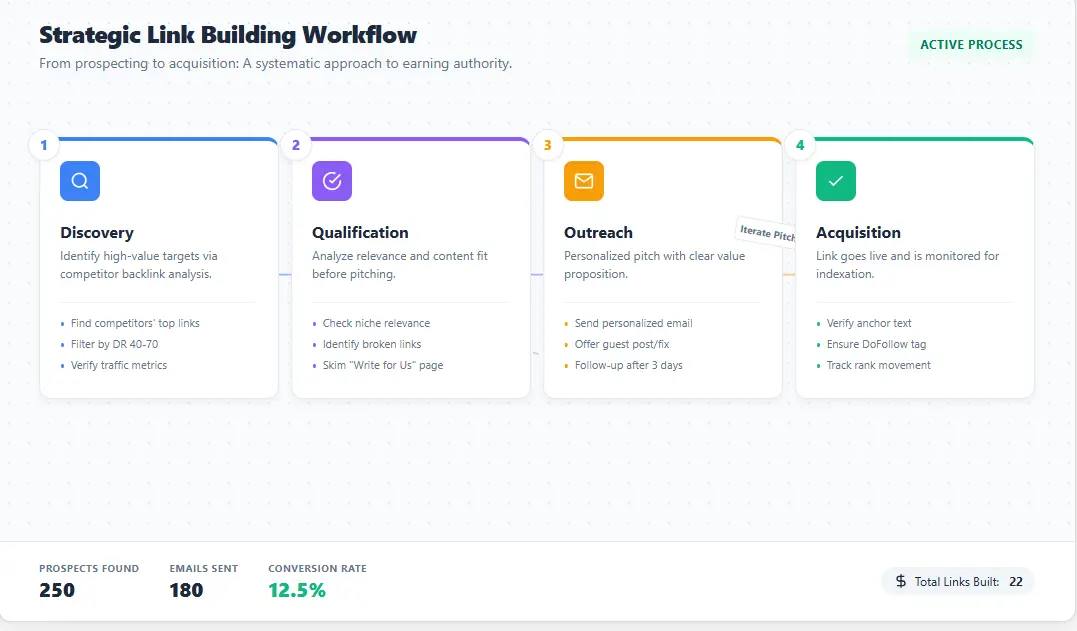
The Outreach Workflow
- Prospecting: Build a list of targets.
- Qualification: Remove sites with zero traffic or spammy metrics.
- Finding Emails: Use tools like Hunter.io or manually check “Contact” pages.
- Personalization: Read a piece of their content.
- Pitching: Send the email.
- Follow-up: The gold lies in the follow-up. You can streamline this process by checking our outreach email templates.
Personalization is King
Templates are good for speed, but personalization is good for conversion.
- Bad: “Hi, I wrote a great article. Please link to it.”
- Good: “Hi [Name], I loved your recent article on [Topic]. Your point about [Specific Detail] was brilliant. I actually wrote a guide that expands on that specific point, offering a [Case Study]. I think your readers would find it a helpful addition to your article.”
Follow-up Strategy
Most people give up after one email. Don’t be most people. This link building guide insists on the multi-touch approach.
- Email 1: The initial pitch.
- Email 2 (3 days later): “Hey [Name], just bumping this to the top of your inbox. Did you get a chance to read my guide?”
- Email 3 (7 days later): “I’ll assume you’re super busy, so I’ll cross this off my list. Hope to connect in the future!” (This is the “takeaway” email—psychologically, people hate losing an opportunity).
Outreach Mistakes
- Sending generic templates.
- Asking for a link immediately. Build rapport first.
- Targeting the wrong person. Don’t email the “info@” address. Find the editor or the content manager.
- Being long-winded. Editors are busy. Get to the point.
For help with the actual writing, check out our backlink outreach email templates.
8. Backlink Audits and Toxic Links
Not all guests are welcome at the party. Sometimes, bad sites link to you. This can hurt your site’s reputation. A robust link building guide always covers maintenance.
What is a Toxic Backlink?
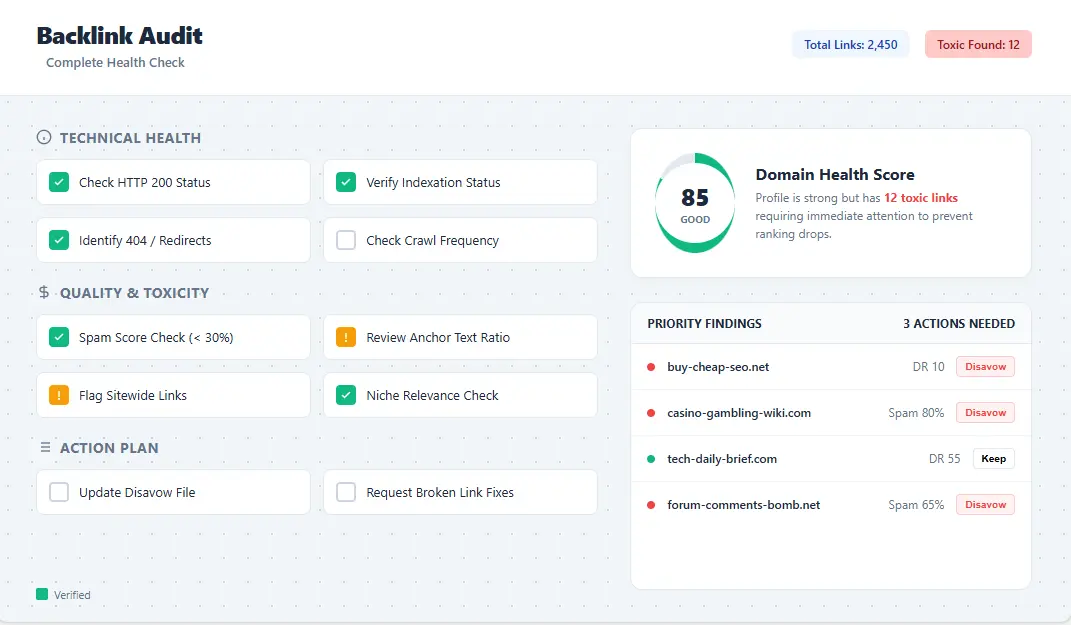
A toxic backlink is a link that:
- Comes from a site built solely for spam (PBN, link farm).
- Uses over-optimized anchor text (e.g., 100 links all saying “Buy Viagra”).
- Is situated in a bad neighborhood (gambling, porn, pharma sites) when your site is clean.
Backlink Audit Process
You need to perform a backlink audit at least once a year.
- Export Data: Use a tool like Ahrefs or Semrush to download a full list of your backlinks.
- Analyze Anchor Text: Look for unnatural spikes. If 50% of your anchors are “Money Keyword,” that’s bad.
- Check Domain Authority (DR): Filter out very low DR sites (0-10) unless they are legitimate niche sites.
- Review Content: Visit the linking pages. If the content is spun garbage or in a foreign language, flag it.
- Manual Review: This is the most important step. Tools can flag “spam,” but sometimes a tool flags a low-quality but legitimate forum. You need human eyes on it.
To Disavow or Not to Disavow?
The Disavow Tool tells Google to ignore specific links.
- The Myth: You need to disavow every nofollow or low-quality link.
- The Reality: Google is smart. It usually ignores low-quality links automatically. You only disavow if you have a manual penalty (you got a message in Google Search Console) or if you see a negative SEO attack (someone is blasting you with 50,000 spam links in 24 hours).
- Warning: Be careful. If you disavow good links, you can tank your own rankings.
Backlink Audit Checklist
- [ ] Check for unnatural spikes in referring domains.
- [ ] Analyze anchor text distribution (avoid 100% exact match).
- [ ] Identify links from penalized domains.
- [ ] Look for sitewide links (links appearing in the sidebar/footer of every page).
- [ ] Review our full backlink audit checklist for a deep dive.
9. Internal Linking vs External Backlinks
This is a debate that rages in SEO circles. Which is more important? A balanced link building guide will argue for both.
Internal Linking
Internal links connect your pages to other pages on your own domain.
- Pros: You control them 100%. You control the anchor text. You decide which page gets the authority.
- Cons: They don’t bring *new* authority into the site (unless the page is powerful enough to generate links itself).
- Best Practice: Use our internal linking template to ensure every new post links back to relevant older posts.
External Backlinks
External links are links from other domains pointing to yours.
- Pros: They bring fresh authority, trust, and traffic. They are the primary way Google votes for your site.
- Cons: Hard to get. You can’t control the anchor text or the placement perfectly.
Internal vs. External Comparison Table
| Feature | Internal Linking | External Backlinks |
|---|---|---|
| Control | High (100%) | Low (Depends on webmaster) |
| Authority Source | Redistributes existing | Brings *new* authority |
| Primary Goal | Site structure, indexing | Ranking power, trust, traffic |
| Risk | Low | High (if spammy) |
10. Local SEO Link Building
If you run a brick-and-mortar business, this is the section of the link building guide you need to read.
Local Citations
A citation is any mention of your business on the web. The most important citations are structured: your NAP (Name, Address, Phone) on a directory.
- The Top Tier: Google Business Profile, Yelp, Facebook, Bing Places.
- The Niche Tier: Healthgrades (for doctors), TripAdvisor (for hospitality), Avvo (for lawyers).
- Why: Consistency is key. If your address is “123 Main St” on Yelp but “123 Main Street” on Bing, Google gets confused.
GBP Links (Google Business Profile)
You can’t exactly “build” links *to* your GBP in the traditional sense, but you can embed your Google Maps map on your website. This creates a connection between your domain and your local entity.
Niche Directories
Avoid generic directories (like “listyourbusiness.com”). Focus on industry-specific ones.
- Strategy: Search for `[Industry] + directory`. If you are a plumber, look for “Plumbers Association of [City]”. These links carry massive local relevance.
Local Partnerships
- Strategy: Sponsor a local little league team, a 5K run, or a charity event.
- Result: They will link to your website from their sponsors page. It’s a relevant, local, and usually permanent link.
Chamber of Commerce Links
Join your local Chamber of Commerce. Almost every Chamber has a website with a directory of members. These are .org or .com extensions, are highly trusted locally, and are usually very cheap to join.
For a deeper dive into ranking locally, check out our local SEO guide.
11. Best Link Building Tools
You can’t do SEO with a notepad and a prayer. You need data. Here are the heavyweights. Every link building guide relies on these tools for execution. You can view our full SEO tools comparison to see how they stack up.
Ahrefs
The industry standard for backlink analysis. The Ahrefs Blog is also a fantastic resource for learning more about advanced techniques.
- Why we love it: Its database is massive. The “Site Explorer” feature shows you exactly who is linking to your competitors, making it easy to steal their strategies.
- Best Feature: “Link Intersect” (shows who links to multiple competitors but not you).
Semrush
An all-in-one powerhouse. Check out the Semrush Blog for weekly SEO insights.
- Why we love it: The “Backlink Audit” tool is incredibly user-friendly for finding toxic links. It categorizes toxicity score automatically.
- Best Feature: The “Link Building Tool,” which helps you find prospects and manage outreach within the dashboard.
SE Ranking
A budget-friendly alternative that punches above its weight.
- Why we love it: Great for smaller agencies or freelancers. The reporting is clean and the backlink checker is accurate enough for 90% of tasks.
- Best Feature: White-label reports.
BuzzStream
An outreach CRM.
- Why we love it: It automates the boring stuff. It scrapes websites, finds contact info, and organizes your email chains.
- Best Feature: Website discovery and CRM integration.
Pitchbox
The enterprise version of outreach tools.
- Why we love it: Highly automated follow-ups. It integrates with Gmail/Outlook and feels very professional.
- Best Feature: AI-assisted personalization.
Hunter.io
Email finding.
- Why we love it: It verifies emails. Sending emails to dead addresses hurts your deliverability.
- Best Feature: Bulk email finder.
Moz
The OG of SEO.
- Why we love it: Moz created Domain Authority (DA). While DA isn’t a Google metric, it’s the standard industry currency for link value. Their beginner’s guide is also a great resource.
- Best Feature: Link Explorer and Spam Score.
Majestic
The historic specialist.
- Why we love it: They focus heavily on the history of links. They have the deepest index of old, dead links which is great for broken link building.
- Best Feature: Trust Flow and Citation Flow metrics.
12. Common Link Building Mistakes
I’ve seen businesses tank their rankings overnight because of these mistakes. Don’t be them. This link building guide is designed to help you avoid these pitfalls.
1. Buying Spam Links
You get an email offering “10,000 backlinks for $5.” Run away. These are almost always bot farms. Google will devalue your entire site.
2. Irrelevant Backlinks
If you run a fitness blog, getting a link from a Russian gaming forum doesn’t help you. Google looks at the semantic neighborhood. Relevance beats raw authority.
3. Anchor Text Over-Optimization
If 100 people link to you with “best SEO tools,” Google knows you are gaming the system. Your anchor text profile should look natural: mostly your brand name (“Moz”), your URL (“moz.com”), and generic terms (“click here”), with a smattering of exact-match keywords.
4. Low-Quality Guest Posts
Writing 500 words of fluff just to put a link in the author bio is dead. Google has devalued author bio links. Put your links in the body text and ensure the content is actually helpful.
5. Link Exchanges (Reciprocal Linking)
“Link to me and I’ll link to you.” While natural exchanges happen, a massive web of sites linking to each other is a footprint PBNs use. Be careful with this.
6. Ignoring Topical Relevance
We touched on this, but it bears repeating. You cannot build a site about “Tech” and then get 1,000 links from “Art” blogs and expect to rank for Tech queries. You need to cluster your links.
7. Forgetting NoFollow Links
Don’t build a profile of 100% dofollow links. It looks artificial. A healthy profile has a mix of nofollow (social media, forums, organic mentions).
8. Ignoring Content SEO
Linking without content is like building a house with no doors. Ensure your content SEO guide is on point so that when people click your new links, they actually stay and convert.
13. Future of Link Building
What happens next? The landscape is shifting faster than ever. This final section of our link building guide looks into the crystal ball.
AI Overviews and Zero-Click SEO
With Google using AI to answer queries directly in the SERP, “Zero-Click” searches are rising. Users don’t always click the result.
- The Impact: This means link building might shift from “traffic driving” to “authority signaling.”
- The Strategy: You still need links to show AI that you are the trusted source for that information. If you are the source the AI cites in its overview, you win the authority game, even if click-through rates drop.
EEAT (Experience, Expertise, Authoritativeness, Trustworthiness)
Google’s rater guidelines heavily emphasize EEAT.
- The Shift: Links from high-authority institutions (universities, hospitals, government) will become more valuable than ever. A link from a personal finance expert with a verified bio is worth more than a link from a generic news site.
Brand Authority and Entity SEO
Google is moving away from “strings” to “things.”
- The Future: Your brand needs to be an entity. This means a strong Wikipedia page, a Crunchbase profile, and a consistent Knowledge Graph.
- Implication: “Brand mentions” (unlinked mentions) might carry more weight as an entity signal, even without the `href` tag.
Topical Authority as the New PageRank
PageRank isn’t going away, but Topical Authority is filtering it. You could have a site with a DR of 10, but if it has extreme topical depth in “Sustainable Coffee,” it can outrank a DR of 60 site that writes about everything. Your link building guide for 2026 must support this topical clustering.
Frequently Asked Questions
Is link building still effective in 2026?
Yes, absolutely. While the methods have changed (more focus on quality and relevance), backlinks remain one of Google’s top three ranking factors. They are the primary way Google determines authority and trust.
What is the difference between dofollow and nofollow links?
Dofollow links pass “link juice” or authority from the referring site to your site, helping you rank. Nofollow links contain a tag that tells search engines not to pass authority, though they are still valuable for traffic and a natural backlink profile.
How many backlinks do I need to rank?
There is no magic number. A new site might need 10-20 high-quality links to rank for low-competition terms, while competitive industries might require hundreds or thousands. Quality always trumps quantity.
How long does it take to see results from link building?
SEO is a marathon, not a sprint. Typically, it takes 3 to 6 months to see significant improvements in rankings after building quality links. New links need to be discovered, indexed, and processed by Google.
Can I do SEO without link building?
You can, but it is very difficult. In low-competition niches, you might rank with great on-page SEO and content. However, for any competitive keyword, competitors almost certainly have a backlink strategy, and you will be outranked without one.
What is anchor text and why does it matter?
Anchor text is the clickable text in a hyperlink. It gives context to search engines about the page you are linking to. Over-optimizing anchor text with exact-match keywords can look spammy and lead to a penalty.
What is the Skyscraper Technique?
The Skyscraper Technique involves finding content that is already performing well in search results, creating something significantly better (longer, more detailed, better designed), and then reaching out to the people who linked to the original content to link to yours instead.
Is guest posting safe?
Yes, guest posting is safe *if* done correctly. Writing high-quality, relevant articles for reputable sites is a white-hat strategy. It becomes unsafe if you post on spammy sites just to get a link or use spun content.
How do I find backlink opportunities?
You can find opportunities by analyzing your competitors’ backlinks (using tools like Ahrefs or Semrush), searching for resource pages, using Google search operators (`inurl:resources`), or using platforms like HARO to connect with journalists.
Should I disavow bad backlinks?
Not always. Google is generally good at ignoring spammy links. You should only use the disavow tool if you have a manual penalty or if you have a massive number of spammy links pointing at your site (negative SEO).
What is local SEO link building?
Local SEO link building focuses on acquiring backlinks from local sources like chambers of commerce, local newspapers, community blogs, and business directories. This helps businesses rank in the Local Pack and map results.
Why do links matter for AI?
Even as AI answers queries directly, AI models rely on the authority of sources to determine accuracy. High-authority backlinks help establish your brand as a trustworthy entity that AI models will cite in their answers.
Conclusion
We covered a lot of ground here. From the humble definition of a link to the advanced intricacies of entity SEO and topical authority. This link building guide was designed to be your roadmap for 2026.
The landscape of 2026 is not about “gaming” Google. It’s about becoming a brand that Google *cannot ignore*. It’s about creating assets that people genuinely want to reference. Link building is hard. It requires patience, thick skin (for the outreach emails), and a commitment to quality. But it is the single most powerful lever you can pull to improve your rankings.
By following the strategies in this link building guide, you are moving away from short-term hacks and toward long-term, sustainable authority.
Your Next Steps:
- Audit your current profile. Are there toxic links hurting you? Use our backlink audit checklist to find out.
- Create a plan. Don’t just wing it. Build a structured SEO link building plan.
- Start building. Write that guide. Pitch that journalist. Fix that internal link.
The digital roads to your website won’t build themselves. Start paving them today using this link building guide as your blueprint.
🚀 Supercharge Your SEO Strategy
Ready to take your backlinks to the next level? Download our free SEO Audit Checklist to see exactly where you stand.
Download Checklist