
Backlink Outreach Email Templates: 18 Examples for Effective Link Building
By Mousume Akter, Founder & Editor, SEORAF
Last updated: November 27, 2026
SEORAF is an independent SEO research and education resource, not an SEO agency. It does not sell rankings or guarantee SEO outcomes. You can read more in the SEORAF editorial policy.
These backlink outreach email templates help you ask for a link in a way that is relevant, honest and easy for the recipient to answer. Backlink outreach means contacting a site owner, editor or writer to give them a specific reason to link to a page of yours. A good email shows you have read their page, explains how the link would help their readers, and makes it easy to say no.
Generic outreach tends to fail for predictable reasons. In Hunter’s 2026 survey of decision makers, 65% identified overly sales-focused messages and 61% identified irrelevance as reasons cold emails fail. These are survey responses about cold email generally, not a measured backlink-outreach success rate. This guide covers the process (prospect research, personalization and follow-ups) and 18 original templates for guest posts, resource pages, broken links, link insertions, original research, unlinked mentions, link reclamation and follow-ups. Treat them as link building outreach templates you adapt, not scripts you copy. It also explains Google’s link spam rules and gives you a checklist to run before you send anything. If you already know what you need, jump to the template chooser.
Two notes before you start:
- I wrote these templates as original starting points. I am not presenting them as tested or proven, and no email can guarantee a reply, a link, a ranking or traffic.
- All names, sites and examples are fictional.
The guide labels its evidence so you can tell where each point comes from:
- Google-documented: stated in Google’s official documentation or blog.
- Regulatory guidance: stated by a regulator such as the FTC or the ICO.
- Published research: findings from a published study. These are usually vendor-run and correlational.
- Practitioner observation: advice from experienced link builders or tool makers.
- SEORAF recommendation: my own editorial suggestion, not a Google requirement.
- Not independently verified: reported by a third party, and I have not checked it against a primary source.
Backlink Outreach Email Templates: Which One Fits Your Situation?
| Your situation | Start with |
|---|---|
| You want to write for a site | Templates 1–2 |
| You can offer a quote or first-hand insight | Template 3 |
| Your page fills a gap in one of their articles | Template 4 |
| They run a resources or links page in your topic | Template 5 |
| One of their pages links to a dead URL | Template 6 |
| A specific paragraph would benefit from your page | Template 7 |
| Their article has outdated information you can correct accurately | Template 8 |
| Your resource is more complete or current than one they link to | Template 9 |
| You published original research | Template 10 |
| You have a sourced data point or chart | Template 11 |
| They mention your brand without linking | Template 12 |
| A link to you has disappeared | Template 13 |
| They link to an old URL of yours | Template 14 |
| No reply yet (including an optional final note) | Template 15 |
| They said yes or maybe | Template 16 |
| They ask for payment or a link swap | Template 17 |
| Your link went live | Template 18 |
Outreach scenarios and the template that fits each one.
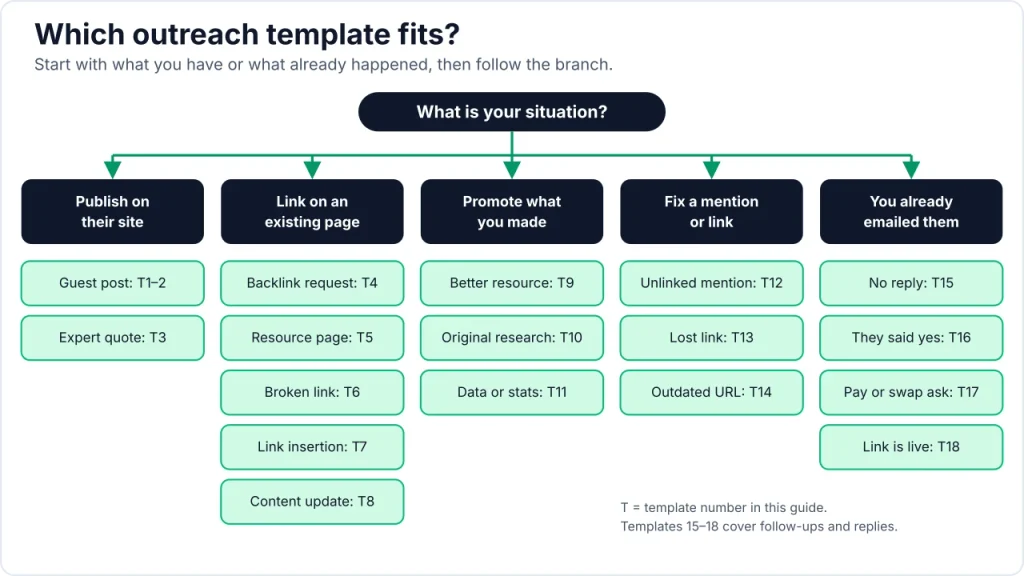
The table above maps common situations to templates. If you prefer a visual route, the decision tree below follows the same logic.
How the 18 Templates Compare
| Template | Main purpose | Typical ask | Biggest risk to avoid |
|---|---|---|---|
| 1. Guest Post Inquiry | Check whether a site takes contributors | A pointer to guidelines | Asking when guidelines already exist |
| 2. Guest Post Pitch | Propose specific article ideas | Consider a pitch | A link-driven pitch sent to many sites |
| 3. Expert Contribution | Offer a quote or insight | Use or edit a quote | Overstating expertise |
| 4. Backlink Request (General) | Fill a gap in an existing article | Consider a link | An irrelevant or promotional page |
| 5. Resource Page | Add to a curated list | Consider a listing | Pitching a product page |
| 6. Broken Link | Report a dead link and offer a replacement | Fix the link | An unverified or non-equivalent replacement |
| 7. Link Insertion | Add a link to one paragraph | Consider a sentence | Dictating anchor text or hiding payment |
| 8. Content Update | Correct outdated information | Update the article | Using a correction as a pretext |
| 9. Skyscraper | Offer a more current alternative | Add or replace a link | Disparaging the existing resource |
| 10. Original Research | Share new data | Cover or cite the study | Overstating findings |
| 11. Statistics and Data | Offer a sourced figure or chart | Reference the data | Unsourced or outdated data |
| 12. Unlinked Mention | Turn a mention into a link | Add a link | Pressing after a decline |
| 13. Link Reclamation | Check on a missing link | Consider restoring it | An entitled tone |
| 14. Link Update | Fix an outdated URL | Swap the link | Pointing to a different page |
| 15. Follow-Up (No Response) | Send one polite reminder | Reply or decline | Repeating the first email |
| 16. Follow-Up (Positive) | Deliver what was agreed | Confirm details | Adding new asks |
| 17. Payment or Swap Reply | Decline politely | None | Presenting paid placement as editorial |
| 18. Thank-You | Close the loop | None | Using it as a hidden new ask |
Comparison of the 18 outreach templates by purpose, ask and main risk.
What Backlink Outreach Is and When It Is Worth Doing
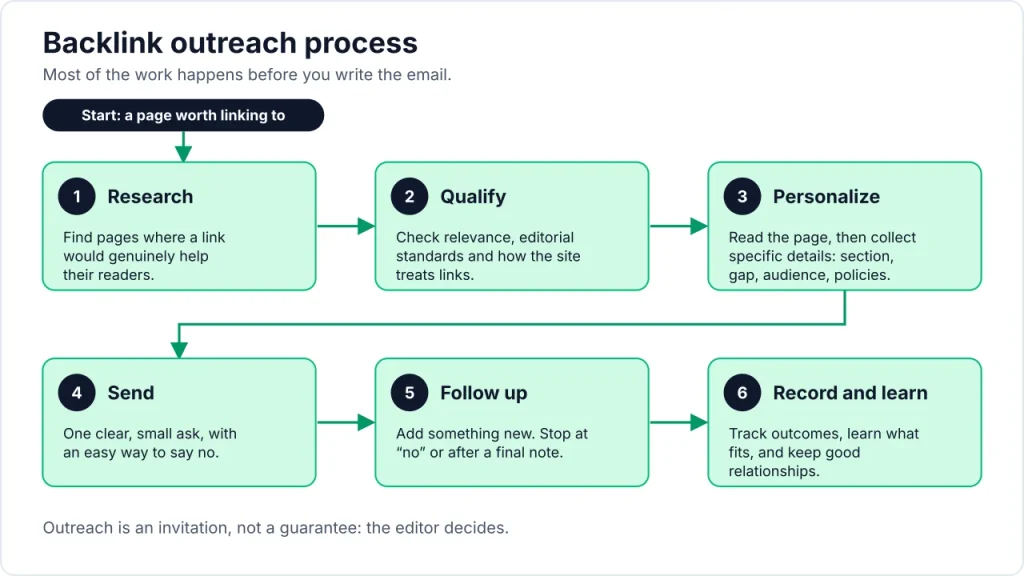
A backlink is a link from one website to another. For a broader overview of the topic, see a broader guide to link building. Ahrefs’ link outreach guide covers the same process this guide follows:
- Create or identify a page that is worth linking to.
- Find pages where a link would genuinely help readers.
- Qualify the sites.
- Research the person and the page.
- Write a short, personalized message.
- Follow up sparingly.
- Record the outcome and learn from it.
Most of the work happens before you write the email, which is why the research sections below matter.
When Outreach Makes Sense
- Your page adds something the recipient’s page lacks, such as data, a tool, a clearer explanation or a more current version.
- You can describe the benefit to their readers in one sentence.
- You would be comfortable if the recipient said no.
When It Doesn’t
- Your page is thin, outdated or mainly promotional. Improve it first. If you do not yet have anything worth linking to, build the asset before you build a prospect list.
- The only reason to contact a site is that it looks authoritative.
- You are planning to offer money, goods or a reciprocal link in exchange for a link without marking it appropriately. The ethics section below explains why.
- You are dealing with unwanted links pointing at your site rather than earning new ones. That is a different task, covered in a separate guide to evaluating unwanted or potentially harmful backlinks.
- You are pitching a journalist about a newsworthy story. That is closer to digital PR than to link outreach. Hunter’s 2026 report lists digital PR as its own category, so treat any figures for it as a different type of outreach.
How Much Do Links Matter?
Not independently verified (press reports of conference remarks): Search Engine Land reported that at Pubcon Pro in Austin in September 2023, Google’s Gary Illyes said people overestimate the importance of links and that they have not been a top-three ranking factor for some time. He did not say links are unimportant, and he disagrees that a fixed top three exists, because each site has different leading factors. In April 2024, Search Engine Roundtable reported that he said Google needs very few links to rank pages.
SEORAF recommendation: treat links as one signal among many, and aim for a small number of relevant, editorially given links rather than a large number of forced ones.
Before You Write: Prospect Research and Qualification
Start With the Asset, Not the List
Decide what you are offering before deciding whom to contact. The asset determines the tactic:
- A guide, tool or explainer fits resource pages, link insertions and gap-filling requests.
- Original research or data fits writers who cover your topic.
- Expertise fits contributor and expert-quote requests.
- An existing brand mention fits unlinked-mention and link-reclamation requests.
If you can’t name an asset, there is nothing to pitch yet.
Qualify the Site
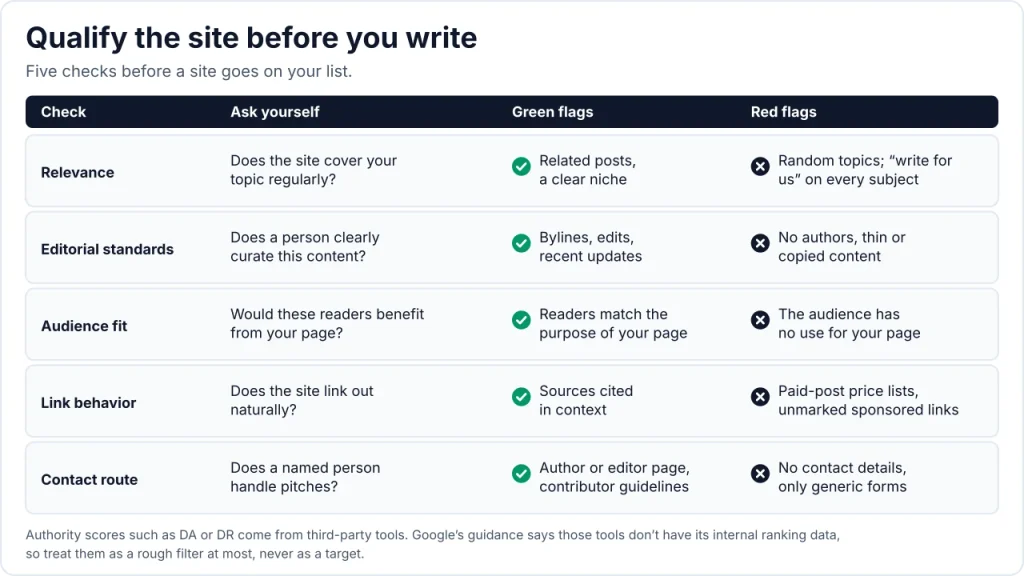
Use a short checklist before adding a site to your list:
| Check | Question to ask | Green flags and red flags |
|---|---|---|
| Relevance | Does the site cover your topic regularly? | Green: related posts, a clear niche. Red: random topics, “write for us” on every subject. |
| Editorial standards | Does a person clearly curate this content? | Green: bylines, edited pages, recent updates. Red: no authors, thin or copied content. |
| Audience fit | Would these readers benefit from your page? | Green: readers match your page’s purpose. Red: the audience has no use for it. |
| Link behavior | Does the site link out naturally? | Green: sources cited in context. Red: paid-post price lists, unmarked sponsored links. |
| Contact route | Does a named person handle pitches? | Green: author or editor page, contributor guidelines. Red: no contact information, only generic forms. |
A short checklist for qualifying outreach prospects.
Google-documented: Google’s guidance on third-party SEO tools and advice says third-party tools do not have access to Google’s internal ranking data. Authority scores such as DA or DR come from those tools, so treat them as a rough filter at most, never as a target. To check a site’s backlink profile, see a dedicated backlink analysis guide, or browse SEORAF’s SEO tools pages.
Research the Recipient’s Website and Content
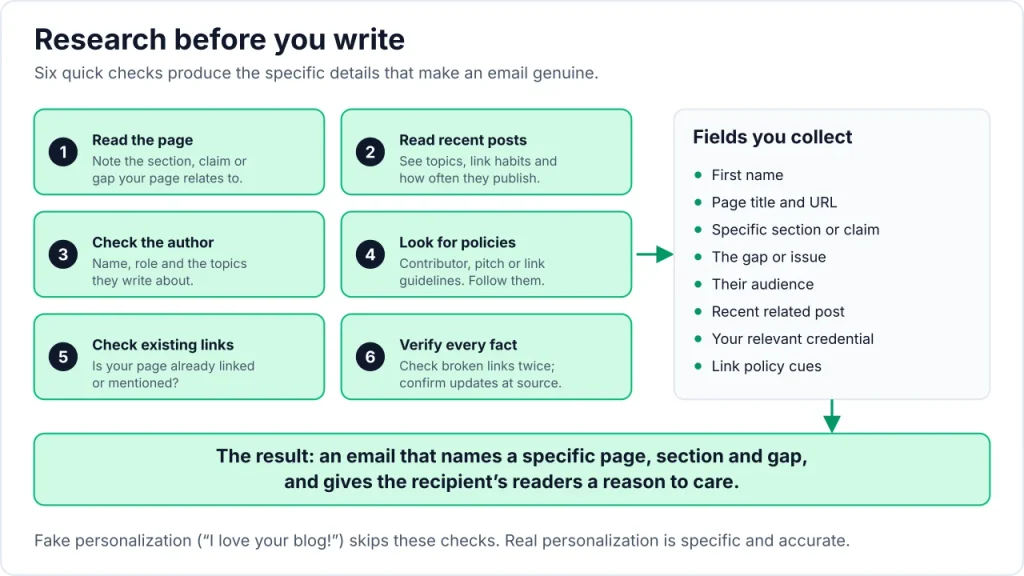
Spend a few minutes on each prospect you intend to contact. It is better to contact fewer sites well than many sites badly.
- Read the page you want a link on. Note the section, claim or gap your page relates to.
- Read five to ten recent posts. Check what the site covers, how it links out and how often it publishes.
- Check the author or editor. Note the name, role and topics they write about repeatedly.
- Look for contributor, pitch or link policies. If guidelines exist, follow them instead of improvising.
- Check whether your page is already linked or mentioned. Don’t ask for a link that already exists.
- Verify anything you plan to mention. For broken links, check on more than one day. For outdated information, confirm the current figure from a primary source.
Find the Right Person
Look for the author of the page, then the editor, then the site owner. Author pages, About pages and contact pages are the usual places to look. A few cautions:
- Regulatory guidance: don’t guess email addresses or harvest them in bulk. The FTC’s CAN-SPAM guide lists harvesting addresses and dictionary attacks among aggravated violations.
- Published research (mixed results): Hunter’s 2026 report found that contacting one or two people per company replied at 5.1%, versus 3.5% for three or more, and advises moving to alternate contacts only if your main contact ignores you. Backlinko’s 2019 study found the opposite pattern: messages to several contacts had a 93% higher response rate, with diminishing returns at five or more. Backlinko also said that, for large sites, it usually makes sense to contact one person first and try another if you hear nothing.
- SEORAF recommendation: start with one well-matched contact, and consider a second only after a reasonable wait.
- If you can’t find an email address, a contact form or a professional profile may work. In Hunter’s survey, 50.5% of decision makers preferred LinkedIn for outreach, versus 25% for email. That survey is about decision makers in a sales context, not site editors, so treat it as a hint rather than a rule.
Define One Clear Ask and a Real Benefit
Decide what exactly you want: a link in a specific place, a guest article, a quote placement or a correction. Then decide what the reader gets.
| Weak benefit | Stronger benefit |
|---|---|
| “It will help your SEO.” | “It adds a worked example your section doesn’t have.” |
| “It’s a great resource.” | “It covers [topic] for beginners, which your article assumes.” |
| “It would benefit both of us.” | “Your link to [old source] is dead; this page covers the same ground.” |
Weak and stronger ways to state the benefit to the recipient.
Personalization Checklist
Fill in a short worksheet for each prospect before you write:
| Field to collect | Where to find it | Fictional example |
|---|---|---|
| First name | Author or About page | Maya |
| Page title and URL | The page itself | “Raised Bed Basics” |
| Specific section or claim | Your reading notes | The “Preparing the soil” section |
| Gap or issue | Compare their page to yours | Doesn’t mention soil pH |
| Their audience | About page, comments | Beginner vegetable gardeners |
| Recent related post | Blog archive | “Seed Starting Calendar” |
| Your relevant credential | Your own About page | Maintains a gardening site |
| Link policy cues | Guidelines, disclosure pages | Contributor guidelines |
Personalization checklist: fields to collect before writing each email.
How to Write a Backlink Request Email: Five Building Blocks
How to Read the Statistics in This Guide
Figures in this guide are published research, not Google documentation:
- Backlinko and Pitchbox’s 2019 analysis of 12 million outreach emails. Pitchbox supplied the data, and Backlinko is owned by Semrush.
- Hunter’s 2026 report on 31 million emails sent by Hunter users in 2025 across all kinds of cold email. Hunter sells outreach software.
Both report correlations, not proven causes. They differ in year, sample and method, so their numbers are not directly comparable and sometimes disagree. Use them as context, not as targets.
Subject Lines
A subject line should accurately describe the email and give the recipient a reason to open it.
Published research: Backlinko found subject lines of 36–50 characters had the best response rate. Hunter found five to six words was a sweet spot, and that “Quick question” style subject lines replied at 2.5% versus 2.9% for other subject lines. Both suggest very short, generic subject lines are weaker than specific ones.
Regulatory guidance: the FTC’s CAN-SPAM guide says deceptive subject lines are prohibited for commercial email. Whether or not that applies to your message, an honest subject line is better practice.
| Weak subject line | Better subject line |
|---|---|
| Link request | Broken link on “Seed Starting Calendar” |
| Partnership opportunity | Soil pH chart for your “Raised Bed Basics” guide |
| Quick question | Do you accept contributed articles on gardening? |
| Re: our conversation (when there wasn’t one) | Updated frost date data for your calendar |
Weak subject lines and more specific alternatives.
Five adaptable patterns:
| Pattern | Best for | Watch out for |
|---|---|---|
| Broken link on “[Page title]” | Broken link building | Verify the link is broken first |
| Suggestion for the [section] section of “[Page title]” | Link insertion, content updates | Don’t pick a section you haven’t read |
| [Topic] figures for your article on [subtopic] | Statistics and data outreach | Make sure the figures are sourced |
| Thank you for mentioning [Brand] in “[Page title]” | Unlinked mentions | Check that the mention is real |
| Do you accept contributed articles on [topic]? | Guest post introductions | Check for existing guidelines first |
Adaptable subject-line patterns by outreach type.
Avoid fake “Re:” prefixes on first emails, misleading urgency and vague lines when your email is about a link.
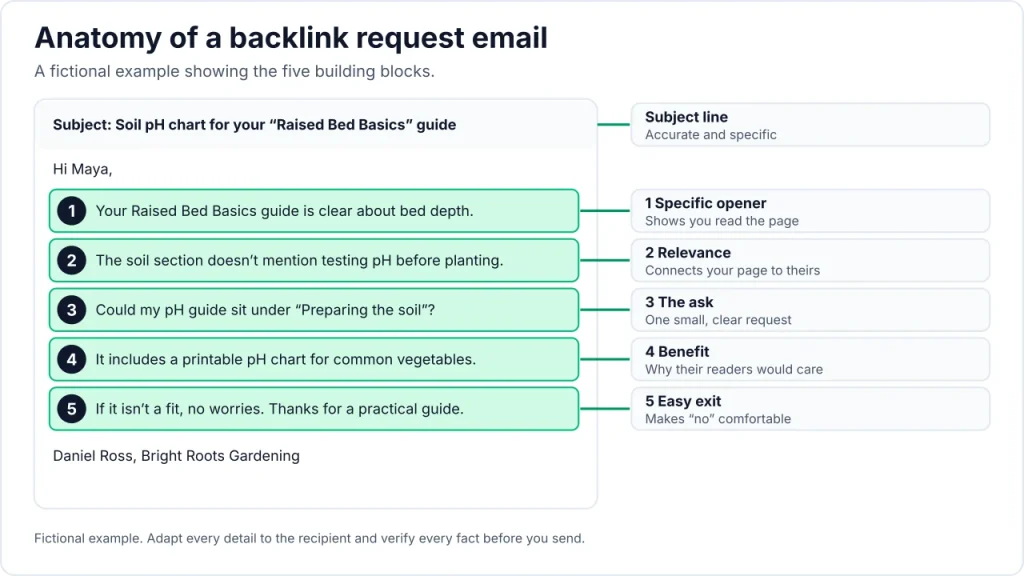
The Five Building Blocks
Most good outreach emails follow the same simple structure.
| Block | Its job | Example |
|---|---|---|
| Specific opener | Shows you read the page | “Your section on frost dates is clear about timing.” |
| Relevance | Connects your page to theirs | “It doesn’t cover container gardens.” |
| The ask | One small, clear request | “It could fit under ‘Preparing the soil.’” |
| Benefit | Why readers would care | “It includes a printable chart.” |
| Easy exit | Makes “no” comfortable | “If it isn’t a fit, no worries.” |
The five building blocks of an outreach email.
Read the blocks as a sequence: the opener proves you read the page, the relevance and the ask explain why you are writing, the benefit shows why the recipient might care, and the easy exit keeps the decision with them.
Length, Tone and Sender Transparency
Published research: the evidence on length is mixed. Hunter found relatively high reply rates at both 61–80 and 181–200 words. SEORAF recommendation: write only as much as you need to be specific, and use short paragraphs. I prefer short emails, but the data does not show a single winning length.
Be clear about who you are:
- Use your real name and role.
- Link to your site so the recipient can check you.
- Send from an address that matches who you are.
- If you are writing for a client or employer, say so.
- For first-contact emails, consider an optional footer such as: “If you’d rather not hear from me, just reply and I won’t email again.” It is courteous, and it supports any legal opt-out requirements that may apply (see the email law section below).
Real Personalization vs. Fake Personalization
Published research: personalization helps when it shows real understanding. In Hunter’s data, emails with two custom attributes in the body replied at 5.6%, versus 3.6% with none, and manually edited emails replied at 5.2% versus 4.4% for fully automated ones. In the same survey, 67% of decision makers said personalization using public information makes them more likely to reply, and 48% called out generic, impersonal messaging as a problem.
- Fake: “I love your blog! Your content is amazing.”
- Real: “Your container gardening post focuses on pots over 16 inches, and I noticed it doesn’t cover smaller balcony planters.”
Deliverability Basics
Published research (Hunter, all cold email rather than link building only): custom-domain senders replied at 5.2% versus 2.5% for freemail senders. Campaigns without open tracking replied at 7.4% versus 4.4% with it. Sending 20–49 emails per day per account replied at 5.7% versus the 4.5% overall average, and the average bounce rate was 3.6%.
SEORAF recommendation:
- Send small, targeted batches.
- Verify addresses before sending.
- Avoid tracking pixels unless you need them.
- Use an address tied to your site where you can.
- If you use a mail-merge or outreach tool, check your email provider’s sending rules.
Regulatory guidance: in the UK, the ICO notes that PECR’s cookie rules can apply to tracking pixels in marketing emails.
Backlink Outreach Email Examples: 4 Weak vs. Improved Rewrites
All examples are fictional. The sender is Daniel Ross of Bright Roots Gardening, writing to Maya Collins, who edits the blog Backyard Basics.
Rewrite 1: The Generic Link Request
Weak
Subject: Link request
Hi,
I came across your website and think it’s great. We have a gardening site and want to exchange links with you. It will help both of our SEO. Let me know.
Thanks
What’s wrong: no name, no page, no reason, a link swap, and a benefit that only concerns the sender.
Improved
Subject: Soil pH chart for your “Raised Bed Basics” guide
Hi Maya,
Your Raised Bed Basics guide is clear about bed depth, but the soil section doesn’t mention testing pH before planting. I recently published a short guide with a printable pH chart for common vegetables: [URL].
If you think it would help your readers, it could fit under “Preparing the soil.” Either way, thanks for a very practical guide.
Daniel Ross, Bright Roots Gardening
Rewrite 2: The Entitled Link Reclamation Request
Weak
Subject: You removed our link
Hi,
We noticed you removed the link to our site from your article. This hurts our rankings. Please restore it immediately. Our content is better than the other sites you link to.
What’s wrong: it is accusatory, implies the link is owed, adds urgency and disparages other sites.
Improved
Subject: Checking a link to our soil test guide in “Raised Bed Basics”
Hi Maya,
“Raised Bed Basics” used to link to our soil test guide, and I can’t find the link now. I’m not sure whether it was removed or broke when we changed our URL.
If it was removed because the guide was out of date, I’ve since updated it with [what changed]: [URL]. If you’ve decided not to link to it, that’s completely fine. I just wanted to check.
Daniel Ross, Bright Roots Gardening
Rewrite 3: The Pushy Guest Post Pitch
Weak
Subject: GUEST POST!!!
Hello Sir/Madam,
We are a leading gardening company offering high-quality SEO articles. We will write free content for your blog. We only need two dofollow links with anchor text “best garden tools.” Reply today because this offer expires.
Regards
What’s wrong: mass-email tone, no topic, keyword-heavy anchor text, a demand about link attributes and artificial urgency.
Google-documented: Google’s 2017 guidance on article campaigns warns about keyword-rich links in large-scale guest articles and notes that site owners dislike aggressive, repeated “post my article” requests.
Improved
Subject: Guest post idea: watering raised beds in hot weather
Hi Maya,
Your readers have good coverage of bed construction, but I couldn’t find a piece on adjusting watering during heat waves. I’d like to propose “How to Water Raised Beds Without Wasting Water.”
I maintain Bright Roots Gardening and have written about irrigation for beginners. Two samples: [link], [link].
I’ll follow your guidelines, including any link rules you have. If the idea isn’t right, I’m happy to adapt it.
Daniel Ross
Rewrite 4: The Vague Broken-Link Report
Weak
Subject: Broken links on your site
Hi, I found broken links on your website. Please fix. You can link to my site instead.
What’s wrong: it doesn’t say which page or link, sounds like a demand, and the replacement is not shown to be relevant.
Improved
Subject: Broken link on “Seed Starting Calendar”
Hi Maya,
While reading your Seed Starting Calendar, I found that the link in the “Frost dates” section ([broken URL]) returns a “not found” error. I checked it on two different days.
In case it helps, my guide to frost dates by region covers similar ground and is current: [URL]. You may prefer another source. I just wanted to flag the broken link.
Daniel Ross, Bright Roots Gardening
From Template to Finished Email: A Worked Example
Here is how the fields in a template become a finished email. Everything is fictional.
Research notes for one prospect
- Page: “Getting Started With Raised Beds” on Backyard Basics, with a “Resources” section at the end.
- Contact: Maya Collins, listed as editor on the About page.
- Gap: the resource list covers bed building and soil, but nothing on watering.
- My page: “How to Water Raised Beds Without Wasting Water”, updated this year, written for beginners.
- Fit: it belongs under the “Practical guides” heading.
Template 5 (Resource Page Outreach), filled in
Subject: Suggestion for your raised bed resources page
Hi Maya,
Your raised bed resources page lists building guides and soil tools for new gardeners. I didn’t see anything on watering, so I’d like to suggest “How to Water Raised Beds Without Wasting Water” ([URL]).
It’s free, was updated this year and is written for beginners, covering how often to water and how to spot overwatering. It might fit under “Practical guides.” If it is not a fit for the list, please feel free to leave it out.
Daniel Ross, Bright Roots Gardening
Every field came from the notes, and nothing in the email is a guess.
Guest Post Outreach Email Templates and Expert Contributions
Guest articles and expert quotes work when you give the site something its readers would value. If a site publishes contributor guidelines, follow them instead of these templates. For background on the tactic itself, see a separate guide to guest posting. Avoid writing a series of articles whose main purpose is to place links, because Google’s guidance on link schemes targets that pattern.
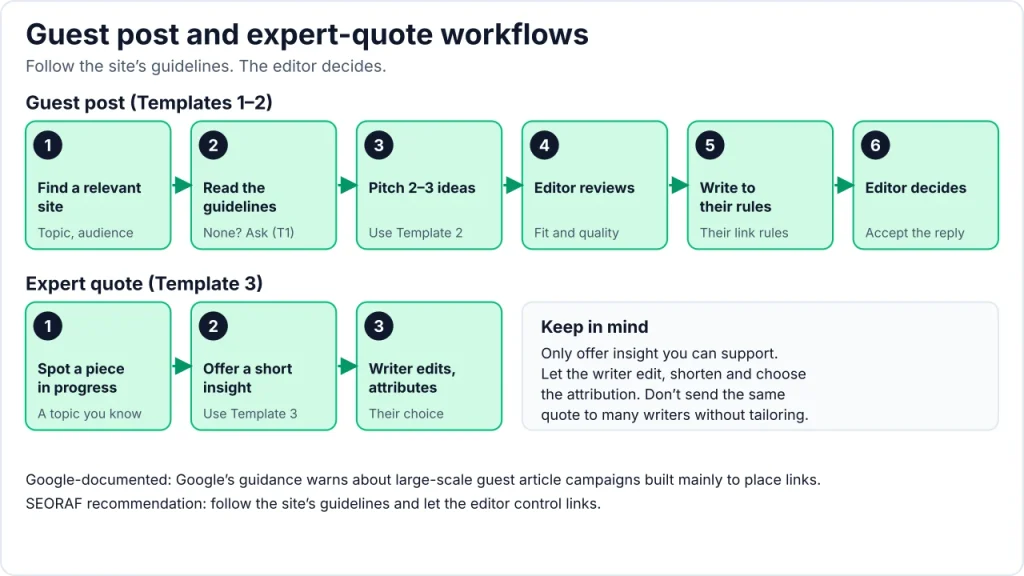
All first-contact templates below can take the optional footer from the building-blocks section: “If you’d rather not hear from me, just reply and I won’t email again.”
Template 1: Guest Post Inquiry
Use when: you have read the site and want to know whether it accepts contributors before pitching.
Subject line: Do you accept contributed articles on [topic]?
Customization fields: [First name], [site name], [recent article title], [specific detail you found useful], [your topic area], [your site]
Hi [First name],
I read “[recent article title]” and found the point about [specific detail] useful. I write about [your topic area] at [your site].
I couldn’t find contributor guidelines on [site name]. Do you accept guest articles? If so, could you point me to your requirements or tell me which topics your readers would most like covered?
If outside contributions are not part of your editorial process, I understand. Thank you for considering it.
[Your name], [role and site]
Why it may be relevant to the recipient: it asks before assuming, shows genuine reading and makes a small request.
Don’t use when: guidelines already exist (follow them), the site states it doesn’t take contributions, the only goal is to place a link, or you are sending the same text to many sites.
Template 2: Guest Post Pitch
Use when: guidelines exist or you have been invited, and you have two or three ideas that fit the audience.
Subject line: Guest article idea for [site name]: [working title]
Alternative: A piece on [audience gap] for your readers
Customization fields: [First name], [site name], [related topic], [audience gap], [two or three working titles], [your credentials], [two writing samples]
Hi [First name],
Your readers have good coverage of [related topic], but I couldn’t find a piece on [audience gap]. I’d like to propose one of these:
- [Working title 1]
- [Working title 2]
- [Working title 3]
I [credential or relevant experience]. Two examples of my writing: [link], [link].
I’ll follow your style and linking guidelines, including any rules you have on how links are marked or worded. If none of these ideas fit, I’m happy to adapt.
Thanks for considering it,
[Your name]
Why it may be relevant to the recipient: it shows a real content gap and puts the editor in control of links. Only promise exclusivity if it is true.
Don’t use when: the same pitch is going to many sites, the link is your main goal, or you cannot commit to the expertise the topic needs. If a site charges for posts, treat that as advertising: disclose it and make sure links are marked appropriately.
Template 3: Expert Contribution Outreach
Use when: a writer is covering a topic where your first-hand experience adds something, and you can give a concise original insight.
Subject line: Expert input for your piece on [topic]
Customization fields: [First name], [article or series], [your role and relevant experience], [your insight in two or three sentences], [bio link]
Hi [First name],
I saw that you’re covering [topic] in [article or series]. I’m [role and relevant experience], and one point that may be useful for readers is this: [your insight in two or three sentences].
Please feel free to edit or shorten it. I’m happy to answer follow-up questions or provide examples. Attribution is up to you; my bio is at [link].
Thank you for your time,
[Your name]
Why it may be relevant to the recipient: it offers usable material for work in progress and leaves attribution to the writer.
Don’t use when: you lack real expertise on the topic, you cannot support your claims, or you would send the same quote to many writers without tailoring it.
Templates for Getting Links on Existing Pages
Existing pages already serve readers, so your request should be small, specific and clearly beneficial. Name the section, name the gap and make it easy for the editor to decide. For a deeper look at one of these tactics, see a dedicated guide to broken link building.
Template 4: Backlink Request Email (General, Value-First)
Use when: their page is on your topic and your page fills a specific gap in it.
Subject line: A resource that may help readers of “[article title]”
Alternative: Resource on [topic] for “[article title]”
Customization fields: [First name], [article title], [section], [what the section covers], [the gap], [your page title and URL], [what it adds]
Hi [First name],
In “[article title]”, the [section] section covers [what the section covers]. One thing readers may still need is [the gap].
I wrote [your page title] ([URL]), which covers [what it adds]. If you think it would help your readers, it could sit alongside that section. If it doesn’t fit, I understand.
Thanks,
[Your name], [role and site]
Why it may be relevant to the recipient: it names a real gap and puts the benefit with the reader.
Don’t use when: your page isn’t clearly relevant, it is thin or mostly promotional, or their article already covers the gap well.
Template 5: Resource Page Outreach Email
Use when: a curated resources page lists tools or articles on a topic that your page genuinely belongs in.
Subject line: Suggestion for your [topic] resources page
Alternative: A [subtopic] resource for your [topic] list
Customization fields: [First name], [resource page title and URL], [what the page lists], [audience], [subtopic], [your resource and URL], [how it differs], [specific content], [category on the page]
Hi [First name],
Your [topic] resources page lists [what it lists, for example guides and tools] for [audience]. I didn’t see anything on [subtopic], so I’d like to suggest [resource title] ([URL]).
It’s [how it differs, for example free, updated in month and year, or written for beginners] and covers [specific content]. It might fit under [category]. If it is not a fit for the list, please feel free to leave it out.
Thank you,
[Your name], [your site]
Why it may be relevant to the recipient: it respects the curator’s judgment and makes the fit easy to evaluate.
Don’t use when: the page looks abandoned or like a link farm, it lists only paid placements, or your resource is mainly a product page.
Template 6: Broken Link Building Email
Use when: you have confirmed that a link on their page is dead and you have a genuinely relevant replacement.
Subject line: Broken link on “[page title]”
Alternative: Dead link in the [section] section of “[page title]”
Customization fields: [First name], [page title and URL], [section], [broken URL], [what you saw, such as a 404 error], [dates checked], [replacement URL], [what the replacement covers]
Hi [First name],
While reading “[page title]”, I found that the link in the [section] section ([broken URL]) now returns [error]. I checked on [date] and again on [later date].
In case it helps, [replacement URL] covers [what the original covered] and is current as of [date]. You may well prefer another source. I just wanted to flag the broken link.
Thanks,
[Your name]
Why it may be relevant to the recipient: it leads with useful information, and the replacement is a secondary offer. Practitioner observation: BuzzStream notes that broken link building is technically a type of link insertion that starts from a verifiable problem on the page.
Don’t use when: the replacement isn’t a true equivalent, you haven’t verified the link is dead (it could be a temporary outage or a redirect), or you are sending the message in bulk without checking each page.
Template 7: Link Insertion Outreach Email
Use when: a specific paragraph would benefit from information your page provides, such as an example, a tool or a data point.
Subject line: Suggestion for the [section] section of “[page title]”
Alternative: Something your [subtopic] paragraph doesn’t cover
Customization fields: [First name], [page title], [subtopic], [what it covers], [what is missing], [your page title and URL], [what it adds], [proposed sentence]
Hi [First name],
In “[page title]”, the paragraph on [subtopic] explains [what it covers] well, but doesn’t include [what is missing]. My article [title] ([URL]) walks through [what it adds].
If you’d like, a short sentence such as “[proposed sentence]” could point readers to it. I’m happy for you to word it however suits the piece.
I’m the author of that page, so please weigh the suggestion with that in mind.
Thanks,
[Your name]
Why it may be relevant to the recipient: it points to an exact location and is open about the sender’s interest. Practitioner observation: BuzzStream describes link insertion as weaving a link into an existing article, unlike guest posting, where you write the whole article. It also says the tactic often fails because of lazy outreach emails, shady paid insertions and mismatched content.
Don’t use when: you want specific keyword-rich anchor text (let the editor choose the wording), your page isn’t clearly relevant to the paragraph, or money or goods are involved. Paid placements need to be qualified (see the ethics section).
Template 8: Content Update Outreach
Use when: an article contains outdated or incorrect information that you can correct with a reliable source.
Subject line: Updated [data point] for “[page title]”
Customization fields: [First name], [page title], [section], [outdated statement], [source], [current information], [source link and date], [optional: your related page]
Hi [First name],
In “[page title]”, the [section] section says [outdated statement]. [Source] now reports [current information] ([source link], [date]).
I thought you might want to update it. If a longer explanation would help, I wrote one at [URL], but the source above is the key point.
Thanks,
[Your name]
Why it may be relevant to the recipient: the correction comes first, with a primary source, and your own page is optional.
Don’t use when: you can’t verify the new figure, the point is a matter of opinion, or the “correction” is a pretext for a link.
Skyscraper, Research and Data Outreach Templates
When you have published something worth citing, such as a guide, a dataset or an improved resource, outreach is about telling the right people it exists. “Right” means people whose existing coverage it would improve, not everyone in your industry.
Template 9: Skyscraper Outreach Email
Use when: you have published a more complete or more current alternative to a resource they link, and you can name concrete differences.
Subject line: Updated alternative to [resource] in “[page title]”
Customization fields: [First name], [page title], [resource they link], [topic], [year], [specific gap], [your title and URL], [three concrete improvements]
Hi [First name],
“[page title]” links to [resource] for [topic]. It’s a helpful resource, though it was published in [year] and doesn’t cover [specific gap].
I recently published [your title] ([URL]). It adds [improvement 1], [improvement 2] and [improvement 3]. If you think it would serve your readers better, you could consider it as an addition or replacement. If it does not add enough for your readers, there is no need to include it.
Thanks,
[Your name]
Why it may be relevant to the recipient: it compares respectfully and gives specific, checkable reasons.
Don’t use when: the improvements are marginal, you’d have to criticize the existing resource, or the linked resource is the recipient’s own product or content.
Template 10: Original Research Outreach
Use when: you have original data with a documented method that is relevant to the recipient’s coverage.
Subject line: New data on [topic]: [headline finding]
Customization fields: [First name], [their related coverage], [headline finding], [method, sample size and dates], [study URL], [charts or data], [limitations]
Hi [First name],
You’ve written about [their related coverage], so I wanted to share new data that may be relevant. I found that [headline finding].
The study [method in one sentence, including sample size and dates]. The full methodology, limitations and charts are here: [URL]. I can share the underlying data or answer questions if useful.
If it fits a future piece, you’re welcome to use the charts with credit. Usage terms are on the page.
Thanks,
[Your name]
Use “we” instead of “I” if a team did the work.
Why it may be relevant to the recipient: it leads with the finding and the method, and it is open about limitations.
Don’t use when: the research isn’t real, the sample or method can’t support the headline, you can’t explain how it was done, or the topic is outside their coverage.
Template 11: Statistics and Data Outreach
Use when: a writer covers a topic and you can supply a specific, sourced data point or chart.
Subject line: [Topic] data point for your [article or series]
Customization fields: [First name], [article title], [topic], [data point], [source and date], [source link], [chart or dataset description and URL], [reuse terms]
Hi [First name],
I noticed “[article title]” discusses [topic]. A data point that may be useful: [data point], according to [source], [date] ([link]).
I compiled [chart or dataset description] here: [URL]. You’re welcome to reference it. The underlying sources are listed at the bottom of the page.
If you need the figures in another format, I can send them.
Thanks,
[Your name]
Why it may be relevant to the recipient: it offers a sourced figure rather than an unsupported claim. The difference from Template 8 is the trigger: Template 8 corrects an error, while this one offers something extra.
Don’t use when: you can’t point to a primary source, the data is outdated, or the article is actually wrong (use Template 8 instead).
Link Reclamation and Unlinked Mention Email Templates
Three situations are easy to confuse:
- Unlinked mention: a page names your brand or work but doesn’t link to it.
- Lost link: a page used to link to you, and the link is gone.
- Outdated link: a page links to an old or moved URL of yours.
Practitioner observation: sources define these differently. BuzzStream, for example, separates reclaiming previously linked mentions from claiming mentions that never linked. Whatever you call them, verify the situation before you write. If you changed or redirected URLs recently, review your redirects and broken links first. Google Search Console can also help you inspect the links Google has discovered for your site.
Template 12: Unlinked Brand Mention Email
Use when: a page mentions your brand, product or report by name, positively or neutrally, without linking to it.
Subject line: Thanks for mentioning [brand] in “[page title]”
Customization fields: [First name], [brand], [page title], [what readers would look for], [URL to link]
Hi [First name],
Thank you for mentioning [brand] in “[page title]”. I appreciate it.
I’m writing because the mention doesn’t link anywhere, and readers may want to find [what readers would look for, for example the full report]. If you’re happy to link to [URL], it would make that easier. There’s no obligation, and thanks again for including us.
[Your name]
Why it may be relevant to the recipient: it starts with gratitude and frames the link as a convenience for readers.
Don’t use when: the mention is negative or inaccurate, it appears in sponsored content, the recipient has already declined, or you can’t identify the mention precisely.
Template 13: Link Reclamation Email
Use when: you know a page used to link to you and the link is now gone.
Subject line: Checking a link to [resource] in “[page title]”
Customization fields: [First name], [page title], [resource title], [possible reason], [current URL], [what changed on your page]
Hi [First name],
I noticed that “[page title]” used to link to [resource title], and I can’t find that link now. It may have been removed during an update, or it may have broken if our URL changed.
The page is currently at [URL] and now covers [what changed]. If the link was removed because the old page was outdated, I hope the updated version is more useful. If you’ve decided not to link, that’s completely fine.
Thanks for your time,
[Your name]
Why it may be relevant to the recipient: it is transparent about what may have happened and accepts the editor’s decision.
Don’t use when: you don’t know why the link disappeared and could fix an issue on your own page first, the removal followed a complaint or dispute, or your page has changed in a way that makes it less relevant.
Template 14: Link Update Request
Use when: a page still links to an old or redirected URL of yours.
Subject line: Updated URL for [resource] in “[page title]”
Customization fields: [First name], [page title], [section], [old URL], [new URL]
Hi [First name],
“[page title]” links to [old URL] in the [section] section. That page has moved and now lives at [new URL].
When you next update the article, you could swap the link so readers go straight to the current page. Thanks for linking to it in the first place.
[Your name]
Why it may be relevant to the recipient: it is a simple correction that helps readers.
Don’t use when: the old URL still works well for readers (the request is then optional), or you want to point the link to a different page than the original.
Backlink Follow-Up Email: Etiquette, Timing and Templates
Follow-Up Etiquette
Follow-ups are polite when they add something and respect a lack of reply. The evidence on how many to send is mixed, so treat any figure as a starting point.
Practitioner observation: Ahrefs’ outreach guide recommends following up once.
Published research:
- Hunter found sequences of three messages replied at 6.8%, versus 3.3% for a single message, and that sequences with more than three follow-ups had a lower average reply rate.
- Backlinko found a single follow-up was associated with 65.8% more replies, and that three or more messages gave the best overall response rate. Its summary and body describe the follow-up lift differently, so cite it carefully.
None of this guarantees a response. A recipient may be busy, away or simply not interested.
Sending day: Backlinko found a small Wednesday edge and better results on weekdays than weekends. Hunter found day of week did not meaningfully affect reply rates. I would not build a schedule around either.
Basic rules:
- Never send a rapid series of follow-ups.
- Stop at “no.”
- Don’t re-add someone to a list after they decline. Keep a suppression list instead.
- Keep a record of what you sent and when.
A Simple Follow-Up Decision Framework
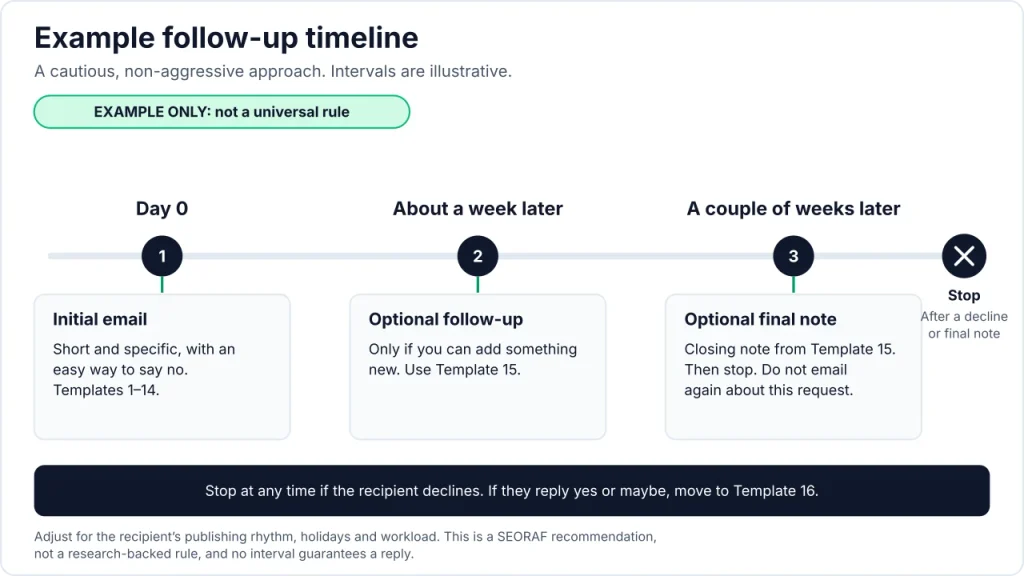
SEORAF recommendation: the timings below are my suggestions, not research findings, and no follow-up guarantees a reply. Adjust them for the recipient’s publishing rhythm, holidays and workload.
Step 1: Did they reply?
| Their reply | What to do |
|---|---|
| Yes or maybe | Reply promptly with exactly what you promised (Template 16). Don’t add new asks. Let them decide wording, placement and link attributes. |
| No, thanks | Reply with a short thank-you, or don’t reply at all. Don’t email again about this. |
| Asks for payment, goods or a link swap | Decline politely (Template 17), or treat it as advertising: require clear disclosure and an appropriately qualified link, normally rel="sponsored". |
| Asks a question or for changes | Answer it fully and briefly. |
| No reply | Go to Step 2. |
How to respond to each type of reply.
Step 2: Is a follow-up justified?
- Was the original email specific and relevant to this person?
- Do I have something genuinely new to add, such as a fix, an example or an update?
- Has enough time passed? Roughly a week is a reasonable starting point.
If the answer to any of these is no, either improve the email for future prospects or stop.
Step 3: send Template 15.
Step 4: Wait longer, then decide. If there is still no reply after a couple of weeks, you can send the optional final note in Template 15 or simply stop.
Step 5: Stop. After the final message, don’t email again about the same request. Record the outcome so you learn from it.
Suggested Follow-Up Schedule
| Stage | Suggested starting point | Notes |
|---|---|---|
| First email | When your research and facts are ready | The day of the week is not a reliable lever |
| First follow-up (Template 15) | Roughly a week later | Add something new |
| Optional final note | A couple of weeks after the first follow-up | Then stop |
| After a “yes” or “maybe” | Reply promptly | Template 16 |
| After a “no” | No further emails | Thank them if appropriate |
SEORAF recommendation: an adjustable follow-up schedule, not a research-backed rule.
Template 15: Follow-Up After No Response (Plus an Optional Final Note)
Use when: there has been no reply after a reasonable wait and you have something new to add.
Subject line: Re: [original subject] (only if you are replying in the same thread)
Customization fields: [First name], [original topic], [new useful detail], [page or site]
Hi [First name],
I’m following up on my email about [original topic]. Since then, [new useful detail, such as a new section, an updated figure or a clearer example].
If it isn’t a good fit for [page or site], just say so and I’ll leave it there.
Thanks,
[Your name]
Optional final note (only if you choose to send a second follow-up):
Hi [First name],
One last note on [original topic], in case my earlier messages were buried. I won’t email again about this.
If [their page] ever needs [what you offered], it’s at [URL]. Thanks for your time.
[Your name]
Why it may be relevant to the recipient: it is short, adds something new and offers a clear way to decline.
Don’t use when: the original email wasn’t relevant (fix targeting instead), they have already replied or declined, or you would be following up on a tight schedule. Don’t add deadlines or “last chance” pressure to the final note.
Template 16: Follow-Up After a Positive Response
Use when: they have replied yes or maybe and you now need to deliver.
Subject line: Re: [original subject]
Customization fields: [First name], [agreed item], [link or attachment], [format questions]
Hi [First name],
Thank you for getting back to me. As discussed, here is [agreed item: draft, quote, image or data]: [link or attachment].
Please tell me if you’d like changes to the format, length or sources. Also let me know how you prefer links and attribution handled. I’m happy to follow your guidelines.
Thanks again,
[Your name]
Why it may be relevant to the recipient: it delivers what was agreed and leaves link decisions with the editor.
Don’t use when: you would be adding new asks, pushing for specific anchor text or link attributes, or sending it before you have what you promised.
Template 17: Reply to a Payment or Link-Swap Request
Use when: the recipient asks for money, free products or a reciprocal link in return for linking.
Subject line: Re: [their subject]
Customization fields: [First name], [optional: your policy on sponsored content]
Hi [First name],
Thanks for your reply and for being upfront. I don’t pay for links or exchange links as a way to get coverage, so I’ll pass on this one.
[Optional, only if true: If you ever publish clearly labeled sponsored content with links marked as sponsored, I’d be glad to look at advertising separately.]
Thank you for your time,
[Your name]
Why it may be relevant to the recipient: it declines politely and keeps the door open to properly labeled advertising. Google-documented: Google’s spam policies list exchanging money, goods or services for links as link spam, while noting that buying and selling links for advertising is acceptable when the links are qualified.
Don’t use when: you do run paid placements and want to continue. In that case, follow your sponsored-content process and make sure links are marked appropriately.
Template 18: Thank-You After the Link Goes Live
Use when: your link or contribution has been published and you have checked that it is live.
Subject line: Thank you for adding [resource] to “[page title]”
Customization fields: [First name], [page title], [resource or link], [relevant future help]
Hi [First name],
I saw that [resource or link] is now in “[page title]”. Thank you, I appreciate you taking the time.
If a future article of yours could use [relevant expertise or resource], I’m happy to help. Otherwise, I’ll leave you to it.
[Your name]
Why it may be relevant to the recipient: it is a simple courtesy that doesn’t make a new request.
Don’t use when: you haven’t verified that the link is live, you want to ask for additional links, or you want to complain about how the link was attributed.
Ethical Link Building and Google’s Link Spam Policies
What Google Says
Google-documented: Google’s spam policies define link spam as creating links to or from a site primarily to manipulate search rankings. They list examples such as buying or selling links, sending a product in exchange for a post with a link, excessive link exchanges, automated link creation, and requiring a link as part of a terms-of-service or contract arrangement without letting the content owner qualify it. The documentation I reviewed does not give a numerical threshold for what counts as “excessive.”
The same policy notes that buying and selling links is a normal part of the web economy for advertising and sponsorship. It is not a violation when those links are appropriately qualified. Google prefers rel="sponsored" for paid placements; rel="nofollow" is also acceptable. These attributes help Google understand the relationship, but they do not guarantee that a link will be followed or pass ranking credit.
In December 2022, Google said it was using its SpamBrain system to neutralize the impact of unnatural links, and that any credit passed by those links is lost. Google’s 2016 guidance on reviewing products received from companies recommends nofollow on such links and disclosure.
If you run a site that publishes contributions, also read Google’s site reputation abuse policy on the spam policies page. It concerns third-party content published mainly to exploit a host site’s ranking signals.
No outreach tactic is “Google-approved.” Google’s guidance on third-party SEO advice says it doesn’t evaluate third-party services and warns against claims that imply approval.
Link Attributes in Plain English
rel="nofollow": a general way to say “I’m not vouching for this link.” Google says it is still acceptable for paid placements, thoughsponsoredis preferred.rel="sponsored": for paid placements, sponsorships and other advertising arrangements.rel="ugc": for links inside user-generated content, such as comments and forum posts.
The editor chooses the attribute. In outreach, don’t demand a “followed” link, and don’t treat an unpaid editorial link and a paid placement as the same thing.
Anchor Text
Google-documented: Google’s link best practices describe good anchor text as descriptive, reasonably concise and relevant to both the page it sits on and the page it links to.
SEORAF recommendation: in outreach, let the editor choose the wording. If you propose a sentence, describe the page plainly and avoid keyword-stuffed phrasing.
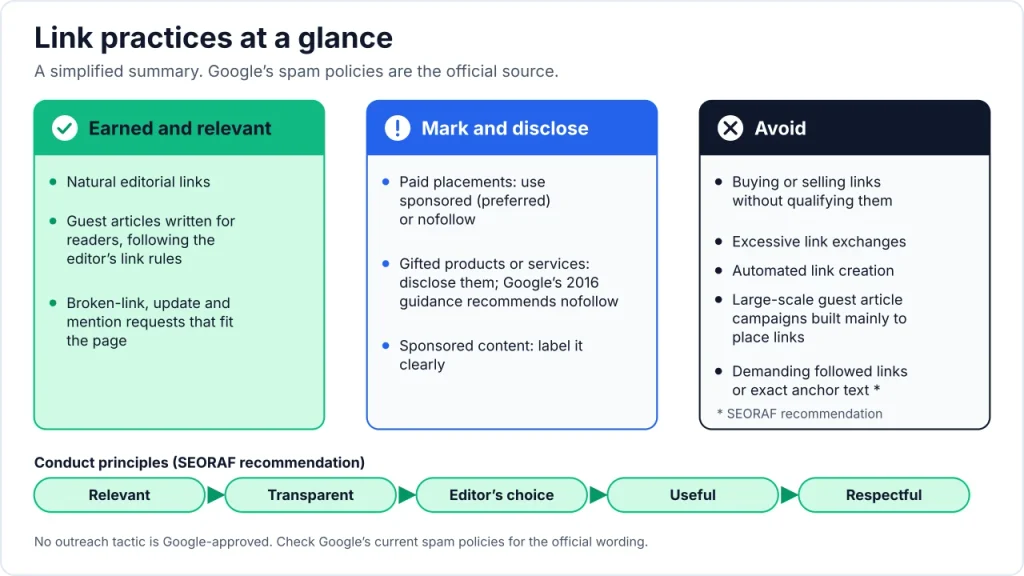
Link Types and Practices at a Glance
| Link type or practice | Google-documented stance (documentation reviewed) | Safer approach |
|---|---|---|
| Natural editorial link: a site links because the page is useful | The baseline; not addressed as a tactic | Earn it by being relevant |
| Guest post link: a link inside an article you contribute | Not inherently a violation. Google’s 2017 guidance flags large-scale, link-driven campaigns with keyword-rich links, and the spam policy lists optimized-anchor links in distributed guest posts or press releases among advertorial examples | Write for the audience and follow the editor’s link rules |
| Paid placement: a link bought or sold | Link spam unless qualified | Use sponsored and disclose |
| Gifted product or service offered for a link or post | Listed as link spam; the 2016 guidance recommends nofollow and disclosure | Do not require a followed link in exchange for a gift. Disclose the relationship and qualify any link appropriately, generally with rel="sponsored" or rel="nofollow". |
| Link exchange: “you link to me, I link to you” | Excessive exchanges are link spam | Link only where it helps readers |
| Automated link creation: programs that create links | Listed as link spam | Send tailored messages to people, not automated link placement |
| Contractually required link: demanded in a contract or terms | Listed if the owner can’t qualify it | Give the content owner the choice |
| Unlinked mention: a page names you without linking | I found no Google documentation on this | Any claim about its ranking value is unverified |
| Broken link outreach: offering a replacement for a dead link | No specific policy found | Relevance is your safeguard |
Link types and outreach practices, with Google’s documented stance and a safer approach.
The table above is detailed. The visual below groups the same ideas into three simple categories: links that need no qualification, links that must be marked or disclosed, and practices to avoid.
Principles for Ethical Outreach
SEORAF recommendation (these are not Google requirements):
- Contact only sites where a link would genuinely help readers.
- Be honest about who you are and what you want.
- Never imply a relationship or endorsement that doesn’t exist.
- Accept “no” and stop.
- Don’t exchange money, goods or services for a link intended to influence rankings. For legitimate advertising or sponsorship, disclose the relationship and qualify the link with
rel="sponsored"(preferred) orrel="nofollow". - Let editors control wording, placement and link attributes.
Email Law and Privacy
This is general information, not legal advice. Requirements vary by country, recipient type and message purpose.
- United States (regulatory guidance): the FTC’s CAN-SPAM guide says the law covers commercial messages and makes no exception for business-to-business email. It turns on a message’s primary purpose. For covered messages it requires accurate sender information, non-deceptive subject lines, a postal address and a working opt-out. Penalties apply per violating email, and the maximum amount is adjusted for inflation every year, so check the FTC’s current figure. Whether a particular link request counts as a commercial message is a legal question; get advice if you are unsure.
- United Kingdom (regulatory guidance): the ICO says the PECR rule on electronic mail marketing doesn’t apply to corporate subscribers, such as companies, but you must not disguise your identity and must give a valid address for opting out. Sole traders and some partnerships count as individual subscribers. UK GDPR can also apply if an email address identifies a person by name. The ICO notes that this guidance is under review because of changes made by the Data (Use and Access) Act, so check for updates.
- Elsewhere: other countries have their own rules. Check the law where your recipient is.
Using AI Responsibly
Published research: AI can help you draft, but it can’t replace reading the recipient’s page. In Hunter’s survey, 69% of US-based decision makers said it bothers them if AI was used to write a cold email. That survey covers cold email in general, but the lesson applies: if a message sounds synthetic or generic, it will be treated that way.
SEORAF recommendation: check every fact yourself, edit anything that sounds templated, and never invent details about the recipient or your own experience. As I read Google’s guidance on explaining how content was created, it concerns published content rather than private emails.
Common Outreach Mistakes and How to Fix Them
| Mistake | Why it fails | Fix |
|---|---|---|
| Sending the same email to hundreds of sites | Reads as generic. Hunter’s data found sequences of 21–50 recipients replied at 6.2%, versus 2.4% for 500+. | Smaller, qualified lists |
| Vague subject lines | Gives no reason to open | Name the page or the offer |
| Asking for a link with no reason | Nothing in it for readers | Identify a specific gap |
| Offering link swaps | Listed as link spam if excessive | Offer value and link where useful |
| Demanding anchor text or “dofollow” | Pressures the editor | Let the editor decide |
| Reporting broken links you haven’t checked | Looks careless | Check on different days |
| Making unfounded claims about your page | Damages trust | Describe only what is true |
| Sending rapid or endless follow-ups | Feels like pressure | Limit follow-ups and stop at “no” |
Common outreach mistakes, why they fail and how to fix them.
Campaign Preparation and Quality-Control Checklist
Before You Build the List
- ☐ My page is worth linking to and I can state what it adds.
- ☐ I know which template fits my situation.
- ☐ Each prospect is relevant to my topic.
- ☐ I checked each site’s editorial standards and link practices.
- ☐ I found a named contact and noted the guidelines page, if any.
- ☐ I have a tracking sheet ready.
Before You Send
- ☐ The email names a specific page, section or gap.
- ☐ The subject line is accurate.
- ☐ The ask is small and clear.
- ☐ The benefit is for the reader, not just me.
- ☐ I verified every fact (broken link, outdated claim, data point).
- ☐ No money, goods or services are exchanged for a ranking-manipulating link; any legitimate paid or gifted placement is disclosed and appropriately qualified.
- ☐ I haven’t demanded a followed link or specific anchor text.
- ☐ Merge fields are filled in correctly and the name is spelled correctly.
- ☐ Links work.
- ☐ My signature has my real name, role and site.
- ☐ I’m sending from an address that identifies me.
- ☐ If my message may count as marketing where the recipient is, I’ve checked the requirements, including an opt-out and any required address.
After You Send
- ☐ I recorded the date, contact and template.
- ☐ I scheduled at most one or two follow-ups.
- ☐ I stopped when someone said no and added them to my suppression list.
- ☐ I verified any link before sending a thank-you.
- ☐ I noted what worked and what didn’t.
Tracking Sheet Fields
Prospect, URL, contact, template used, date sent, follow-up dates, reply (yes, no, none), link live (yes, no), link type and notes.
Measure Your Own Results
Track replies, positive replies, links placed, relevance and time spent. Public benchmarks are hard to compare. Published research: Backlinko and Pitchbox reported that 8.5% of 12 million outreach emails received a response in 2019, while Hunter’s 2026 report put the average cold email sequence reply rate at 4.5%, with its digital PR category at 13%. The datasets differ in year, sample and method, and digital PR isn’t identical to link-building outreach. Your own results will vary.
Backlink Outreach Email FAQs
How long should a backlink outreach email be?
There is no single ideal length. Hunter’s data found relatively high reply rates at both about 61–80 and 181–200 words. I suggest writing only as much as you need to be specific, using short paragraphs.
What makes a good outreach subject line?
One that is accurate, specific and relevant to the recipient’s page. Avoid hype and anything misleading. See the subject-line patterns above.
How many follow-ups should I send, and when?
Ahrefs recommends one follow-up, while Hunter’s data found three total messages worked best in its dataset. My suggestion is to wait about a week and send no more than one or two follow-ups. That is a judgment call, not a rule. Stop if the recipient declines.
Is it okay to ask for a backlink directly?
It can be, if the request is specific, relevant and honest, and the recipient is free to say no. Problems begin when there is no reason for the link or when you offer something improper in exchange.
How do I find the right person to contact?
Check the article’s author, the editor, the About page and the contact page. Start with one well-matched person. Don’t guess or harvest email addresses.
Is paying for a backlink or swapping links allowed?
Google treats buying or selling links to manipulate rankings as link spam. Legitimate advertising and sponsorship links should be qualified with rel="sponsored" (preferred) or rel="nofollow". Disclosure by itself does not replace the link-qualification requirement. Google also lists excessive link exchanges as link spam.
What is the difference between link insertion, guest posting and broken link building?
According to BuzzStream, link insertion means asking for a link inside an existing article, while guest posting means you write the whole article. Broken link building is technically a type of insertion where you suggest a replacement for a dead link.
Can I use AI to write outreach emails?
You can use it to draft, but verify every fact and rewrite anything generic. In Hunter’s survey, 69% of US decision makers said AI-written cold emails bother them.
What reply rate should I expect?
It varies widely. Public figures depend on the year, method and type of outreach, so use them as context only. Track your own results and focus on relevance rather than volume.
Conclusion
The best outreach emails are short, specific and honest. They show that you’ve read the page, offer something that helps readers and accept a “no” gracefully.
To start:
- Pick one page worth linking to.
- Choose the template from the chooser that matches your situation.
- Research five to ten well-matched prospects, fill every placeholder with real details, and send small batches.
For more guides, see the SEORAF SEO resources section.
Sources
Google (official documentation and blog)
- Spam policies for Google web search
- Qualify your outbound links to Google
- Link best practices for Google
- Google’s guidance on third-party SEO tools and advice
- A reminder about links in large-scale article campaigns (2017)
- Best practices for bloggers reviewing products they receive from companies (2016)
- December 2022 link spam update
Regulators
Industry research and practitioner guides
- Backlinko and Pitchbox: We analyzed 12 million outreach emails (2019)
- Hunter: The State of Email Outreach 2026
- Ahrefs: Link building outreach
- BuzzStream: Link reclamation
- BuzzStream: Link insertion
- Search Engine Land: Links are not a top 3 Google Search ranking factor, says Gary Illyes
- Search Engine Roundtable: Google needs very few links to rank pages (2024)
Source interests. Backlinko and Search Engine Land are owned by Semrush. Hunter, Ahrefs, BuzzStream and Pitchbox sell SEO or outreach tools, so treat their figures as vendor data.
How this guide was produced. It draws on Google Search Central documentation, FTC and ICO guidance and published studies. The email templates are original drafts and are not presented as field-tested. If you spot an error, please tell me through the contact page and I will review it.