
Easiest Backlinks to Build: 15 Legitimate Ways for Beginners
By Mousume Akter, Founder & Editor, SEORAF. Last reviewed: 24 November 2026.
Every new website faces the same quiet problem: other sites have to know it exists before they will link to it, and nobody links to a site they have never heard of. That is why so many beginners search for the easiest backlinks, meaning links they can get without a big budget, an outreach team or months of waiting.
Here is the honest version. Some backlinks really are easy to get, and most of those carry limited value on their own. The links that tend to matter most are usually the ones other people decide to give you, which makes them harder. This guide sorts 15 legitimate methods by how much effort they take, explains what each one is realistically good for, and shows you which shortcuts to leave alone.
How to read this guide: claims are labeled by where they come from. Google documents means the guidance appears in Google Search Central. Published research means a study or survey. Practitioner view means the opinion of an SEO publisher or tool vendor. SEORAF recommendation means editorial judgment. SEORAF did not run link-building tests for this article, and nothing here is a promise about rankings. This guide contains no affiliate links.
Quick answer: the easiest backlinks are the ones you can create or request yourself with little effort, such as a few brand profiles, selective directory listings and honest testimonials. They are quick, but usually weak signals on their own, and Google specifically identifies low-quality directory and bookmark links, automated link creation, and forum comments with optimized links as link spam. A selective, genuinely useful listing is different from a mass submission campaign. Start with a small foundation, then move to mentions, communities and genuinely useful resources, where links are earned rather than placed. No backlink, easy or hard, guarantees a ranking.
Best starting points for most beginners:
- A small set of accurate brand profiles (Method 1)
- One or two directory listings that are actually relevant (Method 2 or 3)
- Honest testimonials for tools or vendors you really use (Method 5)
- Polite requests to turn existing brand mentions into links (Method 6)
- Helpful participation in one community (Method 7)
What Counts as an “Easy” Backlink?
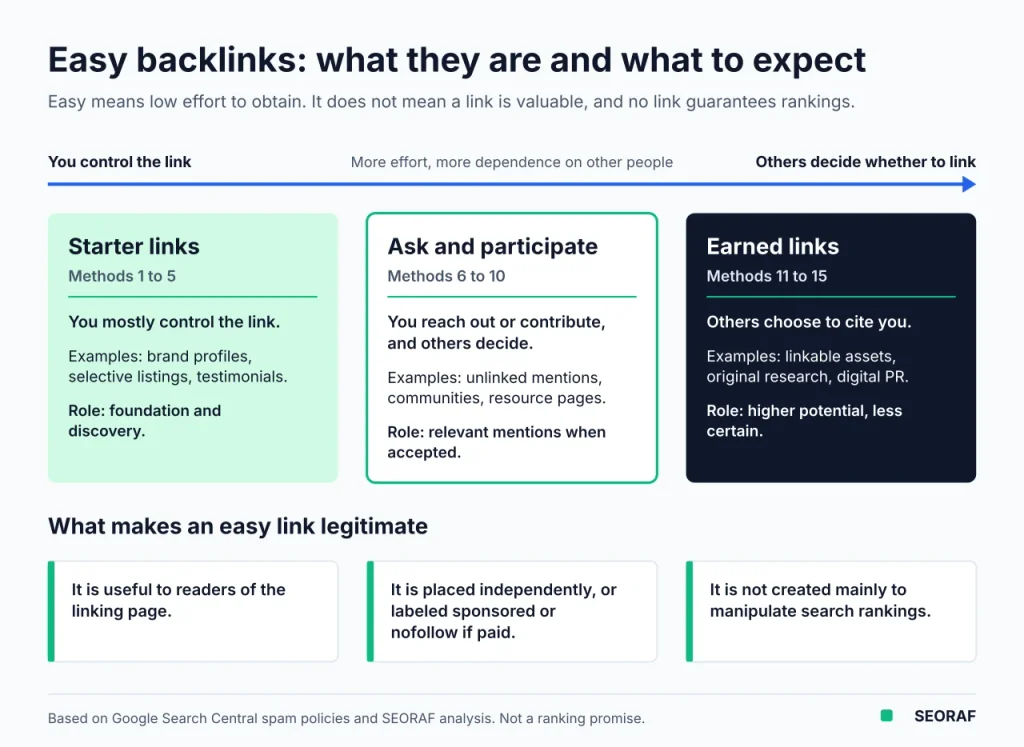
Easy to get is not the same as easy to value
In this guide, an “easy” backlink is a link you can create or request without a budget, a team or an existing audience. A profile on a social platform, a business listing or a testimonial fits that description.
The catch is that a link that is easy for you to place is usually easy for everyone else too, including competitors and spammers. Ahrefs makes this point in its beginner’s guide to link building: links you can add yourself tend to have little value because anyone can add them (practitioner view). Links that are harder to get, such as an editor citing your research, are valuable partly because an independent person decided you deserved the mention (SEORAF reasoning).
Easy does not mean worthless. Foundational links can help people find and verify your site, and occasionally send visitors. They just should not be mistaken for a ranking strategy.
What beginners should realistically expect
- Links are one part of a bigger picture. Google’s guidance on helpful, reliable, people-first content makes clear that its ranking systems aim to reward content that serves people. Links do not replace that (Google documents).
- Links tend to come naturally over time. Google’s SEO Starter Guide says other sites linking to you usually happens as people discover your content, and it lists community engagement, social media and word of mouth as ways to get discovered (Google documents).
- Results take time. The same guide says changes can take anywhere from a few hours to several months to appear in search, and suggests waiting a few weeks before judging an effect (Google documents).
- No one can promise rankings. Google’s advice on working with SEO providers warns that no one can guarantee a top position (Google documents).
Two Google staff statements are worth knowing, though they are not policy. In 2024, Gary Illyes said Google needs very few links to rank pages and that links are less important than they once were. He has also said links are not a top-three ranking factor (Google staff statements, reported by industry publications). Treat these as context, not as a reason to ignore links entirely or to chase them.
Why relevance and quality matter more than quantity
A link from a trusted, relevant page that sends interested readers to your site is a very different thing from a link on an unrelated page nobody visits. SEORAF recommendation: before pursuing any link, ask whether a reader of that page would genuinely find the link useful. If the honest answer is no, the link is unlikely to be worth the effort, and it may belong in the “avoid” category covered later.
Backlink Basics: Links, Attributes and Context
What a backlink is
A backlink (also called an inbound link) is a link from another website to yours. Three terms come up constantly:
- Referring domain: a unique website that links to you. Ten links from one site count as one referring domain.
- Anchor text: the clickable words of a link.
- Link attribute: a label in the link’s code (such as
rel="nofollow") that describes the relationship between the pages.
Google’s SEO Starter Guide notes that Google discovers pages largely by following links, which is one reason links matter. Beyond discovery, Google does not publish how much any particular type of link counts, so claims about the exact value of a link type are opinion unless Google has documented them.
Editorial links vs. self-created links
- Editorial links are placed by someone else who chose to reference your page, such as a writer citing your guide. You cannot force one.
- Self-created links are ones you place yourself, such as a profile, a directory listing or a forum signature. They are fast, but a self-created link does not automatically improve rankings, and some versions are classed as link spam.
Follow, nofollow, sponsored and UGC links
There is no “follow” attribute. A link with no special label is simply a regular link. Google’s documentation on qualifying outbound links describes three labels site owners can add:
| Attribute | Typical use | What Google documents | What not to assume |
|---|---|---|---|
| None (regular link) | Ordinary editorial links | Treated as a regular link | That every regular link passes meaningful ranking value |
rel="sponsored" | Paid or advertising placements | Recommended for paid links | That sponsored links are “bad”; they are legitimate when labeled |
rel="ugc" | Comments, forum posts, user-generated content | Recommended for user-generated links | That such links have no value to readers |
rel="nofollow" | When other values do not fit | Qualified links are generally not followed | That nofollow links are useless; they can still send visitors |
Link attributes as described in Google’s documentation on qualifying outbound links. The publisher, not you, usually decides which attribute a link gets.
Because the publisher decides, always check the attribute rather than assuming. Google treats nofollow, sponsored and ugc as hints, and says links marked with these values will generally not be followed. They may still help people discover your site and can send referral visitors, but do not count on them to pass ranking credit. The publisher is responsible for choosing the appropriate attribute.
Relevant vs. irrelevant links
Relevance means the linking page, its audience and often its location make sense for your site. A local plumber listed by a regional trade association is relevant. The same plumber linked from an unrelated coupon page is not. Relevance is a practical filter (SEORAF recommendation): relevant links tend to send relevant visitors, and they are far less likely to look manipulative.
Link quality and context
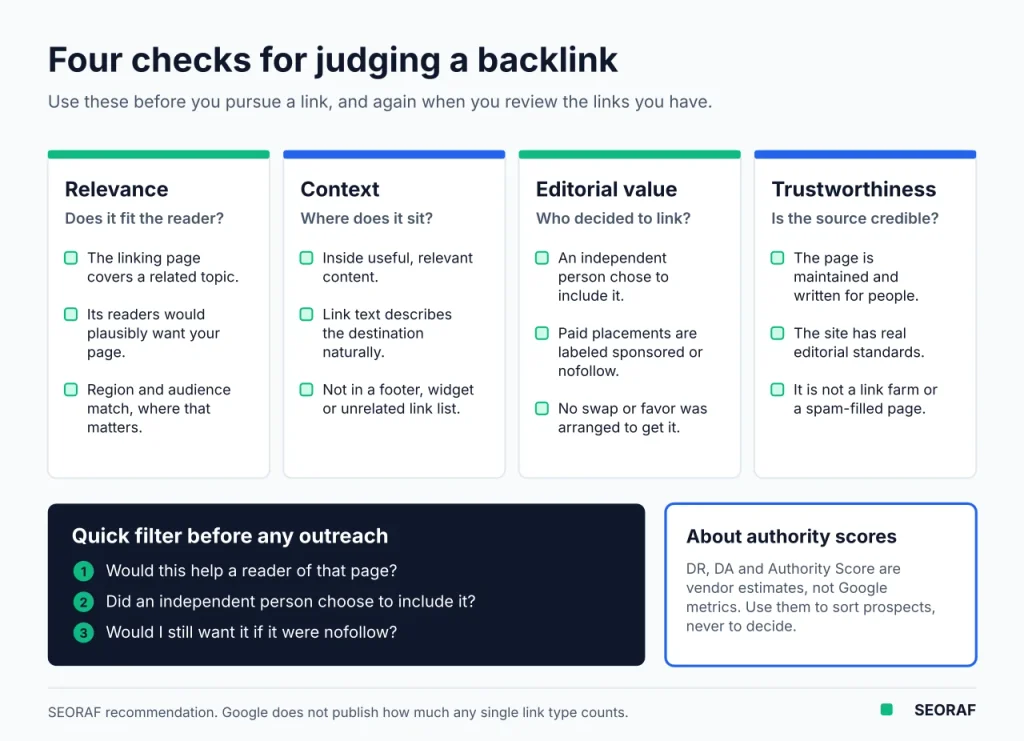
Quality is hard to measure with one number. Useful questions include:
- Is the linking page genuinely useful, maintained and written for people?
- Does the link sit inside relevant content, rather than in a list of unrelated links?
- Is the anchor text natural, describing the destination rather than stuffed with keywords?
- Did an independent person choose to include it, or did someone pay or arrange it?
Google’s spam policies list widely distributed footer and template links as link spam, which is one reason placement matters. Scores from SEO tools (Domain Rating, Domain Authority, Authority Score) are estimates created by those vendors, not Google metrics. They are covered in the measuring section below.
How the 15 Methods Are Rated
Each method includes the same details so you can compare them fairly:
- Difficulty: Low, Medium or High, based on skill and dependence on other people.
- Effort: the shape of the time commitment (a single sitting, ongoing, or weeks), not a number of hours.
- Typical link attribute: what is commonly seen, with the reminder that the publisher decides.
- Who it suits, how to do it, limitations, mistakes and a hypothetical example.
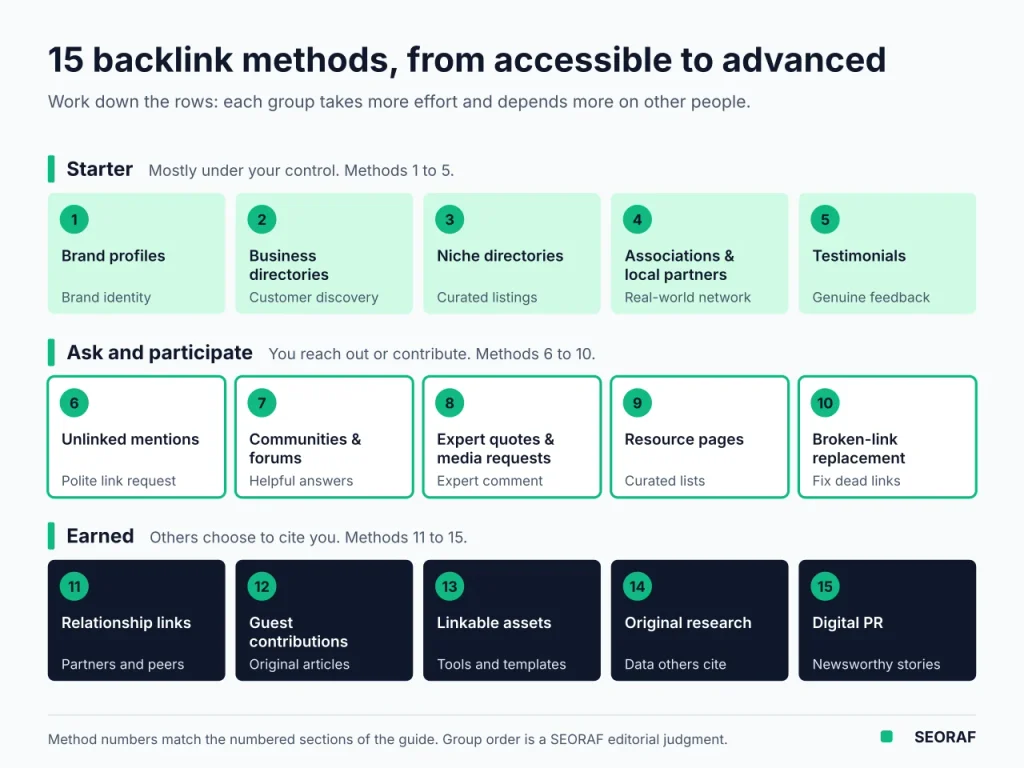
The methods are grouped into three tiers: starter methods you largely control, ask-and-participate methods that need outreach or ongoing contribution, and earned methods where links follow genuine usefulness or newsworthiness. Ratings are SEORAF editorial assessments, not test results, and they do not predict ranking or traffic outcomes. Paid links and automated link tools are deliberately excluded; they appear in the “avoid” section.
The 15 Methods at a Glance
| # | Method | Tier | Difficulty | Effort | Your control | Typical attribute | Best for |
|---|---|---|---|---|---|---|---|
| 1 | Brand profiles | Starter | Low | One sitting, light upkeep | High | Platform-determined, often qualified | Any new site |
| 2 | Business directories | Starter | Low | Hours | High | Varies | Local and service businesses |
| 3 | Niche directories | Starter | Low-Medium | Hours to days | Medium | Varies; paid listings should be sponsored | Category-focused products |
| 4 | Associations and local partners | Starter | Low-Medium | Application plus cost | Medium | Varies; paid sponsorship should be qualified | Local businesses, professionals |
| 5 | Testimonials | Starter | Low | Short, per quote | Low-Medium | Vendor decides | Genuine customers of a vendor |
| 6 | Unlinked mentions | Ask | Low-Medium | Monitoring plus short emails | Low | Owner decides | Brands with existing mentions |
| 7 | Communities and forums | Ask | Medium | Ongoing | Low | Often none, ugc or nofollow | Practitioners |
| 8 | Expert quotes | Ask | Medium | Ongoing monitoring | Low | Varies | People with real expertise |
| 9 | Resource pages | Ask | Medium | Hours per batch | Low | Owner decides | Sites with a useful free resource |
| 10 | Broken-link replacement | Ask | Medium-High | High prospecting time | Low | Owner decides | Sites with relevant content |
| 11 | Relationship links | Earned | Medium | Months | Low-Medium | Their choice | Businesses and peers with networks |
| 12 | Guest contributions | Earned | Medium-High | Days per piece | Medium | Varies; paid placements must be qualified | Experts with time |
| 13 | Linkable assets | Earned | Medium-High | Days to weeks | High to build, low over links | Earned | Sites with expertise and an audience |
| 14 | Original research | Earned | High | Weeks | High to build, low over links | Earned | Teams with data rigor |
| 15 | Digital PR | Earned | High | Weeks to months, may cost money | Low | Often editorial, not guaranteed | Established brands |
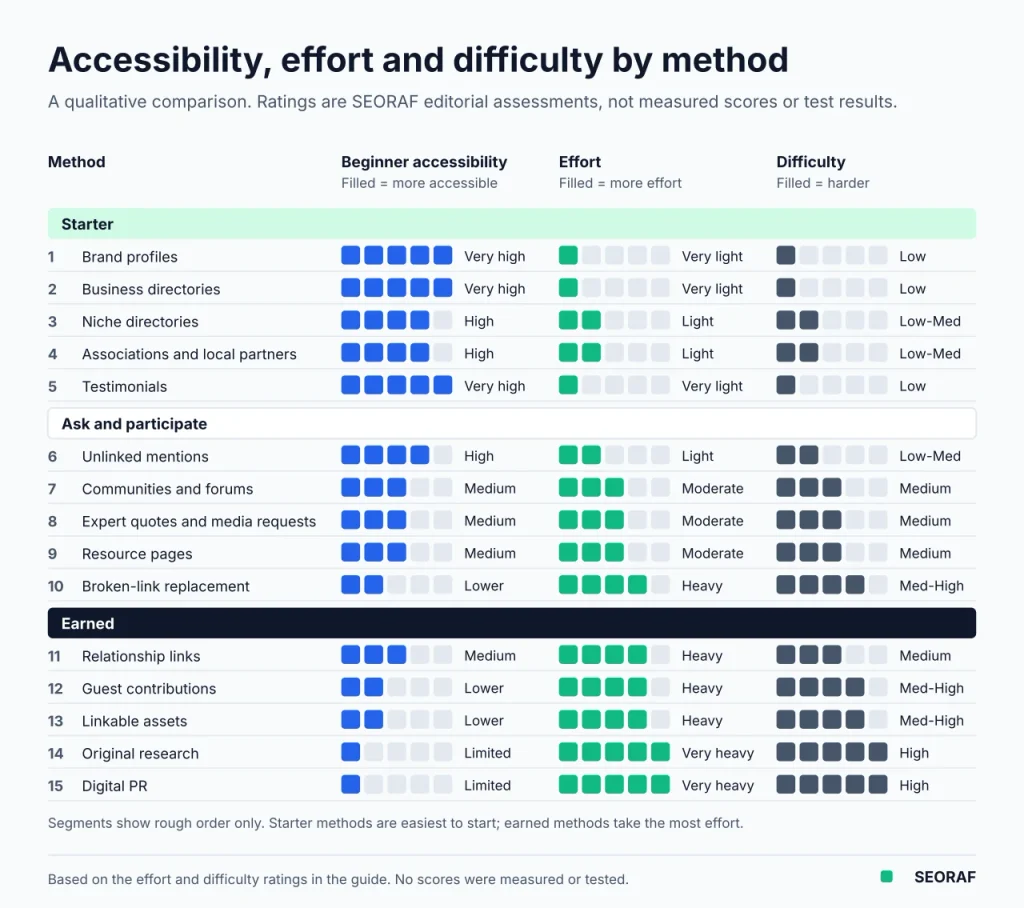
SEORAF editorial assessments, not test results. The publisher or platform decides each link’s attribute.
Starter Backlinks: Low-Effort Foundations (Methods 1-5)
These methods need little or no outreach and are mostly in your control. Think of them as foundations that make your site easier to find and verify, not as ranking drivers.
1. Set Up a Small Set of Brand Profiles
Difficulty: Low · Effort: one sitting plus light upkeep · Typical link attribute: decided by the platform, often qualified or not clickable
A brand profile is an official page or account for your site or business on a platform your audience already uses, such as a professional network or a video channel. Most let you add a website link. The link itself is usually modest, but profiles give people a trustworthy place to confirm who you are and give you a consistent identity across the web.
Who should consider it: any new site, brand or author. Skip platforms where your audience is not present.
How to do it:
- Pick two to four platforms where your readers or customers actually spend time.
- Use the same name, short description and web address on each.
- Complete the profile properly (logo or photo, description, homepage link) rather than leaving it half empty.
- Link to your homepage or main resource, not a deep page you are trying to promote.
- Decide up front whether you will maintain the account. Leave out any you will abandon.
Limitations: Check each link’s attribute rather than assuming. Ahrefs describes this type of link as foundational and of little ranking value by itself (practitioner view). Treat profiles as brand infrastructure.
Mistakes to avoid: registering on dozens of platforms, using keyword-stuffed account names, inconsistent branding, and leaving empty or inactive accounts.
Illustrative scenario (hypothetical): a new software-review site with a professional audience creates a company page on one professional network and one channel where readers ask questions. It uses the same name and description on both and links its homepage. The goal is clarity for visitors, not a ranking boost.
2. Claim Listings in Reputable Business Directories
Difficulty: Low · Effort: a few hours, with occasional corrections · Typical link attribute: varies by directory; paid placements should be labeled sponsored
Business directories list companies with their name, contact details and a website link. For businesses with a real-world presence, accurate listings help customers find you. Any link benefit is secondary.
Who should consider it: local and service businesses. Online-only blogs rarely need this.
How to do it:
- Search for your business name to find listings that already exist, and claim them.
- Add a small number of well-established directories that your customers genuinely use.
- Keep your business name, address and phone number identical everywhere.
- Check whether the listing links to your site and note the attribute.
- Decline paid “link packages.”
Limitations: Google staff have said web directories generally do not help with rankings (a 2017 statement, not documentation, so its current relevance is uncertain). Their main value is accurate customer information.
Google policy check: Google’s spam policies list low-quality directory and bookmark site links as an example of link spam. The practical lesson is to be selective.
Mistakes to avoid: mass submissions, inconsistent business details, paying for “authority” link bundles, and choosing directories purely by a third-party score.
Illustrative scenario (hypothetical): a local accounting firm finds three outdated listings, corrects the phone number and opening hours, and adds two directories that clients commonly use. No claim is made about ranking effects.
3. Get Listed in Curated Niche and Industry Directories
Difficulty: Low to Medium · Effort: hours to days, including approval waits · Typical link attribute: varies; featured or paid listings should be sponsored
Niche directories focus on one industry or topic, such as a software category, a trade or a regional interest. When they are curated and used by real audiences, a listing can put you in front of relevant people.
Who should consider it: products and services with a clear category audience.
How to do it:
- Find directories your audience actually uses, by asking customers or noting where competitors are listed.
- Check for editorial review, active maintenance and signs of real visitors.
- Apply this test (SEORAF recommendation): would you want this listing if the link were nofollow?
- Apply with accurate, specific information.
Limitations: Many directories exist mainly to sell links, so selection matters more than volume. Approval is not guaranteed.
Mistakes to avoid: picking directories by score alone, submitting to hundreds, and paying for placements that are not labeled as sponsored.
Illustrative scenario (hypothetical): a project-management tool lists itself in a software category directory that buyers use when comparing tools. It does so because the audience is there, not for the link.
4. Join Associations and Local Partner Networks
Difficulty: Low to Medium · Effort: an application plus any cost · Typical link attribute: member listings vary; paid sponsorship should be qualified
Industry associations, chambers of commerce and local partner groups often publish member directories or partner pages. Because they reflect real affiliation, they are among the more relevant starter links.
Who should consider it: local businesses and professionals who would benefit from the membership regardless of the link.
How to do it:
- List organizations relevant to your trade, region or customers.
- Check membership criteria, cost and how member listings link out.
- Join only if the membership has real value to you.
- Provide an accurate, complete profile.
- For sponsorships, agree the link attribute in advance.
Limitations: Memberships often cost money, and links may be labeled sponsored or nofollow.
Google policy check: Google’s spam policies say buying or selling links for advertising is normal when properly qualified with nofollow or sponsored. Paying primarily to get a link that passes ranking credit is a different matter. SEORAF recommendation: if the link is the only reason to pay, skip it.
Mistakes to avoid: joining purely for the link, and ignoring the listing afterward.
Illustrative scenario (hypothetical): a bakery joins its local chamber of commerce and a regional food-trail group, mainly to be visible to local customers. Each lists the bakery with a website link.
5. Give Genuine Testimonials and Reviews
Difficulty: Low · Effort: short, per testimonial · Typical link attribute: the vendor decides whether and how to link
A testimonial is a short, truthful endorsement you give a company whose product or service you actually use. Vendors often publish these on their sites, sometimes with the author’s name and website.
Who should consider it: businesses and bloggers who already use vendors and are happy with them. If you have an affiliate relationship with a vendor, your testimonial is not independent, so disclose it.
How to do it:
- Choose vendors you really use.
- Write a specific, honest quote about what the product does for you.
- Offer your name, role and website.
- Let the vendor decide whether to publish and how to link.
- Disclose anything you received in return.
Limitations: You have no control over publication, and many vendors will not link at all.
Google policy check: Google lists exchanging money, goods or services for links that pass ranking credit as link spam. It also specifically names sending someone a product in exchange for a post that includes a link. You can give honest feedback without making a link a condition. If a vendor offers a benefit or payment in exchange for a testimonial or placement, the publisher should qualify the link with rel="sponsored" (or nofollow). Do not present an incentivized endorsement as independent.
Mistakes to avoid: writing exaggerated praise, endorsing tools you have not used, and making a link the price of your feedback.
Illustrative scenario (hypothetical): a freelance designer who has used an invoicing tool for a long time sends the company a short, accurate comment about how it simplified billing, with their name and website. The company decides what to publish.
Before You Ask Anyone for a Link: Finding Prospects and Writing Outreach
Methods 6 through 12 involve asking another person to consider a link. The skills below apply to all of them, so they are covered once here.
Finding relevant opportunities
- Search by topic. Look for pages that collect resources on your subject, using phrases such as “resources,” “useful links” or “recommended tools” alongside your topic.
- Study who links to similar sites. A backlink checker can show which pages link to competing sites. Use this as a source of ideas about which kinds of pages might care about your resource, not as a list to copy. Different tools see different links, so treat their data as estimates.
- Watch for your own name. Set up alerts for your brand name and common variations to find mentions.
- Judge each page honestly. Prioritize relevance, real editorial care and a named person you can contact.
Writing a short, honest outreach request
A good request is short and respectful of the recipient’s time. A simple structure:
- Who you are in one line.
- What you are pointing to, with the exact page.
- Why it helps their readers, in specific terms.
- An easy way to say no, with no pressure.
For example (placeholders in brackets): “Hi [Name], I noticed your page on [topic] mentions [resource], and the link looks broken. I recently published [page title], which covers the same ground. If it is a good fit for your readers, you are welcome to use it. Either way, thanks for maintaining a useful page.”
Send one polite follow-up at most. Never offer payment, free products or link swaps in exchange for a link. Google’s guidance on SEO providers advises caution toward unsolicited SEO emails, so keep your own outreach personal and relevant to avoid looking like the spam recipients are trained to ignore.
Ask-and-Participate Backlinks (Methods 6-10)
These methods take more effort and depend on other people’s decisions. A response is never guaranteed, and each link remains the publisher’s choice.
6. Reclaim Unlinked Brand Mentions
Difficulty: Low to Medium · Effort: monitoring plus short emails · Typical link attribute: the page owner decides
An unlinked mention is a page that names your brand, product or author but does not link to you. Asking the owner to add a link is one of the warmest outreach opportunities because they already know about you. Semrush lists it among its link-building tactics (practitioner view). In a survey reported by Search Engine Land, a large majority of SEO respondents (about 81 percent) said they believe unlinked mentions affect rankings. That is opinion data, not evidence of an effect, so do not rely on it as proof.
Who should consider it: brands that already have mentions. A brand-new site may have none yet.
How to do it:
- Set up alerts for your brand name, product names and common misspellings.
- Check that each mention is accurate and the page is relevant.
- Find a contact person.
- Send a short, friendly request that explains how a link helps readers reach the source.
- Accept a “no” gracefully.
Limitations: Many owners will not respond, and some mentions are on pages where a link would not help anyone.
Mistakes to avoid: demanding a link, sending mass templated emails, and offering payment or exchanges.
Illustrative scenario (hypothetical): a roundup of free design resources names a small studio’s free font guide but does not link to it. The studio’s owner sends a two-sentence note with the guide’s address and thanks the author for the mention.
7. Take Part in Communities and Forums
Difficulty: Medium · Effort: ongoing, a little each week · Typical link attribute: often none, ugc or nofollow
Forums, question-and-answer sites and online groups let you help people and, where rules allow, point to a relevant page of yours. The main benefits are relationships, topic insight and occasional referral visits. Direct ranking value is not something to count on.
Who should consider it: practitioners with real expertise and time to contribute regularly.
How to do it:
- Choose one or two communities where your audience asks questions.
- Read the rules, especially about self-promotion.
- Answer questions thoroughly before ever mentioning your own site.
- Link to your page only when it directly helps and the rules allow it.
- Keep your profile plain and truthful.
Limitations: Google recommends that sites label user-generated links with ugc or nofollow, so expect many of these links to be qualified.
Google policy check: Google’s spam policies list forum comments with optimized links in the post or signature as link spam.
Mistakes to avoid: dropping links without helping, keyword-stuffed signatures, fake personas and breaking community rules.
Illustrative scenario (hypothetical): a bookkeeper answers a beginner’s question about invoice records in a small-business community with a full explanation, then adds a single link to a longer guide as optional reading, where the community’s rules allow it.
8. Contribute Expert Quotes and Answer Journalist Requests
Difficulty: Medium · Effort: ongoing monitoring and quick replies · Typical link attribute: varies; some outlets use nofollow or no link
Journalists and writers sometimes ask experts for short comments, either through request services or on social platforms. If your answer is used, the article may credit you and link to your site.
Current platform status (checked 24 November 2026). HARO has returned under Featured and remains available as a free, three-times-daily email digest for journalist requests. Connectively is also back as the platform-based experience for finding, filtering and responding to media opportunities. The operator’s Help Center says the classic Featured app migrated to Connectively.us on 26 May 2026. Availability, eligibility, submission limits and platform terms can change, so check the official HARO website and Connectively website before signing up. Sources: the official HARO announcement and Connectively Help Center.
Who should consider it: people with demonstrable expertise. This method rewards real knowledge, not volume.
How to do it:
- List the topics you can speak about with authority.
- Prepare a short, accurate bio.
- Join a request service only after confirming it is active and reading its rules.
- Answer only relevant requests, quickly and concisely.
- Follow up courteously, once.
Limitations: Many answers are never used, and links may be nofollow or absent. Outcomes cannot be predicted.
Mistakes to avoid: answering off-topic requests, overstating credentials, missing deadlines and sending generic answers that add nothing.
Illustrative scenario (hypothetical): a nutrition coach sees a request about meal planning, replies within the deadline with a three-sentence answer based on their actual practice, and includes their website address in their sign-off.
9. Request Inclusion on Relevant Resource Pages
Difficulty: Medium · Effort: a few hours per batch of prospects · Typical link attribute: the owner decides
Resource pages collect useful links on a topic. If you have a genuinely helpful free resource, such as a guide, template or tool, you can suggest it to the person who maintains such a page. Ahrefs notes that outreach response rates are typically low (practitioner view), so expect more “no” or silence than yes.
Who should consider it: sites with a useful free resource that fits a specific list.
How to do it:
- Find resource pages on your topic (see the prospecting section above).
- Judge whether each is current and well maintained.
- Confirm your resource adds something the page does not already offer.
- Email the maintainer using the outreach structure above.
- Follow up once, then move on.
Limitations: Low response rates, outdated pages and strict editorial standards.
Mistakes to avoid: pitching commercial pages that are not resources, mass emails, and offering link swaps.
Illustrative scenario (hypothetical): a site with a free printable weekly-planner template contacts the maintainer of a “tools for freelancers” page, explains briefly what the template covers, and leaves the decision to them.
10. Offer Replacements for Broken Links
Difficulty: Medium to High · Effort: high prospecting time · Typical link attribute: the owner decides
Websites accumulate dead links over time. If a relevant page links to a resource that no longer exists, you can let the owner know and, where your page is a genuine equivalent, suggest it as a replacement. It works because you are fixing a real problem for them.
Who should consider it: sites that already have solid content on the topic.
How to do it:
- Find relevant pages with outbound links that return errors (a link-checking tool can help).
- Confirm the link is truly broken and note exactly where it appears.
- Check that your page genuinely covers what the dead page did.
- Email the owner with the exact location and your suggestion.
Limitations: It is time-consuming, and your replacement has to be a true match. Tool data may be incomplete, and links labeled “broken” sometimes work.
Mistakes to avoid: suggesting a weak replacement, not verifying the break, and pressing after a “no.”
Illustrative scenario (hypothetical): a guide links to a glossary that has been taken offline. A site with a maintained glossary of the same terms writes to the guide’s author, pointing out the dead link and offering its glossary as an option.
Earned Backlinks: Advanced Approaches (Methods 11-15)
These methods take the most effort, and none guarantees a link. Before investing, make sure the pages you want to promote are crawlable and indexable; a technical SEO audit is a good way to check.
11. Earn Links Through Real Relationships
Difficulty: Medium · Effort: slow, over months · Typical link attribute: their choice
Many good links come from people you already know: suppliers, customers, partners, peers and event organizers. Ahrefs notes that existing relationships raise the odds of a positive response (practitioner view). A link here is a by-product of a genuine connection.
Who should consider it: businesses with an existing network, and bloggers with peers in the same field.
How to do it:
- List your existing relationships.
- Note where they naturally mention others, such as case studies, partner pages, newsletters or resource lists.
- Offer something useful to their audience (data, a quote, a guide).
- Mention the link only where it fits, and never as a condition.
Limitations: It is slow and cannot be forced.
Google policy check: Google’s spam policies list excessive link exchanges (“link to me and I’ll link to you”), and partner pages created only for cross-linking, as link spam. They also list requiring a link as part of a contract or terms without letting the other party qualify it.
Mistakes to avoid: reciprocal trades, making a link part of an agreement, and asking for sitewide links.
Illustrative scenario (hypothetical): a software maker’s long-term customer writes a case study about how they use the product and links to it on their own initiative. The maker helped by supplying screenshots and accurate details, and asked for nothing in return.
12. Write Guest Contributions for Relevant Publications
Difficulty: Medium to High · Effort: days per piece · Typical link attribute: varies; paid or sponsored placements must be qualified
A guest contribution is an original article you write for another publication, which may credit you and link to your site where it genuinely helps readers. Done properly, it reaches a new audience. Done badly, it is a known spam pattern.
Who should consider it: people with real expertise and time to write well.
How to do it:
- Shortlist publications relevant to your topic with real editorial standards.
- Read their contributor guidelines.
- Pitch a specific, useful topic, not a generic offer.
- Write original work for that publication alone.
- Link only to resources that genuinely help readers, according to the publication’s policy.
Limitations: It takes time, acceptance is not guaranteed, and some sites charge for publication.
Google policy check: Google’s spam policies list links with optimized anchor text in guest posts or press releases distributed on other sites, and paid articles that pass ranking credit, as link spam. Paid placements should be labeled sponsored or nofollow.
Mistakes to avoid: mass guest posting, recycling the same article, keyword-stuffed anchors, and publishing on low-quality sites.
Illustrative scenario (hypothetical): a local nutritionist pitches a seasonal eating guide to a regional health blog, writes it specifically for that audience, and includes one link to a related resource on their own site.
13. Create Linkable Assets (Tools, Templates, Checklists)
Difficulty: Medium to High · Effort: days to weeks · Typical link attribute: earned, so it varies
A linkable asset is a resource useful enough that others may reference it: a free tool, template, checklist, calculator or well-organized glossary. Ahrefs stresses that assets need promotion, because people cannot link to what they do not know exists (practitioner view).
Who should consider it: sites with real expertise and an audience to share it with.
How to do it:
- Identify a recurring problem your audience faces. Topics with achievable demand, as covered in our guide to low-competition keywords, are a sensible place to start.
- Check what already exists and aim to be clearly more useful, not just different.
- Build it and publish it on a crawlable page.
- Share it with relevant audiences and with sites that already link to similar resources.
- Keep it accurate and maintained.
Limitations: It may attract few or no links. Effort is high and the outcome is uncertain.
Google policy check: Google’s spam policies list creating low-value content primarily to attract links as a manipulation tactic. The test is whether the asset genuinely serves readers.
Mistakes to avoid: building and then waiting, publishing thin tools, copying a competitor’s asset and neglecting updates.
Illustrative scenario (hypothetical): a freelancer builds a simple monthly budgeting template for self-employed people, publishes it on a clear page, and shares it with a few newsletter authors who cover freelancing. Whether anyone links is up to them.
14. Publish Original Research or Data
Difficulty: High · Effort: weeks · Typical link attribute: earned
Original research means first-party surveys, datasets or analyses of public data that others may cite. Ahrefs lists proprietary data and surveys among link-worthy content types (practitioner view). SEORAF has not conducted any such research for this article, and this section is guidance only.
Who should consider it: teams with access to data and the discipline to handle it carefully.
How to do it:
- Choose a narrow question your audience cares about.
- Design a sound method before collecting anything.
- Collect and analyze the data honestly.
- Write down the limitations.
- Publish the methodology alongside the findings.
- Share the results with relevant publications and communities.
Limitations: High effort, no guaranteed links, and credibility depends entirely on rigor. Check privacy and legal requirements for any data you collect.
Mistakes to avoid: presenting a small sample as definitive, hiding the method, and chasing headlines at the expense of accuracy.
Illustrative scenario (hypothetical): a company with a newsletter list surveys its own subscribers about how they track expenses, reports the sample size and limits clearly, and publishes the results. This only works if the survey is actually run.
15. Pursue Digital PR (Graduation Tier)
Difficulty: High · Effort: weeks to months, and it can cost money · Typical link attribute: coverage is often editorial, but links are not guaranteed
Digital PR means creating something genuinely newsworthy and pitching it to relevant journalists. It is not an “easy” tactic, which is why it sits last. It is here because it is what many sites graduate to once simpler methods are in place.
Who should consider it: established brands with resources and something worth reporting.
How to do it:
- Find an angle that is genuinely newsworthy to a specific audience.
- Build a supporting asset, such as data, a report or a useful tool.
- Research journalists who cover that topic.
- Send personalized pitches.
- Respond helpfully to follow-ups and track coverage.
Limitations: It is slow and expensive, and many outlets use no link or a nofollow link.
Google policy check: Google’s spam policies list optimized anchor text in press releases distributed on other sites, and paid articles passing ranking credit, as link spam. Sponsored coverage should be qualified.
Mistakes to avoid: pitching non-news, mass blasts, paying for placement without qualification, and expecting every story to include a link.
Illustrative scenario (hypothetical): a regional business publishes a dashboard summarizing publicly available local data and pitches it to reporters who cover that region, with a clear summary of what the data shows and its limits.
Backlink Shortcuts to Avoid
Google policy check: Google’s spam policies describe link spam as creating links to or from a site primarily to manipulate its ranking in search results. The same page also says its spam definition now covers attempts to manipulate generative AI responses in Google Search. Google has described its link spam updates as working by nullifying the value of manipulative links, and its 2021 announcement explains the approach. Buying and selling links is acceptable for advertising purposes only when properly qualified.
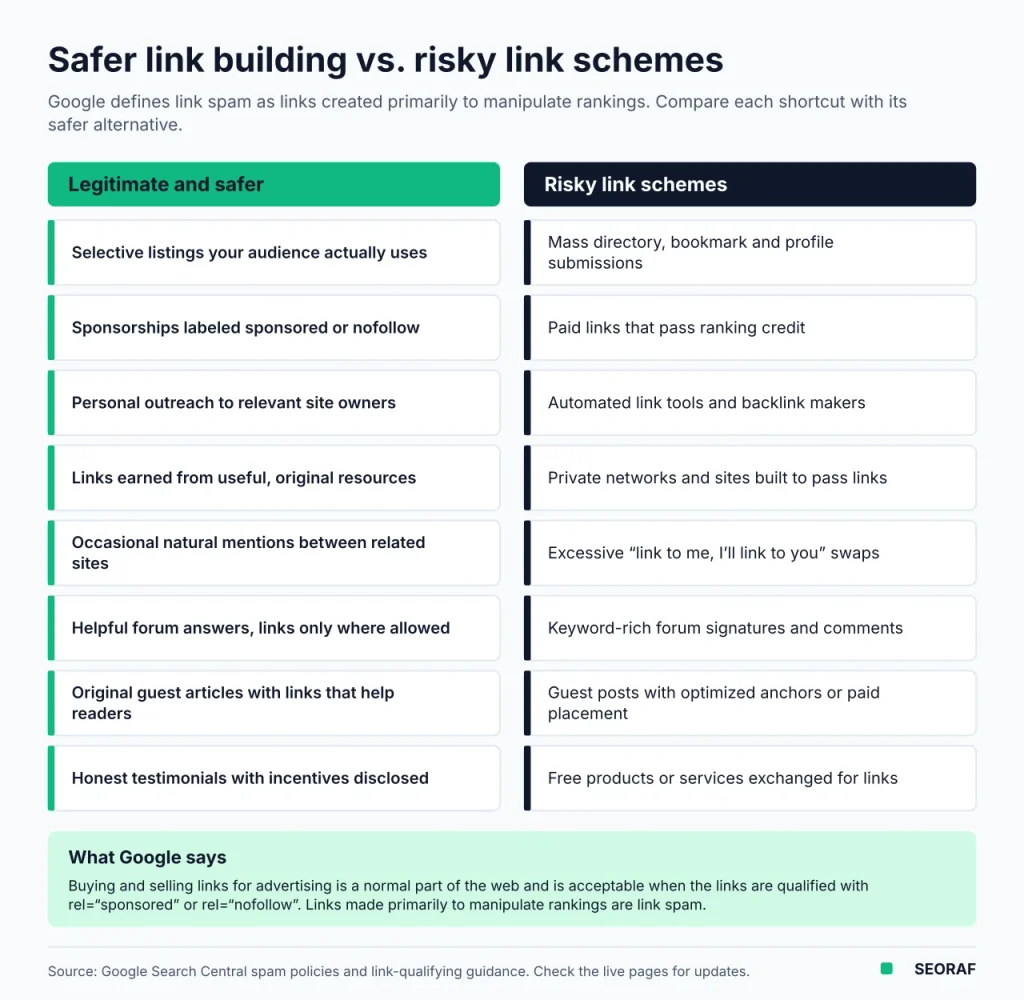
| Tempting shortcut | Why it appeals | What Google documents | Safer alternative |
|---|---|---|---|
| Backlink makers and automated tools | Fast and cheap | Using automated programs or services to create links is listed as link spam | Hand-built foundations (Methods 1-5) |
| Buying links without labeling | Guaranteed placement | Exchanging money for links that pass ranking credit is link spam; qualified advertising is acceptable | Sponsorships labeled sponsored or nofollow |
| Private blog networks and link-passing sites | Full control | Link schemes created primarily to manipulate rankings are covered by the policy | Earned or editorial links |
| Mass directory, bookmark and profile submissions | “Free authority” | Low-quality directory and bookmark links are named | Selective listings (Methods 2-3) |
| Excessive reciprocal links | Mutual benefit | Excessive link exchanges and cross-link-only partner pages are named | Relationship links (Method 11) |
| Keyword-rich forum signatures or comment links | Visible anchor text | Forum comments with optimized links are named | Genuine participation (Method 7) |
| Footer or widget links spread across sites | Scalable | Widely distributed footer links and keyword-rich widget links are named | None needed |
| Misleading guest posting | Authority transfer | Optimized-anchor guest-post links and paid articles are named | Method 12 done properly |
| “Guaranteed ranking” link packages | Certainty | No one can guarantee rankings | Walk away |
Based on Google Search Central’s spam policies, as read at the time of review. Check the live page, as policies change.
Paid links and legitimate sponsorship
Paying for advertising or sponsorship is a normal part of marketing. It becomes link spam when payment is used to get links that pass ranking credit without being labeled. If you pay, the link should be marked rel="sponsored" (or nofollow), as described in Google’s documentation. Google also warns that buying links can lead to manual action.
Automated link building and private networks
Tools that mass-produce links are exactly what the spam policy targets. “Private blog network” is industry shorthand rather than Google’s own term, but the practice it describes, creating sites mainly to pass links, falls under the policy’s broader prohibition on links built to manipulate rankings.
Irrelevant directories and excessive reciprocal links
A few relevant listings are fine. Hundreds of submissions to unrelated directories look like manipulation and are unlikely to attract customers. Likewise, a handful of natural mentions between related sites is normal, but systematic “link to me, I’ll link to you” arrangements are not.
Misleading guest posting and unsolicited link-sale emails
Guest posting turns spammy when it becomes a volume game: the same article recycled across sites, optimized anchor text, or paid placements presented as editorial. Emails offering “guaranteed” links or rankings deserve skepticism, which is the advice in Google’s guidance on SEO providers.
A quick link hygiene checklist
SEORAF recommendation: before pursuing any link, ask three questions.
- Would this link help a reader of that page?
- Did an independent person choose it, rather than me paying or arranging it?
- Would I still want it if it were nofollow?
If the answer to any of these is no, reconsider.
Which Methods Should You Start With?
The right starting point depends on what you already have: time, expertise, an existing network, or a real-world business.
| Site type | Start with | Add next | Later | Cautions |
|---|---|---|---|---|
| New blog, affiliate or review site | 1, 5, 7 | 6, 8, 12 | 13 | Disclose affiliate relationships; avoid shortcuts |
| Local business | 2, 4, 5 | 6, 11 | 15 (local angle) | Keep listings accurate; think carefully before paying for memberships |
| Established website | 6, 9, 11 | 10, 13 | 14, 15 | Prioritize relevance over volume |
| Very little time | 1, 5 | 6 | Nothing yet | Do one method well rather than five badly |
Numbers refer to the 15 methods above. SEORAF recommendations, not guarantees.
Whatever your type, start with the low-risk methods you control, then add one outreach method, and expand only after you have a feel for the effort involved. The right starting set is the smallest one you will actually maintain.
A Beginner Backlink Action Plan
This is a SEORAF recommendation for sequencing your effort, not a timeline for rankings or traffic.
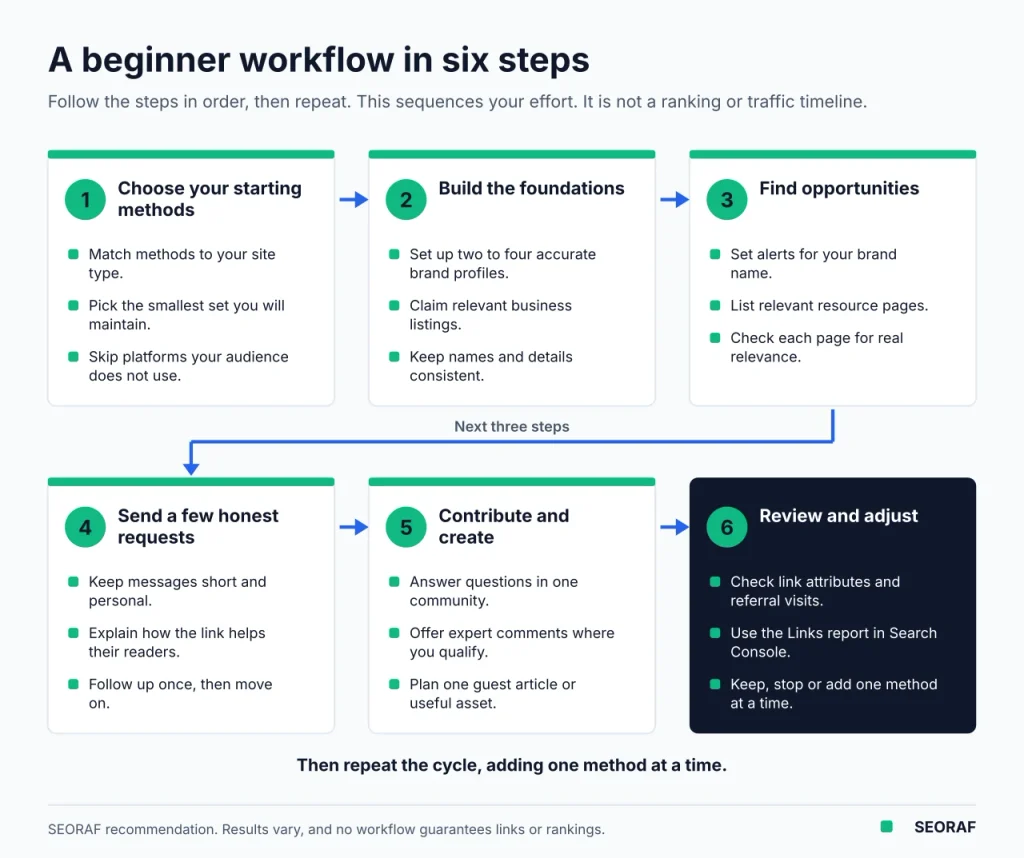
Phase 1: Foundations
- Choose your starting methods from the table above.
- Set up two to four brand profiles and, if relevant, claim existing business listings.
- Write down your brand name variations for later mention tracking.
Phase 2: First requests
- Look for unlinked mentions of your brand and send a few polite requests.
- Find one or two resource pages where your content genuinely fits.
- Use the outreach structure from earlier.
Phase 3: Contribute
- Join one community and start answering questions.
- Decide whether a guest contribution or a linkable asset suits your skills and time.
Phase 4: Review
- Check your links using the measures in the next section.
- Keep what is working, stop what is not, and add one new method at a time.
A simple tracking sheet needs only a few columns: date, method, page or contact, what you asked for, response, link status, link attribute and notes.
How to Tell Whether Your Backlinks Are Working
Measurement helps you decide what to keep doing. It does not prove that a particular link caused a ranking change.
| Metric | What it tells you | Where to find it | Limits |
|---|---|---|---|
| Referring domains | How many unique sites link to you | Search Console, backlink tools | Different tools find different links |
| Relevant backlinks | Whether links fit your topic and audience | Manual review | Subjective; needs a consistent standard |
| Link attributes | Whether links are regular, sponsored, ugc or nofollow | Inspecting the page or a tool | Attributes can change over time |
| Referral traffic | Visits that came through links | Your analytics | Does not capture any ranking effect |
| Search Console Links report | Links Google reports to your site | Google Search Console | A useful view, not a complete census |
| Third-party authority scores | A vendor’s estimate of link strength | Vendor tools | Not Google metrics; each vendor calculates differently |
SEORAF summary of common backlink measures and their limits.
Checking links and attributes
To check a link’s attribute, open the linking page, right-click the link and choose “Inspect,” then look for rel values such as nofollow, sponsored or ugc. Some SEO browser extensions can highlight these automatically; see our comparison of SEO Chrome extensions and verify the features of any you try. For Search Console itself, our Google Search Console guide covers setup, and Search Console’s Links report shows linking sites and linked pages. If some of your linked pages now return errors, see our guide to fixing 404 errors, and check for incoming links before removing content (see SEO content pruning).
The limits of third-party authority metrics
Domain Rating, Domain Authority, Authority Score and similar numbers are created by tool vendors to estimate link strength. They are not Google’s ranking systems, they are not interchangeable between tools, and a high score does not guarantee a link is valuable or safe. Use them as rough sorting aids, never as the main reason to pursue or reject a link.
What not to conclude from short-term changes
Rankings fluctuate for many reasons, and Google says search changes can take weeks to months to show. Avoid crediting or blaming a single link for a change. Look at overall patterns across several weeks.
Easiest Backlinks FAQs
What are the easiest backlinks for a new website?
Brand profiles, a few relevant directory or association listings and honest testimonials are the most accessible. They are also usually the weakest signals, so use them as a foundation rather than a strategy.
Do easy or free backlinks help SEO?
It depends, and no one can promise an effect. Ahrefs describes self-placed links as generally low in value (practitioner view), and Google does not publish how much any specific link type counts.
Can easy backlinks hurt my site?
Links created primarily to manipulate rankings can fall under Google’s link spam policy. A few accurate, relevant listings are different from mass submissions or automated links. See the shortcuts section.
Do nofollow links help?
Google says links marked nofollow, sponsored or ugc will generally not be followed, and treats these attributes as hints. They can still send visitors and build awareness. Do not assume they pass ranking credit, and do not assume they have no value to readers.
Are directory submissions still worth it?
Selectively, for relevant, curated directories your audience uses. Google’s spam policies list low-quality directory links as spam, and Google staff have said directories generally do not help rankings.
Are backlink generators safe?
No. Google’s spam policies list using automated programs or services to create links as link spam.
Should I buy backlinks?
Paid links that pass ranking credit are link spam under Google’s policies. Advertising and sponsorship are acceptable if properly qualified. SEORAF recommends spending effort and budget on useful content and genuine relationships instead.
Is HARO still available?
Yes. As checked on 24 November 2026, HARO is operating again as a free email digest with morning, afternoon and evening editions. Connectively is also available as a platform-based service. Check the official HARO site and Connectively for current access, terms and submission rules. See Method 8 for the official announcements.
How many backlinks do I need?
There is no documented number. Google staff have said Google needs very few links to rank pages (a 2024 statement, not documentation), and what a page needs depends on its topic and competition.
How long until backlinks affect rankings?
Google’s SEO Starter Guide says changes can take from a few hours to several months to appear, and suggests waiting a few weeks before judging. No timeline is guaranteed.
How do I check my backlinks?
Use Google Search Console’s Links report together with a third-party backlink tool, and expect the two to differ. See the measuring section above.
Do backlinks matter for AI search?
Evidence is limited and correlational. A Semrush study of about 1,000 domains reported that link quality and authority were associated with stronger AI visibility, but it uses Semrush’s own authority metric and comes from a vendor, so treat it as published research with caveats. Google’s spam policies also now cover attempts to manipulate generative AI responses. For broader context, see our AI SEO workflow guide.
Conclusion: Your Next Steps
The easiest backlinks are real, but they are rarely the most valuable. Treat them as groundwork, keep them accurate and relevant, and spend your growing effort on links other people choose to give you.
Here is what to do this week:
- Pick your starting methods from the site-type table.
- Set up two to four accurate brand profiles, or claim the business listings you already have.
- Search for existing mentions of your brand and send two or three polite requests.
- Choose one community and answer a few questions helpfully.
- Create a simple tracking sheet and note each link’s attribute as it appears.
Links work best as part of a wider plan; for that, see our guide to increasing organic traffic, and browse the SEORAF resources for related guides.
Sources and How This Guide Was Built
Method: this guide is based on a review of Google Search Central documentation, recognized industry guides and published studies, followed by SEORAF’s editorial judgment. SEORAF did not run link-building experiments, publish proprietary data or verify the current link attributes of individual platforms. Tool and platform details change, so check live sources before acting. Review date: 24 November 2026.
Google-documented guidance:
- Spam policies for Google web search
- Qualify your outbound links to Google
- SEO Starter Guide
- Do you need an SEO professional?
- Creating helpful, reliable, people-first content
- Google link spam update announcement (2021)
Google staff statements (not policy):
- Google needs very few links to rank pages (Search Engine Roundtable)
- Links are not a top-three ranking factor (Search Engine Land)
- Google on web directories (Search Engine Roundtable)
Published research:
- Semrush backlinks and AI search study (correlational, vendor-produced)
- Survey of SEO professionals on links (Search Engine Land) (opinion data)
Practitioner views:
- Ahrefs: Link Building for SEO, The Beginner’s Guide
- Semrush: link-building tactics
- HARO: Connectively is Back, and HARO Isn’t Going Anywhere
- Connectively Help Center: HARO is acquired by Featured
- Connectively Help Center: Featured-to-Connectively migration
Written by Mousume Akter, Founder & Editor of SEORAF, an independent SEO knowledge resource. SEORAF is not an agency and does not sell rankings.