
AI SEO Workflow: The Exact Step-by-Step System to Rank #1 on Google in 2026
Most websites fail not because of content… but because of wrong SEO workflow.
You’ve been there. You spend weeks writing what you think is a “masterpiece.” You hit publish, wait three days, and then… silence. Crickets. Maybe a few impressions, but zero clicks.
It’s frustrating, isn’t it? You feel like you’re screaming into a void while competitors with worse content are sitting comfortably in the top 3 spots. You’ve checked your technical SEO guide, and everything seems fine. So, what gives?
Here is the hard truth: In 2026, writing great content is the baseline, not the differentiator. The differentiator is speed, scale, and precision.
What if AI could handle 70% of your SEO process?
I’m not talking about spammy bots churning out garbage. I’m talking about a sophisticated AI SEO workflow that acts as your personal strategist, writer, and analyst combined. Imagine a system that finds the gaps in your market, analyzes what Google wants, outlines a perfect post, drafts it, and optimizes it before you even finish your morning coffee.
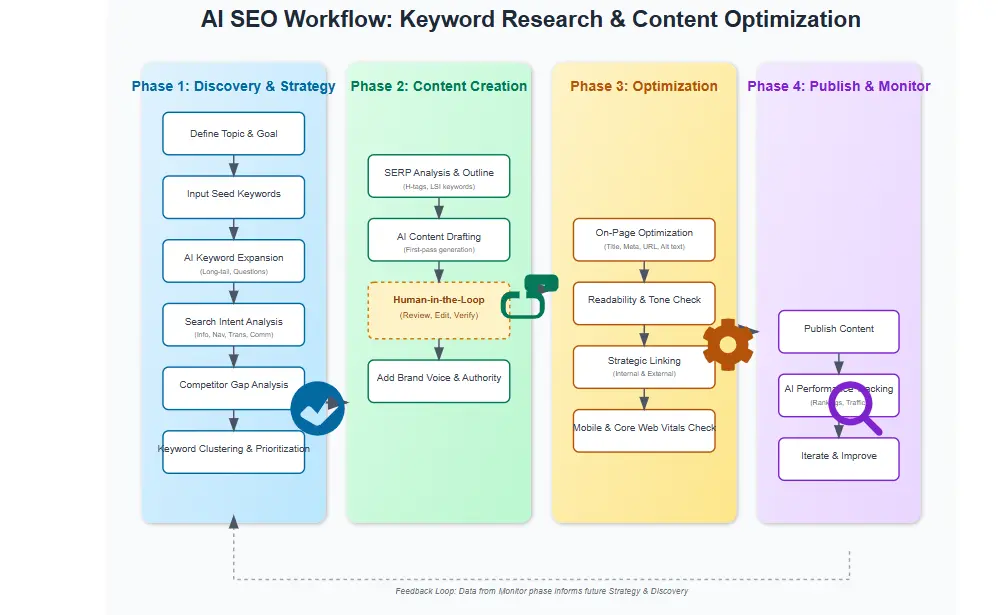
That isn’t science fiction. It’s the new standard for ranking. In this guide, I’m going to hand you the exact AI SEO strategy 2026 blueprint. No fluff. Just a step-by-step system you can steal and implement today to transform your organic traffic.
The Silent Killer: Why Traditional SEO is Failing You
Let’s look at why the old ways are broken. If you are still manually opening Excel sheets to type in keywords one by one, you are already losing. The AI SEO process is not just a buzzword; it is a survival mechanism in a landscape that evolves daily.
Key Takeaway
Speed is the new currency of SEO. If your workflow takes weeks from idea to publish, you are too slow for Google’s real-time web.
Why manual keyword research fails:
Humans are biased. We tend to guess what our audience searches for. We rely on “search volume” metrics that are often inflated or outdated. We miss the long-tail conversational queries that voice search and AI chatbots are driving traffic to right now. This is where utilizing AI for keyword research becomes a game-changer, removing the bias and finding data you would miss. If you haven’t updated your keyword research checklist to include AI prompts, you are flying blind.
Furthermore, Google’s Search Quality Evaluator Guidelines emphasize the value of content. If your content covers a topic shallowly because you were in a rush, a competitor using an AI SEO workflow to cover every semantic nuance will outrank you every single time.
What is an AI SEO Workflow?
So, what exactly is this workflow? Think of traditional SEO like trying to build a house with a spoon. An AI SEO workflow is showing up with an excavator, a 3D printer, and a team of robots.
It is a structured system where you use Artificial Intelligence to execute the repetitive, data-heavy, and analytical tasks of SEO, while you focus on strategy, creativity, and brand voice. This SEO automation workflow transforms the grind into a streamlined pipeline.
The Formula 1 Analogy:
Think of it like a Formula 1 race team.
- You (The Human): You are the Driver. You steer the car, make the split-second decisions, and feel the track.
- AI (The Pit Crew & Engineers): They calculate the tire pressure, fuel load, and aerodynamics in real-time. They tell you how to drive to win.
Without the driver, the car goes nowhere. Without the crew, the driver has no chance of winning. An AI SEO workflow integrates these two roles seamlessly, allowing you to leverage content SEO at scale without losing the human touch.
Step 1: Unlocking Hidden Traffic with AI Keyword Research
The foundation of any AI SEO workflow is finding the right opportunities—not just the most popular ones. Manual tools like Ahrefs and Semrush are great for historical data, but AI helps you predict what is happening now.
The Process:
Instead of just looking for high volume, we use AI to find low competition, high intent keywords. This is a critical part of the AI SEO process. You must align your strategy with the user’s search intent guide to succeed.
1. Seed Input:
Go to ChatGPT or Claude. Input your broad niche.
Prompt: “Act as an SEO expert. I run a website about [Sustainable Gardening]. Generate 20 long-tail keywords that have high user intent but low competition. Focus on ‘how-to’ and problem-solving queries.”
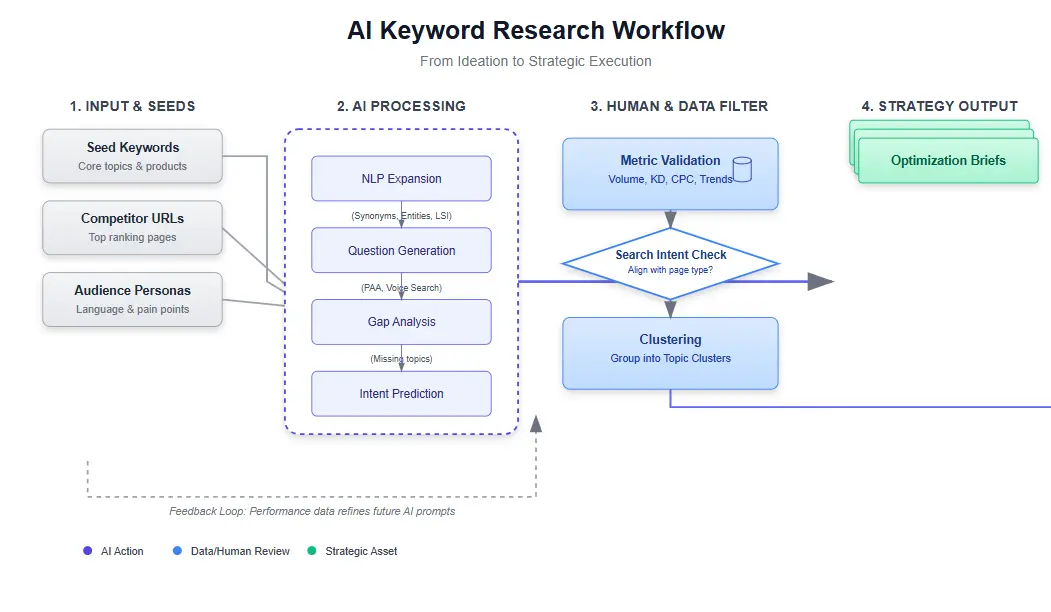
2. Cluster Mapping:
Google loves topical authority. You can’t rank for “Best Running Shoes” if you’ve never written about “Socks” or “Marathon Training.” Use AI to build a topical authority map.
Prompt: “Take these 50 keywords and group them into topical clusters. Identify the ‘Pillar Page’ for each cluster and the ‘Cluster Content’ that should link back to it.”
This approach uses AI for keyword research to find the gaps. AI can analyze semantic relationships between words that humans often miss. It ensures you are building a web of knowledge, not just isolated pages. A successful AI SEO workflow relies on this clustering to build authority fast.
Step 2: Crushing Competitors with AI Analysis
Now you know what to write about. But how do you win? You need to reverse-engineer the top 3 results. This is where the AI SEO process shines. It can read and digest 5,000 words of competitor content in seconds, something that would take a human analyst hours. This is similar to how advanced SEO audits work, but faster.
The Workflow:
- Identify the Rivals: Take your target keyword. Plug it into Google. Grab the URLs of the top 3 ranking posts.
- The “Gap” Analysis: Feed those URLs into an AI tool (like Perplexity or a custom GPT) or copy-paste the text into ChatGPT.
- The Prompt: “Analyze these three articles about [Topic]. Identify:
- The common sub-topics they all cover (Table Stakes).
- Questions they answer.
- Specific data points or statistics they cite.
- Crucially: Tell me what topics, questions, or data points they missed.
This AI SEO workflow ensures you aren’t just copying; you are identifying the open spaces in the market and moving into them. Semrush offers similar gap analysis features, but AI adds a layer of qualitative reasoning that pure data tools sometimes miss.
Step 3: The “Blueprint” Strategy for Perfect Content
This is the step most people skip, and it’s the reason they fail. Never ask AI to “Write an article about X.” That’s how you get generic, robotic content. Instead, ask AI to build you a Blueprint. A Content Brief dictates the structure, the headings, the tone, and the entities you must include in your AI SEO workflow. This aligns perfectly with a semantic SEO strategy.
Pro Tip
Always ask for NLP entities in your brief. Google looks for these specific terms to understand the context of your page.
The Framework:
Using the gaps you found in Step 2, create a prompt:
Prompt: “Create a comprehensive content brief for a post titled [Your Title]. The target audience is [Audience]. The tone is [Tone: e.g., Witty, Professional].
- Structure: Create H2s and H3s that cover the standard topics plus the ‘Gap’ topics we identified earlier.
- NLP Entities: List the specific entities (names, places, scientific terms) Google expects to see for this topic.
- Formatting: Include suggestions for bullet points, tables, and FAQs to win Featured Snippets.”
This brief ensures your article covers the topic with more depth than anyone else. It primes the AI to think like an editor, not a robot. According to Google Search Central, structured content is easier for crawlers to parse, making this a vital step in your AI SEO workflow.
Step 4: The Human-AI Hybrid Writing System
Here is where the magic happens—and where the danger lives. If you just copy-paste the output from OpenAI‘s ChatGPT, you will not rank in 2026. Google is getting better at detecting “undetectable AI,” and more importantly, users hate reading dry text.
You need a Human + AI Hybrid Workflow.
The 70/30 Rule:
Let AI do the heavy lifting (70%), but you must inject the soul (30%). This is the only safe way to execute an AI SEO workflow for writing.
1. The Drafting:
Upload your Content Brief to your AI tool.
Prompt: “Write the introduction for H2: [Heading]. Use a storytelling hook. Keep it under 100 words.”
Prompt: “Write the section for H2: [Heading]. Use the data points mentioned in the brief. Use short sentences.”
2. The Human Polish (The EEAT Injection):
This is how you add Experience, Expertise, Authoritativeness, and Trustworthiness. You can use SEO templates to streamline this.
- Add Personal Anecdotes: “When I tried this method in 2024, I noticed…”
- Add Original Images: Don’t use stock photos. Take screenshots of your own data.
- Add Specific Opinions: AI is neutral. Rankings require controversy. Take a stand.
Scenario:
Let’s say you are writing about “Keto Diets.”
AI writes: “Keto diets involve reducing carbohydrate intake.”
You edit: “I tried the Keto diet for three months. While the weight loss was fast, the brain fog in week two was brutal. Here is how I hacked my way through it.”
The second version has EEAT signals. The first is generic. The AI SEO workflow relies on AI to build the skeleton, but you must provide the heartbeat.
Step 5: Laser-Focused AI Content Optimization
You’ve written the post. But is it perfect? Probably not. It might be too hard to read. It might miss some internal links. It might lack semantic density.
This is where we use tools like Surfer SEO, Frase, or NeuronWriter. This step is essential for a complete AI SEO workflow. If you have old content cluttering your site, you might also need to look into SEO content pruning before optimizing.
The Process:
- Audit: Paste your draft into the tool. It will compare your text against the top 10 ranking pages.
- Score: It gives you a score (e.g., 65/100).
- Optimization Loop:
- Missing Keywords: The tool says you used the word “SEO” 5 times, but competitors use it 12 times. Action: Add it naturally to a few headers.
- Readability: The tool says your sentences are too long. Action: Break them up.
- Structure: The tool suggests adding a “Conclusion” header. Action: Add it.
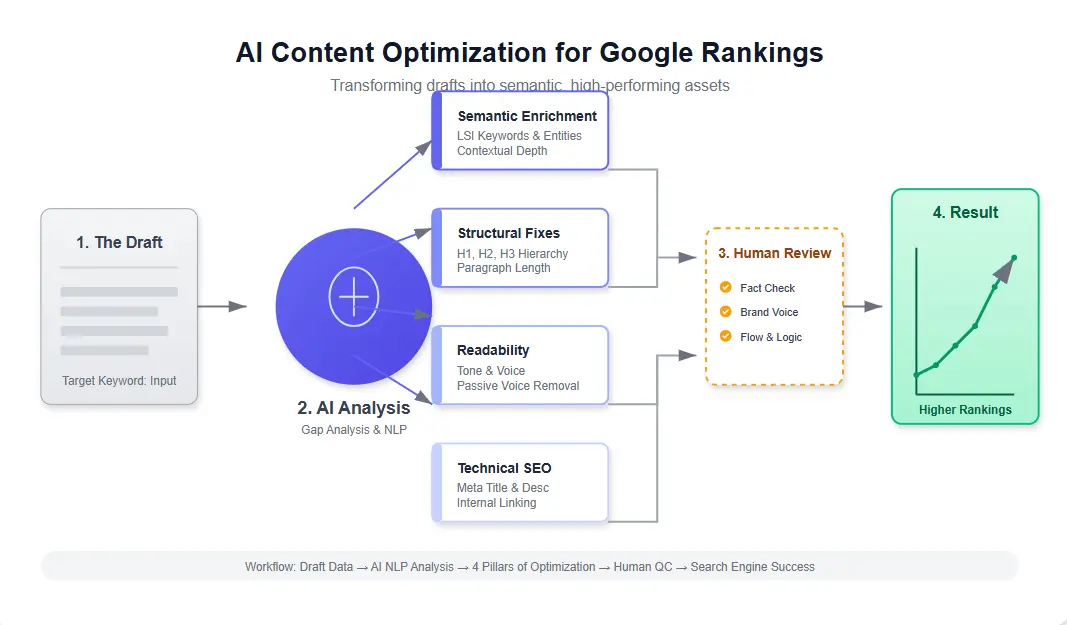
This SEO automation workflow removes the guesswork. You aren’t optimizing based on feel; you are optimizing based on what is currently working on page one.
Internal Linking with AI:
Don’t forget to link your pages together.
Prompt: “Here is a list of my 10 latest blog posts. Read the new draft I just wrote. Suggest 3 internal links I should add to this new draft to boost my topical authority.”
Step 6: The Ultimate Tech Stack for SEO Automation
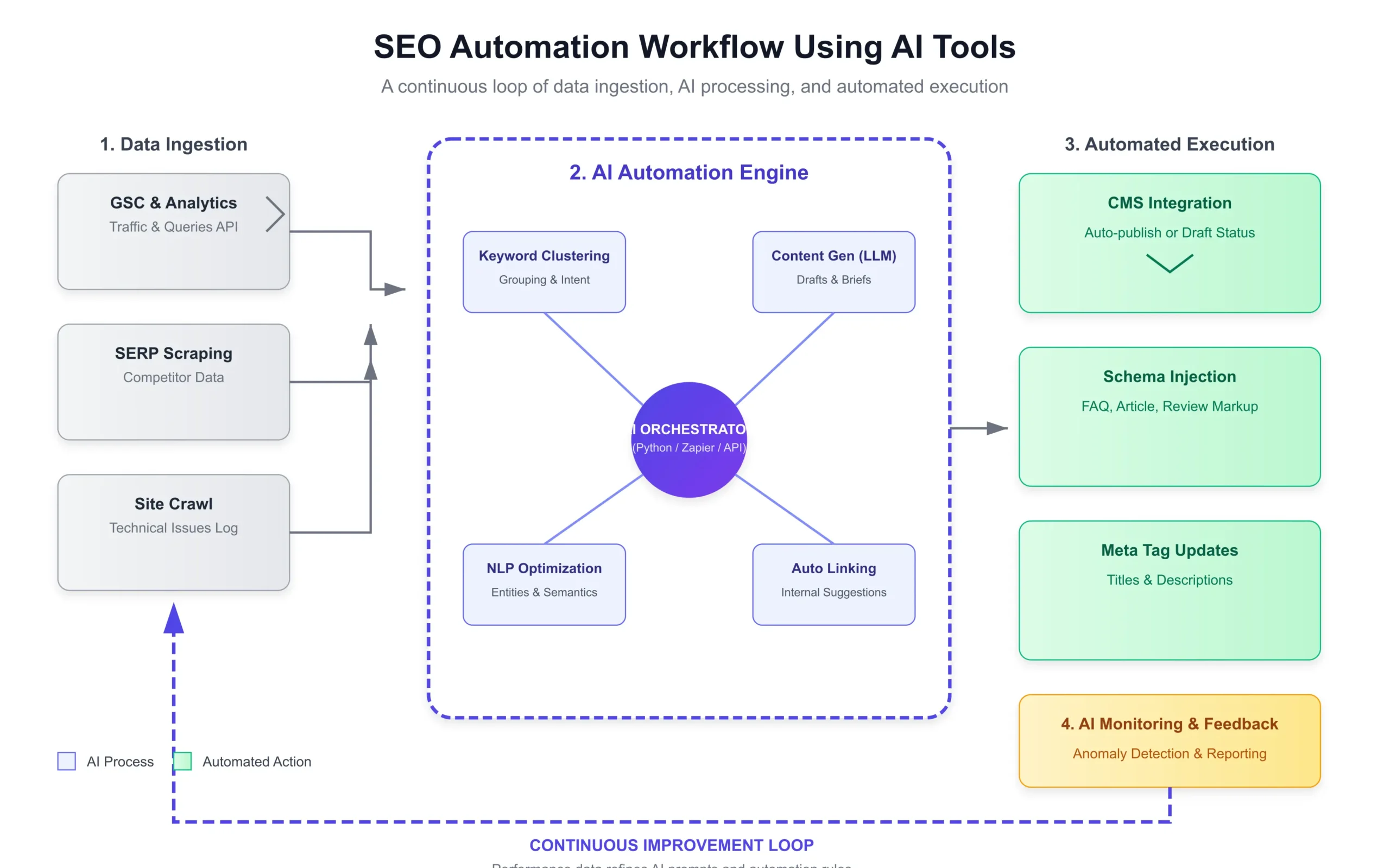
To run this AI SEO workflow, you need a tech stack. You don’t need everything, but you need the right things. Here is the 2026 stack:
| Tool Category | Recommended Tools | Best For |
|---|---|---|
| Research & Ideation | ChatGPT-4, Claude 3.5, Perplexity | Brainstorming, clustering, and competitor gaps. |
| Data & volume | Ahrefs, Semrush | Accurate search volume and backlink data. |
| Content Optimization | Surfer SEO, NeuronWriter, Frase | NLP guidelines, content scoring, and SERP analysis. |
| Programmatic SEO | Make.com (Integromat), Zapier | Connecting the workflow (e.g., Auto-posting). |
Workflow Integration:
The pros connect these tools. For example, you might use Zapier to send a new keyword from Ahrefs directly to a Google Sheet, which triggers a ChatGPT prompt to write a title tag. This level of SEO automation workflow allows you to scale from 10 posts a month to 50 without hiring a massive team. Just ensure you don’t overlook the technical side, like checking your JavaScript SEO checklist, as dynamic content can complicate indexing.
Advanced SEO Strategy 2026
Ready to go pro? The AI SEO strategy 2026 isn’t just about writing faster; it’s about building a smarter entity.
1. Topical Clusters & The Hub-and-Spoke Model
Use AI to visualize your entire site architecture.
Prompt: “I have a website about [Coffee]. Create a hub-and-spoke model. The ‘Hub’ is ‘Guide to Coffee.’ Generate 50 ‘Spoke’ article ideas that cover every aspect of coffee (brewing, beans, machines, history) to establish topical authority.”
When Google sees you cover the entire subject, it trusts you as an expert. This is the core of a winning AI SEO strategy 2026.
2. The Internal Linking Silo
A strong internal linking structure passes link equity efficiently.
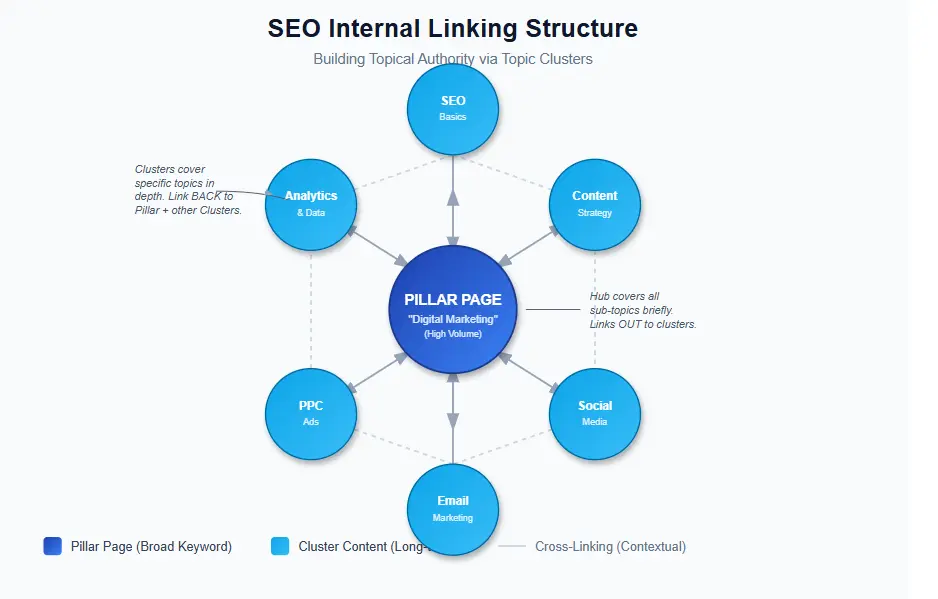
Don’t just link randomly. Create a silo structure where your Pillar page links to Cluster pages, and Cluster pages link back to the Pillar page and to each other. This reinforces the semantic relevance of your entire site.
3. Programmatic SEO (For Scale)
This is for advanced users. If you have thousands of product pages (e.g., “Running Shoes for Size 10”), you can’t write them manually. Use AI to generate unique descriptions for thousands of pages based on a CSV of data. Warning: This requires strict technical setup to avoid duplicate content issues in your AI SEO workflow.
4. CTR Optimization with AI
Ranking #1 is useless if nobody clicks. Use AI to generate 10 different Title Tags and Meta Descriptions for your page.
Prompt: “Generate 10 emotional, curiosity-driven title tags for this post. Use power words. Keep them under 60 characters.”
A/B test these to boost your Click-Through Rate (CTR), which signals to Google that your result is valuable.
Final Verdict: The Future is Now
The landscape of search has changed forever. You can either stick to the manual methods of the past—staring at spreadsheets, guessing at keywords, and watching competitors zoom past you—or you can embrace the future.
The AI SEO workflow is not about replacing your expertise. It’s about amplifying it. It’s about removing the grunt work so you can focus on the high-level strategy that actually moves the needle.
By using AI for keyword research, competitor analysis, and optimization, you can build a site that Google loves and users adore. This AI SEO strategy 2026 is your roadmap to the top.
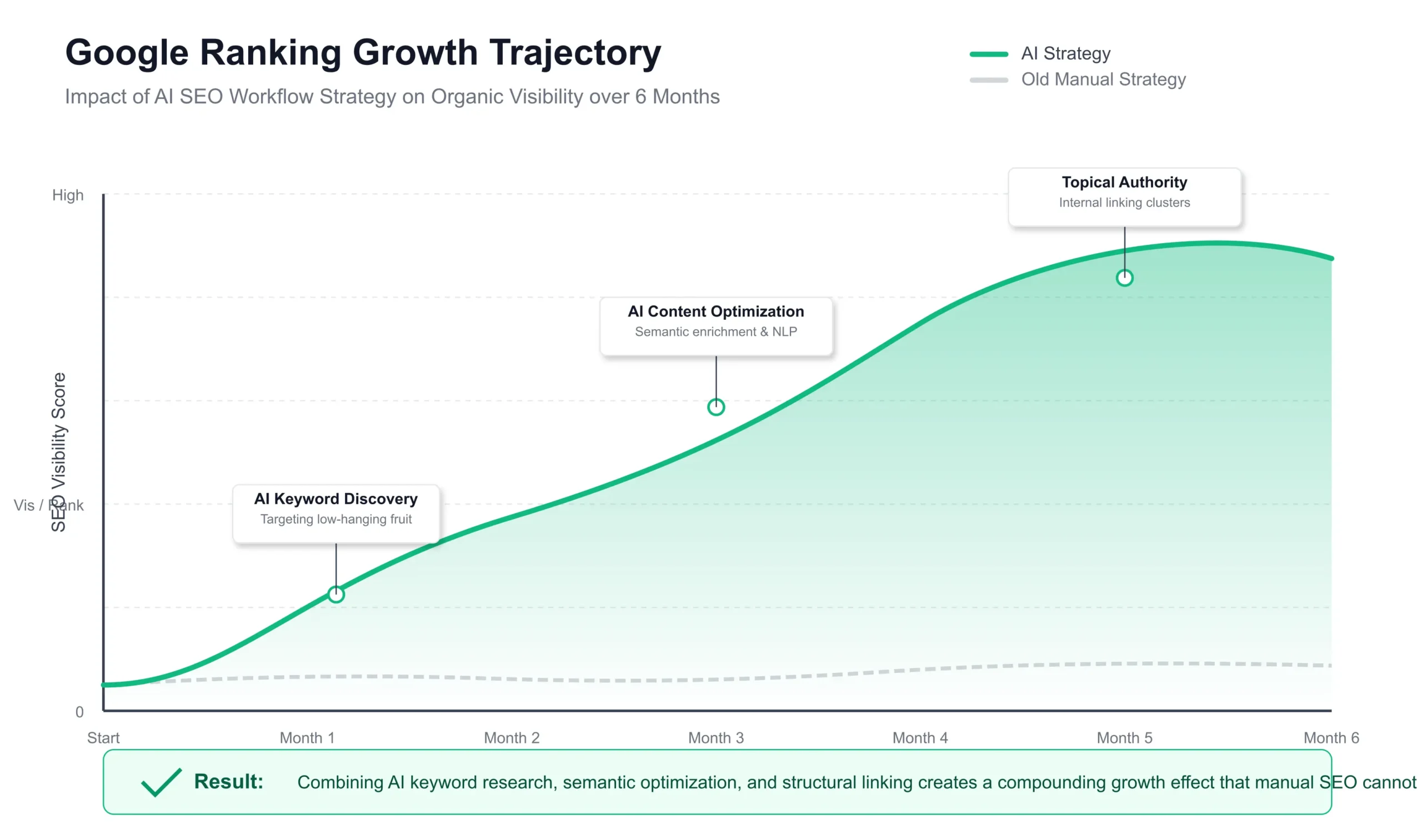
AI doesn’t replace SEO—it upgrades it.
So, what are you waiting for? The robots aren’t taking your job; they are applying for it. Are you ready to be their manager?
Start building your AI SEO workflow today.
Frequently Asked Questions (FAQ)
No. AI is a tool, like a hammer. A hammer doesn’t replace a carpenter. SEOs who use AI will replace SEOs who don’t.
Pure, unedited AI content can be bad if it provides no unique value. However, “Human + AI” hybrid content, where AI handles structure and humans add insight, is perfectly safe and highly effective.
There is no single “best” tool. A combination of ChatGPT/Claude (for writing/thinking) and Surfer/NeuronWriter (for data/guidelines) forms the ultimate AI SEO workflow stack.
Focus on EEAT (Experience, Expertise, Authoritativeness, Trustworthiness). Add personal stories, real-world examples, and original data to every post in your AI SEO workflow.
It is possible for low-competition keywords, but for competitive terms, you need a holistic strategy including backlinks and technical SEO, which AI assists with but doesn’t fully automate yet.
Most users report saving 50-70% of their time. What used to take 4 hours can now be done in 1 to 1.5 hours using an optimized AI SEO process.