
7 Search Intent Secrets to Skyrocket Rankings
The High-Traffic, Zero-Sale Problem
I remember the meeting vividly. It was a Tuesday afternoon, and I was sitting across from a marketing director who was visibly frustrated. He pulled up his Google Analytics dashboard, pointed to a massive spike in traffic, and said, “Look at this. We are hitting 60,000 visitors a month. But our bounce rate is 89%, and we aren’t selling a single thing.”
He looked at me, eyes wide, and asked the question that plagues many businesses: “Is SEO broken? Why does this search intent guide stuff matter if we have the traffic?”
The problem wasn’t the volume; the problem was the alignment. They had optimized their homepage for the keyword “CRM software”—a highly transactional term. However, the content Google was ranking them for was a fluffy blog post titled “What is a CRM?”
Users searching for “CRM software” had their credit cards on their keyboards. They wanted to buy, compare, or start a free trial. Instead, they landed on a dictionary definition. They read one sentence, realized they weren’t being helped, and clicked the “back” button immediately. In the SEO world, we call this “pogo-sticking,” and it is a death sentence for your rankings.
SEO wasn’t broken. Their search intent guide strategy was non-existent. They failed to understand that Google doesn’t just rank keywords; it ranks solutions to problems.
After the Helpful Content Update and the rise of BERT and MUM, Google’s NLP (Natural Language Processing) has become frighteningly sophisticated. It no longer matches strings of text; it matches the *meaning* behind the text. If you want to rank #1, you need to stop obsessing over keyword volume and start obsessing over user satisfaction. That is the core lesson of this search intent guide.
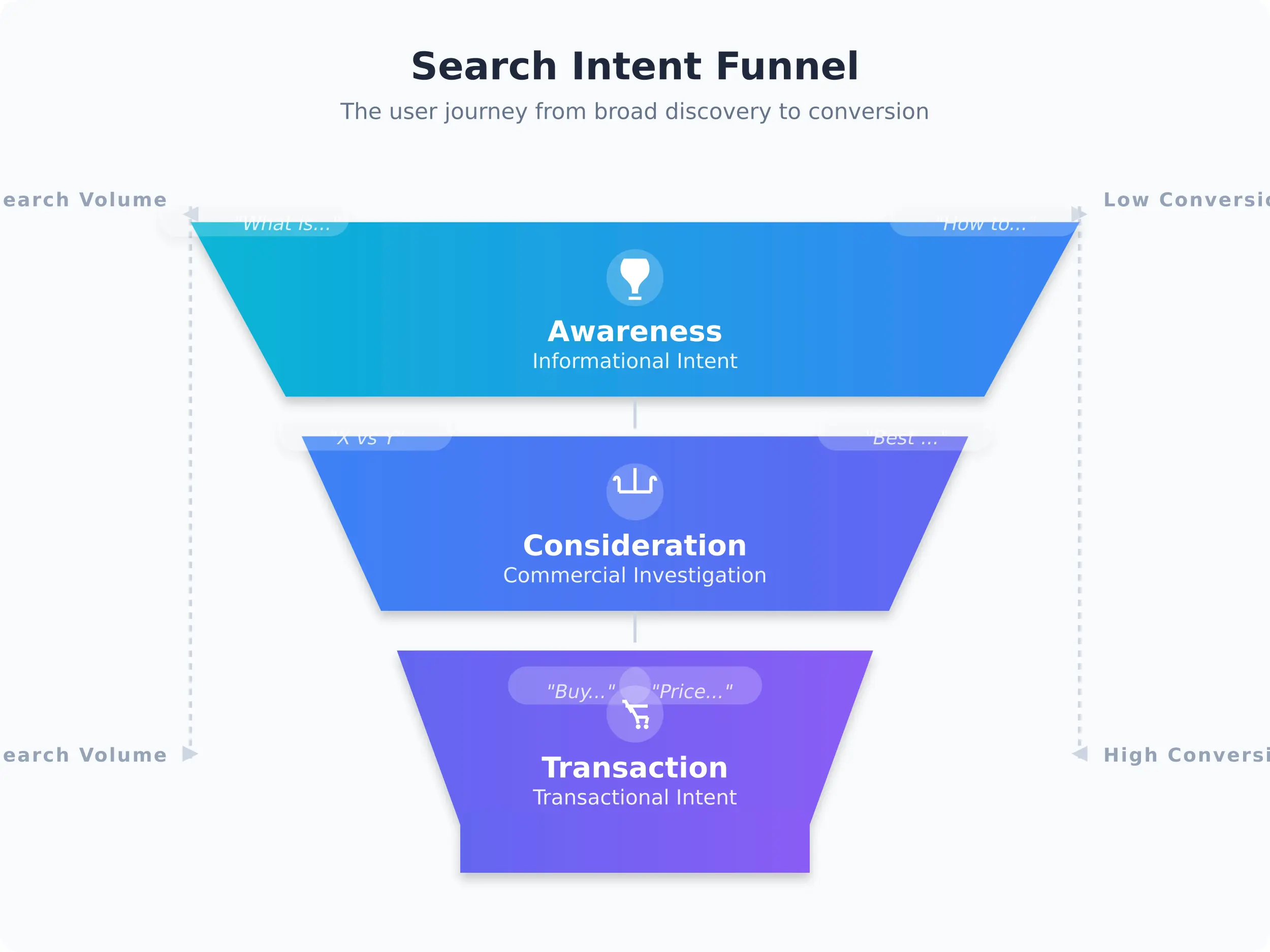
What is Search Intent? (The Definitive Answer)
Before we dive into the tactics, we need to establish a foundation. What exactly are we talking about when we use the term? As we progress through this search intent guide, we will refer to this concept constantly.
Search Intent (also known as User Intent) is the primary goal a user has when typing a specific query into a search engine. It represents the specific answer, resource, or action the user is hoping to find.
In the early days of the internet, search engines were rudimentary. If you typed “blue shoes,” they looked for pages with the words “blue” and “shoes” repeated the most times. Today, the algorithm is a mind-reader. It tries to determine *why* you want blue shoes. Do you want to buy them? Do you want to see pictures of them for design inspiration? Or do you want to know the history of blue shoes?
As you will learn throughout this search intent guide, if your content fails to align with the “why” behind the query, you do not stand a chance—regardless of how many backlinks you build or how fast your site loads. The modern search landscape is dictated by semantic SEO, which prioritizes the relationship between words and concepts over mere repetition.
The 4 Types of Search Intent: A Deep Dive
Most generic guides give you a list and move on. But in this comprehensive search intent guide, we are going to break down the four core categories, the psychological triggers behind them, and the exact content formats that win.
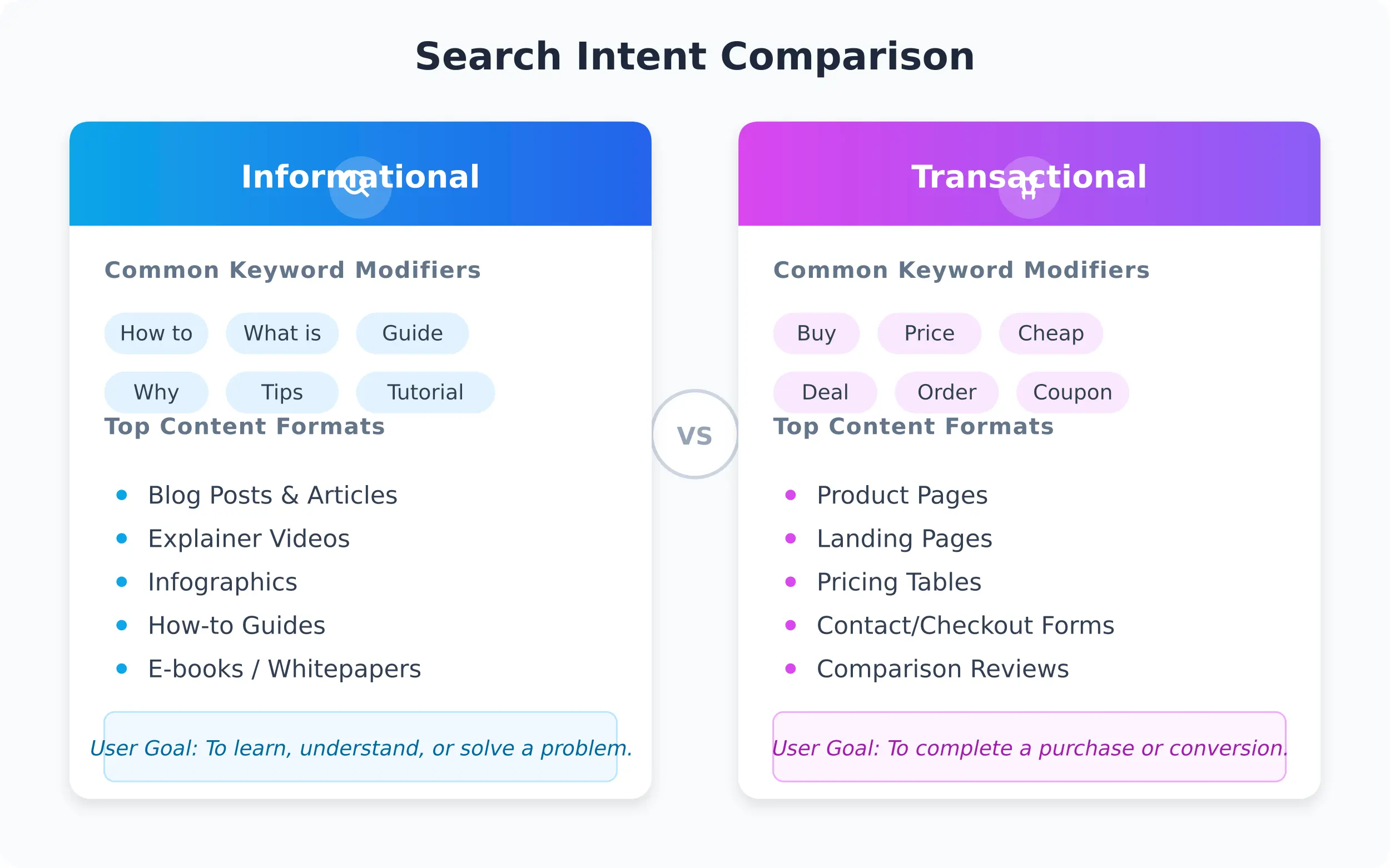
1. Informational Intent
This is the “I want to learn” stage. The user is at the very top of the funnel. They are not ready to buy yet; they are researching, diagnosing a problem, or satisfying curiosity.
- User Mindset: “Teach me. Explain this to me.”
- Trigger Keywords: How to, what is, why does, best way to, guide, tutorial, ideas for, tips, definition of.
- Content Formats: Comprehensive blog posts, “How-to” guides, infographics, explainer videos, glossaries, checklists.
- Example: “how to tie a windsor knot” or “what is blockchain.”
When targeting informational intent in your search intent guide strategy, your goal is to provide value quickly. Do not hide the answer behind a paywall or a popup. Give them the solution immediately to build trust. You want to be the authoritative source that Google cites in its AI Overviews.
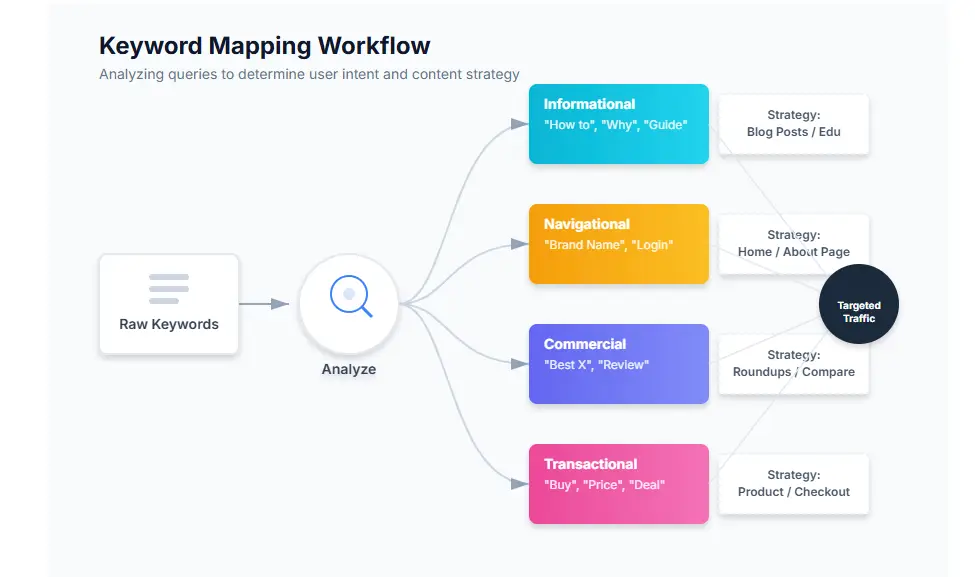
2. Navigational Intent
This is the “I want to go there” stage. The user knows exactly where they want to end up. They are using Google as a navigation bar because it is faster than typing in a URL.
- User Mindset: “Take me to that specific site.”
- Trigger Keywords: Brand names (e.g., “Nike”), specific product names (e.g., “iPhone 15 Pro”), “login,” “official site,” “customer support,” “contact.”
- Content Formats: Home page, specific product landing page, login portal, contact page.
- Example: “Facebook login,” “Semrush,” “YouTube,” “Gmail.”
There is little SEO opportunity here unless you own the brand. If you try to rank for a competitor’s brand name with an informational article, Google will likely suppress you in favor of the brand’s official site because of entity salience. The search engine trusts the brand entity for navigational queries.
3. Commercial Investigation Intent
This is the “I’m comparing” stage. The user is close to buying but needs reassurance. They are weighing pros and cons. This is the “consideration” phase.
- User Mindset: “Compare this for me. Which one is best?”
- Trigger Keywords: Best, vs, review, comparison, top 10, rating, [year] (e.g., “best CRM 2024”), alternative to.
- Content Formats: “Best X” listicles (Roundups), comparison charts (“A vs B”), in-depth product reviews, category pages.
- Example: “Nike vs Adidas running shoes” or “best SEO tools for small business.”
This is where money is made. A good search intent guide will tell you that commercial intent pages require high levels of trust. You need to show benchmarks, pricing, and unbiased pros/cons. Users here are skeptical; they are looking for third-party validation.
4. Transactional Intent
This is the “I’m buying” stage. The user has their wallet out. They have made the decision; they just need to execute the transaction.
- User Mindset: “Let me buy this now.”
- Trigger Keywords: Buy, cheap, discount, coupon, deal, order, download (for software), price, “for sale,” subscribe.
- Content Formats: Product pages, landing pages with clear CTAs, pricing tables, shopping cart pages.
- Example: “buy iPhone 15 pro max,” “cheap running shoes,” “HubSpot pricing.”
For transactional intent, friction is the enemy. If a user searches “buy” and lands on a page that requires three clicks to find the price, you have lost them. This is where technical SEO and UX play a massive role in your search intent guide execution.
Warning: Not every query fits neatly into one box. Many keywords have mixed intent. As you apply this search intent guide, be wary of oversimplification.
- Example: “Coffee maker.”
- Google shows product pages (Transactional) and “Best of” lists (Commercial Investigation) and “How to” videos (Informational).
- The Fix: Look at the SERP. If the top 3 results are listicles, don’t write a product page. If the top 3 are product pages, don’t write a blog post. You must match the dominant format of the current winners. The search intent guide rule here is: The SERP is the boss.
How Google Actually Detects Intent: The NLP Engine
You might wonder, how does a robot algorithm know I want to buy shoes versus learn about shoes? It isn’t magic; it is Semantic SEO and User Behavior Data working in tandem. To master this search intent guide, you must understand the engine under the hood.
1. Co-occurrence & Contextual Entities
Google looks at the words surrounding your query to disambiguate meaning. This is the heart of Natural Language Processing (NLP).
If you search just “Apple,” Google has to guess. But look at the context clues:
• “Apple pie recipe” -> Fruit.
• “Apple stock price” -> Tech Company.
• “Apple news” -> Tech Company.
Google understands that “recipe,” “pie,” and “cinnamon” are semantically related to fruit, while “stock,” “iPhone,” and “MacBook” are entities related to the corporation. Your search intent guide strategy must include related entities to help Google understand your content.
2. User Behavior Signals (Pogo-sticking & Dwell Time)
This is the democracy of the web. If users click your result, stay for 2 seconds, and click back to Google to choose a different result, Google learns a harsh truth: your page didn’t satisfy the intent. This is called “pogo-sticking,” and it is a massive negative ranking signal.
Conversely, if they click your link and stay for 5 minutes (long dwell time), Google assumes you answered the question perfectly. This reinforces why following a search intent guide is critical for retention.
3. Synonyms and Query Refinement
Google has a massive database of entities. It understands that “sneakers,” “kicks,” “trainers,” and “running shoes” often refer to the same concept in a commercial context. If you optimize for “running shoes” but your content uses “sneakers” naturally, Google still understands the intent. This semantic understanding is why keyword stuffing is dead; context is king.
Search Intent vs. Keyword Intent: The Critical Difference
This is a debate I often have in the SEO community. Is there a difference between the keyword and the intent? Yes, and understanding this nuance is what separates a novice from an expert following a search intent guide.
- Keyword Intent: This is the literal, grammatical interpretation of the phrase based on structure (e.g., a question mark denotes a question). It is static and dictionary-based.
- Search Intent: This is the *dynamic* intent derived from aggregate data, history, and user behavior. It is what users *actually* want, not what the grammar suggests.
Real-World Example from the Search Intent Guide:
Keyword: “CRM”
- Keyword Interpretation: It’s a noun. It stands for Customer Relationship Management. A strict keyword-matching algorithm might think an article defining “CRM” is the best result.
- Search Interpretation: Historically, 90% of users searching “CRM” are looking for software to buy. Google now ranks software providers (HubSpot, Salesforce) above dictionary definitions because it prioritizes the likely search intent over the keyword intent.
The Takeaway: Do not rely on your intuition of what a keyword *should* mean. Rely on what Google *thinks* it means. Always verify using the SERPs. This is a fundamental rule of any search intent guide.
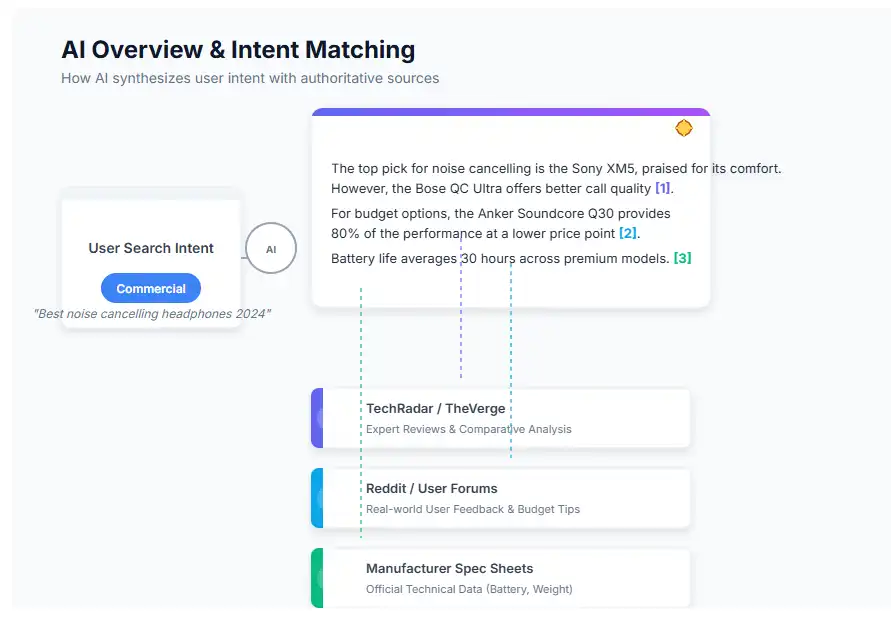
AI Overviews and Search Intent: The New Frontier
With the rollout of AI Overviews (SGE – Search Generative Experience), the landscape of search intent has shifted again. AI Overviews typically target Informational Intent and Commercial Investigation queries.
- If a user asks “How to clean running shoes,” Google’s AI scrapes top blogs to generate a summarized answer right at the top.
- The Risk: If you target informational keywords, you might lose clicks to the AI Overview. This is called “zero-click search.”
- The Opportunity: Google cites sources in the AI Overview. Being the cited source requires high EEAT (Experience, Expertise, Authoritativeness, Trustworthiness) and clear, structured data.
Strategy for AI Overviews in this Search Intent Guide:
Structure your content with step-by-step bullets and clear definitions. AI models love this structure. If your content is easy to scrape and summarize, you are more likely to be the reference. If you are the reference, you get the brand authority and the traffic from users who want to read the full details. A modern search intent guide must address AI visibility.
The Intent Optimization Framework
Reading a search intent guide is useless without a workflow. Here is the exact optimization framework I use to align content with intent. Stop guessing and start using this process.
Step 1: The SERP Audit (The Non-Negotiable)
Before you write a single word, go Incognito and Google your target keyword.
- Are the results product pages? -> Create a transactional page.
- Are they “Best of” lists? -> Write a comparison piece.
- Are they videos? -> Make a video or embed one.
- Are they short definitions? -> Write a concise answer followed by depth.
Step 2: Content Angle Analysis
Look at the top 3 ranking pages. What is their unique “angle”?
- Competitor A: “Best for beginners”
- Competitor B: “Best on a budget”
- Competitor C: “Best for enterprise”
Your search intent guide strategy should identify a gap. If everyone is targeting “beginners,” you should target “experts” or “professionals.” Differentiate based on the *who*, not just the *what*.
Step 3: Format Matching
If the top results are listicles, do not write a massive wall of text. If the top results are short definitions, do not write a 5,000-word pillar page (unless you are confident you can outrank them with a Skyscraper technique). Mimic the successful format, but make the content 10x better.
Step 4: The “Deep Click” Test
Click the top result. Scroll to the bottom. Is there a related post that answers the *next* logical question? If so, you need to cover that topic in your content or internally link to it. This keeps the user on your site and signals topical authority. To help with this, perform a content gap analysis. This step is crucial for the success of any search intent guide.
SERP Analysis Strategy: A Cheat Sheet
Use this table to analyze the Search Engine Results Page (SERP) like a pro. This is a crucial component of any search intent guide.
| SERP Feature | Likely Intent | Recommended Action |
|---|---|---|
| Featured Snippet (Position Zero) |
Informational (Direct Answer) |
Format answer in a clear paragraph or list at the very top of your content. |
| Product Carousel | Transactional | Optimize product schema markup and ensure high-quality images are present. |
| “People Also Ask” | Informational / Broad | Include these exact questions as H2s or H3s in your content. |
| Local Pack | Navigational / Local | Optimize Google Business Profile and build local landing pages. |
| Top Stories | Informational (News/Trending) |
Publish timely content with NewsArticle structured data. |
| Knowledge Panel | Navigational (Entity-based) |
Optimize your Wikipedia page and social profiles to build entity salience. |
Search Intent for Affiliate SEO
Affiliate marketers often make the mistake of being too aggressive too early. If you are building an affiliate site, you are almost always targeting Commercial Investigation Intent. This is a specific strategy I emphasize in this search intent guide.
Do not write a product page (Transactional) for a query like “best camping tents.” Write a “Best Camping Tents for 2024” roundup.
- Why? Users in the research phase want to compare options. If you give them one product to buy immediately, they will leave to find comparisons elsewhere.
- Tactic: Use comparison tables. “Model A” vs “Model B”. This satisfies the user’s need to weigh options before you hit them with the affiliate link.
According to Ahrefs, successful affiliate sites focus heavily on “Best X” keywords because they capture users who are ready to buy but need one final push.
Search Intent for Local SEO
Local SEO is unique because the intent is often implicitly navigational and transactional combined with geography. A good search intent guide must address local nuances.
- Query: “Plumber near me” or “Pizza in New York.”
- Intent: The user wants a physical location or a phone number right now.
- Strategy: Your landing page must have the NAP (Name, Address, Phone) visible above the fold. Don’t bury your contact info in the footer.
Moz consistently highlights proximity and relevance as key factors, meaning your content must match the *local* intent of the query (e.g., mentioning specific neighborhoods or landmarks).
Common Search Intent Mistakes
I audit dozens of sites a month, and I see the same errors repeatedly. Here are the three most common intent-killing mistakes that violate the principles of this search intent guide:
1. The “Homepage for Everything” Error
Trying to rank your homepage for every type of intent. Your homepage cannot effectively answer “What is X,” “Buy X,” and “Reviews of X” simultaneously. It confuses Google and frustrates users. You need separate pages for each stage of the funnel.
2. Ignoring Keyword Modifiers
Targeting “CRM” (Transactional) with content meant for “What is a CRM” (Informational). This is the classic Keyword Cannibalization issue. Google doesn’t know which page to rank, so it ranks neither. Check our guide on fixing keyword cannibalization if you see your own pages fighting for the same spot.
3. Thin Transactional Content
Creating a product page with just a “Buy Now” button and a price. Transactional users need reassurance to convert. They need specs, warranty info, shipping details, and social proof (reviews) to complete the action. A thin page signals low relevance. This is a major pitfall warned against in any search intent guide.
Best Tools for Search Intent Analysis
You don’t need to guess; these tools tell you exactly what Google wants. Integrating these into your search intent guide workflow will save you hours.
- Surfer SEO: Excellent for analyzing the top-ranking pages’ structure, word count, and keyword usage. It gives you a “Content Score” based on how well you match the intent of the SERP.
- Ahrefs: Great for keyword clustering and understanding the parent topic of a keyword to ensure topical authority.
- Semrush: Their “Intent” label in the keyword overview tool is fantastic for bulk analysis. Semrush also offers excellent SERP feature tracking.
- AlsoAsked: visualizes the “People Also Ask” data, showing you the branching questions users have. It is goldmine for informational intent.
- Google Search Console: Look at the queries where you have impressions but low clicks. Your intent might be slightly off, or your title tag isn’t matching the user’s desire.
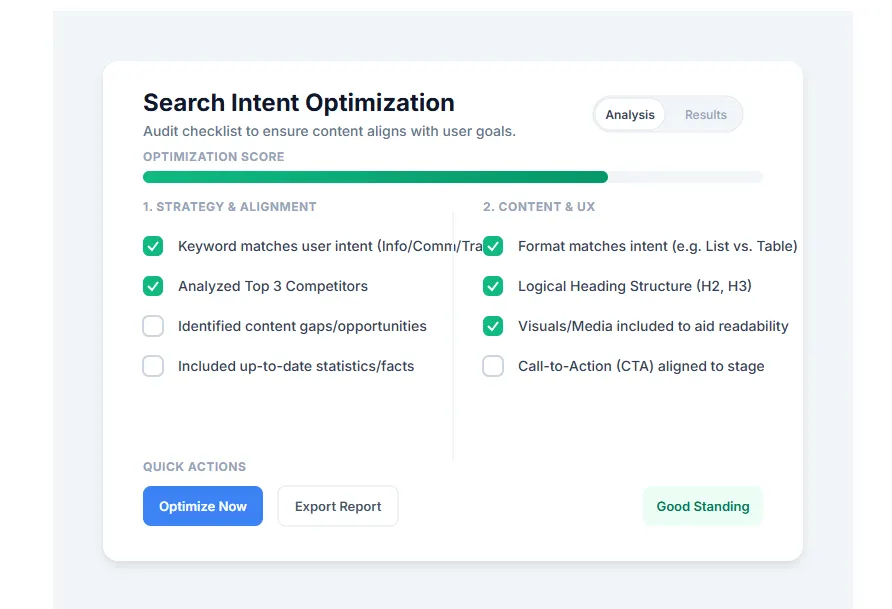
The Ultimate Search Intent Checklist
Before you hit “Publish,” run your content through this search intent guide checklist. If you miss any of these, you risk losing your ranking.
- SERP Match: Does my page format match the top 3 results?
- Keyword Modifier Check: Did I verify if the keyword implies “buy,” “learn,” or “go”?
- Content Depth: Did I answer the question immediately, or did I bury the lead?
- User Journey: Does the page guide the user to the next logical step (internal link)?
- Topical Authority: Does this page fit into a broader cluster of content I own? (See: Topical Authority Map).
- Mobile First: Does the content look good on mobile? (Most transactional searches happen on mobile).
Frequently Asked Questions
This section of the search intent guide addresses the most common questions strategists ask.
What is Search Intent in SEO?
Search intent is the purpose behind a user’s search query. It is the reason *why* someone types a specific phrase into Google, whether to learn, buy, or find a specific website. Optimizing for it is the core of this search intent guide.
Why is Search Intent important for SEO?
Google’s primary goal is user satisfaction. If your content satisfies the user’s intent better than competitors, Google will rank you higher. Ignoring intent leads to high bounce rates and low rankings. This is a foundational principle of SEO according to Search Engine Land.
What are the 4 types of Search Intent?
The four main types are:
- Informational: To learn something.
- Navigational: To find a specific site.
- Commercial: To investigate products or services.
- Transactional: To complete a purchase.
How do I optimize for Search Intent?
Analyze the SERPs for your target keyword. Identify the dominant content format (blog, product page, video), and create content that provides the best possible answer or solution in that specific format. Use this search intent guide to verify your approach.
Can a keyword have multiple intents?
Yes, this is called mixed intent. A query like “cloud storage” can show ads (Transactional), reviews (Commercial), and definitions (Informational). You must analyze the balance of the SERP to decide which intent to prioritize.
How does AI affect Search Intent?
AI Overviews are changing how informational queries are answered. Google now summarizes answers from multiple sources. To optimize for this, your content must be structured clearly and authoritatively to be cited as the source.
Conclusion: Stop Writing for Robots
We covered a lot of ground in this search intent guide. We moved from the basic definitions to advanced NLP concepts and AI Overviews.
Here is the bottom line: The era of “keyword stuffing” is dead. The era of “intent satisfying” is here.
If you want to rank #1, stop looking at your keyword density tool. Start looking at your users. Ask yourself: “Does this page give them exactly what they want, right now?”
If the answer is yes, you will win. This search intent guide is your roadmap. Follow it, audit your content, and watch your rankings climb. If you are looking for more foundational strategies, check out our SEO for beginners guide or learn how to increase organic traffic through proper optimization.
Next Steps to Boost Your SEO:
- If you are new to this, start with the fundamentals in our SEO for Beginners guide.
- Ready to build a strategy that dominates? Build a Topical Authority Map to ensure you cover every angle of user intent in your niche.
- Ensure your site health is perfect with our Technical SEO Guide.