
On-Page SEO Checklist: 15 Powerful Steps to Boost Rankings Fast (2026)
Follow this proven On-Page SEO Checklist to optimize every page, improve rankings, and drive more traffic.
You published a page. You hit publish. You waited. Nothing happened. No rankings, no traffic, no leads.
Here is the truth: publishing content is not the same as optimizing it. Google ranks pages that send clear signals about relevance and quality. If you aren’t sending those signals deliberately, you are leaving rankings to chance.
That is exactly what this On-Page SEO Checklist fixes. It gives you a repeatable system to optimize every page so search engines understand your content and readers actually engage with it.
What is On-Page SEO Checklist?
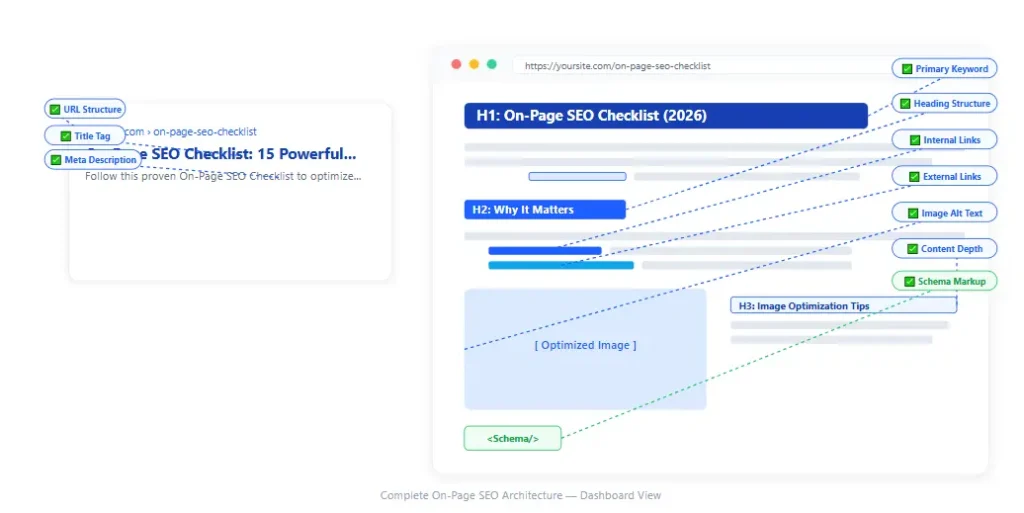
An On-Page SEO Checklist is a step-by-step framework to optimize individual web pages for target keywords. Unlike off-page SEO (backlinks), on-page SEO focuses on elements within your direct control.
This includes your title tag, meta description, heading structure, content depth, image optimization, internal linking, URL structure, and schema markup. Every element sends a distinct signal to Google about your page’s topic and value.
Most beginners write content, add a keyword in the title, and call it done. Then they wonder why competitors with weaker content outrank them. A proper On-Page SEO Checklist ensures you never miss these critical ranking signals.
Like a pilot’s pre-flight checklist, you follow the system to avoid disasters. Apply this On-Page SEO Checklist every time you publish, and you permanently eliminate guesswork from your SEO workflow.
Why On-Page SEO Matters
On-page SEO is the foundation of your search strategy. Without it, backlinks and technical setups fail to deliver results.
Google needs clarity. If your title is weak, headings are missing, and your keyword appears once in 3,000 words, Google has to guess your page’s topic. Guessing doesn’t lead to rankings.
Users decide in 3 seconds. When someone clicks your result, they immediately scan the page. If the heading doesn’t match their intent, they bounce. High bounce rates send negative signals. Your On-Page SEO Checklist aligns content with intent instantly.
You control 100% of it. You can’t control who links to you or when Google updates its algorithm. But you control every on-page element, making this the highest-ROI activity in SEO.
It compounds over time. Every optimized page ranks for more keywords, drives more traffic, and passes authority to other pages via internal links. For deeper context on how this fits into the bigger picture, check out our Technical SEO Guide.
Complete On-Page SEO Checklist: 15 Powerful Steps
Every item below has a direct, measurable impact on rankings. Do not skip them.
1. Target One Primary Keyword Per Page
Every page should target one primary keyword and two to four secondary keywords. Trying to rank for multiple primary keywords dilutes your signal and confuses Google. Map one specific keyword to one specific page.
2. Write a Click-Worthy Title Tag
Your title tag is the most important on-page element. Include your primary keyword near the beginning and keep it under 60 characters. Add power words or emotional triggers to boost CTR. “15 Powerful Steps to Boost Rankings Fast” always outperforms “On-Page SEO Steps.”
3. Craft a Meta Description That Drives Clicks
Meta descriptions massively affect click-through rate. Keep them under 155 characters, include your keyword naturally, and add a clear benefit. Every page on your On-Page SEO Checklist needs a unique, compelling meta description.
4. Structure Headings Properly (H1-H6)
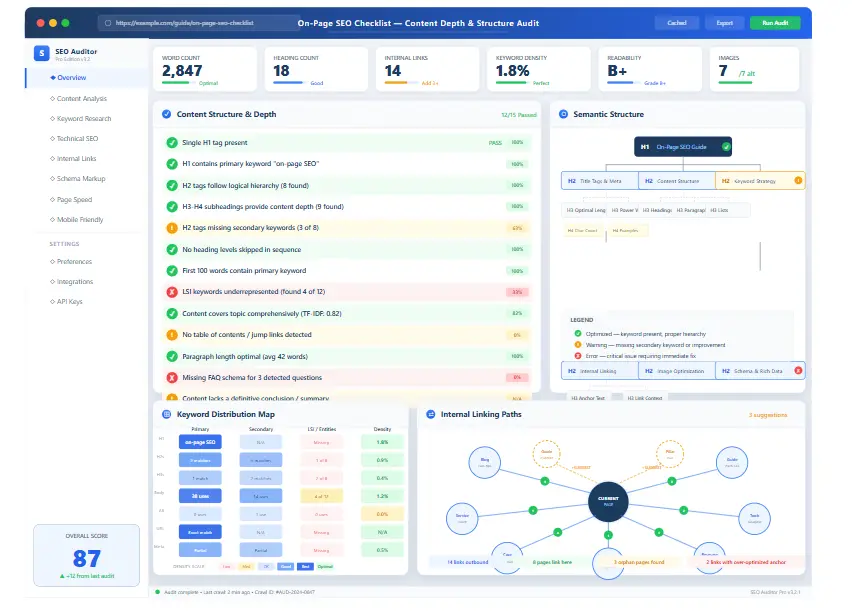
Use one H1 per page. Use H2s for main sections and H3s for subsections. Never skip heading levels. Include your primary keyword in the H1 and at least one H2 to help Google understand your content hierarchy.
5. Write In-Depth, Helpful Content with E-E-A-T
Content quality is the biggest ranking factor. Cover the topic fully and answer related questions. Show real experience, add author bios, and cite sources to satisfy Google’s E-E-A-T guidelines. This is the most valuable item on the On-Page SEO Checklist.
6. Use Keywords Naturally in the First 100 Words
Google places extra weight on opening content. Include your primary keyword within the first 100 words naturally. This signals relevance immediately to both Google and the reader.
7. Optimize All Images
Images waste SEO value when not optimized. Every image on your On-Page SEO Checklist needs:
- Descriptive file names (not IMG_1234.jpg)
- Alt text with relevant keywords
- Compressed file size (use WebP format)
- Proper dimensions to prevent layout shift
- Lazy loading for images below the fold
8. Build a Strong Internal Linking Structure
Internal links pass authority between pages and help Google discover content. Every page should link to three to five related pages. Use descriptive anchor text, but avoid over-optimizing with exact-match keywords.
9. Optimize URL Structure
Your URL should be short, clean, and include the primary keyword. Good: yoursite.com/on-page-seo-checklist. Bad: yoursite.com/p=12345?category=seo. Keep URLs under 60 characters and use hyphens, never underscores.
10. Add Schema Markup
Schema markup is structured data that helps Google understand your content and earns rich results like FAQ snippets. At minimum, add Article schema to blog posts. Tools like Google Search Central help you implement and test this.
11. Improve Page Speed
Page speed is a confirmed ranking factor. Target a Largest Contentful Paint (LCP) under 2.5 seconds. Compress images, minify CSS/JS, use a CDN, and upgrade hosting. Reference our Technical SEO Guide for detailed steps.
12. Make the Page Mobile-Friendly
Google uses mobile-first indexing. Test pages on real phones. Ensure text is readable without zooming, buttons are tappable, and nothing overflows the screen. Responsive design is mandatory on this On-Page SEO Checklist.
13. Optimize for User Experience Signals
Google measures dwell time, bounce rate, and scroll depth. Improve UX by using short paragraphs, bullet points, images, and clear formatting. A scannable page keeps users engaged longer.
14. Add External Links to Authoritative Sources
Linking out to authoritative sources adds credibility. Link to resources like our SEO Crawler Guide for deeper dives. Use nofollow for sponsored links and dofollow for informational references.
15. Track and Update Regularly
On-page SEO is never a one-time task. Audit your top pages every three to six months. Refresh statistics, add new information, and re-optimize for keyword shifts. A living On-Page SEO Checklist always outperforms a static one.
Download the Complete On-Page SEO Checklist PDF
Get the exact checklist used by SEO experts to rank pages on Google. Print it, share it, use it for every page you publish.
Good vs Bad On-Page SEO
Seeing the difference makes the On-Page SEO Checklist much clearer. Here is a direct comparison:
| Element | Bad On-Page SEO | Good On-Page SEO |
|---|---|---|
| Title Tag | Home – My Website | On-Page SEO Checklist: 15 Steps to Rank Fast |
| Meta Description | We do SEO services. | Follow this proven On-Page SEO Checklist with 15 powerful steps to boost rankings fast. |
| URL | /page?id=482 | /on-page-seo-checklist |
| Heading Structure | No H1, random H2s | One H1, logical H2/H3 hierarchy |
| Keyword Placement | Keyword mentioned once | Keyword in title, H1, first 100 words |
| Images | IMG_2847.jpg, no alt text | Descriptive name, alt text, WebP, compressed |
| Internal Links | Zero internal links | 3-5 contextual links to related pages |
| Content Depth | 300 words, surface level | Comprehensive, answers all questions |
| Page Speed | 6 second load time | Under 2.5 second LCP |
| Mobile | Text overlaps, tiny buttons | Fully responsive, easy to navigate |
If your pages look like the “Bad” column, you are leaving rankings on the table. Run through the On-Page SEO Checklist and fix each element systematically.
Step-by-Step Optimization Process
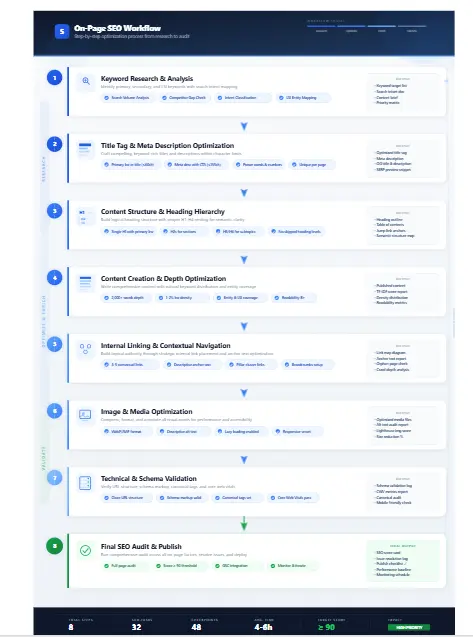
Knowing the correct execution order is critical. Here is the workflow for applying this On-Page SEO Checklist:
Step 1: Research before writing. Identify your primary keyword, search intent, and competitor gaps. Don’t write until you know what you are optimizing for.
Step 2: Write content first. Don’t optimize while writing—it kills flow. Write the best content possible, then optimize using the On-Page SEO Checklist.
Step 3: Optimize title and meta. Craft a compelling title tag and meta description. Ensure the keyword is placed correctly.
Step 4: Fix heading structure. Verify one H1, logical H2s, and proper H3s. Ensure headings describe the content below them.
Step 5: Add links. Link to three to five related pages on your site. Add one to two external links to authoritative sources.
Step 6: Optimize images. Rename files, add alt text, compress to WebP, and verify dimensions.
Step 7: Run technical checks. Test page speed, check mobile responsiveness, and validate schema. For a full sweep, use an SEO Crawler.
Step 8: Final review. Read from a user’s perspective. Does it answer the query? Is it scannable? Would you trust it?
Internal Linking Strategy
Internal linking is the most underrated item on any On-Page SEO Checklist. A proper strategy can boost rankings without earning a single new backlink.
Why it matters: Internal links pass PageRank between pages, help Google discover content, establish topic clusters, and keep users on your site longer.
How many links: Aim for three to five on short pages, and five to ten on long-form content. Every link must serve a purpose for the reader.
Anchor text: Use descriptive text that tells Google what the linked page is about. Avoid exact-match anchors on every link. Mix in natural variations.
Link deep: Don’t point all links to your homepage. Link to specific blog posts and service pages. Deep links distribute authority where it matters most.
Create topic clusters: Organize content into pillar pages (broad topics) and cluster pages (specific subtopics). Link them together to build topical authority. This transforms your On-Page SEO Checklist into a strategic system. For local businesses, this also supports your Local SEO Guide by connecting location and service pages.
Technical + On-Page Connection
On-page SEO relies on a solid technical foundation. If your technical setup is broken, a perfectly executed On-Page SEO Checklist won’t deliver results.
Crawlability: Google must find and crawl your pages. If robots.txt blocks important pages or your sitemap is missing pages, your on-page work is wasted. Run regular crawls using an SEO Crawler.
Indexability: Crawled pages must be indexed. Check Google Search Console for errors and use the URL Inspection tool to test pages.
Core Web Vitals: LCP, FID, and CLS are technical metrics that directly impact user experience. A beautifully optimized page that takes seven seconds to load will still lose to a fast-loading mediocre page.
Canonical tags: If you have duplicate pages, canonical tags tell Google which version to index. Without them, you split ranking signals across multiple URLs.
HTTPS: Every page on your On-Page SEO Checklist must be served over HTTPS. Mixed content warnings hurt rankings and trust.
Fix your technical foundation first. Think of technical SEO as the house foundation and on-page SEO as the interior design.
Advanced Optimization Tips
Once you master the basics, these tactics will push your pages even higher.
Optimize for featured snippets: Identify questions your keyword triggers in search results. Answer them directly using a “What is [Topic]?” H2 format followed by a concise 40-60 word answer.
Target People Also Ask (PAA): Search your keyword and note every PAA question. Create a dedicated H3 for each question in your content and provide a clear, direct answer below it.
Use semantic keywords: Include related terms and synonyms naturally. If writing about the On-Page SEO Checklist, including terms like “meta tags,” “heading structure,” and “page speed” signals comprehensive coverage to Google’s NLP models.
Add content upgrades: Place downloadable resources within your content to increase dwell time and generate leads. The PDF download in this guide is built natively into the On-Page SEO Checklist experience.
Optimize for passage ranking: Google can rank specific passages within a long page. Structure content so each H2 section stands on its own as a complete answer.
Monitor CTR aggressively: Use Google Search Console to find pages with decent positions but low CTR. Improve their title tags and meta descriptions. Tools like Ahrefs and SEMrush can help analyze these gaps.
Tools for On-Page SEO
You don’t need a dozen expensive tools to execute this On-Page SEO Checklist. Just the right ones:
Google Search Console: Free and essential. Shows keywords, CTR, indexing status, and technical issues. Start here.
Ahrefs or SEMrush: Paid tools for keyword research, competitor analysis, and on-page audits. Both have built-in On-Page SEO Checklist scoring features.
PageSpeed Insights: Free Google tool that measures Core Web Vitals and gives prioritized speed recommendations.
Screaming Frog or an SEO Crawler: Free for up to 500 URLs. Crawls your site to find broken links, missing meta tags, and duplicate content. Our SEO Crawler Guide covers setup.
Schema Validators: Google’s Rich Results Test verifies your structured data is implemented correctly.
Grammarly or Hemingway Editor: Improves readability and fixes grammar. Readability directly impacts engagement signals.
Common On-Page SEO Mistakes
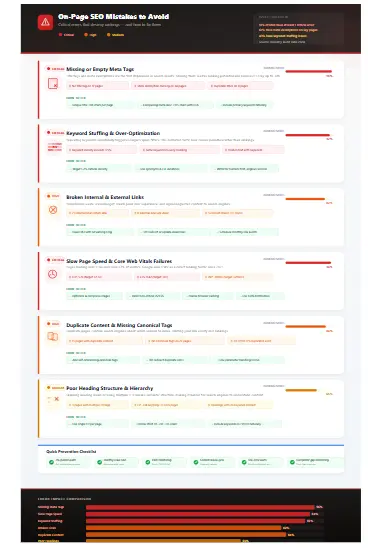
Even experienced SEOs make these mistakes. Ensure none are silently killing your rankings.
Keyword stuffing: Cramming your keyword into every sentence hurts readability and can trigger spam penalties. The On-Page SEO Checklist recommends 1-1.3% density for a reason.
Ignoring search intent: If someone searches “best running shoes” and your page covers “how shoes are made,” you missed the intent. Match content format to what searchers want.
Duplicate meta tags: Every page needs a unique title and meta description. Duplicate tags confuse Google and hurt CTR.
Forgetting E-E-A-T signals: Publishing without author bios, sources, or demonstrated experience hurts your trust score. Add clear credentials to every page.
Publishing orphans: New pages with zero internal links may go undiscovered by Google for weeks. Always link from existing content to new pages.
Publishing thin content: 300-word posts won’t rank in 2026. Match or exceed the depth of pages currently on page one.
Neglecting old content: Auditing and updating old content is often faster and more effective than publishing something new. Add this to your recurring On-Page SEO Checklist routine.
Frequently Asked Questions
An On-Page SEO Checklist is a structured list of optimization tasks applied to web pages. It covers title tags, meta descriptions, headings, content quality, internal links, image optimization, URL structure, and schema markup to ensure pages send clear relevance signals to Google.
Start with keyword research. Write your content first without optimizing. Then go through the checklist item by item: optimize the title and meta, fix headings, add links, optimize images, check speed, validate mobile responsiveness, and add schema. Finally, do a user-perspective review before publishing.
Review individual pages every three to six months. Update the checklist itself whenever Google announces major algorithm changes. At minimum, perform a full site audit once per quarter to catch emerging issues.
On-page SEO optimizes elements within your control on the page: content, titles, headings, and URLs. Off-page SEO involves external factors like backlinks, brand mentions, and domain authority. On-page is the foundation you should build first.
Yes, for low-competition, long-tail keywords. Strong on-page optimization can rank pages in niche topics without backlinks. However, for competitive keywords, backlinks are almost always necessary to push above established competitors.
Typically four to twelve weeks for re-optimized existing pages. Brand new pages may take three to six months depending on competition and domain authority. Be patient and consistent with your optimization efforts.
Conclusion
This On-Page SEO Checklist is a complete ranking system built from real-world results. When you apply these 15 steps to every page, you stop relying on luck and start building predictable, scalable traffic.
Sites ranking on page one aren’t there by accident. They’ve systematically optimized their tags, structured their headings, written comprehensive content, and built strategic internal links. You can do the same starting today.
Start with your most important pages. Run them through this On-Page SEO Checklist, fix every gap, and apply the same process to every new page you create.
Get the Free On-Page SEO Checklist PDF
Download the exact 15-step checklist SEO professionals use to rank on Google. Print it. Check it off. Rank higher.
If you want a professional analysis of your site, request a free SEO audit. We’ll identify exactly what’s holding your pages back and give you a prioritized plan.
Your competitors are already optimizing their pages. The only question is: will you?