
SE Ranking vs Ahrefs (2026): Pricing, Limits, and Which to Choose
Compare plan limits, rank-tracking frequency, keyword and backlink research, site audits, AI visibility, add-on costs, and billing terms before choosing an SEO platform.
Last verified: October 9, 2026. Pricing and plan limits can change; confirm the linked vendor pages before purchasing.
Disclosure: Links to SE Ranking on this page are affiliate links, and SEORAF earns a commission if you buy through them. Links to Ahrefs go straight to Ahrefs’s own pages. Commission does not decide what we recommend, and this page says plainly when Ahrefs is the better fit. Read our affiliate disclosure and editorial policy.
Most people reach a page like this with the same quiet worry: pay for the wrong SEO tool, find out in month three, and be stuck. The worry is reasonable here. Ahrefs says it does not issue refunds in general, and SE Ranking says payments are non-refundable unless service was not delivered. So the useful question in the SE Ranking vs Ahrefs decision is not “which is better?” It is “whose limits match the work I will do next month, and which mistake is cheaper to undo?”
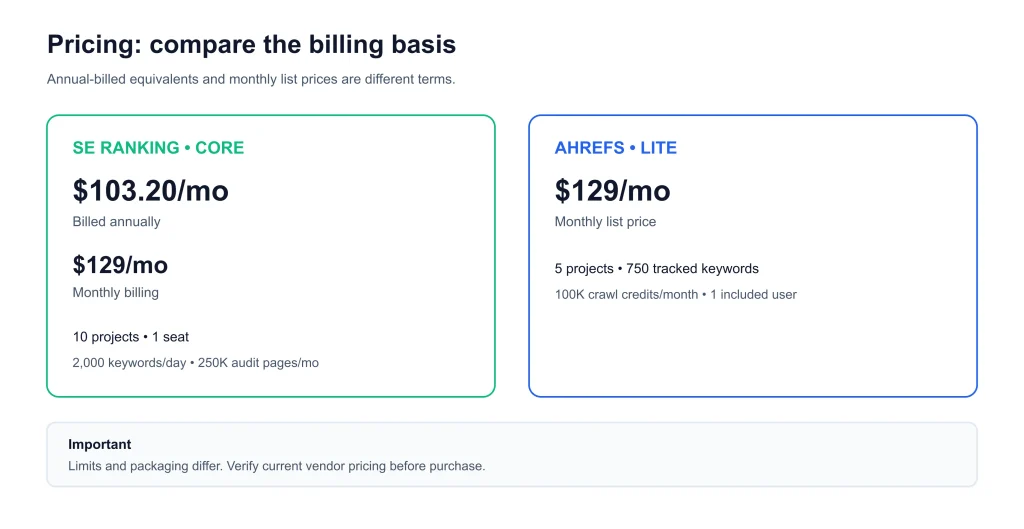
Here is the first surprise. At monthly list price, SE Ranking Core and Ahrefs Lite both cost $129. The difference sits in what that $129 includes: how often rankings update, how many keywords you can track, what reporting costs extra, and how much research data you get. That is what this page compares.
We checked both vendors’ official pricing, data and terms pages for this update. Prices change often, so check the vendor pages again before you pay.
How to read this comparison
Every figure below is labeled by where it comes from:
- Official: stated by the vendor on its own pages. It is the vendor’s claim, not proof of performance.
- Independent: from a third party with no stake in the result.
- Derived: SEORAF arithmetic from official numbers, with the inputs shown.
- Editorial: SEORAF’s opinion, based on the facts cited next to it.
SEORAF is an independent SEO knowledge resource, not an agency, and does not sell rankings. This comparison does not promise ranking, traffic, or revenue outcomes.
SEORAF did not run accuracy tests for this article. We did not measure keyword volume, ranking accuracy or backlink coverage in either tool, and we did not log into either product to confirm in-app limits. What we did is read the official pricing, data and terms pages and the help-center articles cited below, compare them against what third-party reviews claim, and flag where they disagree. If you want to test accuracy yourself, there is a step-by-step plan further down.
The short answer
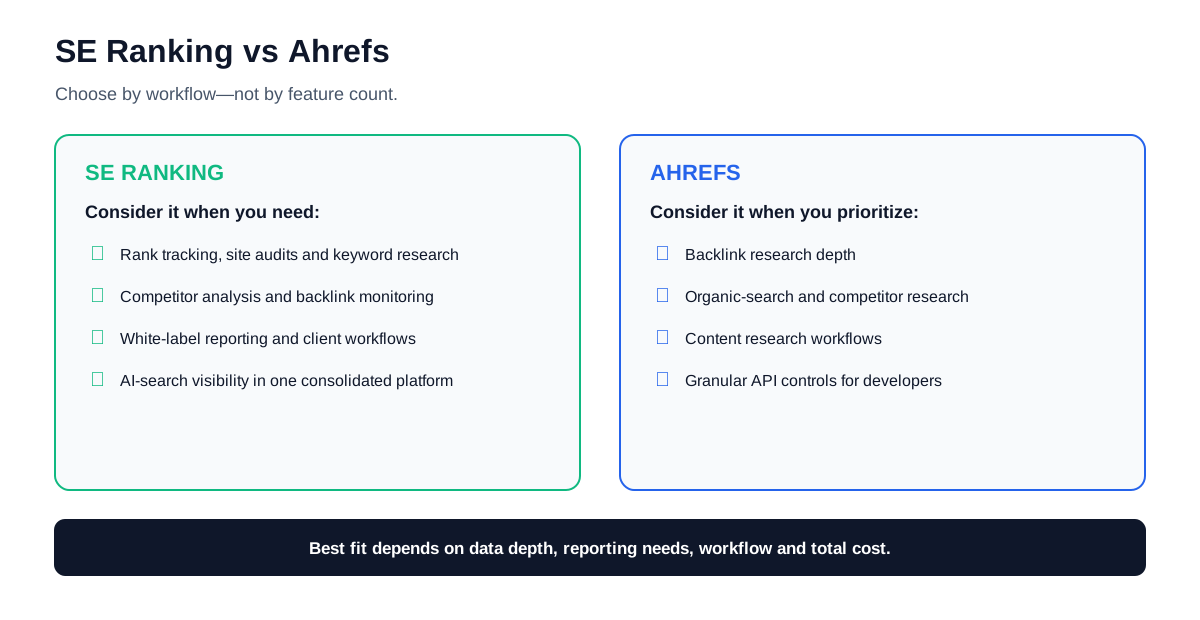
Editorial view: Choose SE Ranking when the work repeats: daily position tracking, scheduled reports, several sites, and a lot of audit capacity for the money. Choose Ahrefs when research drives billable work: link prospecting, finding linkable content, and deep competitor investigation. Use both only when you have a specific job each does that the other does not.
| Your main job | Lean toward | Why |
|---|---|---|
| Daily rank tracking for many keywords | SE Ranking | Core lists 2,000 keywords tracked daily. Ahrefs documents weekly updates on every plan. |
| Branded client reports | SE Ranking | White-label is documented in the Agency Pack add-on. It is not documented for Ahrefs. |
| Link prospecting and content-link research | Ahrefs | Content Explorer is listed from the Standard plan up. SE Ranking’s plans page lists no equivalent. |
| Keyword data outside the US and UK | Test both first | Published per-country database sizes differ by about 1.8x in the UK and about 29x in India (Derived). |
| Tracking your own brand in AI answers at modest volume | SE Ranking, on paper | Core includes 100 prompts tracked daily. Ahrefs Lite includes 5 tracked prompts. The units differ and neither was tested. |
| Researching other brands across AI answers at scale | Ahrefs | Brand Radar, from $199 a month, sits on an index of 470M+ organic prompts. |
Skip SE Ranking if your billable work depends on link prospecting or content-link research, or if your main market is one where its published keyword database is far smaller than Ahrefs’s. Test with your own keywords first.
Skip Ahrefs if you need daily position data (its pages document weekly updates on every plan), branded white-label client reports (not documented), or a free trial of a paid plan (none exists; there is a free tier and a $29 Starter plan).
If daily tracking and reporting are your main job: Check SE Ranking’s plans and 14-day trial (sponsored link). The trial needs no credit card and is limited to 10 projects, 750 keywords a day and 20 AI prompts a day. Annual plans are billed upfront and payments are generally non-refundable.
If link research is your main job: See Ahrefs’s current plans. Ahrefs has no free trial for paid plans and says it does not issue refunds in general.
Plan against plan at the same price
Compare plans by price, not by name. Each Ahrefs plan has a SE Ranking plan within a few dollars of it.
| Ahrefs Lite | SE Ranking Core | Ahrefs Standard | SE Ranking Growth | |
|---|---|---|---|---|
| Monthly list price | $129 | $129 | $249 | $279 |
| Annual price shown | Not displayed (“save up to 17%”) | $103.20/month | Not displayed | $223.20/month |
| Tracked keywords | 750 | 2,000 | 2,000 | 5,000 |
| Ranking update cadence | Weekly | Daily | Weekly | Daily |
| Cost per tracked keyword per month (Derived) | $0.172 | $0.065 | $0.125 | $0.056 |
| Projects | 5 unverified-ownership projects; verified-ownership projects listed as unlimited | 10 | 20 unverified; verified listed as unlimited | 30 |
| Users or seats included | 1 | 1 manager seat | 1 | 3 manager seats |
| Extra user or seat | $40/month | from $16 | $60/month | from $16 |
| Historical data | 6 months | Up to 6 months | 2 years | Full history |
| Site audit allowance | 100,000 crawl credits/month; up to 25,000 pages per project | 250,000 pages/month; up to 250,000 per project | 500,000 crawl credits/month; up to 50,000 pages per project | 2M pages/month; up to 1M per project |
| AI prompts tracked | 5 | 100 daily | 10 | 250 daily |
| API and MCP | Included | 25K API credits/month plus MCP | Included | 100K API credits/month plus MCP |
| Research metering | 1,000 credits per user per month | Keyword, competitor and backlink research listed as unlimited | Unlimited credits per user | Same as Core |
Sources: Ahrefs pricing, SE Ranking plans, and SE Ranking’s historical data help article. Cost per keyword is monthly list price divided by tracked keywords (for example, $129 / 750 = $0.172).
Four notes that the table cannot carry:
- Ahrefs’s project count is narrower than it looks. Its plan-comparison table lists the 5, 20 and 50 project limits under “unverified ownership.” Projects for sites you have verified are listed as unlimited on every plan. If you mostly track your own sites, the headline project cap may not bind you.
- Crawl credits and pages are different units. Treat the audit row as a rough guide to scale, not an exact match.
- Cost per keyword is not cost per outcome. It only says how much tracking capacity each dollar buys, and SE Ranking updates that capacity daily where Ahrefs documents weekly.
- Ahrefs Lite meters research. It allows 1,000 credits per user per month, while Standard and above list unlimited credits per user. Heavy researchers on Lite should expect to hit that ceiling.
What you will actually pay
Annual versus monthly
SE Ranking Core is $103.20 a month on annual billing (a 20% saving off $129) and Growth is $223.20 (off $279). Ahrefs advertises “pay annually, save up to 17%,” but its pricing page shows only monthly prices, and its FAQ says switching to annual billing means contacting support. The page’s own meta description says 20%, so we could not confirm the exact annual figure. If the full 17% applied, Standard would be about $207 a month (Derived: $249 x 0.83). Treat that as a ceiling on the discount until Ahrefs shows the number.
Add-ons that change the total
| Add-on | Price | What it adds | Catch |
|---|---|---|---|
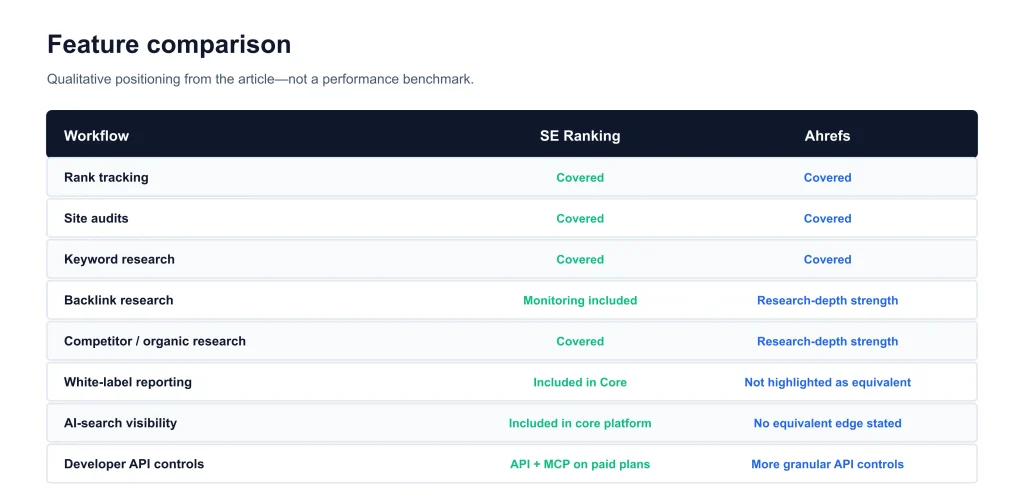
| SE Ranking Agency Pack | +$69/month | White-label platform and reports, client seats, scheduled reporting with AI summaries, lead generator, agency directory listing | Annual plans only |
| SE Ranking AI Search | +$71.20/month annual ($89 monthly) | AI results tracker, unlimited competitor research, SE Visible access (200 prompts) | The plans page does not say whether these prompts add to the 100 already included on Core |
| SE Ranking API | +$45/month | 3M API credits | Annual billing only |
| Ahrefs Report Builder | $99/month | 50 reports, 500 widgets, scheduling | White-label is not documented |
| Ahrefs Brand Radar | from $199/month | AI visibility research across 470M+ organic prompts, plus tracking of your own prompts | “From” price; scope varies |
| Ahrefs custom prompt packages | $50, $100 or $250/month | 2,500, 7,000 or 25,000 checks per month | Overage billed at $0.020, $0.015 or $0.010 per check |
| Ahrefs Content Kit | from $99/month | AI Content Helper, AI Content Grader | One module still listed as “soon” |
Four scenarios
These are list-price scenarios built from the pages above. SE Ranking figures use annual billing where noted; Ahrefs figures use monthly list because it does not display annual prices. The tools do not match feature for feature, so read each row as “what this workflow costs to assemble,” not “which is the better product.”
| Scenario | SE Ranking | Ahrefs |
|---|---|---|
| A. Solo site owner: tracking, audits, keyword research, no client reporting | Core: $103.20/month annual, or $129 monthly | Lite: $129/month |
| B. Freelancer sending scheduled client reports | Core + Agency Pack: $172.20/month (annual required) | Lite + Report Builder add-on: $228/month. White-label not documented. We priced the add-on because scheduling is not listed for Lite itself. |
| C. Link research as a billable service | Growth: $223.20/month annual, or $279 monthly. No Content Explorer equivalent documented. | Standard: $249/month, Content Explorer included |
| D. Adding AI-answer monitoring beyond the base plan | Core + AI Search: $174.40/month annual | Lite + Brand Radar: from $328/month |
For a plan-by-plan view of SE Ranking alone, see our SE Ranking pricing guide.
If you send client reports: white-label sits in SE Ranking’s Agency Pack, not in the base plan. See the Agency Pack and current plans (sponsored link). Because the pack requires an annual plan, ask SE Ranking support whether you can preview white-label reports during the trial before you commit.
Billing and commitment terms
| SE Ranking | Ahrefs | |
|---|---|---|
| Free trial | 14 days, no credit card. Limits: up to 10 projects, 750 keywords a day, 20 AI prompts a day, AI competitive research for 3 domains. | None for paid plans. Ahrefs Free gives limited Site Explorer and Site Audit access for site owners. |
| Cheapest way to test | The trial | Starter at $29/month, monthly only. It includes Keywords Explorer, Site Audit and Rank Tracker with 200 credits a month. You cannot buy extra users, credits or add-ons on it. Its Rank Tracker and Site Audit limits appear in comparison charts we could not read as text, so check them before you buy. |
| Annual billing | Billed upfront; 20% off | “Up to 17%” off; switching to annual goes through support |
| Refunds | Non-refundable unless service was not delivered or a promotion says otherwise | No refunds in general; a monthly subscriber who has not used the service can ask, and Ahrefs decides |
| Cancellation | Cancel anytime; effective at the end of the paid term | Cancel anytime; effective at the end of the billing period |
| Changing plans | Upgrade or downgrade from billing settings; features are tied to tiers | The FAQ says upgrades apply immediately and downgrades at period end. The Terms say changes take effect after the current period. We could not reconcile the two. |
| If a payment is overdue | Terms say ranking updates may stop three days after a missed payment and projects may be deleted 60 days after | Terms allow suspension or termination for unpaid balances, plus possible collection costs and interest |
| Price changes | No specific price-change clause found; the Terms can be updated by posting | Price changes apply at renewal; prices exclude taxes; non-USD payments use a fixed conversion rate Ahrefs sets |
| Pay-as-you-go charges | Extra keywords, seats, articles and locations are priced add-ons | If enabled, extra credits and data are charged automatically when usage exceeds plan limits; extra users are charged automatically unless prepaid |
Sources: SE Ranking plans and FAQ, SE Ranking Terms, Ahrefs pricing and FAQ, Ahrefs Terms, Ahrefs Starter plan. Read the relevant clauses yourself before relying on them, since terms change.
Editorial view: The cheaper mistake to reverse is a monthly plan, not an annual one. Where you can, start monthly. The exception is SE Ranking’s Agency Pack, which cannot be bought on a monthly plan, so that decision is a commitment you should test first.
Rank tracking and reporting
Official sources are clear on cadence. SE Ranking lists keyword limits as tracked daily on both Core and Growth. Ahrefs’s help center says tracked keywords update weekly by default on all subscription plans and does not mention a daily option or a paid add-on for one (Ahrefs help). Some third-party reviews say Ahrefs Standard tracks daily. That conflicts with Ahrefs’s own pages, so we have not repeated it. If you rely on a daily-tracking claim for Ahrefs, ask Ahrefs support to confirm it in writing.
Editorial view on why cadence matters: with weekly updates you see one data point per keyword per week. If a page drops on a Tuesday, you will not see it until the next refresh, and you cannot tell a client what happened on the day. For agencies and anyone running content or technical changes, that is the difference between diagnosing a drop and guessing at it. For a site owner who checks rankings monthly, weekly data is often enough.
On reporting, SE Ranking documents white-label reports and client seats in the Agency Pack, and lists Data Studio, Matomo, GA4 and Google Search Console integrations on Core. Ahrefs’s Report Builder can email PDFs to up to 50 recipients per report, and recipients do not need an Ahrefs account. It supports hourly, daily, weekly and quarterly schedules (daily sends run on workdays only). The page does not mention logos, colors or custom domains, and the pricing page lists a Looker Studio integration under the Advanced plan. Absence from documentation is not proof that a feature does not exist, so confirm any white-label need with Ahrefs before you buy.
Editorial view: For recurring client reporting, SE Ranking is the lower-friction option on paper, because daily data and white-label are both documented. For internal reporting where unbranded PDFs are fine, the gap narrows.
For wider options, see our guide to rank tracking software.
Keyword research
Difficulty scores are not interchangeable
Ahrefs says its keyword difficulty has one input: the number of referring domains linking to the pages that rank in the top 10 for the keyword (Ahrefs help). It also states that the metric reflects the average difficulty for any site, not yours, and that no metric reliably predicts your chance of ranking (Ahrefs). SE Ranking describes a proprietary score built from the quality of the top-10 domains and their backlink profiles, with no published formula, and says a backlink database update changed how the score is calculated (SE Ranking).
The practical rule: compare each tool’s score only against that tool’s own scale. A keyword can look easy in one and hard in the other because the inputs differ, not because one is wrong. Always read the live search results page before you commit to writing something.
Database size depends on the market
Ahrefs reports 28.7B filtered keywords across 217 locations (110B ever seen). SE Ranking reports about 5.4B keywords across 188 geographic databases and 2.2B domain profiles. The totals hide large differences by country:
| Market | Ahrefs keyword index | SE Ranking keywords | Ratio |
|---|---|---|---|
| United States | 2.7B | 591M | about 4.6x |
| United Kingdom | 1.4B | 769M | about 1.8x |
| India | 1.4B | 49M | about 29x |
| Bangladesh | 391M | 25M | about 16x |
Sources: Ahrefs data page (index counts are undated) and SE Ranking data page (table dated October 3, 2026; its FAQ rounds the US and UK slightly differently, at 584M and 755M).
A bigger database does not guarantee a better answer for your keywords, and a smaller one is not a weakness for a market where you track a few hundred terms. It is a reason to test in your own market before you pay, especially if you work in a market where the ratio is large.
Both vendors also sell keyword tooling around the database. SE Ranking lists a keyword grouper among its core tools and includes 25 or 50 content-marketing articles depending on the plan; Ahrefs lists Keywords Explorer features such as keyword clusters and search intents from Standard. We have not compared how well either performs.
For other options, see the best keyword research tools.
Backlinks and content research
Both vendors publish index sizes, and the metrics are not like-for-like:
| Ahrefs | SE Ranking | |
|---|---|---|
| Link records | 35.0T external backlink history records | 2.7T backlinks |
| Domains | 285.7M domains (post-vetting) | 420M indexed domains |
| Pages | 493.9B pages in index | Not stated |
| Crawl rate | 5M pages crawled per minute | 6B pages crawled daily |
| Freshness | Index refreshed every 15 to 30 minutes | 58% of backlinks updated within 90 days |
Two reading cautions. First, “history records” and “backlinks” are different counts, and the vendors vet domains differently, which is why SE Ranking’s domain count is higher while Ahrefs’s link-record count is much higher. Second, the crawl-rate gap is smaller than the link-record gap suggests: 5M pages a minute works out to about 7.2B a day (Derived: 5,000,000 x 60 x 24), against SE Ranking’s 6B. That is arithmetic on vendor claims, not a measured result, and we found no independent study that tests SE Ranking’s index against Ahrefs’s.
What is documented is a feature difference. Ahrefs lists Content Explorer and Batch Analysis from Standard upward. SE Ranking’s plans page lists backlink research and monitoring on both plans but names no Content Explorer equivalent.
Editorial view: If finding link prospects or linkable content is billable work, Ahrefs’s Standard plan fits it more directly. If backlinks are one input among many and you mainly monitor your own profile, SE Ranking’s listed backlink tools may be enough, and you can confirm that with the trial.
If link research is your main job: See Ahrefs’s plans and what each tier includes. Content Explorer starts at Standard ($249 a month list), so Lite will not cover it.
Site audit
On plan allowances, SE Ranking Core lists 250,000 audit pages a month against Ahrefs Lite’s 100,000 crawl credits with a 25,000-page limit per project. At the Growth and Standard level, the figures are 2M pages a month against 500,000 credits and 50,000 pages per project. Ahrefs also sells per-project boosts ($20 or $200 a month per project) that raise always-on audit speed and add features. SE Ranking lists page-change monitoring on Growth.
Neither vendor’s pricing page documents how its crawler handles JavaScript-heavy sites, and we have not tested it, so we make no claim there. If a large or script-heavy site is your main use, run both tools’ audits against your own pages during a trial and compare the findings by hand.
AI visibility
This is the area where the units differ most, so numbers are easy to misread.
| Ahrefs | SE Ranking | |
|---|---|---|
| Included in plans | 5, 10 and 20 tracked prompts on Lite, Standard and Advanced (150, 300 and 600 checks a month) | 100 and 250 prompts tracked daily on Core and Growth, across 5 AI engines |
| Add-on | Brand Radar from $199/month; custom prompt packages $50, $100 or $250/month | AI Search add-on $71.20/month annual ($89 monthly) |
| Research on other brands | Index of 470M+ organic prompts across six AI indexes (AI Overviews 325.0M, AI Mode 17.8M, ChatGPT 30.2M, Copilot 29.8M, Gemini 30.1M, Perplexity 29.9M) | 25.5M+ prompts tracked across five AI engines; competitive research limited to 5 domains on Core and 15 on Growth |
| Engines named | Six AI indexes; check the current vendor page for the latest list and scope | The plans page names four for the add-on (AI Overviews, AI Mode, Perplexity, ChatGPT); the tracker page names five, adding Gemini |
In Ahrefs’s model, tracking one prompt on one platform in one location uses one check. SE Ranking counts prompts. That is why “5 prompts” and “100 prompts” cannot be compared directly. Some third-party reviews say Ahrefs has no AI visibility tracking; its pricing page lists tracked prompts on every plan and Brand Radar as a product, so that claim is outdated.
Editorial view: If you only need to watch your own brand across a modest set of prompts, SE Ranking’s included allowance goes further on paper. If you want to research other brands across a large prompt index, Ahrefs’s Brand Radar is built for that. We have not tested the data quality of either.
Seats, API and MCP
Both tools list API and MCP access. Ahrefs shows maximum rows per request of 100 on Lite, 250 on Standard and 500 on Advanced. SE Ranking lists 25K research API credits a month on Core and 100K on Growth, with a separate API add-on ($45 a month, annual only) and a standalone data API from $179 a month. Because the units differ, compare against the volume you actually plan to pull rather than the headline numbers.
Seat costs differ too. Ahrefs includes one user and sells extra users at $40, $60 and $80 a month on Lite, Standard and Advanced. SE Ranking includes one manager seat on Core and three on Growth, with extra manager seats from $16. SE Ranking also notes that one login allows one active session at a time, so sharing a login is discouraged.
What independent evidence exists
Less than the comparison pages suggest.
- No independent head-to-head including SE Ranking turned up. We found none that compares its data against Ahrefs’s.
- Traffic estimates (Independent, one study). In December 2024, Promodo compared estimated organic traffic against Google Search Console data for 184 websites over the first half of 2024. Among Semrush, Similarweb and Ahrefs, Ahrefs had the lowest average error, 48.63%, and tended to underestimate. SE Ranking was not tested (Collaborator write-up). The lesson is that any tool’s traffic estimate is rough, not that SE Ranking is better or worse.
- A backlink-index study we excluded. A widely cited 2021 comparison of backlink APIs did not include SE Ranking and was sponsored by SEO PowerSuite, a competing vendor (Search Engine Land).
- User reviews (Independent, sentiment only). G2’s comparison page lists SE Ranking at 4.7 out of 5 from 1,596 reviews and Ahrefs at 4.5 from 714 when we checked on October 9, 2026. The reviewer mix differs: 87.2% of SE Ranking reviews come from small businesses against 63.7% for Ahrefs, so the ratings reflect different buyers. G2 also shows “free trial: yes” for Ahrefs, which refers to the Ahrefs Free plan, not a trial of a paid plan (G2).
Why you have seen conflicting numbers
Many comparison pages repeat older prices and claims. These are the ones most likely to mislead you, checked against the vendors’ own pages on October 9, 2026:
| What some reviews say | What the official pages say |
|---|---|
| SE Ranking starts at $39 to $65 a month | Core is $129 monthly or $103.20 annual; Growth is $279 or $223.20. Older Essential, Pro and Business plans are now listed as legacy plans in SE Ranking’s help center. |
| Ahrefs Standard tracks rankings daily | Ahrefs documents weekly updates on all plans. |
| Ahrefs Lite includes 500 credits | The pricing page lists 1,000 credits per user. |
| SE Ranking Core includes white-label | White-label is part of the Agency Pack add-on (+$69 a month, annual only). |
| Ahrefs Starter has no rank tracking | Ahrefs’s Starter page lists Rank Tracker among included tools; its limits sit in charts we could not read as text. |
| Ahrefs has no AI visibility tracking | Tracked AI prompts are on every plan and Brand Radar is a separate product. |
Pros and cons
SE Ranking
Pros
- Daily tracking at entry level: 2,000 keywords daily on Core, where Ahrefs documents weekly updates on every plan.
- Lower cost per tracked keyword: $0.065 on Core against $0.172 on Ahrefs Lite at monthly list (Derived).
- A 14-day trial with no credit card.
- White-label reporting is documented, and extra seats start at $16.
- Larger audit allowance at the same monthly price, and Data Studio integration listed on the base plan.
Cons
- Smaller published keyword database (about 5.4B against 28.7B), with the widest gaps in markets such as India and Bangladesh.
- No Content Explorer equivalent documented on the plans page.
- White-label, AI Search and the API add-on cost extra, and some require annual billing.
- Core has one manager seat and about six months of historical data.
- Payments are generally non-refundable, including on annual plans.
Ahrefs
Pros
- Larger published keyword and backlink figures, and a vendor-stated 15 to 30 minute index refresh.
- Content Explorer from Standard, with 2 and 5 years of history on Standard and Advanced.
- Verified-ownership projects are listed as unlimited on every plan.
- Monthly billing with no contracts, plus a free tier and a $29 Starter plan for low-cost evaluation.
- A large AI prompt index for researching other brands.
Cons
- Weekly rank updates on every plan.
- No free trial of a paid plan, and no refunds in general.
- White-label reporting is not documented.
- Extra users cost $40 to $80 a month, Lite meters research at 1,000 credits per user, and reporting and AI add-ons raise the total.
- Annual billing requires contacting support, and its FAQ and Terms disagree on when plan changes take effect.
Which should you choose? A decision system
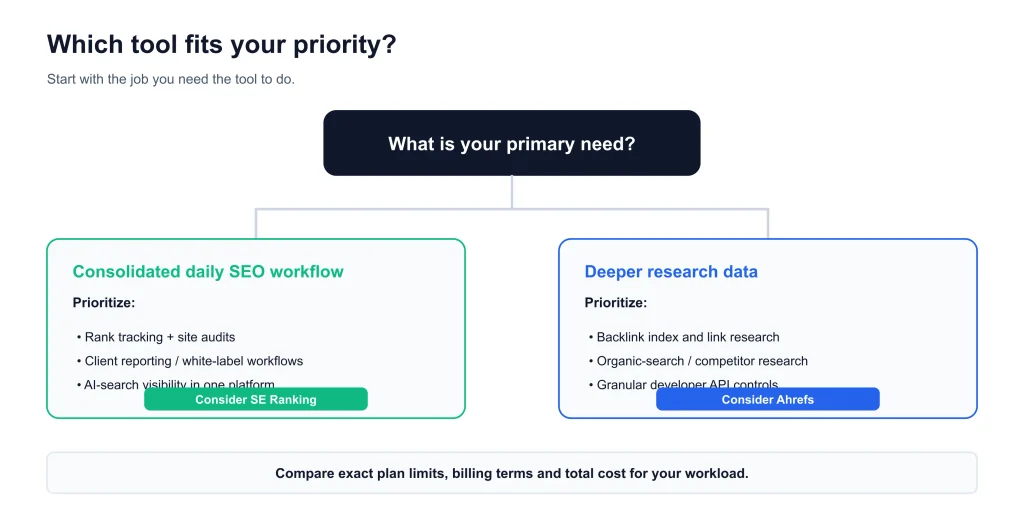
Answer in order and stop at the first “yes.”
- Do you send scheduled or branded reports to clients? Start with SE Ranking Core plus the Agency Pack. Confirm the annual commitment suits you first.
- Is link prospecting or content-link research part of what you bill for? Start with Ahrefs Standard. If link work is only occasional, compare Ahrefs Lite with SE Ranking’s backlink tools on a trial.
- Do you need positions daily? SE Ranking, per the official cadence.
- Is your main market outside the US and UK? Run the 14-day test below before you pay either vendor.
- Do you want to track your own brand in AI answers? At modest volume, compare SE Ranking Core’s included 100 daily prompts with Ahrefs’s tracked prompts and Brand Radar pricing. For research on other brands at scale, Ahrefs is built for it.
- None of these apply? Pick the cheaper plan on the matchup table and use the trial or Starter plan to check the fit.
When using both makes sense
Two subscriptions are justified only if two of your answers point in different directions, for example daily client reporting and billable link research. Budget for both, then re-check after a quarter whether each is still earning its cost.
What would change this guidance
- Ahrefs documents daily tracking on a plan, or white-label reporting.
- SE Ranking documents a Content Explorer equivalent.
- Either vendor changes plan limits or prices. We re-check both pricing pages on each update.
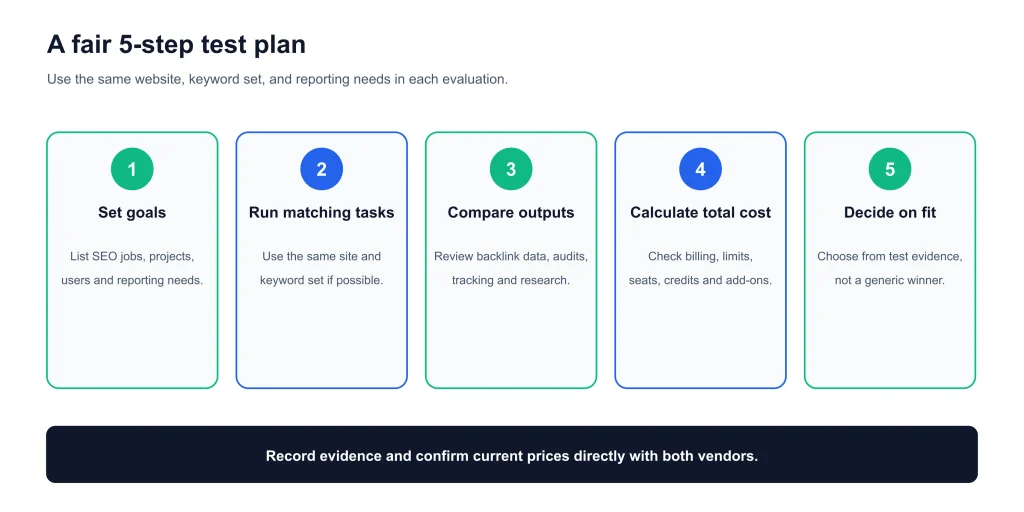
A 14-day plan to test them on your own data
This is a method for you to run, not a set of results. Decide in advance what difference would change your mind, so the numbers do not talk you into the tool you already preferred.
- Days 1 and 2: pick the sample. Choose 20 keywords: 10 you already rank for (positions 1 to 20) and 10 you are targeting. Add your target country or city.
- Days 2 and 3: set up tracking. Start the SE Ranking trial (sponsored link) and add the keywords. For Ahrefs, which has no trial of paid plans, use the $29 Starter plan billed monthly or a free Ahrefs account as a limited check, and note which tools you cannot reach on it.
- Day 3 onward: record available updates. Log each tool’s reported position when it refreshes. Because Ahrefs documents weekly updates while SE Ranking lists daily tracking, do not treat missing daily Ahrefs observations as ranking changes. Check a small sample manually in a clean browser set to the same location.
- Day 7: compare volume and difficulty. Compare the tools’ estimates for the same keywords, country, and date range. Use Google Search Console query data as context for your own site, not as ground-truth search volume: impressions are not equivalent to a third-party tool’s monthly search-volume estimate. Difficulty scores use different inputs, so do not compare them as if they were the same scale.
- Day 10: test the reporting you need. Build the exact client or internal report you would send, and check whether it needs a separate add-on.
- Day 14: decide. Score each tool against the question you started with: daily tracking, reporting, link research, or market coverage. If you choose annual billing, remember the refund terms above.
Limitations of this comparison
- No hands-on accuracy testing. We did not measure keyword volume, ranking accuracy or backlink coverage, and we did not log into either product to verify in-app limits.
- No independent study includes SE Ranking against Ahrefs. The single accuracy study we cite did not test SE Ranking.
- Vendor figures are vendor-defined. Index sizes, “keywords” and “backlinks” are counted differently, so do not rank the tools on them alone.
- Unresolved conflicts. Ahrefs’s annual discount (17% on the pricing page, 20% in its metadata) and plan-change timing (FAQ against Terms). SE Ranking’s Agency Pack client seats (30 on the plans page, 10 at the starting tier on the Agency Pack page), its AI engine list (four against five), and its renewal wording in the Terms. Whether an Ahrefs daily-tracking add-on exists is undocumented.
- Prices are list prices. Taxes, currency conversion and promotions can change what you pay. Ahrefs says its prices exclude taxes and fees.
- Interface and ease of use are not ranked. We cannot rank them without testing, and the review ratings above reflect different buyer mixes.
If neither fits
- Our guide to SE Ranking alternatives compares eleven other tools.
- Our guide to Ahrefs alternatives covers four.
- SE Ranking vs Semrush and Moz vs Semrush vs Ahrefs cover other pairings.
- To read each tool on its own, see our SE Ranking review and Ahrefs review. Our review methodology explains how we evaluate tools.
Frequently asked questions
Is SE Ranking better than Ahrefs?
Neither wins across the board. Core and Lite cost the same $129 at monthly list. SE Ranking offers daily tracking and larger audit allowances at that price; Ahrefs publishes larger data indexes and has Content Explorer from Standard. The better tool is the one whose limits match your work.
Which is cheaper?
At monthly list, Core and Lite are both $129, and Ahrefs Standard ($249) is cheaper than SE Ranking Growth ($279). On annual billing, SE Ranking’s prices are $103.20 and $223.20 a month. Ahrefs does not display annual prices. Add-ons change the total, so check the scenario table above.
Does Ahrefs track rankings daily?
Its pricing page and help center document weekly updates on all plans, and we found no official daily option.
Does Ahrefs offer white-label reports?
Not in the documentation we checked. Its Report Builder emails PDFs but does not mention custom branding. SE Ranking documents white-label in its Agency Pack add-on.
Is there a free trial?
SE Ranking offers 14 days with no credit card and limited usage. Ahrefs does not offer a free trial of paid plans, though it has a free tier with limited tools and a $29 Starter plan billed monthly.
Can SE Ranking replace Ahrefs?
It depends on whether you rely on Content Explorer or on Ahrefs’s larger indexes. Many daily tracking, auditing and reporting workflows are covered on paper. No independent study compares their coverage, so test with your own keywords before you cancel anything.
Do I need both?
Only if you have a daily-reporting need and a research need that point to different tools. Otherwise start with one and add the other when you hit a limit you can name.
Which is better for agencies, freelancers or beginners?
For agencies and freelancers who deliver recurring reports, SE Ranking’s documented daily tracking and white-label add-on fit the workflow, and the total cost is in the scenario table. For link-building specialists, Ahrefs Standard fits better. We cannot rank ease of use without testing it, so use a trial or the Starter plan to judge the interface yourself.
How do their AI visibility features differ?
Ahrefs includes 5 to 20 tracked prompts on its plans and sells Brand Radar from $199 a month for research across a 470M+ organic-prompt index. SE Ranking includes 100 to 250 prompts tracked daily on its plans and sells a 200-prompt AI Search add-on. The units differ, so compare them against the number of prompts you actually need.
Is the data accurate?
We have not tested it, and neither vendor’s accuracy has been compared against the other’s in an independent study that we could find. Treat estimates as directional and check your own numbers against Google Search Console.
SE Ranking vs Ahrefs: the final verdict
Editorial view: For recurring tracking, reporting and several sites, SE Ranking fits the documented limits better for the money. For link and content research as a paid service, Ahrefs’s Standard plan is the more direct fit. Both views rest on the cited plan pages, not on a hands-on accuracy test, so treat them as a starting point and confirm on your own data.
| Your situation | Next step |
|---|---|
| Daily tracking, scheduled or branded client reports | SE Ranking plans and 14-day trial (sponsored link). No credit card for the trial; annual plans are billed upfront and generally non-refundable. |
| Link prospecting, Content Explorer, deep competitor research | Ahrefs plans. No free trial of paid plans; the $29 Starter plan is monthly only. |
| Not sure | Run the 14-day test plan on your own keywords, then decide. |
Sources and update log
- Ahrefs pricing and FAQ
- Ahrefs data page
- Ahrefs Terms
- Ahrefs Starter plan
- Ahrefs help: how often tracked keywords update
- Ahrefs help: keyword difficulty and Ahrefs keyword difficulty guide
- Ahrefs Report Builder
- SE Ranking plans and FAQ (page last modified September 10, 2026)
- SE Ranking Agency Pack
- SE Ranking data page (country table dated October 3, 2026)
- SE Ranking Terms of Service
- SE Ranking help: historical data
- SE Ranking: metrics in SE Ranking
- Collaborator and Promodo: traffic estimate accuracy study (December 2024)
- Search Engine Land: backlink API study (December 2021, sponsored by a competing vendor)
- G2: Ahrefs vs SE Ranking
Update log: October 9, 2026: prices, limits and billing terms re-verified from official pages. We re-check both vendors’ pricing pages on each update, and we will correct this page if a vendor changes a plan or terms.
Affiliate disclosure: Links to SE Ranking on this page are affiliate links, and SEORAF earns a commission if you buy through them. Links to Ahrefs go straight to Ahrefs’s own pages. Commission rates are not a factor in our recommendations. See our affiliate disclosure and editorial policy.