
Moz vs SEMrush vs Ahrefs (2026): Which Tool Wins?
A comprehensive 4500+ word analysis. Features, AI tools, pricing, backlinks, and ranking tools compared. Find the winner.
Introduction: The Ultimate SEO Tool Battle of 2026
The digital marketing landscape of 2026 is more competitive than ever before. As search algorithms evolve and artificial intelligence reshapes how we approach content, our reliance on reliable software has shifted from a luxury to an absolute necessity. For anyone building an online presence, the decision of which software to subscribe to is daunting. You are likely staring at monthly subscription fees that can easily run into the hundreds, wondering if the investment will actually yield a return. This is the central dilemma of Moz vs SEMrush vs Ahrefs.
This is not just a matter of choosing a tool; it is about choosing a partner in your growth journey. The Moz vs SEMrush vs Ahrefs debate has raged for years, but the parameters of the battle have changed. Moz is the community educator, SEMrush is the aggressive marketing suite, and Ahrefs is the data purist. Each of these platforms has evolved significantly in 2026, integrating AI, expanding databases, and refining user interfaces to capture a larger share of the best SEO tools 2026 market.
In this extensive SEO software comparison, we move beyond surface-level marketing copy. We are going to dissect the technical capabilities of each platform, examining their keyword databases, backlink indexing speed, site audit accuracy, and pricing structures. Whether you are a small business owner looking for a domain authority checker, an agency needing robust SEO ranking tools, or an affiliate marketer hunting for low-competition keywords, understanding the nuances is critical. Our goal is to provide clarity on which platform fits your specific workflow, ensuring you don’t waste money on features you will never use.
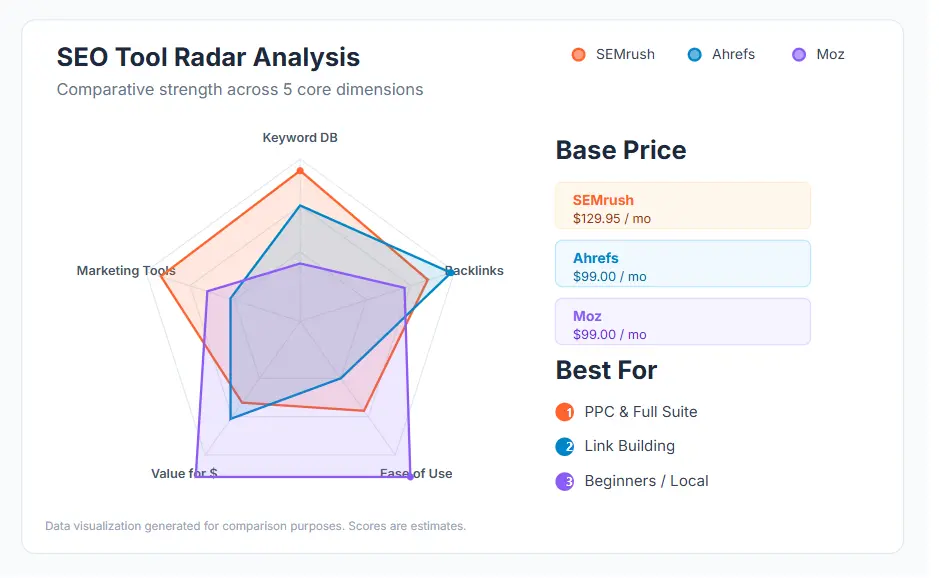
We have tested these tools extensively. We have crawled sites, audited links, and tracked rankings to provide a verdict based on real-world performance. The search intent behind queries like “Moz vs SEMrush vs Ahrefs” is not just curiosity; it is a business-critical decision. We will cover everything from the beginner-friendliness of Moz’s interface to the raw power of Ahrefs’ Site Explorer and the versatility of SEMrush’s all-in-one approach. Let’s dive into the deep end of the digital marketing tools spectrum.
Moz Overview: The SEO Educator & Community Favorite
Moz has been a cornerstone of the search engine optimization industry since its inception as SEOmoz in 2004. Founded by Rand Fishkin, the company built its reputation on transparency, ethical SEO practices, and a genuine desire to educate the market. In the context of Moz vs SEMrush vs Ahrefs comparison, Moz occupies a unique space as the “good guy” of the industry. It is a platform that feels personal, driven by a community of marketers who trust its proprietary metrics implicitly.
The cornerstone of Moz’s offering is its proprietary metrics: Domain Authority (DA) and Page Authority (PA). While Google does not use these metrics directly in its algorithm, they have become the standard currency of the web for valuing link opportunities. As noted in our detailed Moz Pro review, a high DA score is often the first thing a client looks at when gauging the potential value of a partnership or guest post opportunity.
Moz’s interface is arguably the cleanest and most welcoming in the industry. It avoids the data density that plagues competitors. Upon logging in, you are greeted with a straightforward dashboard that guides you through setting up a “Campaign.” This setup process is educational in itself, prompting you to connect Google Analytics and Search Console, identifying technical issues like 404s and duplicate content, and tracking keywords. It lowers the barrier to entry significantly for best SEO tools 2026 beginners.
Beyond the software, Moz Academy is a treasure trove of free resources. They offer certifications and guides that cover everything from the basics of crawling to complex schema implementation. For local businesses, Moz Local is an indispensable tool that helps manage citations across the web, ensuring NAP (Name, Address, Phone) consistency. In the Moz vs SEMrush vs Ahrefs debate, Moz wins hands down on usability and education. It is the tool you choose if you want to understand the “why” behind your rankings, rather than just looking at a spreadsheet of numbers.
Try Moz Pro for Free
Start your 30-day free trial and experience the cleanest interface in SEO.
Start Moz Free TrialSEMrush Overview: The All-In-One Marketing Powerhouse
SEMrush entered the market shortly after Moz but took a radically different approach. While Moz was focused on teaching the nuances of SEO, SEMrush was built for reconnaissance and competitive intelligence. It has evolved into the definitive “All-in-One Marketing Toolkit.” In the Moz vs SEMrush vs Ahrefs comparison, SEMrush is the heavyweight contender for agencies and enterprises that need to manage multiple channels—SEO, PPC, Social Media, and Content—from a single login.
The sheer scale of SEMrush’s database is staggering. They boast a keyword database of over 25 billion keywords and a backlink index of 43 trillion URLs. This volume allows them to provide insights that other tools simply miss. Their “Traffic Journey” feature, which visualizes the path a user takes from a social media ad or organic search all the way to a purchase, is a game-changer for multi-channel marketers. This level of integration is rare in the SEMrush vs Ahrefs comparison, giving SEMrush a distinct edge for full-stack marketing teams.
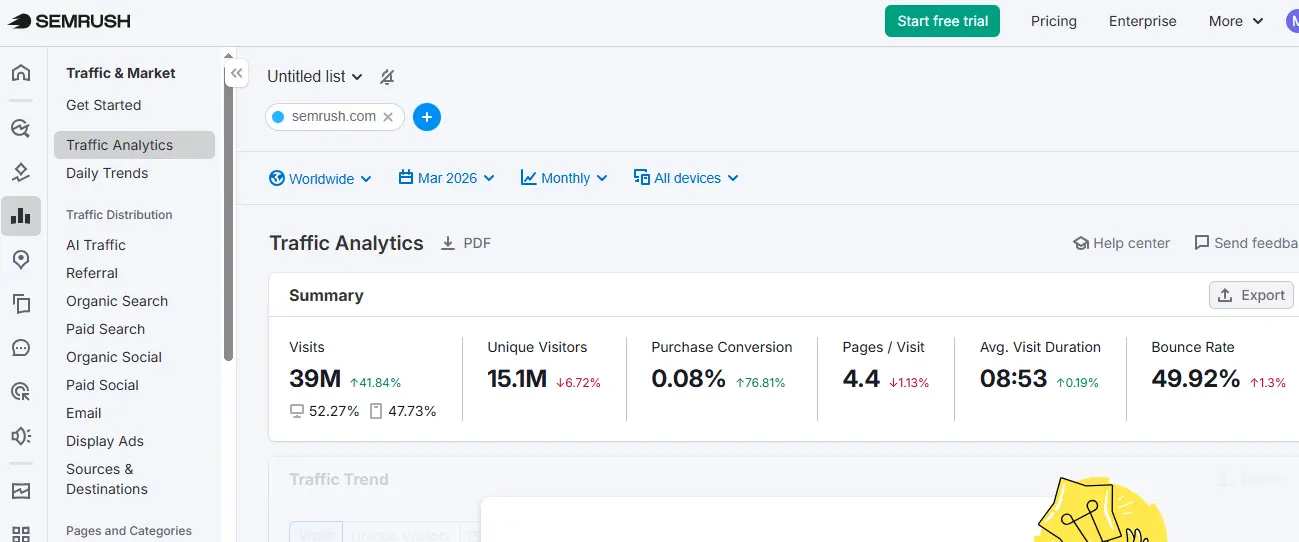
One of SEMrush’s standout features is the “Keyword Magic Tool.” It allows for an incredibly granular filtering process, where you can filter keywords by intent, word count, SERP features (like People Also Ask), and difficulty. The “Keyword Gap” analysis is another killer feature; it allows you to input your domain and up to five competitors to see exactly which keywords they rank for that you do not. This is pure gold for strategists looking to capture market share quickly.
SEMrush also excels in PPC research. It allows you to see the exact ad copy your competitors are using, the keywords they are bidding on, and how their ad budgets have fluctuated over time. For an agency managing an ad account for a client, this data is invaluable. While our SE Ranking vs SEMrush analysis might show value in cheaper alternatives for pure SEO, few can match SEMrush’s depth for paid search.
However, this power comes with complexity. The interface is dense. It is packed with reports, sub-menus, and graphs. For a beginner, SEMrush can feel like stepping into the cockpit of a fighter jet. The learning curve is steep. But for a power user, it is a playground of data. In the Moz vs SEMrush vs Ahrefs landscape, SEMrush is the choice for those who need to spy on competitors, manage paid ads, and execute a holistic strategy across every digital channel available.
Ahrefs Overview: The Data Purist & Backlink King
Ahrefs is the relatively new kid on the block compared to Moz and SEMrush, but it has disrupted the market by focusing obsessively on one thing: data accuracy. While Moz focuses on education and SEMrush on marketing suites, Ahrefs focuses on truth. In the Moz vs SEMrush vs Ahrefs debate, Ahrefs is widely considered the owner of the most accurate and freshest backlink index in the industry.
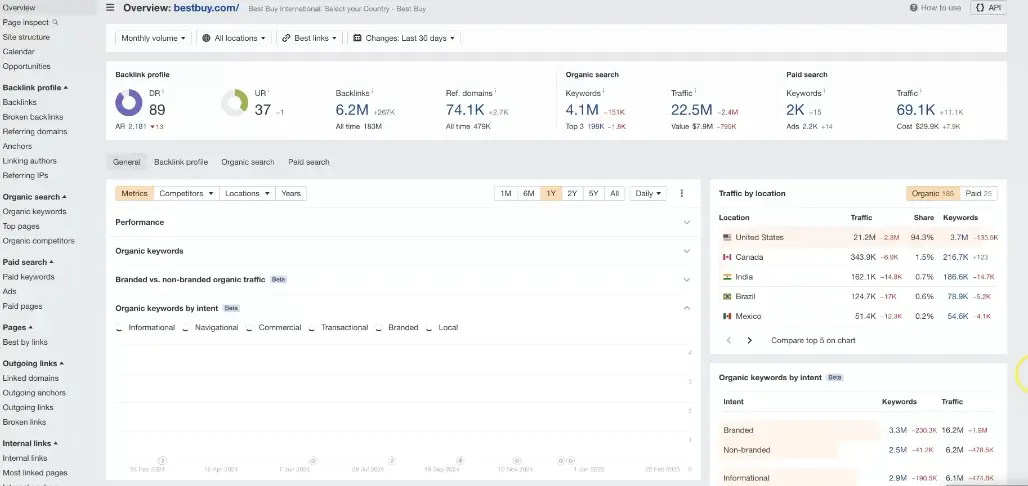
Their “Live Index” updates every 15 minutes. If you publish a new post and get a link, you can see it in Ahrefs almost instantly. This speed is unmatched. Their Site Explorer tool is legendary for its depth, allowing you to see the backlink profile of any domain down to the specific URL level, complete with anchor text distribution, link type (dofollow/nofollow), and “DR” (Domain Rating) and “UR” (URL Rating) metrics. For many in the SEO ranking tools community, Ahrefs is the trusted source of truth for backlinks.
Another major differentiator is their “Content Explorer.” This tool allows you to search the web for content based on topic, language, and social shares. You can see which articles about a specific topic went viral on Facebook or Twitter. This is essentially reverse-engineering content success. It is incredibly popular in the affiliate marketing and “niche site” communities, where finding untapped content ideas is the difference between profit and loss.
While SEMrush is a marketing suite and Moz is an educator, Ahrefs is a pure SEO tool. They recently added “Site Audit” features, which are excellent, but their core ethos remains link analysis and keyword research. The interface is functional and data-dense, prioritizing information over aesthetics. In the Moz vs Ahrefs comparison specifically, Ahrefs wins hands down on the volume and freshness of backlink data. It is the tool of choice for hardcore SEOs who live and die by their backlink profiles and need a SEMrush vs Ahrefs comparison that highlights data granularity.
Moz vs SEMrush vs Ahrefs: Features Comparison
Before we dive deep into the nitty-gritty, let’s look at how these three titans stack up against each other across the core features that matter most. This table serves as a quick reference for the SEO software comparison.
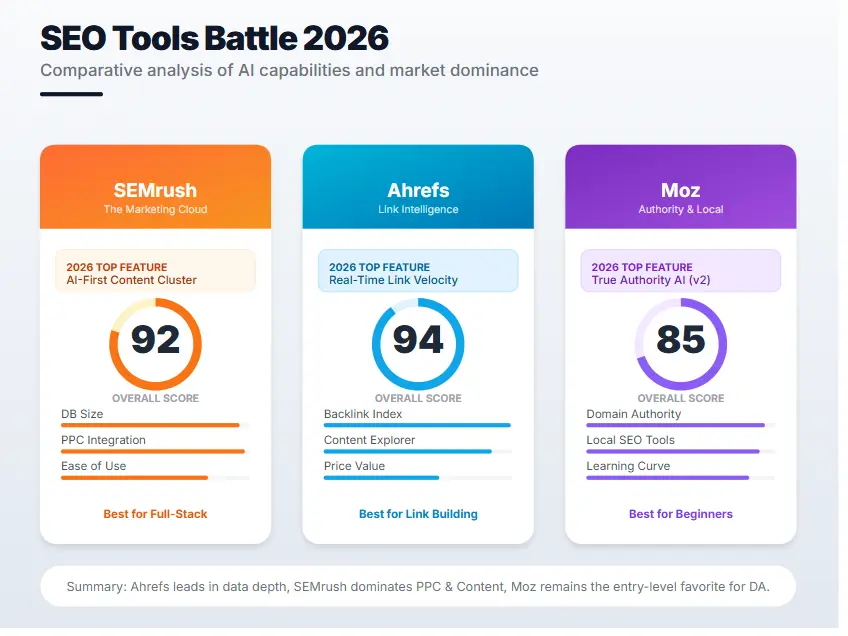
| Feature | Moz Pro | SEMrush | Ahrefs |
|---|---|---|---|
| Keyword Database | 500M Keywords | 25B+ Keywords | 10B+ Keywords |
| Backlink Index | 40T Trillion URLs | 43 Trillion URLs | 16 Trillion+ URLs (Fresh) |
| Unique Metric | Domain Authority (DA) | Authority Score | Domain Rating (DR) |
| Pricing (Entry) | $99/mo | $129.95/mo | $129/mo |
| Ease of Use | High (Beginner Friendly) | Medium (Complex) | Medium (Data Heavy) |
| Best For | Local SEO & Beginners | Agencies & PPC | Link Builders |
Keyword Research Comparison
Keyword research is the foundation of any SEO strategy, and all three tools offer robust solutions, but they serve different masters. A solid strategy relies on a combination of seed keyword expansion and gap analysis. This is where the Moz vs SEMrush vs Ahrefs difference becomes most apparent.
Moz Keyword Explorer
Moz’s Keyword Explorer is famous for its “Priority Score.” This metric takes the monthly search volume, the difficulty of the keyword, and the organic Click-Through Rate (CTR) and spits out a single number from 0-100. It is incredibly helpful for small business owners who don’t have time to analyze dozens of metrics. However, Moz’s database is the smallest of the three (approx. 500 million keywords). In the Moz vs SEMrush specific debate, SEMrush wins on volume, but Moz wins on prioritization.
SEMrush Keyword Magic Tool
SEMrush boasts the largest keyword database in the world—over 25 billion keywords. This volume is unmatched in the industry. The “Keyword Magic Tool” allows you to filter keywords by intent. You can select informational, navigational, commercial, or transactional intent with a single click. It also excels at “Keyword Gap” analysis. Here, you can put in your domain and a competitor’s domain to see exactly which keywords you are missing.
This is critical for a keyword research guide that drives growth. The tool also identifies SERP features, allowing you to target keywords that have featured snippets or local packs.
Ahrefs Keywords Explorer
Ahrefs sits in the middle in terms of database size (around 10 billion keywords), but they pride themselves on “Click” data. While other tools estimate search volume, Ahrefs shows you how many clicks the search results actually get. This is crucial because ranking #1 for a question-based query might get zero clicks if Google answers it in a “Featured Snippet.” Ahrefs helps you avoid keywords that look good on paper but drive no traffic.
Winner: SEMrush
While Moz is accurate and Ahrefs provides click data, SEMrush’s sheer volume and granular filtering options make it the king of keyword research in this best SEO tools 2026 comparison.
Backlink Analysis Comparison
If keyword research is the foundation, backlinks are the pillars. This is where the Moz vs Ahrefs rivalry heats up significantly. A robust backlink strategy requires accurate data to avoid toxic domains and identify goldmines.
Moz Link Explorer
Moz introduced Spam Score, a metric that predicts the likelihood of a subdomain being penalized or banned by Google. This is invaluable for link builders who want to avoid toxic links. Moz also popularized Domain Authority (DA). However, their backlink index is the smallest and slowest to update of the three. It is curated for quality, but you might miss newer links.
SEMrush Backlink Analytics
SEMrush has a massive index and excellent features for identifying toxic links automatically. Their “Backlink Audit” tool is very advanced, allowing you to segment links by type and toxicity level easily. It is a very close runner-up to Ahrefs.
Ahrefs Site Explorer
Ahrefs is the undisputed king of backlinks. Their “Live Index” updates every 15 minutes. When you get a new link, you will see it in Ahrefs almost immediately. The granularity of their data—showing “Dofollow” vs “Nofollow” breakdowns, anchor text cloud, and link history—is unparalleled. For the SEMrush vs Ahrefs debate specifically, almost all professionals agree Ahrefs has the superior link index.
Winner: Ahrefs
While Moz offers the best spam filtering and SEMrush has great auditing tools, Ahrefs provides the most comprehensive, up-to-date, and detailed backlink analysis in the Moz vs Ahrefs and SEMrush vs Ahrefs showdown.
Pricing Comparison: Cost vs. Value
Value is a critical component of the Moz vs SEMrush vs Ahrefs decision. We must look at what you get for the entry-level price versus the “usable” price.
Moz Pro Pricing
Moz starts at $99/month for the “Standard” plan. This includes 5 campaigns and 5,000 monthly keyword queries. It is the most affordable entry-level plan of the three. Their “Medium” plan is $179, and “Large” is $299. Even at entry level, you get full access to their keyword difficulty score and site audits without hitting a wall immediately.
SEMrush Pricing
SEMrush starts at $129.95/month for the “Pro” plan. However, the limits on the lower plans are tight (10,000 results per report). To unlock the true power (like the Content Marketing Toolkit), you usually need to jump to the “Guru” plan at $249.95/month. This creates a steep jump in cost for power users.
Ahrefs Pricing
Ahrefs starts at $129/month for the “Lite” plan. But the Lite plan is very restricted (only 5 queries per day in Site Explorer). To get real daily usage, you are forced into the “Standard” plan at $249/month.
Winner: Moz
Moz offers the best entry-level value for small businesses and freelancers. In the Moz vs SEMrush and Moz vs Ahrefs pricing battles, Moz provides full access to its core features at a significantly lower price point than the competitors.
AI SEO Tools Impact 2026: The New Frontier
The landscape of best SEO tools 2026 is being rewritten by artificial intelligence. Google’s SGE (Search Generative Experience) and the widespread adoption of Large Language Models (LLMs) like ChatGPT have forced SEO platforms to adapt. How does the Moz vs SEMrush vs Ahrefs comparison look in this new AI era?
SEMrush’s AI Writing Assistant
SEMrush has been the most aggressive in integrating AI. Their “SEO Content Template” leverages AI to generate articles based on the keywords and competitive analysis you feed it. It can suggest titles, structure, and even generate content drafts. This is a massive time-saver for content teams. It addresses the problem of “blank page syndrome” and ensures that the content generated is semantically aligned with the SERP intent. For digital marketing tools, this integration of creation and optimization is a key differentiator.
Ahrefs AI Content Gap
Ahrefs has taken a different approach to AI. Instead of writing for you, they use AI to interpret their massive dataset. The “Content Gap” tool now uses AI to identify why your competitors are beating you and suggests topic clusters you might be missing. It is less about generative AI and more about analytical AI. This fits their brand as data purists; they use AI to help you make better decisions, not just to write faster.
Moz’s Learning Model Updates
Moz has been more cautious with AI generation, focusing instead on using AI to enhance their core metrics. Their Spam Score algorithm has been updated using machine learning to better detect sophisticated link farms that previously evaded filters. While they don’t have a “write my article” button, their keyword research tools and site audits have become smarter, prioritizing errors that are more likely to impact rankings in an AI-driven search world.
In the Moz vs SEMrush vs Ahrefs AI battle, SEMrush wins on features, but Moz wins on safety. Google has explicitly stated that “spammy” AI-generated content can be penalized. Moz’s focus on quality over quantity aligns better with this reality, whereas SEMrush’s users must be careful not to over-rely on their AI writer without human editing.
Real Use Case Comparison: Agency vs. Freelancer
Choosing the right tool often comes down to your job title. The Moz vs SEMrush vs Ahrefs choice varies wildly depending on whether you are a one-person army or part of a 50-person agency.
The Agency Perspective: Why SEMrush Wins
Agencies need reporting. Lots of it. They need to show clients that they are winning. SEMrush has built-in “My Reports” that are customizable and can be white-labeled. Furthermore, agencies often manage PPC for clients alongside SEO. Having the PPC data from SEMrush inside the same dashboard where they manage SEO is a workflow killer. The ability to set up “Projects” for every client and track all channels in one place makes SEMrush the undisputed king for agencies in this SEO software comparison.
The Freelancer Perspective: Why Moz Wins
Freelancers and solopreneurs wear every hat. They don’t have time to learn a complex interface. They need to log in, fix the red errors, and send a report. Moz’s interface facilitates this perfectly. The pricing is also a major factor; $99 is much easier to swallow than $129+ for a freelancer with variable income. Moreover, the educational resources of Moz Academy help freelancers upskill their services and justify their fees to clients. For the SEO ranking tools market, Moz is the freelancer’s best friend.
The Link Builder Perspective: Why Ahrefs Wins
If you are a professional link builder or an SEO specialist focused on off-page optimization, you need data accuracy above all else. You need to know if a link is dofollow, you need to know the anchor text immediately, and you need to know if a site is indexed. Ahrefs provides this faster and more accurately than anyone else. While Moz is great for checking DA, Ahrefs is the tool you actually use to find the links.
Which Tool Increases Ranking Faster?
This is the ultimate question. Can a piece of software actually make you rank faster? In the Moz vs SEMrush vs Ahrefs comparison, the answer lies in a combination of data accuracy and usability.
Data Accuracy (Ahrefs): If you spend three months building links to a keyword that actually has no traffic (because it is dominated by snippets), you wasted three months. Ahrefs helps you avoid this with click data. Accurate data prevents wasted effort.
Implementation Speed (Moz): A complex tool like SEMrush offers 1000 ways to fix your site, but you might get overwhelmed and fix zero. Moz gives you the top 5 priorities. You fix them today. Next week, you fix the next 5. By fixing things, you move the needle. Moz speeds up implementation.
Conclusion: Ahrefs increases ranking potential by preventing waste. Moz increases ranking velocity by encouraging action. SEMrush, while powerful, can sometimes cause “analysis paralysis.”
Pros & Cons Summary
Moz Pros & Cons
- Pros: Industry-standard DA/PA metrics, Beginner-friendly UI, Excellent Spam Score, Great educational content, Affordable entry-level pricing.
- Cons: Smaller keyword database, Slower backlink updates, Fewer “all-in-one” features compared to SEMrush.
SEMrush Pros & Cons
- Pros: Massive keyword database, All-in-one marketing suite (SEO, PPC, Social), Best competitive intelligence, Keyword Magic Tool.
- Cons: Steep learning curve, Expensive higher-tier plans, Interface can feel cluttered, Lower tiers have strict limits.
Ahrefs Pros & Cons
- Pros: Best backlink index (fresh & fast), Click-based keyword data, Clean content explorer, Excellent for affiliate marketing.
- Cons: No dedicated PPC/Social tools, Expensive for full features, “Lite” plan is too restrictive.
Final Verdict: Which SEO Tool is Best?
So, who wins the Moz vs SEMrush vs Ahrefs war in 2026?
If you are an agency with a $5,000 monthly budget managing enterprise clients, SEMrush or Ahrefs might be better for you. You need the raw power and volume they provide. If you are looking for a robust SEO analytics tool or similar lower-cost tools, you are price-sensitive.
However, if you are a small business owner, a freelancer, or an in-house marketer at a growing company, the answer is Moz.
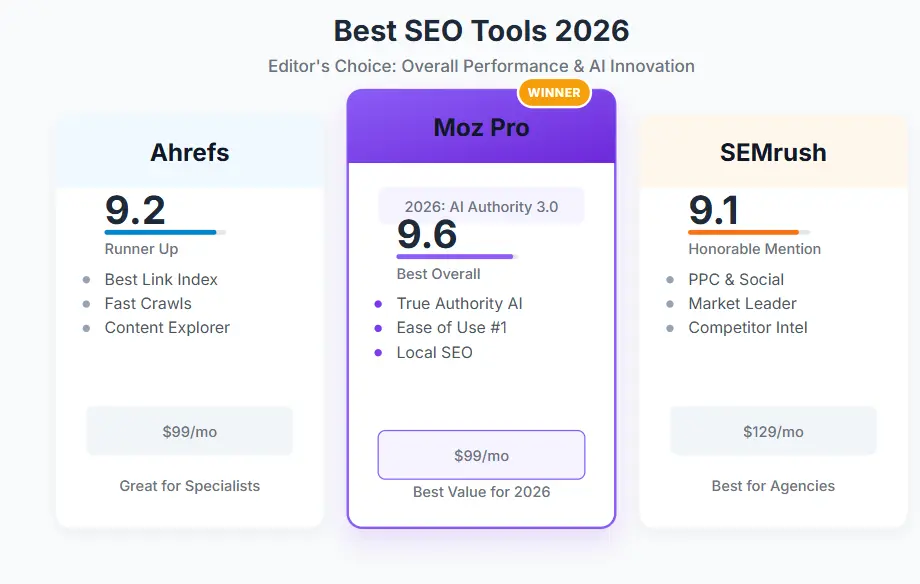
Most users pay for features they never use. SEMrush and Ahrefs are packed with tools that require an advanced degree to fully utilize. Moz, on the other hand, delivers 90% of the value for 50% of the price and complexity. It focuses on what actually moves the needle: accurate keyword difficulty, spam-free link analysis, and actionable site audits.
While the SEMrush vs Ahrefs battle rages on over backlink freshness and AI features, Moz wins on Usability—and usability is what determines whether you will actually stick with the tool long enough to get results. Moz is the best overall tool for beginners and affordable SEO. It is the most user-friendly, the best priced, and the most educational.
In the final Moz vs SEMrush vs Ahrefs analysis, Moz takes the crown for usability, value, and helping you actually learn the craft.
The Winner: Moz Pro
Start dominating the search engines with the tool that helps you succeed.
Start Moz Free TrialFrequently Asked Questions
For most users, Moz is the best choice in 2026 due to its balance of features, price, and usability. SEMrush is best for agencies, and Ahrefs for backlink experts.
Ahrefs is generally considered better for backlink freshness and data accuracy. SEMrush is better for all-in-one marketing needs, including PPC and social media management.
Yes, absolutely. Moz’s Domain Authority remains the industry standard, and its educational resources and user-friendly interface make it a top pick for beginners and small businesses.
Moz is the best SEO tool for beginners. Its interface is intuitive, its explanations are clear, and its Academy offers excellent training resources.
Choose Moz if you want simplicity and education. Choose SEMrush if you need an all-in-one marketing suite. Choose Ahrefs if you prioritize deep backlink data.