
SE Ranking Alternatives: Where to Switch, What to Add, and When to Stay
By Mousume Akter, Founder & Editor, SEORAF · Last verified: October 8, 2026
Disclosure: This page currently contains no affiliate links. When affiliate links are used on SEORAF, they are clearly labeled and do not determine how tools are evaluated.
Choosing among SE Ranking alternatives starts with one question: what is SE Ranking not doing for you? Some people want broader research data. Others want simpler reporting, specialist rank tracking, or AI search visibility. In many cases, however, the real issue is a plan limit rather than a missing capability.
An SE Ranking alternative can replace most of what SE Ranking does—such as rank tracking, site auditing, keyword research, backlink research, and reporting—or fill one specific gap alongside it, such as specialist rank tracking or AI search monitoring.
That distinction matters. You may not need to replace SE Ranking at all.
This guide therefore groups alternatives into four roles: replace SE Ranking, replace one job, add a specialist tool, or stay with SE Ranking. I compare them by use case, cost structure, tracking limits, research capabilities, reporting, ease of use, and what you may give up when switching.
Prices and plan details should always be rechecked on the vendor’s official page before purchase because software plans and limits can change.
The Short Answer
The best SE Ranking alternative depends on the gap you are trying to solve. Semrush and Ahrefs make more sense when you need broader research capabilities; Mangools is worth considering when simplicity matters more than breadth; AccuRanker and Nightwatch are specialist options for tracking; and tools such as Peec AI can complement an SEO platform when AI-search visibility is the specific gap.
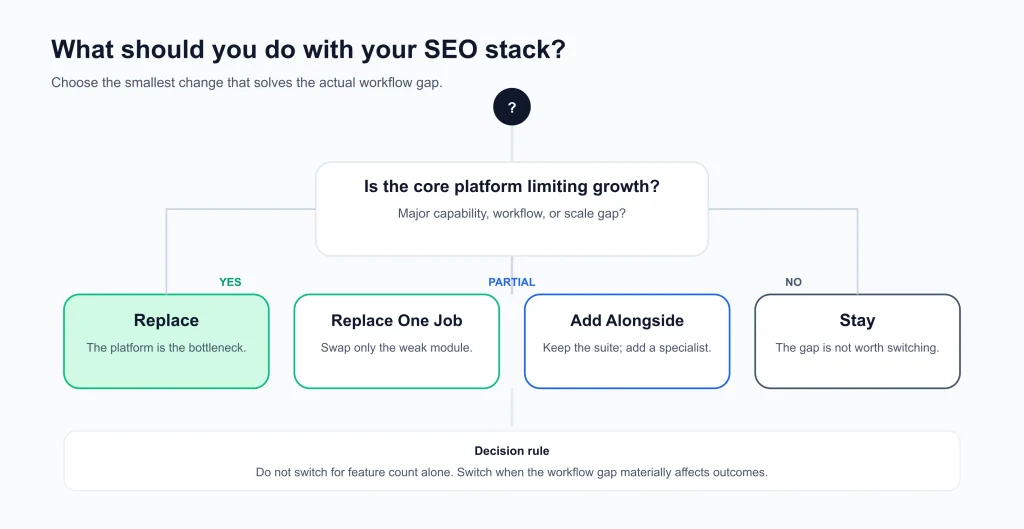
- Broader SEO suite: Semrush or Ahrefs
- Lighter workflow: Mangools
- Specialist rank tracking: AccuRanker or Nightwatch
- AI-search visibility: compare SE Ranking’s own capabilities before adding a specialist tool
- Desktop/self-managed workflow: SEO PowerSuite may be worth evaluating
- When to stay: your problem is a plan, workflow, or configuration issue rather than a genuine capability gap
Why People Look for SE Ranking Alternatives
There is no single reason to leave SE Ranking. The right alternative depends on what is actually limiting your workflow.
Cost structure
Vendor states: SE Ranking currently lists Core at $129 per month, or $103.20 per month when billed annually. The plan includes 10 projects, one manager seat, 2,000 tracked keywords, and 100 AI prompts tracked daily. SE Ranking also lists unlimited keyword, competitor, and backlink research within the plan.For a fuller breakdown of plans and limits, see our SE Ranking pricing and plans guide.
That means price alone is not necessarily a strong reason to switch. The better question is whether the alternative gives you capabilities you will actually use.
Plan limits
Project count, tracked keywords, seats, AI prompts, historical data, reporting, and other limits can matter more than the headline subscription price. Before switching, write down your actual usage and compare that usage—not just the advertised starting price—across platforms.
Data depth
Some reviewers consider larger platforms such as Semrush or Ahrefs stronger choices for certain research workflows. That does not automatically make them better for every site. A larger database is useful only when the additional coverage changes the decisions you make.
For that reason, test the tools against your own niche whenever possible rather than assuming that a database-size claim guarantees better results.
AI-search visibility
AI-search tracking is now part of several major SEO platforms. SE Ranking itself lists daily AI-prompt tracking in Core, so buying a second AI-visibility product only makes sense if it provides coverage, reporting, or workflows that your existing setup does not.
Workflow and interface
Sometimes the problem is not missing data. You may prefer a different interface, reporting workflow, tracking model, or way of organizing projects. That is a legitimate reason to evaluate alternatives, but it is best tested during a trial rather than assumed from screenshots or feature lists.If you are choosing a tool based on a specific SEO task, see our SEO tools by use case guide.
When SE Ranking may still be the better choice
- Your work already combines tracking, audits, research, reporting, and AI visibility successfully.
- Your current limits can be solved by changing the plan rather than changing platforms.
- You would need a second subscription to reproduce a capability that SE Ranking already provides.
- You have years of reports, tracking history, workflows, or client processes built around the platform.
- The alternative looks cheaper until you add seats, projects, keywords, reporting, or specialist tools.
Who should probably stay
Freelancers and small agencies that already have an effective SE Ranking workflow should not switch simply because another platform has a longer feature list. If the existing system solves the work, changing platforms creates migration and learning costs without necessarily improving the outcome.
If you are still deciding whether to keep the platform, read our SE Ranking review for a closer look at its pricing, limits, and overall fit.
SE Ranking Alternatives at a Glance
| Tool | Role vs SE Ranking | Best fit | Main strength | Main limitation |
|---|---|---|---|---|
| Semrush | Replace | Broader SEO and AI-search workflows | Broad feature and research ecosystem | Higher cost as usage and add-ons increase |
| Ahrefs | Replace | Organic and backlink research | Deep research-oriented workflow | Rank Tracker updates are weekly on listed plans |
| Mangools | Replace, lighter | Beginners and simpler workflows | Focused toolset | Narrower scope than a full SEO suite |
| AccuRanker | Replace one job | Tracking-focused teams | Dedicated rank tracking | Not a complete SEO suite |
| Nightwatch | Replace one job | Location-heavy tracking | Tracking and local visibility workflows | Not a full replacement for every SEO workflow |
| SEO PowerSuite | Different model | Self-managed workflows | Bundled desktop-oriented toolkit | Confirm current licensing and collaboration model |
| Peec AI | Add alongside | AI-search analytics | AI-visibility-focused workflow | Does not replace classic SEO software |
| Surfer | Add alongside | Content-focused teams | Content optimization workflow | Not a full replacement for SEO research and tracking |
Editorial note: This table is a decision aid, not a ranking. Feature availability, limits, and pricing can change, so verify the current vendor documentation before buying.
Entry-Plan Comparison
Entry prices are useful only when the included capacity matches your workload. A cheaper plan with insufficient keywords, projects, or tracking frequency can become more expensive after upgrades.
| Platform | Listed entry price | Projects/sites | Tracked keywords | Tracking note |
|---|---|---|---|---|
| SE Ranking Core | $129 monthly $103.20/mo annually | 10 projects | 2,000 | Daily |
| Semrush SEO | $139 monthly $117.33/mo annually | 5 websites | 500 | Daily |
| Ahrefs Lite | $129/mo | 5 unverified projects | 750 | Weekly |
SE Ranking’s official page currently lists 10 projects and 2,000 daily tracked keywords on Core. Semrush lists 5 websites and 500 daily tracked keywords on its SEO plan. Ahrefs lists 5 unverified projects, 750 tracked keywords, and weekly Rank Tracker updates on Lite.
My view: based on these listed entry allowances alone, SE Ranking is not an obvious budget loser. The stronger reason to move is usually a specific research, tracking, workflow, or data requirement.
Which SE Ranking Alternative Should You Choose?
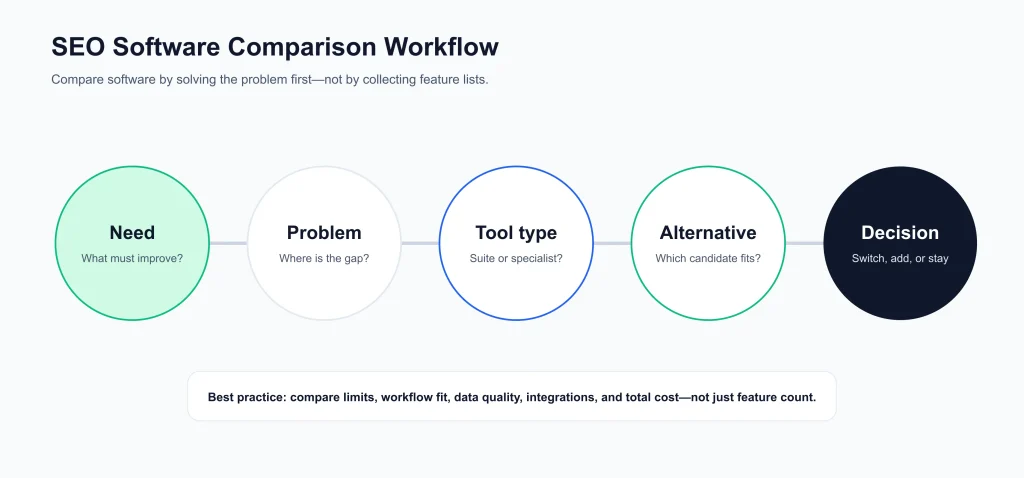
First identify the actual problem. If it is a plan limit or configuration issue, changing platforms may be unnecessary. If it is a genuine capability gap, a specialist or broader platform may make more sense.If you want to compare SEO platforms by broader use cases before choosing, see our guide to the best SEO tools.
| If your main need is… | Consider… | Check before choosing |
|---|---|---|
| Broader research | Semrush or Ahrefs | Whether the additional data changes your workflow |
| Backlink research | Ahrefs or Semrush | Test your own niche and link opportunities |
| Dedicated rank tracking | AccuRanker or Nightwatch | Keyword limits and update frequency |
| Simpler workflow | Mangools | Which suite features you would lose |
| Agency reporting | Compare SE Ranking, Semrush, and Nightwatch | White-label and reporting costs |
| AI-search visibility | SE Ranking first, then specialist tools if necessary | Platforms, prompts, reporting, and price |
| Content optimization | Surfer | Whether your existing platform already covers the workflow |
| Self-managed SEO software | SEO PowerSuite | Current license, storage, and collaboration model |
| No genuine capability gap | Stay with SE Ranking | Fix the specific issue first |
Broader SEO Suites
Semrush
Role vs SE Ranking: Replace for users who want a broader SEO and AI-search ecosystem.
Best for: teams that want extensive research, competitive analysis, SEO workflows, and AI-search visibility in one platform.
Why consider it: Semrush’s current SEO plan includes keyword research, competitor analysis, Position Tracking, Site Audit, and AI-search capabilities. The listed SEO price is $139 monthly or $117.33 per month billed annually, with 5 websites and 500 daily tracked keywords.
Strongest advantage: breadth. Higher plans add more websites, tracked keywords, historical data, content optimization, keyword-cannibalization analysis, and multi-location/device tracking.
Important limitation: the entry plan provides less daily keyword-tracking capacity than SE Ranking Core, so do not assume that the broader feature set automatically gives better value.
When not to choose it: if your existing SE Ranking workflow already covers your needs and you would not use the additional research ecosystem.
My view: Semrush is most compelling when you need breadth, not simply because it is another well-known SEO platform.
Ahrefs
Role vs SE Ranking: Replace for research-focused workflows.
Best for: users who prioritize organic-search and backlink research.
Why consider it: Ahrefs’ current plans include Site Explorer, Keywords Explorer, Site Audit, Rank Tracker, Competitive Analysis, and AI-visibility features such as Brand Radar. Lite is currently listed at $129 per month with 5 unverified projects, 750 tracked keywords, and weekly Rank Tracker updates.
Strongest advantage: research depth and a large web-scale data ecosystem.
Important limitation: Lite’s listed Rank Tracker frequency is weekly. If you require daily rank monitoring, compare the actual tracking requirements and available options before switching.
Pricing and value: Ahrefs says it does not run discounts and does not offer a conventional trial, although Ahrefs Free provides limited access for site owners.
When not to choose it: if frequent rank tracking and an all-in-one workflow matter more to you than research depth.
My view: Ahrefs makes the strongest case when research—not simply rank tracking—is the reason you are considering a switch.
Lighter and Simpler Options
Mangools
Role vs SE Ranking: Potential lighter replacement.
Best for: users who prefer a focused workflow rather than a large SEO platform.
Why consider it: Mangools is known for a focused collection of SEO tools covering keyword research, SERP analysis, rank tracking, backlink research, and site/domain analysis.
Important limitation: it should not be treated as a one-for-one replacement for every enterprise or agency workflow in a broader SEO suite.
Pricing and value: verify current plans and limits directly on Mangools before publishing or purchasing. I have intentionally removed unverified price and trial claims from this article rather than presenting third-party figures as current facts.
When not to choose it: if you require extensive auditing, advanced reporting, large-scale projects, or a broad all-in-one platform.
Specialist Alternatives for Rank Tracking
AccuRanker
Role vs SE Ranking: Replace one job—rank tracking.
Best for: teams where rank tracking is the primary requirement.
Why consider it: AccuRanker focuses heavily on rank tracking and reporting rather than trying to replace every SEO workflow.
Strongest advantage: specialization.
Important limitation: you may still need another platform for broader SEO research, auditing, and backlink workflows.
When not to choose it: if the main reason you are looking at alternatives is that you want one platform rather than a specialist tool plus another subscription.
My view: consider AccuRanker when tracking itself is the problem—not simply because you want a different SEO suite.
Nightwatch
Role vs SE Ranking: Specialist tracking option.
Best for: users with substantial local or multi-location tracking requirements.
Why consider it: Nightwatch focuses on rank tracking, local visibility, reporting, and related monitoring workflows.
Important limitation: it is not a direct replacement for every SEO research capability you may currently use in SE Ranking.
Pricing and value: verify current currency, billing frequency, keyword allowances, and promotions directly on the vendor’s pricing page before purchase.
When not to choose it: if you need deep keyword and backlink research from the same platform.
SEO PowerSuite: A Different Operating Model
Best for: users who prefer a self-managed SEO software workflow.
The vendor presents SEO PowerSuite as a suite containing Rank Tracker, WebSite Auditor, SEO SpyGlass, and LinkAssistant. Because licensing, editions, delivery model, and collaboration options can change, verify the current official product and pricing information before making it your replacement for a cloud platform.For a broader overview of SEO platforms and software categories, see our SEO software hub.
When not to choose it: if shared cloud dashboards and simple team collaboration are essential requirements and the current licensing model does not fit them.
Tools to Add Alongside SE Ranking
Peec AI
Role vs SE Ranking: Add alongside for AI-search analytics.
Best for: teams whose main gap is monitoring brand visibility in AI-generated search experiences.
The key question is whether the specialist reporting and AI-platform coverage add something that your existing SE Ranking setup does not. If SE Ranking’s AI-search capabilities already answer your reporting needs, a second subscription may add cost without enough additional value.
When not to choose it: if your AI-search requirements are already satisfied by your primary SEO platform.
Surfer
Role vs SE Ranking: Add alongside for content optimization.
Best for: content teams that need a dedicated content-optimization workflow.
Surfer is more naturally evaluated as a content-focused complement than as a complete replacement for an SEO platform covering tracking, audits, research, and reporting.
When not to choose it: if your existing content workflow already provides the recommendations you need.
Cheaper and Free Options: What You Actually Give Up
A lower sticker price does not automatically mean lower total cost. You may need to add another tool when a cheaper platform lacks tracking, auditing, backlink research, reporting, or another capability you use regularly.If you are looking for free options for individual SEO tasks, see our guide to free SEO tools.
| Option | What it can mean | What to check |
|---|---|---|
| Free plan | Permanent but limited access | Projects, reports, keywords, exports, and data limits |
| Free trial | Temporary access to paid features | Trial length, card requirement, and cancellation terms |
| Free first-party tools | Useful data from individual platforms | What they do not replace from a complete SEO suite |
A free trial is not a free plan. Treat them differently when comparing alternatives.
What You’ll Really Pay: A Simple Worksheet
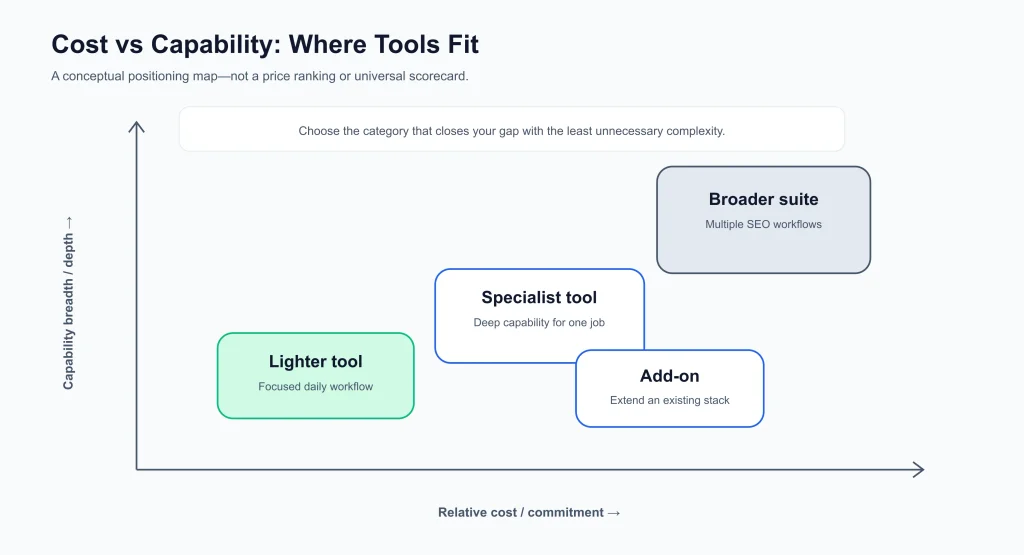
- List the jobs: tracking, keyword research, backlinks, audits, reporting, AI visibility, and anything else you actually use.
- Record your usage: projects, keywords, locations, seats, prompts, reports, and exports.
- Price that usage: use the official plan page for each candidate.
- Add switching costs: migration time, rebuilding reports, training, and temporary overlap.
- Add missing capabilities: if a cheaper platform requires a second subscription, include that cost.
- Compare outcomes: choose the setup that solves the work you actually need done.
Before You Switch: Costs, Risks and a Trial Test
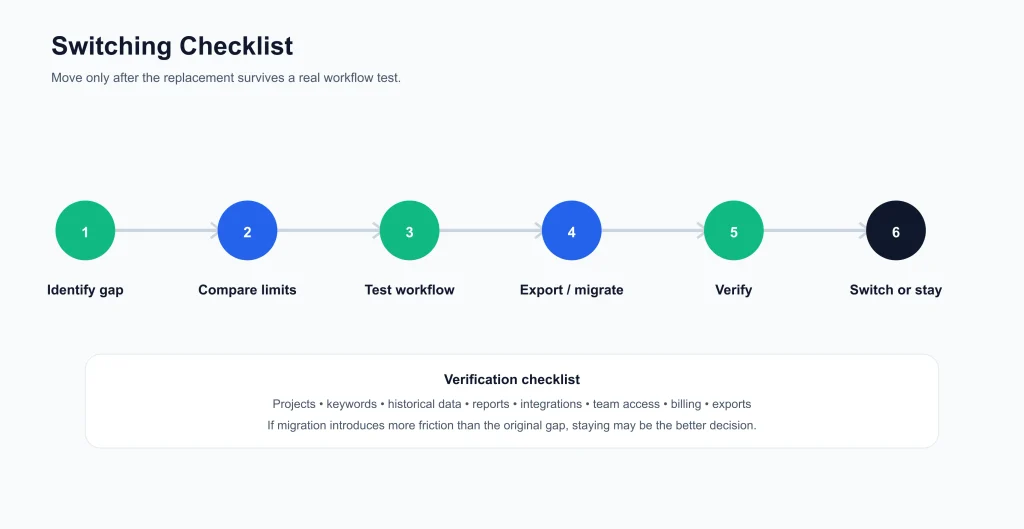
Switching checklist
- Can you export the data and reports you need?
- Which dashboards or client reports will you have to rebuild?
- Will you pay for two platforms during the transition?
- Does the new project’s, seat, keyword, and tracking structure fit your actual workload?
- Does the new tool solve the original problem better than simply changing your current plan?
A fair trial test
- Load a representative keyword set into both tools.
- Run the comparison long enough to observe the workflow you actually care about.
- Compare relevant results against first-party data where appropriate.
- Export a report from each platform.
- Test the specific feature that caused you to search for an alternative.
If the candidate does not clearly improve the problem that started your search, staying with SE Ranking may be the better decision.
Frequently Asked Questions
What is the best alternative to SE Ranking?
There is no single best alternative for every user. Semrush and Ahrefs are worth considering for broader research, Mangools for a simpler workflow, and AccuRanker or Nightwatch for specialist tracking. If SE Ranking already solves your work, staying may be the better choice.
What is the cheapest SE Ranking alternative?
There is no universally cheapest option because plans measure different things. Compare the projects, keywords, seats, tracking frequency, reports, and additional tools you actually need rather than comparing the starting subscription price alone.
Is there a free alternative to SE Ranking?
No free option completely reproduces a paid SEO platform’s full workflow. Some platforms offer limited free access or trials, while first-party tools can provide useful data for individual SEO tasks. Treat these as partial replacements rather than automatic one-for-one substitutes.
Which SE Ranking alternative is best for beginners?
A simpler tool such as Mangools may suit beginners who do not need the breadth of a large SEO suite. However, the better choice depends on which tasks you actually need to perform. A trial of SE Ranking can also reveal whether the problem is complexity or simply setup.
Which SE Ranking alternative is best for agencies?
Agencies should compare project limits, client reporting, white-label capabilities, seats, keyword tracking, local tracking, and the total cost of serving each client. Do not choose solely from the advertised starting price.
Should I switch from SE Ranking?
Switch when a documented capability or capacity problem blocks your work and another platform solves it well enough to justify the total cost of switching. If the issue is a plan setting or one narrow feature, upgrading or adding a specialist tool may make more sense.
Should I replace SE Ranking or add another tool?
Add a specialist tool when only one workflow is missing—for example, AI-search monitoring or specialist rank tracking. Replace SE Ranking when several important parts of your workflow have outgrown the platform.
Which alternative is strongest for backlink research?
Ahrefs and Semrush are commonly considered strong options for backlink and organic-search research. The better choice depends on your niche and the specific link research you perform, so test the data you actually need rather than relying only on database-size claims.
Which SE Ranking alternatives track AI-search visibility?
Several SEO platforms and specialist tools now offer AI-search visibility features. SE Ranking, Semrush, Ahrefs, Nightwatch, Peec AI, and others should be compared by the AI platforms covered, prompt limits, update frequency, reporting, and total cost rather than by the existence of an “AI” label alone.
Which SE Ranking Alternative Fits You?
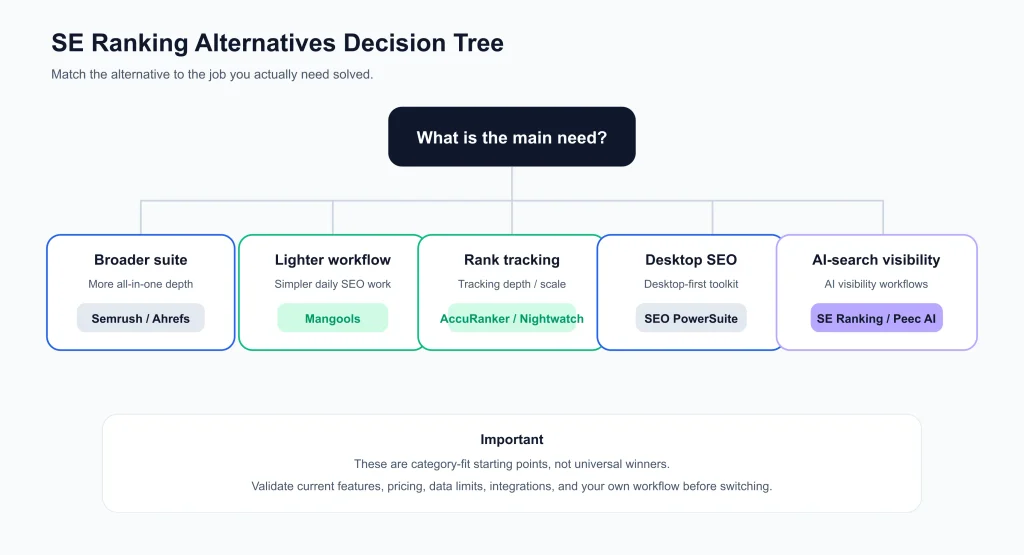
Start with the reason you searched for an alternative:
- Need broader research: compare Semrush and Ahrefs against the specific data you need.
- Want a simpler workflow: evaluate what Mangools gives you and what you would lose.
- Have a tracking problem: compare specialist trackers such as AccuRanker or Nightwatch.
- Need AI-search reporting: evaluate SE Ranking’s existing capabilities before adding another platform.
- Have a cost or plan problem: compare the cost of changing plans against the cost of switching.
- Have no meaningful capability gap: stay with SE Ranking.
The best alternative is not necessarily the platform with the longest feature list. It is the one that solves your actual problem without creating a larger one through extra cost, complexity, or missing capabilities.
Official Pricing and Product Pages
Before paying for any platform, check the vendor’s current plans, limits, billing terms, and included features:
- SE Ranking plans
- Semrush plans
- Ahrefs plans
- AccuRanker pricing
- Nightwatch pricing
- Peec AI pricing
- Surfer pricing
- Mangools
- SEO PowerSuite
How I Evaluated These Tools
I’m an independent SEO editor, not an agency, and I have not presented these tools as personally tested for this guide. Nothing here is presented as personal test data.
Plan, price, limit, and feature claims should be treated as time-sensitive vendor information. I prioritize official vendor documentation where available and identify editorial judgments separately. Where current official information could not be confirmed, I have deliberately avoided presenting a specific price or limit as fact.
My recommendations are based on use case rather than affiliate compensation. If affiliate relationships are added later, the disclosure and relevant links will be updated accordingly.
Last Reviewed
Last reviewed: October 8, 2026. Software pricing, limits, features, and trial terms can change. Verify the current vendor page before making a purchase.
If you notice an outdated factual detail, update the affected vendor section and this review date after verification.