
SE Ranking: Review, Pricing, Features & Limits 2026
Disclosure: SEORAF may earn a commission if you buy SE Ranking through links marked “affiliate link” on this page, at no extra cost to you. That is a financial interest. To help you judge the review, claims are labeled as vendor statements, third-party opinions, or SEORAF’s own view.
SE Ranking is a cloud-based, all-in-one SEO platform that combines rank tracking, keyword and competitor research, website audits, backlink tools, reporting, and AI-search tracking in one dashboard. It is positioned for freelancers, in-house teams, and agencies. This SE Ranking review examines the current 2026 Core and Growth plans, their limits, major features, add-ons, alternatives, and who the platform is most likely to fit.
The important point is that the advertised plan price is only part of the decision. Keyword and prompt allowances, seats, Agency Pack, AI Search, API usage, and other extras can change the effective cost. That is why this review looks at both the headline price and the limits behind it.
Some older reviews still describe Essential, Pro, and Business tiers. SE Ranking now lists those as legacy plans, so this review uses the current Core and Growth structure.
SEORAF is an independent SEO knowledge and research resource, not a software vendor or agency. This review is based primarily on SE Ranking’s official pricing pages and help center, checked on October 8, 2026, with clearly labeled third-party opinions where useful. SEORAF has not conducted a full hands-on accuracy benchmark, so the final recommendation is based on documented features, pricing, limits, and a structured trial approach.
SE Ranking: Quick Verdict
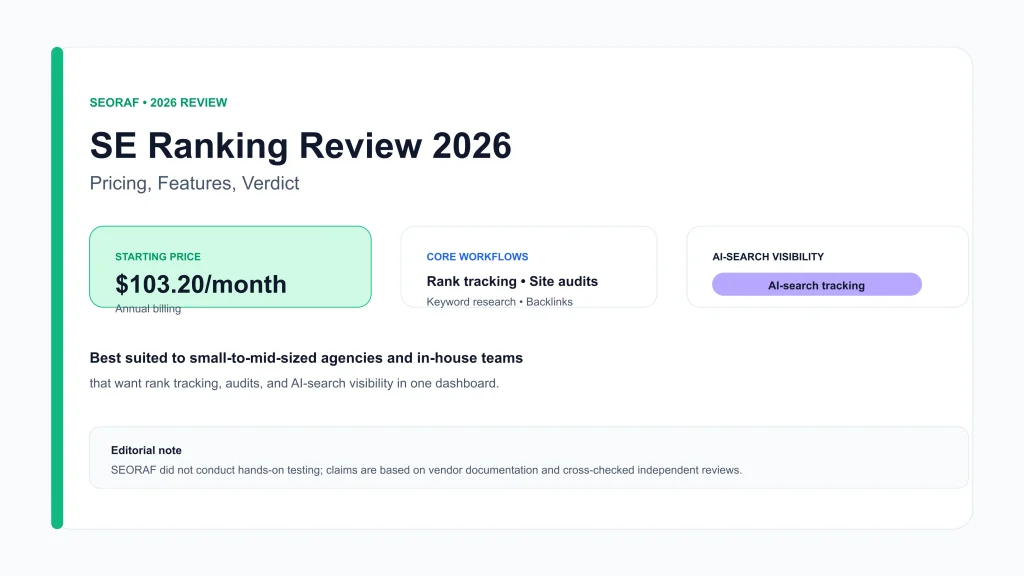
SE Ranking is a broad SEO platform that can make sense for freelancers, small teams, and agencies that want rank tracking, audits, research, reporting, and AI-search monitoring in one place. SEORAF view: its strongest selling point is the combination of breadth, daily rank tracking, and agency-oriented workflows. The main decision points are capacity, add-on costs, billing terms, and whether its data meets your requirements.
- May suit: freelancers, small teams, and agencies that want several SEO workflows in one platform.
- Check carefully: project, keyword, prompt, seat, reporting, and add-on limits.
- Look elsewhere if: you need only occasional SEO research, highly specialized data depth, or agency features without annual billing.
Price summary: Core is listed at $129 per month on monthly billing or $103.20 per month as the monthly equivalent of annual billing. Growth is $279 monthly or $223.20 as the annual-billing equivalent. Enterprise is custom, and selected capabilities are available as add-ons. Prices were checked on October 8, 2026 and can change.
Bottom line: SE Ranking is worth testing if you need an all-in-one SEO workflow and its limits fit your workload. Do not judge it by the entry price alone; calculate the cost of the features and capacity you will actually use.
SE Ranking Pricing in 2026
SE Ranking’s current self-serve structure consists of Core and Growth, with a custom Enterprise option and several add-ons. Essential, Pro, and Business are legacy plans and should not be used as the basis for a current buying decision.
Core vs Growth Pricing
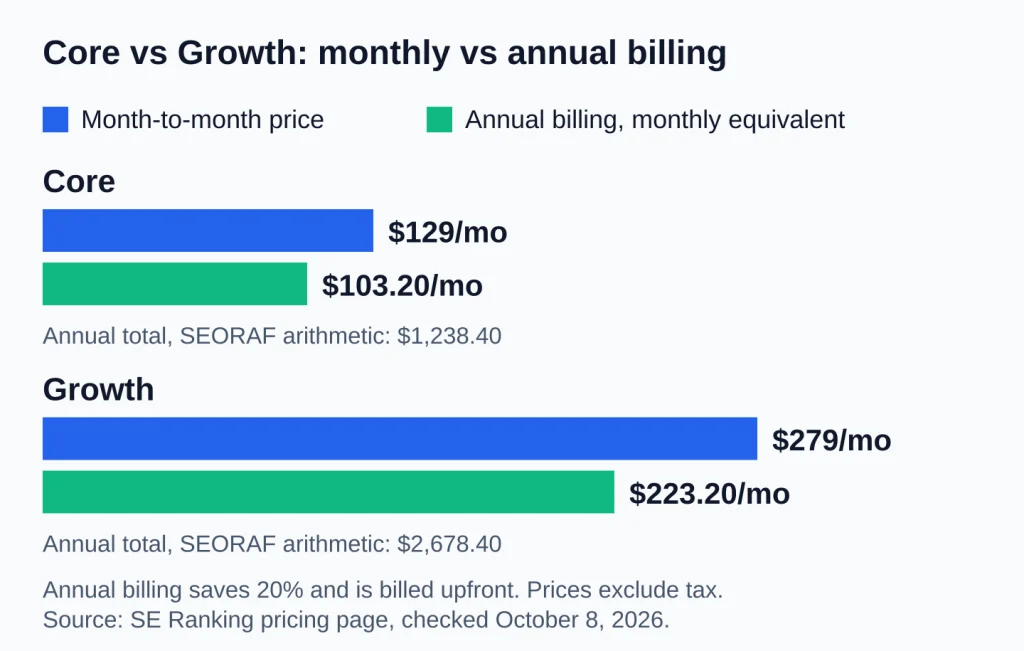
SE Ranking’s pricing page provides monthly and annual billing options. The annual figures shown below are monthly equivalents of annual billing, not month-to-month prices.
SE Ranking 2026 headline pricing
| Plan | Monthly billing | Annual-billing equivalent | Best suited to |
|---|---|---|---|
| Core | $129/month | $103.20/month | Smaller teams and individual users |
| Growth | $279/month | $223.20/month | Growing teams and multi-client work |
| Enterprise | Custom | Custom | Larger or specialized requirements |
On annual billing, SEORAF arithmetic gives approximately $1,238.40 per year for Core and $2,678.40 per year for Growth, before tax and extras. SE Ranking states that annual plans are billed upfront.
SE Ranking also states that a quarterly payment schedule with an annual commitment may be discussed with sales. Treat that as a sales arrangement rather than assuming it is a standard checkout option.
SE Ranking Add-Ons
The headline plan price does not necessarily represent the total cost. Agency features, AI-search capacity, API usage, seats, keywords, and other capacity can require additional payment.
Selected SE Ranking add-ons
| Add-on | Entry price shown | Billing | Main purpose |
|---|---|---|---|
| Agency Pack | +$69/month | Annual billing only | Client seats, white label, scheduled reporting and agency features |
| AI Search | +$71.20/month | Annual billing | Higher AI-search capacity, competitor research and SE Visible access |
| API | See checkout | Annual billing/add-on structure | Additional API capacity and credits |
Important: add-ons have their own tiers, so the entry prices above should not be treated as the maximum or universal cost.
SE Ranking’s own pages currently show inconsistent starting information for the API add-on. Because the pricing pages do not fully agree on the starting price and credit description, SEORAF recommends using the amount and allowance displayed for your account at checkout rather than relying on a single published API figure.
Third-party reviews also identify add-ons as an important part of the total cost. SEORAF view: compare the cost of your actual configuration, not just the Core or Growth headline price.
Example Annual Costs
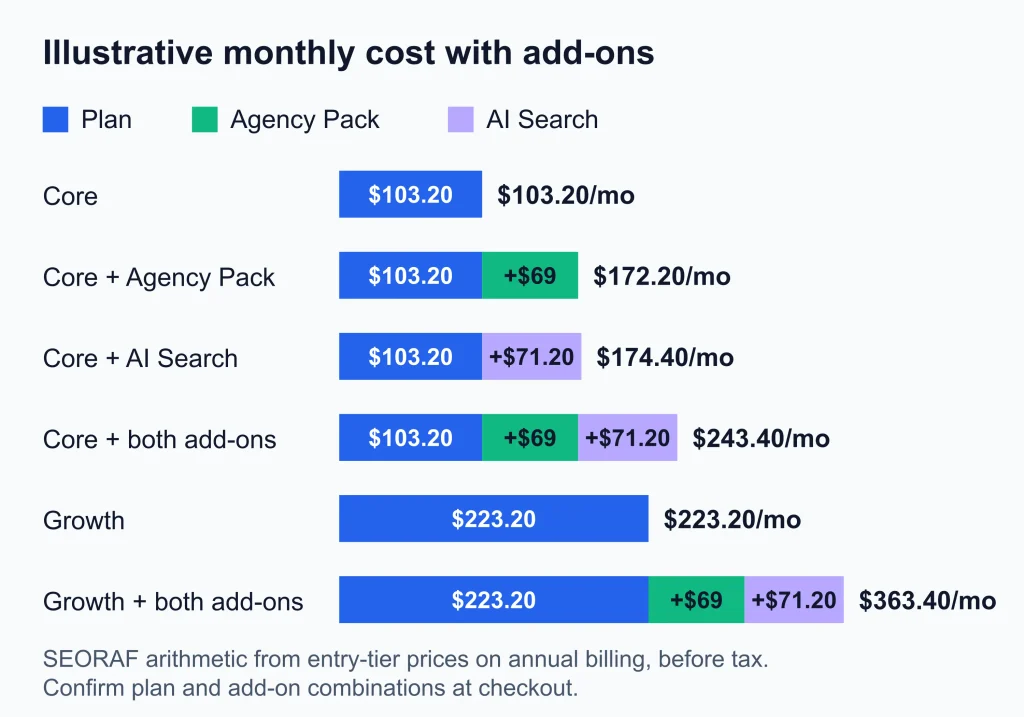
Using the listed annual-billing entry prices, the basic arithmetic looks like this:
Illustrative SE Ranking annual-billing cost scenarios
| Configuration | Monthly equivalent | Approx. annual cost |
|---|---|---|
| Core | $103.20 | $1,238.40 |
| Core + Agency Pack | $172.20 | $2,066.40 |
| Core + AI Search | $174.40 | $2,092.80 |
| Core + both add-ons | $243.40 | $2,920.80 |
| Growth | $223.20 | $2,678.40 |
| Growth + both add-ons | $363.40 | $4,360.80 |
These are illustrative calculations, not quotes. Taxes, higher add-on tiers, extra seats, extra keywords, and other capacity can increase the final amount.
Free Trial, Cancellation and Refunds
According to SE Ranking, the free trial lasts 14 days and does not require a credit card. SE Ranking’s pages describe some trial allowances differently, so the safest approach is to confirm the exact limits shown when you activate the trial.
The pricing FAQ describes starter usage including up to 10 projects, 750 tracked keywords per day, and 20 AI prompts per day. Other SE Ranking pages describe the trial more broadly. This difference does not change the main recommendation: check the limits displayed for your trial account before using it as a capacity test.
SE Ranking states that payments are generally non-refundable, subject to its stated exceptions and promotional terms. Annual subscriptions include free assisted migration, while monthly users can use self-serve import options.
SE Ranking also states that one active session is allowed per login. Teams should therefore use appropriate seats or guest access rather than treating one shared login as a team account.
Prices and terms can change, so confirm the current subscription details before paying.
Check current SE Ranking pricing and start the free trial (affiliate link)
SE Ranking Plans and Limits
The practical difference between Core and Growth is not simply the feature list. Capacity also changes across projects, seats, tracked keywords, AI prompts, research, reporting, and other allowances.
Selected SE Ranking Core and Growth limits
| Limit | Core | Growth |
|---|---|---|
| Projects | 10 | 30 |
| Manager seats | 1 | 3 |
| Keywords tracked daily | 2,000 | 5,000 |
| AI prompts tracked daily | 100 | 250 |
| LLMs to track | 5 | 5 |
| AI competitive research domains | 5 | 15 |
| Audit capacity | See current plan details | See current plan details |
| On-page checker / SERP analyzer | 50 | 1,000 |
| Report Builder reports | 10 | 30 |
| Data export rows | 50,000 | 100,000 |
| Content marketing articles | 25 | 50 |
| Research API credits/month | 25,000 | 100,000 |
| Local marketing locations | 3 | 3 |
| Local/map rank-tracking keywords | 1,500 | 1,500 |
| Historical data | See current plan details | Project lifetime |
Why some limits are marked “see current plan details”: SE Ranking’s own pages have presented certain allowances differently, particularly audit capacity and some API figures. Rather than presenting a disputed number as definitive, SEORAF recommends confirming the current plan card before relying on it for a large project.
For API usage, SE Ranking’s pricing page and help center list 25,000 monthly API credits for Core and 100,000 for Growth, while another SE Ranking page describes Growth differently. Treat the plan page shown for your account as the final reference.
What Growth Adds
Growth increases several capacity limits and adds capabilities such as guest links, page-change monitoring, and dedicated customer support. For agencies, the bigger question is whether Growth plus the Agency Pack provides better value than using a different platform.
SE Ranking also lists extra manager seats from $16, extra keywords from $22.40 on Core or $32 on Growth, and extra content articles from $39.20. Because billing periods and tiers can vary, confirm the exact amount before purchase.
SEORAF recommendation: calculate your maximum monthly usage first. A cheaper plan that repeatedly requires extras may be more expensive in practice than the next tier.
Check Core and Growth limits on SE Ranking
Affiliate link: SEORAF may earn a commission. Confirm current pricing and terms before subscribing.
For a dedicated breakdown of pricing, limits, and cost scenarios, see the SE Ranking pricing guide.
SE Ranking Features
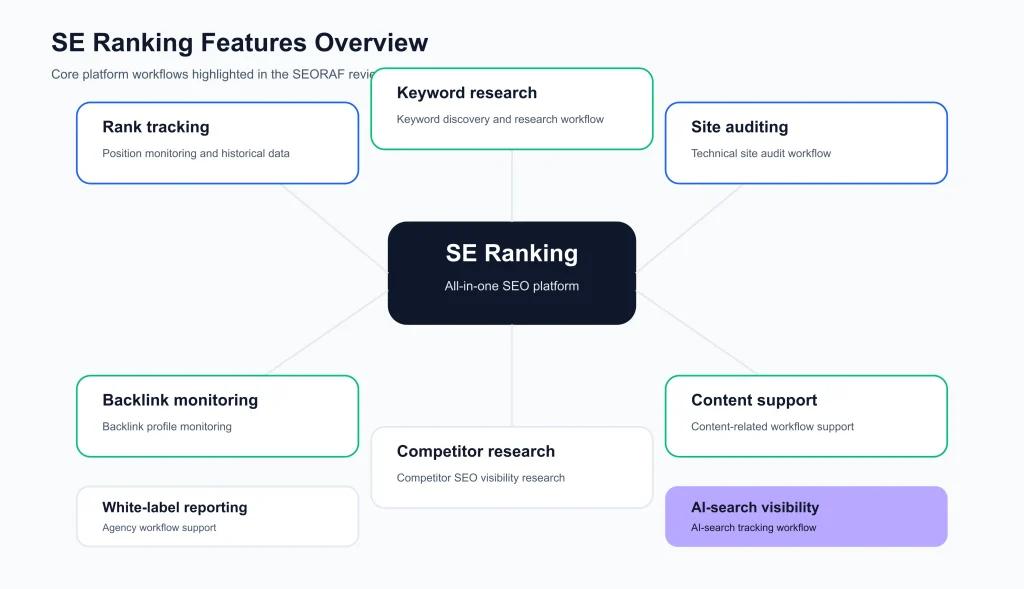
SE Ranking combines several SEO workflows in one platform. The most useful way to evaluate the feature set is by task rather than by the number of tools in the navigation.
Rank Tracking
According to SE Ranking, its rank tracker monitors daily positions across Google, Bing, and YouTube, with desktop and mobile tracking, location targeting, competitor comparison, and SERP-feature monitoring.
Core lists 2,000 tracked keywords daily and Growth lists 5,000. SEORAF view: the important question is how your combination of keywords, engines, devices, and locations consumes that allowance. Test your real setup during the trial.
Keyword Research
SE Ranking’s keyword research tools provide search-volume, difficulty, intent, SERP, long-tail, and question-related data, with keyword grouping available through its Keyword Grouper.
The platform describes keyword, competitor, and backlink research as unlimited while also displaying database-related allowances. Because those concepts measure different things, do not assume “unlimited research” means unlimited exports, database expansion, or every type of lookup.
Competitor Research
Competitor research can surface keywords, pages, paid terms, and estimated traffic. SE Ranking also provides traffic analytics covering organic, paid, and AI-related estimates.
SEORAF view: competitor traffic and visibility figures are estimates rather than a competitor’s private analytics. Use them for directional research, not as exact traffic numbers.
Website Audit
SE Ranking’s website audit checks technical areas including crawlability, indexability, mobile issues, security, structured data, and other site-health signals.
An automated audit is useful for finding issues, but it does not automatically determine which problems matter most to a particular business. Pairing the audit with a structured technical SEO process can produce a more useful prioritization.
On-Page SEO and Content Tools
SE Ranking’s On-Page SEO Checker evaluates a URL against a target keyword and provides recommendations across content, technical factors, and links. Its Content Marketing platform provides briefs, optimization guidance, scoring, and AI-assisted writing features.
SEORAF view: on-page scores are useful as checklists, not ranking predictions. A higher score does not guarantee a higher position.
Backlink Research
SE Ranking provides backlink research, backlink monitoring, and a Backlink Gap Analyzer. These tools can help identify referring domains, anchors, lost or gained links, and competitive link opportunities.
Backlink database size and freshness are difficult to judge from marketing pages alone. Third-party view: TechRadar’s February 2026 review described SE Ranking as less granular than tools such as Ahrefs or Majestic for some backlink filtering tasks.
SEORAF recommendation: if backlink research is your primary reason for buying an SEO platform, compare the same domains in the tools you are considering before committing.
Local Marketing
SE Ranking’s local SEO features include local rank tracking, Google Business Profile-related tools, citation and review functionality, and listing management across more than 100 directories according to the vendor.
The current plan comparison lists 3 local marketing locations and 1,500 local and map rank-tracking keywords on both Core and Growth. Additional locations may cost extra.
SEORAF view: agencies should calculate local locations and keywords separately from ordinary project capacity before deciding whether the platform fits.
Reporting
Report Builder is included on both plans, with 10 reports on Core and 30 on Growth. Data-export allowances are listed at 50,000 rows on Core and 100,000 on Growth.
White-label platform and reporting capabilities, unlimited scheduled reporting, AI summaries, and client seats are associated with the Agency Pack.
If client reporting is central to your workflow, test one complete report during the trial rather than assuming the presence of Report Builder means every agency reporting feature is included.
Integrations, API and MCP
SE Ranking lists integrations including Google Analytics 4, Google Search Console, Looker Studio, and Matomo. It also references integrations with automation and reporting platforms such as Zapier, Make, n8n, Whatagraph, and AgencyAnalytics.
Both Core and Growth include MCP access according to SE Ranking’s pricing information. API capacity is separate from ordinary platform usage, and the published API figures should be confirmed against the current account because SE Ranking’s own pages have not always presented them consistently.
AI Search and GEO Tracking
AI-search tracking is one of the newer parts of SE Ranking and deserves separate evaluation.
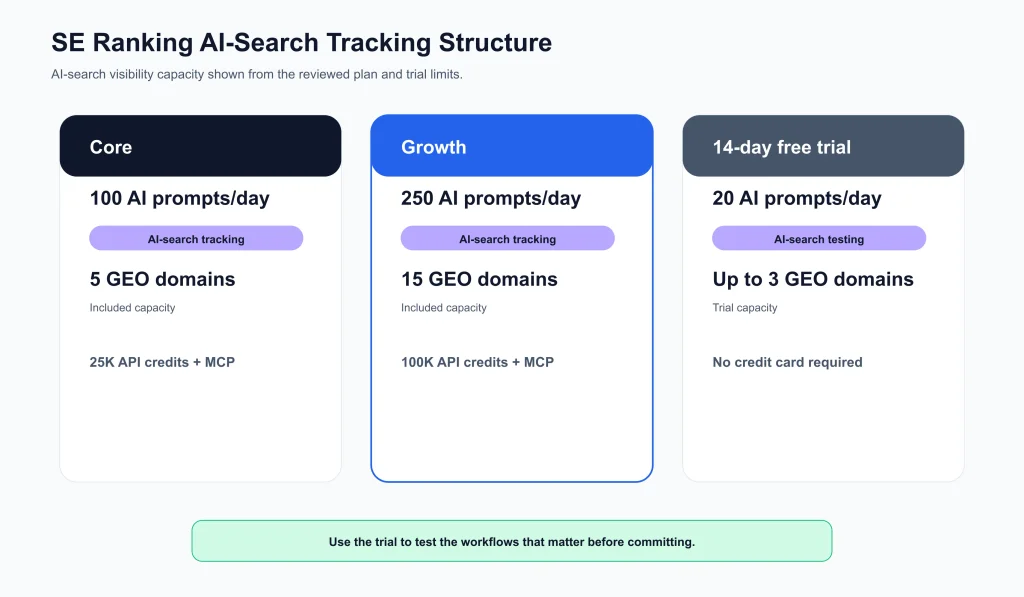
How SE Ranking structures AI-search tracking, the AI Search add-on, and SE Visible.
SE Ranking’s help center says the AI Results Tracker is available on the trial and on Core, Growth, and Enterprise. It covers AI platforms including Google AI Overviews, AI Mode, Gemini, ChatGPT, and Perplexity.
Core lists 100 daily AI prompts and Growth lists 250. The AI Search add-on increases capacity and adds competitor research and access to SE Visible. The add-on therefore expands the AI-search workflow rather than simply being the only way to access AI Results Tracker.
SE Ranking says prompt limits apply across projects in the account. Third-party interpretation from DIY AI indicates that a check can represent a prompt tracked on one platform, meaning the same question across multiple AI platforms may consume multiple checks. Because SE Ranking does not make every counting detail equally explicit, test prompt consumption during the trial before choosing a plan based on AI volume.
Traditional rank tracking and AI-visibility tracking also measure different things. Traditional tracking measures search positions, while AI tracking examines visibility, mentions, and related signals in AI-generated answers.
SEORAF view: AI results can change between runs and platforms. Use AI visibility data to identify trends and opportunities rather than treating one observation as a permanent ranking or visibility result.
Who Should Use SE Ranking?
Beginners
SE Ranking can suit beginners who want multiple SEO workflows in one dashboard, but its breadth also means there is a learning curve.
SE Ranking provides a Help Center, Academy resources, and customer support. Third-party view: TechRadar has described a learning curve as users move beyond the basic functions.
SEORAF view: if you operate one small site and need only occasional research, compare the platform with free tools before paying for an all-in-one suite.
Freelancers and Small Businesses
Core’s 10 projects and 1 manager seat can be relevant to freelancers and small teams, provided the keyword and reporting allowances match their workload.
Before subscribing, calculate how many websites, keywords, locations, users, and reports you will actually manage. If you need white-label reporting or additional client access, include the Agency Pack in the calculation.
Agencies
Agencies should evaluate SE Ranking based on the full client-delivery stack, not the base plan alone.
Compare project capacity, manager seats, client seats, white-label requirements, scheduled reporting, extra keywords, local locations, and AI-search usage. Growth provides higher capacity and guest links, while the Agency Pack adds agency-specific functionality.
SEORAF view: SE Ranking can be attractive for agencies that value an integrated workflow, but the final comparison should use the actual number of clients and deliverables rather than generic “agency” positioning.
SE Ranking Pros and Cons
| Pros | Evidence basis | Cons | Evidence basis |
|---|---|---|---|
| Broad SEO workflow covering tracking, audits, research, local SEO, reporting and AI search | Vendor documentation | Total cost can rise with add-ons and extra capacity | Pricing structure |
| Daily rank tracking | Vendor documentation | Agency Pack and API have annual-billing considerations | Vendor pricing information |
| AI-search tracking included in Core and Growth | Vendor help center | Some usage-counting details require confirmation | Vendor documentation / SEORAF view |
| Agency capabilities available through dedicated options | Vendor documentation | Payments are generally non-refundable | Vendor pricing FAQ |
| 14-day trial without a credit card | Vendor statement | Some published figures differ between SE Ranking pages | Vendor pages |
| Competitor research and reporting workflow | Third-party reviews | Backlink filtering may be less granular than specialist competitors | Third-party view |
SE Ranking Limitations
The biggest issues are not necessarily missing features. They are the details that can affect whether the platform represents good value for a particular workflow.
- Capacity counting: check how keywords, engines, devices, locations, and AI platforms affect your allowances.
- Add-on costs: calculate the real configuration rather than comparing only Core and Growth prices.
- Published-page differences: some API, audit, and trial figures have appeared differently across SE Ranking’s own pages. Use the current account and checkout information as the final reference.
- Data depth: vendor-reported database sizes do not establish that a platform is the best choice for every research task.
- Billing flexibility: annual billing and non-refundable payment terms matter if you are uncertain about long-term usage.
These limitations do not make SE Ranking a poor product. They simply make workload-based testing more important than buying from the feature list alone.
SE Ranking vs Ahrefs
This comparison focuses on documented plan and policy differences checked against the vendors’ pricing information. It is not a benchmark of database accuracy or backlink coverage.
| Criterion | SE Ranking | Ahrefs |
|---|---|---|
| Plan structure | Core, Growth and Enterprise, plus add-ons | Lite, Standard, Advanced and Enterprise, plus Starter and free access options |
| Entry monthly price | Core: $129/month | Lite: $129/month |
| Rank tracking at entry level | Daily tracking; 2,000 daily keywords on Core | Weekly update frequency; 750 tracked keywords on Lite |
| Free access | 14-day trial without a credit card | Ahrefs Free with limited access |
| AI visibility | AI prompt tracking in Core and Growth, plus AI Search and SE Visible options | AI prompt tracking and Brand Radar options vary by plan |
SE Ranking may fit better if daily rank tracking, higher entry-level tracking capacity, and an integrated reporting workflow matter most to you.
Ahrefs may fit better if keyword and backlink research depth is your primary requirement and your own testing shows it provides the data you need.
Neither conclusion should be based solely on a feature checklist. Test the same domains, keywords, and research tasks in both platforms if those areas are important to your business.
For a deeper comparison, see the SE Ranking vs Ahrefs comparison.
SE Ranking vs Semrush
SE Ranking and Semrush overlap heavily as all-in-one SEO platforms, but their product structures and feature priorities differ.
| Criterion | SE Ranking | Semrush |
|---|---|---|
| Entry SEO plan | Core: $129/month | SEO Toolkit Pro: $139.95/month |
| Plan structure | Core, Growth and Enterprise, plus add-ons | SEO Toolkit Pro, Guru and Business, with broader Semrush product options |
| Free trial | 14 days, no credit card required | Semrush lists a seven-day trial for the relevant toolkit |
SE Ranking may fit better if its tracking, reporting, research and add-on structure matches your workflow and budget.
Semrush may fit better if its broader product ecosystem or specific modules provide capabilities you need beyond SE Ranking.
Pricing and product packaging can change, so compare the current plans directly before making a final decision.
SE Ranking Alternatives
Consider an alternative when SE Ranking’s limits, billing structure, data depth, or feature priorities do not match your requirements.
- Ahrefs: consider it when keyword and backlink research depth is your main priority.
- Semrush: consider it when you need capabilities or modules that fit its broader ecosystem.
- SE Visible: consider it when your primary requirement is AI-visibility tracking rather than a complete SEO platform.
- Free tools: consider Google Search Console and other free resources when you manage a small site and do not need extensive commercial SEO data.
For a more detailed comparison of alternatives, see the SE Ranking alternatives guide.
Is SE Ranking Worth It?
SE Ranking is worth considering when its limits match your workload and the total cost of your required features remains competitive. It becomes harder to justify when you need only occasional SEO research, require specialized data depth, or must keep the setup extremely simple.
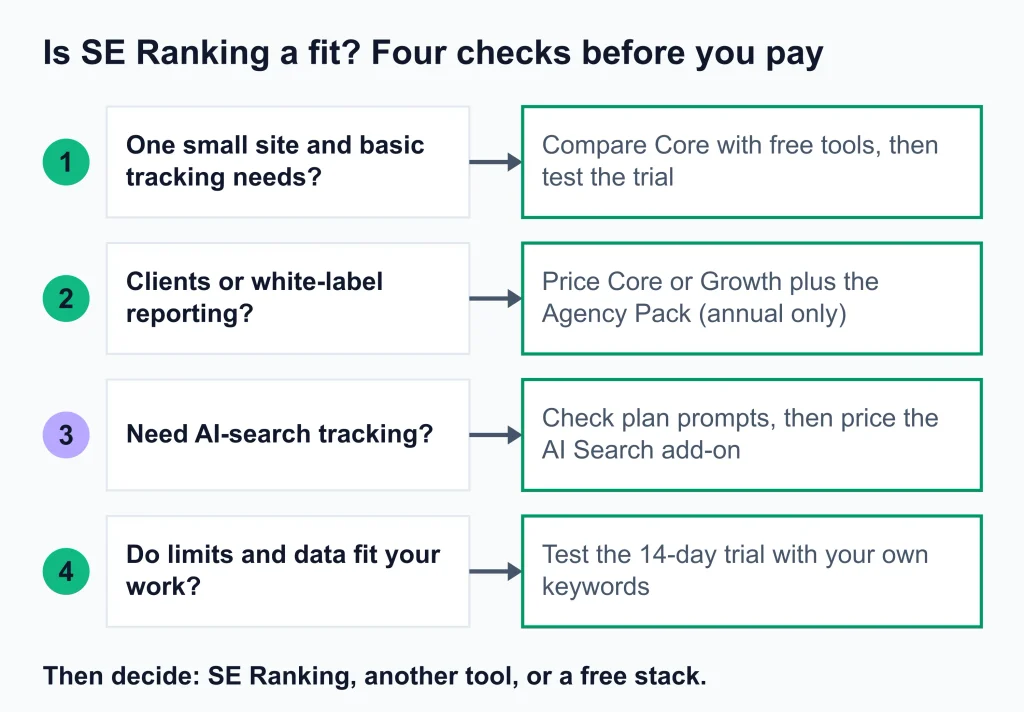
Use this simple decision rule:
- Small site and basic needs: compare Core with free tools first.
- Multiple clients: calculate projects, seats, Agency Pack and reporting costs.
- AI-search tracking: test prompt consumption before choosing a capacity level.
- Research-heavy workflow: compare the same domains and keywords against Ahrefs or Semrush.
For a dedicated cost-versus-value analysis, see Is SE Ranking Worth It?
SE Ranking Buying Checklist
- Count your keywords. Include the engines, devices, locations, and frequency you actually need.
- Count your websites and clients. Compare them with project limits.
- Count your users. Check manager seats, guest access, and whether you need additional seats.
- Price agency features. Add the Agency Pack if you require white labeling, client seats, or expanded reporting.
- Price AI usage. Confirm prompt limits and how checks are counted.
- Calculate the annual total. Include the plan, add-ons, seats, keywords, and other capacity.
- Test before paying. Use the trial with your own domains, keywords, reports, and AI prompts.
- Review billing terms. Confirm annual commitments and refund conditions before purchase.
How to Test the 14-Day Trial
SEORAF view: the most reliable way to judge SE Ranking for your needs is to test your own data rather than relying only on feature comparisons.
- Add a representative keyword set and let rankings populate.
- Spot-check a sample of rankings against manual searches.
- Run a website audit on a site you understand well.
- Compare several competitor domains with another SEO platform if data depth matters.
- Create one report and assess whether it meets your actual reporting requirements.
- Set up several AI prompts and monitor how usage is counted.
- Record the limits you reached and calculate what your real monthly or annual cost would be.
If the platform performs well on your own data and the total cost fits your workload, the trial provides a much stronger basis for purchase than a generic feature checklist.
Start the 14-day SE Ranking free trial
Affiliate link: SEORAF may earn a commission. SE Ranking states that the trial does not require a credit card. Confirm current terms when signing up.
SE Ranking FAQ
What is SE Ranking?
SE Ranking is an all-in-one SEO platform that combines rank tracking, keyword and competitor research, website auditing, backlink tools, reporting, local SEO features, and AI-search tracking.
How much does SE Ranking cost in 2026?
Core is listed at $129 per month on monthly billing or $103.20 per month as the monthly equivalent of annual billing. Growth is $279 monthly or $223.20 as the annual-billing equivalent. Enterprise pricing is custom, and selected capabilities require add-ons.
Does SE Ranking have a free trial?
Yes. SE Ranking states that its free trial lasts 14 days and does not require a credit card. Some published trial allowances differ across its pages, so confirm the limits shown when activating your trial.
Is AI tracking included in SE Ranking?
Yes. SE Ranking’s AI Results Tracker is available on Core and Growth with daily prompt allowances. The AI Search add-on expands capacity and adds additional AI-search capabilities.
How are SE Ranking AI prompts counted?
SE Ranking states that the prompt limit applies across projects in the account. Third-party explanations indicate that a prompt tracked on one AI platform can count as one check, so the same question across multiple platforms may consume multiple checks. Because the detailed counting model can be difficult to interpret from the published pages, test your expected usage during the trial.
Can SE Ranking replace Google Search Console?
No. Google Search Console provides first-party Google search data for your own site. SE Ranking is a third-party SEO platform for tracking and research. SE Ranking supports Search Console integration, so the two can be used together.
Can several people share one SE Ranking login?
SE Ranking states that one active session is allowed per login. Teams should use additional seats or appropriate guest access instead of relying on a shared login.
Does SE Ranking have an API?
Yes. SE Ranking offers API access and lists monthly API credits with Core and Growth, with larger usage available through additional API options. Because SE Ranking’s own pages have presented some API pricing and credit figures differently, confirm the exact allowance and price for your account before purchase.
Is SE Ranking accurate?
SEORAF cannot give a universal accuracy score. Database sizes are vendor-reported, and accuracy can vary by data type, location, search engine, and platform. Use the trial to compare rankings and research data against sources you already trust.
Is SE Ranking good for agencies?
It can be. Agencies should evaluate project capacity, seats, client access, reporting, white labeling, extra keywords, local locations, and add-ons together. The Agency Pack can materially change the total cost.
Is SE Ranking better than Ahrefs?
Neither is universally better. SE Ranking may be more attractive for daily rank tracking and an integrated workflow, while Ahrefs may be preferable when keyword and backlink research depth is the main requirement. Test the same tasks in both before deciding.
Is SE Ranking better than Semrush?
It depends on the workflow. SE Ranking can be a strong option when its tracking, reporting, research, and pricing structure fit your needs. Semrush may be preferable when its broader product ecosystem or specific modules provide capabilities you require.
Final Verdict: Who Should Choose SE Ranking?
SE Ranking is a credible all-in-one SEO platform, but the right question is not simply whether it has enough features. The better question is whether its limits, data, workflow, and total cost fit your specific work.
Its strongest case is for users who want rank tracking, audits, research, reporting, local SEO, and AI-search monitoring in one environment. Its biggest decision points are the cost of add-ons, capacity limits, annual-billing requirements for some options, and the depth of data compared with specialist competitors.
- Choose SE Ranking when you want several SEO workflows in one platform, need regular rank tracking, and your workload fits Core or Growth.
- Consider Ahrefs when keyword and backlink research depth is your primary requirement.
- Consider Semrush when its broader ecosystem or specific modules better match your workflow.
- Consider free tools when you manage a small site and need only basic search-performance information.
SEORAF’s final recommendation: do not buy SE Ranking because of the feature count or headline discount. Run the 14-day trial with your own keywords, domains, reports, and AI prompts. Then compare the actual annual cost with the alternatives you would realistically use.
Test SE Ranking with your own SEO data
Affiliate link: SEORAF may earn a commission. Confirm current pricing, limits, and trial terms on SE Ranking’s site.
Sources and Update Log
Primary Sources
This review primarily uses SE Ranking’s official product, pricing, and help-center documentation, checked October 8, 2026.
- SE Ranking pricing and subscription page
- SE Ranking features page
- SE Ranking rank tracker page
- SE Ranking AI Results Tracker overview
- SE Ranking AI Results Tracker rankings and prompt limits
- SE Ranking AI Results Tracker setup guide
- SE Ranking API pricing help page
- SE Ranking API plans
- Ahrefs pricing
- Semrush SEO Toolkit pricing and limits
Third-Party Sources
Third-party sources are used as opinions or interpretations, not as independent verification of SE Ranking’s proprietary database size, accuracy, or customer claims.
Update Log
- October 8, 2026: Review updated for the current Core and Growth plan structure. Pricing, limits, trial terms, AI-search information, API documentation, and competitor pricing were checked against available vendor documentation. Where SE Ranking’s own pages present conflicting figures, the article identifies the conflict and recommends confirming the current account or checkout information.