
Is SE Ranking Worth It in 2027? Cost, Limits & Who Should Buy
By Mousume Akter, Founder & Editor, SEORAF. Pricing and limits last verified October 7, 2026, against SE Ranking’s current subscription and help-center documentation, plus current Ahrefs and Semrush pricing documentation.
Is SE Ranking worth it? It is worth considering if you track rankings, audit sites, research keywords and competitors, and report SEO performance regularly enough to use an all-in-one platform. It is probably unnecessary if you manage one small site and only need occasional checks. In 2026, the real question is no longer whether SE Ranking is simply “cheap”; it is whether its limits and workflow replace enough of your existing SEO stack to justify the total cost.
This guide answers one question: should you pay for SE Ranking? It focuses on price, limits, add-ons, use cases, competitors and the trial decision. For a broader feature-by-feature review, see the SE Ranking review and the SE Ranking pricing guide.
How to read this page: vendor statements are identified as such; third-party figures are used only where they add useful context; and anything described as “My take” is my editorial judgment. This article does not claim hands-on testing or guaranteed performance results.
Is SE Ranking worth the money in 2026?
SE Ranking is worth considering when you use several of its core functions every week and the subscription replaces enough separate tools or manual work to justify its cost. It is less compelling when you use only one narrow function, rarely log in, or already have equivalent tooling through an agency or employer.
The strongest value argument is therefore not the headline subscription price. It is capacity plus consolidation: how many projects you need, how many keywords you track, how much audit capacity you consume, how many people need access, whether you need AI-search monitoring, and whether you can actually cancel tools that SE Ranking replaces.
What changed in 2026
SE Ranking’s current lineup is built around Core, Growth and Enterprise. The current subscription page lists Core at $129 per month or $103.20 per month when billed annually, while Growth is $279 or $223.20 respectively. Annual billing is advertised as 20% cheaper.
That changes the buying conversation. At $129 monthly, SE Ranking Core is priced at the same headline monthly level as Ahrefs Lite, while Semrush Pro is currently $139.95 monthly.
My take: SE Ranking should not be sold as the obvious budget winner in 2026. Its case is stronger when its project capacity, daily rank-tracking allowance, integrated SEO/GEO workflow and reporting features fit your workload.
SE Ranking offers a 14-day free trial without requiring a credit card. Use that trial to test your actual projects before committing to annual billing.
Check SE Ranking’s current plans and start the 14-day trial .
Who should buy, compare or skip
| Your situation | Verdict | Sensible next step |
|---|---|---|
| One small site, occasional rank checks | Probably unnecessary | Start with free first-party data such as Google Search Console |
| In-house SEO with recurring tracking and reporting | Likely worth considering | Trial Core with your real project |
| Freelancer with several clients | Likely worth considering if reporting/client access matters | Price the Agency Pack into your actual workflow |
| Small agency with many projects | Worth considering Growth | Compare Growth plus required add-ons with competing suites |
| Backlink research is your main SEO job | Compare alternatives first | Test backlink results against domains you know |
| AI visibility is your only requirement | Compare alternatives first | Compare AI Search costs with specialist AI-visibility products |
SE Ranking pricing and plans: what you actually pay
SE Ranking’s current subscription page lists two self-serve plans plus Enterprise. Core is $129 monthly or $103.20 per month on annual billing. Growth is $279 monthly or $223.20 per month on annual billing. Enterprise is custom-priced. Annual billing is advertised as 20% cheaper, and annual subscriptions include free migration.
| Plan | Monthly billing | Annual billing, monthly equivalent | Annual upfront total |
|---|---|---|---|
| Core | $129 | $103.20 | $1,238.40 |
| Growth | $279 | $223.20 | $2,678.40 |
| Enterprise | Custom | Custom | Custom |
These are list prices shown by SE Ranking at the time of review. Taxes, currency conversion and any account-specific commercial terms can affect the final amount shown at checkout.
The limits that decide Core vs Growth
| Limit | Core | Growth |
|---|---|---|
| Projects | 10 | 30 |
| Manager seats | 1 | 3 |
| Keywords tracked daily | 2,000 | 5,000 |
| AI prompts tracked daily | 100 | 250 |
| GEO research domains | 5 | 15 |
| Audit pages per month | 250,000 | 2,000,000 |
| Historical data | 6 months | All-time project history |
| Research API credits | 25,000/month | 100,000/month |
| Growth-only additions | — | Guest links, page-change monitoring, onboarding/customer-success features |
SE Ranking’s current comparison table confirms the 10/30 project limits, 1/3 manager seats, 2,000/5,000 daily tracked keywords, 100/250 daily AI prompts, 250,000/2 million audit pages, 6-month/all-time history and 25K/100K monthly research API credits.
That makes the Core-versus-Growth decision fairly simple: Core is primarily a capacity question; Growth becomes more attractive when project count, keyword volume, history, collaboration or page-change monitoring pushes you beyond Core.
Add-ons and additional costs
| Add-on or capacity | Current listed pricing | What it affects |
|---|---|---|
| Agency Pack | From $69/month on annual billing | White-label platform and reporting, 30 client seats, Lead Generator, unlimited scheduled reporting with AI summaries and Agency Catalog placement |
| AI Search | 200 checks: $89 monthly / $71.20 annual 450 checks: $179 / $143.20 1,000 checks: $345 / $276 | Extends AI-search tracking and AI competitive-research capacity and includes SE Visible access |
| Extra manager seats | From $16/month | Additional internal users |
| Extra tracked keywords | From $22.40 on Core; from $32 on Growth | Additional rank-tracking capacity |
| Extra articles | From $39.20 | Additional content capacity |
| Extra locations | From $18.40 | Additional local SEO locations |
The Agency Pack is an annual-billing add-on. SE Ranking says it includes white-labeling, 30 client seats, Lead Generator, unlimited scheduled reporting with AI summaries and Agency Catalog placement.
For AI Search, SE Ranking defines one check as one prompt on one AI platform. Tracking one prompt across five supported AI engines therefore consumes five checks. The current add-on page lists AI Overviews, AI Mode, ChatGPT, Perplexity and Gemini among the supported platforms.
Important: do not confuse the plan’s daily AI-prompt allowance with the add-on’s monthly check allowance. They are different capacity measures.
What about API pricing?
SE Ranking’s current subscription page includes API credits in Core and Growth, while SE Ranking also offers higher-volume API options separately. The current subscription page lists 25,000 research API credits per month on Core and 100,000 on Growth.
Because SE Ranking presents multiple API products and credit tiers, I would not budget a separate API add-on from an older review without checking the current API offer at the time of purchase.
My take: if your workflow needs API volume, calculate the API cost separately instead of assuming the included monthly credits will be enough.
Billing rules to know before paying
- Annual billing is paid upfront at the advertised annual rate.
- Core and Growth are available on monthly or annual billing.
- The Agency Pack is an annual-billing add-on.
- Additional manager seats can be added rather than sharing one login.
- Growth includes guest links for client access without using an internal manager seat.
- Always check the current checkout and terms before making a non-trivial annual purchase.
What you get for the money: features that affect value
| Feature area | What the current plan page lists | Why it affects value |
|---|---|---|
| Rank tracking | Daily keyword tracking, with limits scaling from 2,000 on Core to 5,000 on Growth | Useful when rankings are a recurring reporting requirement |
| Keyword and competitor research | Unlimited keyword, competitor and backlink research is listed in the base subscription | Reduces the need to buy separate research tools for routine work |
| Website audit | 250,000 account-level audit pages on Core and 2 million on Growth | More than enough for many small and medium sites; large sites should check project-level limits |
| Reporting | Report Builder and scheduled reports, with 10 reports listed on Core and 30 on Growth | Can reduce recurring reporting work |
| Integrations | Data Studio, Matomo, GA4 and Google Search Console integrations | Useful when SEO data needs to be combined with first-party analytics |
| AI/GEO visibility | 100 daily prompts on Core and 250 on Growth, with five LLMs listed; AI Search expands capacity | Useful when AI-search visibility is part of your reporting workflow |
| Local SEO | 3 locations and 1,500 local/map keywords on both Core and Growth, plus listing management across 100+ directories | Good fit for a limited number of local markets; larger location counts may require extras |
| API and MCP | API credits and MCP access are included in the current Core and Growth plans | Useful for automation and custom reporting workflows |
SE Ranking’s current subscription page also lists 5 LLMs to track, 5 GEO-research domains on Core and 15 on Growth, plus 3 local locations on both plans.
These are capability statements, not ranking guarantees. A larger keyword database, more tracked prompts or more audit capacity does not by itself produce better rankings or AI visibility.
Cost vs value: how to decide
Sticker price is the wrong number to compare. Use the total monthly cost of the setup you would actually run, then compare it with the tools and time it replaces.
| Setup | Monthly equivalent on annual billing | Annual total |
|---|---|---|
| Core | $103.20 | $1,238.40 |
| Core + AI Search, 200 checks | $174.40 | $2,092.80 |
| Core + Agency Pack | $172.20 | $2,066.40 |
| Core + Agency Pack + AI Search, 200 checks | $243.40 | $2,920.80 |
| Growth | $223.20 | $2,678.40 |
| Growth + Agency Pack + AI Search, 200 checks | $363.40 | $4,360.80 |
SEORAF arithmetic based on the listed entry prices. These examples exclude taxes, extra seats, extra keywords, extra locations and higher AI Search packages.
Run three tests with your own numbers:
- Cost per active project. At full capacity, Core’s annual-equivalent cost is about $10.32 per project across 10 projects; Growth is about $7.44 across 30. That does not mean you actually pay those amounts per project. If you use only three Core projects, the effective cost per active project is much higher.
- Tools replaced. Add what you currently pay for rank tracking, auditing, research, reporting and AI visibility. The saving exists only if you actually cancel overlapping subscriptions.
- Time saved. Estimate how much recurring reporting, research and audit work the platform would remove from your workflow. Use your own value for that time rather than accepting a generic “hours saved” claim.
If the numbers look favorable, test your real projects before committing to annual billing.
Test your numbers in SE Ranking’s free trial .
Real-world use cases: who gets the most value
Beginners
SE Ranking is worth considering for a beginner who is actively learning SEO across multiple sites or wants one platform for ranking, auditing and research. It is probably unnecessary if you only manage one small site and mostly need first-party performance data.
For a single site, start with Google Search Console and other free resources before paying for a full SEO suite.
Freelancers
SE Ranking can make sense for freelancers managing several client projects, especially when recurring rankings, audits and reports are part of the service. The Agency Pack becomes relevant when white-labeling and client-facing features matter.
Compare alternatives first if you need deeper backlink research, many collaborators or a large number of locations.
Small businesses
It can be worthwhile when one person owns SEO and needs recurring rank tracking, competitor research, audits and reporting. The main test is whether that person will actually use the platform often enough to justify the subscription.
If an outside agency already provides these tools and reports, buying a separate platform may create unnecessary duplication.
In-house SEO teams
Core can fit a small in-house team that needs one manager seat and up to 10 projects. Growth becomes more relevant when three internal managers, 30 projects, larger keyword capacity, full historical data or page-change monitoring are required.
Agencies
Agencies should price two things separately: the Core/Growth capacity and the Agency Pack client workflow.
The Agency Pack adds white-label platform and reporting, 30 client seats, Lead Generator, scheduled-reporting features and Agency Catalog placement.
Growth is more appropriate when the underlying SEO workload itself exceeds Core’s project or keyword capacity. The Agency Pack does not turn Core into Growth; it is a separate layer on top of the selected subscription.
Local SEO
SE Ranking lists three locations on both Core and Growth, with 1,500 local and map keywords and listing management across 100+ directories.
That can be enough for a small local SEO workload. If you manage many locations, calculate the additional location cost before deciding.
AI SEO and GEO workflows
SE Ranking is particularly interesting if you want traditional rank tracking and AI-search visibility in the same platform. Core lists 100 daily prompts and Growth lists 250, with five LLMs to track. The AI Search add-on provides larger monthly check packages and expanded AI-search capabilities.
However, AI visibility should be treated as a measurement problem, not a ranking promise. Tracking a brand in ChatGPT, Gemini, Perplexity or Google’s AI surfaces does not guarantee that the brand will appear there more often.
Pros, cons and limitations
| Pros | Cons and limitations |
|---|---|
| Broad SEO and GEO workflow under one subscription | The entry price is no longer a simple low-cost advantage |
| 10 projects and 2,000 daily tracked keywords on Core | Core includes only one manager seat |
| AI-search tracking is included with defined base limits | Higher AI-search usage requires an additional package |
| Agency Pack provides white-label and client-facing features | Agency Pack requires annual billing |
| API and MCP access are included in the current plans | Higher-volume API usage can require additional capacity |
| Strong consolidation potential | It may still need to be paired with specialist tools for specific workflows |
Is SE Ranking good enough compared with Ahrefs or Semrush?
There is no universal winner. The useful comparison is the workload each plan can support.
| Value factor | SE Ranking Core | Ahrefs Lite | Semrush Pro |
|---|---|---|---|
| Monthly price | $129 | $129 | $139.95 |
| Projects / websites | 10 projects | 5 unverified projects; verified projects can be unlimited | 5 websites |
| Rank tracking | 2,000 keywords, daily | 750 tracked keywords, weekly | 500 tracked keywords |
| AI visibility | 100 daily prompts; 5 LLMs listed | 5 tracked AI prompts; 150 monthly checks | AI capabilities vary by product/add-on |
| Site audit capacity | 250,000 pages/month | 100,000 crawl credits/month | 100,000 pages/month |
| Free trial | 14 days, no card required | No paid-plan free trial | 7 days |
Ahrefs currently lists Lite at $129/month with 750 tracked keywords, weekly updates, 100,000 crawl credits and five tracked AI prompts. It also states that paid-plan users can purchase additional users and other add-ons.
Semrush’s current SEO Toolkit documentation lists Pro at $139.95/month, with five websites to monitor, 500 tracked keywords and 100,000 pages crawled per month. Guru is $249.95/month and raises those limits to 15 websites, 1,500 tracked keywords and 300,000 crawl pages.
My take: I would lean toward SE Ranking when daily rank tracking, audits, reporting and AI visibility need to live in one workflow. I would compare Ahrefs first when backlink and content research are the dominant jobs. I would compare Semrush first when broader marketing intelligence and advertising-related research matter.
Do not treat the keyword numbers as directly interchangeable. Each vendor counts and updates tracked keywords differently.
Run your own projects through SE Ranking’s trial .
Who should not buy SE Ranking?
Skip it, or at least delay the purchase, if any of these describe your situation:
- You run one small site and only check rankings occasionally.
- Nobody will use the platform regularly.
- An agency or employer already supplies equivalent SEO software.
- Your main job is link prospecting or outreach rather than SEO measurement and research.
- You need many seats or locations and the additional capacity makes the total cost unattractive.
- You only need one narrow SEO function that can be handled by a much cheaper specialist tool.
When should I choose an alternative?
Choose an alternative when the job you care about most is better served elsewhere or when the total cost of the required SE Ranking capacity no longer makes sense.
- Deep backlink research: compare Ahrefs first.
- Broader marketing and advertising intelligence: compare Semrush first.
- AI visibility only: compare standalone AI-visibility products against the cost of the SE Ranking AI Search add-on.
- Only rank tracking: compare dedicated rank trackers.
- Only keyword research: compare dedicated keyword-research tools.
- One small website: start with free first-party data and upgrade only when the workload justifies it.
For a broader list of alternatives, see SE Ranking alternatives.
Free trial: how to test whether it is worth it
SE Ranking offers a 14-day trial without requiring a credit card. The trial is intended to let you evaluate the platform before purchasing. Because trial capacity can differ from the full paid plan, do not assume that a trial’s limits represent Core or Growth’s complete capacity.
The most useful approach is to test a representative sample rather than trying to recreate your entire production workload during the trial.
| Test | What to do | Pass signal |
|---|---|---|
| Rank accuracy | Track a representative keyword sample and compare with manual checks and first-party data | Differences are acceptable for your reporting |
| Keyword counting | Add keywords using the engines, locations and devices you actually need | Usage behaves as expected |
| Capacity | Count projects, keywords, locations, prompts and seats | Core or Growth fits without expensive extras |
| Audit usefulness | Crawl a representative site and review the issue prioritization | The output produces an actionable fix list |
| Research | Run keyword, competitor and backlink research in your actual niche | Data is useful enough for your workflow |
| Reporting | Build one stakeholder or client report | It saves time and contains what the recipient needs |
| AI tracking | Track the prompts that matter to your brand or clients | You understand both output quality and expected check usage |
| Team access | Test manager and guest access if multiple people are involved | You do not need to share credentials |
| Total cost | Price the exact plan plus required add-ons | The total is justified by your workload |
Decision path: should I pay for SE Ranking?
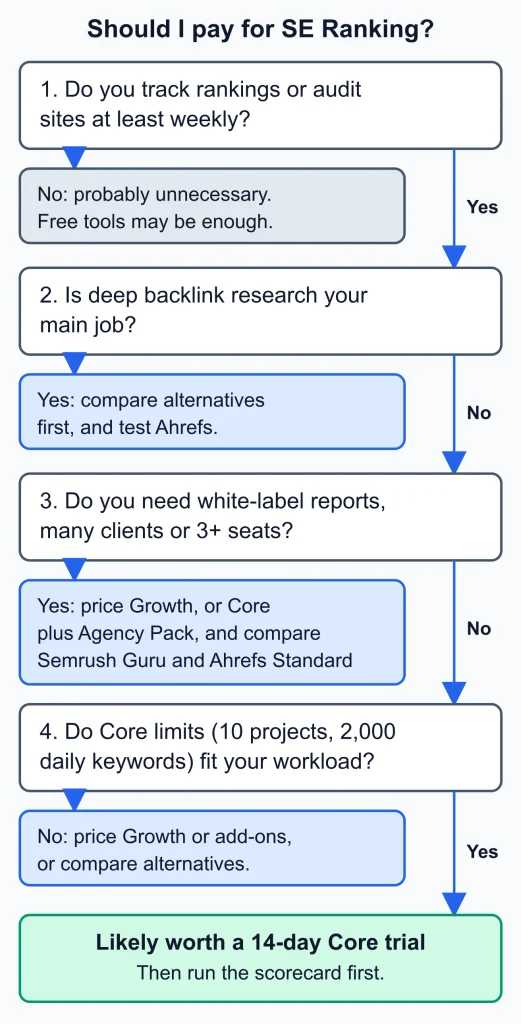
If two or more answers point toward “compare alternatives,” do that comparison before paying. Use the same projects and representative keywords wherever possible so that the comparison is meaningful.
SE Ranking vs paying for several tools
The strongest value argument for SE Ranking is consolidation. If you currently pay separately for rank tracking, site auditing, keyword research, backlink research, reporting and AI-search monitoring, one platform may reduce both subscription overlap and workflow fragmentation.
But consolidation is not automatically a saving. If you keep the old tools after buying SE Ranking, your total cost has increased.
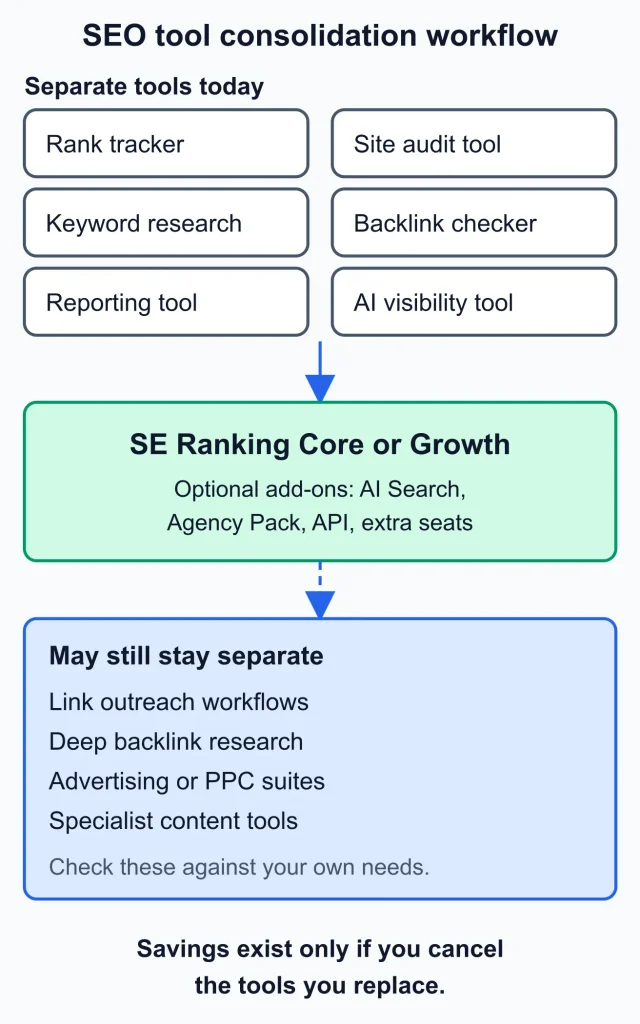
Compare using current invoices, not memory. List each tool’s monthly cost, identify which jobs SE Ranking would replace, add the required SE Ranking add-ons and then calculate the difference.
For broader category context, see SEORAF’s SEO software and SEO tools guides.
Final verdict: is SE Ranking worth it?
Yes, for the right workload. SE Ranking is worth considering when rank tracking, audits, keyword research, competitor research, reporting and AI-search visibility are recurring parts of your SEO workflow and the plan capacity fits without excessive add-ons.
I would be most likely to recommend testing Core for a freelancer, small business or small in-house workflow that fits within 10 projects and 2,000 daily tracked keywords. Growth becomes more compelling when you need 30 projects, three manager seats, 5,000 daily tracked keywords, full project history or Growth-specific collaboration and monitoring features.
I would compare Ahrefs first if backlink and content research are the dominant reasons for buying SEO software. I would compare Semrush first if broader marketing intelligence is the priority. And I would skip a full platform altogether if one small site and occasional SEO checks are all you need.
The key 2026 lesson is simple: do not compare SE Ranking’s $129 headline price with a competitor’s headline price and stop there. Compare the exact plan, limits, add-ons, seats, AI capacity and tools you would actually replace.
I do not promise ranking, traffic or AI-visibility results from SE Ranking or any other SEO platform. The strongest buying signal is whether the software performs the jobs you actually need at a total cost you are comfortable paying.
Start the SE Ranking trial and run the scorecard .
Related SEORAF guides
- SE Ranking review: broader product and feature analysis.
- SE Ranking pricing guide: plans, limits and billing details.
- SE Ranking alternatives: options if SE Ranking does not fit.
- SE Ranking vs Ahrefs: head-to-head comparison.
- Keyword research tools: category guide.
- AI SEO tools: AI-focused SEO software category.
- SEO software: broader software hub.
- SEO tools: broader tool hub.
Editorial standards and sources
Last verified: October 7, 2026.
Pricing and plan limits in this article are based primarily on current first-party vendor documentation. Third-party sources are not used to manufacture ratings, review counts, user results or performance claims. Prices and product limits can change, so readers should confirm the current vendor page before purchasing.
- SE Ranking subscription page — current Core, Growth and Enterprise pricing, project limits, keyword limits, GEO limits, audit capacity, API credits and integrations.
- SE Ranking Help Center — AI Search add-on pricing, check calculation and supported AI platforms.
- SE Ranking FAQ — Agency Pack, client seats, billing and account-access information.
- Ahrefs Plans & Pricing — current Lite pricing, projects, rank-tracking, crawl and AI limits.
- Ahrefs Help Center — current Lite usage, rank tracking and AI visibility details.
- Semrush SEO Toolkit Pricing and Plans — current Pro, Guru and Business pricing and limits.
Editorial note: This article is a buying guide, not a guarantee of SEO performance. The most reliable way to judge value is to test representative projects, calculate the exact total cost and compare the output with at least one realistic alternative.