
Home / SEO Guides
SEO Guides: The Complete Learning Path from Beginner to Advanced
Follow a practical SEO learning path across 10 core categories — from fundamentals and keyword research to content, technical SEO, local SEO, link building, ecommerce, and advanced AI-search topics.
How to use this hub: You do not need to read every guide in order. Choose the category that matches your current goal, learn the core concept, apply it to a real page or website, and then move into the next supporting topic.
Learning SEO is rarely difficult because every individual concept is impossible. The harder problem is knowing what to learn first, which topics depend on earlier knowledge, and when a tactic is actually useful. A beginner may encounter crawl budget before understanding crawling, or link-building advice before learning how to build a page worth referencing. This hub is designed to solve that sequencing problem.
The learning path starts with the concepts that explain how search works, moves into keyword and page-level planning, and then progresses toward broader content systems, technical infrastructure, authority building, specialized SEO, and advanced search environments. The order is a useful default rather than a rigid curriculum. A local business, ecommerce store, publisher, or mature site may need to enter at a different point.
Each category below is intentionally different. The category description explains its role in the larger SEO system; the learning focus tells you what to understand; and the linked resources take you into deeper, narrower material. When a category has limited published coverage, that gap is stated openly instead of being filled with unrelated pages.
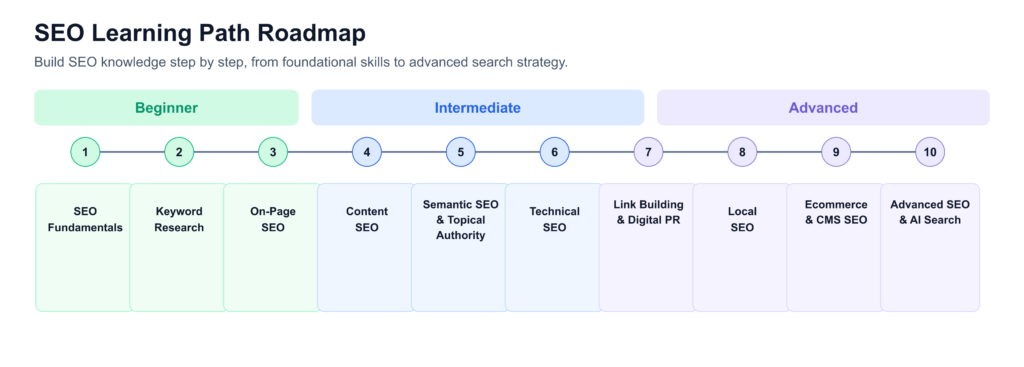
The 10 SEO categories arranged from foundational to advanced learning.
The roadmap above shows when a topic fits into the learning journey. The category map below shows how the topics connect as one SEO knowledge system.
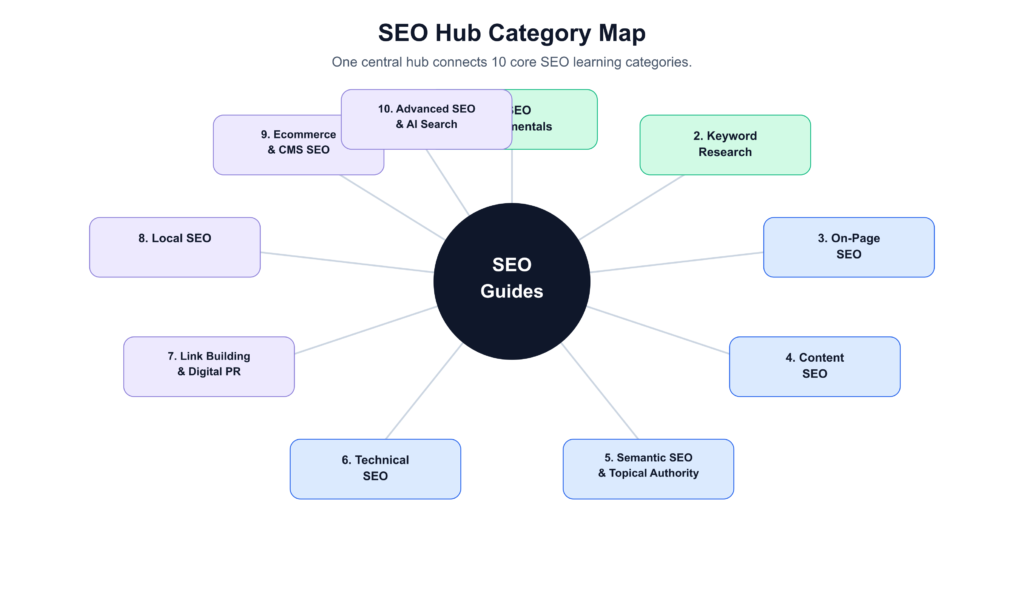
The 10 SEO categories connected as one structured learning hub.

SEO Fundamentals
Beginner
SEO fundamentals give you the mental model needed to understand everything else in this learning path. Before optimizing a page, it helps to understand the basic relationship between search queries, crawling, indexing, search results, relevance, and the content a searcher expects to find.
This stage is also where you learn the basic language of SEO: search intent, SERP, URL, title tag, internal link, canonical, indexability, and other terms that later guides will use without stopping to define them. A solid vocabulary makes technical and strategic discussions easier to follow.Google’s SEO Starter Guide provides a useful foundation for understanding how search engines discover and present content.
What to learn: how search engines discover and process pages, core SEO terminology, search intent, basic page optimization, and the difference between technical, on-page, content, and off-page work.
Best next step: Once the fundamentals are comfortable, move into Keyword Research. That is where general SEO knowledge becomes a specific content and page-targeting strategy.

Keyword Research
Beginner
Keyword research helps you translate an audience need into a page opportunity. The task is larger than collecting phrases with search volume. You need to understand what a query means, what type of result the searcher expects, how closely the topic fits your website, and whether the opportunity deserves a dedicated page.
Strong keyword research also prevents content duplication. Related queries can often be grouped around one page instead of creating several thin URLs that compete for similar intent. This becomes the bridge between research and content architecture.For Google’s guidance on creating content for people rather than search engines, see Google Search Central’s helpful content guidance.
What to learn: keyword discovery, search intent, keyword clustering, prioritization, keyword-to-page mapping, and understanding the difference between informational, commercial, and action-oriented searches.
Best next step: After you know which topics deserve pages, move into On-Page SEO so you can structure and optimize the pages around those topics.

On-Page SEO
Beginner
On-page SEO is the point where your research becomes visible on an actual page. Titles, headings, internal links, content structure, image context, and metadata should help both readers and search systems understand the page’s purpose.
Good on-page optimization is not about repeating an exact keyword in every possible location. It is about making the page clearly relevant to its intended query while keeping the information useful and easy to navigate.
What to learn: title tags, meta descriptions, heading hierarchy, internal linking, page structure, image context, content clarity, and basic on-page quality checks..

Content SEO
Intermediate
Content SEO is about creating pages that satisfy the reason someone searched in the first place. Keyword research tells you what people are looking for; content SEO determines how thoroughly, clearly, and usefully the resulting page answers that need.
This includes selecting the right format, covering meaningful subtopics, answering natural follow-up questions, and removing unnecessary material. The strongest content is not automatically the longest content. It is content with an appropriate scope and useful information density.
What to learn: search-intent alignment, content planning, topical coverage, content briefs, information gain, structure, updating, and editorial quality.
Key connection: Keyword research decides which search opportunities deserve attention; Content SEO determines how well the resulting page serves those opportunities.
Best next step: Learn Semantic SEO and Topical Authority when your site moves beyond individual pages and starts building a connected knowledge base.

Semantic SEO & Topical Authority
Intermediate
Semantic SEO focuses on relationships: between entities, related concepts, questions, pages, and the broader topic a website is trying to cover. Instead of treating every query as an isolated keyword, you begin thinking about how multiple pieces of content support one another.
Topical authority is therefore not simply “write more articles.” It involves deciding which subtopics genuinely belong in your coverage, how those resources connect, and where a broad pillar should hand the reader to a narrower guide.
What to learn: semantic relationships, entities, topical maps, content clusters, supporting pages, internal-link architecture, and information coverage.
Best next step: Once content relationships are clear, Technical SEO helps ensure the underlying website can expose those pages through a clean, accessible architecture.

Technical SEO
Intermediate
Technical SEO deals with the infrastructure behind search visibility: crawling, indexing, site architecture, rendering, performance, redirects, structured data, and other technical systems that influence how a website can be accessed and processed.
Technical SEO becomes easier when you already understand content and intent. You can then judge technical problems according to the pages and business goals they affect instead of treating every warning as equally important.For Google’s official crawling and indexing documentation, see Google Search Central’s Crawling and Indexing documentation.
What to learn: crawling, indexing, site architecture, Core Web Vitals, JavaScript SEO, redirects, XML sitemaps, robots.txt, structured data, and technical audit workflows.
Important: Technical SEO is not synonymous with fixing every crawler warning. Prioritize issues according to accessibility, affected URLs, business importance, and evidence of real impact.

Link Building & Digital PR
Advanced
Link building focuses on earning relevant references from other websites. It works best when it is connected to something genuinely useful: research, original resources, expert commentary, strong educational content, or another asset that people have a reason to reference.
Digital PR expands that idea by treating useful stories and resources as things that can earn attention beyond traditional outreach. Quantity alone is not a sufficient measure of link quality; relevance, context, editorial value, and the broader reason a link exists all matter.For Google’s guidance on practices that violate its search policies, see Google Search Essentials spam policies.
What to learn: link evaluation, outreach principles, digital PR, linkable assets, relationship building, and risk-aware acquisition strategies.
Best next step: Choose a specialized SEO path based on the type of website or search market you are working with.

Local SEO
Intermediate
Local SEO is designed for businesses that need visibility in a defined geographic market. It combines website relevance with business information, location signals, local content, reviews, and the broader consistency of how a business is represented online.
The best starting point depends on the business. A service-area company, storefront, multi-location organization, and practitioner may have different priorities even when they target similar local queries.
What to learn: local search intent, local landing pages, business profiles, local relevance, citations, reviews, location-focused content, and measurement.

Ecommerce & CMS SEO
Advanced
Ecommerce and CMS SEO becomes more complex as a site grows. Product variations, categories, filters, parameters, templates, pagination, large inventories, and platform-specific controls can create URL patterns that are uncommon on smaller websites.
The priority is not to apply every advanced technique at once. Start by understanding how the platform creates URLs and templates, then determine which versions deserve discovery, which should be consolidated, and which should remain out of the primary crawl path.
What to learn: ecommerce architecture, product and category SEO, faceted navigation, duplicate URL patterns, CMS templates, internal linking, and large-site auditing.
Coverage note: a dedicated Ecommerce & CMS SEO pillar is still an area for future expansion. Until then, this hub points only to an existing relevant audit resource.

Advanced SEO & AI Search
Advanced
Advanced SEO builds on the earlier categories rather than replacing them. This stage is where you can work with large-scale content systems, advanced audits, programmatic approaches, AI-assisted workflows, and changing search interfaces while keeping the basic principles of relevance, accessibility, quality, and usefulness intact.
AI search is especially important to approach carefully. New search interfaces do not remove the need for strong content, sound technical foundations, and clear information architecture. Instead, they add another layer of visibility and retrieval considerations that mature SEO systems need to monitor.For Google’s current documentation on AI features and search visibility, see Google Search Central’s guidance on AI features.
What to learn: advanced auditing, scalable content systems, AI-assisted workflows, programmatic SEO governance, AI-search visibility, and long-term SEO strategy.
A learning hub works best when it is more than a directory. The broad category gives orientation, while narrower pages answer the specific question that comes next. Someone learning keyword research may need a checklist; someone learning technical SEO may need a crawling guide; someone studying topical authority may need a content map. The links should support that progression rather than simply increase the number of URLs on the page.
This is the practical pillar-and-cluster model: a broad page establishes the category, supporting resources go deeper into individual subjects, and contextual links help users move between related pieces. The same principle can be used inside each category, not just across this hub.
How to use the SEO learning structure
| Layer | Purpose | Reader action |
|---|---|---|
| Hub | Orient the reader within a broad subject | Choose the relevant category |
| Pillar guide | Explain the broader subject in depth | Learn the complete framework |
| Supporting guide | Answer a focused question or workflow | Apply a specific technique |
| Tool / checklist / template | Turn knowledge into action | Test, plan, or implement |
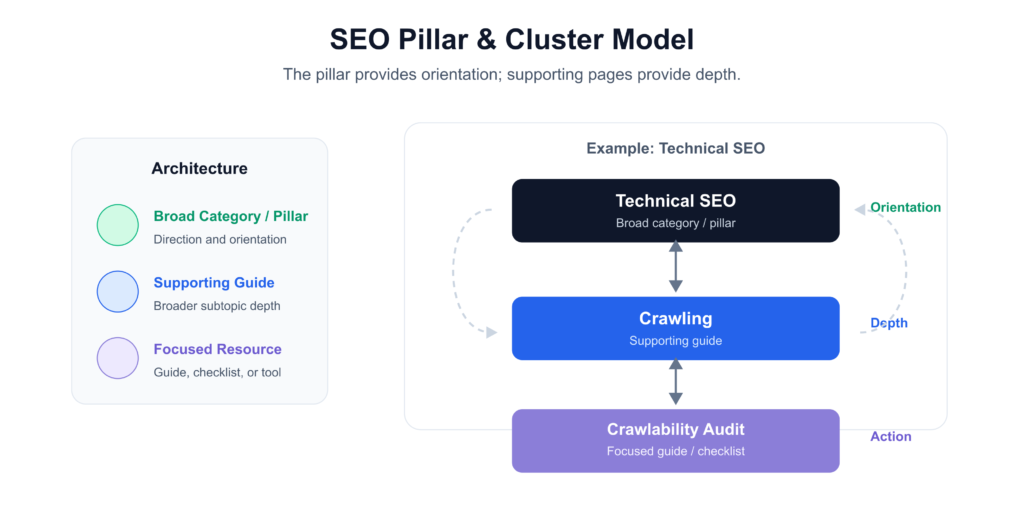
Broad SEO categories connect to narrower guides and practical resources.
A Practical Order for Learning SEO
The 10 categories do not need to be treated as isolated subjects. They form a progression because each stage changes how you approach the next one.
| Stage | Primary question | What comes next |
|---|---|---|
| Fundamentals | How does SEO work? | Keyword Research |
| Keyword Research | What should this site target? | On-Page SEO |
| On-Page SEO | How should each page be optimized? | Content SEO |
| Content SEO | How should the topic be covered? | Semantic SEO |
| Semantic SEO | How do related pages connect? | Technical SEO |
| Technical SEO | Can the site be accessed and processed properly? | Authority / specialization |
| Advanced | How do I scale and adapt the system? | Continuous improvement |
This progression matters because SEO decisions are connected. A technical issue can affect a content asset; keyword mapping can change internal linking; a new content cluster can create a new architectural requirement; and a platform migration can affect every category at once.
Quick Start: Choose Your Entry Point
You do not need to start at Category 1. Choose the path that matches the problem you are trying to solve today, then follow the related categories as your needs expand.
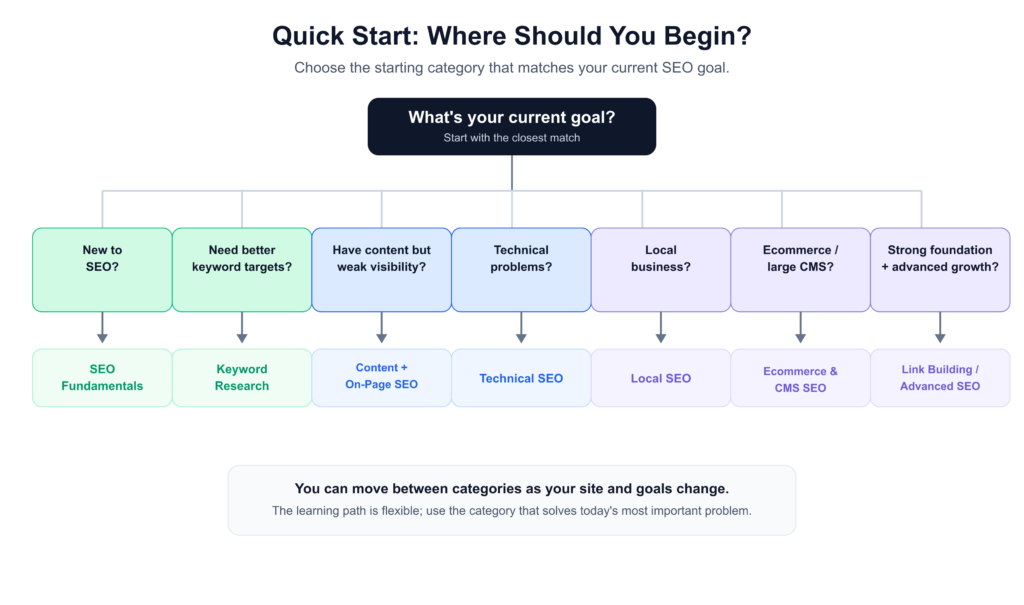
Choose the SEO category that best matches your current objective.
Common Mistakes When Learning SEO
A structured learning path also helps you avoid predictable mistakes. The goal is not to eliminate experimentation; it is to understand the difference between a useful experiment and a tactic applied before its underlying conditions exist.
| Common mistake | Better approach |
|---|---|
| Starting with advanced tactics | Build fundamentals first, then move to specialist topics. |
| Choosing keywords by volume alone | Evaluate intent, relevance, competition, and business value. |
| Publishing without a content structure | Map topics and page roles before producing large amounts of content. |
| Treating every technical warning as critical | Prioritize based on affected URLs, evidence, and actual site goals. |
| Building links before creating useful assets | Develop pages or resources that provide a legitimate reason to be referenced. |
| Trying every new AI tactic | Keep strong SEO fundamentals in place and test new workflows carefully. |
How to Measure Your Progress
Learning SEO should eventually lead to measurable improvements in how you plan, diagnose, and improve websites. Do not judge progress only by rankings. Your process itself should become clearer and more repeatable.
Early progress might mean you can correctly identify search intent, explain why two URLs should or should not compete, build a clean content cluster, or diagnose a crawlability problem without treating every error as equally important.
Later progress may involve designing site architecture, planning scalable content systems, interpreting Search Console and crawl data, managing migrations, or deciding which emerging AI-search changes deserve testing.
A useful rule: Learn → apply → observe → document → improve. Repeating that cycle is usually more valuable than collecting an ever-growing list of tactics.
Frequently Asked Questions
SEO is easier to build as a system than as a collection of disconnected tactics. Learn the concept, apply it to real pages, observe what changes, and then move into the next related category. This hub is designed to give you that map so you always have a clear place to go next.
MA
Founder, SEORAF