
Local SEO Ranking Factors: What Google Confirms vs. What Remains Unproven
Last reviewed: October 3, 2026
Local SEO ranking factors are the signals and systems that influence which businesses Google shows for searches with local intent, such as “dentist near me” or “bakery in [city].” Google says local results are mainly based on relevance, distance, and prominence, while also keeping the details of its ranking systems confidential. Many more detailed “ranking factor” lists come from industry surveys and practitioner observations rather than from Google.
This guide separates what Google documents from what published industry research reports, what SEORAF recommends as practical best practice, and what remains unproven. The goal is not to give you a magic ranking formula, but to help you decide where your effort is most defensible.
Editorial disclosure. SEORAF publishes independent SEO guides and tools and also offers services. This article is editorial and is based primarily on Google documentation and the industry research listed under Sources. It does not promote a SEORAF service, and it does not guarantee rankings, traffic, leads, or visibility. About SEORAF.
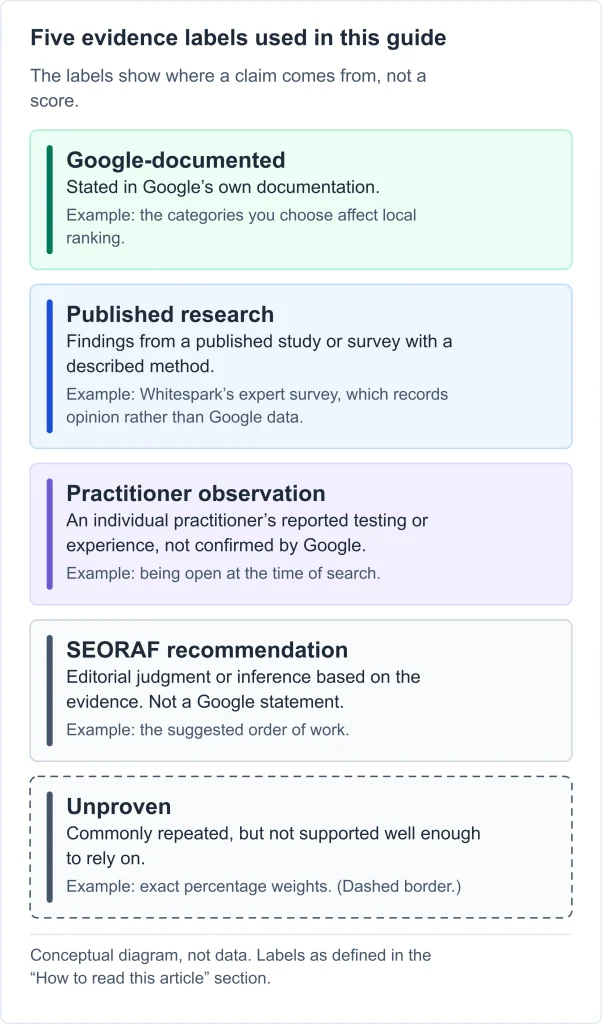
The five evidence labels used throughout this guide. Conceptual diagram, not ranking data.
Quick answer: what is confirmed, reported, and unproven?
If you want the shortest defensible answer, start with Google’s framework. Google says local results are mainly based on relevance, distance, and prominence. It also says there is no way to request or pay for a better local ranking and that its ranking-system details are kept confidential.
Local ranking claims grouped by evidence level
| Evidence level | What it covers |
|---|---|
| Google-documented | Google’s local framework centers on relevance, distance, and prominence. Google also documents the importance of accurate and complete Business Profile information, categories, reviews, and other profile-management requirements. |
| Published research | Whitespark’s 2026 expert survey ranks 187 factors separately for local pack/Maps, local organic results, AI-search visibility, and Local Services Ads. These rankings represent expert opinion, observation, and testing—not Google’s published ranking weights. |
| Practitioner observation | Practitioners report possible effects from signals such as being open at the time of search or having certain services configured. These observations should not be presented as confirmed Google ranking rules. |
| SEORAF recommendation | Actions SEORAF considers sensible based on the documented evidence and the limitations of the available research. |
| Unproven | Claims for which the available evidence is too weak to treat the signal as a dependable ranking lever, such as precise percentage weights, routine Google Posts frequency, social follower counts, or geo-tagging photos. |
How to read this article
Not every statement about local SEO has the same level of evidence. Each major claim in this guide should therefore be interpreted using one of five labels.
Evidence labels used in this guide
| Label | Meaning |
|---|---|
| Google-documented | Stated in Google’s own documentation reviewed for this article. |
| Published research | Findings from a published study or survey with a described methodology. Whitespark’s report belongs here, but its rankings represent expert opinion rather than Google’s internal data. |
| Practitioner observation | A reported test, experience, or observation from an SEO practitioner. It is not equivalent to a Google statement. |
| SEORAF recommendation | Editorial judgment based on the evidence above and the practical risk or usefulness of an action. |
| Unproven | A commonly repeated claim that does not have enough evidence here to justify treating it as a reliable ranking lever. |
Methodology and what “not documented” means
Review date: October 3, 2026.
“Not documented” means that we did not find the stated claim in the Google documentation reviewed for this article on the review date. It does not prove that Google does not use the signal. Google’s ranking systems are more complex than the information it publicly discloses, and documentation can change.
About the industry survey. Whitespark’s 2026 Local Search Ranking Factors report was published November 6, 2025. It surveyed 47 local-search experts, asking them to score 187 factors across several areas, including local pack/Maps, local organic, AI-search visibility, and Local Services Ads. Whitespark explicitly states that none of the experts have special access to Google’s internal local-search algorithm.
For that reason, a Whitespark rank such as “1st” or “5th” should be read as the factor experts scored most highly in that survey, not as Google’s ranking position, algorithm weight, or proof of causation.
What SEORAF did not do. SEORAF has not conducted a controlled ranking experiment for this article and has not independently reproduced the tests referenced by individual practitioners in the survey commentary.
Which results do local ranking factors apply to?
One reason local SEO advice becomes confusing is that “local rankings” can describe several different search surfaces. A factor reported for the local pack should not automatically be treated as a factor for local organic results.
Local result types compared
| Result type | What it is | Evidence used in this guide |
|---|---|---|
| Local pack and Maps | Map-based business results that can appear in Google Search and Google Maps. | Google’s local-ranking documentation plus Whitespark’s separate local-pack/Maps survey results. |
| Local organic results | Regular web pages that appear for searches with local intent. | Google’s general Search documentation plus Whitespark’s separate local-organic survey results. |
| Local Services Ads | A paid advertising format available for eligible categories and markets. | Whitespark reports a separate survey section for Local Services Ads. These should not be confused with organic local rankings. |
| AI search features | AI-generated search experiences that may include links or business information. | Google’s generative-AI guidance and Whitespark’s separate AI-visibility survey column. |
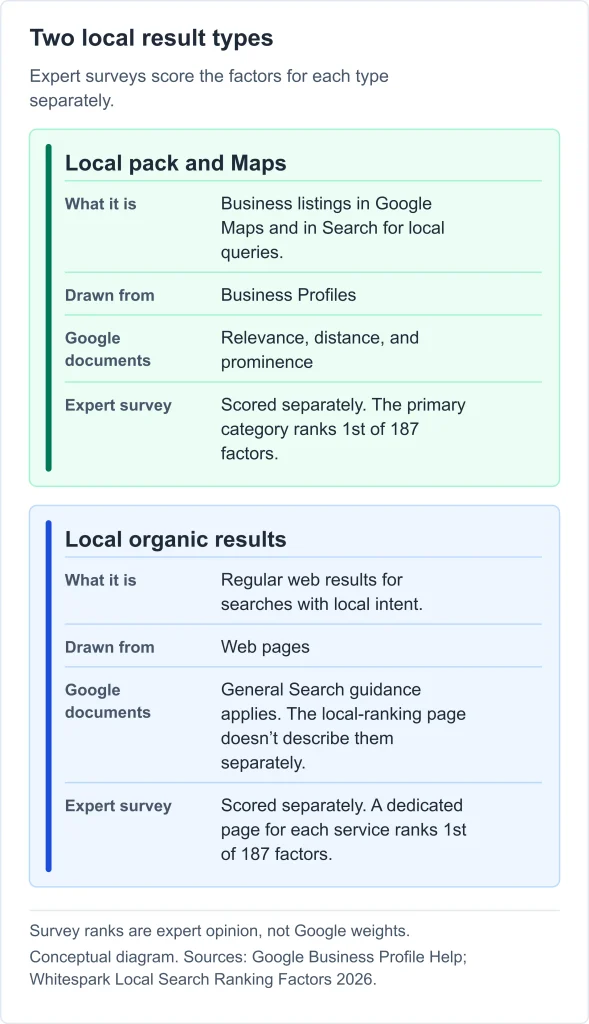
Local pack and local organic results are different search surfaces. Conceptual diagram, not ranking data.
Key terms used in this guide
| Term | Meaning |
|---|---|
| Google Business Profile | The business profile used to manage how an eligible business appears across Google Search and Maps. |
| Local pack | The map-based group of business listings shown for many local searches. |
| Local organic results | Regular website results that appear for searches with local intent. |
| Local search visibility | A SEORAF working term for how often and where a business appears for relevant local searches. It is not a Google metric. |
| NAP | Name, address, and phone number. In practical local SEO discussions, NAP often refers to the core business identity details used across websites and listings. |
| Citation | A business mention or listing containing identifying business information on another website or platform. |
| Service-area business | A business that serves customers at their locations rather than receiving customers at its business address. |
| Hybrid business | A business that receives customers at its own staffed location and also travels to customers. |
| Structured data | Machine-readable code that helps search engines understand information on a page. |
| Doorway pages | Pages created primarily to rank for specific, similar search queries rather than provide useful independent value. |
What does Google say determines local rankings?
Google-documented: Google’s local-ranking documentation says local results are mainly based on relevance, distance, and prominence. The same documentation says there is no way to request or pay for a better local ranking and that Google keeps its ranking-system details confidential.
Google’s current page uses “popularity” in the introductory sentence but uses “Prominence” as the section heading and then explains that prominence reflects how well-known a business is. This guide therefore uses prominence as the clearer term.
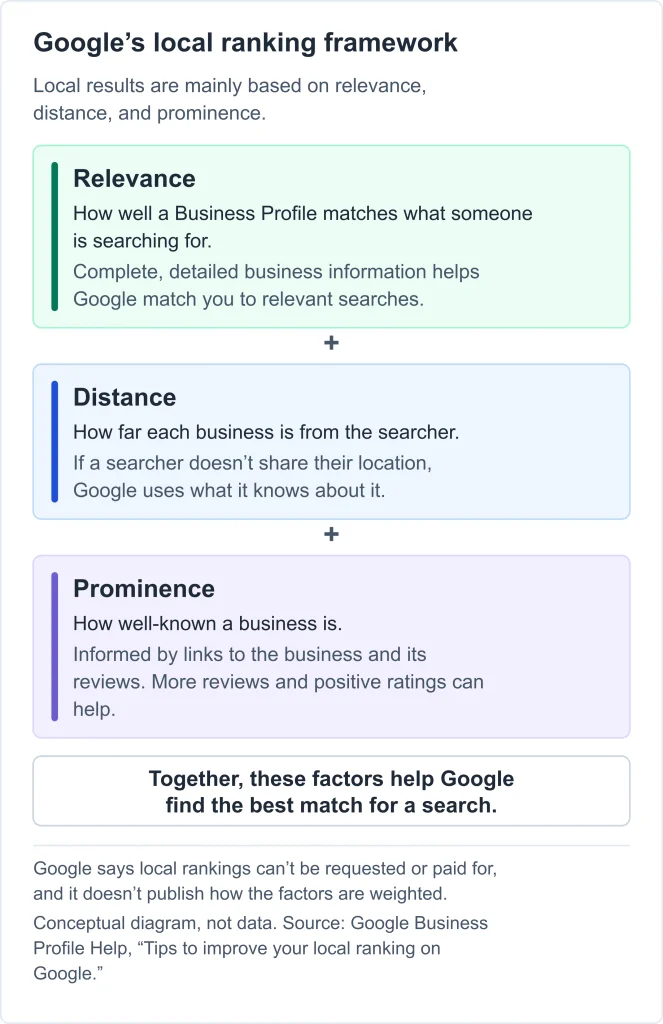
Google’s documented local-ranking framework: relevance, distance, and prominence. Conceptual diagram, not a percentage weighting.
Relevance, distance, and prominence
| Factor | What Google documents | Practical implication | What experts add |
|---|---|---|---|
| Relevance | How well a Business Profile matches what someone is searching for. Complete and detailed business information helps Google understand the business. | Make the profile and website accurately describe what the business actually offers. | Whitespark experts rank the primary category highly, along with several other profile and relevance-related signals. |
| Distance | How far the business is from the customer searching. If the customer does not share their location, Google uses what it knows about their location. | Distance is partly outside the business’s control. | Whitespark ranks searcher-business proximity very highly for the local pack. |
| Prominence | How well-known the business is. Google says prominence is also informed by information such as websites linking to the business and the number of reviews. | Build genuine reputation and authority rather than trying to manufacture signals. | Experts rank many review, link, and behavioural signals within this broader area. |
Does the closest business always rank first?
SEORAF interpretation: No. Google describes distance as one of several factors that work together. A business that is farther away can therefore appear ahead when other factors make it a better match for the search.
What Google does not publish
- Exact percentage weights for relevance, distance, and prominence.
- A complete list of every signal used by its local-ranking systems.
- A public formula showing how individual signals are combined.
Google explicitly says it keeps its ranking-system details confidential.
Google Business Profile: what Google documents
Google’s local-ranking guidance places significant emphasis on maintaining an accurate and complete Business Profile. Google says verification makes a profile more likely to show, while complete and accurate business information makes a business more likely to appear in relevant local searches.
Verification and complete information
Google-documented: Verification tells Google that you are authorized to represent the business and makes the profile more likely to show. Google also says businesses with complete and accurate information are more likely to show in local search results.
Business categories
Google-documented: The categories selected for a Business Profile affect local ranking. Google recommends choosing the most specific category that accurately represents the core business and using as few categories as necessary. It also says category information can be detected from the business website and other information about the business across the web.
Published research: In Whitespark’s 2026 local-pack survey, Primary GBP Category ranks 1st of 187 factors. Additional GBP Categories also rank highly. Those rankings reflect expert opinion, not Google’s published weighting.
SEORAF recommendation: Choose the most specific accurate primary category and add additional categories only when they genuinely describe distinct parts of the business.
Business name
Google-documented: A Business Profile name should reflect the business’s real-world name. Adding unnecessary information such as marketing taglines, phone numbers, URLs, service information, or location information is not permitted under Google’s business-representation guidelines.
Published research: Whitespark’s 2026 experts rank Keywords in GBP Business Title 3rd for local pack/Maps. That survey result should not be interpreted as permission to keyword-stuff a business name.
SEORAF recommendation: Use the real-world business name consistently. Do not add keywords simply because an industry survey reports an association between keywords in business titles and visibility.
Address, service areas, and business type
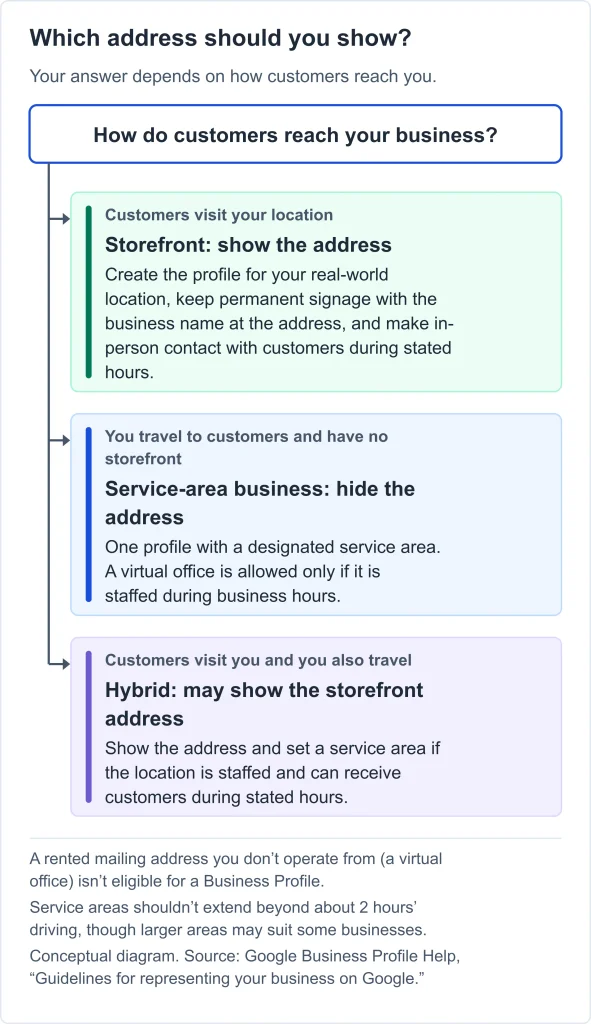
Business type and address-display decisions based on Google’s eligibility guidance. Conceptual diagram, not ranking data.
Storefront, service-area, and hybrid businesses
| Business type | General rule | Address |
|---|---|---|
| Storefront | A genuine location where customers can visit the business during stated hours and where the business meets Google’s eligibility requirements. | Show the eligible real-world address. |
| Service-area business | Serves customers at their locations and does not operate as a customer-facing storefront at the listed address. | Hide the address. |
| Hybrid business | Receives customers at a staffed location and also travels to customers. | May show the eligible storefront address and define a service area. |
Google’s guidelines also place restrictions on virtual offices and shared workspaces. A rented mailing address that is not an actual operating location is not automatically eligible for a Business Profile. A co-working location must meet Google’s conditions, including appropriate staffing and customer-facing operation, where applicable.
SEORAF recommendation: Do not choose an address because you believe it will improve rankings. Choose the business type and address configuration that accurately represents how the business operates.
Business hours
Google-documented: Businesses should provide accurate customer-facing hours and use special hours when appropriate. Some businesses, such as those that operate only by appointment or have highly variable schedules, have different requirements.
Practitioner observation: Whitespark’s 2026 experts rank Business is Open at Time of Search 5th for local pack/Maps. That is a strong survey result, but the article should not turn it into a Google-confirmed ranking rule unless Google explicitly documents that effect.
SEORAF recommendation: Publish truthful hours because they help customers understand when they can reach or visit the business. Do not manipulate hours to chase rankings.
Services, photos, and Google Posts
- Services: Industry practitioners report possible ranking effects from predefined or custom services. Whitespark’s 2026 survey ranks Presence of GBP Custom Services 48th for local pack/Maps. Treat this as published expert research, not Google-confirmed causation.
- Photos and videos: Google recommends appropriate business-specific photos and explains how they appear on Business Profiles. That does not by itself establish a ranking effect.
- Google Posts: Google provides profile-content functionality for posts, but the Google documentation reviewed here does not establish a dependable ranking boost from posting at a particular frequency.
Other documented profile rules
- Use the real-world business name.
- Maintain accurate business information.
- Use an eligible business location or service-area configuration.
- Avoid creating multiple profiles for the same business location.
- Follow Google’s guidelines for descriptions, phone numbers, categories, hours, and other profile fields.
Does consistent business information affect rankings?
Short answer: Google documents that Business Profile information can come from multiple sources, including a business’s website and other publicly available information. However, that is not the same as Google publishing “NAP consistency” as an independent local-ranking factor.
Google-documented: Google says it can use publicly available information, including content crawled from the web and a business’s official website, along with licensed data and user contributions, to source Business Profile information.
Published research: Whitespark’s 2026 experts rank several NAP- and citation-related factors separately. For example, HTML NAP Matching GBP NAP ranks 55th for local organic results, while citation-related factors receive different rankings.
SEORAF recommendation: Keep your important business details consistent and accurate across your website and major business listings. Treat this as an accuracy and data-quality practice rather than a guaranteed ranking lever.
Do reviews affect local rankings?
Google-documented: Google explicitly says prominence is informed by the number of reviews a business has and that more reviews and positive ratings can help local ranking. Google does not publish a percentage weight for reviews.
Review-related signals: documentation versus survey opinion
| Review signal | Google documentation | Whitespark local-pack result |
|---|---|---|
| Positive ratings | Google says positive ratings can help. | High numerical Google ratings rank highly. |
| Review quantity | Google says more reviews can help. | Quantity of reviews is ranked highly by experts. |
| Review recency | No specific weighting published. | Experts rank recency highly. |
| Review velocity | No specific weighting published. | Experts rank sustained review flow as a separate factor. |
| Keywords in reviews | No specific ranking effect published. | Experts rank it separately, but this is not a Google-confirmed lever. |
Policy: Google prohibits offering incentives in exchange for posting, changing, or removing reviews. A safer approach is to ask real customers for honest feedback and respond professionally.
SEORAF recommendation: Build a genuine review process, request honest reviews without incentives, and respond helpfully to customers.
How do your website and local landing pages fit in?
Google’s local-ranking documentation focuses on Business Profiles, but your website still matters to local search. Google says a business’s official website can be one source of Business Profile information, and regular web results follow Google’s broader Search systems.
Published research: Whitespark’s 2026 experts rank Dedicated Page for Each Service 1st for local organic results and Geographic Keyword Relevance of Content 2nd. These are expert survey results, not Google’s published local-ranking formula.
Service pages
A useful service page explains one genuine service clearly. For example, a heating company could have separate pages for emergency boiler repair, boiler installation, and annual servicing if those are real services it provides.
SEORAF recommendation: Create service pages because they help users understand what you actually offer and give search engines clearer page-level context—not because a survey guarantees that a dedicated page will rank.
Location pages
A location page should represent a real location or genuinely served area. Creating large numbers of near-identical city pages simply by swapping place names can create quality and spam-policy risks.
SEORAF recommendation: Publish a location page when it provides meaningful, location-specific information that a customer would genuinely find useful.
Local page types and when they fit
| Page type | Good use | Main caution |
|---|---|---|
| Business-location page | Represents a real business location with useful local information. | Keep details accurate and consistent. |
| Service page | Explains a genuine service in useful detail. | Avoid thin or near-duplicate pages. |
| Location page | Provides useful information about a real location or genuinely served area. | Do not create pages only to capture every city variation. |
| Near-identical city pages | Usually weak when the only meaningful change is the city name. | Can resemble doorway or scaled low-value content. |
Do backlinks, citations, and mentions matter?
Backlinks
Google-documented: Google says prominence is informed by information such as how many websites link to the business. This supports treating genuine links as part of broader business prominence, but Google does not publish a local link-weight formula.
Published research: Whitespark’s 2026 experts rank link-quality factors highly for local organic results. For example, Quality/Authority of Inbound Links to Domain ranks 3rd for local organic results.
SEORAF recommendation: Earn relevant links through genuine partnerships, useful resources, professional associations, community involvement, or editorial coverage. Do not buy links or participate in manipulative link schemes.
Citations and mentions
Google’s documentation does not present “build hundreds of citations” as a local-ranking strategy. Whitespark’s 2026 survey contains multiple citation-related factors, but their rankings vary by result type.
SEORAF recommendation: Prioritize accurate listings on important platforms rather than pursuing directory volume for its own sake.
Structured data, technical SEO, and mobile usability
Structured data
Google-documented: LocalBusiness structured data can help Google understand business details and may support search features. Google does not describe LocalBusiness structured data as a guaranteed local-ranking boost.
SEORAF recommendation: Use accurate structured data that matches visible page content. Treat it as a way to communicate information clearly, not as a secret ranking lever.
Technical SEO
Your local pages still need to be accessible to search engines. Make sure important pages can be crawled, indexed when appropriate, and provide consistent business information.
For broader technical foundations, see our SEO crawler guide.
Mobile usability
Google-documented: Google uses Core Web Vitals in its ranking systems and explains that good page-experience signals do not guarantee top rankings. These systems apply broadly to Google Search and should not be presented as a special local-pack ranking formula.
SEORAF recommendation: Make your address, phone number, hours, directions, and contact options easy to use on mobile because customers use them—not because mobile usability guarantees a local ranking improvement.
Which signals do experts suspect but Google has not confirmed?
Whitespark’s 2026 report contains many factors that experts believe may influence local-pack visibility but that are not described in Google’s public local-ranking documentation as individual ranking factors.
Selected expert-ranked signals that should not be mistaken for Google-confirmed weights
| Signal | Whitespark local-pack rank | Interpretation |
|---|---|---|
| Business open at time of search | 5th | High expert-survey score; not presented here as a Google-confirmed standalone ranking factor. |
| Physical address in city of search | 4th | Strong survey result, but it should not be converted into a universal “must be in the city” ranking rule. |
| Searches for the business name | 23rd | Survey association; customer demand and brand awareness can also influence this metric. |
| Clicks to call | 57th | Survey result; customer demand and ranking position can both affect the number of calls. |
| Engagement signals | Varies by factor | Survey evidence does not establish a simple universal ranking formula. |
Important: A high survey position does not establish causation. Some signals may partly reflect other underlying factors, such as business popularity, searcher intent, location, or existing prominence.
Does local SEO work differently for AI answers?
Google-documented: Google says its guidance for generative AI search is an extension of good SEO rather than a separate “AI ranking system” that requires special optimization. Google also says Business Profiles can help businesses be visible in AI responses and that indexing or serving is never guaranteed.
Google’s guidance also warns against approaches such as creating content primarily to manipulate AI visibility, seeking inauthentic mentions, or relying on special files or markup as shortcuts.
Published research: Whitespark added an AI-search visibility column in its 2026 survey. The report itself notes that the scoring can be ambiguous because different AI systems have access to different information.
SEORAF recommendation: Do not create a separate “AI SEO trick” layer on top of basic quality. Make your business information accurate, publish genuinely useful service and location content, build real authority, and make important information accessible to search engines.
Evidence at a glance
The Whitespark ranks below are survey ranks, not Google weights. They show how experts scored factors in the 2026 report.
Selected local SEO signals and evidence status
| Signal | Google documentation | Whitespark 2026 |
|---|---|---|
| Relevance | Core local-ranking factor | Reflected through multiple expert-ranked signals |
| Distance | Core local-ranking factor | Proximity ranks 2nd for local pack/Maps |
| Prominence | Core local-ranking factor | Reflected through multiple link, review, and popularity-related signals |
| Primary GBP category | Categories affect local ranking | 1st for local pack/Maps |
| Keywords in GBP business title | Unnecessary information in business names is not permitted | 3rd for local pack/Maps |
| High Google ratings | Positive ratings can help | 6th for local pack/Maps |
| Dedicated page for each service | Not stated as a local-pack ranking factor | 1st for local organic results |
| Geographic relevance of content | Not stated as a standalone local-pack factor | 2nd for local organic results |
| Inbound-link quality | Links inform prominence | 3rd for local organic results |
| Schema markup | Useful for communicating structured information; not a stated local-ranking weight | Surveyed separately from Google’s documentation |
| Google Posts frequency | No dependable ranking boost documented here | Low-ranked in the survey |
| Geo-tagged photos | No ranking boost documented here | Very low-ranked in the survey |
Common myths and overstatements
Local SEO claims checked against the evidence
| Claim | Better interpretation |
|---|---|
| Google publishes exact local-ranking weights. | Google identifies broad factors but keeps ranking-system details confidential. |
| Reviews represent a fixed percentage of the algorithm. | Google says reviews can help, but it does not publish a fixed percentage weight. |
| You can pay Google for a better local ranking. | Google explicitly says there is no way to request or pay for a better local ranking. |
| Put keywords in your Business Profile name. | Use the real-world business name. Survey correlations do not override Google’s business-name guidelines. |
| More categories are always better. | Use accurate, specific categories rather than adding categories simply for ranking. |
| Schema markup automatically boosts local rankings. | Structured data communicates information; it should not be presented as a guaranteed ranking lever. |
| Posting on a fixed weekly schedule guarantees better rankings. | No such guarantee is supported by the evidence reviewed here. |
| Geo-tagging every photo is a local-ranking strategy. | The available expert survey does not justify treating this as a dependable ranking lever. |
| Hundreds of directory listings automatically improve rankings. | Prioritize accurate, useful business listings instead of directory volume. |
| A rented virtual office is a safe Business Profile address. | An address must meet Google’s eligibility requirements. A mailing address alone is not enough. |
| A larger service area automatically creates wider rankings. | Define the area the business genuinely serves and follow Google’s service-area rules. |
How should you prioritize local SEO work?
The following order is SEORAF’s editorial recommendation. It is not a Google ranking order and does not guarantee an improvement.
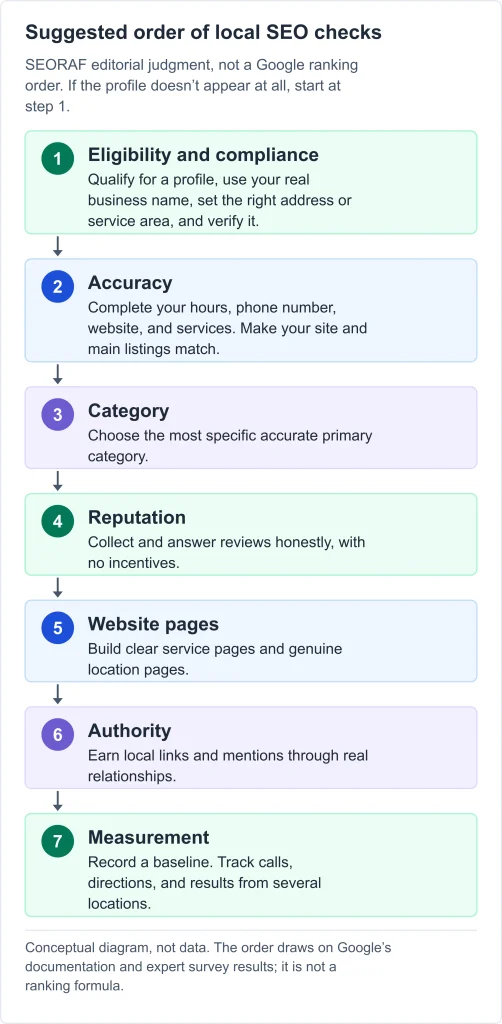
Suggested local SEO triage order. SEORAF editorial recommendation, not a Google ranking formula.
- Eligibility and compliance. Confirm that the business qualifies and that the profile follows Google’s rules.
- Accuracy. Check the name, address, phone number, hours, website, and other important information.
- Category. Select the most specific accurate primary category.
- Reputation. Build a genuine process for collecting and responding to customer reviews.
- Website usefulness. Create clear service and location pages where they genuinely help customers.
- Authority. Earn relevant links and mentions through legitimate relationships and useful contributions.
- Measurement. Establish a baseline and track changes over time rather than reacting to one rank check.
How do you measure progress without promising rankings?
There is no single universal local rank position. Results can vary by searcher location, query, device, and search surface. Measure several outcomes instead.
Ways to measure local-search progress
| Measure | What it can show | Main limitation |
|---|---|---|
| Business Profile performance | Profile visibility and customer actions reported by Google. | Metrics can change over time and are not a complete measure of organic local ranking. |
| Calls and enquiries | Whether visibility turns into real customer contact. | Does not identify every cause of an enquiry. |
| Search Console and analytics | Organic website performance and page-level search visibility. | Does not represent the full local-pack picture. |
| Location-based rank checks | Visibility from multiple geographic points. | Results depend on the tool, location, query set, and checking method. |
| Review trends | Review volume, rating, and reputation trends. | These measures are not proof of a specific ranking effect. |
- Record a baseline with the date and search conditions.
- Keep a dated change log.
- Check several locations when geographic visibility matters.
- Judge success using customer actions as well as search visibility.
Frequently asked questions
What are the most important local SEO ranking factors?
Google says local results are mainly based on relevance, distance, and prominence. Beyond those broad factors, Google does not publish a complete ranking-weight table. Industry surveys such as Whitespark’s 2026 report provide expert opinions about individual signals, but those rankings are not Google’s internal weights.
Do reviews affect local rankings?
Yes, Google explicitly says more reviews and positive ratings can help local ranking. Google does not publish a fixed percentage weight for reviews or a complete formula for how individual review signals are combined.
Are citations or NAP consistency ranking factors?
Google documents that business information can come from multiple sources, including the business’s official website. However, that does not establish a standalone Google ranking weight for citation consistency. Keeping important business information accurate is still a sensible data-quality practice.
Do Google Posts, photos, or schema markup improve rankings?
The evidence reviewed here does not justify presenting any of these as guaranteed ranking levers. Google documents useful purposes for profile content, photos, and structured data, while industry surveys separately score some of these signals.
Should a service-area business show its address?
A genuine service-area business generally hides its address in its Business Profile. A hybrid business that also receives customers at an eligible staffed location may be able to show that address and define a service area. Always follow Google’s current eligibility guidance.
How long do local SEO changes take to show?
There is no reliable universal timeline for a ranking improvement. Profile edits, indexing, search-system processing, and competitive conditions can all differ. Treat Google’s documented processing timelines as operational guidance rather than promises of ranking improvement.
Sources
Reviewed: October 3, 2026.
Google documentation
- Tips to improve your local ranking on Google
- Guidelines for representing your business on Google
- Business eligibility and ownership guidelines
- Manage your business category
- How Google sources and uses information in Business Profiles
- Tips to get more reviews on Google
- Tips for business-specific photos on Google
- Manage your Business Profile strength
- Understand your Business Profile performance and insights
- Optimizing your website for generative AI features on Google Search
- Spam policies for Google web search
- Understanding page experience in Google Search results
- Local business structured data
Industry research
- Whitespark: Local Search Ranking Factors 2026. Published November 6, 2025. The report surveys 47 experts and scores 187 factors across multiple search surfaces. It represents expert opinion and observation rather than Google’s internal ranking data.
Corrections: If you find an outdated or inaccurate statement, please contact SEORAF through the contact page. Google documentation and third-party research can change, so verify important claims against the current source pages before making significant changes to a Business Profile or website.