
Content Marketing Checklist: 50+ Proven Steps
Stop guessing what works. Follow this step-by-step content marketing checklist to plan, create, distribute, and measure content that actually drives traffic and conversions in 2026.
The Complete Content Marketing Checklist
Every item below serves a specific purpose in your content strategy checklist. Whether you are building a content planning checklist from scratch or refining an existing blog content workflow, these 50+ steps cover the full content lifecycle—from initial research to performance measurement.
A well-structured content marketing checklist eliminates the guesswork that plagues most marketing teams. Instead of wondering what to do next, your team follows a repeatable system. This 2026 edition reflects the latest algorithm changes, AI-assisted workflows, and distribution strategies that actually move the needle in today’s competitive landscape.
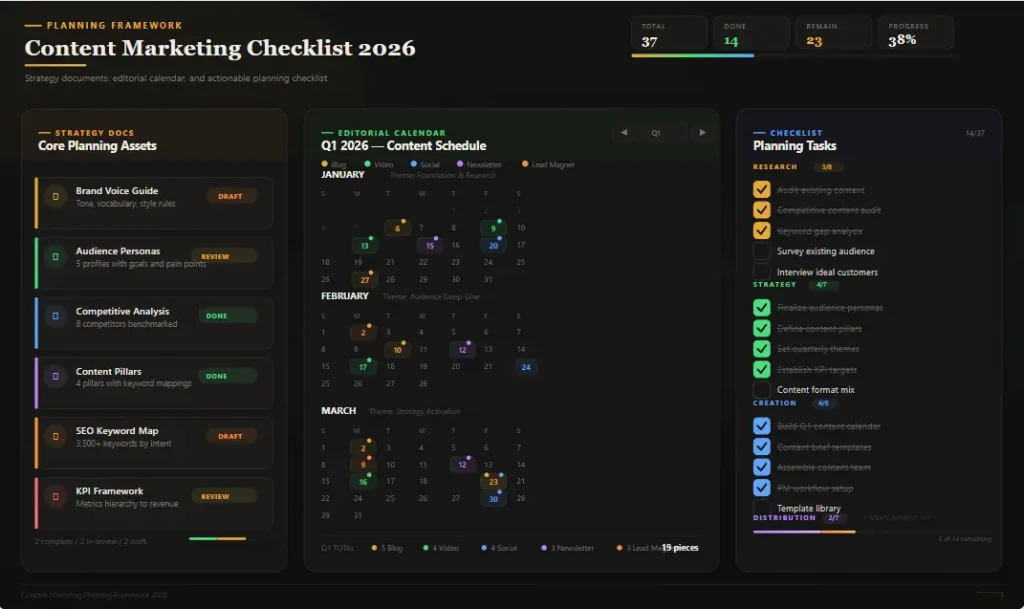
A comprehensive checklist starts with strategic planning before any content gets created.
A mid-sized B2B company struggled with inconsistent publishing and flat engagement. After implementing this content marketing checklist—defining personas, building a calendar, and systematizing distribution—their organic traffic grew 127%, lead generation jumped 89%, and content engagement tripled. This systematic approach was the turning point that turned chaos into a predictable engine.
3x Increase in Content EngagementStrategy & Planning
Every strong content marketing checklist starts here. Without a strategy foundation, even the best content fails to deliver business results. This section of your guide ensures your team aligns on goals, audience, and process before writing a single word, saving countless hours of wasted effort down the line.
- Define content marketing goals and KPIs
- Create detailed audience personas with pain points
- Conduct competitor analysis and content gap research
- Establish brand voice and tone guidelines
- Build a content strategy template with publishing schedule
- Set budget allocation for creation and promotion
- Define content pillars and topic clusters
- Assign team roles and approval workflows
Content Ideation
The ideation phase determines whether you create content people actually search for. Skip this step and you will waste resources on topics nobody cares about. A content planning checklist without rigorous ideation is a recipe for low traffic and poor engagement metrics.
- Research high search volume low competition keywords
- Analyze top-performing content in your niche
- Use AnswerThePublic and Google Trends for topic discovery
- Survey your audience for real pain points and questions
- Map ideas to each stage of the buyer’s journey
- Prioritize topics by impact vs. effort
- Create a centralized idea capture system
- Validate search intent for every topic before writing
Content Creation
This is where your content marketing checklist translates strategy into tangible assets. Every piece should meet strict quality standards before reaching your audience. A blog content workflow built on this section catches errors early and maintains consistency across every single published page on your website.
- Write compelling headlines with power words and numbers
- Structure with clear H2/H3 heading hierarchy
- Include keywords naturally—avoid stuffing
- Add internal links to 3–5 related pages per piece
- Cite authoritative external sources to build trust
- Optimize images with descriptive alt text and WebP format
- Write a benefit-driven meta description (150–160 chars)
- Proofread for grammar, readability, and style consistency
Content Distribution
The most overlooked section of any content marketing checklist. Publishing is only 20% of the work—distribution is where actual results happen. Your strategy must include a concrete distribution plan for every single piece, or you are leaving most of its potential untapped in the dark corners of the internet.
- Promote on relevant social media platforms
- Share with email newsletter subscribers
- Reach out to industry influencers for amplification
- Repurpose into videos, infographics, and social threads
- Submit to curation platforms and communities
- Use paid promotion for high-priority pieces
- Engage with comments and build community around content
- Update and republish evergreen content quarterly
Analytics & Optimization
A content marketing checklist without measurement is inherently incomplete. This section turns your content strategy checklist into a data-driven system. Track what works, kill what does not, and continuously refine your approach based on real numbers—never assumptions or gut feelings.
- Set up Google Analytics 4 and Search Console
- Track traffic, engagement, and conversion KPIs
- Monitor keyword rankings and organic visibility
- Analyze performance by topic and format
- A/B test headlines and CTAs on top pages
- Identify and refresh underperforming content
- Build monthly performance reports for stakeholders
- Adjust strategy based on data—not assumptions
Technical SEO
Even the best content marketing checklist fails if your technical foundation is broken. This section ensures search engines can crawl, index, and rank your content without encountering roadblocks. Run a technical SEO audit before scaling your blog content workflow to avoid incredibly costly fixes down the road.
- Ensure mobile-friendly responsive design
- Optimize Core Web Vitals and page speed
- Implement schema markup for rich results
- Submit XML sitemap to search engines
- Set up clean, descriptive URL structure
- Add canonical tags to prevent duplication
- Enforce HTTPS across all pages
- Run a technical SEO audit quarterly
Content Leaders With a Documented Strategy Are 13x More Likely to Report Success
A content marketing checklist works because it balances creativity with consistency. Your team focuses on compelling narratives while the framework covers strategic and technical elements that usually get overlooked. The best checklist becomes a living document that evolves with your business.
If you are also building backlinks to support your content, our guide on the easiest backlinks to build pairs perfectly with this content marketing checklist for a complete organic growth system. A solid checklist alone drives traffic—but combined with authoritative link building, the results multiply exponentially.
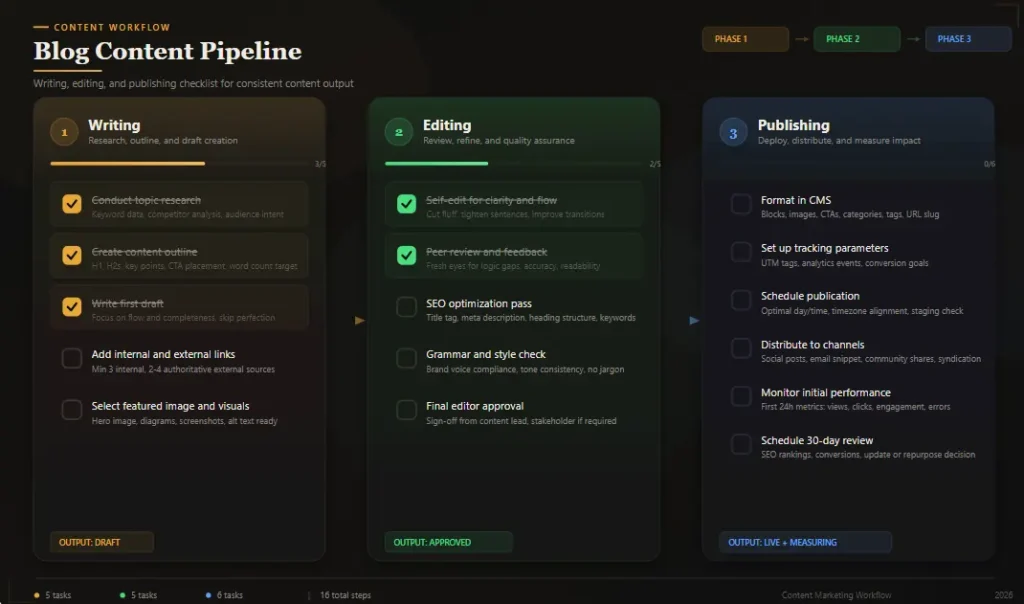
A structured workflow ensures every piece moves through your process without bottlenecks.
Research from the Content Marketing Institute confirms that documented strategies consistently outperform undocumented ones. Your content marketing checklist should specify what to do, why it matters, and how to measure each step’s impact. Teams that treat their framework as a living document—not a static list—see the strongest results over time.
Beginner vs Advanced Checklist
Not every team needs the same level of complexity. The right content marketing checklist scales with your experience. Here is how to tailor this content strategy checklist and content planning checklist to your current level, available resources, and overall growth ambitions.
- Start with 3–5 core audience personas
- Pick one primary channel (blog or email)
- Publish 2–4 quality pieces per month
- Focus on long-tail keywords with clear intent
- Use free tools: GA4, Search Console, AnswerThePublic
- Repurpose each article into 2–3 social posts
- Track 3 KPIs: traffic, time on page, conversions
- Build internal links naturally as you go
- Layered personas with psychographic data
- Omnichannel distribution with channel-specific strategies
- Topic clusters with pillar content architecture
- A/B test headlines, CTAs, and content formats
- Advanced tools: SEMrush, Ahrefs, Clearscope
- Programmatic SEO + AI-assisted workflows
- Attribution modeling and assisted conversion tracking
- Content lifecycle management with refresh cadences
Beginners: nail items 1–3 in Strategy & Planning before touching anything else. Advanced teams should focus on the Analytics & Optimization section—most growth is hiding in your existing content. Regardless of level, every content marketing checklist should start with deep audience research.
Common Mistakes to Avoid
Even experienced marketers slip on these pitfalls. Your content marketing checklist is designed to catch them before they cost you traffic, resources, and revenue. Review these mistakes against your current content strategy checklist to find hidden gaps in your process.
Creating content for “everyone” means it resonates with no one. This is the number one reason content marketing checklists fail. Always start with persona validation and search intent analysis before writing a single word.
Publishing is only 20% of the job. If your strategy does not include distribution steps for every piece, you are leaving most of its potential untapped and wasting your creation budget.
Over-optimizing hurts readability and rankings. Your content planning checklist should emphasize natural keyword placement—Google understands context, not just exact-match phrases.
Without defined KPIs before publishing, you cannot know what is working. Every strategy must set clear targets for each piece before it goes live.
The best content compounds over time. Your content strategy checklist should include quarterly refresh tasks. Update, repurpose, and redistribute top performers instead of only chasing new topics.
Slow pages, missing schema, and broken links undermine even the best blog content workflow. Run a technical SEO audit before scaling production on any content marketing checklist.
Skipping audience research is the root cause of almost every other mistake on this list. When your content marketing checklist does not start with knowing exactly who you are writing for, everything else—topics, tone, distribution, measurement—falls apart. Fix this one thing and your system instantly becomes 10x more effective.
Pro Tips for Faster Results
These tactics come from high-growth campaigns. Add them to your content marketing checklist once the fundamentals are solid. A mature content strategy checklist includes these acceleration tactics, while a beginner content planning checklist should focus strictly on the basics first to avoid overwhelm.
Build a Content Repurposing Engine
Turn every long-form article into 5+ assets: social threads, email snippets, video scripts, infographics, and podcast talking points. One piece becomes an entire campaign. This is the highest-ROI item you can add to any framework.
Steal Formats from Top Performers
Analyze the top 10 results for your target keyword. Note their structure, word count, and media types. Match what works—then make yours noticeably better. Your content marketing checklist should include a competitive analysis step for every major piece.
Batch Your Content Production
Dedicate full days to ideation, writing, or editing. Batching eliminates context-switching and can double your output without burning out your team. Add batching blocks to your blog content workflow and watch productivity surge dramatically.
Create a “Content Refresh” Calendar
Schedule quarterly reviews of your top 20 posts. Update stats, add new sections, fix broken links, and re-promote. This single item can recover 30–40% of declining traffic without writing a single new article.
Use Data to Kill Underperformers
If a piece has not hit its KPI targets after 90 days, either fix it or merge it into a stronger page. Your content planning checklist should include a quarterly content pruning process. Do not let weak content dilute your overall site quality.
Content without authority struggles to rank. Pair this content marketing checklist with a proven link building strategy—start with our list of the easiest backlinks to build to accelerate your organic growth. The best systems always include off-page signals as part of the measurement framework.
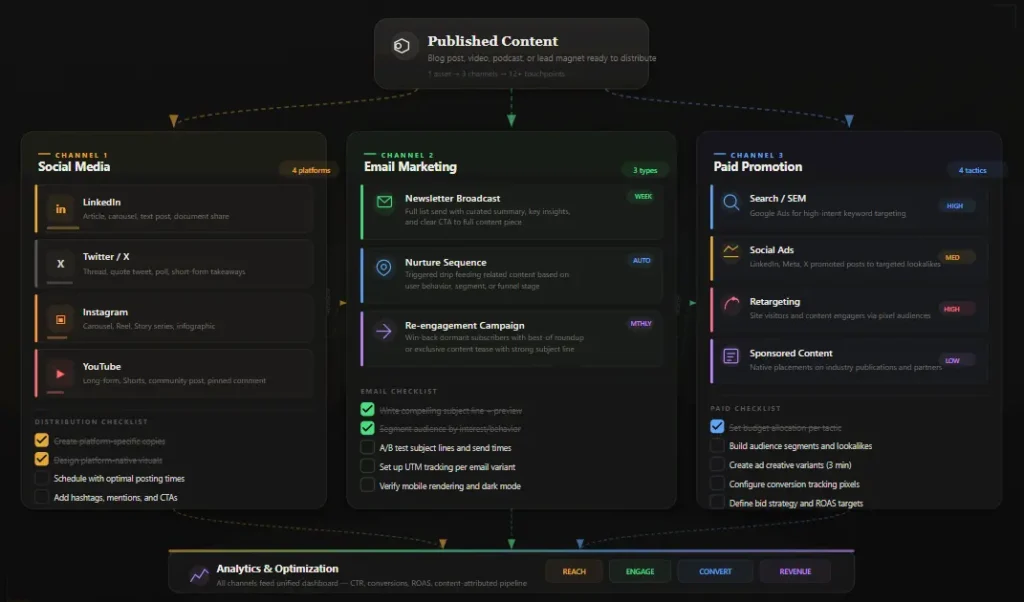
Effective content distribution requires a multi-channel approach tailored to where your audience lives.
Essential Content Marketing Tools
Start with four categories: research, planning, creation, and measurement. Add tools only when your blog content workflow demands it. The right tool stack supports your content marketing checklist—not replaces your strategy or human creativity.
All-in-one SEO and content toolkit for keyword research, competitor analysis, and content auditing. Essential for any content marketing checklist.
Visual content calendar to plan, organize, and execute marketing campaigns across channels. The backbone of a solid content planning checklist.
Track website traffic, user behavior, and conversion events to measure content ROI. Required by every serious marketing team.
Create professional visuals, infographics, and social graphics without a designer. Great for the creation phase of your content strategy checklist.
Simple podcast hosting with built-in promotion tools and performance analytics for teams expanding their strategy to multi-format audio.
Email marketing platform to distribute content, nurture leads, and automate sequences. A must-have for your distribution section.
Video hosting with marketing features, lead capture, and detailed analytics for teams expanding their process to include professional video content.
Visual project boards to manage your blog content workflow from idea to publish. Keeps your content marketing checklist organized and actionable.
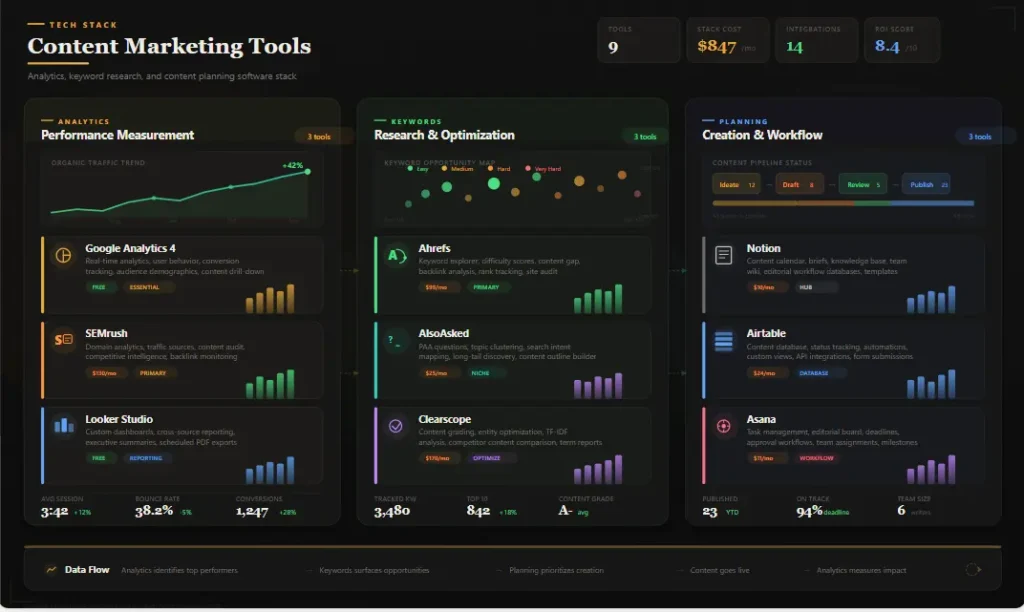
The right tool stack supports your process—not replaces your overarching strategy.
For deeper content gap discovery, Moz complements SEMrush well—especially for link analysis and domain authority tracking. Start free, upgrade when your content marketing checklist outgrows the basic free tier limits.
Download Free Checklist + Bonus Template
Get instant access to our printable content marketing checklist 2026 PDF plus a bonus content calendar template. Start executing your content strategy checklist today.
🔒 We respect your privacy. Unsubscribe anytime.
Frequently Asked Questions
How often should I update my content marketing checklist?
Review your content marketing checklist quarterly. Do a deeper refresh twice per year, and update anytime platforms, audience behavior, or your business goals change significantly. A static document quickly becomes outdated.
What is the most important item on a content marketing checklist?
Knowing your target audience—personas, pain points, and search intent—is the foundation of any content marketing checklist. It shapes every decision: topics, tone, formats, and distribution channels. Skip this and the rest loses effectiveness.
How can I measure the success of my content marketing checklist?
Track KPIs tied to your goals: organic traffic, engagement rate, leads generated, conversions, keyword rankings, and assisted conversions. Compare results against your pre-checklist baseline. A well-built content marketing checklist includes measurement steps for every piece.
Should I create different checklists for different content types?
Yes. Maintain one master content marketing checklist, then create mini checklists for blog posts, videos, podcasts, and case studies—each format has unique requirements for creation, optimization, and distribution.
How can a small business use this content marketing checklist with limited resources?
Prioritize high-impact items first: audience research, one primary channel, consistent publishing, and repurposing. A content marketing checklist for small teams should focus on depth over breadth to maximize limited bandwidth.
How do I balance SEO with engaging content?
Start with audience needs and search intent, write for humans first, then optimize technical SEO elements afterward. Treat SEO and user experience as complementary—not competing—priorities in your content marketing checklist.
What tools do I need for content marketing in 2026?
Start with four essentials: a keyword research tool (SEMrush or Ahrefs), a content calendar (CoSchedule or Trello), analytics (Google Analytics 4), and an email platform (Mailchimp). Add more as your strategy matures and your workflow demands it.
How long does content marketing take to show results?
Most strategies take 6 to 12 months to show significant organic results. However, paid promotion and email distribution can generate traffic and leads within weeks. Consistency—something your framework enforces—is the key accelerator.
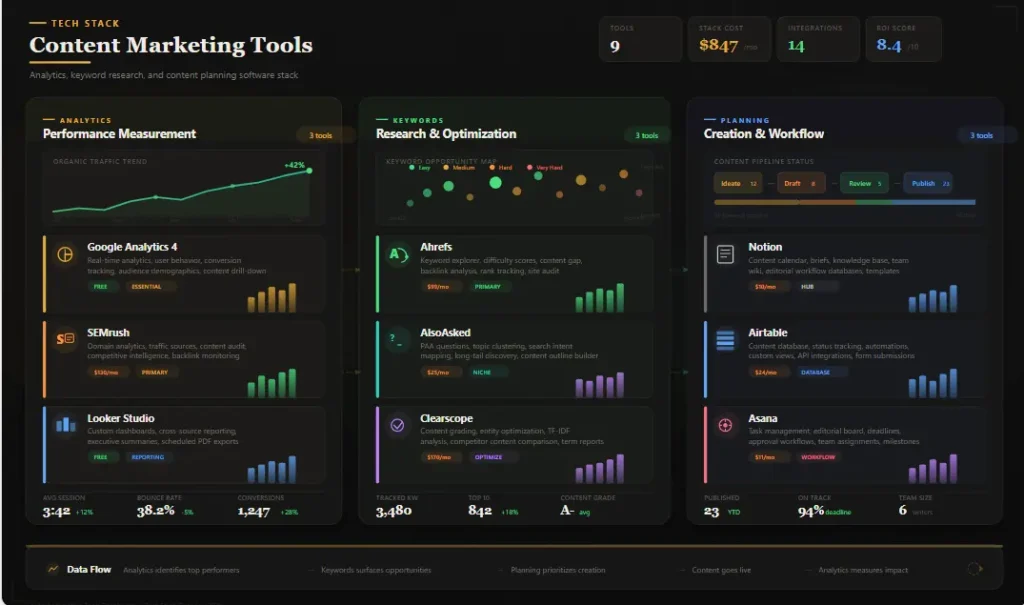
Regular performance analysis ensures your strategy stays aligned with real business outcomes.
Content marketing delivers strong ROI because it compounds over time. Publish consistently, refresh your winners quarterly, and use this framework to keep quality high as you scale. For the latest algorithm changes that might affect your content strategy checklist, follow Search Engine Journal.