
Moz vs Semrush vs Ahrefs: Which SEO Tool Fits Your Workflow?
Moz Pro, Semrush and Ahrefs are three paid SEO platforms that overlap on keyword research, backlink analysis, site audits and rank tracking. They differ in what they are built around, how they limit usage and what they charge once you add users, keywords or AI tracking. There is no single winner, and that is the honest starting point of this comparison.
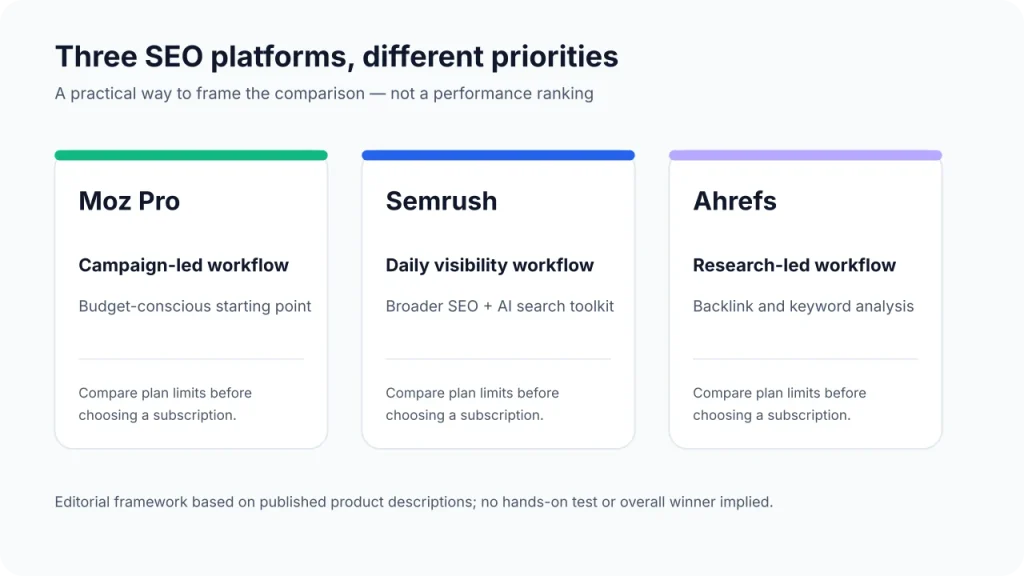
The short answer:
- Moz Pro is a lower-priced route into a full SEO suite, based on third-party-reported pricing. Its workflow is organised around campaigns and Domain Authority. It may suit small sites and tighter budgets, but its current plan details need confirming on Moz’s own site.
- Semrush tracks keywords daily and includes AI visibility features in its current SEO + AI Search plans. It costs more at the entry level and charges for extra users.
- Ahrefs is a strong option where backlinks and keyword data are central to the work. API and MCP access are included with its three main paid plans (Lite, Standard and Advanced), but rank tracking updates weekly. Its $29 Starter plan is much more limited than Lite.
The sections below explain why, compare the features one by one, and show how the pricing limits change the real cost. I have not tested these tools for this article. The comparison relies on official pricing and help pages where I could verify them, plus third-party reports where I could not. I label which is which.
Affiliate disclosure: the Moz links in this article are affiliate links, so SEORAF may earn a commission if you buy through them. The links to Semrush and Ahrefs are ordinary links to their official pages, and I have not added affiliate links for them. My recommendations are based on what each product does and who it suits, not on commission. Moz does not come out as the default winner here. See the SEORAF affiliate disclosure and editorial policy for how I handle this.
Last verified: 11 November 2026. Prices, limits and trial terms can change, so check the vendor’s own page before you pay. Moz-specific figures marked as third-party reports have not been independently confirmed against Moz’s current official documentation.
Moz vs Semrush vs Ahrefs at a glance
This table gives the quick view. Semrush and Ahrefs figures come from their official pricing and help pages. Moz figures come from third-party reports, so confirm them on Moz’s site before making a purchase.
| Item | Moz Pro | Semrush | Ahrefs |
|---|---|---|---|
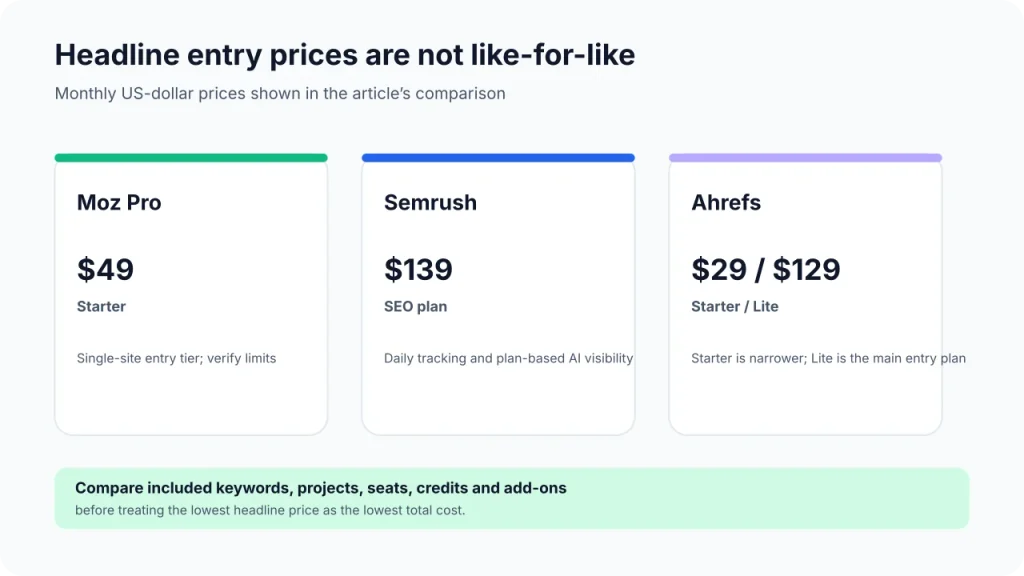
| Lowest listed entry price | Starter $49 (third-party report) | SEO plan $139 | Starter $29 (limited plan) |
| First main suite plan | Standard $99 | SEO plan $139 | Lite $129 |
| Other main plans | Medium $179, Large $299 | Starter $199, Pro+ $299, Advanced custom | Standard $249, Advanced $449, Enterprise $1,499 |
| Free access or trial | Reported 7-day trial on Medium; confirm current terms | Free plan and trial offer; check current duration and terms | No free trial; Ahrefs Free for verified site owners |
| Tracked keywords on first main plan | 300 (Standard, reported) | 500 (SEO plan) | 750 (Lite) |
| Rank-tracking updates | Weekly, plus on-demand checks (reported) | Daily keyword tracking | Weekly |
| AI visibility tracking | Reported; plan limits unclear | Included, with prompt limits by plan | 5 / 10 / 20 tracked prompts and 150 / 300 / 600 monthly checks on Lite / Standard / Advanced |
| API access | Separate paid product (reported) | Advanced API access on Advanced; MCP on Starter and higher plans | API and MCP on Lite, Standard and Advanced; not Starter |
| Local SEO | Moz Local sold separately | Local toolkit available separately | GBP Monitor (beta) |
| Reporting | Custom reports and PDF export (reported) | Base Report and Pro Report add-ons | Report Builder included, with plan-specific limits |
| Evidence basis | Third-party reports | Official pricing page | Official pricing and help pages |
Prices in US dollars as checked on 11 November 2026. Ahrefs Enterprise is listed at $1,499 per month with an annual commitment. Semrush Advanced uses custom pricing. Moz figures remain third-party-reported.
How I compared them
I reviewed the official pricing pages for Ahrefs and Semrush, along with Ahrefs’ and Semrush’s own explanations of keyword difficulty and search volume. I could not verify Moz’s current pricing and help-page details directly while preparing this article, so the Moz details come from third-party reviews and pricing guides. Where those sources disagreed or lacked confirmation, I say so instead of presenting the figures as established facts.
I use four labels throughout:
- Official page: stated on the vendor’s own pricing, product or help page.
- Vendor claim: a figure the vendor publishes about its own data, which I cannot independently check.
- Third-party report: stated by an independent review or pricing guide.
- My view: an editorial judgement based on the facts above it.
I do not give numeric scores or name an overall winner, because the right tool depends on what you need to do and how much you can spend. I also did not find an independent study comparing the data accuracy of all three tools that I could verify, so I make no accuracy claims.
What each platform offers
Moz Pro
Moz has been in SEO for a long time, and Moz Pro is built around campaigns, its Keyword Explorer, Link Explorer, Site Crawl and Rank Tracker, as well as its own Domain Authority score. A third-party review lists Keyword Explorer, Link Explorer, Site Crawl, Rank Tracker, On-Page Grader and custom reports as the main working areas. Moz describes the product as approachable for people who are not technical SEOs.
Third-party sources report four public plans: Starter at $49 a month for one site, then Standard at $99, Medium at $179 and Large at $299, with roughly 20% off for annual billing. Higher plans are reported to include more than one user. These figures have not been confirmed against Moz’s current official pricing page. Reports also describe Moz’s keyword database as smaller than those of the other two platforms and say it does not provide traffic estimates, but I could not verify either point on Moz’s site. Treat them as third-party claims, not confirmed product limitations.
If Moz looks like a fit, the sensible step is to read the current plan limits and trial terms before you sign up. You can view Moz Pro’s current plans and trial options (affiliate link). Check the trial length, the eligible plan and the cancellation terms on the signup page, because reports about them have varied over time.
Semrush
Semrush now sells its main plans as “SEO + AI Search”: an SEO plan at $139 a month, Starter at $199, Pro+ at $299 and a custom Advanced plan. Annual billing displays equivalent monthly prices of $117.33, $165.17 and $248.17 for the first three plans. Older articles may still use the names Pro, Guru and Business, or “Semrush One”, so expect some naming confusion when you read other comparisons. The current pricing page lists keyword research, competitor insights, Position Tracking, Site Audit, AI search tracking and custom prompt monitoring.
Semrush also sells separate toolkits for local SEO, content, social, advertising and PR, which suits teams that want more than organic search in one account. Its free plan includes one demo project and ten reports a day. The pricing page also offers a free-trial option; check the signup page for the current trial duration, eligibility and payment terms.
Ahrefs
Ahrefs describes its plans as helping a business stay discoverable in search and AI, powered by its own web crawler and index. The official plan table lists Site Explorer, Keywords Explorer, Site Audit, Rank Tracker, Brand Radar, a dashboard and competitive analysis. Its three main self-serve plans are Lite at $129, Standard at $249 and Advanced at $449 a month. Enterprise is listed at $1,499 a month with an annual commitment. Ahrefs also offers a $29 Starter plan, but it has much narrower limits than Lite.
Ahrefs says it does not offer a free trial. Instead, site owners who verify ownership can use Ahrefs Free, which gives limited access to Site Explorer and Site Audit. Ahrefs’ pricing page advertises savings of up to 17% with annual billing; this is different from a free trial or a promotional discount.
Feature comparison
The features below look similar on paper. The differences sit in the limits, the update frequency and how each score is calculated.
Overall feature coverage
| Capability | Moz Pro | Semrush | Ahrefs |
|---|---|---|---|
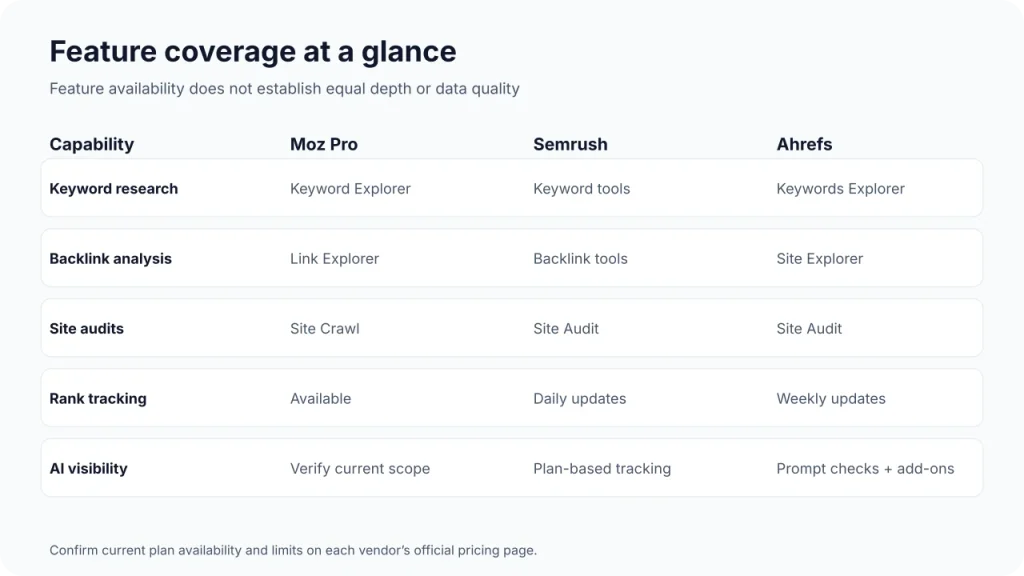
| Keyword research | Yes (Keyword Explorer) | Yes (Keyword Overview, Keyword Magic Tool) | Yes (Keywords Explorer) |
| Backlink analysis | Yes (Link Explorer) | Yes | Yes (Site Explorer) |
| Site audit | Yes (Site Crawl); depth not independently tested here | Yes (Site Audit) | Yes (Site Audit) |
| Rank tracking | Yes | Yes, daily | Yes, weekly |
| Competitor analysis | Yes | Yes; share of voice on Advanced | Yes; additional traffic analytics options may cost extra |
| Local SEO | Separate Moz Local product | Separate Local toolkit | GBP Monitor (beta) |
| Reporting | Custom reports and PDF export (reported) | Base Report and Pro Report add-ons | Report Builder included, with plan-specific limits |
| API and integrations | Separate paid API (reported) | MCP on Starter and higher plans; advanced API on Advanced | API and MCP on Lite, Standard and Advanced; not Starter |
| AI visibility | Reported, details vary | Included with plan-specific prompt limits | Tracked prompts and monthly checks on main plans |
Semrush and Ahrefs: official pricing pages and help documentation. Moz: third-party reports, so confirm details on Moz’s site.
A “yes” here only means the feature exists. It says nothing about depth or quality, and I have not tested any of them.
Keyword research and difficulty scores
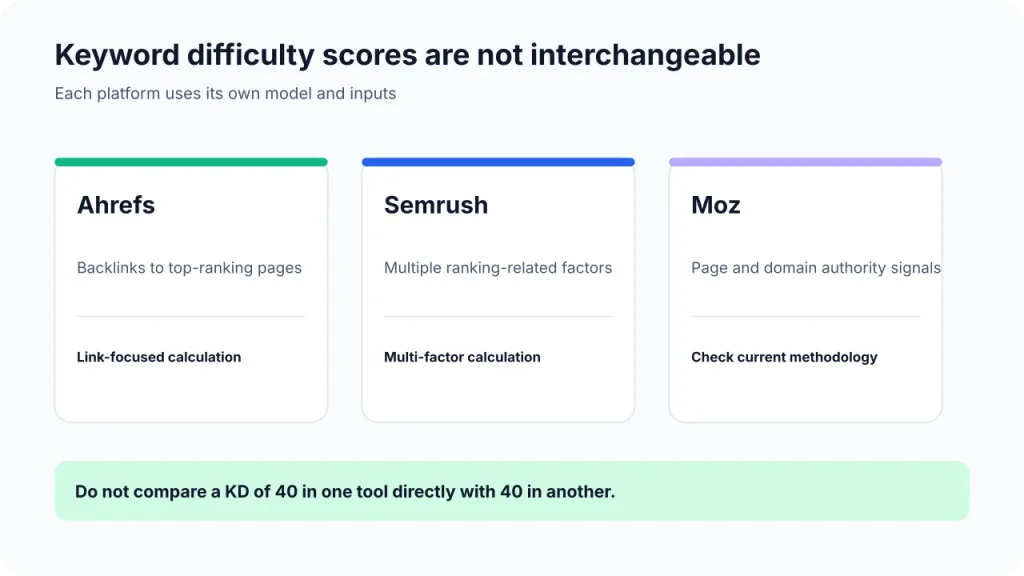
All three show search volume and a keyword difficulty (KD) score, but the scores are calculated differently, so a KD of 40 in one tool does not mean the same as 40 in another.
- Ahrefs says its KD is calculated from the number of backlinks to the top-ranking pages and takes nothing else into account. Its search volume is based on a 12-month average.
- Semrush says its KD analyses more than ten parameters, including referring domains, authority scores, search intent signals and SERP features. It also states that its search volume is a modelled estimate, not an official Google number.
- Moz help text, quoted by Search Engine Land, says its KD weights the Page Authority and Domain Authority of page-one results. That quote is dated, so check Moz’s current explanation. Third-party guides also report that Moz has shown search volume as ranges rather than single numbers.
Database size is a common selling point, but published figures can become outdated and may use different counting methods. Ahrefs and Semrush publish large keyword database figures on their product pages, while third-party comparisons have reported smaller figures for Moz. These numbers are not a like-for-like independent measurement, so I have not used them to rank the tools. A larger database may help with niche or long-tail searches, but it does not prove that the numbers are more accurate.
For a practical way to turn any of these numbers into a plan, see SEORAF’s keyword research guide.
Backlink analysis and authority metrics
Each tool crawls the web to build its own link index. Vendors and third-party comparisons publish different index-size figures, but those numbers can use different definitions and become outdated. Size alone is a weak guide: a smaller index can still be fresher or better filtered, and I found no independent test that settles which platform has the most useful backlink data for every type of site.
On plan features, Ahrefs lists broken backlinks, Content Explorer and more Site Explorer views from its Standard plan upward. Semrush includes backlink analysis as a core feature. Moz’s Link Explorer is its backlink tool.
Domain Authority (Moz), Domain Rating (Ahrefs) and Authority Score (Semrush) are each company’s own scores, not metrics Google publishes. They are calculated differently, so they should not be compared across tools. Third-party comparisons describe Moz’s and Ahrefs’ scores as being heavily influenced by backlinks, while Semrush’s Authority Score also considers other signals. Treat that as a high-level summary and check each vendor’s documentation for the current method. For link strategy rather than tool choice, see the link building guide.
Technical SEO audits
A site audit crawls your pages and lists problems such as broken links, redirect chains, missing titles and duplicate content. What differs is how much you can crawl and how deep the checks go.
- Ahrefs publishes crawl credits per main plan: 100,000 on Lite, 500,000 on Standard and 1.5 million on Advanced. Its pricing page also lists an always-on audit feature; check the plan details for the exact availability and limits.
- Semrush includes Site Audit on its plans, and Starter lists an AI-ready Site Audit. The pricing page I reviewed does not state a comparable audit crawl-credit limit, so I cannot compare that number.
- Moz Site Crawl is reported at roughly 400,000 pages a month on Standard, rising to 2 million on Medium and 5 million on Large. These figures come from third-party comparisons and have not been confirmed against Moz’s current official plan documentation. Claims that its checks are less comprehensive are independent opinions, not tested results.
A big crawl allowance matters mainly for large sites. A typical small site may not reach these caps, so check issue coverage and the clarity of explanations before focusing on crawl volume.
Rank tracking
Rank tracking records where your pages appear for chosen keywords over time. The practical differences are how often it updates and how many keywords you can track.
| Tool and plan | Tracked keywords | Update frequency | Basis |
|---|---|---|---|
| Moz Standard / Medium / Large | 300 / 1,500 / 3,000 | Weekly, plus on-demand checks (reported) | Third-party report |
| Semrush SEO / Starter / Pro+ / Advanced | 500 / 500 / 1,500 / 5,000+ | Daily | Official page |
| Ahrefs Lite / Standard / Advanced | 750 / 2,000 / 5,000 | Weekly | Official page |
| Ahrefs Starter | 50 | Weekly | Official Help Center |
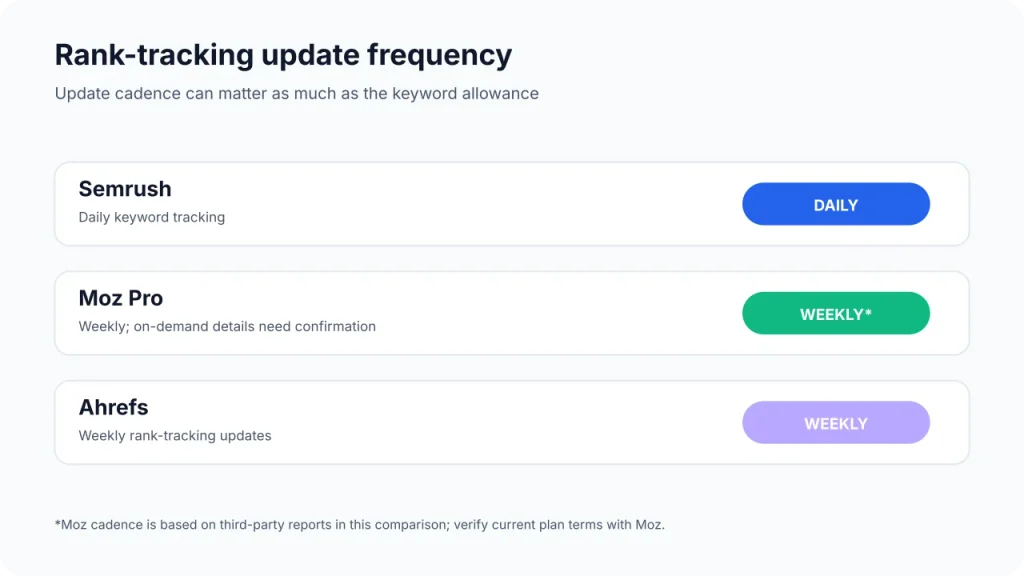
Moz limits come from third-party reports. Semrush and Ahrefs limits come from their official pricing and help pages.
Here is a simple example. Say you want to track 1,000 keywords across a content site. Based on the listed limits, you would need Moz Medium, Semrush Pro+ or Ahrefs Standard. Ahrefs Starter is not comparable to Lite because it tracks only 50 keywords. The cheaper main plans in each line stop at 300 to 750. That is arithmetic from the published limits, not a recommendation.
Competitor analysis
Competitor analysis means seeing which keywords and links a rival site has that you do not. Ahrefs’ plans list competitive analysis and allow up to 20 competitors per project on its three main self-serve plans. Ahrefs also offers Traffic Analytics for additional traffic research; check its current pricing and availability separately. Semrush lists competitor insights on its plans and adds share of voice on Advanced. Third-party reports say Moz does not provide traffic estimates, but I could not confirm that on Moz’s site. For method rather than tools, see SEORAF’s competitor analysis guide and the Semrush competitor analysis tools page.
Local SEO
None of the three is a pure local SEO tool, and each handles local differently. Moz Local is a separate product, with third-party pricing pages reporting different per-location prices. I could not verify a current price directly from Moz, so I have not treated those figures as confirmed. Semrush offers a separate Local toolkit. Ahrefs lists GBP Monitor, a Google Business Profile tool, in beta. If you manage many locations, compare dedicated local tools as well, since that is a different buying decision.
Reporting and client deliverables
Reporting matters most for freelancers and agencies. Semrush sells a Base Report for $10 a month and a Pro Report for $20 a month, with the Pro version adding branding, white-labelling and AI-generated summaries. Ahrefs includes Report Builder with plan-specific report and widget limits; it is not simply a $99 monthly add-on required by every user. Scheduling availability and reporting limits vary by plan. Third-party reviews say Moz offers PDF export and scheduling, with branding and templates on some plans, but I could not confirm the current details on Moz’s official site. Include reporting limits and any add-on costs in your budget.
AI features and AI visibility tracking
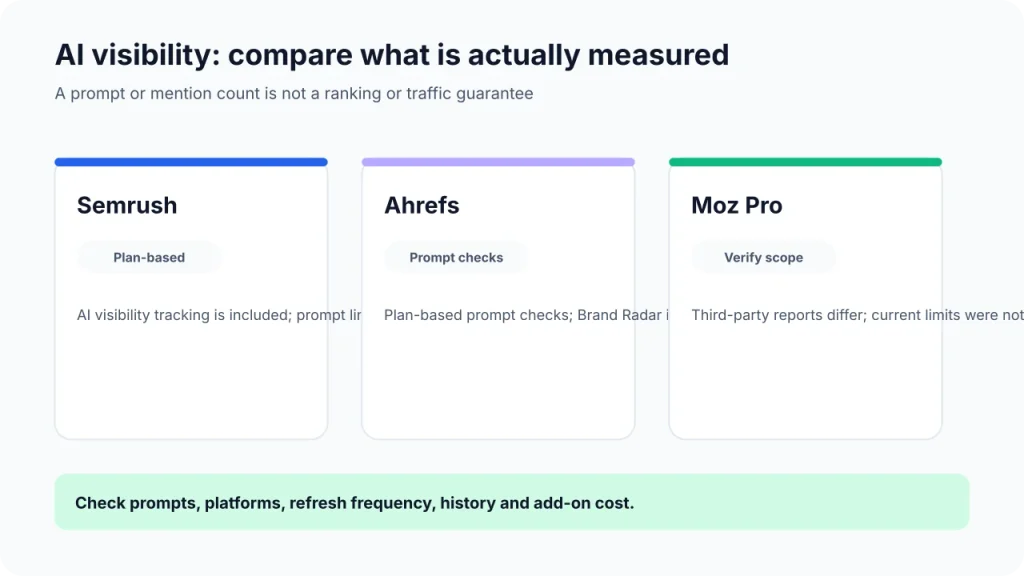
AI visibility tracking checks whether and how your brand or pages appear in answers from AI assistants and AI search. It is a new area, the tools measure different things, and tracking a mention does not guarantee any outcome.
| Item | Moz Pro | Semrush | Ahrefs |
|---|---|---|---|
| Included in main plans | Reported; sources disagree on prompt limits | Yes; prompt limits vary by plan. Starter lists 50 daily prompts, Pro+ 100 and Advanced unlimited | Yes: 5 / 10 / 20 tracked prompts and 150 / 300 / 600 monthly checks (Lite / Standard / Advanced) |
| Extra cost | Not verified | Enterprise customisation and other optional services | Brand Radar from $199 a month; custom prompt packages from $50 a month |
| Basis | Third-party report | Official page | Official pricing page |
Ahrefs prompt counts and monthly checks are different measures: tracked prompts are not the same as monthly checks. Moz AI limits vary across third-party sources, so no figure is given here.
Semrush also lists AI sentiment tracking and, on Starter, an AI-ready site audit. Ahrefs’ Brand Radar is a separate product that starts at $199 a month. Its custom prompt packages are priced separately and use monthly checks. If AI visibility is central to your decision, compare the exact prompts, platforms, locations and reporting each plan covers on the vendor’s page.
Pricing, limits and total cost
Plan snapshot
| Plan | Monthly billing | Annual billing (per month) | Basis |
|---|---|---|---|
| Moz Starter | $49 | Not verified | Third-party |
| Moz Standard / Medium / Large | $99 / $179 / $299 | $79 / $143 / $239 (reported) | Third-party |
| Semrush SEO | $139 | $117.33 | Official |
| Semrush Starter / Pro+ | $199 / $299 | $165.17 / $248.17 | Official |
| Semrush Advanced | Custom, request a demo | Custom | Official |
| Ahrefs Lite / Standard / Advanced | $129 / $249 / $449 | Up to 17% off with annual billing | Official |
| Ahrefs Starter | $29 | Monthly renewal only | Official |
| Ahrefs Enterprise | $1,499 | Annual commitment required | Official |
US dollars, checked 11 November 2026. Moz prices and annual discounts are third-party-reported. Semrush annual prices are displayed as monthly equivalents billed annually. Ahrefs advertises savings of up to 17% with annual billing.
Two caveats stop the headline prices from misleading you. First, annual plans are generally billed for the year rather than month by month, so check the billing terms before subscribing. Ahrefs Starter renews monthly, while its main plans offer annual billing with savings of up to 17%. Second, the cheapest plan in each line has the tightest limits, which the next section shows.
Limits that decide your real cost
| Limit | Moz (third-party) | Semrush (official) | Ahrefs (official) |
|---|---|---|---|
| Sites or projects | 3 / 10 / 25 (reported) | 5 / 5 / 15 / 40+ | 5 / 20 / 50 unverified projects; unlimited verified projects on main plans |
| Tracked keywords | 300 / 1,500 / 3,000 | 500 / 500 / 1,500 / 5,000+ | 750 / 2,000 / 5,000 |
| Historical data | Not verified | From Pro+ | 6 months / 2 years / 5 years |
| Usage model | Monthly keyword and crawl quotas (reported) | Plan-specific limits; 10 reports a day on the free plan | Credits: 1,000 per user on Lite; unlimited on Standard and Advanced |
Semrush columns follow its plans in order: SEO, Starter, Pro+, Advanced. Moz and Ahrefs columns follow their three main plans. Ahrefs Starter is a separate limited plan and is not included in the main-plan comparison.
Ahrefs’ unlimited verified projects need proof that you own or can administer the domain. The main plans also have separate limits for unverified projects. That helps agencies and consultants who manage client sites, and it matters less for someone researching competitors. Ahrefs Lite’s 1,000 credits per user are a ceiling worth checking if you plan heavy research. Starter is more restrictive: it includes 200 monthly credits, one unverified project and 50 tracked keywords.
Seats, add-ons and billing
Seats add up quickly. Ahrefs lists extra users at $40 on Lite, $60 on Standard and $80 on Advanced. Semrush lists additional users from $45 a month. Third-party reports put Moz’s extra seats at $49, with seats bundled into higher plans (one on Standard, two on Medium, three on Large). Confirm Moz’s current seat allowances and extra-user price before relying on those figures.
Here is an illustrative monthly total for a three-person team on monthly billing. It uses the published figures available for each platform, so it excludes add-ons, taxes and any per-plan differences Semrush applies to seat prices. These plans also have different feature and usage limits, so the totals are not like-for-like.
| Setup | Calculation | Approximate monthly total |
|---|---|---|
| Moz Medium | $179 with two seats, plus one extra seat at $49 (reported) | $228 |
| Moz Large | $299 with three seats (reported) | $299 |
| Semrush Starter | $199 plus two users at “from $45” | At least $289 |
| Ahrefs Lite | $129 plus two users at $40 | $209 |
| Ahrefs Standard | $249 plus two users at $60 | $369 |
Illustrative arithmetic, not a quote. Moz seat figures are third-party-reported. Plans differ in limits, so these totals are not like-for-like.
Other documented costs: Ahrefs add-ons include Brand Radar from $199 a month, Content Kit from $99 a month and Traffic Analytics at an additional cost. Report Builder is included with Ahrefs plans, with plan-specific report, widget and scheduling limits; it should not be treated as a mandatory $99 add-on. Ahrefs also offers custom prompt packages from $50 a month, and extra usage may be billed if you enable pay-as-you-go. Semrush sells report add-ons and a $90 Lead Generation add-on. The Semrush pricing plans page goes deeper on its options.
Free trials and free access
- Moz: several recent third-party sources say the trial is 7 days, available on the Medium plan with monthly billing only, requires a card and is limited to one per customer. One source says it cites Moz’s own help article for these terms, and it also says older “30-day trial” claims are out of date. I could not confirm this on Moz’s site, so check at signup. A free Moz account is also reported to include limited keyword and link queries.
- Semrush: a free plan with one demo project and ten reports a day, plus a free-trial offer on its pricing page. Check the signup page for the current trial length, eligibility and payment terms. See SEORAF’s Semrush free trial page for more information.
- Ahrefs: no free trial. Ahrefs Free gives verified site owners limited Site Explorer and Site Audit access. The $29 Starter plan is a paid, limited plan rather than a free trial.
If you decide to try Moz, you can check Moz Pro’s current trial terms (affiliate link). Look at which plan the trial applies to and what it converts into if you do not cancel.
Strengths and limitations
These are my summaries of the documented facts above, not test results.
Moz Pro: strengths and limitations
- Strengths: lower reported entry pricing among the full-suite options, seats reportedly bundled into higher plans, a free Moz account and MozBar, and a campaign-based setup aimed at non-specialists.
- Limitations: fewer sites on lower plans, a smaller reported keyword database with a reported 1,000-suggestion cap, reported site-crawl limits and plan details I could not confirm on Moz’s site. These database and crawl comparisons are not independently tested here.
Semrush: strengths and limitations
- Strengths: daily keyword tracking, AI visibility features built into the main plans, report add-ons with white-labelling, historical data from Pro+, and separate toolkits if you need more than SEO.
- Limitations: a higher entry price than Moz Standard and Ahrefs Lite, paid extra users, a custom-priced Advanced plan, and plan names that differ between older articles and the current pricing page.
Ahrefs: strengths and limitations
- Strengths: API and MCP access on the three main paid plans, unlimited verified projects, a documented link-based keyword difficulty, Report Builder included with plan-specific limits, and long historical data on higher plans.
- Limitations: weekly rank-tracking updates, credit limits on Lite, a much narrower Starter plan, some reporting and AI options with plan-specific or additional costs, and no free trial.
Which tool fits which user
Use this guide as a starting point and confirm limits against your own situation. “Fits” means the documented limits and features line up with the use, not that I tested it.
Beginners
Start with free options before you pay. Ahrefs Free (with verified ownership) and Semrush’s free plan cost nothing, and Moz’s free account is reported to offer limited queries. If you want a paid suite, Moz Standard’s reported pricing is below the main entry plans from Semrush and Ahrefs, as long as you confirm the limits first. Ahrefs Starter costs less, but it has only 50 tracked keywords and a much narrower feature set than Lite. Our SEO for beginners guide covers the basics, and the free SEO tools list shows other starting points.
Bloggers and niche-site owners
Keyword research and a limited budget usually decide this. Ahrefs Lite or Moz Standard offer a paid start at different price points, while Semrush’s SEO plan costs more than Ahrefs Lite. Ahrefs’ unlimited verified projects help if you own several sites, although the plan still has limits for unverified projects. If you mostly need keyword ideas, check whether a dedicated keyword tool is enough, and see best all-in-one SEO tools for other options.
Freelancers and consultants
Project counts, reporting and seat costs matter here. Ahrefs Standard’s unlimited verified projects and Semrush’s white-label report add-on both address client work. Moz’s bundled seats may help if you work with one or more collaborators, but confirm the current seat limits. Price the reporting add-ons and extra users in, since they can change the total cost.
Small businesses
A small business with one site and a modest budget is a use case Moz Pro’s lower reported plans may suit, and it is a reasonable shortlist item. If local visibility is the main goal, remember that Moz Local, Semrush’s Local toolkit and Ahrefs’ beta GBP Monitor are separate or early-stage offerings, so compare them against dedicated local software.
In-house SEO professionals
Data depth, API access and history tend to matter most. Ahrefs offers API and MCP on its three main paid plans and up to five years of history on Advanced. Semrush adds daily tracking and historical data from Pro+. Both are reasonable shortlist candidates for a specialist, and which one fits depends on whether you value link research or daily tracking more.
Agencies
Agencies need many projects, seats and client reports. Semrush’s 15 websites on Pro+ and 40 or more on Advanced, plus report add-ons, line up with that. Ahrefs offers unlimited verified projects on its main plans and up to 10 extra users on Advanced. Moz’s Large plan lists 25 sites in third-party reports. Calculate the seat and add-on costs for your team before comparing sticker prices.
Enterprise teams
Enterprise needs such as custom limits, security controls and support are negotiated or plan-specific. Semrush lists custom Advanced and Enterprise options. Ahrefs lists Enterprise at $1,499 per month with an annual commitment, including uncapped API access, SSO and audit logs. Ask each vendor for a demo and written limits. I did not verify Moz’s enterprise offering.
When two of the three are your real choice
Moz vs Semrush
Moz’s reported pricing is lower, with a campaign-based setup, while Semrush gives you daily tracking, more clearly documented AI visibility features and add-on toolkits at a higher price. Choose by budget and whether you need daily data. Read the Moz Pro review and Semrush review for more depth.
Moz vs Ahrefs
Moz’s reported full-suite entry price is lower, while Ahrefs offers documented keyword research, API access on its main plans and more clearly published project limits. If link and keyword research are central, Ahrefs’ published specifications may suit that workflow. If you want a lower-cost start on one site, Moz’s reported lower plans are worth checking. The Moz Pro review covers its features in detail.
Semrush vs Ahrefs
These two overlap most. Semrush leans toward daily tracking and a broader toolkit, while Ahrefs emphasises link research, API access on its main plans and flexible verified-project limits. SEORAF has a dedicated page for this pair: Semrush vs Ahrefs.
When not to buy each tool
- Moz Pro: skip it if you need a very large keyword database, traffic estimates or many client sites, or if you cannot confirm the plan limits you need on Moz’s site.
- Semrush: skip it if you only need basic keyword research on a small budget, or if extra users and add-ons would push the cost beyond what you will use.
- Ahrefs: skip it if you need daily rank updates, want a free trial, or would exceed the limits of the plan you can afford.
If none of these fits, look at SEO software alternatives, best SEO software, the Mangools vs Ahrefs comparison or SE Ranking vs Semrush.
How to test them yourself in a trial
A fair comparison uses the same inputs in each tool. Trial periods and free access differ, so plan before you start:
- Pick five keywords you already care about, one competitor and your own domain.
- Run the same keyword research and note volume, difficulty and the intent shown for each, remembering that scores differ by design.
- Open your backlink profile and check whether the links you already know about appear.
- Run a site audit and compare which issues each one flags and how clearly it explains them.
- Set up rank tracking for a short list and see how the reports look.
- Write down the exact limit you hit first, then cancel or switch plans before any trial converts into a paid subscription.
Ahrefs has no trial, so use Ahrefs Free on a site you own to try its audit and Site Explorer. Check the trial length, eligibility and the plan each trial starts on before you enter payment details.
Final verdict
I would not name one winner, because the three tools solve slightly different problems at different price points. Based on the published facts, here is how I would shortlist:
- Shortlist Moz Pro if you manage one or a few sites, want a lower-priced full-suite option and a campaign-based setup, and are happy to confirm the plan limits and trial terms on Moz’s site first.
- Shortlist Semrush if daily rank tracking and built-in AI visibility tracking matter, you manage several sites, and you can absorb a higher entry price and paid extra users.
- Shortlist Ahrefs if backlink and keyword research is your daily work, you want API access on a main paid plan, and weekly rank updates are acceptable.
None of these tools can promise rankings or traffic. They show data, and the results depend on what you do with it. Whichever you choose, compare it against your own sites and check the limits that you will actually reach.
Moz is the only product here with an affiliate link, and it appears where reader intent calls for it. If you want to check Moz Pro’s plans, you can view Moz Pro’s current pricing and trial (affiliate link). For other side-by-side options, browse SEORAF’s SEO software comparisons.
Frequently asked questions
Which is better: Moz, Semrush or Ahrefs?
It depends on your use. Moz has lower reported pricing for its full-suite plans, Semrush offers daily tracking and built-in AI visibility features, and Ahrefs offers API access on its three main paid plans and strong link research tools. See the verdict above for how I would shortlist them.
Is Moz better than Ahrefs?
Not in every way. Moz’s reported full-suite pricing is lower, while Ahrefs documents its plan limits, keyword research features and API access more clearly. The better one is the one whose limits match your work.
Which is the cheapest?
Ahrefs Starter at $29 and Moz Starter at a third-party-reported $49 are the lowest listed entry prices, but both are limited in different ways. Ahrefs Starter tracks 50 keywords, while Moz’s Starter limits should be confirmed with Moz. Among the main plans, Moz Standard is reported at $99, Ahrefs Lite is $129 and Semrush SEO is $139. Totals change once you add users and add-ons, as the three-person example shows.
Do Moz, Semrush and Ahrefs offer free trials?
Semrush offers a free plan and advertises a free-trial option; check the signup page for the current duration and terms. Ahrefs offers no free trial but has Ahrefs Free for verified site owners. Moz’s trial is reported as 7 days on Medium with monthly billing, which you should confirm at signup.
Is Domain Authority the same as Domain Rating?
No. Domain Authority is Moz’s score, Domain Rating is Ahrefs’ and Authority Score is Semrush’s. Each is calculated differently, and none is a score Google publishes, so do not compare them directly across tools.
Which tool tracks AI visibility?
Semrush and Ahrefs both list AI prompt tracking. Semrush includes AI visibility features in its SEO + AI Search plans, while Ahrefs includes tracked prompts and monthly checks in its main plans. Ahrefs Brand Radar is a separate product from $199 a month. Moz is reported to have AI visibility features, but I could not verify its current limits.
Which is best for beginners or small businesses?
Moz’s lower reported full-suite prices may suit small sites, while the free plans from Semrush and Ahrefs let you explore some features at no cost. Ahrefs Starter is another low-cost option, but its 50-keyword tracking limit makes it narrower than Lite. See the user sections above for more detail.
Do I need more than one of these tools?
Most people do not. Pick one that covers your main work and use free tools for the rest. Some specialists pair two, but that increases the cost, so check that the additional data justifies it.
Sources, verification log and update log
Official pages (checked 11 November 2026):
- Ahrefs plans and pricing
- Ahrefs Help Center: differences between subscription plans
- Ahrefs Help Center: About Ahrefs Starter plan
- Ahrefs Report Builder and plan limits
- Semrush SEO and AI Search plans
- Semrush keyword research, Keyword Overview and search volume checker
Third-party sources (used for Moz and selected comparison details):
- Style Factory: Ahrefs vs Moz vs Semrush (independent, affiliate-linked)
- Style Factory: Moz review and Search Atlas: Moz review (plan limits)
- Moz pricing guide citing Moz’s help article (trial terms)
- Search Engine Land: keyword difficulty guide (quoted Moz help text)
- Moz pricing guide (Moz Local and API pricing reports)
Not independently verified: Moz’s own current pricing, trial terms, plan limits, keyword database size, crawl limits, API pricing and AI limits; Semrush’s comparable Site Audit crawl-credit limits; and any independent accuracy comparison of the three tools. Third-party Moz figures are included as reported information, not confirmed vendor specifications. Confirm these details on the vendors’ pages before buying.
Update log: 11 November 2026, revised the comparison to clarify Ahrefs Starter and main-plan limits, Enterprise pricing, AI prompt tracking and Report Builder availability. Semrush plan prices and limits were checked against its current pricing page. Moz plan details remain third-party-reported where official confirmation was unavailable. I will update the page when plans change. For how SEORAF handles reviews and corrections, see the review methodology.