
WebCEO Alternatives: Best SEO Tools to Consider in 2026
WebCEO suits some SEO teams well and frustrates others. The difference usually comes down to how many clients or sites you manage, how you track rankings, and what you need to show clients each month. If you are looking at WebCEO alternatives, the useful question is not which tool is best in general. It is which one fits the job you are paying it to do.
I wrote this guide to help you decide whether to stay with WebCEO, switch to another SEO platform, add a specialist tool, find something cheaper, or choose a platform built for agencies. It compares WebCEO with Semrush, Ahrefs, SE Ranking, Mangools, Serpstat and Moz Pro, and covers two specialists, Screaming Frog and SpyFu, that do part of the job rather than all of it.
Disclosure and how I researched this. I may earn a commission if you buy WebCEO through links marked “affiliate link.” That gives me a reason to favour WebCEO, so I applied the same criteria to every tool and included the cases where staying with WebCEO makes sense. Other tools are linked to their official pages. I have not tested any of these tools hands-on for this article. Features and prices come from each vendor’s own pages, which I read on 18 and 19 November 2026, plus independent sources such as Capterra and TechRadar. Where a vendor and a reviewer disagree, or where I could not confirm something, I say so. See my affiliate disclosure and how SEORAF reviews software.
By Mousume Akter, Founder & Editor of SEORAF. Based on vendor documentation and independent reviews, not my own product testing. Last updated: 20 November 2026. Prices are in US dollars as shown on vendor pages and change often, so confirm them on the vendor’s site before you buy.
Quick Answer: Best WebCEO Alternatives in 2026
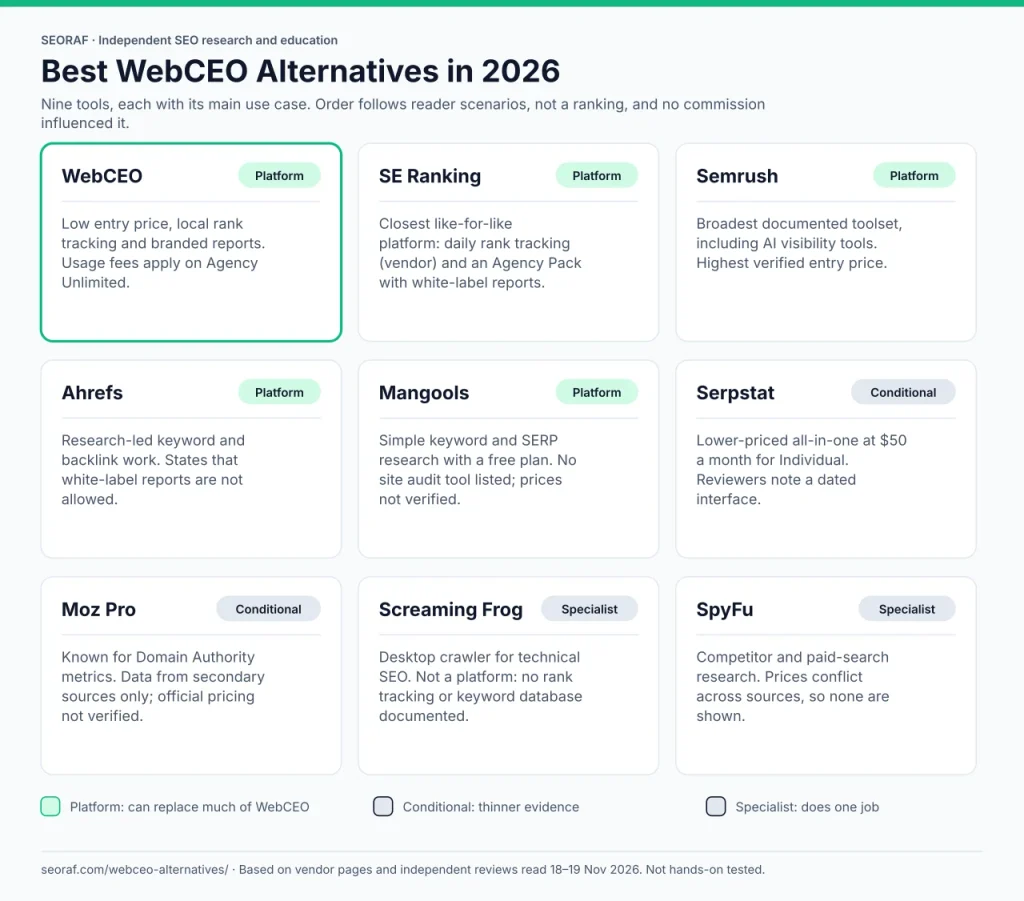
The best WebCEO alternative depends on the job. For a like-for-like platform with an agency layer, SE Ranking is the closest match I found in the documentation. For deeper research, Semrush and Ahrefs are the obvious comparisons, and I do not name a winner between them because the evidence does not separate them. For simple keyword work, Mangools is a lighter option. For technical crawling, Screaming Frog adds a capability rather than replacing WebCEO.
| If you need… | Consider | Why | Main catch |
|---|---|---|---|
| A like-for-like platform with white-label reporting | SE Ranking | Agency Pack adds white-label reports and 30 client seats; SE Ranking states daily Top-100 rank tracking on every plan | The Agency Pack is an annual-only add-on; some reviewers describe a smaller keyword database |
| The broadest toolset and a larger budget | Semrush | Wide documented toolset including AI visibility tools | Highest list price among the entry plans I could verify; white-label is billed per report |
| Research-heavy keyword and link work | Ahrefs (alongside Semrush) | Research tools on every paid plan, plus a free tier for sites you own | Ahrefs says it does not allow white-labelled reports; no trial |
| Simple keyword and SERP research | Mangools | Simple tool set and a free plan | No site audit tool listed; I could not verify current prices |
| A lower-priced all-in-one | Serpstat, or WebCEO Solo | Serpstat Individual lists 5 projects at $50 a month; WebCEO Solo is $36 for 1 project | Tiers are not equivalent; Serpstat evidence beyond the vendor page is thin |
| Technical crawling | Screaming Frog SEO Spider | JavaScript rendering, custom extraction, large crawls | It is a crawler, not a platform |
| To keep what you have | WebCEO | Low entry price, local rank tracking, branded reports, 14-day trial | Usage fees on Agency Unlimited; some reviewers cite a dated interface |
Quick picks by need. Prices and plan details are in the pricing section below.
Jump to: why people leave, reviews, pricing, picks by use case, how to choose, or when to stay with WebCEO.
Why Look for a WebCEO Alternative?
Most people do not leave a tool because of one flaw. They leave because a specific need stops fitting. These are the reasons I found documented, and none of them is a reason to switch by itself.
The cost model can be hard to forecast
WebCEO’s Agency Unlimited plan has a base fee plus usage fees: $2 per project, $4 per 1,000 rank queries, $0.80 per 1,000 backlinks, $5 per extra user and $0.49 per SEO lead, according to WebCEO’s pricing page. A “rank query” is WebCEO’s unit for a keyword checked in one location on one device across the results pages you choose, each scan. A keyword tracked in several locations or on several devices counts several times. If you cannot estimate that number, you cannot forecast the bill. Flat tiers are easier to budget, though they have their own caps.
Research depth
Some Capterra reviewers compare WebCEO’s keyword data unfavourably with Ahrefs and Semrush, and G2 reviewers ask for better keyword intent data. These are small, directional samples. WebCEO’s keyword tool page documents a KEI score (a ratio of searches to competition) and does not describe a keyword difficulty score. Backlink data comes from Majestic under a partnership WebCEO describes, and I could not confirm whether it also runs its own backlink crawler.
Interface and reporting flexibility
Some Capterra reviewers describe the interface as dated or cluttered and mention a learning curve. A few also want more control over report layouts. WebCEO’s reporting includes branded reports and a white-label domain, but the white-label domain is limited to the Agency Unlimited plan.
Gaps and inconsistencies in the documentation
WebCEO’s own pages disagree on the white-label add-on ($40 a month on the pricing and white-label pages, $80 on the agency page FAQ). The Task Manager and API plan availability are also described inconsistently. I could not find AI search visibility tracking among the tools or integrations on the pages I read, which may matter if you track brand mentions in AI answers. That is a gap in what I found, not proof the feature does not exist.
What Is WebCEO?
WebCEO is a cloud-based SEO platform that bundles 24 tools under one subscription, according to its tools overview. The set covers rank tracking, keyword research, site audits, backlink analysis, competitor research, analytics integrations, social metrics, reporting and a task manager, with agency features such as branded reports, a white-label domain and an API. It is aimed at small agencies, freelancers and in-house teams that manage several sites. That audience description is my reading of its feature set and pricing, not a quote from the vendor.
For my fuller assessment of the product itself, see my WebCEO review. This guide only covers what matters for comparing it with other tools.
WebCEO plans at a glance
| Plan | Monthly | Billed annually (per month) | Projects | Keywords | Rank depth and scans | Pages audited |
|---|---|---|---|---|---|---|
| Solo | $36 | $32 (3-month minimum) | 1 | 100 | Top-50, weekly | 1,000 |
| Startup | $119 | $99 | 5 | 750 | Top-50, weekly | 5,000 |
| Agency Unlimited | $99 plus usage fees | $83 plus usage fees | Unlimited ($2 each) | Unlimited ($4 per 1,000 rank queries) | Top-100, daily | Up to 50,000 per project |
| Corporate | $299 | $251 | 30 | 2,400 | Top-50, weekly | 150,000 |
WebCEO pricing and limits as shown on its pricing page, checked 18 and 19 November 2026. WebCEO states that annual billing saves 16% on Startup, Agency Unlimited and Corporate.
Branded reports start on the Startup plan. A white-label domain (your own subdomain with live read-only client reports) is available only on Agency Unlimited, as an add-on. WebCEO offers a 14-day free trial with no credit card, limited to 1 project, 10 tracked keywords and 100-page audits. The trial excludes the white-label domain, scheduled report emails and API use. I found no free plan, and WebCEO states that an account becomes read-only once a paid term ends.
Independent ratings give some context. Capterra shows 4.8 out of 5 from 75 reviews and G2 shows 4.7 from 166 reviews, as of early November 2026. Reviewers mainly praise support and value. Both are small review pools, and I treat them as a signal, not a verdict.
Best WebCEO Alternatives in 2026
I started with nine candidates and kept the ones that are genuinely useful to a WebCEO user. They fall into three groups:
- Platform alternatives: SE Ranking, Semrush, Ahrefs and Mangools. Each can replace much of what WebCEO does, with different trade-offs.
- Conditional alternatives: Serpstat and Moz Pro. Both are plausible, but my evidence is thinner. I could not read Moz’s own pricing page.
- Specialists: Screaming Frog SEO Spider (technical crawling) and SpyFu (competitor and paid-search research). They solve one job well and do not replace WebCEO.
I left Similarweb out. It is built for market and traffic intelligence, its plan pages did not confirm site audit or backlink tools in a plan, and its traffic figures are modelled from panel and partner data. It can be a complement, but it is not a WebCEO replacement. The order below follows reader scenarios, starting with the closest like-for-like option. It is not a ranking and it is not influenced by commissions.
In the reviews, “stated by the vendor” means the claim comes from the vendor’s own page, and “reported by reviewers” means it comes from an independent source such as Capterra or TechRadar. Neither is the same as my own testing, which I have not done.
WebCEO Alternatives Reviewed
SE Ranking
SE Ranking is an all-in-one platform with rank tracking, keyword research, site audits, backlink checking and monitoring, competitor research and reporting. Its subscription page lists Core at $129 a month ($103.20 a month billed annually) and Growth at $279 ($223.20 annually). Core includes 10 projects, 1 manager seat, 2,000 tracked keywords updated daily and 250,000 audit pages a month. Growth includes 30 projects, 3 seats, 5,000 keywords and 2 million audit pages.
What stands out is rank tracking and the agency layer. SE Ranking states that it tracks the top 100 results daily on every plan, across Google, Bing, Yahoo and YouTube, with city, region and ZIP-level local tracking and 35+ Google SERP features, including AI Overview presence (rank tracking page). The Agency Pack add-on costs $69 a month on annual billing and adds white-label reports and platform, your own domain and SMTP, and 30 view-only client seats (agencies page). A 14-day trial needs no card and allows up to 10 projects and 750 keywords a day.
On Capterra, SE Ranking shows 4.7 from 303 reviews (updated 9 November 2026), with ease of use at 4.6 and support at 4.7. Recurring complaints in that sample include price increases over time, a keyword database smaller than the largest suites, and some AI features sold separately. A few reviewers report broken daily scans or failed report delivery. SE Ranking does not publish its backlink index size on the pages I read, and its statement that the index is “on par with Ahrefs and Semrush” is a vendor claim I could not verify. For plan detail, see my SE Ranking pricing guide and SE Ranking free trial guide.
Pros
- Documented agency pack with white-label and client seats
- Daily Top-100 tracking on every plan (vendor statement)
- 14-day trial with up to 10 projects
Trade-offs
- Agency features, API and AI visibility are add-ons, so the real price is above the plan price
- Unused paid funds are generally not refunded
- Reviewer reports on rank-tracking reliability are worth testing in the trial
Best for: small and mid-size agencies and in-house teams that want white-label reporting and a 10-project starting point. Skip it if the lowest possible entry price matters most: Core starts at $129 a month, against $36 for WebCEO Solo, though Solo is a far smaller tier (1 project, 100 keywords).
Semrush
Semrush is a broad online-marketing platform in which the SEO Toolkit is one product among several. Its current SEO and AI Search pricing page lists SEO at $139 a month ($117.33 billed annually), Starter at $199 ($165.17), Pro+ at $299 ($248.17) and a custom Advanced plan. The SEO plan covers 5 websites and 500 keywords tracked daily; Pro+ covers 15 websites and 1,500 keywords. Semrush also publishes an older SEO Toolkit price list (Pro $139.95, Guru $249.95, Business $499.95 a month) on a help page. I could not confirm how the two lists relate, so I do not mix their limits.
Documented strengths include the Keyword Magic Tool, which Semrush says draws on a database of 28 billion-plus keywords across 142 regional databases (vendor claim, not independently verified), plus Position Tracking that shows featured snippets, AI Overviews and local packs, and a Site Audit covering 120 on-page and technical checks. Semrush offers a free plan (1 demo project, 10 reports a day) and a 7-day trial that each person can use once.
White-label is not part of the plan price. It comes through Semrush Pro Report, billed at $20 per report per month, and extra users cost $45, $80 or $100 a month depending on tier (user management page). On the older SEO Toolkit tiers, Site Audit limits are 100,000 to 1,000,000 pages a month but only 20,000 pages per campaign on Pro and Guru. I did not review independent ratings for Semrush in this round, so I make no reviewer-based claims about it. For audit detail, see my Semrush Site Audit guide.
Pros
- Widest documented toolset in this comparison
- Free plan and a 7-day trial
- AI visibility tools alongside classic SEO tools
Trade-offs
- Highest entry price among the platforms whose entry prices I could verify
- White-label billed per report; extra seats cost more
- Two plan structures coexist, which makes limits easy to misread
Best for: teams that want one broad platform and can absorb the price, and agencies at higher tiers. Skip it if you need a low monthly cost or would need many white-labelled reports.
Ahrefs
Ahrefs is a research-led platform built around Site Explorer, Keywords Explorer, Rank Tracker and Site Audit, listed on its tools page alongside Content Explorer, Link Intersect, Content Gap and Brand Radar for AI brand monitoring. According to its pricing page, Lite is $129 a month, Standard $249 and Advanced $449, with tracked keywords of 750, 2,000 and 5,000. A $29 Starter plan exists with 50 tracked keywords and 100 credits a month, and Ahrefs Free gives limited Site Explorer and Site Audit for sites you verify as your own (pricing blog, updated 17 November 2026).
Ahrefs says Site Audit checks for 170+ issues. That figure and Semrush’s 120 are each self-reported and counted differently, so they are not a quality comparison. Ahrefs billing and policy details matter to agencies: the Ahrefs FAQ says annual billing is “10 months for 12” on Lite and above (the pricing page words it differently, so confirm at checkout), there is no free trial of paid plans, refunds are generally not issued, and an undated help article states that Ahrefs does not allow white-labelled reports. Report Builder is capped (for example 2,500 rows per report on Lite). I did not review independent ratings for Ahrefs, and I could not find a published backlink index size.
Pros
- Research tools on every paid plan
- Free tier for sites you verify
- $29 Starter for light use
Trade-offs
- No white-label reports
- No trial of paid plans
- Credit and row limits cap data pulls
Best for: in-house SEOs, content teams and link builders whose work centres on research. Skip it if you must deliver branded client reports from the tool, or want to trial a paid plan first.
Mangools
Mangools is a set of simple tools sold together: KWFinder for keywords, SERPChecker, SERPWatcher for rank tracking, LinkMiner for backlinks, SiteProfiler and AI Search Watcher. Its plan limits article lists Basic, Premium and Agency tiers: keyword lookups per day of 100, 500 and 1,200; tracked keywords of 200, 700 and 1,500; and backlink rows per month of 100,000, 500,000 and 1.2 million. Rank updates are weekly except daily on Agency. Sub-users are 0, 3 and 5.
Two details matter for a WebCEO user. First, LinkMiner uses Majestic’s Fresh Index (Mangools FAQ), the same provider WebCEO names for its backlink data, so switching changes the interface rather than the link index. Second, no site audit tool appears among the tools on the plan page. I could not verify current prices: the pricing pages I could read showed no dollar figures, and compare pages say “from $37.70/month” without a billing cycle. Mangools offers a free plan with no card and a 48-hour refund window. Mangools’ own compare page claims white-label custom reports, which I could not verify.
On Capterra, Mangools shows 4.8 from 91 reviews (updated 3 November 2026) with ease of use at 4.8, and reviewers frequently praise value. Complaints in the same sample include tracked-keyword caps, some reliability problems and backlink data that some find limited or less accurate than competitors’. My Mangools pricing guide and Mangools vs Semrush comparison go deeper.
Best for: freelancers, bloggers and small businesses focused on keyword and SERP research. Skip it if you need technical audits, confirmed white-label delivery or thousands of tracked keywords.
Serpstat
Serpstat is a lower-priced all-in-one with keyword research, rank tracking, site audit, backlink analysis and competitor tools. Its pricing page lists Individual at $50 a month, Team at $100, Team x2 at $169 and Agency at $410. Individual includes 5 projects, 10,000 rank checks a month and 30,000 audit pages; Team and above have unlimited projects. White-label reports are on the Agency plan only, and Individual has no API. A 7-day trial charges a refunded $1 card check. The page shows annual savings that do not reconcile with its “up to 27%” wording, so I treat annual prices as unverified.
Capterra shows 4.7 from 171 reviews (updated 21 October 2026) with ease of use at 4.4. Reviewers cite value and support, and also a dated or clunky interface, a credit system that limits data pulls and keyword databases that are smaller for some markets. Serpstat’s own feature page I used for tool descriptions dates from 2021, so I confirm only the current pricing-page details above.
Best for: budget-conscious freelancers and small agencies who accept a denser interface. Skip it if your market has thin keyword coverage or you want white-label without paying for the $410 plan.
Moz Pro
Moz Pro is the platform most associated with Domain Authority and Spam Score, with Keyword Explorer, Link Explorer, site crawling, rank tracking and reports. I could not verify current plan prices from Moz’s own pricing page. A TechRadar review (updated 6 February 2026) and a third-party guide publish secondary price information, but I am not reproducing those figures as current prices because I could not confirm them with Moz. Check Moz’s official site for a current quote before comparing costs.
TechRadar lists a smaller database, limited integrations, a steeper learning curve for some, a dashboard it finds less intuitive than Semrush or Ahrefs, and no live support channels as limitations. Reported strengths are Domain Authority metrics, spam detection and transparent pricing. Note that WebCEO already shows Moz Domain Authority in its competitor reports, so the metric alone is not a reason to switch. My Moz review covers the wider Moz ecosystem.
Best for: SEOs who value Moz’s metrics and work with a small number of sites. Skip it if you need many campaigns or confirmed white-label reporting.
Screaming Frog SEO Spider (specialist crawler)
Screaming Frog is a desktop website crawler, not an all-in-one platform. Its product page lists JavaScript rendering through an integrated Chromium engine, custom extraction with XPath, CSS Path or regex, scheduled crawls with exports to Google Sheets, and integrations with Google Analytics, Search Console and PageSpeed Insights. It claims checks for over 300 issues, which is a vendor figure. The FAQ says a licence costs £199 per user per year (also listed as $279) and the free version is limited to 500 URLs per crawl. The default 2GB of memory typically handles crawls of 100,000 to 1 million URLs.
I did not find rank tracking, a keyword database or client reporting documented on the pages I read, so it cannot replace WebCEO. It is worth considering next to a platform if WebCEO’s audit limits or crawl controls are your bottleneck. WebCEO’s audit page does not document a JavaScript rendering method.
SpyFu (situational)
SpyFu focuses on competitor keyword and paid-search research, with rank history and backlink tools. SpyFu’s own comparison blog says its backlink analysis is less advanced than Semrush’s and its site audit is newly launched. A TechRadar review reports coverage limited to the US and UK (one source, so verify before relying on it). I could not read SpyFu’s official pricing pages and sources conflict, so I give no price. See my SpyFu pricing guide if competitor research is your main need.
WebCEO vs Alternatives: Comparison Table
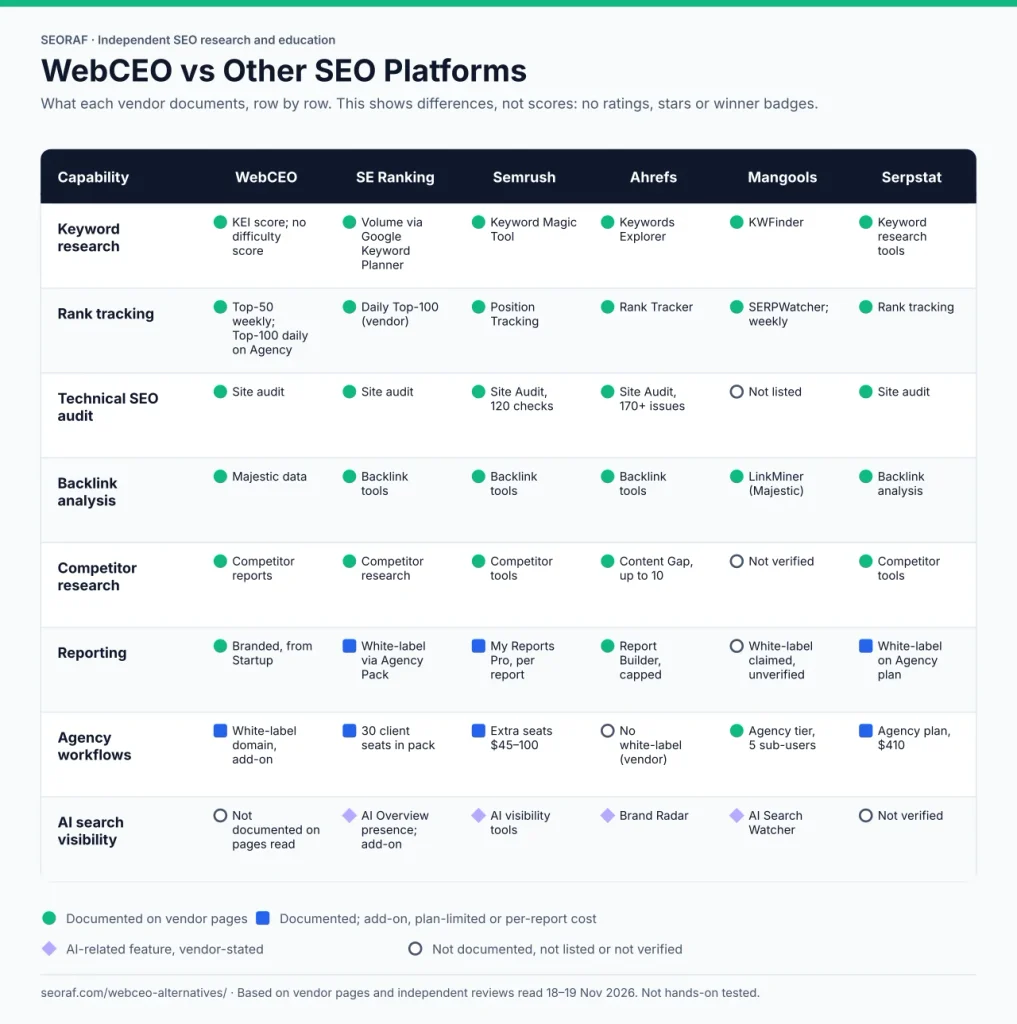
This table compares what each vendor documents for its entry-level or closest-fit paid plan. “Not documented” means I did not find it on the pages I read, not that the feature is absent. The tiers are not equivalent, so read it as a map of differences, not a scoreboard.
| Tool | Type | Rank tracking | Site audit | Backlinks | White-label reports | Free option |
|---|---|---|---|---|---|---|
| WebCEO | All-in-one | Yes; Top-50 weekly, Top-100 daily on Agency Unlimited | Yes | Yes (Majestic data) | Agency Unlimited add-on | 14-day trial, no card |
| SE Ranking | All-in-one | Yes; daily Top-100 (vendor) | Yes | Yes | Agency Pack add-on, annual only | 14-day trial, no card |
| Semrush | Marketing suite | Yes | Yes (120 checks) | Yes | Pro Report, per report | Free plan; 7-day trial |
| Ahrefs | Research-led suite | Yes | Yes (170+ issues) | Yes | Not allowed (vendor help page) | Ahrefs Free (verified sites); no trial |
| Mangools | Tool bundle | Yes (SERPWatcher) | Not listed | Yes (Majestic) | Claimed, not verified | Free plan |
| Serpstat | All-in-one | Yes | Yes | Yes | Agency plan only | 7-day trial ($1 card check) |
| Moz Pro | All-in-one | Yes | Yes | Yes | Not verified | Not verified |
| Screaming Frog | Crawler | No | Yes (desktop) | Via API metrics | No | Free, 500 URLs |
Documented capabilities from vendor pages read on 18 and 19 November 2026. Moz details are from secondary sources.
Pricing Comparison
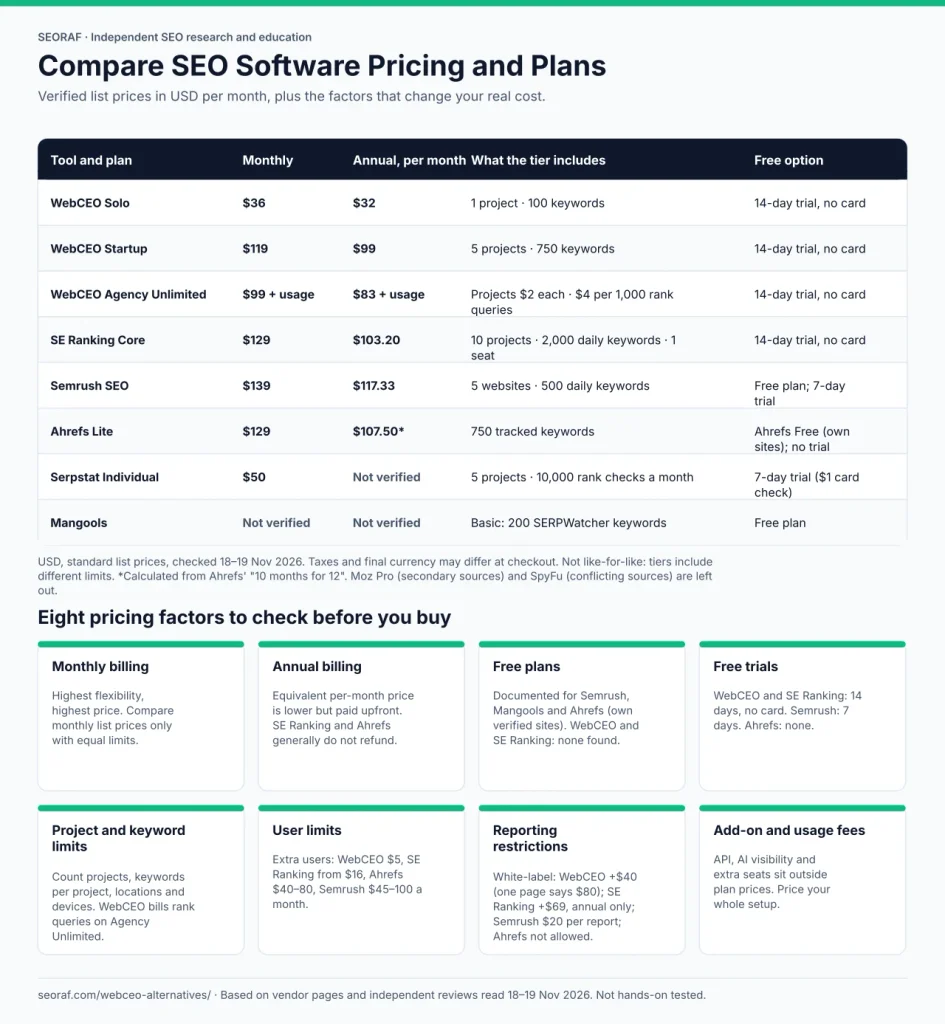
Prices are in US dollars per month as shown on each vendor’s page on 18 and 19 November 2026. Taxes and final currency may differ at checkout. These are standard list prices, and I do not list any time-limited promotions. Compare tiers by what they include, not by position in the lineup.
| Tool and plan | Monthly billing | Annual billing (per month equivalent) | What the entry tier includes |
|---|---|---|---|
| WebCEO Solo | $36 | $32 | 1 project, 100 keywords, Top-50 weekly |
| WebCEO Startup | $119 | $99 | 5 projects, 750 keywords |
| WebCEO Agency Unlimited | $99 plus usage fees | $83 plus usage fees | Unlimited projects at $2 each, daily Top-100 |
| SE Ranking Core | $129 | $103.20 | 10 projects, 2,000 daily keywords, 1 seat |
| SE Ranking Growth | $279 | $223.20 | 30 projects, 5,000 keywords, 3 seats |
| Semrush SEO | $139 | $117.33 | 5 websites, 500 daily keywords |
| Semrush Pro+ | $299 | $248.17 | 15 websites, 1,500 keywords |
| Ahrefs Starter | $29 | Not verified | 50 tracked keywords, limited credits |
| Ahrefs Lite | $129 | $107.50 (calculated equivalent; annual payment upfront) | 750 tracked keywords |
| Ahrefs Standard | $249 | $207.50 (calculated equivalent; annual payment upfront) | 2,000 tracked keywords |
| Mangools | Not verified | Not verified | Basic: 200 SERPWatcher keywords, 100 lookups a day |
| Serpstat Individual | $50 | Not verified | 5 projects, 10,000 rank checks a month |
| Serpstat Team | $100 | Not verified | Unlimited projects |
| Moz Pro | Not verified | Not verified | Check current plan limits with Moz |
| Screaming Frog | £199 per year (also listed at $279) | Not applicable | Single-user licence; free version up to 500 URLs |
Standard list prices checked 18 and 19 November 2026. Ahrefs annual-equivalent figures are my calculations from the current monthly prices and the vendor’s 10-months-for-12 annual billing offer; they are not separate monthly billing prices. Moz figures are from TechRadar and a third-party guide. SpyFu is omitted because its prices conflict across sources.
Costs that sit outside the plan price
| Need | WebCEO | SE Ranking | Semrush | Ahrefs |
|---|---|---|---|---|
| White-label reports | +$40 a month on Agency Unlimited (one page says $80) | Agency Pack +$69 a month, annual only | $20 per report per month | Not allowed |
| Extra users | $5 each (first month free) | From $16 each | $45, $80 or $100 depending on tier | $40, $60 or $80 on Lite, Standard, Advanced |
| API | Plan scope described inconsistently | $45 a month annual, $48 monthly | Not verified | Not verified |
Add-on costs from vendor pages. SE Ranking’s older agency page lists a lower API price, so confirm before buying.
A worked WebCEO example (hypothetical)
Suppose an agency has 10 client projects, 3 extra users and 20,000 rank queries a month, and wants the white-label domain. On monthly billing, before backlink and lead fees and tax, that is $99 + (10 × $2) + (3 × $5) + (20 × $4) + $40 = $254 a month. The numbers are invented to show the method. They are not a quote, and I do not claim this is cheaper or more expensive than SE Ranking, whose Core plan on annual billing ($103.20) plus the Agency Pack ($69) comes to $172.20 before extra seats. The two include different things, so the totals are not like-for-like.
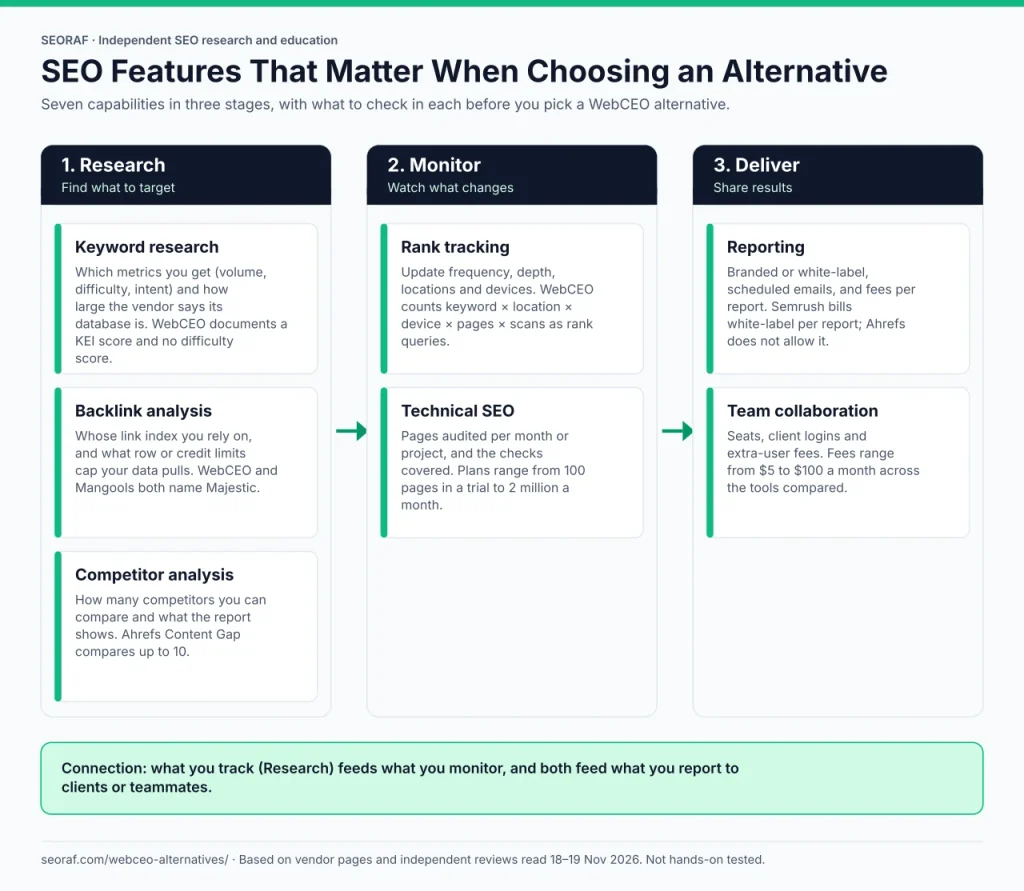
To price your own setup, count your projects, the keywords per project and the locations and devices you track. Multiply keywords by locations, devices and scans a month to get rank queries, add your seats, and then add the reporting add-on you need. Do the same on the other vendors using their own limits.
Features Comparison
Some terms first. Crawl credits are Ahrefs’ monthly allowance for site audits and similar crawling. White-label means client-facing reports or a portal that carry your brand instead of the vendor’s. Majestic is a separate link-index company whose data both WebCEO and Mangools use.
| Feature | WebCEO | SE Ranking | Semrush | Ahrefs |
|---|---|---|---|---|
| Keyword metrics | KEI score; no difficulty score documented | Volume from Google Keyword Planner and Trends | 28B+ keywords, 142 databases (vendor claim) | Keywords Explorer; database size not verified here |
| Local rank tracking | Zip-code locations; desktop, mobile, tablet | City, region and ZIP; desktop and mobile | Local packs shown in Position Tracking | Rank tracking in 190+ countries; local depth not verified |
| Search engines tracked | 370+ (vendor claim) | Google, Bing, Yahoo, YouTube | Not verified | Not verified |
| AI visibility | Not documented on pages I read | AI Overview presence; SE Visible add-on from $71 | AI visibility tools in current plans | Brand Radar |
| Site audit | Yes; 100 to 50,000 pages depending on plan | 250,000 or 2M pages a month | 120 checks | 170+ issues; crawl credits apply |
| Backlink data | Majestic partnership plus Moz DA/PA | Own index; size not published | Backlink Analytics tool; index size not verified | Backlink tools; index size not verified |
| Reporting | Branded; scheduled emails (not in trial) | White-label via Agency Pack | Pro Report | Report Builder; capped rows |
Documented features only. Vendor claims are marked; I did not test any of them.
Why do these differences matter? Weekly versus daily rank updates change how fast you spot a drop. Local tracking depth matters for clients who sell in specific cities. Where a vendor owns its backlink index, you are not tied to a partner’s coverage. White-label rules decide whether you can hand clients a branded report without extra cost or at all.
Best WebCEO Alternatives by Use Case
Where the evidence does not separate two tools, I say so instead of naming a winner.
| Use case | Consider | Reason | Caveat |
|---|---|---|---|
| Closest overall alternative | SE Ranking | Similar scope, agency add-on, daily tracking, trial | Add-ons raise the real price |
| Agencies needing white-label | SE Ranking or WebCEO Agency Unlimited | Both document white-label; Serpstat Agency does too at $410 | Costs are structured differently |
| Keyword research | Semrush or Ahrefs | Largest documented research tools; I do not rank them | Higher prices; vendor database claims unverified |
| Backlink research | Ahrefs or Semrush | Own link tools with dedicated analysis features | No published index sizes to compare |
| Budget | WebCEO Solo, Ahrefs Starter, Serpstat Individual | Lowest documented entry prices | Very different limits |
| Technical SEO | Screaming Frog next to a platform | JavaScript rendering and custom extraction | Crawler only |
| Beginners | Mangools or SE Ranking | Reviewers rate ease of use at 4.8 and 4.6 on Capterra | Small samples; Mangools lacks a site audit tool |
Picks by scenario. These are my judgment from the documented evidence, not test results.
WebCEO vs Semrush
Semrush is a broad marketing suite, while WebCEO is a narrower SEO toolset with a lower entry price and a usage-based agency plan. Semrush’s SEO plan at $139 a month covers 5 websites and 500 daily keywords. WebCEO Startup at $119 covers 5 projects and 750 weekly keywords. Those are different tiers, and daily versus weekly tracking is a real difference.
Semrush documents a free plan, a larger keyword database claim and wider marketing tools. WebCEO documents lower entry pricing, a white-label domain as a flat add-on and zip-code rank tracking. For many white-labelled client reports, Semrush’s $20 per report per month can add up, while WebCEO’s usage fees can add up in other ways. Choose Semrush if you want one platform beyond SEO and the budget allows. Choose WebCEO if cost and branded reporting for several small clients matter more.
WebCEO vs Ahrefs
Ahrefs is built around research, and WebCEO around monitoring and reporting. Ahrefs does not allow white-labelled reports, according to its help article, so an agency that must deliver branded reports from the tool will find WebCEO a better fit on that point alone. Ahrefs has no free trial, while WebCEO offers 14 days. In the other direction, Ahrefs lists Content Explorer, Link Intersect and Content Gap tools that I did not find documented on WebCEO’s pages.
Ahrefs Lite is $129 a month for 750 tracked keywords, which compares with WebCEO Startup at $119 for 750. Whether Ahrefs’ link and keyword data is better is something I could not verify, and neither vendor publishes figures I can compare. Pick Ahrefs if research drives your work and you do not need white-label. Pick WebCEO if you deliver monthly client reports.
WebCEO vs SE Ranking
This is the closest pairing. Both offer rank tracking, audits, backlinks, reporting, a trial with no card and white-label options. Both document local tracking: WebCEO at zip-code level and SE Ranking at city, region and ZIP level, so local tracking is not a differentiator. SE Ranking lists daily Top-100 tracking on every plan, while WebCEO reaches that only on Agency Unlimited.
The pricing logic differs. WebCEO charges per project, rank query and user on Agency Unlimited, and SE Ranking uses flat tiers with add-ons. A small number of heavily tracked projects may suit one model, and many lightly tracked projects the other. Run your own numbers with both free trials, and watch for the rank-tracking reliability reports on SE Ranking and the dated-interface comments on WebCEO.
How to Choose the Right Alternative
Work through these steps in order. Most readers can finish them in under an hour.
- Write down the job. Rank tracking for clients, keyword research for content, link research, audits, or all of these.
- Count your numbers. Projects, keywords per project, locations, devices and users.
- Decide on reporting. If clients need branded reports, rule out Ahrefs and check the add-on cost elsewhere.
- Price your setup using the method in the pricing section, on each vendor’s own limits.
- Shortlist two or three tools that pass steps 1 to 3.
- Test with your own data. Use a trial for a real project and compare rank results against a source you trust. If you are already on WebCEO, its 14-day free trial (affiliate link) is a low-risk way to try it on the same project. SE Ranking and Semrush also offer trials; Ahrefs does not.
- Check cancellation and refund terms before paying, especially annual plans.
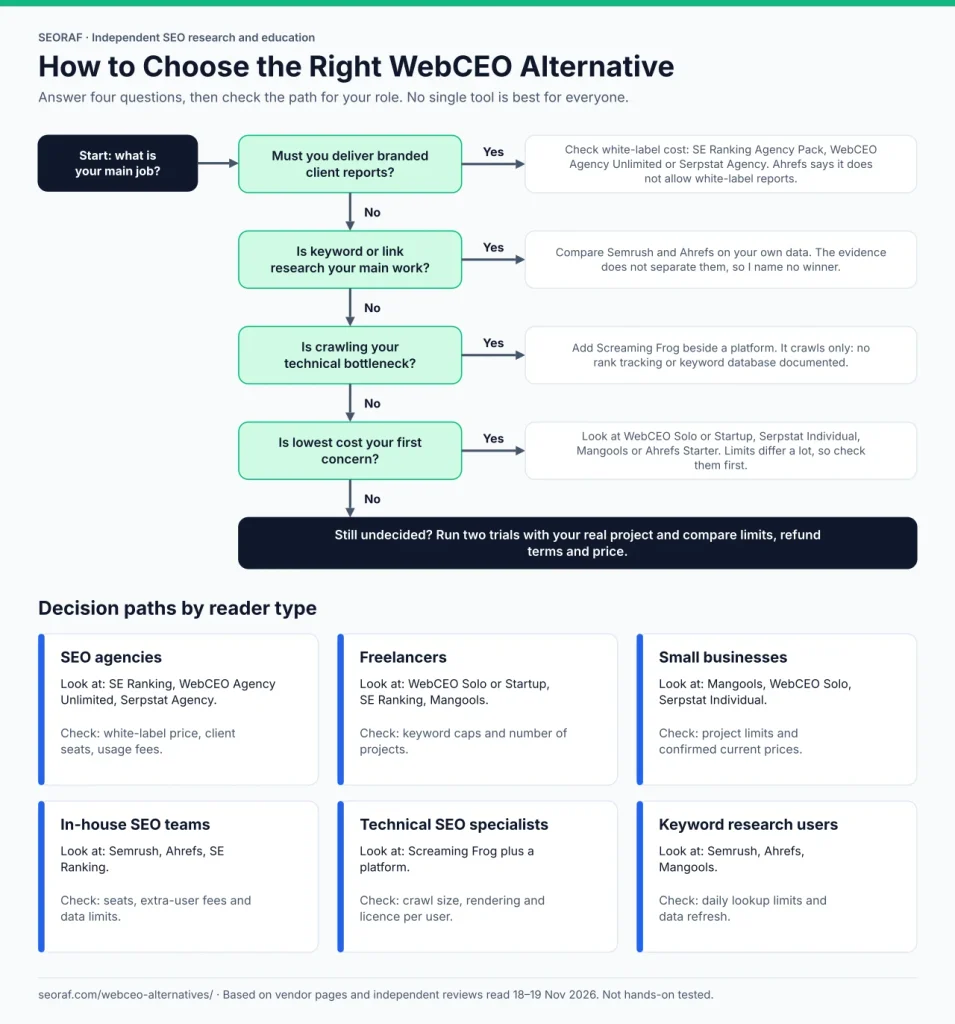
Annual billing saves roughly 16% to 17% on several of these tools, but it also locks money in. SE Ranking says unused paid funds are generally not refunded and Ahrefs says refunds are generally not issued, so test first and commit second. For rank tracking specifics, see my rank tracking software guide and the wider SEO software comparisons.
When WebCEO Is Still Worth Considering
Staying with WebCEO, or starting with it, is reasonable in these cases:
- You manage one or a few small sites and the $36 Solo or $119 Startup tier covers your numbers.
- You need local, zip-code rank tracking across devices.
- You send branded client reports and can estimate your usage fees.
- Reviewers’ praise for support and value matters to you; Capterra shows 4.8 from 75 reviews and G2 4.7 from 166.
Be cautious if you expect deep keyword intelligence, AI search visibility tracking, a modern interface or predictable bills at high volume. You can check the fit yourself with the WebCEO free trial (affiliate link): it needs no card, runs 14 days and covers 1 project and 10 keywords. If it does not fit, you can move on; because WebCEO says an account becomes read-only once a paid term ends, check what you can keep before that point. Nothing in this guide depends on you choosing it.
Frequently Asked Questions
What is the best alternative to WebCEO?
There is no single best. SE Ranking is the closest like-for-like platform in the documentation, Semrush and Ahrefs suit research-heavy work, and Mangools suits simple keyword research.
Is WebCEO cheaper than Semrush?
Its entry prices are lower: $36 for Solo and $119 for Startup, against $139 for Semrush’s SEO plan. The plans include different limits, and Agency Unlimited costs vary with usage, so compare your own setup.
Does WebCEO have a free plan?
I found no free plan. It offers a 14-day trial with no credit card, limited to 1 project, 10 keywords and 100-page audits.
Which WebCEO alternative is best for agencies?
SE Ranking with the Agency Pack and WebCEO Agency Unlimited both document white-label reporting. Serpstat’s Agency plan does too, at $410 a month. Ahrefs says it does not allow white-labelled reports.
Can I white-label reports in Semrush?
Yes, through Semrush Pro Report, billed at $20 per report per month according to Semrush’s current help page.
Where does WebCEO get its backlink data?
WebCEO describes a partnership with Majestic and shows Moz Domain Authority and Page Authority. I could not confirm whether it also runs its own crawler.
Is Screaming Frog a WebCEO alternative?
Only for crawling. It has no documented rank tracking or keyword database, so it works alongside a platform and does not replace one.
Did you test these tools?
No. This guide relies on vendor documentation and independent reviews, and I label which is which. I update it when I find changes.
Which tool tracks AI search visibility?
Semrush, Ahrefs (Brand Radar), SE Ranking (SE Visible add-on) and Mangools (AI Search Watcher) document AI visibility features. I did not find it on the WebCEO pages I read.
Is WebCEO still worth using in 2026?
It can be, if its plan limits match your numbers and you value local tracking, branded reports and a low entry price. Reviewer-reported weak spots are keyword data depth, a dated interface and report customization, so check those in a trial.
Does WebCEO offer white-label reporting?
Yes, but only on Agency Unlimited, as an add-on. Its pricing and white-label pages say $40 a month, while the agency page FAQ says $80, so confirm the current price before you budget.
Final Verdict
The right choice depends on which of these paths describes you:
- Keep WebCEO if its limits fit your numbers and you value local tracking, branded reports and a low entry price.
- Switch to SE Ranking for a like-for-like platform with a documented agency layer.
- Choose Semrush or Ahrefs if research depth matters more than price, remembering that Ahrefs does not allow white-label reports.
- Choose Mangools or Serpstat for a lower-cost route, after confirming current prices.
- Add Screaming Frog if crawling is the bottleneck.
If you are undecided, run your real project through two trials and compare. The WebCEO trial (affiliate link) is one option and SE Ranking’s trial another. No tool here guarantees rankings, traffic or revenue, and I make no such claim.
Sources and Verification
Vendor pages were read on 18 and 19 November 2026: WebCEO pricing, SE Ranking plans, Semrush pricing, Ahrefs pricing, Mangools plans, Serpstat pricing and Screaming Frog FAQ. Independent review listings: Capterra WebCEO reviews, G2 WebCEO reviews, Capterra SE Ranking reviews, Capterra Mangools reviews, and Capterra Serpstat reviews; TechRadar’s Moz Pro review. Review counts and ratings are snapshots and can change. Not verified: current Moz, SpyFu and Mangools official prices, Ahrefs and Semrush independent ratings, and the white-label price conflict on WebCEO’s pages.