
Best Enterprise SEO Software: 7 Tools Compared (2026)
11 Oct 2026 · By Mousume Akter, SEORAF
Which Enterprise SEO Platform Is Right for Your Team?
There is no single best enterprise SEO platform. The right choice depends on what is actually constraining your team: research and reporting breadth, technical visibility at scale, or content operations. Matching the buyer to the platform type comes first; the vendor shortlist follows.
- Large in-house teams that want one system for research, rank tracking, reporting and workflow: start with the all-in-one platforms: seoClarity, Conductor, BrightEdge, Semrush Enterprise and Ahrefs Enterprise. The first three are built around enterprise workflow and services; the last two are research-led and more self-serve.
- Technical SEO leaders responsible for millions of URLs, JavaScript rendering, log files and release regressions: shortlist a specialized technical platform, Botify or Lumar, and plan to pair it with a keyword and reporting tool.
- Content and brand teams focused on content operations and AI-search visibility: look at Conductor, BrightEdge and the content features in seoClarity, then test whether their technical depth is enough for your site.
- Agencies serving enterprise clients: weight multi-client structure, API access, data export and seat or project limits above everything else. Semrush and Ahrefs are the usual starting points; confirm client-management terms directly.
- Multi-site organizations: prioritize governance (SSO, role-based access, audit logs), per-domain limits and how pricing scales as you add sites.
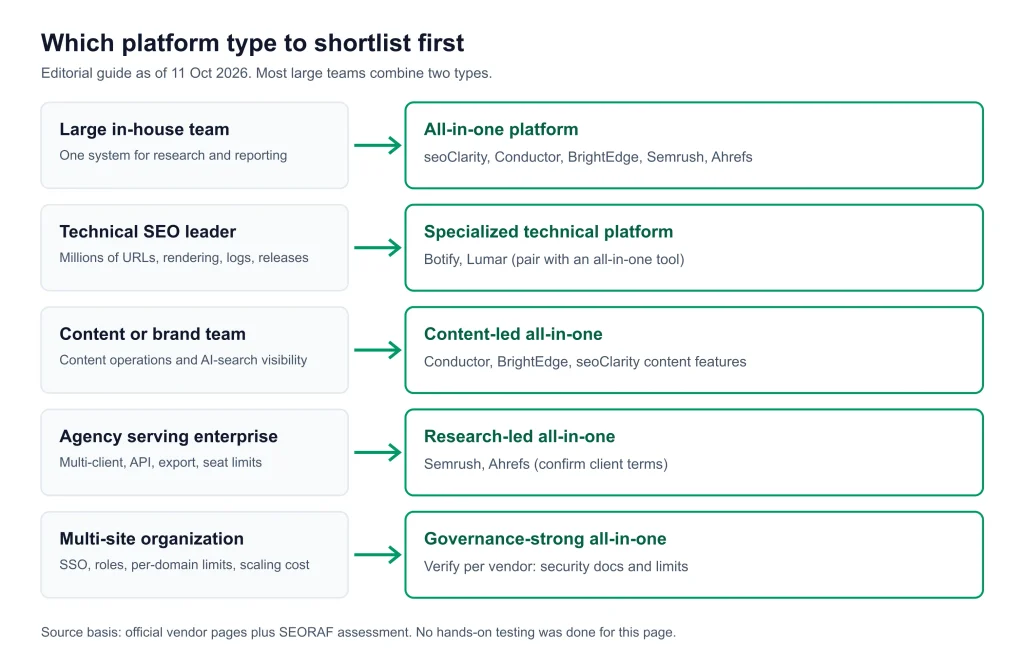
Most large organizations end up with a combination, for example an all-in-one platform plus one technical crawler, rather than a single tool. Teams below enterprise scale are usually better served by the tools in our best SEO tools guide and best all-in-one SEO tools page.
SEORAF has not run hands-on tests of these platforms for this page. Product descriptions are based on vendor documentation and are labeled accordingly. Pricing and features are time-sensitive; verify them directly with each vendor before making a purchase. Research checked 11 October 2026.
Disclosure and how this page was researched
Affiliate disclosure. SEORAF may earn a commission if you buy through some links on this page. Links that may earn a commission are marked as sponsored, and commission availability does not determine which products are included or how they are described. See our affiliate disclosure and editorial policy.
Ownership note. Adobe completed its acquisition of Semrush on 28 April 2026, according to Semrush’s customer FAQ.
Evidence labels used throughout:
- Vendor-stated: taken from an official vendor page or documentation and not independently checked.
- Independently verified: confirmed by testing or an independent source. None of the product claims in this draft carry this label, because no hands-on testing was done for it.
- SEORAF assessment: editorial judgment, labeled as such.
- Unverified: not confirmed in official sources during research; ask the vendor.
Method details are in our review methodology. Vendors were included only where official sources showed enterprise relevance. Analyst-report placements are treated as vendor-stated, because the Forrester report is paywalled and was not read in full.
How enterprise SEO buying differs from mid-market
The feature checklist matters less at enterprise scale than the operating conditions around it.
- Scale changes what breaks. Crawl caps, keyword-tracking limits, API rate limits and report-generation time all become binding constraints once you manage millions of URLs or dozens of domains.
- More teams touch the tool. SEO, engineering, content, analytics, legal and security all have a stake. Access control, audit trails and integration with release workflows often decide the deal.
- Data has to leave the tool. Enterprise teams usually need rankings, crawl data and visibility metrics in a warehouse or BI layer, so export and API terms matter as much as the interface.
- Pricing is rarely a price list. Most vendors here sell by quote, with usage-based or domain- and keyword-based models and annual terms. Compare the pricing model, not only the number.
- Services are part of the product. Onboarding, customer success and data services can matter more than another dashboard.
If you are still comparing self-serve plans, our Semrush vs Ahrefs comparison and SEO software pricing guide are better starting points.
Comparison table
Two tables, because positioning and technical capability answer different questions. Vendor-stated claims are identified as such; pricing and feature details should be reconfirmed before purchase.
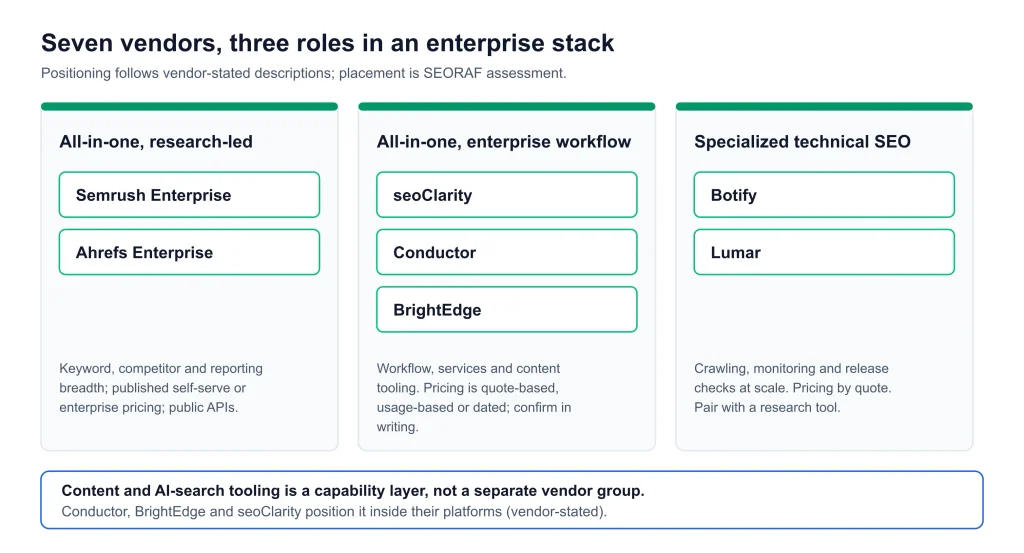
Table 1: Positioning, pricing model and verification status
| Platform | Category | Best fit | Pricing model | Verification status |
|---|---|---|---|---|
| Semrush Enterprise | All-in-one, research-led | Teams wanting broad keyword, competitor and reporting coverage with enterprise controls | Published self-serve monthly list prices: SEO $139, Starter $199, Pro+ $299 and Advanced $549 per month; annual-billing equivalents differ. Enterprise is custom quote. | Vendor-stated; official pricing page checked 11 Oct 2026 |
| Ahrefs Enterprise | All-in-one, research-led | Link, keyword and competitor research at large scale; API-driven workflows | $1,499 per month with annual commitment required; confirm the contractual total with sales. | Vendor-stated; official pricing page checked 11 Oct 2026 |
| seoClarity | All-in-one, enterprise workflow | Large teams wanting platform plus data services and managed support | Published representative starting prices of $2,500, $3,200 and $4,500 per month; the vendor’s page dates these figures to 11 Oct 2022. Obtain a current quote. | Vendor-stated historical pricing; current pricing must be verified |
| Conductor | All-in-one, content and organic-marketing led | Content-heavy organizations tying SEO to content workflow and AI-search visibility | Essentials, Growth and Enterprise tiers with published limits; pricing is usage-based and not publicly listed. | Vendor-stated; no public price |
| BrightEdge | All-in-one, enterprise content and automation | Large brands wanting enterprise reporting with automation and content tools | No published pricing verified in the reviewed sources. | Vendor-stated positioning; contract terms and limits require confirmation |
| Botify | Specialized technical SEO | Very large sites needing deep crawling, log analysis and technical monitoring | No published pricing verified in the reviewed sources. | Vendor-stated; obtain a quote and confirm plan limits |
| Lumar | Specialized technical SEO | Technical teams wanting crawl monitoring and release-pipeline checks | Pricing by enquiry form. | Vendor-stated; no public price |
Table 2: API, governance and limitations
| Platform | API and data access | Security and governance | Main limitation or open question |
|---|---|---|---|
| Semrush Enterprise | Public API documentation; the Advanced plan lists API data integration. Enterprise offers custom integrations and API access. | Enterprise lists SSO, team governance, audit logs, an SLA and multi-million-page crawling. | Enterprise terms are quote-only; Adobe ownership means asking about roadmap and data handling. |
| Ahrefs Enterprise | Uncapped API access and custom API endpoints are listed on the official pricing page; API documentation is available at docs.ahrefs.com/api. | Enterprise lists SSO, enterprise-grade security, access management and audit logs. | Not positioned as a log-file or large-scale rendering platform (SEORAF assessment); confirm the crawl limits and workflow fit for your site. |
| seoClarity | Data services and API-related capabilities are described by the vendor; confirm access, scope and any extra fees. | Security controls and certifications were not fully verified in this research. | Published starting prices are representative figures dated 2022; cost is based on domains and keywords. Confirm current pricing and API terms. |
| Conductor | API and AI-agent integrations are described on vendor pages; confirm scope and availability for the proposed plan. | SSO, MFA, RBAC and the specific SOC 2 and ISO certifications should be confirmed against current security documentation for the contracted product and plan. | Technical crawl depth should be validated against a specialist. |
| BrightEdge | Not verified in this research. | Not verified in this research. | Ask the vendor for written details on limits, API, governance and security documentation. |
| Botify | API terms and limits were not verified in this research. | SSO is documented as included with Botify Enterprise. GDPR compliance is described on its data and compliance page. SOC 2 Type II status was not confirmed in the sources reviewed here. | Technical focus; keyword and competitor research usually need another tool (SEORAF assessment). |
| Lumar | GraphQL API is documented by the vendor. | The vendor’s pricing page states SOC 2 Type 2 certification. | Technical focus; broader research and content tooling sits elsewhere (SEORAF assessment). |
A blank or “not verified” cell means the official sources reviewed did not establish the capability. It does not mean the capability is absent. Confirm current availability, contractual scope and plan eligibility with the vendor.
All-in-one enterprise SEO platforms
These cover keyword research, competitor analysis, rank tracking and reporting in one system. Their differences lie in workflow depth, services and how much technical crawling they do well.
Semrush Enterprise
- Best fit: teams that want broad research and reporting coverage with enterprise access controls, including agencies and in-house teams already using Semrush.
- Strengths (vendor-stated): the Enterprise tier lists multi-million-page crawling, SSO, audit logs and an SLA, and Semrush maintains a public API. The self-serve ladder lets you pilot before negotiating.
- Limitations: Enterprise terms are by quote, and lower plans carry caps. Adobe’s acquisition, completed 28 April 2026, is worth a procurement question about roadmap, bundling and data handling.
- Pricing model: published monthly self-serve list prices are SEO $139, Starter $199, Pro+ $299 and Advanced $549, with lower monthly equivalents available on annual billing. Enterprise is custom-priced.
- Verification: vendor-stated; official pricing and acquisition FAQ checked 11 Oct 2026. Read our Semrush review and the Semrush vs Ahrefs comparison for more.
Ahrefs Enterprise
- Best fit: research-led teams that prize link and keyword data and want API access to feed their own systems.
- Strengths (vendor-stated): the official pricing page lists an Enterprise price and details uncapped API access, custom API endpoints, SSO, access management and audit logs.
- Limitations: the official pricing page lists $1,499 per month with an annual commitment required. Confirm the final contractual price and usage terms directly with Ahrefs. In our assessment it is not a replacement for a log-file or large-scale rendering platform.
- Pricing model: published Enterprise price of $1,499 per month with annual commitment required.
- Verification: vendor-stated; official pricing page checked 11 Oct 2026. See our Ahrefs review.
seoClarity
- Best fit: large teams that want an enterprise platform with data services and hands-on support.
- Strengths (vendor-stated): it publishes representative starting prices, and it describes data services for pulling data into other systems.
- Limitations: the pricing page explicitly dates its representative figures to 11 October 2022, so treat them as historical reference figures, not current confirmed prices. Pricing scales with domains and keywords; confirm API availability and any additional fees.
- Pricing model: historical representative starting prices of $2,500, $3,200 and $4,500 per month; obtain a current quote.
- Verification: vendor-stated historical pricing; confirm current prices and terms directly.
Conductor
- Best fit: content-heavy organizations that want SEO tied to content workflow and AI-search visibility.
- Strengths (vendor-stated): published tier limits and an enterprise-oriented product for cross-functional teams. Security controls and certifications should be confirmed against current vendor documentation for the proposed plan.
- Limitations: no public prices and usage-based terms make budgeting harder. If technical SEO is your main constraint, test crawl depth against a specialist.
- Pricing model: Essentials, Growth and Enterprise tiers, usage-based, quoted.
- Verification: vendor-stated; confirm the current security and plan details.
BrightEdge
- Best fit: large brands wanting enterprise reporting alongside automation and content tooling, per its enterprise SEO platform materials.
- Strengths (vendor-stated): positioned for enterprise use, with workflow automation and AI-assisted content features described on its site.
- Limitations: no published pricing was verified in the reviewed sources, and public detail on limits, API and governance was insufficient to confirm them. Ask for those items in writing.
- Pricing model: not published in the sources reviewed.
- Verification: vendor-stated at a high level; plan-specific details unverified.
Specialized technical SEO platforms
These focus on crawling, site health and technical monitoring at scale. Most enterprise stacks pair one with an all-in-one tool. Background reading: our technical SEO guide and crawling guide.
Botify
- Best fit: very large or complex sites (large ecommerce, publishers, marketplaces) where crawl budget, rendering and log data drive decisions.
- Strengths (vendor-stated): an enterprise-size solutions page; Botify documents SSO as included with its Enterprise plan and describes GDPR compliance on its data and compliance page.
- Limitations: no published pricing was verified in this research; API terms and limits were not confirmed. SOC 2 Type II status was not established from the sources reviewed. Keyword and competitor research generally needs another tool (SEORAF assessment).
- Pricing model: quote-based.
- Verification: vendor-stated; confirm current security documentation and API terms.
Lumar
- Best fit: technical teams who want continuous crawl monitoring and to catch regressions before release.
- Strengths (vendor-stated): a documented GraphQL API and SOC 2 Type 2 certification. Confirm the exact CI/CD integration and plan availability for your intended workflow.
- Limitations: pricing is by enquiry only, and broader keyword and content tooling sits outside its focus (SEORAF assessment).
- Pricing model: quote-based via form.
- Verification: vendor-stated; API and pricing pages checked. Confirm current plan terms.
For desktop crawling at smaller scale, see our Screaming Frog free vs paid guide, Sitebulb review and ContentKing review.
Enterprise content and AI-search platforms
This is a capability layer rather than a separate set of vendors. Conductor (content creation features), BrightEdge (Copilot and other AI-assisted features) and seoClarity (content features) each position AI-assisted content and AI-search visibility tooling inside their platforms. These are vendor-stated capabilities, not independent test results.
What to test before you rely on it:
- How AI-search visibility is measured: ask which engines and prompts are tracked, how often, from which locations, and how sampling works. Methods differ and are rarely standardized.
- Where content recommendations come from: ask whether they derive from your own SERP data, and whether you can export them.
- Workflow fit: check that briefs, approvals and publishing hand-offs match how your content team already works.
- Claims about outcomes: treat any promised ranking or traffic results as marketing, not evidence.
For standalone content tooling, see our MarketMuse review.
What to test in each capability area
This table is a testing guide for your own trial or proof of concept, not a scorecard. The right-hand column is SEORAF assessment.
Capability areas, what to test, and where platform categories usually differ
| Capability | What to test | Where categories usually differ |
|---|---|---|
| Enterprise-scale crawling | Crawl your largest section with JavaScript rendering on; check caps, speed, scheduling and segmentation | Technical specialists are built around this; all-in-one platforms vary in depth |
| Site monitoring | Alerting on template changes, robots and canonical regressions; false-positive rate | Specialists and CI/CD-integrated tools are strongest on pre-release checks |
| Keyword and competitor research | Data coverage in your markets and languages; refresh cadence; tracking limits | Research-led all-in-one platforms are usually stronger here than crawlers |
| Reporting | Custom dashboards, scheduled exports, stakeholder views, white-labeling for agencies | Enterprise platforms emphasize reporting; check how much is self-serve |
| Collaboration and workflow | Task assignment, approvals, ticketing hand-offs, comments | Content-led platforms invest more in workflow |
| Integrations | Analytics, Search Console, BI tools, ticketing, CMS | Ask for the actual integration list and who maintains it |
| API access | Rate limits, quotas, cost, data freshness, schema stability | Check whether API use is included or billed separately |
| Governance | SSO, role-based access, audit logs, data residency, certifications | Request current security documentation rather than relying on web pages |
| Support and services | Onboarding scope, named contacts, response times, training | Services-heavy vendors cost more but reduce internal load |
| Scalability | Number of domains, keywords, URLs and users at your 24-month projection | Pricing models differ; model your growth, not today’s size |
Selection criteria and how to weight them
The weights below are SEORAF’s editorial judgment, not measured scores. Adjust them to your situation.
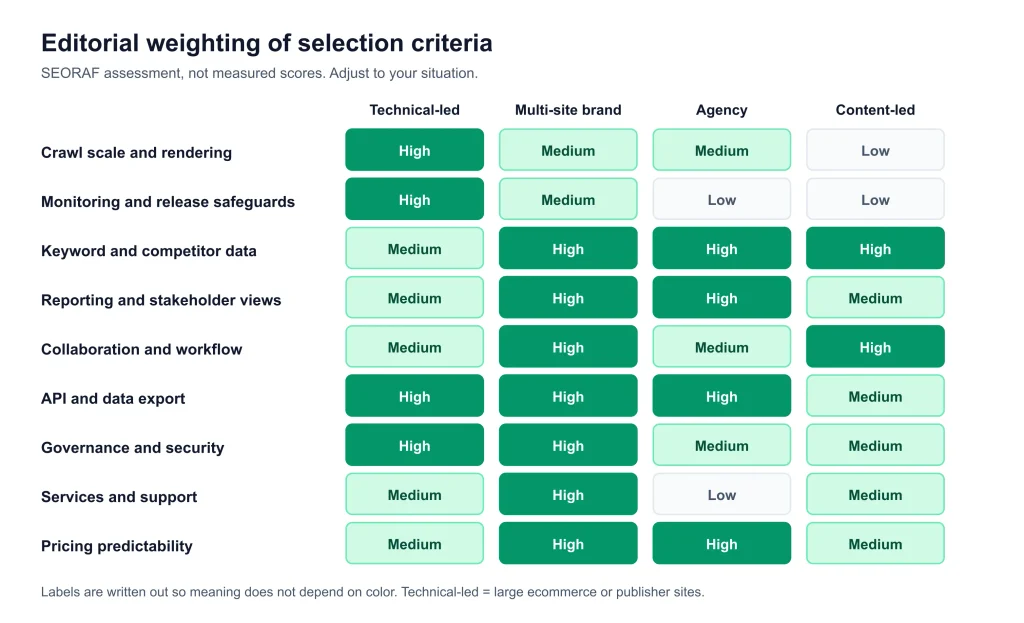
Editorial weighting of selection criteria by buyer type (SEORAF assessment)
| Criterion | Technical-led (large ecommerce, publisher) | Multi-site brand | Agency | Content-led team |
|---|---|---|---|---|
| Crawl scale and rendering | High | Medium | Medium | Low |
| Monitoring and release safeguards | High | Medium | Low | Low |
| Keyword and competitor data | Medium | High | High | High |
| Reporting and client or stakeholder views | Medium | High | High | Medium |
| Collaboration and workflow | Medium | High | Medium | High |
| API and data export | High | High | High | Medium |
| Governance and security | High | High | Medium | Medium |
| Services and support | Medium | High | Low | Medium |
| Pricing predictability | Medium | High | High | Medium |
Two rules help most. First, pick the one or two criteria that would make a deployment fail and test those before anything else. Second, if technical crawl depth is a high-weight criterion, include a specialist in the shortlist rather than assuming an all-in-one tool covers it.
Procurement questions to ask every vendor
- Which limits apply to my contract: domains, keywords, URLs crawled, users, API calls, report exports?
- What happens when I exceed a limit: overage fees, throttling or a forced upgrade?
- Is API access included, and what are the rate limits and any extra cost?
- Can I export raw data to my warehouse, and in what formats and frequency?
- Which security attestations can you provide today, with dates (SOC 2 report, ISO certificates)? Do you support SSO, role-based access and audit logs on my tier?
- What are the contract length, renewal terms, price-increase caps and exit or data-return terms?
- What onboarding is included, who is my named contact, and what are support response times?
- What changed in the product or ownership in the last 12 months, and what is on the committed roadmap?
- Can I run a proof of concept on my own site with my own success criteria before signing?
- For AI-search features: how is visibility measured, and can I see the method?
Implementation considerations
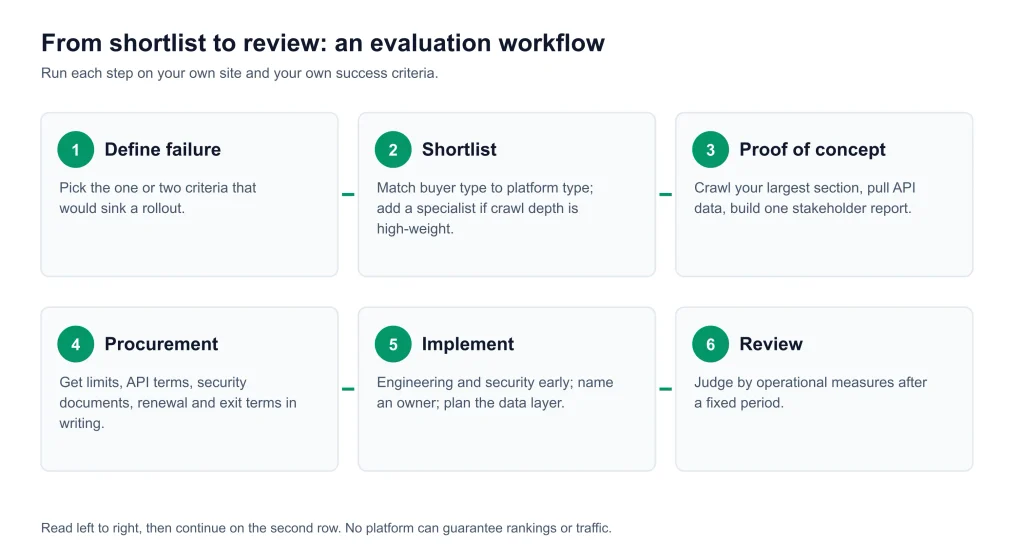
- Run a proof of concept first. Define two or three pass/fail tests, such as crawling your largest template set, pulling data through the API, and producing one stakeholder report.
- Involve engineering and security early. SSO, data-processing terms and release-pipeline integrations take longer than the SEO team expects.
- Plan the data layer. Decide where rankings and crawl data live long term, and who owns the schema.
- Assign owners and workflows. A platform nobody owns becomes a dashboard nobody reads. Name an administrator and agree how findings reach engineering backlogs.
- Budget time for onboarding. Expect configuration of domains, segments, tracking sets and permissions before the data is useful.
- Decide how you will judge success. Choose operational measures such as time-to-detect regressions or reporting hours saved, and review them after a fixed period.
Common buying mistakes
- Buying the biggest suite for a technical problem. If the bottleneck is crawling at scale, breadth of features elsewhere will not fix it.
- Comparing list prices. Pricing models differ (published tiers, usage-based, domain and keyword-based), so compare total cost at your projected scale.
- Trusting stale pricing. Some published prices are dated or contradicted by third-party pages. Get quotes in writing.
- Treating analyst placements as proof of fit. Rankings reflect criteria that may not match yours.
- Skipping the proof of concept. Demos use clean data. Your site will not.
- Ignoring exit terms. Ask how data is returned if you leave.
- Underestimating adoption. Training and workflow design usually decide whether the tool pays off.
- Accepting outcome promises. No platform can guarantee rankings or traffic.
Frequently asked questions
Do I need both an all-in-one platform and a technical crawler?
Often yes for very large sites, because the strengths differ. For smaller enterprise sites, an all-in-one platform with adequate crawl limits may be enough. Test your own site to decide.
Are Semrush and Ahrefs really enterprise tools?
Both publish enterprise-oriented offerings (Semrush Enterprise; Ahrefs Enterprise) and API access options. They are research-led and more self-serve than the services-heavy vendors, which suits some teams and not others. See our Semrush vs Ahrefs comparison.
Why are so many prices missing?
BrightEdge, Botify, Conductor and Lumar do not publish prices in the sources reviewed, and seoClarity’s published figures are explicitly dated 2022 on its own pricing page. Ask for a written quote based on your domains, keywords and URLs.
What if enterprise platforms are more than we need?
Look at SE Ranking alternatives and our SEO software alternatives guide.
Sources
Official vendor pages were reviewed on 11 October 2026 where indicated. Re-verify before publishing or acting on pricing. Source links are plain references and are not affiliate links.
- Semrush: Pricing · Enterprise · API · Adobe acquisition FAQ
- Ahrefs: Pricing · Enterprise · API docs
- seoClarity: Pricing · Data services
- Conductor: Pricing · Enterprise · AgentStack
- BrightEdge: Home · SEO platform
- Botify: Home · Enterprise · Data and compliance · SSO documentation
- Lumar: Home · Pricing · API
- Analyst report (paywalled, not read in full): Forrester Wave: SEO Solutions, Q3 2025