Is Ahrefs worth the cost in 2026? We examine its features, pricing, backlink and competitive research capabilities, AI-visibility tools, limitations, and best-fit users.
By Mousume Akter·Last verified: August 25, 2026
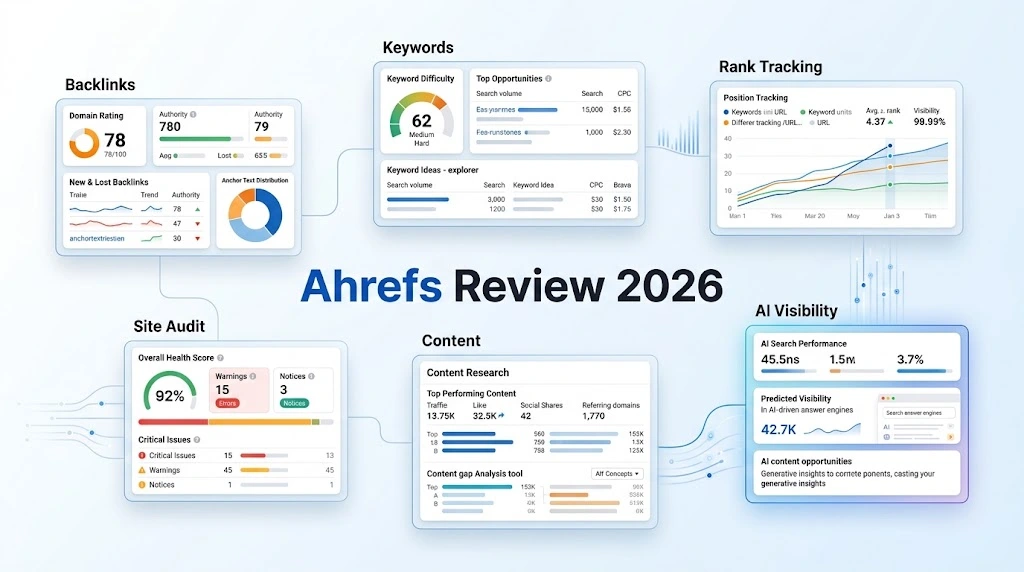
Ahrefs combines backlink intelligence, keyword research, technical SEO, content research, and AI-visibility tools.
Introduction & Research Methodology
Ahrefs is one of the most established names in SEO software and is frequently evaluated by agencies, in-house SEO teams, and site owners deciding whether its data, features, and pricing justify the cost. This review focuses on that practical buying question: Is Ahrefs worth paying for in 2026, and which types of users are most likely to benefit from it?
The review evaluates Ahrefs across its core SEO capabilities, including backlink and competitive research, keyword research, rank tracking, technical SEO auditing, content research, AI-visibility features, reporting, API access, pricing, usage limits, and overall value relative to competing SEO platforms.
Research scope: This review is based primarily on Ahrefs’ official documentation, pricing information, product pages, and product announcements. Relevant claims were cross-checked against independent third-party sources, including user-review platforms and industry pricing references, where appropriate.
SEORAF has not conducted hands-on testing of Ahrefs for this review. Therefore, the article does not present interface impressions, workflow performance, or usability observations as first-hand experience. Where a statement reflects third-party commentary rather than information published by Ahrefs, that distinction is identified explicitly.
Pricing and plan information was checked against Ahrefs’ official pricing information on August 25, 2026. Because SaaS pricing, features, usage limits, and product policies can change, readers should confirm current details before purchasing. Any information that could not be independently confirmed at the time of research is identified as unconfirmed rather than estimated or presented as fact.
Editorial standard: This review separates documented vendor claims, independently reported information, and SEORAF analysis. No numeric rating is assigned because SEORAF’s confirmed scoring methodology has not yet been applied to Ahrefs.
Quick Verdict
Ahrefs is a strong choice for agencies, in-house SEO teams, and advanced SEO professionals who prioritize backlink analysis, competitor research, technical SEO, and access to a broad SEO data platform. Its biggest advantage is the depth of its SEO data and the number of workflows available within one platform. For readers comparing SEO software reviews, Ahrefs stands out most when backlink intelligence and competitive research matter more than having the lowest monthly subscription cost.
Our Bottom Line
Ahrefs is worth considering if deep SEO data is more important to you than choosing the cheapest SEO tool. Its feature set is particularly relevant for teams that regularly perform backlink research, competitor analysis, technical audits, rank tracking, keyword research, and large-scale SEO research. However, users should evaluate the complete Ahrefs pricing structure rather than judging value from the headline plan price alone.
The biggest commercial change to consider in 2026 is Ahrefs’ move away from traditional free trials. According to Ahrefs’ official pricing information , the company currently does not offer a free trial on its paid plans. Instead, it provides a permanently free, limited Ahrefs Free account and a $29/month Starter plan as its lowest-cost paid entry point. The free account can help prospective customers explore selected capabilities, but it does not provide the complete experience available on paid plans.
Best for: SEO agencies, in-house teams, backlink analysis, competitive research, technical SEO workflows, keyword research, and users who can justify a higher monthly SEO software budget.
Bottom line: Ahrefs remains a serious SEO platform, but its value depends on how extensively you use its data and whether its pricing model fits your workflow. If you are still comparing platforms, explore our guide to the best SEO tools before making a final decision. This Ahrefs review does not assign a numeric score because SEORAF’s confirmed scoring methodology has not yet been applied to Ahrefs.
What Is Ahrefs?
Ahrefs is an SEO software platform designed to research, monitor, and improve organic search performance. Developed by Ahrefs Pte. Ltd., the platform has historically been best known for its backlink data and competitive analysis capabilities. Over time, the Ahrefs SEO tool has expanded into keyword research, rank tracking, technical SEO auditing, content research, analytics, reporting, and AI-search visibility.
For readers evaluating an SEO software review, the important distinction is that Ahrefs is no longer simply a backlink checker. It combines multiple SEO workflows in one platform, allowing professionals to research competitors, identify backlink opportunities, discover keywords, monitor rankings, audit technical issues, and investigate content performance. This broader scope is one reason Ahrefs is commonly evaluated alongside other all-in-one SEO platforms.
What Ahrefs Includes
The current Ahrefs platform includes Site Explorer, Keywords Explorer, Rank Tracker, Site Audit, Content Explorer, Web Analytics, Bot Analytics, AI Content Helper, Social Media Manager, and Brand Radar. Account and reporting capabilities also include Dashboards, Portfolios, Report Builder, API access, and an MCP Server, with availability depending on the specific plan or product.
For the latest plan availability and pricing, check Ahrefs’ official pricing page .
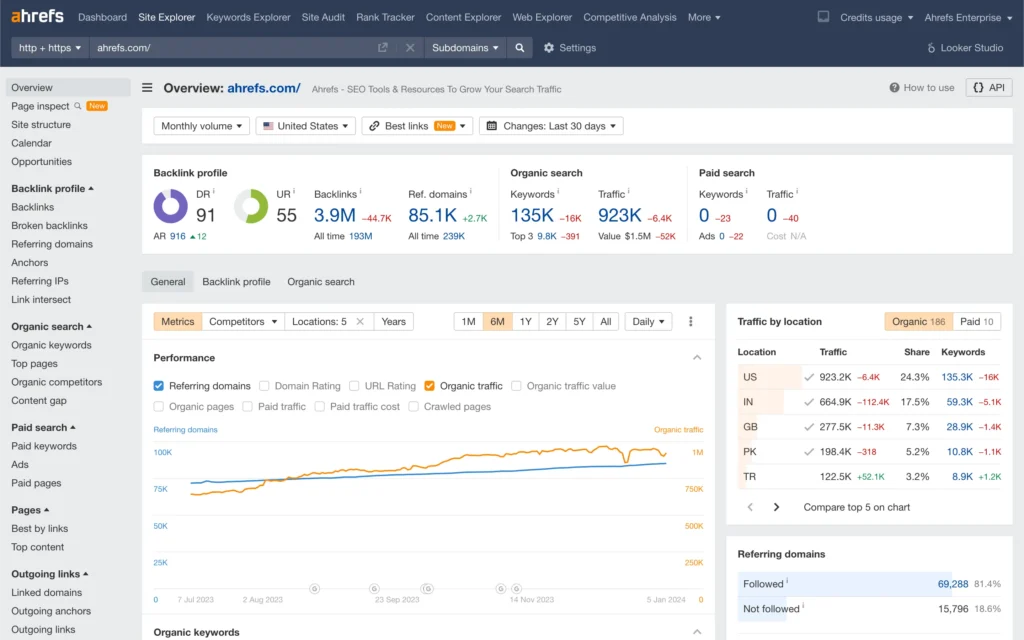
Ahrefs Site Explorer remains one of the platform’s most recognizable products. It allows users to investigate domains and URLs using backlink, organic-search, competitive, and paid-search data. Keywords Explorer supports keyword discovery and search demand research, while Rank Tracker monitors search positions over time. Site Audit focuses on technical SEO issues, and Content Explorer helps users research topics and content opportunities.
Ahrefs has also expanded into AI-search optimization. Its Brand Radar product is designed to monitor brand and product visibility in AI-generated answers, extending traditional SEO measurement into the growing area of AI visibility. This makes Ahrefs relevant not only to conventional search optimization but also to teams monitoring how their brands appear across emerging AI-search experiences.
The platform’s historical strength in Ahrefs backlink analysis also supports Ahrefs competitor analysis. SEO teams can use backlink and search-performance data to investigate competing domains, identify content opportunities, and understand how websites acquire organic visibility. However, claims about comparative index size, freshness, or accuracy should be treated as independently sourced unless SEORAF has conducted its own benchmark testing.
Ahrefs also operates several products that should not be confused with the standard subscription. Letaido is a separately branded, agent-based marketing workspace built on Ahrefs’ underlying data. Firehose is a separate real-time web and brand-mention monitoring product, while Yep is a separate search engine. These are distinct offerings rather than additional tiers within the core Ahrefs pricing structure.
Who is Ahrefs for? Ahrefs is primarily suited to SEO specialists, agencies, in-house marketing teams, content teams, and advanced site owners who need detailed SEO data, backlink research, competitive intelligence, and multiple SEO workflows in one platform. Its breadth can help teams consolidate several tools, although its pricing and learning curve may make it less suitable for users looking for the simplest or lowest-cost SEO solution.
Key Features
Ahrefs has evolved from a backlink-focused SEO platform into a broader search and marketing data suite. Its current Ahrefs features cover several stages of the SEO workflow, including competitor research, keyword research, rank tracking, technical auditing, content discovery, reporting, and AI-search visibility. The exact availability and usage limits vary by subscription tier, so a feature being part of the Ahrefs SEO tool ecosystem does not necessarily mean it is included without additional cost.
For readers evaluating the platform as part of an SEO software review or comparing it with other best SEO tools, the important question is not simply how many tools Ahrefs offers. The practical issue is whether its data depth, usage limits, refresh rates, and paid add-ons match the workflow a team actually needs.
1. Site Explorer
Site Explorer is one of Ahrefs’ best-known tools and is designed for researching domains and individual URLs. It brings together backlink, organic-search, competitor, and paid-search information to help users investigate how a website is performing and where its search visibility may be coming from.
SEO professionals can use Site Explorer to investigate competitor websites, identify pages attracting search traffic, examine referring domains, research backlink opportunities, and analyze the search terms associated with a domain. This makes it useful for both competitive research and link-building workflows.
Ahrefs’ backlink data is also one of the platform’s most frequently discussed differentiators. Independent SEO commentary often highlights the breadth and refresh characteristics of its backlink index. However, SEORAF has not independently measured Ahrefs’ index against competing databases in this review, so those comparative observations should not be interpreted as a SEORAF benchmark.Explore Ahrefs Site Explorer on the official Ahrefs website for the current feature set.
2. Keywords Explorer
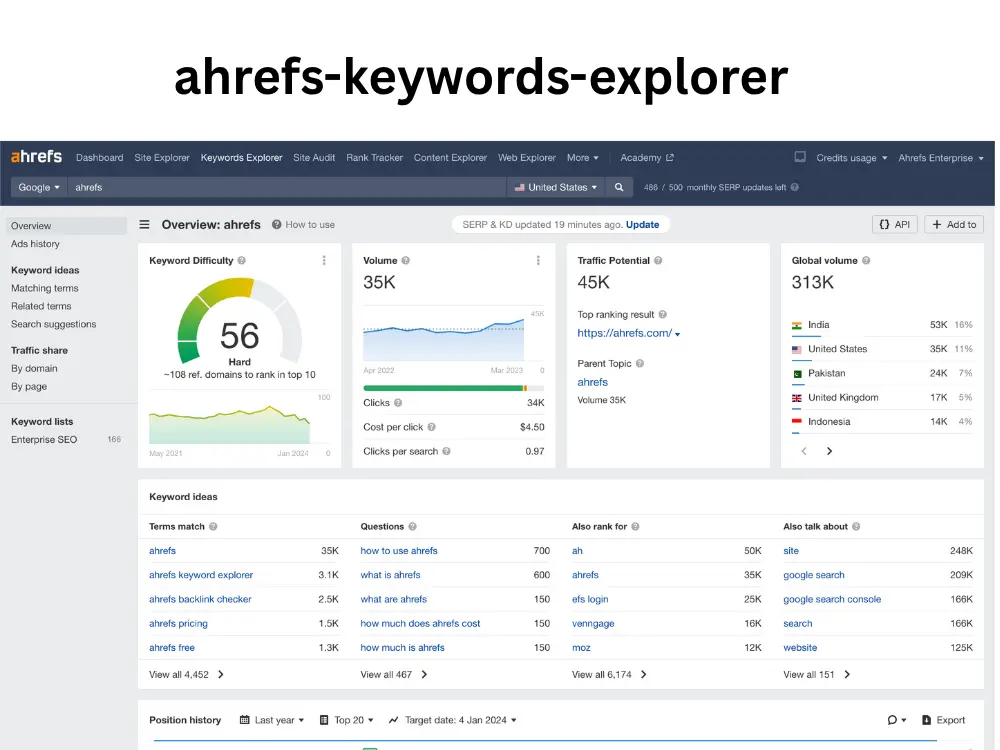
Keywords Explorer supports keyword research by providing keyword ideas, search-volume estimates, difficulty metrics, and related search data. It is designed to help users move from a broad topic to specific search opportunities that can be evaluated for content planning and SEO targeting.
Keyword research is available across major SEO platforms, so the value of Ahrefs’ implementation depends not only on the existence of these features but also on the underlying data and how useful the estimates are for a particular market. SEORAF has not performed an independent accuracy test of Ahrefs’ search-volume or difficulty estimates against competing databases.
For teams building a broader keyword research workflow, Keywords Explorer is most useful when its data is combined with search intent, SERP analysis, competitor research, and content planning rather than treated as a standalone keyword list.
3. Rank Tracker
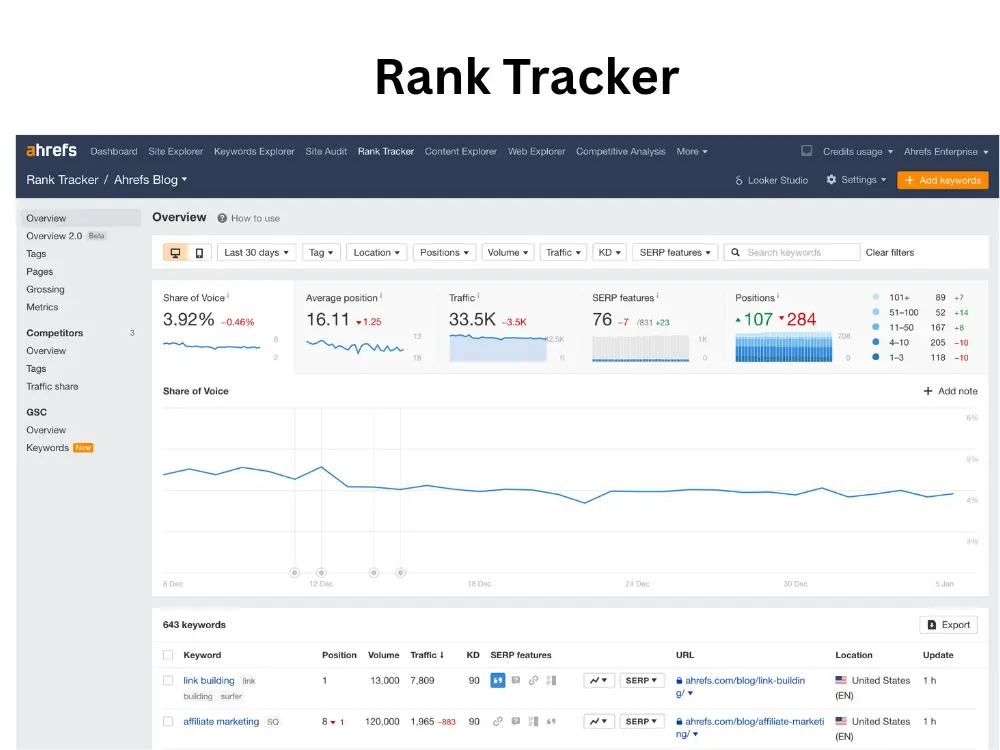
Rank Tracker monitors search-position performance over time, allowing users to track target keywords across projects and review ranking trends. Historical tracking can help SEO teams evaluate whether optimization work is associated with changes in search visibility.
For agencies and in-house teams, rank tracking can also provide a recurring measurement layer for client or stakeholder reporting. The number of tracked keywords and other usage limits depend on the selected plan, making plan-level limits important when estimating the cost of larger tracking programs.
4. Site Audit
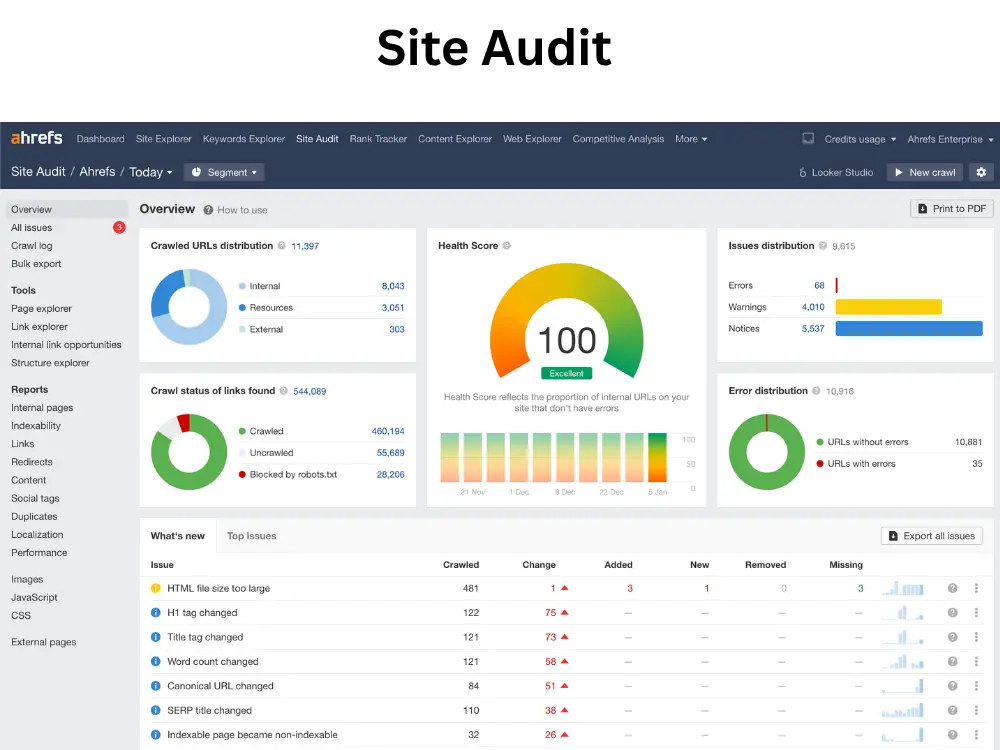
Site Audit crawls websites to identify technical SEO issues and provides reports that can help teams prioritize remediation. It is intended for identifying problems that may affect crawling, indexing, internal linking, page resources, and other technical aspects of a website.
Site Audit is particularly relevant for agencies managing multiple websites and technical SEO teams performing recurring audits. Crawl capacity, however, is subject to plan-level credit limits. Teams with large websites or frequent crawl schedules should therefore evaluate expected crawl volume before selecting a plan.
Teams working through a broader technical SEO process can use Site Audit as one diagnostic layer, but an audit report should not automatically be treated as proof that every reported issue is a ranking problem.
5. Content Explorer
Content Explorer is designed for content research and discovery. Users can investigate content around a topic and identify pages that have attracted search visibility, links, or other measurable signals. This can support topic research, competitor content analysis, link-prospecting workflows, and content ideation.
For content teams, its main value is the ability to research existing content before deciding what to create or improve. As with other Ahrefs features, the precise capabilities and usage allowances depend on the account and plan.See Content Explorer on Ahrefs for the current capabilities and use cases.
6. Technical, Web & Bot Analytics
Ahrefs has expanded its analytics capabilities beyond traditional SEO reports. Web Analytics provides website traffic measurement, while Bot Analytics focuses on crawler activity and can help site owners understand how automated crawlers interact with their websites.
Bot-focused reporting is increasingly relevant as websites receive activity from search-engine crawlers as well as AI and other automated agents. For technical SEO teams, this creates another layer of visibility into crawler behavior that complements traditional site auditing.See Ahrefs Brand Radar for the current AI-visibility features and pricing structure.
7. AI Content & AI-Visibility Tools
Ahrefs has also expanded into AI-search-related workflows. Its AI Content Helper supports content creation and optimization workflows, while Brand Radar focuses on monitoring how brands and products are represented in AI-generated answers.
Brand Radar is particularly different from Ahrefs’ traditional SEO features because it addresses visibility in AI-generated search experiences rather than conventional rankings alone. It is offered as a separate paid add-on rather than being automatically included with every core subscription.
8. API & MCP Server
API access and MCP Server access are important capabilities for agencies, developers, and teams building custom SEO workflows. According to the reviewed plan information, these capabilities are available starting with the Lite plan rather than being restricted exclusively to Enterprise.
API usage is subject to plan-specific row limits per request. The reviewed limits are 100 rows for Lite, 250 for Standard, 500 for Advanced, and uncapped access for Enterprise. Teams intending to automate large-scale data extraction should therefore evaluate the row ceiling and expected request volume before choosing a plan.Read Ahrefs’ MCP Server documentation before designing a production workflow around this capability.
9. Reporting & Project Management
Ahrefs includes account-level tools designed to organize projects and present SEO data. Dashboards provide an overview of monitored projects, while Portfolios allow multiple projects to be grouped for broader account management.
Report Builder extends the reporting workflow by allowing users to create client-facing or stakeholder reports using Ahrefs data. Report Builder is separately priced, so agencies should distinguish between reporting functionality available within the core platform and the additional capabilities that require an add-on.
10. Project Boost & Data Refresh
Project Boost provides additional options for projects that require increased crawl frequency or faster data refreshes. The Pro and Max versions are separately priced per project rather than being automatically bundled into every subscription.
This distinction matters for organizations managing large or frequently changing websites. A lower headline subscription price may not represent the complete operational cost if a team needs additional crawl capacity, faster refreshes, reporting, or AI-visibility monitoring.
Feature evaluation tip: Do not evaluate Ahrefs solely by counting tools. The more useful question is whether the included limits, data access, refresh frequency, and separately priced add-ons match your actual SEO workflow. A team using backlink research heavily may value Ahrefs differently from a team whose primary need is inexpensive rank tracking or high-volume technical crawling.
Pricing & Plans
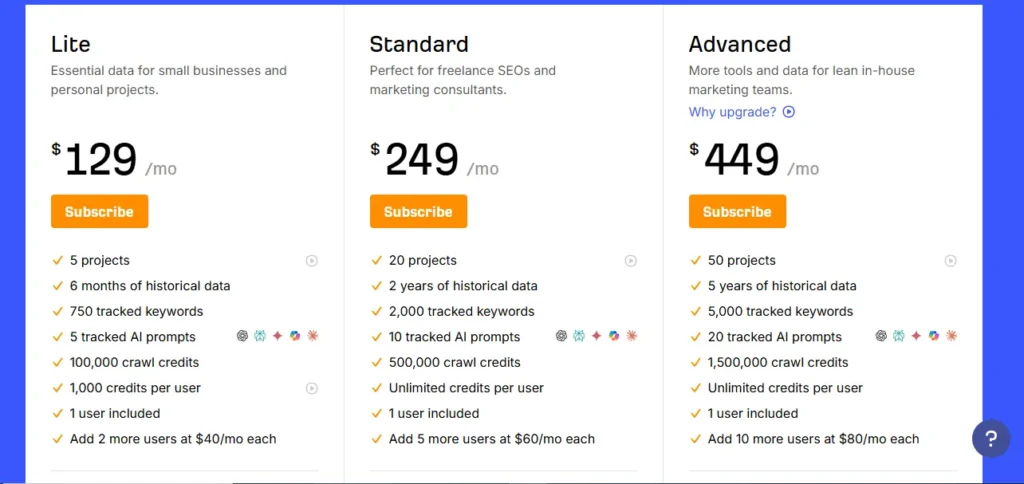
All figures below were pulled directly from Ahrefs’ official pricing page and verified August 25, 2026. Confirm current Ahrefs pricing before making a purchase decision, since SaaS pricing changes over time.
Does Ahrefs offer a free trial? No. Ahrefs does not currently offer a free trial on any paid plan, and its own FAQ states it does not run discounts. The practical alternative is the permanently free Ahrefs Free tier, which offers limited access to Site Explorer, Site Audit, and Web Analytics without a credit card, plus unlimited access to the beta Social Media Manager tool and one AI Content Helper document per month.
Plan
Monthly price
Projects
Historical data
Tracked keywords
Crawl credits
Included users
Ahrefs Free
$0
Limited
—
—
—
1
Starter
$29/mo
Entry-level access
—
—
—
1
Lite
$129/mo
5
6 months
750
100K
1 (+2 at $40/mo each)
Standard
$249/mo
20
2 years
2,000
500K
1 (+5 at $60/mo each)
Advanced
$449/mo
50
5 years
5,000
1.5M
1 (+10 at $80/mo each)
Enterprise
$1,499/mo*
Custom
Unlimited
Custom
Custom
Custom
* Enterprise requires an annual commitment. The self-serve plans remain available with monthly billing. Exact annual-discounted monthly figures were not confirmed on the primary pricing page at the time of this review, although Ahrefs states that annual billing can save up to 17%. Specific annual prices should therefore be checked directly before publication or purchase.
Ahrefs Free vs. Paid Plans
Ahrefs Free is a permanent free account rather than a time-limited trial. It provides limited access to selected Ahrefs capabilities, including Site Explorer, Site Audit, and Web Analytics, without requiring a credit card. It also includes unlimited access to the beta Social Media Manager and one AI Content Helper document per month.
The lowest-cost paid option is Starter at $29/month. Users looking for the broader traditional Ahrefs workflow should pay particular attention to the Lite plan at $129/month, which introduces the larger project, keyword, crawl, and historical-data allowances shown above.For readers comparing the wider SEO software market, see our SEO software reviews to evaluate Ahrefs alongside other major SEO platforms.
Does Ahrefs offer a free trial? No. Ahrefs currently states that it does not offer a free trial on its paid plans and does not run discounts. The permanent Ahrefs Free account is the main low-risk way to explore selected functionality before purchasing a paid subscription.
Add-ons & Additional Costs
The headline subscription price is not necessarily the complete monthly cost. Ahrefs offers several separately priced add-ons:
Content Kit: from $99/month
Report Builder: $99/month
Project Boost Pro: $20/month per project
Project Boost Max: $200/month per project
Brand Radar: from $199/month
Custom Prompt packages: $50–$250/month
Additional users are also billed separately beyond the included seats. Ahrefs states that extra users can be added on a pay-as-you-go basis unless prepaid, and unused pay-as-you-go credits carry over for three billing months. This means agencies and larger teams should calculate expected seat usage alongside the base subscription.
Billing, Refunds & Payment
Ahrefs states that it has no setup fees and no long-term contract requirement on its self-serve plans. Refunds are generally not provided, with limited exceptions for monthly subscriptions where there has been no material usage. Self-serve plans accept major cards including Visa, Mastercard, American Express, and UnionPay, while Enterprise customers can also use wire transfer.
Realistic cost warning: A $129 or $249 headline price should not automatically be treated as the final team cost. Extra seats, Brand Radar, reporting, Project Boost, Content Kit, and usage-related overages can increase monthly spend. Teams should model their expected projects, keywords, crawl volume, users, and required add-ons before comparing Ahrefs with competitors.If you are also evaluating the platform itself rather than pricing alone, continue to our full Ahrefs review for its features, limitations, use cases, and overall verdict.See Ahrefs’ Official Pricing Page
Pricing verdict: Ahrefs offers a low-cost entry through Ahrefs Free and Starter, but the more substantial SEO workflow begins at a considerably higher monthly price. For professional teams, the right plan depends less on the headline subscription and more on the combination of data requirements, usage limits, seats, historical access, and add-ons.
Pros & Cons
Ahrefs review findings show several strengths that make Ahrefs a serious option for professional SEO teams, but its pricing structure, usage limits, and lack of a paid-plan trial create meaningful trade-offs. The points below summarize the main advantages and limitations identified during this review.
Pros
Strong backlink and competitive research: Ahrefs’ backlink data is repeatedly highlighted by independent SEO sources as one of its most notable differentiators.
Broad SEO workflow coverage: Site Explorer, Keywords Explorer, Rank Tracker, Site Audit, Content Explorer, analytics, reporting, and AI-visibility tools cover multiple SEO workflows within one platform.
Permanent free option: Ahrefs Free provides limited access without a time-limited trial or credit-card requirement, giving prospective users a way to explore selected functionality before paying.
API and MCP availability: API and MCP Server access begin at the Lite plan rather than being restricted exclusively to Enterprise, which can benefit teams building custom SEO workflows.
Cons
No paid-plan free trial: Users cannot currently evaluate the full paid product through a traditional trial period before committing to a subscription. Ahrefs’ current pricing and plan policies should therefore be checked directly on its official pricing page before purchase
Higher professional entry cost: The Lite plan starts at $129/month, which may be difficult to justify for small sites, individual users, or budget-conscious teams.
Usage-based constraints: Plan-level crawl credits, keyword allowances, API row limits, and other usage boundaries can matter for high-volume workflows.
Add-on costs can increase total spend: Brand Radar, Report Builder, Content Kit, Project Boost, and additional users can add substantially to the base subscription cost. Readers comparing Ahrefs alternatives should therefore compare realistic total cost rather than headline plan pricing alone.
How to interpret the trade-off: Ahrefs’ strengths become more valuable when a team actively uses its competitive, backlink, technical, and research capabilities. For users who need only basic SEO functionality, the higher professional-tier cost and additional usage or add-on charges may reduce its overall value.
Who Should Use It?
Ahrefs is best suited to users who need more than basic keyword research or rank tracking. Its broader data set and combination of competitive research, backlink analysis, technical auditing, content research, and AI-visibility capabilities make it particularly relevant to professional SEO workflows. For readers comparing SEO software reviews, Ahrefs is especially relevant when backlink intelligence and competitive research are major priorities.
SEO Agencies
Agencies managing multiple client websites can benefit from Ahrefs’ combination of competitor research, backlink analysis, site auditing, rank tracking, project management, and reporting capabilities. Multiple projects and additional user options can also support larger agency workflows, although teams should calculate the resulting subscription and add-on costs. For agencies evaluating best SEO tools, Ahrefs can be a strong option when competitive and backlink research are central to their workflow.
In-House SEO Teams
In-house teams can use Ahrefs to monitor competitors, research keywords, investigate backlink profiles, audit technical issues, track rankings, and evaluate content opportunities. It is particularly relevant when SEO is a significant part of the organization’s acquisition strategy.
Advanced SEO Professionals
Experienced SEO specialists who regularly work with backlink data, competitive intelligence, technical audits, and large-scale search research are likely to get more value from Ahrefs’ broader feature set than users who need only basic SEO functions.
Developers & Data-Driven Teams
Teams building custom SEO dashboards, automated workflows, or internal tools may find the availability of Ahrefs API and MCP Server access from the Lite plan useful. However, plan-specific API row limits should be checked against the expected data volume before committing. Teams researching programmatic SEO workflows should also review Ahrefs’ current API documentation before implementation.
Best-fit summary: Choose Ahrefs when backlink intelligence, competitive research, and a broad professional SEO workflow justify the subscription cost. If your requirements are limited to basic SEO tasks, a simpler or lower-cost platform may provide a better fit.
Who Should Avoid It?
Ahrefs is a powerful professional SEO platform, but its feature breadth and pricing model are not a natural fit for every user. The following audiences should consider alternatives or start with Ahrefs Free before committing to a paid plan.
Users Who Need a Full Free Trial
If your buying process depends on testing the complete paid product before spending money, Ahrefs may not be the best fit. It currently does not offer a traditional free trial for paid plans. The permanent Ahrefs Free account provides limited functionality but does not replicate the full paid experience.
Very Budget-Conscious Users
Users looking for a low-cost professional SEO suite may find the $129/month Lite plan difficult to justify. The headline subscription can also increase when additional users or separately priced features are required.
Low-Usage SEO Projects
If you only need occasional keyword research, simple rank monitoring, or basic website checks, Ahrefs’ broader professional feature set may be more than you need. A simpler SEO platform can be more appropriate for a limited workflow.
Teams Requiring Predictable All-Inclusive Costs
Teams that need a single fixed monthly price should review Ahrefs’ add-ons, additional-user charges, and usage-based limits carefully. Reporting, AI-visibility tracking, faster project refreshes, and other requirements can create costs beyond the base subscription.
Users Who Need a Full Free Trial
If your buying process depends on testing the complete paid product before spending money, Ahrefs may not be the best fit. It currently does not offer a traditional free trial for paid plans. The permanent Ahrefs Free account provides limited functionality but does not replicate the full paid experience.
Decision rule: If you need deep SEO data and will actively use multiple Ahrefs workflows, the platform may justify its cost. If your needs are narrow, trial-dependent, or highly budget-sensitive, compare simpler alternatives before upgrading.
Ease of Use
Ahrefs’ ease of use should be evaluated with some caution in this review because SEORAF has not conducted hands-on testing of the platform’s interface or onboarding process. The observations here are based on the breadth of Ahrefs’ current toolset and patterns reported in independent third-party commentary rather than first-hand SEORAF testing.
Ahrefs has grown considerably from its original backlink-focused identity into a broader SEO platform covering competitive research, keyword research, rank tracking, technical auditing, content research, analytics, reporting, and AI-visibility monitoring. That breadth can be useful for experienced SEO professionals because multiple workflows are available within the same account. At the same time, a larger feature set can require more time for new users to understand which reports, metrics, and tools are relevant to a particular task.
Learning Curve
Independent user commentary, including reviews on platforms such as G2, indicates that some users perceive Ahrefs as having a learning curve, particularly when compared with more streamlined SEO products. This should be treated as a third-party observation rather than a confirmed SEORAF usability score. Users with prior SEO-tool experience may find the broader workflow easier to navigate because many of the underlying concepts—keywords, backlinks, rankings, competitors, and technical issues—are already familiar.
Evaluating Ahrefs Before Paying
The current pricing model makes usability evaluation more important. Ahrefs does not offer a traditional free trial for paid plans, so users cannot rely on a full-featured trial period to assess the interface before purchasing. Instead, prospective customers can use the permanent Ahrefs Free account to explore selected functionality. However, the free account is limited and should not be treated as a complete substitute for evaluating every paid feature.
Usability takeaway: Ahrefs is more likely to suit users who are comfortable working with a multi-tool SEO platform and interpreting detailed SEO data. Beginners should use the free tier to become familiar with the platform before deciding whether the paid plans provide enough additional value for their workflow.
Overall, the available evidence supports describing Ahrefs as a feature-rich professional platform rather than labeling it objectively “easy” or “difficult.” The practical experience can vary substantially depending on the user’s SEO knowledge, workflow complexity, and familiarity with comparable SEO software.
Performance, Data & Limitations
Ahrefs’ value depends heavily on the depth of its underlying data and how much of that data a particular plan makes available. While the platform provides a broad range of SEO datasets, important limits apply to historical access, crawling, API usage, keywords, projects, and certain advanced capabilities. These restrictions matter most for agencies, enterprise teams, and users working with large websites or high-volume workflows.
Historical Data Is Plan-Dependent
Historical data access is explicitly tiered across the paid plans. Lite includes six months, Standard includes two years, Advanced includes five years, and Enterprise provides unlimited historical data. Organizations that regularly analyze long-term ranking, backlink, or competitive trends should therefore consider historical-data requirements before choosing a lower-priced plan.
Crawl Credits Can Limit High-Volume Use
Site crawling is subject to plan-level allowances rather than being universally unlimited. The reviewed pricing information lists approximately 100,000 crawl credits for Lite, 500,000 for Standard, and 1.5 million for Advanced. Teams conducting frequent technical audits across large websites should estimate their expected crawl consumption rather than assuming the headline subscription price covers unlimited crawling.
API Row Limits Affect Scaling
Ahrefs provides API access from the Lite plan, but the maximum number of rows returned per request varies by tier. The reviewed limits are 100 rows on Lite, 250 on Standard, and 500 on Advanced, while Enterprise provides uncapped access. These limits may be relevant when developers automate large exports or build internal reporting systems around Ahrefs data.
Usage, Add-Ons & Overage Considerations
The practical cost of Ahrefs can increase when a team requires additional users, faster project refreshes, reporting, content functionality, or AI-visibility monitoring. Separately priced products such as Brand Radar, Report Builder, and Project Boost should therefore be treated as part of the total operating cost when those capabilities are essential to the workflow.
No independent performance benchmark: SEORAF has not independently measured Ahrefs’ backlink-index size, database freshness, crawl speed, keyword-volume accuracy, or API performance against competing platforms for this review. Claims about comparative data quality should therefore be treated as vendor claims or third-party observations unless independently tested.
Another structural limitation is the absence of a traditional free trial for paid plans. Ahrefs currently offers a permanent free account instead, but its restricted functionality does not provide a complete test of every paid capability. This makes pre-purchase research particularly important for teams whose workflows depend on higher usage limits or specialized features.
Overall, Ahrefs’ main limitations are not simply about whether a feature exists. The more important questions are how much data is accessible, how quickly it can be refreshed, how much usage the plan permits, and which capabilities require additional payment. Those factors should be evaluated alongside the base subscription when estimating real-world suitability and cost.
Ahrefs vs Alternatives
Ahrefs is rarely evaluated in isolation. Most buyers compare it with other established SEO platforms before deciding which combination of data, features, pricing, and usability best matches their workflow. The three most relevant comparisons for this review are Semrush, SE Ranking, and Moz Pro.
Platform
Main strength
Best suited to
Key trade-off
Ahrefs
Backlink and competitive SEO data
Professional SEO teams and agencies
Higher professional-tier cost and usage limits
Semrush
Broad SEO and wider marketing-suite coverage
SEO and broader digital-marketing teams
Large feature set can require careful plan evaluation
SE Ranking
Core SEO workflows with a lower-cost positioning
Budget-conscious agencies and businesses
Different data coverage and feature depth depending on workflow
Moz Pro
Simpler SEO workflow and approachable positioning
Beginners and smaller SEO teams
Narrower overall platform scope than Ahrefs
Ahrefs vs Semrush
Ahrefs and Semrush are both broad SEO platforms, but their traditional strengths differ. Ahrefs is particularly associated with backlink and competitive research, while Semrush has developed a broader marketing-suite position that extends beyond core SEO into areas such as paid-search and wider marketing workflows. Buyers choosing between them should prioritize the datasets and workflows their team actually uses rather than comparing feature counts alone.For a more detailed comparison, see our Semrush review.
Ahrefs vs SE Ranking
SE Ranking is commonly considered when price is a more important factor and the required workflow centers on core SEO tasks such as rank tracking, keyword research, site auditing, and reporting. Ahrefs may be more attractive when deeper backlink and competitive research is a primary requirement. Actual value depends on the required limits, data coverage, and team size.
Ahrefs vs Moz Pro
Moz Pro is often positioned as a more approachable option for users who prioritize simplicity. Ahrefs offers a broader current feature surface and deeper professional research workflows, while Moz Pro may appeal to smaller teams or users who do not need the full breadth of Ahrefs’ platform.
Which alternative should you choose? Choose Ahrefs when backlink intelligence and competitive SEO research are central to your workflow. Consider Semrush when broader marketing functionality matters, SE Ranking when cost efficiency is a major consideration, or Moz Pro when a simpler SEO experience is the priority. These are positioning-based comparisons, not independent performance benchmarks conducted by SEORAF.
Final Verdict
Ahrefs remains a serious professional SEO platform for teams that need deep competitive, backlink, keyword, and technical SEO data. Its broad toolset makes it possible to manage multiple SEO workflows within one platform, while API and MCP Server access can make the product relevant to agencies and data-driven teams building custom workflows.
The strongest reason to choose Ahrefs is its combination of competitive research and backlink intelligence with a wider SEO platform. For agencies, in-house SEO teams, and experienced practitioners who regularly use these capabilities, the subscription can be justified by workflow consolidation and access to professional-level data.
Where Ahrefs Falls Short
The main concerns are its professional-tier cost, usage restrictions, separately priced add-ons, and the absence of a traditional free trial. The Lite plan starts at $129/month, while additional users and products such as Brand Radar, Report Builder, and Project Boost can increase the total cost. Users with narrow SEO requirements or strict software budgets may therefore find a simpler alternative more practical.
The 2026 pricing model also changes how prospective customers should evaluate Ahrefs. Instead of testing the complete paid product through a conventional trial, users can explore the limited permanent Ahrefs Free account before deciding whether a paid plan provides enough additional value.
Our recommendation: Consider Ahrefs if backlink intelligence, competitive research, and professional SEO data are central to your work and the recurring cost fits your budget. If you prioritize a full free trial, low monthly cost, or predictable all-inclusive pricing, compare alternatives before committing.
This review does not assign a numeric score. SEORAF has not yet applied a confirmed scoring methodology to Ahrefs, so presenting a numerical rating would create false precision. The verdict is therefore based on the documented features, pricing information, usage considerations, and evidence reviewed for this article.
FAQs
No. Ahrefs currently does not offer a traditional free trial for its paid plans. Instead, it provides a permanently free Ahrefs Free account with limited functionality. Users can also start with the $29/month Starter plan if they need paid access. Because the free account does not expose the complete paid feature set, it should not be treated as a full replacement for a paid-plan trial.
No. Ahrefs currently does not offer a traditional free trial for its paid plans. Instead, it provides a permanently free Ahrefs Free account with limited functionality. Users can also start with the $29/month Starter plan if they need paid access. Because the free account does not expose the complete paid feature set, it should not be treated as a full replacement for a paid-plan trial.
Ahrefs’ current paid plans range from $29/month for Starter to $449/month for Advanced. Enterprise pricing starts at $1,499/month and requires an annual commitment. The Lite plan costs $129/month, while Standard costs $249/month. Additional users and optional products such as Brand Radar, Report Builder, Content Kit, and Project Boost can increase the total monthly cost.
Ahrefs can be worth the cost for agencies, in-house SEO teams, and experienced professionals who regularly use backlink intelligence, competitive research, technical auditing, keyword research, and related SEO workflows. It may be harder to justify for users who need only basic SEO functions or who require a very low and predictable monthly software budget.
Ahrefs can be used by beginners, but its broad feature set may require more time to learn than a simpler SEO platform. This review does not provide a SEORAF hands-on usability rating. Independent user commentary suggests that some users experience a learning curve. Beginners can use Ahrefs Free to become familiar with selected parts of the platform before considering a paid subscription.
Yes. API and MCP Server access are available starting with the Lite plan at $129/month. API request limits vary by subscription tier, so teams planning automated or large-scale data workflows should review the applicable row limits before choosing a plan.
Ahrefs is used for a wide range of SEO workflows, including backlink analysis, competitor research, keyword research, rank tracking, technical SEO auditing, content research, analytics, reporting, and AI-visibility monitoring. Site Explorer and its backlink and competitive research capabilities remain central to the platform’s reputation.
Both are broad SEO platforms, but their traditional positioning differs. Ahrefs is particularly associated with backlink and competitive research, while Semrush has a broader marketing-suite orientation that extends beyond core SEO. The better choice depends on which datasets and workflows are most important to the buyer.
No. Letaido is a separately branded product built using Ahrefs’ underlying data. It operates separately from the standard Ahrefs subscription structure and should not be treated as another Ahrefs plan or pricing tier.
Sources / Research Notes
This Ahrefs review was researched using a primary-source-first approach. Ahrefs’ official pricing information, product documentation, and product announcements were used to verify plan names, pricing, feature availability, usage limits, and product relationships. Pricing and plan information was last checked directly against Ahrefs’ official pricing information on August 25, 2026.
Independent sources, including third-party reviews and industry pricing coverage, were used as secondary evidence where appropriate, particularly for user-reported perceptions and comparative observations. These sources were not treated as substitutes for Ahrefs’ own documentation when a primary source was available.
Research limitation: SEORAF did not conduct hands-on comparative testing of Ahrefs for this review. Claims about backlink-index size, data freshness, keyword-volume accuracy, crawl speed, interface usability, or competitor superiority should therefore be understood as vendor-documented information or third-party observations unless explicitly identified as independently tested.
Verification note: SaaS pricing, features, usage limits, and product policies can change. Readers should confirm current details directly with Ahrefs before making a purchase decision.