
Best SEO Software in 2026: How to Choose by Use Case, Budget, and Limits
By Mousume Akter, Founder & Editor, SEORAF · Last reviewed: October 9, 2026
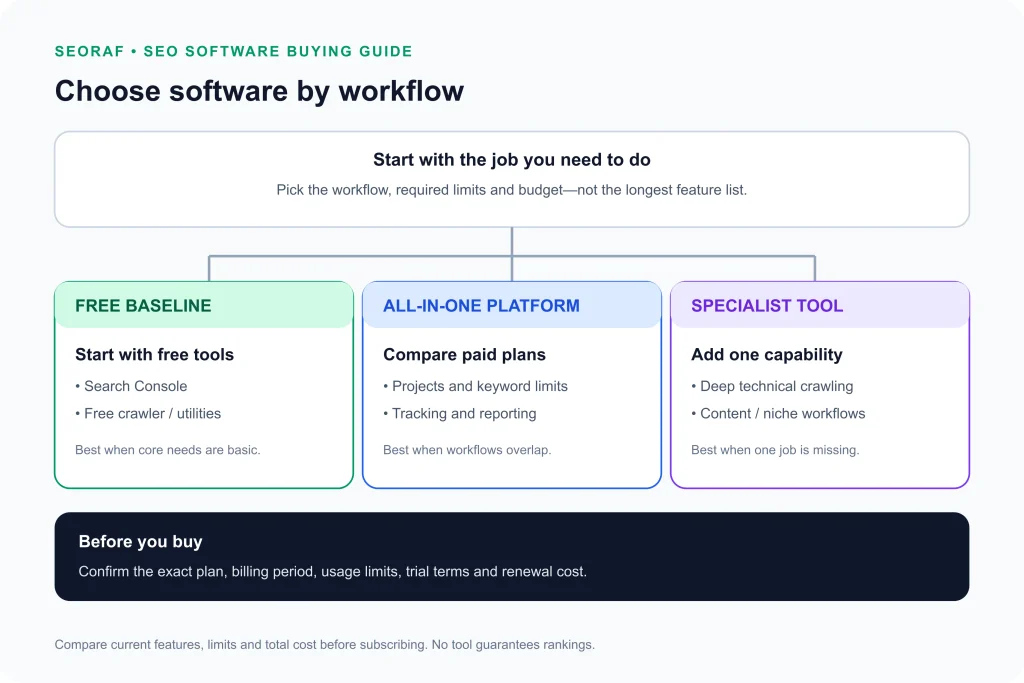
The best SEO software is the one that matches your workflow, site size, and budget—not the platform with the longest feature list. This guide compares all-in-one platforms with specialist tools and free options, explains the limits that affect real cost, and helps you decide whether to buy, trial first, or wait.
SEORAF is an independent SEO knowledge resource, not an agency, and I don’t sell rankings. This guide uses official vendor pricing pages, product documentation, and clearly labelled editorial interpretation. I have not hands-on tested these products for this article, so I do not claim to rank their interface quality, data accuracy, or speed. Vendor-stated features and limits are not independent proof of performance.
Affiliate disclosure: On this page, only the links labeled “affiliate link” go to SE Ranking through SEORAF’s affiliate link. If you buy through one of them, SEORAF may earn a commission at no extra cost to you. Every other vendor link goes to an official page and earns nothing. SE Ranking gets the same criteria, limits, and cons as every other product here, and you can go straight to seranking.com if you prefer not to use an affiliate link.
The Short Answer
- Start free: Google Search Console costs nothing and shows Google’s own data for your site. Add a paid platform only when you hit a limit you can name.
- If you want an all-in-one platform: shortlist Semrush, Ahrefs, and SE Ranking, and test two of them on a trial or free plan against your own Search Console data.
- If your need is technical audits: a crawler plus Search Console may be all you need.
Not sure where you fit? Jump to the buy, trial first, or choose an alternative guide.
Quick Picks: Best SEO Software by Need
If you only read one section, read this one. These are shortlists, not verdicts. Each row names software worth evaluating for that need, and the right choice still depends on your site size, budget, and team.
| If you need… | Category to shortlist | Worth evaluating | Go deeper |
|---|---|---|---|
| One platform for keyword research, audits, rank tracking and competitor analysis | All-in-one platform | Semrush, Ahrefs, SE Ranking | SEO tools by category |
| A free or very low-cost starting point | Free baseline | Google Search Console, Screaming Frog (free up to 500 URLs), the free tiers some platforms offer | Free SEO tools |
| Beginner-friendly setup | Free baseline plus one entry-level platform trial | Google Search Console, plus a platform trial where one is offered | Best SEO tools for beginners |
| Client work and white-label reporting | Platform with reporting add-ons | SE Ranking (Agency Pack), Semrush (report add-ons), Ahrefs (Report Builder, with an add-on for higher limits) | Agency section below |
| Deep technical crawling | Dedicated crawler | Screaming Frog SEO Spider, with Google Search Console | Crawling |
| Content optimization | Specialist content tool | A content-optimization specialist such as Surfer (pricing not verified here), or content features inside a platform | SEO tools by use case |
| AI search visibility tracking | Platform AI plan or add-on | Semrush, Ahrefs, SE Ranking (each handles it differently) | AI SEO tools |
What Counts as SEO Software (and What Doesn’t)
SEO software is any program that helps you research search demand, audit a site, track rankings, analyze competitors or links, or report on organic performance. The market splits into three shapes, and the shape matters more than the brand.
All-in-one platforms vs specialists
All-in-one platforms bundle keyword research, site audits, rank tracking, competitor analysis, and backlink data under one subscription. Semrush, Ahrefs, and SE Ranking are the three covered in depth here. Specialists do one job in more depth, such as crawling a site or optimizing content. First-party tools like Google Search Console report your own site’s data directly from Google.
SEO software vs SEO tools
In the pages I reviewed, titles often use “tools” and “software” for the same products. On SEORAF, this page covers the software-buying decision: platforms, stacks, budgets, and limits. For individual single-purpose utilities, use the SEO tools directory. For a plain-language definition of the category, see the SEO software overview.
How This List Was Built
Criteria used
Each product was checked against the same questions: what core SEO jobs it covers (rank tracking, audits, keyword and competitor research, backlinks, content features, reporting), whether it documents AI-visibility tracking, whether it has a free plan or trial, how entry pricing is structured, and which usage limits cap the entry plan.
Evidence types
- Official vendor pages: pricing, plan limits, and trial terms. Treated as vendor-stated, not independently confirmed.
- Official documentation: for example, Google’s own description of Search Console.
- Independent sources: used to check how widely quoted prices agree.
- Editorial interpretation: labeled as my view throughout.
What this page does not claim
I have not hands-on tested these products for this article, so I don’t rank them on interface quality, data accuracy, or speed. I haven’t compared the underlying keyword or backlink datasets, so I can’t say whose data is “best”. There are no star ratings, scores, or user counts here. Google’s guidance on writing high quality reviews asks for first-hand evidence when something is called “best”. Because I have not tested these products, I frame each pick as “worth shortlisting for” and tell you what to test yourself during a trial.
How affiliate links are handled
- Only SE Ranking is linked through an affiliate link on this page, and those links are labeled and carry
rel="sponsored nofollow". - Every product, including SE Ranking, gets listed limits and cons. Entry-plan numbers are shown side by side so you can compare without relying on my summary.
- Calls to action appear only after the relevant information, and the page includes sections on when not to buy and when to choose an alternative.
- A commission is possible only if you buy through an affiliate link. It does not change the price you pay.
A practical warning from the research behind this page: third-party articles often disagree with each other and with the vendors. Several pages I found still list Semrush’s older plan names and prices, while Semrush’s own pricing page currently shows different plan names and prices. That is why every price below comes from an official page and carries a date.
Best SEO Software Compared at a Glance
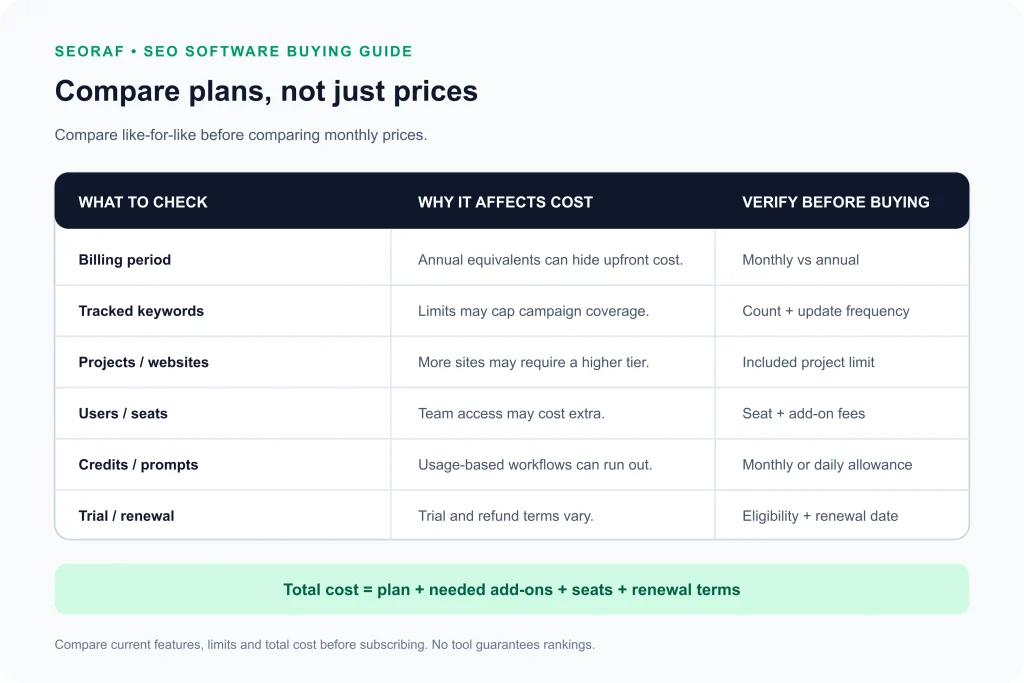
Read this table as a starting point for trials, not a ranking. Prices are the dollar list prices shown on each vendor’s page on October 9, 2026. The pages do not all state their billing currency or tax treatment, so regional pricing may differ.
| Software | Category | Best-fit scenario (editorial) | Entry paid pricing | Free option or trial | AI-visibility tracking | Key limit to check |
|---|---|---|---|---|---|---|
| Semrush | All-in-one platform | Teams that want broad SEO research and tracking in one place | SEO plan: $139/mo monthly, or $117.33/mo billed annually | Free plan (1 demo project, 10 reports/day). Free-trial availability is shown by plan; confirm duration and eligibility in the signup flow. | The current pricing page lists AI-search visibility features on the SEO plan and daily prompt allowances on Starter (50), Pro+ (100), and Advanced (200). Exact allowances and packaging differ by plan; verify the live plan comparison. | 5 websites and 500 daily tracked keywords on the entry plan; extra users from $45/mo |
| Ahrefs | All-in-one platform | Research-heavy work: competitors, backlinks, content opportunities | Lite: $129/mo. Starter is listed at $29/mo with 200 credits per month, 50 tracked keywords, monthly renewal, and no extra users or credits. Annual billing on eligible plans is advertised as saving up to 17%. | Ahrefs Free offers limited features for verified sites. Annual billing is advertised as saving up to 17% on eligible plans. | Lite lists 5 tracked AI prompts and 150 checks per month; higher plans list different allowances. Verify any separate Brand Radar pricing before purchase. | Lite: 5 projects, 750 tracked keywords, 6 months of historical data, weekly rank updates |
| SE Ranking | All-in-one platform | Small teams and agencies that want daily rank tracking across several projects, plus audits and reporting | Core: $129/mo monthly, or $103.20/mo billed annually | Free 14-day trial, no credit card required. Trial usage is capped below Core (750 tracked keywords and 20 AI prompts per day). | 100 prompts tracked daily on Core; separate AI Search add-on available | Core: 10 projects, 1 manager seat, 2k daily keywords, 250k audit pages per month |
| Screaming Frog SEO Spider | Technical crawler (desktop software) | Technical audits of small to very large sites | $279 per licence per year for 1 to 4 licences; volume tiers from $265 down to $235 per licence (GBP and EUR prices are available through a currency toggle) | Free version, crawls up to 500 URLs | No AI-visibility tracking listed on its pricing page (it lists AI integrations for crawling instead) | Free version stops at 500 URLs; crawl size depends on your machine’s memory and storage |
| Google Search Console | First-party site data | Every site owner, as the baseline | Free | Free | No AI-visibility reporting described in Google’s documentation | Reports on your own site only; not a competitor or keyword-research tool |
Table notes: Every capability and limit in this table is vendor-stated or comes from Google’s documentation. “Best-fit scenario” is my editorial interpretation. AI-visibility tracking is not directly comparable between vendors because prompt limits, tracked platforms, and definitions differ. Surfer, a content-optimization specialist, is mentioned elsewhere as a category example only; its pricing and limits were not verified from an official source, so it is not in this table.
Entry Plans Side by Side
This table puts three paid plans on one grid so you can compare what you actually get. Figures are vendor-stated from official pages checked on October 9, 2026. Units differ between vendors, and some allowances are plan-specific; use this as a buying checklist, not a performance ranking.
| Row | Semrush: SEO plan | Ahrefs: Lite | SE Ranking: Core |
|---|---|---|---|
| Monthly price | $139 | $129 | $129 |
| Annual billing | $117.33/mo equivalent | Listed as saving up to 17%; annual price not computed here | $103.20/mo equivalent, billed upfront |
| Sites or projects | 5 websites | 5 projects | 10 projects |
| Rank tracking | 500 keywords tracked daily | 750 tracked keywords, weekly updates | 2k keywords tracked daily |
| AI visibility / prompts | AI-search features are listed; verify the current prompt allowance for the SEO plan | 5 prompts daily; 150 checks per month on Lite | 100 prompts daily |
| Users | Extra users from $45/mo | 1 included; up to 2 more at $40/mo each | 1 manager seat; extra seats from $16 |
| Historical data | Listed from Pro+ upward | 6 months on Lite | Core displays “6/mo” without a clear period definition; Growth lists all-time project history |
| Free option | Free plan (1 demo project) | Ahrefs Free (limited, your own site) | None beyond the trial |
| Trial | Seven days, per the pricing page | No trial or discounts | 14 days, no credit card, capped usage |
| Refund terms | Written request within 7 calendar days of an initial online order paid by credit card (policy copies word the scope differently, so check your plan) | Generally no refunds; monthly subscribers who haven’t used the service can ask | Non-refundable except where service wasn’t delivered as promised |
How to read it (editorial): a lower sticker price does not mean lower cost if you need more users, more tracked keywords, or add-ons. The cheapest plan that fits your real site count and tracking needs is the better deal.
Pros, Cons, and Who Should Skip Each Option
Pros and cons below come from the vendors’ official pages unless marked as editorial. I haven’t tested these products hands-on, so I don’t list claims about interface quality or data accuracy as pros or cons.
Semrush
Pros (vendor-stated):
- A free plan exists (1 demo project, 10 reports a day).
- The pricing page states a seven-day free trial.
- The current pricing page lists AI-search visibility features across its SEO + AI Search plan lineup; exact prompt allowances depend on the selected plan.
- A wide plan ladder, reaching API access on Advanced.
Cons:
- The entry plan covers 5 websites and 500 daily tracked keywords.
- Extra users start at $45/mo.
- The Advanced plan shows no free-trial button.
- AI feature packaging and prompt allowances vary by plan; verify the exact plan comparison before purchasing.
- Plan names have changed, and many third-party articles still show old plans and prices.
A good fit if you want broad coverage and the included research, tracking, and reporting limits fit your workflow. Consider skipping if the required plan or add-ons exceed your budget. Check the current plan names, AI features, prompt allowance, and trial terms on Semrush’s official pricing page before subscribing.
Ahrefs
Pros (vendor-stated):
- Ahrefs Free gives limited access to Site Explorer and Site Audit for your own site.
- A $29/mo Starter plan exists for light research.
- Lite lists API and MCP access.
- Historical data deepens by plan: 6 months on Lite, 2 years on Standard, 5 years on Advanced.
Cons:
- There are no discounts or free trials, and refunds are generally not issued.
- Lite rank updates are weekly, and Content Explorer starts at Standard.
- Starter and Lite have credit limits. Starter includes 200 credits per month; verifying a project can add a separate allowance for use on that verified project. Starter renews monthly and does not allow extra users or purchased credits.
A good fit if your work leans on competitor and backlink research and the Lite limits cover your needs. Consider skipping if you need daily rank updates, because Lite lists weekly updates, or you want to test a paid plan before committing. Check the current limits and terms on Ahrefs’ official pricing page and its Starter plan documentation.
SE Ranking
Pros (vendor-stated):
- A free 14-day trial with no credit card required.
- Core lists 2k keywords tracked daily, 100 AI prompts daily, and 10 projects.
- Core’s annual monthly-equivalent ($103.20) is below Semrush’s entry-plan equivalent ($117.33). Ahrefs’ annual price isn’t shown on its pricing page, so I don’t compare it.
- An Agency Pack add-on adds white-label tools and client seats; extra manager seats start at $16.
Cons:
- Annual plans are billed upfront, and payments are non-refundable except where service wasn’t delivered as promised.
- Core includes one manager seat.
- The trial is capped below Core (750 tracked keywords and 20 AI prompts a day), so it won’t show you Core’s full limits.
- The Agency Pack and API add-ons are annual-billing only, and the AI Search add-on costs extra.
- There is no free plan beyond the trial.
A good fit if you want daily rank tracking across several projects and you’re willing to test it on a trial first (editorial view). Consider skipping if free tools already cover your needs, or you won’t commit to annual billing and the monthly price is more than you want to pay. For depth, see the SE Ranking review, and for a value verdict see whether SE Ranking is worth it.
If you want to evaluate it, you can start the SE Ranking free trial (affiliate link), or go directly to seranking.com. Use the seven-day evaluation plan below as a checklist; the evaluation schedule is not a statement about the vendor’s trial duration.
Screaming Frog SEO Spider and Google Search Console
Pros: Search Console is free and shows Google’s own data for your site. Screaming Frog is free up to 500 URLs and sold as an annual licence beyond that (vendor-stated).
Cons: Neither is a keyword-research or competitor tool, neither is built for daily client reporting, and Screaming Frog’s free version stops at 500 URLs.
A good fit if you mainly need technical audits and indexing data. Consider skipping if you need competitor or keyword research. See free SEO tools.
Best SEO Software by Use Case
Best all-in-one SEO platforms for most teams
Worth shortlisting: Semrush, Ahrefs, SE Ranking.
These three cover a broad range of everyday SEO jobs. The differences that matter most are the included limits, update frequency, team seats, and add-on costs. Semrush’s SEO plan lists 5 websites and 500 daily tracked keywords; Ahrefs Lite lists 5 projects, 750 tracked keywords, and weekly rank updates; SE Ranking Core lists 10 projects and 2,000 daily tracked keywords. These are vendor-stated allowances and are not directly interchangeable, so compare them against your actual workload.
What to test in a trial: whether the keyword data for your market looks credible, how readable the audit output is, and whether the reports you need are on your plan.
Read the dedicated pages for depth: SE Ranking review and SE Ranking vs Ahrefs.
Best SEO software for agencies and white-label reporting
Agencies hit limits that individuals may not: project count, user seats, white-label reports, and client access. SE Ranking lists an Agency Pack add-on from $69/month with annual billing; Semrush lists report add-ons, including a Pro Report option with white-labeling; Ahrefs includes Report Builder with plan-based report limits. Add-on prices and entitlements can change, so verify the current amount, billing cycle, and report allowance on each official pricing page before calculating a client-work stack.
Editorial view: for client work, the real cost is the plan plus seats plus reporting add-ons. Price the full setup before comparing headline plan prices. If you need an audit delivered as a service rather than software, see SEO audit service.
Best SEO software for freelancers and small businesses
For a single site or a few, start with Google Search Console, which is free, and add a paid platform only when you can name a real gap. The entry plans compared here cost roughly $100–$140 per month on an annual monthly-equivalent or month-to-month basis, depending on the product and billing cycle. Ahrefs also lists a limited $29/month Starter plan for light research. Check the exact allowance and total commitment before subscribing.
For beginner-specific picks, see best SEO tools for beginners. I have not evaluated interface difficulty hands-on, so this page does not rank tools by ease of use.
Best software for technical SEO and crawling
A dedicated crawler goes deeper than the audit module inside most platforms. Screaming Frog SEO Spider is desktop software that is free up to 500 URLs; a licence removes that limit and unlocks advanced features. Google Search Console adds Google’s own view: it shows whether Google can find and crawl your site and helps you fix indexing problems.
Editorial view: small sites often get far with Search Console and the free crawler. Platform audits earn their place when you want scheduled, hosted monitoring. Learn the fundamentals first in the technical SEO guide and the crawling hub.
Best software for content optimization
Content optimization tools compare drafts with competing pages and suggest topics to consider. Platform features and add-ons differ: Semrush lists content optimization on Pro+ and above, while SE Ranking lists 25 content-marketing articles on Core and 50 on Growth. Ahrefs lists a Content Kit add-on; verify its current price and eligibility on the official site. Specialists such as Surfer may provide a more focused editor workflow, but its current pricing and limits were not verified for this guide.
Editorial view: a content score is a guide, not a ranking promise. It cannot tell you whether your page is actually the most helpful answer.
Best software for backlink and competitor research
All three platforms offer backlink and competitor research, but I have not independently compared index size, freshness, or data accuracy. Ahrefs Lite lists six months of historical data; SE Ranking Growth lists history across the project lifetime, while Core displays the ambiguous label “6/mo”; Semrush lists historical SEO data from Pro+ upward. Confirm the date range and features available on your selected plan before relying on historical comparisons.
What to check: how much history your plan includes, because trend analysis depends on it.
Best software for rank tracking and AI-visibility tracking
Rank tracking is where plan limits become important. Compare update frequency, tracked keyword counts, search locations, and devices. AI-visibility tracking is newer and less standardized. Semrush lists AI-search features and plan-specific prompt allowances; Ahrefs lists tracked prompts and monthly checks by plan; SE Ranking lists daily prompt allowances. These are different measuring sticks, so match them to your real prompt list and the platforms you need to monitor. For the category overview, see AI SEO tools.
One Platform or a Stack? How to Decide
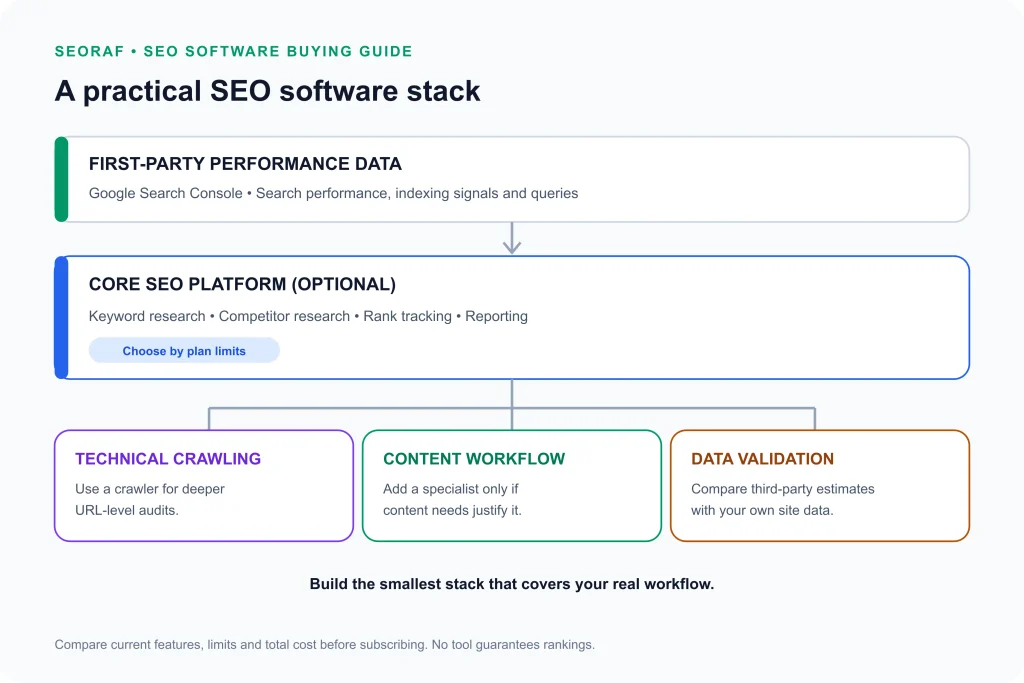
When an all-in-one platform is enough
One platform tends to be enough when you manage a modest number of sites, your needs are mostly research, tracking, and audits, and you prefer a single bill and login.
When to combine a platform with specialists or free tools
Add Search Console from day one: it is free and it is your site’s first-party data. Add a crawler when you need deep technical audits. Add a content specialist when content scoring is a daily workflow. Free baselines are covered on the free SEO tools page.
Cost of overlap
Different tools often repeat the same feature, such as two rank trackers or two site audits. List what each tool is uniquely for before subscribing. Cancel what overlaps.
SEO Software Pricing: What to Check Before You Buy
This section covers how to read pricing. For plan-by-plan detail on SE Ranking, use the SE Ranking pricing page. Prices below were read from official pages on October 9, 2026.
Why prices differ between articles
Plan names, billing periods, regional pricing, and add-ons all change. Semrush’s current pricing page lists SEO, Starter, Pro+, and Advanced plans, yet third-party articles I found still use older names and numbers. Treat any price without a date and an official source as a lead, not a fact.
Monthly-equivalent annual vs month-to-month
Vendors often headline the annual price divided by twelve. Semrush’s SEO plan is $117.33/mo when billed annually versus $139/mo monthly. SE Ranking’s Core plan is $103.20/mo annually versus $129/mo monthly, and annual plans are billed upfront. These monthly equivalents are not month-to-month prices; compare the total amount due at checkout. Ahrefs lists its plan prices monthly and notes annual billing saves up to 17%. Always compare like with like, and note what you pay today versus what you commit to.
Usage limits that change the real cost
- Projects or websites: Semrush’s entry plan covers 5 websites, Ahrefs Lite 5 projects, SE Ranking Core 10 projects.
- Tracked keywords and prompts: different units and update frequencies across vendors.
- User seats: extra users start at $45/mo on Semrush, $40/mo on Ahrefs Lite, and from $16 on SE Ranking.
- Crawl or audit size: SE Ranking Core lists 250k audit pages per month, and Ahrefs Lite lists 100,000 crawl credits.
- Add-ons: reporting, API access, content features, and AI visibility are often priced separately.
Free trials, refunds and cancellation
Trial, refund, and cancellation terms differ and can change. SE Ranking currently lists a 14-day trial with no credit card required. Semrush displays trial availability by plan; confirm the duration, eligibility, and any payment requirements on the live signup flow. Ahrefs offers a free account, but do not assume it offers a free trial of a paid plan. Before subscribing, read the current refund and cancellation terms and confirm which plan and payment method they cover.
Total cost of a stack
Add up plan price, extra seats, add-ons, and any specialist tool. A modest platform plus an affordable crawler can cost less than a higher plan of one platform, but only if you actually use both.
Pricing note: the listed prices and limits were checked against official pages on October 9, 2026, but not every add-on term can be independently confirmed from a static pricing page. Prices, availability, regional currency, taxes, limits, and trial terms can change. Recheck the exact checkout and plan details before paying.
Limitations and Trade-Offs of SEO Software
Metrics are estimates, not Google data
Keyword volumes, difficulty scores, and traffic estimates are each vendor’s own calculations, built from its own data. Google Search Console is the first-party source for how your own site performs in Google Search. Use platform estimates for prioritization, and use Search Console to check reality.
Software does not replace strategy
No subscription creates good content, a sound site structure, or links people want to give. Tools surface opportunities and problems. People decide what to do about them.
Learning curve and feature overload
Broad platforms contain many reports. Beginners can pay for far more than they use. Start with one workflow, such as tracking and auditing one site, and expand only when you hit a real limit.
AI-visibility tracking is still evolving
Prompt limits, tracked platforms, and definitions vary by vendor and change often. Check each vendor’s current documentation before basing a decision on it.
Vendor claims need corroboration
Marketing statements about data size or accuracy are vendor claims. Prefer a trial on your own site over a claim.
Buy, Trial First, or Choose an Alternative?
The best purchase decision is often “not yet” or “something cheaper”. Use this table to find your situation. These are editorial suggestions based on the plan limits above, not guarantees about outcomes.
| Your situation | Reasonable next step | Why |
|---|---|---|
| One small site, no client work, no tracking needs yet | Stay with Search Console and a free crawler | Free tools cover indexing and technical basics |
| You’ve hit a limit in free tools | Trial an entry plan from two platforms | Compare the data against your own Search Console numbers |
| Daily rank tracking across several sites on a modest budget | Trial SE Ranking Core and compare with Semrush’s SEO plan | Their entry plans differ on projects, tracked keywords, and seats |
| Work centered on competitor and backlink research | Check whether Ahrefs Lite’s limits are enough; price Standard if not | Lite has weekly rank updates and 6 months of history, and Content Explorer starts at Standard |
| Agency or client reporting | Price the whole setup: plan, seats, reporting add-ons | Seats and add-ons can add substantially to the headline plan |
| Mainly technical audits | Use a crawler plus Search Console, not a platform | A dedicated crawler may be all you need |
| Mainly content scoring | Look at a specialist, after verifying its current pricing officially | Platforms cover research and tracking; specialists go deeper on drafts |
| You can’t name one concrete job the software would do | Don’t subscribe yet | Paying before you have a defined job is an easy way to waste money |
When SE Ranking isn’t the right call
- Your needs are met by free tools.
- You want to try a product with no payment details and need more than the trial’s capped usage to judge it (the trial is limited to 750 tracked keywords and 20 AI prompts a day).
- After testing, another platform’s data looks better for your market. Trust your test over any ranking list, including this one.
When to cancel or not renew
Check usage before each renewal. If you can’t point to a decision the software helped you make, or you consistently use a fraction of the limits, move down a plan, switch to a cheaper option, or cancel. Annual plans are billed upfront, so decide before renewal, not after.
A Seven-Day Software Evaluation Plan
A trial is only useful if you test the things you would pay for. This is a suggested seven-day evaluation schedule, not a claim that every vendor offers a seven-day trial or a vendor-mandated procedure. Adapt it to the trial period available to you.
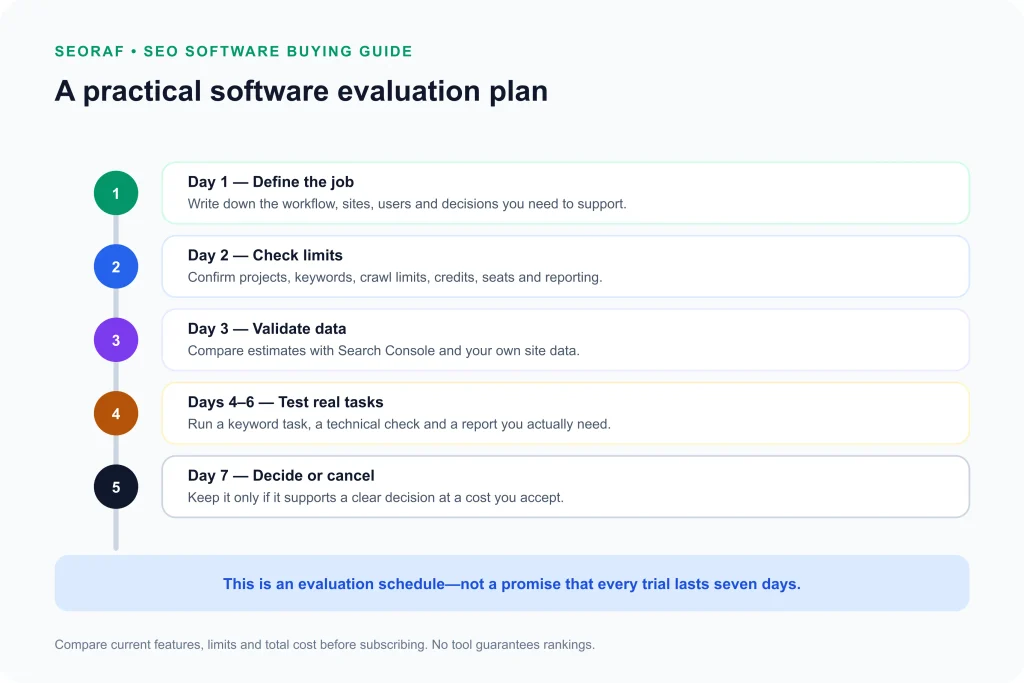
- Day 1: add one real site and connect Search Console if the platform supports it.
- Day 2: add the keywords you actually care about, not sample ones, and note how many your plan allows.
- Day 3: compare rank and traffic figures with your own Search Console data. Note differences, and don’t assume either side is exact.
- Day 4: run a site audit and check whether the issues it finds are real and actionable.
- Day 5: export or schedule a report in the format you’d send to a client or manager.
- Day 6: price your real setup: seats, add-ons, and the plan you’d need once trial caps are lifted.
- Day 7: decide. Write down one specific decision the software helped you make. If you can’t, don’t subscribe.
Trial caps differ from paid-plan limits, so check what the paid plan actually allows before judging a trial.
How to Choose: A Buying Checklist
- Define the job: tracking, auditing, research, content, reporting, or all of these.
- Count what you manage: sites, keywords, locations, and users.
- Set a budget ceiling: including seats and add-ons.
- Use the trial: load your real site and check data against Search Console.
- Check exports and integrations: reporting, API, and Search Console or analytics connections.
- Read the billing terms: annual upfront payments, refunds, and cancellation.
- Plan your exit: confirm you can export your data.
Red flags: unclear limits on the pricing page, headline prices with no billing basis, unverifiable “best” claims, and pressure tactics such as countdown timers.
Alternatives and Deeper Comparisons
This page is the shortlist. For depth on individual products, go here next:
- SE Ranking review for the product evaluation
- SE Ranking alternatives if SE Ranking doesn’t fit
- SE Ranking vs Ahrefs for a direct comparison
- SE Ranking pricing for plan-level detail
- Best SEO tools for individual tools by job
Frequently Asked Questions
What is the best SEO software overall?
There is no single answer. Semrush, Ahrefs, and SE Ranking are the all-in-one platforms covered here, and the better fit depends on your site count, tracking needs, team size, and budget. Use the quick picks, then test two of them on a trial or free plan.
Is all-in-one SEO software better than separate tools?
Not automatically. An all-in-one platform is simpler to manage. Separate tools can go deeper on one job, such as crawling. See one platform or a stack.
What is the difference between SEO software and SEO tools?
The terms overlap. This page uses “software” for the platform-and-stack buying decision. Single-purpose utilities are covered in the SEO tools directory.
How much does SEO software cost?
As of the October 9, 2026 check, the three full-platform entry plans compared here (Semrush SEO, SE Ranking Core, and Ahrefs Lite) are listed at roughly $103–$139 per month depending on whether the figure is an annual monthly equivalent or a month-to-month price. Ahrefs also lists a limited $29/month Starter plan. Screaming Frog lists $279 per licence per year for the first four licences. These are different billing models, so check the pricing section and vendor pages before comparing totals.
Can free tools replace paid SEO software?
For many small sites, Google Search Console and a free crawler cover the basics. Paid platforms add competitor data, keyword research, and automated tracking. See the free SEO tools page.
Which SEO software is best for agencies?
Agencies should compare projects, seats, white-label reporting, and client access, not only plan price. The official pages show different routes: SE Ranking’s Agency Pack (annual billing only), Semrush’s report add-ons, and Ahrefs’ Report Builder with its add-on. Price the whole setup before comparing. See the agency section.
Do I need AI-visibility tracking?
Only if monitoring how your brand appears in AI answers matters to your goals. The feature is new, and vendors measure it differently. See AI SEO tools.
How often should I re-evaluate my SEO software?
At least at each renewal, and whenever your site count, team size, or reporting needs change. Vendors change plans and prices, so re-check the official pricing page first.
Final Recommendation: How to Choose Without Overspending
- Just starting out, or on a tight budget: begin with Google Search Console and, if useful, the free crawler. Add a paid platform only when you hit a clear limit.
- One site, regular SEO work: trial an all-in-one platform’s entry plan and check its data against Search Console.
- Agency or multi-client work: price the full setup, including seats and reporting add-ons.
- Technical focus: pair a crawler with Search Console.
- Content-heavy site: consider a content specialist only after research and technical basics are covered.
Before paying, test two platforms against your own Search Console data. If SE Ranking is one of them, you can start its free trial through SEORAF (affiliate link) or go directly to seranking.com. For Semrush and Ahrefs, use their official pages. No software guarantees rankings or traffic. These tools help you find and prioritize work, and results still depend on your site, your competition, and your execution.
Sources and Update Log
Sources (accessed October 9, 2026)
- Semrush SEO + AI Search pricing: semrush.com/pricing/seo-ai-search (plan names, prices, limits, AI features, trial availability, add-ons)
- Semrush cancellation and refund policy: semrush.com/refund (refund request window)
- Ahrefs plans and pricing: ahrefs.com/pricing (plan prices, limits, historical data, annual billing and add-ons)
- SE Ranking subscription page: seranking.com/subscription.html (plans, annual vs monthly prices, limits, add-ons, trial and refund terms)
- Ahrefs Starter plan help article: help.ahrefs.com (200 monthly credits, 50 tracked keywords, plan terms)
- Screaming Frog SEO Spider pricing: screamingfrog.co.uk/seo-spider/pricing (free 500-URL limit, licence price in USD, bulk tiers, annual licence term)
- Google Search Console documentation: support.google.com/webmasters/answer/9128668
- Google Search Central, writing high quality reviews: developers.google.com
Surfer pricing and limits were not verified from an official page and are intentionally omitted.
Update log
- October 9, 2026 (editorial review): Added a short answer near the top, mobile-scrollable tables with column headers, Semrush refund-window source, and clearer notes on Semrush entry-plan AI tracking. Removed an unverified Surfer table row and softened unsupported generalizations.
- October 9, 2026 (conversion edit): Added an entry-plan comparison, pros and cons with who should skip each option, a buy-or-alternative decision guide, and a seven-day trial plan. Reduced affiliate links to labeled trial CTAs and tightened the disclosure.
- October 9, 2026 (audit): Corrected Screaming Frog pricing from an outdated £199 figure to the $279 listed on its official page; reconciled Semrush plan names and AI-search feature claims against the current plan comparison; corrected Ahrefs Starter to 200 monthly credits and 50 tracked keywords; flagged SE Ranking Core historical data as an ambiguous vendor label; clarified trial and billing language.
- October 9, 2026: Initial version. Pricing, limits, and trial terms checked against the official pages listed above.