
Topical Authority Map Template for SEO: The Ultimate 2026 Guide
In the era of AI Overviews and semantic search, writing isolated blog posts is no longer enough. You need a Topical Authority Map Template for SEO to organize your content, establish entity relationships, and dominate your niche. This guide provides the exact blueprint used by enterprise SEO teams to build scalable, high-ranking content strategies.
Introduction
The landscape of Search Engine Optimization has fundamentally shifted. We have moved from a world of “keyword matching” to “intent matching.” Google’s algorithms, specifically BERT, MUM, and the Knowledge Graph, no longer look just for strings of text; they look for concepts, entities, and the relationships between them. This is why topical authority becomes your competitive moat.
Historically, SEOs could target a high-volume keyword, write 500 words, and build a few links to rank. Today, that strategy is dead. Google demands comprehensiveness. It wants to serve users content from a source that clearly understands the entire subject matter, not just a fragment of it. This is why a Topical Authority Map Template for SEO is no longer optional; it is essential for success.
A Topical Authority Map Template for SEO serves as the strategic foundation of your digital presence. It visualizes your website’s architecture, ensuring every piece of content supports the others, creating a self-reinforcing network of relevance. Whether you are running an affiliate site, a local business, or a SaaS platform, this guide will walk you through the process of mapping, building, and executing a winning semantic SEO strategy.
Think of your website not as a library of random books, but as a university curriculum. You don’t just offer a class on “Advanced Calculus” without also offering “Algebra” and “Geometry.” Your topical authority map is that curriculum, guiding the user (and Google) from basic concepts to advanced mastery.
What Is a Topical Authority Map?
A Topical Authority Map is a hierarchical blueprint that organizes your website’s content into clusters of related topics. It structures your site architecture around a central “Pillar” page (broad topic) which links to and is supported by “Cluster” pages (specific subtopics). This structure is also known as a topic cluster or content hub.
Unlike a simple keyword list or a spreadsheet of URLs, a Topical Authority Map Template for SEO focuses on semantic relationships. It groups keywords based on meaning and user intent rather than just phrase match. This structure helps Google understand the context of your content, ensuring that when a user asks a question, your site is recognized as the comprehensive answer.
By utilizing a semantic SEO map, you are essentially drawing a roadmap for Googlebot. You are saying, “Here is the main subject (Pillar), and here are all the nuances, questions, and details (Clusters) that make this subject complete.” This reduces the “semantic distance” between your pages, signaling to search engines that your domain is a dense, authoritative source of information on this specific topic.
The core components of this topical authority map template include:
- Pillar Pages: Broad, high-level overviews (e.g., “Content Marketing”).
- Cluster Pages: Specific, deep-dive articles (e.g., “How to Write a Headline”).
- Internal Links: The connective tissue that binds the cluster to the pillar.
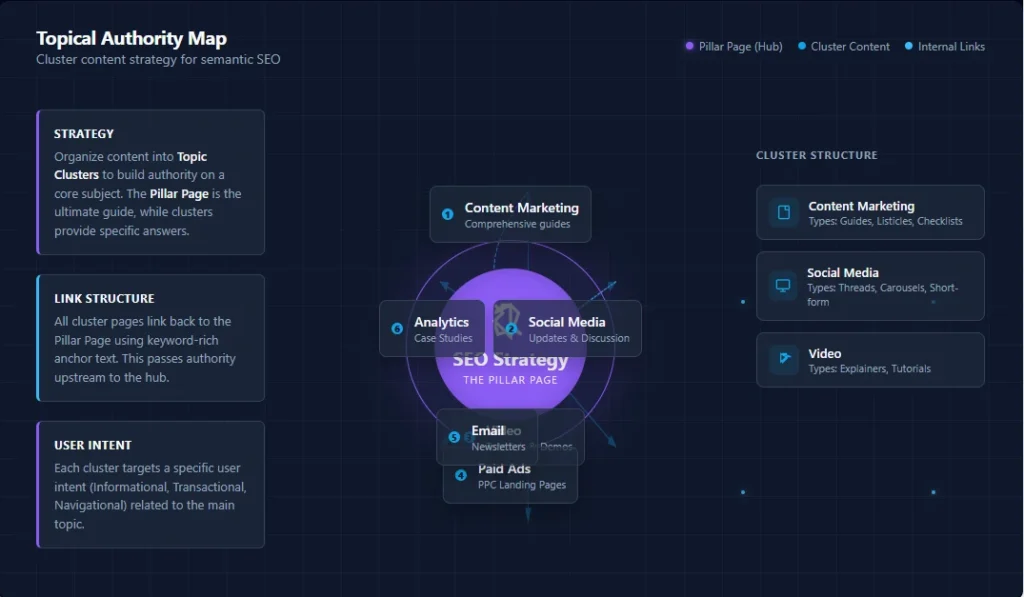
Prompt: Create a clean SEO diagram showing topical authority map with pillar page in center and cluster pages branching like a tree structure. Modern SaaS style UI, white background, minimal design, arrows showing internal linking flow.
For those looking to audit their current site structure to fit this SEO topical map model, our Technical SEO Guide offers deep insights into site architecture optimization.
How Google Uses Topical Authority
Understanding the “why” helps you execute the “how.” Google uses complex NLP (Natural Language Processing) to evaluate your topical authority framework. The search giant’s primary goal is to satisfy user intent. If a user searches for “how to brew coffee,” and Google serves a page from a site that only talks about coffee mugs, the user isn’t satisfied. Google wants to serve results from sites that know everything about coffee.
Here is how a Topical Authority Map Template for SEO influences algorithmic factors:
- Internal Linking & PageRank: Maps force you to create internal links, which pass PageRank (link equity). When a cluster page links to a pillar, it votes for the pillar’s importance. When the pillar links back to the cluster, it boosts the cluster’s visibility. This circular flow strengthens the entire silo.
- Semantic Relevance: By using consistent terminology and related entities across your clusters, you strengthen the “concept vector” for your domain. Google understands that “running shoes,” “pronation,” and “marathon training” are semantically related. A topical authority map ensures you cover these relationships.
- Content Depth: A map prevents shallow content. It forces you to answer every question a user might have. Google measures the comprehensiveness of your content. If you lack coverage on a sub-topic, Google may view your site as incomplete compared to a competitor who covers the whole ecosystem.
- Crawl Efficiency: A well-structured seo silo structure helps Googlebot find and index your pages faster. A clear hierarchy reduces crawl depth, ensuring your most important content is found quickly.
Google’s official documentation emphasizes the importance of site architecture and helping Google understand your content. You can read more about how Google views site structure in the Google Search Central documentation. Additionally, leading industry resources like Moz’s guide on topical authority provide further validation of this strategy for modern SEO.
Sites using clear topical silos often see indexing speeds improve significantly because Google can easily understand the site hierarchy via crawl paths. Use an SEO Crawler Guide to check your current crawl depth and identify orphan pages that break your topical map template.
Step-by-Step: Building Your Topical Authority Map
Ready to build your own Topical Authority Map Template for SEO? Follow this exact framework used by semantic SEO experts. This process transforms a random list of keywords into a strategic asset.
Step 1: Niche Selection & Scope Definition
Don’t boil the ocean. Select a niche narrow enough to dominate, but broad enough to sustain content. Instead of “Fitness,” choose “Home Calisthenics.” Instead of “Marketing,” choose “B2B SaaS SEO.” The broader the topic, the more competition you face. A defined scope allows you to build authority faster. Define the “Seed Keyword” that represents the core of your business. This is the first entry in your topical authority map template.
Step 2: Comprehensive Keyword Mining
Use tools like Ahrefs or Semrush. Export thousands of keywords related to your seed. Don’t filter by volume yet; you want the long tail. Look at what competitors are ranking for. This is often called a “Gap Analysis.” If a competitor ranks for a term you don’t, add it to your list. For tool recommendations, check our guide on the Best SEO Tools.
Step 3: Semantic Grouping & Intent Mapping
This is the most critical step in the Topical Authority Map Template for SEO. Group keywords by intent and meaning, not just words. Group “best running shoes” with “top footwear for jogging,” not with “shoe repair shop.” Identify the Search Intent for every group: Informational (learning), Transactional (buying), or Navigational (finding a specific page). This ensures your semantic content planning aligns with what users actually want.
Step 4: Identifying Pillars and Clusters
Look at your groups. The broad terms with high search volume are your Pillar Pages. The specific questions and long-tail terms within that group are your Cluster Pages. A good rule of thumb is that a Pillar page should be able to link to 10-20 cluster pages. This structure is the backbone of your topical cluster template.
Step 5: URL Structure Planning (Siloing)
Plan your URLs to reflect the hierarchy. This is technically known as “URL Siloing” and is a key part of the Topical Authority Map Template for SEO.
- Pillar:
domain.com/calisthenics/ - Cluster:
domain.com/calisthenics/beginner-routine/
This physical directory structure reinforces the topical authority map to Google.
Step 6: Content Briefing and Creation
Write the Pillar first. It acts as the anchor. Then, write the clusters. Ensure every cluster links back to the Pillar using exact-match or semantic anchor text. If you are leveraging AI to assist with drafting, ensure you have a strong process in place. Read our guide on How to Write SEO Content Using AI to maintain quality while scaling production for your topical authority map.
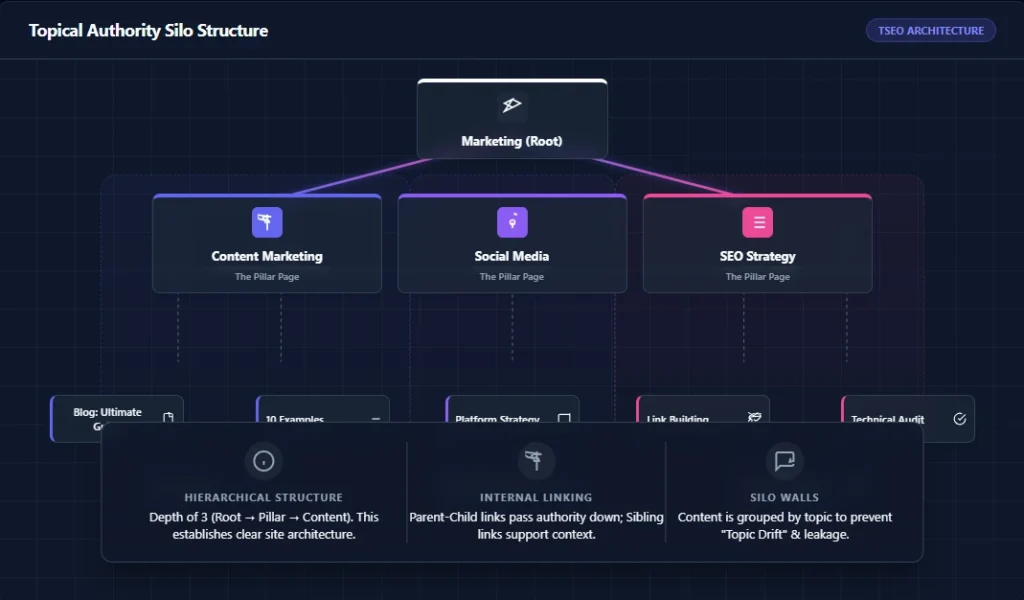
Prompt: Visual SEO silo architecture showing hierarchical structure of website content grouped into clusters like technical SEO, content SEO, and link building. Clean infographic style.
Step 7: Interlinking Strategy
Map out the internal links before you publish. The Pillar must link to every Cluster. Clusters should link to the Pillar and, where relevant, to sibling Clusters. This creates a tight mesh of relevance. A Internal Linking Template can be invaluable here to track which pages link to which in your SEO topical map.
Step 8: Optimization and Entity Salience
Optimize your content for entities. Ensure you are using the language of your niche. If you are writing about “Java,” ensure the context distinguishes it from coffee or the island, depending on your niche. Use Schema markup to help Google understand the entities on your page. This completes the creation phase of your Topical Authority Map Template for SEO.
Topical Authority Map Templates
Theory is good, but examples are better. Here are three distinct Topical Authority Map Template for SEO examples for different business models. Use these as inspiration for your own topical cluster template.
1. Affiliate Site Example (Niche: “Home Coffee”)
Affiliate sites rely on commercial intent. The topical authority map must bridge information (“how to”) with transaction (“buy this”). The goal is to capture researchers early in the funnel and guide them to the purchase pages.
| Level | Page Title | Primary Keyword | Intent & Role |
|---|---|---|---|
| Pillar | Best Coffee Makers 2026 | best coffee machine | Commercial: Hub for all reviews. Links to all categories. High purchase intent. |
| Cluster | Espresso Machine Reviews | best espresso machine | Commercial: Specific product category. Focus on features and price. |
| Cluster | Drip vs French Press | drip vs french press | Informational: Helps user decide which brewing method suits them. |
| Cluster | How to Grind Coffee Beans | how to grind coffee | Informational: Top of funnel. Captures early researchers. Links to grinder reviews. |
| Cluster | Coffee Grinder Buying Guide | coffee grinder guide | Commercial: Transactional intent for supporting equipment. |
2. Local SEO Example (Business: “Dentist in Chicago”)
Local businesses use topical authority map template strategies to capture service-specific searches and location-based modifiers. The map here often overlaps with physical service menus.
| Level | Page Title | Primary Keyword | Focus |
|---|---|---|---|
| Homepage | Chicago Family Dental | dentist chicago | Brand hub, links to all services, social proof, location map. |
| Pillar | Our Dental Services | dental services | Overview of treatments. Acts as a hub for specific service pages. |
| Cluster | Cosmetic Veneers | porcelain veneers chicago | High-value service. Before/after photos. Conversion focus. |
| Cluster | Emergency Tooth Extraction | emergency dentist chicago | Urgent intent. High conversion rate. Immediate CTA. |
| Cluster | Dental Implants Cost | cost of dental implants | Informational with transactional intent. Addresses pricing objections. |
3. SaaS Example (Product: “Project Management Tool”)
SaaS topical authority map examples target problems and methodologies, positioning the product as the solution. The map educates the user on the *problem* so they understand the value of the *solution*.
| Level | Page Title | Primary Keyword | Strategy |
|---|---|---|---|
| Pillar | Project Management Guide | project management | Educational hub. Establishes authority. Defines “What is PM?” |
| Cluster | Agile Methodology Explained | what is agile | Attracts users looking for methodology. Tool is positioned as the enabler. |
| Cluster | Asana Alternatives | asana alternative | Competitive conquest. Compares features. High intent to switch tools. |
| Cluster | Gantt Chart Software | gantt chart software | Feature-specific search. Bottom of funnel. Tool specific. |
| Cluster | Remote Team Collaboration | remote work tools | Broader pain-point targeting. Captures users before they know they need PM software. |
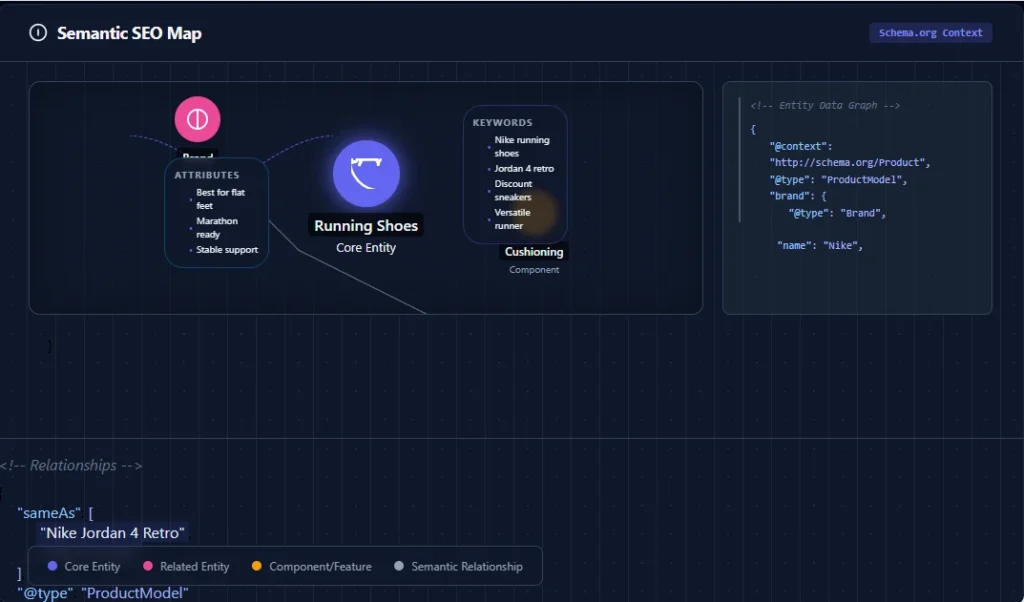
Prompt: Semantic SEO map showing entities, keywords, and content relationships connected in a network style diagram.
Advanced Internal Linking Strategies
Creating the content is only half the battle. Wiring it together is where the Topical Authority Map Template for SEO magic happens. A robust internal linking strategy is the mechanism that distributes authority and defines relevance. Without it, your topical authority map is just a collection of disconnected pages.
The goal is to create a “tight mesh” of relevance. You want to reduce the number of clicks it takes to get from any page on your site to any other related page (reducing click depth).
The Parent-Child Relationship
This is non-negotiable. Every Cluster page must have a link pointing back to the Pillar page. This tells Google, “This page belongs to the Pillar topic.” Place this link high up in the content (within the first 100 words) for maximum impact. Similarly, the Pillar page must link to every Cluster page, usually in a summary section or a table of contents within the article.
The Sibling Relationship
Cluster pages should link to each other. If you are reading a blog post about “Espresso Machines,” a link to “Best Coffee Beans for Espresso” is highly relevant. This creates a web of authority that supports the entire cluster. It keeps users on your site longer, improving engagement metrics.
Anchor Text Optimization
Avoid generic anchors like “click here” or “read more.” Use descriptive, semantic anchors that include your target keywords. For example, “Our guide on grind size explains this in detail.” However, be careful not to over-optimize. Keep it natural and helpful for the user.
The Orphan Page: An orphan page is a page that has no internal links pointing to it. It is only accessible via a direct URL or the sitemap. Google treats orphan pages as low-quality because no other content on your site “vouches” for them. Ensure every page is in your topical authority map template.
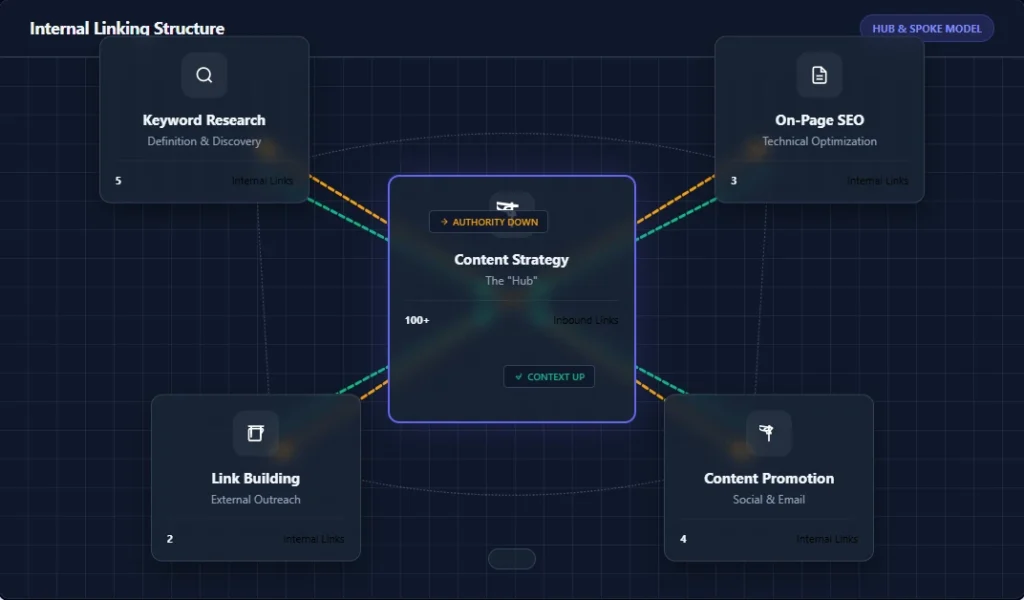
Prompt: Internal linking visualization showing arrows between blog posts, pillar pages, and category pages with SEO flow optimization concept.
Common Topical Authority Mistakes to Avoid
Even with a great Topical Authority Map Template for SEO, it is easy to stumble. Here are the pitfalls that ruin campaigns. Avoiding these will save you months of wasted effort.
- Keyword Cannibalization: Creating multiple pages targeting the exact same keyword intent. This confuses Google and causes your own pages to compete against each other. If you have two pages about “best coffee makers,” merge them into one super-authoritative page in your topical authority map.
- Thin Content: Writing 300-word cluster pages. Google’s Helpful Content Update penalizes thin content. If a topic is important enough to be a cluster, it deserves 1,000+ words of expert advice. Depth is required for topical authority examples to work.
- Ignoring User Intent: Not every keyword fits into your blog. Some keywords are transactional (“buy,” “price,” “cost”) and should be product or service pages, not blog posts. A Topical Authority Map Template for SEO respects intent. Don’t force a transactional query into an informational article.
- Breaking the Silo: Linking from your “Coffee” cluster to your “Digital Marketing” article just for the sake of an internal link. This dilutes the semantic relevance of your Coffee silo. Keep links strictly relevant to the topic at hand in your SEO topical map.
- Random Publishing: Writing about “Coffee” on Monday and “Digital Marketing” on Tuesday. This dilutes your domain authority. Stick to your topical map template. If you want to expand to a new topic, start a new map/silo.
If you suspect you have these issues, perform a backlink audit. Check out our guide on 7 Best Free Backlink Checker Tools to see how your authority is currently distributed.
Best Tools & Analytics for Topical Maps
Building these Topical Authority Map Template for SEO plans manually in Excel is possible but slow. These tools can accelerate your semantic SEO map creation and provide the analytics you need to measure success.
- Keyword Research: Ahrefs and Semrush are industry standards. Use the “Keyword Gap” and “Topic Research” tools to find what competitors are ranking for. You can read detailed comparisons in our Semrush Review.
- Content Optimization: Surfer SEO and Frase are excellent for ensuring your content includes the correct semantic entities and NLP phrases for each topic.
- Technical Auditing: Screaming Frog and Sitebulb are essential. Use them to crawl your existing site and find orphan pages or broken links that disrupt your topical authority map.
- Analytics: Don’t just build; measure. Use SEO Analytics Tools to track the rankings of your entire cluster, not just individual keywords. Look for aggregate growth.
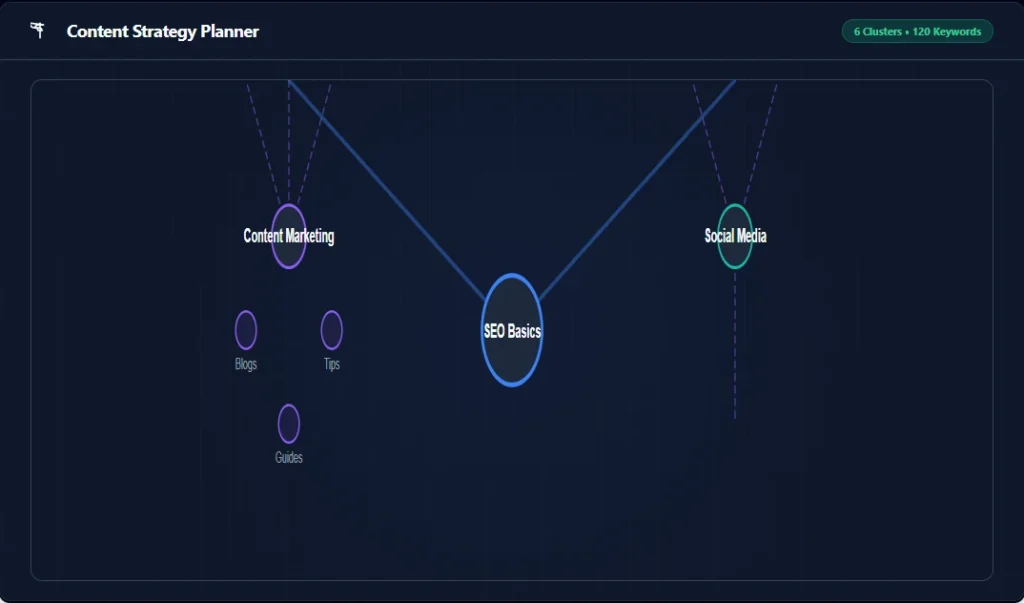
Prompt: SEO content planning dashboard showing keyword clusters, content calendar, and topical map planning in a modern analytics interface.
For large sites, managing this scale of content requires careful attention to technical constraints. Read our Crawl Budget Optimization Guide for Large Websites to ensure Google can process your new massive Topical Authority Map Template for SEO efficiently.
Frequently Asked Questions
What is the difference between a topical map and a sitemap?
A sitemap (usually XML) is a technical file for search engines to list URLs. A topical authority map is a strategic content plan for humans (and SEOs) to organize themes, intent, and semantic relationships. A sitemap tells Google where the pages are; a Topical Authority Map Template for SEO tells Google what the pages mean.
How long does it take to build topical authority?
It varies by competition, but typically 3 to 6 months of consistent publishing and internal linking is required to see significant shifts in rankings for established domains. New domains may take longer. It is a long-term play, not a quick fix for your topical authority map.
Can I have overlapping topics?
You should avoid it. Overlap creates ambiguity in Google’s eyes. If two pages cover the same intent, consolidate them. Use a topical cluster template to clearly define boundaries between your topics to prevent keyword cannibalization.
Does topical authority help with AI Overviews?
Yes, significantly. AI Overviews (SGE) synthesize information from diverse sources to answer complex queries. Being a recognized authority on a topic increases your likelihood of being cited as a source in AI-generated answers. If your content is the most comprehensive on the web, the AI needs your Topical Authority Map Template for SEO data.
What is entity salience in SEO?
Entity salience is the relevance or importance of a specific entity (like a person, place, or thing) within a document. A good topical authority map maximizes salience by using related terms and entities consistently across your cluster, reinforcing the main topic.
How many keywords should be in a topical cluster?
There is no fixed number, but a robust cluster usually has 1 Pillar page and 10–30 supporting cluster articles. The key is covering the topic comprehensively, not hitting a specific number. If the topic requires 50 articles to cover fully, write 50.
Is topical authority better than backlinks?
They work together. Topical authority makes your site relevant; backlinks make it popular. You need both to rank. However, in the age of semantic search, topical authority is the foundation. You can’t rank with links if your content isn’t topically relevant. A Topical Authority Map Template for SEO helps you build that relevance.
Stop Guessing. Start Mapping.
Download our premium Topical Authority Map Template for SEO (PDF & Excel). Includes the Affiliate, Local, and SaaS frameworks, a keyword clustering sheet, and an internal link tracker.
Need help implementing this strategy? Schedule a Strategy Consultation.
Conclusion
The era of scattergun SEO is over. To compete in 2026 and beyond, you must be organized, semantic, and comprehensive. A Topical Authority Map Template for SEO is not just a document; it is the strategic foundation of your entire digital presence. It transforms your website from a collection of random pages into a cohesive, authoritative knowledge base.
By grouping your content into pillars and clusters, optimizing your internal linking, and respecting search intent, you signal to Google that you are the definitive expert in your niche. This leads to higher rankings, more traffic, improved CTR, and ultimately, more revenue.
Don’t wait for your competitors to figure this out. Start mapping your topic today, check out our other SEO Templates for more resources, and take control of your search destiny. Remember: a strong 4000-word article built on a solid topical authority map beats a weak 10,000-word article almost every time. Download your Topical Authority Map Template for SEO now to begin.