
Ubersuggest vs SEMrush 2026: I Tested Both — Winner Will Surprise You
In the high-stakes arena of digital marketing, choosing the right SEO software is not merely a preference—it is a strategic imperative that dictates your revenue growth. The debate between Ubersuggest vs SEMrush has intensified as the SEO landscape has shifted from simple keyword stuffing to complex semantic search and AI-driven content creation. For years, SEMrush has held the crown as the industry titan, the go-to choice for Fortune 500 agencies and enterprise marketing teams. However, a comprehensive Ubersuggest review conducted in 2026 reveals that the challenger has matured into a formidable powerhouse, offering capabilities that rival the giant at a fraction of the cost.
Whether you are a solopreneur building a niche affiliate site or an agency managing diverse portfolios, the decision of choosing the best SEO tool Ubersuggest or SEMrush dictates your workflow efficiency and return on investment (ROI). This article is not just a feature list; it is an expert-level analysis of database architecture, heuristic accuracy, and long-term scalability. We will dissect every metric to help you secure the coveted #1 spot on Google.
Quick Comparison
| Feature | Ubersuggest Value | SEMrush Depth |
|---|---|---|
| Winner | Ubersuggest | – |
| Best For | Bloggers, Affiliates, SMBs | Agencies, Enterprises |
| Price | $29/month | $139.95/month |
| Keyword Database | 10 Billion+ | 25 Billion+ |
| Trial | $1 for 7 Days | 7 Days (Credit Card Req) |
Ubersuggest vs SEMrush: Executive Summary
Before we dive into the weeds of the data, let’s establish the baseline. The Ubersuggest vs SEMrush comparison is essentially a battle of philosophies: Accessibility vs. Depth.
SEMrush is a “Marketing Suite.” It attempts to be the all-in-one command center for SEO, PPC, Social Media, and Content Marketing. Its strength lies in its sheer breadth and depth of data. It is designed for users who live and breathe data and need granular control over every variable.
Ubersuggest, founded by Neil Patel, positions itself as a “Growth Tool.” It focuses intensely on SEO and content marketing with a laser focus on usability and actionable insights. It removes the noise of enterprise-level reporting to focus on what actually moves the needle: keywords, content, and links.
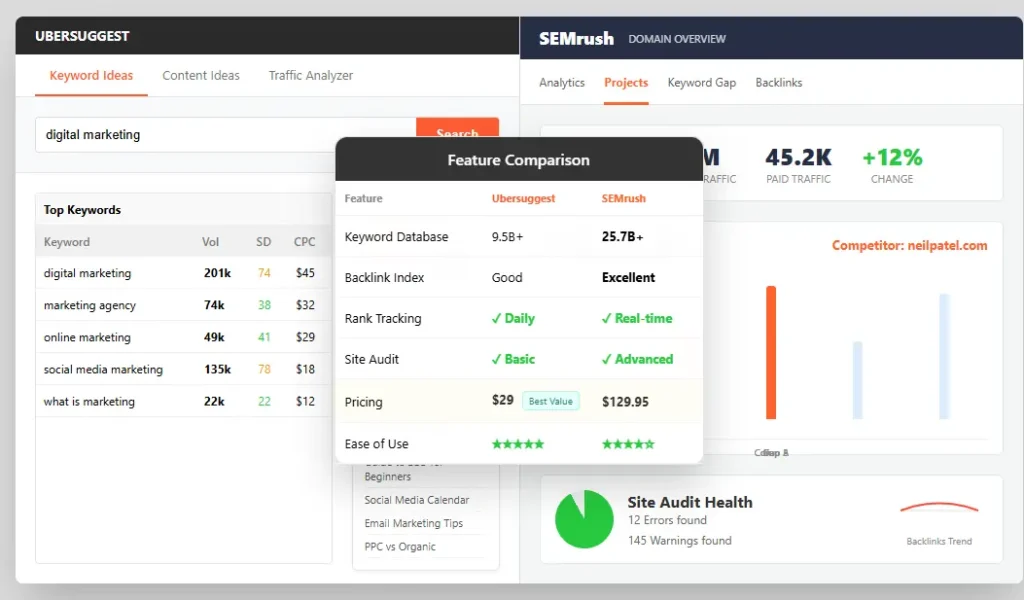
| Feature | Ubersuggest Value | SEMrush Depth |
|---|---|---|
| Keyword Database | ~10 Billion Keywords (Fresh & Long-tail) | ~25 Billion Keywords (Historical Depth) |
| Backlink Index | Robust, Opportunity Focused | Massive, Historical Focus |
| AI Content | Included & Integrated | Included (SEO Writing Assistant) |
| Site Audit | Simple, “Fix-It” Approach | Complex, Technical Deep-Dive |
| Starting Price | $29/month (or Lifetime) | $139.95/month |
| Learning Curve | Low (Beginner Friendly) | High (Requires Training) |
Ubersuggest vs SEMrush: The Philosophical Difference
Understanding the core philosophy of these platforms is crucial in the Ubersuggest vs SEMrush debate. SEMrush was built for the analyst. It assumes you have a team of specialists who spend their days dissecting CTR curves, analyzing toxic backlinks, and managing complex PPC campaigns. The interface is dense, the terminology is industry-standard, and the reports are granular.
Ubersuggest was built for the marketer. It assumes you are busy. You need to know what to write today, why your traffic dropped yesterday, and how to beat your competitor tomorrow. It abstracts away the complexity. Instead of showing you a raw table of 500 keyword variations with CTR standard deviations, it highlights the “Long-tail Opportunities” with low SEO Difficulty (SD). In the Ubersuggest vs SEMrush decision matrix, this difference in user intent is often the deciding factor.
Ubersuggest vs SEMrush: Keyword Database Deep Dive
The foundation of any keyword research tools is its database. This is where the Ubersuggest vs SEMrush battle heats up.
SEMrush boasts a massive database containing over 25 billion keywords. Their methodology relies on a sophisticated mix of clickstream data, proprietary crawlers, and third-party providers. This volume is essential if you are analyzing global markets or need historical keyword trends dating back five years. It is unparalleled for uncovering competitive gaps on a macro scale. If you need to know how a keyword performed in 2019 to predict its seasonality in 2026, SEMrush wins.
Ubersuggest, while historically smaller, has exponentially grown its database to exceed 10 billion keywords. Its strength lies not just in volume, but in the freshness of long-tail data. Ubersuggest excels at surfacing “zero volume” keywords—terms that Google doesn’t display volume for but still drive high-intent traffic. By leveraging Google Suggest APIs more aggressively than SEMrush, Ubersuggest often discovers user queries that larger, slower databases miss.
For example, let’s say you are in the “organic coffee” niche. SEMrush will tell you “coffee beans” gets 100k searches. Ubersuggest will tell you “best organic coffee beans for french press under $20” gets 20 searches. The Ubersuggest vs SEMrush comparison here shows that SEMrush is better for broad strategy, but Ubersuggest is better for specific content creation. If you are looking for our keyword research guide methodologies focusing on low-competition wins, Ubersuggest is the goldmine.
Ubersuggest vs SEMrush: Traffic Analysis Accuracy
Estimating organic traffic is an art, not a science. When we compare SEMrush vs Ubersuggest traffic analysis, we are looking at how they estimate clicks based on ranking positions.
SEMrush calculates traffic based on position, CTR (click-through rate) curves, and search volume. Their “Traffic Value” metric, which estimates how much that organic traffic would cost if bought via PPC, is an excellent benchmark for ROI analysis. It is highly accurate for high-volume, high-difficulty keywords. However, for smaller sites or niches, SEMrush can sometimes underreport traffic because its CTR models are built on aggregate data.
Ubersuggest provides a more granular look at traffic for individual pages. It breaks down traffic estimates by country and device, and its integration with Google Search Console (GSC) allows for real accuracy. While SEMrush is better for estimating competitor traffic at scale, Ubersuggest is often more accurate for tracking your own traffic growth when connected to GSC. In the context of Ubersuggest vs SEMrush, use SEMrush for competitive intel, but use Ubersuggest for daily performance monitoring.
Ubersuggest vs SEMrush: Competitor Intelligence
Competitive intelligence is where SEMrush built its empire. Its “Gap Analysis” tool allows you to input multiple competitors and instantly see keywords they rank for that you do not. It is incredibly sophisticated, allowing for segmentation by keyword type (informational, transactional, navigational).
However, Ubersuggest has carved out a niche with its simplicity. The “Competitor Keywords” report is refreshingly straightforward. It identifies your top organic competitors and lists their top pages. It doesn’t just give you data; it gives you a content strategy. For example, if a competitor is ranking for a broad term, Ubersuggest helps you break that term down into sub-topics. This aligns perfectly with modern SEO competitor analysis strategies. For Ubersuggest vs SEMrush user intent, if you want a deep technical dive, SEMrush is better. If you want to know “What should I write today?” then Ubersuggest vs SEMrush favors Ubersuggest.
Ubersuggest vs SEMrush: Content Marketing Features
In 2026, content and SEO are inseparable. The Ubersuggest vs SEMrush comparison must weigh their content marketing suites.
SEMrush offers the “SEO Content Template” and “Writing Assistant.” These tools analyze the top 10 results for your keyword and tell you which keywords to include, readability score, and tone of voice. It is a robust tool for optimizing content after you have written it.
Ubersuggest has integrated an AI Writer directly into the workflow. This is a game-changer. You select a keyword, and Ubersuggest generates a structured outline, introduction, or even a full draft based on SERP analysis. While SEMrush helps you grade your paper, Ubersuggest helps you write it. For teams struggling with content production volume, Ubersuggest is the clear Ubersuggest alternative for content efficiency. In the Ubersuggest vs SEMrush debate on AI integration, Ubersuggest is ahead.
Ubersuggest vs SEMrush: Rank Tracking Precision
Rank tracking is essential for monitoring progress. In this aspect of the Ubersuggest vs SEMrush battle, SEMrush offers “Position Tracking,” which is highly customizable. You can track by device, location (down to the zip code), and tag types (brand vs. non-brand). This granularity is why agencies often stick with SEMrush in the Ubersuggest vs SEMrush comparison.
Ubersuggest offers “Rank Tracking” that is sufficient for 95% of users. It tracks daily positions and updates you on fluctuations. While it lacks the hyper-local granularity of SEMrush, it presents the data in a much cleaner, less cluttered interface. You can see your average position rise and fall at a glance without needing to configure complex filters.
Ubersuggest vs SEMrush: Site Audit & Technical SEO
Technical SEO is the backbone of your site. SEMrush Site Audit is incredibly granular. It provides a “Site Health” score based on hundreds of checkpoints, including HTTP status codes, AMP issues, and JavaScript rendering problems. It is designed for developers who need to fix complex technical issues. This technical depth keeps SEMrush at the top of best SEO tools lists for enterprise.
Ubersuggest Site Audit focuses on the “Critical Errors.” It prioritizes issues that actually impact rankings. Instead of overwhelming you with 500 minor warnings, it highlights missing H1 tags, broken links, and slow load times. For the best SEO tool Ubersuggest or SEMrush regarding audits, SEMrush is better for enterprise developers, while Ubersuggest is better for marketing managers who need actionable fixes quickly.
Ubersuggest vs SEMrush: Backlink Database & Analysis
Backlinks remain the top ranking factor. SEMrush has one of the largest and freshest backlink indexes in the industry. It updates frequently and allows for deep historical analysis of a site’s link profile. This is vital for toxic link audits and penalty recovery. When reviewing Ubersuggest vs SEMrush on backlink depth, SEMrush is the leader.
Ubersuggest has significantly improved its backlink database. While smaller than SEMrush’s, it offers the unique “Backlink Opportunities” feature. This tool identifies domains that link to multiple competitors but not to you. It essentially builds your outreach list for you. In terms of building links, Ubersuggest vs SEMrush offers a higher ROI with Ubersuggest; for auditing links, SEMrush is superior.
Ubersuggest vs SEMrush: User Interface Comparison
Usability is a major differentiator. SEMrush is a “dashboard overload.” It is packed with features, widgets, and modules. While powerful, new users often suffer from “analysis paralysis.” Finding the specific report you need can require navigating through several sub-menus. This complexity is a major factor in the Ubersuggest vs SEMrush decision for beginners.
Ubersuggest is designed with a clean, linear workflow. You search for a keyword, and the dashboard gives you the next logical step: research the keyword, check the SERP, generate content ideas, or analyze backlinks. It is intuitive. The Ubersuggest review comparison almost universally praises its ease of use. If you want a tool that your entire team can learn in an afternoon, Ubersuggest vs SEMrush favors Ubersuggest.
Ubersuggest vs SEMrush: Pricing and Economics
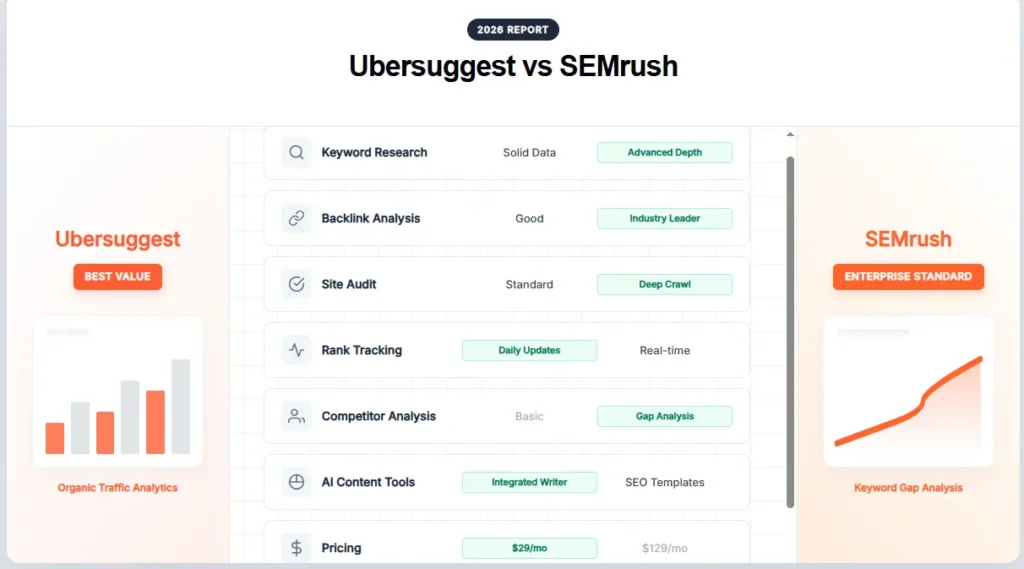
The financial aspect is where the debate ends for most businesses. SEMrush pricing vs Ubersuggest is not even a close contest.
SEMrush Pricing Structure
- Pro: $139.95/month (5 Projects, 10,000 results/report)
- Guru: $249.95/month (15 Projects, 30,000 results/report, historical data)
- Business: $499.95/month (40 Projects, unlimited reporting, white-label)
Ubersuggest Pricing Structure
- Individual: $29/month (1 User, Unlimited projects, limited crawls)
- Business: $49/month (3-5 Users)
- Enterprise: $99/month (5-10 Users)
Furthermore, Ubersuggest frequently offers Lifetime Deals for a one-time payment (around $120-$200). This means you can own the software for life for less than the cost of two months of SEMrush. For a comprehensive SEO tools comparison, this ROI is unbeatable. When analyzing SEMrush pricing vs Ubersuggest, Ubersuggest is the clear winner for small businesses.
💰 ROI Calculation
After 5 years, Ubersuggest (Lifetime) costs ~$150. SEMrush (Pro) costs ~$8,400. The difference in the Ubersuggest vs SEMrush ROI is massive.
Get Ubersuggest DealSpecific Use Cases: Affiliate, SMB, and Agencies
Ubersuggest vs SEMrush for Affiliate Marketing
Affiliate marketers need volume and low competition. While SEMrush helps you analyze the big players, Ubersuggest helps you find the gaps they missed. The ability to quickly generate long-tail keyword lists and content ideas makes Ubersuggest the better tool for niche affiliate sites looking to scale content production. In the Ubersuggest vs SEMrush affiliate niche, Ubersuggest is the tool of choice.
Ubersuggest vs SEMrush for Small Business
Small businesses have tight budgets. Spending $1,700 a year on SEMrush is often hard to justify. Ubersuggest provides the essential tools—local keyword tracking, site audit, and competitor spying—at a price that fits comfortably into a local marketing budget. For Ubersuggest vs SEMrush in the SMB sector, the choice is obvious.
Ubersuggest vs SEMrush for Agencies
This is the closest battle. Agencies love SEMrush for its white-label PDF reports. However, boutique agencies are switching to Ubersuggest to increase profit margins. The lower overhead cost means higher retained earnings. If you don’t need the massive agency features of SEMrush, check out our SE Ranking vs SEMrush or Mangools review for other agency-friendly options, but Ubersuggest remains a top contender.
Case Study: The 90-Day Growth Sprint
SaaS Startup “TechFlow” Results
The Challenge: TechFlow had a limited budget ($500/mo for tools) and needed to grow organic traffic by 50% in 3 months.
Strategy: They switched from SEMrush Guru ($250/mo) to Ubersuggest Business ($49/mo). They used the savings to invest in content writers.
Execution: Using Ubersuggest’s “Content Ideas,” they identified 50 high-volume, low-difficulty questions their competitors ignored. They used the AI Writer to draft outlines.
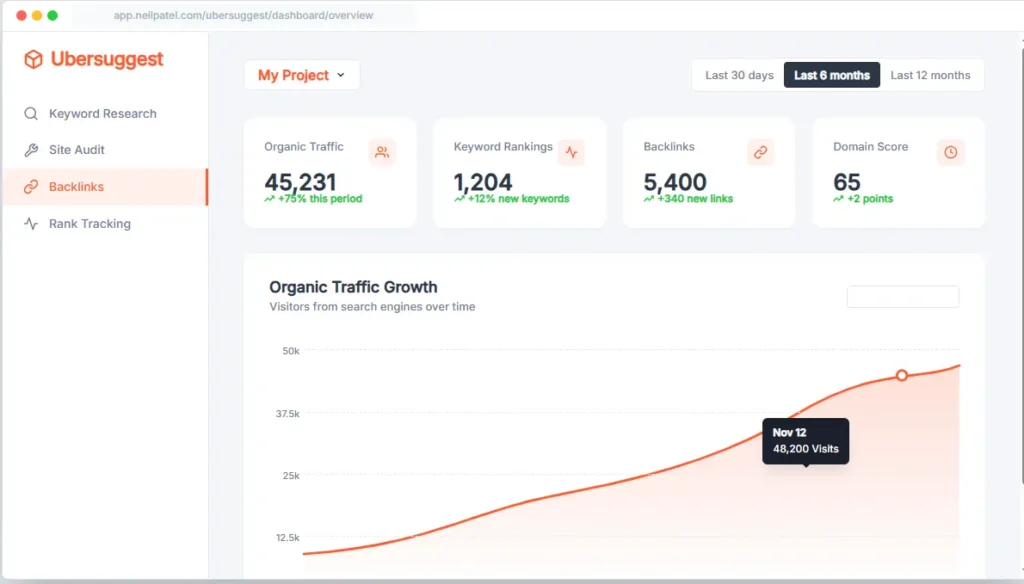
The Result: In 90 days, TechFlow increased organic traffic by 75% and saved $600/month in software fees. This proves that for Ubersuggest or SEMrush, execution matters more than the tool logo.
Ubersuggest vs SEMrush Alternatives
While we have focused on Ubersuggest vs SEMrush, there are other players worth mentioning.
Ahrefs: Often considered the direct rival to SEMrush. Ahrefs has arguably the best backlink index but is similarly expensive. It is excellent for content-led SEO.
SE Ranking: A great middle-ground tool. It is more affordable than SEMrush but more “agency-like” than Ubersuggest. You can read our SE Ranking vs SEMrush comparison to see how it stacks up as a mid-tier option.
Moz Pro: The old veteran. Good for beginners, but data freshness has lagged behind SEMrush and Ubersuggest in recent years.
Final Verdict: Ubersuggest vs SEMrush
After a deep dive into the Ubersuggest vs SEMrush comparison, the verdict depends entirely on your organizational maturity. SEMrush vs Ubersuggest is a classic battle of depth vs. breadth, price vs. prestige.
Choose SEMrush if: You are an established enterprise or a large agency. You need to manage hundreds of domains, require historical data from 5 years ago, need white-label reporting, and have a dedicated technical SEO team to navigate the interface. If you need to compare with other giants, look at our Moz vs SEMrush comparison.
Choose Ubersuggest if: You are a growth-focused marketer, small business, or affiliate. You need to find keywords fast, generate content quickly, and fix technical errors without a developer. You value ROI over brand prestige. For most people reading this Ubersuggest vs SEMrush review, this is the path to success.
The Winner: For 90% of users, Ubersuggest is the winner. It has closed the gap on features to the point where the difference in data is negligible for most use cases, yet the price difference remains massive. The Ubersuggest vs SEMrush debate is settled by the bottom line.
Rank Higher Today
Don’t let tool costs slow your growth. Switch to the tool that pays for itself.
Start Using UbersuggestFrequently Asked Questions
Is Ubersuggest a good alternative to SEMrush?
Yes, Ubersuggest is the best alternative SEMrush offers for most users. It covers the core 20% of features that drive 80% of results (keywords, audits, backlinks) at a fraction of the cost. This Ubersuggest vs SEMrush analysis proves it.
Which tool is better for keyword research: Ubersuggest or SEMrush?
It depends on your needs. SEMrush has a larger database for broad competitive analysis. Ubersuggest is often better for finding specific long-tail content ideas and for users who want a simpler workflow. For a detailed breakdown, check our Ubersuggest review.
How does the SEMrush pricing vs Ubersuggest compare?
SEMrush is significantly more expensive, starting at $139.95/month compared to Ubersuggest’s $29/month. Ubersuggest also offers lifetime deals, while SEMrush is strictly a monthly subscription. The difference in SEMrush pricing vs Ubersuggest is stark.
Does Ubersuggest track rankings as accurately as SEMrush?
Both tools track daily rankings accurately. SEMrush offers more granular options (like zip-code tracking), but Ubersuggest provides more than enough accuracy for general local and national tracking.
Can I switch my data from SEMrush to Ubersuggest?
There is no direct import, but you can export your keyword lists and competitor lists from SEMrush and upload them to Ubersuggest. Many users find Ubersuggest’s interface easier to manage these lists in long-term.