
Best Ecommerce SEO Software in 2026: Compare Plans by Store Size, Platform, and Catalog Limits
By Mousume Akter, SEO strategist and Founder & Editor, SEORAF · Last reviewed: October 13, 2026 · Prices, limits and billing terms read from official vendor pages on October 13, 2026
Affiliate disclosure: links labeled “affiliate link” go to SE Ranking and may earn SEORAF a commission at no extra cost to you. Every other vendor link on this page is an official link that earns nothing. Full disclosure.
An online store asks more of SEO software than a blog does. You have category pages, product pages, filters that multiply URLs, product variants and stock that changes daily. A tool that looks fine on a pricing page can hit a ceiling at your catalog’s size, or charge you for features a small store never uses.
If you’re searching for the best ecommerce SEO software, the honest answer depends on your store size, platform and the limits of each plan. This guide compares three all-in-one platforms (Semrush, Ahrefs and SE Ranking), one catalog crawler (Screaming Frog) and Google’s free tools. It also covers what to test before paying, and when the right answer is “not yet.” Here, “best” means best fit for a store profile based on published plan limits and billing terms. It is not a tested ranking.
Jump to: Quick picks · Prices and limits · Platform details · Total cost · Common objections · Should you buy? · Trial plan · FAQ
Independence: SEORAF is an independent SEO knowledge resource, not an agency, and I don’t sell rankings. SE Ranking is the only affiliate relationship on this page. It gets the same criteria, limits and cons as every other product here, and you can go straight to seranking.com if you prefer not to use an affiliate link. Other SEORAF pages I link to may carry their own disclosures. See the editorial policy for how I handle this.
Evidence labels: vendor-stated means read from an official vendor page. Google documentation means from Google’s own docs. Editorial view is my interpretation. I have not hands-on tested these products for this article.
The Short Answer: Best Ecommerce SEO Software for Different Store Sizes
- Free tools are enough if you run a small store and can’t yet name a limit you’ve hit. Google Search Console, the free crawler (500 URLs) and Ahrefs Free for a store you verify cost nothing.
- Add a crawler if your problem is technical: filters, duplicate URLs, variants or indexing on a larger catalog. A crawler plus Search Console may do more for you than a platform subscription.
- Trial an all-in-one platform if you need keyword research, competitor data or daily rank tracking. Shortlist Semrush, Ahrefs and SE Ranking, then trial two against your own Search Console numbers.
- Check catalog math and billing terms before you pay. Tracked-keyword caps, audit limits, seat counts and refund rules change the real cost more than the headline price does.
Quick Picks: Best-Fit Ecommerce SEO Software by Store Profile and Need
These are shortlists, not verdicts. They are my editorial reading of the vendor-stated limits below, not test results. Start with your store size, then check the table by need.
By store size
| Your store | Start with | Read next |
|---|---|---|
| Small store, one site, no tracking needs yet | Google Search Console, Merchant Center free listings if you’re eligible, and the free crawler (500 URLs). Add a paid platform only when you hit a limit you can name. | Free baseline |
| Growing catalog, one in-house marketer | Search Console plus a crawler licence. Trial one platform if you need keyword research, competitor data or daily tracking. | Crawlers |
| Large catalog, many filters or a headless storefront | A crawler that can handle your URL count, plus Search Console. Treat platform audits as a second opinion. | Crawlers |
| Agency or multi-store operator | Price the whole setup: plan, seats and reporting add-ons. | Total cost |
| Content-led store (guides, buying advice) | A platform for research and tracking. Add a content specialist later. | Content tools |
Editorial shortlists by store profile. Not test results.
By main need
| Main need | Worth shortlisting (editorial) | Vendor-stated detail to check |
|---|---|---|
| Crawl filters, variants and duplicates on a large catalog | Screaming Frog plus Search Console | Free version stops at 500 URLs. JavaScript rendering is part of the paid licence ($279 a year). Very large crawls depend on your computer. |
| Competitor and backlink research | Ahrefs or Semrush | Ahrefs Lite lists 750 tracked keywords with weekly updates, and Content Explorer starts at the Standard plan. Semrush’s entry SEO plan lists basic keyword research and competitor analysis. |
| Rank tracking across many category and product keywords | SE Ranking, Semrush or Ahrefs, depending on volume | SE Ranking Core lists 2,000 keywords tracked daily. Semrush SEO lists 500 daily (1,500 on Pro+). Ahrefs Lite lists 750 with weekly updates. Check how each counts locations and devices. |
| Category and product pages competing with each other; multiple locations or devices | Semrush Pro+ | Semrush lists keyword cannibalization analysis and multi-location/device tracking at Pro+ ($299 monthly), not on the entry plan. I haven’t compared how other platforms handle these. |
| Agency or multi-store work with client reports | SE Ranking, Semrush or Ahrefs, priced with add-ons | SE Ranking Agency Pack is +$69/mo (annual billing only). Semrush lists report add-ons at $10 and $20 a month. Ahrefs Report Builder is a $99/mo add-on (Lite includes 5 reports). |
| Tight budget | Free baseline, then a trial | Search Console is free, Ahrefs Free covers sites you verify, and SE Ranking and Semrush list free trials. Ahrefs lists none for paid plans. |
Fit is an editorial reading of vendor-stated limits. Confirm each detail on the vendor’s page.
Ecommerce SEO Software Compared at a Glance
I split the comparison into three short tables so each one reads cleanly on a phone: prices, limits, and billing terms. Read them as a starting point for trials, not a ranking. Units differ between vendors, so a bigger number is not automatically better.
Price sources: all prices, limits and billing terms in this article come from the vendors’ official pages, read on October 13, 2026 (listed under Sources). The pages showed US dollars when I read them, and vendors may show other currencies or add taxes depending on your location.
Table 1: Entry prices (vendor-stated)
| Software | Monthly billing | Annual billing: monthly equivalent | Annual billing: charged upfront (my arithmetic) |
|---|---|---|---|
| Semrush (SEO plan) | $139 | $117.33 | $1,407.96 |
| Ahrefs (Lite) | $129 | Listed as saving up to 17%; exact figure not shown, so not computed | Not computed |
| SE Ranking (Core) | $129 | $103.20 | $1,238.40 |
| Screaming Frog SEO Spider | No monthly option | Not applicable | $279 per licence per year (£199 or €245 in other currencies) |
| Google Search Console | Free | Free | Free |
List prices in US dollars. Annual totals are the listed monthly equivalent multiplied by twelve, which is my arithmetic, not a vendor figure.
Table 2: Limits that matter for stores (vendor-stated)
| Software | Sites or projects | Rank tracking | Audit or crawl | Users |
|---|---|---|---|---|
| Semrush (SEO) | 5 websites | 500 keywords daily | Site Audit included; page limit not verified here | Extra users from $45/mo |
| Ahrefs (Lite) | Unlimited verified projects; 5 unverified | 750 keywords, weekly updates; 6 months of history | Verified store: 5,000 credits per project per month. Unverified: 100,000 credits and 25,000 pages per project (see below). | 1 included; up to 2 more at $40/mo each |
| SE Ranking (Core) | 10 projects | 2,000 keywords daily | 250k audit pages a month (250k per project) | 1 manager seat; extra seats from $16/mo |
| Screaming Frog | Not applicable | Not a rank tracker | Free: 500 URLs per crawl. Paid: depends on your machine. | One user per licence |
| Search Console | Sites you own | Your own queries only | Google’s indexing reports | Free for verified owners and users |
Entry-plan limits as listed by each vendor. Units differ, so confirm each limit against your own catalog.
Table 3: Trials, annual billing and refunds (vendor-stated)
| Software | Free option or trial | Annual billing | Refunds and cancellation |
|---|---|---|---|
| Semrush | Free plan: 1 demo project, 10 reports a day, no credit card. “Try for free” offers on the SEO, Starter and Pro+ plans; the page says seven days. An uncancelled trial converts automatically to a paid subscription, which Semrush’s help article describes as monthly for standalone products. | “Save up to 17%” | Refund only for your initial subscription with a commitment of 12 months or longer, or an initial add-on purchase, bought on Semrush.com by credit card and requested in writing within 7 calendar days. Month-to-month plans, renewals and trial conversions are not eligible. |
| Ahrefs | No free trial of paid plans is listed, and Ahrefs says it never runs discounts. Ahrefs Free covers sites you verify. A limited Starter plan is $29/mo. | “Save up to 17%”; to switch to annual billing, contact support | No contracts; cancel anytime and the plan runs to the end of the billing period. No refunds in general. For monthly plans you can request one if you haven’t used the service, but Ahrefs may decline if there’s material activity. |
| SE Ranking | 14-day trial, no credit card, with starter limits: up to 10 projects, 750 tracked keywords a day, 20 AI prompts a day, and AI competitive research for up to 3 domains | Save 20%; billed upfront. Sales can discuss a quarterly payment schedule with an annual commitment. | You can cancel anytime. Payments are non-refundable, except where the service wasn’t delivered as promised or a promotion says otherwise. |
| Screaming Frog | Free version (500 URLs, restricted configuration, crawls can’t be saved) | Annual licence | Not verified here |
Terms as shown on the vendors’ pages on October 13, 2026. Check the live terms for your exact plan and billing option.
Semrush plan families: the pricing page I read lists the SEO + AI Search plans: SEO, Starter ($199 monthly), Pro+ ($299) and Advanced ($549). Semrush’s own cancellation help article refers to “legacy Pro, Guru, or Business” subscriptions, and third-party pricing guides describe those as a separate SEO Classic line. I couldn’t confirm on an official pricing page whether that line is still sold or what it costs, so every Semrush figure in this article is for the SEO + AI Search plans only. If you’re quoted Pro, Guru or Business, compare its limits separately.
What I haven’t verified: Semrush’s audit page limits, whether Semrush’s trial needs a card at signup, Screaming Frog’s refund terms, Sitebulb’s pricing, Surfer’s pricing, and any store-specific app. I haven’t compared keyword or backlink data quality or interface quality. Check these on the vendor’s page before paying.
What Ecommerce SEO Software Has to Handle
Most SEO software was built around keywords, backlinks and blog-style pages. Stores add problems that deserve their own test criteria.
Catalog-scale crawling
A store with thousands of products can exceed a plan’s audit or crawl allowance quickly. Compare the allowance to your actual URL count, including filtered, paginated and variant URLs, not just the number of products you sell. The crawling guide explains how crawlers discover URLs.
Faceted navigation, variants and pagination
Filters for size, color, price and brand can generate large numbers of near-duplicate URLs. Google’s documentation on managing crawling of faceted navigation URLs says that if you don’t need those URLs indexed, you should prevent crawling of them, for example with robots.txt. If you do need them indexed, it recommends using the standard & parameter separator, keeping the order of filters in path-based URLs consistent, and returning a 404 for combinations with no results. It describes rel="canonical" and nofollow as generally less effective in the long term than blocking crawling.
In a trial, look at whether a tool surfaces these URLs clearly enough for you to make that decision. Your site architecture decides how many of them exist in the first place.
Category and product keyword research
Category pages and product pages serve different intents, and your research tool should let you tell them apart. Without intent filtering, you end up sorting by hand. The free keyword intent tool and the keyword research guide can help you build that habit before you pay for anything.
Structured data and Google’s merchant surfaces
Google’s Product structured data documentation describes two classes: product snippets for pages where people can’t buy directly, and merchant listings for pages where they can. Google also says that providing both on-page structured data and a Merchant Center feed maximizes eligibility (see Share your product data with Google).
Search Console has separate Merchant listings and Product snippets reports for checking your own pages. Whatever platform you buy, structured data validation is a free job Google already does.
Platform fit and bulk editing
Whether your store runs on Shopify, WooCommerce, BigCommerce, Adobe Commerce or a headless setup decides what a third-party tool can fix directly and what you must change inside the platform. General SEO platforms analyze publicly accessible pages. They don’t edit your store’s templates.
Start With the Free Baseline
Google Search Console reports how your own site performs in Google Search: indexing, queries, pages and the structured data reports above. It’s free, and it’s the first-party source every paid platform should be checked against. It does not do competitor research or keyword discovery.
Google Merchant Center also lets you opt into free listings, and Bing Webmaster Tools covers Bing. Ahrefs Free is another free option for a store you own: after you verify ownership, Ahrefs lists 5,000 Site Audit crawl credits per verified project each month. That is enough to audit a small store, though not a large catalog.
For a quick look before paying for anything, try the free SEO audit tool or browse the free SEO tools.
How This Comparison Was Built
Criteria
I’m an SEO strategist, and I checked each product against the same questions: which core jobs it covers (research, audits, rank tracking, competitor and backlink data, reporting), what it limits at entry level (projects, tracked keywords, audit pages, seats), whether it documents AI-visibility tracking, and what free option, trial and refund terms it lists.
The evidence standard, and where this page falls short of it
Google’s guidance on writing high quality reviews says that when you recommend something as the best for a purpose, you should include why, with first-hand supporting evidence. I have not hands-on tested these products for this article, so this page is a research-based comparison, not a test-based ranking. That’s why I call each pick “best fit (editorial)” or “worth shortlisting,” and why I include a seven-day trial plan so you can produce first-hand evidence on your own store.
I don’t rank these products on interface quality, data accuracy or speed, and I haven’t compared their keyword or backlink datasets. There are no scores, star ratings or user counts here, and no store results.
Pricing and freshness
Every price, limit and billing term here was read from an official vendor page on October 13, 2026, except where the article says a page wasn’t read. Where an official page didn’t say something, the article says so. I don’t use third-party price trackers as sources. The one claim that comes from third-party guides is that Semrush’s Pro, Guru and Business plans may be sold as an “SEO Classic” line, and I flag it as unconfirmed above. Prices, limits and trial terms change, so confirm them on the live page before you pay.
How affiliate links are handled
- Only SE Ranking is linked through an affiliate link. Those links are labeled and carry
rel="sponsored nofollow". - Every product, including SE Ranking, gets listed limits and cons.
- Calls to action appear after the relevant information, never before it, and each affiliate link has a direct non-affiliate alternative next to it.
- The page includes sections on when not to buy and when to choose an alternative.
All-in-One Platforms for Online Stores
These three cover keyword research, site audits, rank tracking and competitor analysis in one subscription. For depth outside ecommerce, see best all-in-one SEO tools and Semrush vs Ahrefs.
Semrush
Vendor-stated (SEO + AI Search plans):
- The entry SEO plan is $139 a month, or $117.33 a month billed annually. It covers 5 websites and 500 keywords tracked daily, and lists Position Tracking, Site Audit, basic keyword research and competitor analysis, and AI-search features.
- Starter is $199 ($165.17 annual) and adds 50 daily AI prompts. Pro+ is $299 ($248.17 annual) and lists 15 websites, 1,500 keywords daily, historical SEO data, content optimization, keyword cannibalization analysis, multi-location/device tracking and 100 daily prompts. Advanced is $549 ($455.67 annual).
- A free plan exists (1 demo project, 10 reports a day, no credit card). The SEO, Starter and Pro+ plans show “Try for free,” and the page says seven days. If you don’t cancel a trial before it ends, it converts to a paid subscription. I couldn’t confirm from official pages whether a card is needed at signup, so check at checkout.
- Extra users start at $45 a month. Report add-ons are $10 (Base) and $20 (Pro, with white-labeling) a month.
- Refunds are narrow. Semrush’s help article offers a one-time, 7-day money-back guarantee only for an initial subscription with a commitment of 12 months or longer, or an initial add-on purchase, bought on Semrush.com by credit card and requested in writing within 7 calendar days. Month-to-month subscriptions, renewals and payments from a trial that converted are not eligible. Cancelling doesn’t automatically request a refund.
- Best fit (editorial): you want broad research and tracking, and your priority pages fit within the tracking caps. If category-versus-product overlap or multi-location tracking matters, note that Semrush lists those at Pro+, not on the entry plan.
- Consider skipping if: you need many users or sites at the entry price, or you only need technical audits.
- Verify before buying: audit page limits for your plan, whether you’re looking at the SEO + AI Search plans or a legacy plan family, and the refund conditions for the billing option you choose.
Check Semrush’s live plans and its cancellation and refund help article (official pages, no affiliate). More detail: Semrush pricing plans and Semrush Site Audit.
Ahrefs
Vendor-stated:
- Lite is $129 a month. Ahrefs lists annual billing as saving up to 17% and says switching to annual billing means contacting support.
- Lite lists 750 tracked keywords (weekly updates), 6 months of historical data, and 5 tracked AI prompts with 150 checks a month.
- Verified-ownership projects are unlimited, and Lite allows 5 unverified projects.
- One user is included, and Lite allows up to 2 more at $40 a month each. Ahrefs says additional users are charged automatically on a pay-as-you-go basis if you haven’t prepaid for them.
- Content Explorer starts at the Standard plan ($249 a month). Add-ons include Report Builder at $99 a month (Lite includes 5 reports) and Content Kit from $99 a month.
- No free trial of paid plans is listed, and Ahrefs says it never runs discounts. Ahrefs Free covers sites you verify, and a limited Starter plan is $29 a month.
- There are no contracts or setup fees. You can cancel anytime, and the plan runs to the end of the billing period. Ahrefs does not issue refunds in general. For monthly subscriptions you can request one if you haven’t used the service, but it may be declined if there’s material account activity.
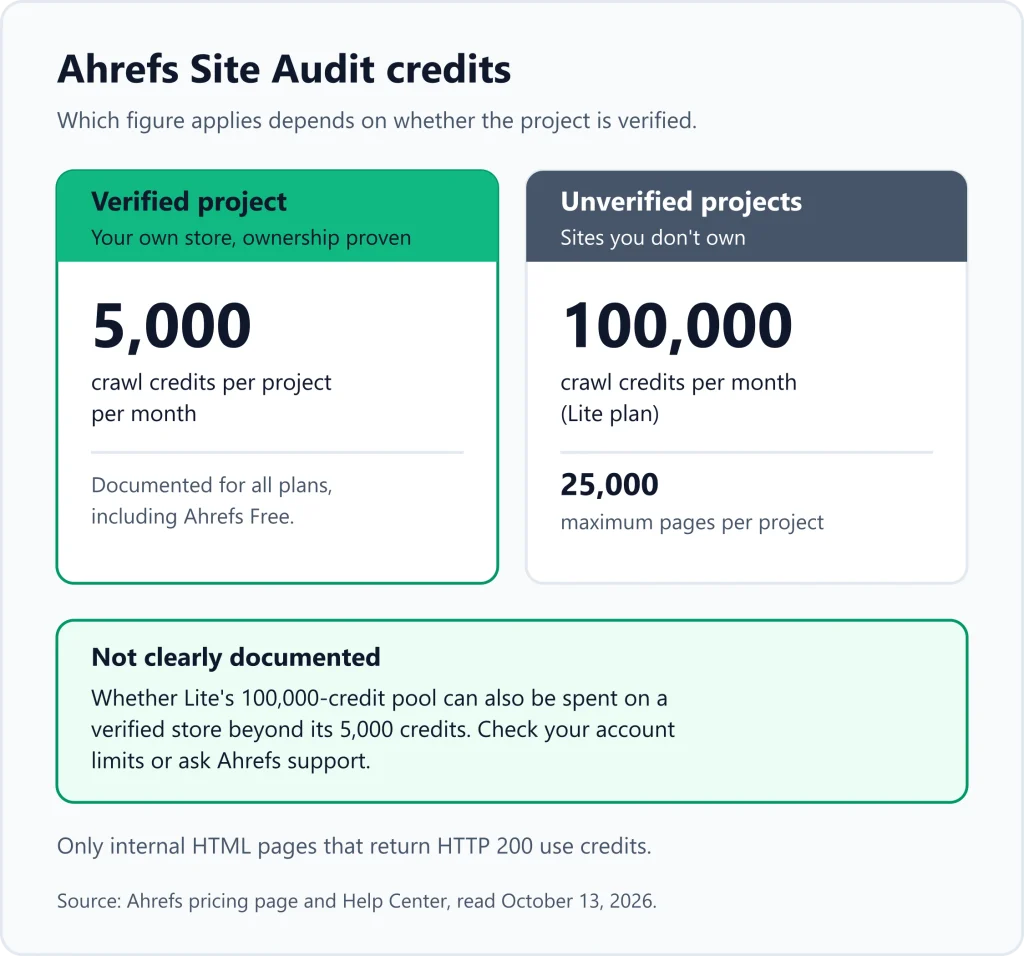
How Ahrefs Site Audit credits apply to your store
This is easy to misread, so I’m separating the figures:
- Verified project (your own store, after you prove ownership): Ahrefs’ Help Center documents 5,000 crawl credits per verified project per month, available on all plans, including Ahrefs Free.
- Unverified projects (sites you don’t own): Ahrefs’ plan-comparison article lists Lite’s 25,000 maximum pages per project and 100,000 monthly crawl credits under “Unverified project.” The pricing page shows the same two figures without that label.
- What uses credits: only internal HTML pages that return an HTTP 200 status. You can set a maximum number of internal pages per crawl.
- What the documentation doesn’t settle: I couldn’t find a clear statement that Lite’s 100,000-credit pool can also be spent on a verified store beyond its 5,000 credits. So don’t assume 100,000 credits of audit capacity for your own catalog. Check Account Settings, Limits and Usage, or ask Ahrefs support, before you rely on Ahrefs for a large store.
- Best fit (editorial): your work leans on competitor and backlink research.
- Consider skipping if: you need daily rank updates, want to test a paid plan first, or track more than a few hundred keywords across categories and products.
- Verify before buying: how many crawl credits your verified store can actually use, and the current limits on higher plans.
Check Ahrefs’ live plans (official page, no affiliate), plus Ahrefs Help Center articles on plan differences, verified projects and how crawl credits are spent.
SE Ranking
Vendor-stated pros:
- Core is $129 a month, or $103.20 a month billed annually (the page says annual billing saves 20%).
- It lists 10 projects, 2,000 keywords and 100 AI prompts tracked daily, and 250k audit pages a month (250k maximum per project).
- The 14-day trial needs no credit card.
- Extra manager seats start at $16 a month. An Agency Pack add-on (white-label platform and reporting, 30 client seats) is +$69 a month, annual billing only.
Cons:
- Annual plans are billed upfront, and payments are non-refundable except where the service wasn’t delivered as promised or a promotion says otherwise.
- Core includes one manager seat.
- The trial has starter limits (10 projects, 750 tracked keywords a day, 20 AI prompts a day, AI competitive research for 3 domains), so it won’t show you Core’s full limits.
- No free plan is listed beyond the trial, and add-ons cost extra. The AI Search add-on (200 prompts) is $71.20 a month on annual billing or $89 monthly.
- Best fit (editorial): you want daily tracking across several stores or projects on a modest budget, and you’ll test it first.
- Consider skipping if: free tools already cover your needs, or you won’t commit to upfront annual billing and the monthly price is more than you want to pay.
- Verify before buying: that the paid limits (not the capped trial’s) fit your catalog, how keyword counts treat locations and search engines, and the refund terms for your billing choice.
If you want to evaluate it, you can try SE Ranking’s 14-day trial (affiliate link) or go to seranking.com directly (no affiliate). Use the seven-day ecommerce trial plan to judge it against your own data. More detail: SE Ranking vs Semrush and SE Ranking pricing.
Affiliate note: if you buy through the affiliate link, SEORAF may earn a commission at no extra cost to you. The direct link earns nothing, and the trial itself is free either way.
Crawlers for Large Catalogs
Editorial view: a dedicated crawler usually goes deeper than the audit module inside a platform, which matters when filters, variants and pagination create crawl complexity.
Screaming Frog SEO Spider
Vendor-stated (official FAQ):
- The SEO Spider is free for crawls up to 500 URLs. The free version restricts configuration options, and crawls can’t be saved or reopened.
- A licence is $279 per year per user (£199 or €245 in other currencies). Volume discounts are listed for larger purchases, so check the pricing page.
- JavaScript rendering is part of the paid licence, which matters for headless or script-heavy storefronts.
- It’s desktop software, so very large crawls depend on your computer’s memory and storage.
- Best fit (editorial): catalogs where filters, variants and duplicates are the main problem, and a low annual cost matters.
- Consider skipping if: you need keyword research, competitor data or hosted client reporting. It isn’t built for those.
- Verify before buying: if you crawl a hosted store such as Shopify, check your platform’s guidance on crawl rate limits before running a large crawl. I haven’t verified Screaming Frog’s refund terms.
Read the SEO Spider FAQ and the pricing page (official, no affiliate), plus my Screaming Frog free vs paid features breakdown.
Other crawlers worth evaluating
Sitebulb is another crawler worth a look if you prefer a more guided audit report. I haven’t verified its current pricing for this guide, so check it on the vendor’s site.
Platform-Native Settings and Store Apps
Before buying any app, check what your store platform already lets you edit: titles, meta descriptions, URL handles, redirects and sitemaps. App marketplaces list many SEO apps, and community discussions show no consensus on a single best one.
I haven’t evaluated individual store apps for this guide, so I won’t rank them. If you consider one, test it on a staging copy or a small collection first, and check that it doesn’t duplicate something your platform already does.
Category-Page and Content Tools
Content-optimization tools compare a draft with competing pages and suggest topics to consider. They can help with category-page copy and buying guides, but a content score is a guide, not a ranking promise. It can’t tell you whether the page is the most helpful answer for a shopper.
Semrush lists content optimization at Pro+. SE Ranking Core lists 25 content-marketing articles (extra articles from $39.20). Ahrefs sells content features as a separate Content Kit add-on from $99 a month. Specialists such as Surfer focus on the editor workflow, and I did not verify Surfer’s current pricing for this guide. See my Surfer SEO review for context, and look at content tools only after your technical basics are sound.
AI Visibility Tracking: What Is and Isn’t Established
Vendors now bundle AI-visibility features. Semrush lists daily prompt allowances from Starter upward (50 on Starter, 100 on Pro+, 200 on Advanced), and its entry SEO plan lists AI-search features without a stated allowance. SE Ranking Core lists 100 prompts a day. Ahrefs Lite lists 5 tracked prompts and 150 checks a month.
These measuring sticks aren’t comparable: prompt limits, tracked platforms and definitions differ and change often. Editorially, I’d treat this as a secondary layer for most stores, since Search Console still describes the organic traffic you can verify. Check each vendor’s current documentation before basing a purchase on it, and see AI SEO tools for the category overview.
Best Fit by Store Size and Use Case
Small store (up to a few hundred products)
Start with Search Console and the free crawler. A few hundred products can still exceed 500 URLs once filters and pagination count, so check your URL count before assuming the free crawl covers everything. Add a platform trial when you want keyword research or tracking, and keep your ecommerce SEO audit checklist handy for the manual work no tool replaces.
Growing catalog (thousands of URLs)
Editorial view: this is where a crawler licence tends to pay for itself, because you need to see every filter and variant URL. Add one all-in-one platform if you need competitor data or daily tracking.
An illustration of the tracking math: 25 priority categories with 3 keyword variants each, plus your 50 best-selling products, is 125 tracked keywords before locations or devices. Check how each vendor counts those.
Large catalog, many filters or a headless storefront
Prioritize a crawler that can render your pages (JavaScript rendering is a paid-licence feature in Screaming Frog) and handle your URL volume, backed by a machine with enough memory. Treat platform audit allowances as a second opinion, not your only view. SE Ranking Core lists 250k audit pages a month, while Ahrefs documents only 5,000 crawl credits per verified project, so confirm your own numbers before paying.
Agencies and multi-store operators
Your real cost is plan plus seats plus reporting add-ons. SE Ranking lists an Agency Pack at +$69 a month (annual billing only), Semrush lists report add-ons at $10 and $20 a month, and Ahrefs lists a Report Builder add-on at $99 a month. Verify current add-on prices and client-reporting limits before comparing stacks.
Content-led stores
If buying guides and category copy drive your traffic, prioritize keyword research and competitor content analysis in a platform. Add a content specialist later, once you know that’s your bottleneck.
What a Stack Actually Costs
Headline prices hide billing differences. The tables below use list prices, ignore taxes and add-ons, and show the billing commitment for each row. Annual plans are charged upfront, so the monthly equivalent is not what you pay at checkout.
Platform plus crawler, by billing option
| Setup | Billing commitment | Platform per year | Total per year | Monthly equivalent |
|---|---|---|---|---|
| Search Console plus free crawler | None | $0 | $0 | $0 |
| Search Console plus Screaming Frog licence | Annual licence | $0 | $279 | $23.25 |
| SE Ranking Core, annual billing | 12 months, paid upfront | $1,238.40 | $1,517.40 | About $126.45 |
| SE Ranking Core, monthly billing | Month to month | $1,548 | $1,827 | $152.25 |
| Semrush SEO, annual billing | Billed annually | $1,407.96 | $1,686.96 | About $140.58 |
| Semrush SEO, monthly billing | Month to month | $1,668 | $1,947 | $162.25 |
| Ahrefs Lite, monthly billing | Month to month | $1,548 | $1,827 | $152.25 |
List prices in US dollars, one user. Rows with a platform include one Screaming Frog licence ($279 a year) in the total. Ahrefs annual billing is not computed because the exact annual price isn’t shown on the page.
A two-person team, monthly billing
This is a like-for-like illustration: the entry plan plus one extra user, billed monthly at list prices.
| Platform | Plan plus one extra user | Monthly total |
|---|---|---|
| SE Ranking Core | $129 plus from $16 | From $145 |
| Ahrefs Lite | $129 plus $40 | $169 |
| Semrush SEO | $139 plus from $45 | From $184 |
Monthly list prices for the entry plan plus one additional user. “From” means the vendor lists a starting price.
Editorial view: a lower sticker price doesn’t mean a lower cost if you need more users, more tracked keywords or add-ons. The cheapest plan that fits your real site count and tracking needs is the better deal. Higher tiers raise both limits and prices, so price the tier you’d actually need once trial caps are lifted.
Common Objections, Answered Plainly
| Objection | What the facts say | What to do |
|---|---|---|
| “It’s too expensive.” | On monthly billing, entry plans list at $129 (Ahrefs Lite, SE Ranking Core) and $139 (Semrush SEO). Annual billing lowers the monthly equivalent (SE Ranking $103.20, Semrush $117.33) but is charged upfront. Free tools cover many small-store basics. | Start at $0 and add a paid tool only for a named gap. |
| “I can’t tell if it fits my store.” | SE Ranking offers a 14-day trial with no card and starter limits. Semrush has a free plan and shows “Try for free” on the SEO, Starter and Pro+ plans, but an uncancelled Semrush trial converts to a paid subscription. Ahrefs lists no trial of paid plans. | Run the seven-day plan on your real data. Trial limits are lower than paid limits. Set a reminder to cancel before a trial ends. |
| “Annual billing locks me in.” | Annual plans are charged upfront. Semrush refunds only an initial 12-month-or-longer order requested in writing within 7 calendar days, and monthly plans are not refundable. Ahrefs generally doesn’t refund. SE Ranking payments are non-refundable except where service wasn’t delivered as promised. | Test with a free plan or trial first. Read the current refund terms for the exact billing option before you pay. |
| “My catalog is too big.” | Audit allowances differ: SE Ranking Core lists 250k pages a month, Ahrefs documents 5,000 crawl credits per verified project, and I haven’t verified Semrush’s. | Compare limits to your real URL count, and consider a crawler. |
| “Will it improve my rankings?” | No software guarantees rankings or traffic. | Judge a tool by the decisions it helps you make. |
| “Is this page biased by the affiliate link?” | SE Ranking is the only affiliate link on this page, and it gets the same criteria and cons as every other product. I have not hands-on tested any of them. | Use the direct, non-affiliate links if you prefer, and trust your own test over any list. |
Objections answered from vendor-stated terms. Confirm current terms before buying.
Limitations and Trade-Offs
- Metrics are estimates. Keyword volumes, difficulty scores and traffic figures come from each vendor’s own models. Search Console is the first-party source for your own performance.
- Software finds work; it doesn’t do it. Fixing faceted URLs, rewriting category pages and earning links still takes people.
- Vendor claims need corroboration. Test on your own store instead of trusting a feature list.
- Prices and limits change. Recheck the live plan comparison and checkout before paying.
- Vendor documentation can leave gaps. Where a limit isn’t clearly stated (Semrush’s audit pages, whether Ahrefs’ Lite pool applies to a verified store), I say so instead of guessing.
- This page is not a hands-on test. It compares vendor-stated plans and Google’s documentation, and it can’t tell you whose data or interface is better.
- No tool guarantees rankings or traffic. Results depend on your site, competition and execution.
Should You Buy, Trial First, or Choose an Alternative?
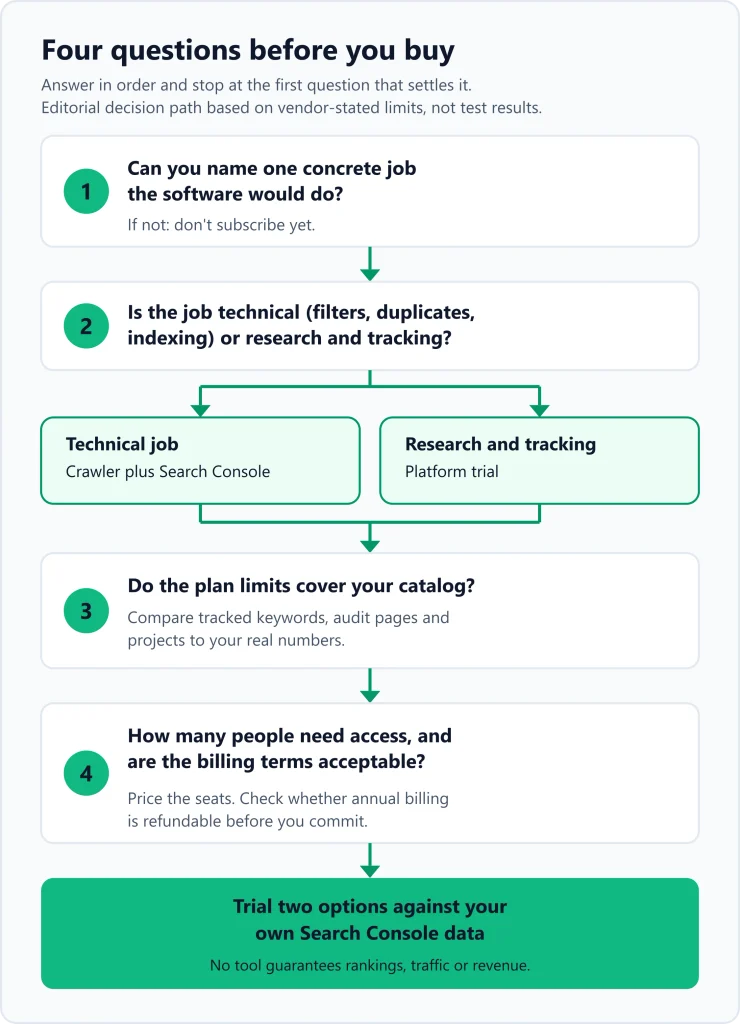
Answer these four questions in order. Stop at the first one that settles it.
- Can you name one concrete job the software would do? If not, don’t subscribe yet.
- Is the job technical (filters, duplicates, indexing) or research and tracking? Technical points to a crawler plus Search Console. Research and tracking points to a platform trial.
- Do the plan limits cover your catalog? Compare tracked keywords, audit pages and projects to your real numbers.
- How many people need access, and can you accept the billing terms? Price the seats, and check whether annual billing is refundable before you commit.
| Your situation | Reasonable next step | Why |
|---|---|---|
| Small store, no tracking needs yet | Search Console plus the free crawler | Free tools cover indexing and technical basics |
| Hit a limit in free tools | Trial two platforms’ entry plans | Compare their data against your own Search Console numbers |
| Technical issues dominate | Crawler plus Search Console | A crawler may be all you need |
| Daily tracking across several stores on a modest budget | Trial SE Ranking Core and compare with Semrush’s SEO plan | They differ on projects, tracked keywords, seats and refund terms |
| Competitor and backlink research is the job | Check whether Ahrefs Lite’s limits are enough | Lite lists 750 keywords with weekly updates, and no paid-plan trial |
| You can’t name one concrete job | Don’t subscribe yet | Paying before you have a defined job is an easy way to waste money |
Suggested next steps by situation. Editorial view.
When SE Ranking isn’t the right call
- Your needs are met by free tools.
- You need more than the trial’s starter limits to judge it.
- After testing, another platform’s data looks better for your market. Trust your test over any list, including this one.
When to cancel or not renew
Check usage before each renewal. If you can’t point to a decision the software helped you make, or you use a small fraction of the limits, move down a plan or cancel. Annual plans are charged upfront, so decide before renewal, not after. If you cancel Semrush, its cancellation form emails a confirmation link that you must click within 24 hours, or billing continues.
A Seven-Day Ecommerce Trial Plan
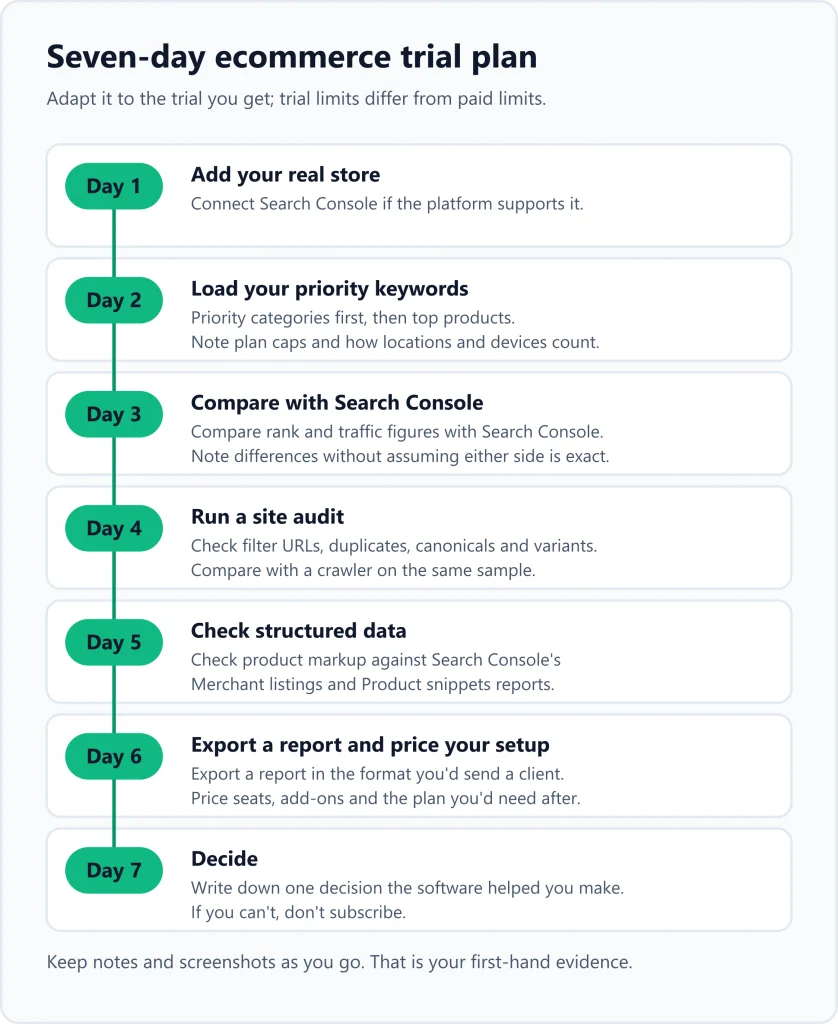
This is a suggested schedule, not a claim that every vendor offers a seven-day trial. Adapt it to the trial you actually get, and remember that trial limits differ from paid-plan limits. Keep notes and screenshots as you go. That’s the first-hand evidence a recommendation should rest on.
- Day 1: add your real store and connect Search Console if the platform supports it.
- Day 2: load the keywords you care about: priority categories first, then top products. Note how many your plan allows and how it counts locations and devices.
- Day 3: compare rank and traffic figures with your Search Console data. Note differences without assuming either side is exact.
- Day 4: run a site audit and check whether it surfaces filter URLs, duplicate content, canonical issues and variants clearly. Compare with a crawler on the same sample, and note how many crawl credits or audit pages the run used.
- Day 5: check product structured data against Search Console’s Merchant listings and Product snippets reports.
- Day 6: export or schedule a report in the format you’d send to a manager or client, and price your real setup (seats, add-ons, the plan you’d need after the trial).
- Day 7: decide. Write down one specific decision the software helped you make. If you can’t, don’t subscribe.
Related Guides
- Best SEO software for the general comparison beyond ecommerce
- Ecommerce SEO audit checklist for the step-by-step audit process
- SEO tools by category and the SEO tools directory
- Competitor analysis guide
- Review methodology
Frequently Asked Questions
What is the best SEO software for ecommerce?
There’s no single answer. Semrush, Ahrefs and SE Ranking are the all-in-one platforms covered here, Screaming Frog is the crawler, and the right mix depends on your catalog size, platform, team and budget. Use the quick picks, then test two options against your own Search Console data.
Do I need ecommerce-specific SEO software?
Not necessarily. General platforms analyze any publicly accessible store. What matters is whether their limits and reports fit catalog-scale problems such as filters, variants and large URL counts. That’s what the trial plan tests.
Is Google Search Console enough for a small online store?
For many small stores, Search Console plus a free crawler covers indexing, performance and technical basics. Paid platforms add competitor data, keyword research and automated tracking, so buy one when you can name a gap.
What’s the best SEO software for Shopify or WooCommerce?
I haven’t tested platform-specific apps, so I don’t name a winner. General platforms and crawlers work on publicly accessible pages whatever your store runs on. Check your platform’s native SEO settings before adding an app, and trial anything on a small collection first.
How much does ecommerce SEO software cost?
On monthly billing, the three platform entry plans list at $129 to $139 a month. Annual billing is listed at $103.20 (SE Ranking) and $117.33 (Semrush) per month, charged upfront, and Ahrefs lists annual savings of up to 17%. Screaming Frog is $279 per licence per year. Seats, add-ons and higher tiers change the total, so use the stack cost tables and confirm on vendor pages.
Does Ahrefs Lite give me 100,000 crawl credits to audit my own store?
Not necessarily. Ahrefs documents 5,000 crawl credits per verified project per month, and it lists Lite’s 100,000 monthly credits under unverified projects. Its pages don’t clearly say whether the larger pool can also be used on a verified store, so confirm in your account limits or with Ahrefs support before relying on it.
Do I need a crawler if my platform has a site audit?
Often not for a small store. For large catalogs, a dedicated crawler can give a more detailed view of filters, canonicals and variants. Compare your platform’s audit allowance with your URL count first.
Do I need AI-visibility tracking for my store?
Only if monitoring how your brand appears in AI answers matters to your goals. The feature is new, and vendors measure it differently.
Are monthly plans safer than annual plans?
Not always. Monthly billing gives flexibility, but Semrush’s policy doesn’t refund month-to-month subscriptions, renewals or trial conversions, while an initial 12-month-or-longer order has a 7-day written-request window. SE Ranking annual payments are non-refundable except where service wasn’t delivered as promised, and Ahrefs generally doesn’t refund. Terms differ by vendor and change, so read the current refund policy for the exact plan before paying.
Does SEORAF earn money from this page?
Possibly. SE Ranking links labeled “affiliate link” may earn a commission if you buy through them, at no extra cost to you. Links to Semrush, Ahrefs, Screaming Frog and Google on this page are official links and earn nothing. Other SEORAF pages I link to may carry their own disclosures.
Will SEO software improve my rankings or sales?
Software helps you find and prioritize work. It doesn’t guarantee rankings, traffic or revenue, and I can’t promise any outcome from using it.
Final Recommendation: Choose Without Overspending
- Just starting out: Search Console and the free crawler. Add a paid platform when you hit a clear limit.
- Growing store: add a crawler licence if filters and variants are your problem, and trial one platform if research or tracking is.
- Large or headless catalog: start with the crawler and verify every limit against your URL count.
- Agency or multi-store: price the full setup, including add-ons and billing terms, before comparing plans.
Before paying, test two platforms against your own Search Console data. No software guarantees rankings or traffic. These tools help you find and prioritize work, and results still depend on your store, your competition and your execution.
Compare live plans before you decide
Three official pricing pages and one trial link. Only the SE Ranking trial button is an affiliate link, and the direct SE Ranking button next to it earns nothing.
SE Ranking trial (affiliate link)
SE Ranking plans (direct, no affiliate)
Affiliate note: SEORAF may earn a commission if you buy through the “affiliate link” button, at no extra cost to you. Prices and trial terms can change, so confirm them on the vendor’s page.
Not ready to buy anything? Start with the free route: work through the ecommerce SEO audit checklist first.
Sources and Update Log
Sources
Vendor pages below were read on October 13, 2026 unless noted. Vendor-stated features and limits are not independent proof of performance.
- Semrush SEO + AI Search plans and pricing: semrush.com/pricing/seo-ai-search (prices, limits, free plan, add-ons, trial)
- Semrush cancellation, trial and refund help article: Canceling Your Subscription (read in full). It links to the Semrush Cancellation and Refund Policy, which I did not read in full.
- Ahrefs plans and pricing: ahrefs.com/pricing (prices, limits, add-ons, billing and refund FAQ). The page’s meta description mentions saving 20% on annual billing, while its page text says up to 17%; I used the page text.
- Ahrefs Help Center: plan differences, what is a verified project and how crawl credits are spent (the crawl-credits article is older)
- SE Ranking subscription page: seranking.com/subscription.html (plans, limits, add-ons, trial, billing and refund FAQ; the page’s last-modified date was September 10, 2026)
- Screaming Frog SEO Spider: FAQ (500-URL limit, licence price, JavaScript rendering) and pricing page (not read in full)
- Google Search Console documentation: support.google.com/webmasters/answer/9128668
- Google: Managing crawling of faceted navigation URLs (page last updated December 18, 2025), Introduction to Product structured data, Share your product data with Google, the Merchant listings report announcement and Write high quality reviews
The suggestion that Semrush’s Pro, Guru and Business plans may be sold as an “SEO Classic” line comes from third-party pricing guides, not an official Semrush page, and is flagged as unconfirmed in the article.
Update log
- October 13, 2026: prices, limits, trial and refund terms re-read from official vendor pages. Separated Ahrefs verified and unverified crawl credits, described Semrush’s legacy plan names, added Semrush trial-conversion and refund conditions, corrected SE Ranking trial limits, tightened the cost and limits tables, and added the Content Kit and Agency Pack details.