
Content SEO: The Complete Guide
Search for “content SEO” and you’ll land on two very different kinds of answers: a checklist of keyword tactics, or a vague appeal to “quality content.” Neither tells you what actually determines whether Google — and increasingly, AI Overviews — treats your content as worth ranking.
Content SEO is the practice of researching, structuring, creating, optimizing, and maintaining content so it satisfies search intent, provides useful information, demonstrates appropriate trust and expertise, and can be understood by search systems. It is distinct from technical SEO, which deals primarily with how a site is crawled, rendered, indexed, and technically structured, and from off-page SEO, which concerns signals originating outside the site.
The practical difference is important. Content SEO is not simply “put keywords in an article.” It is the process of deciding what page should exist, what question it should answer, what information it should contain, how that information should be organized, how it should demonstrate trust, and how it should be maintained after publication.
This guide explains that process from search intent and topic coverage through content creation, optimization, auditing, consolidation, freshness, and AI Search. It also draws a clear boundary between what Google has actually documented and what the SEO industry merely assumes.
What Does Content SEO Include?
A useful content SEO system covers the complete lifecycle of a content asset rather than stopping when an article is published.
| Area | What it involves | Primary question |
|---|---|---|
| Topic selection | Choosing subjects aligned with audience needs and site strategy | Should this page exist? |
| Search intent | Understanding what searchers are trying to accomplish | What does the user actually need? |
| Entity and topic coverage | Defining important concepts, entities, questions, and relationships | What must the page explain? |
| Content structure | Organizing information into a logical reading and decision path | What should the reader learn first? |
| Content creation | Writing or producing useful, accurate, original content | Does the page genuinely help? |
| On-page optimization | Titles, headings, descriptions, links, media, and page-level optimization | Can users and search systems understand the page? |
| Trust and evidence | Sources, experience, expertise, accuracy, transparency, and appropriate attribution | Why should the reader trust this? |
| Internal linking | Connecting related pages through meaningful contextual links | How does this page fit the site’s knowledge structure? |
| Content maintenance | Auditing, updating, consolidating, and pruning | Is the page still the right answer? |
This lifecycle view is more useful than defining content SEO as keyword optimization because it explains what happens before, during, and after publication.
Content SEO vs. Technical SEO vs. Off-Page SEO
SEO work splits into different operational areas because each requires a different diagnostic process. Content problems do not necessarily appear in a crawl report, and technical problems cannot always be solved by rewriting an article.
| Content SEO | Technical SEO | Off-Page SEO | |
|---|---|---|---|
| What it covers | What’s written or shown on the page | How the site is built, crawled, rendered, and indexed | Signals originating outside your own site |
| Typical tasks | Intent mapping, content structure, topic coverage, content updates | Crawlability, indexation, rendering, canonicalization, performance | Digital PR, link acquisition, reputation, external relationships |
| Who usually owns it | Content strategists, writers, editors, SEO specialists | Technical SEOs, developers, engineers | PR, outreach, partnerships, marketing teams |
| Example deliverable | A page that directly satisfies a defined search intent | A resolved indexing or crawl issue | A relevant external reference or earned link |
Content SEO is where this guide concentrates, but the boundaries should remain clear. If a page cannot be crawled or indexed, rewriting it is unlikely to solve the underlying problem. If a page is technically sound but does not satisfy the query, technical fixes alone will not create relevance.
The best SEO programs therefore diagnose the bottleneck before choosing the intervention.
How Google Actually Evaluates Content Quality
One of the most important distinctions in modern content SEO is the difference between Google’s documented quality concepts and simplified SEO checklists that claim to turn those concepts into a score.
Google’s Search systems use many signals and systems to determine which results are relevant and useful. Google’s documentation describes ranking as a complex system rather than a single “content quality score” that publishers can manually optimize against.
That means content SEO should focus on producing genuinely useful pages rather than trying to reverse-engineer one universal checklist.
What E-E-A-T Actually Means
E-E-A-T stands for Experience, Expertise, Authoritativeness, and Trustworthiness. It is used within Google’s Search Quality Rater Guidelines as a framework for assessing the quality of content and sources.
Trust is especially important because a page can appear knowledgeable while still being inaccurate, misleading, poorly sourced, or otherwise unreliable. Expertise alone does not make an inaccurate answer trustworthy.
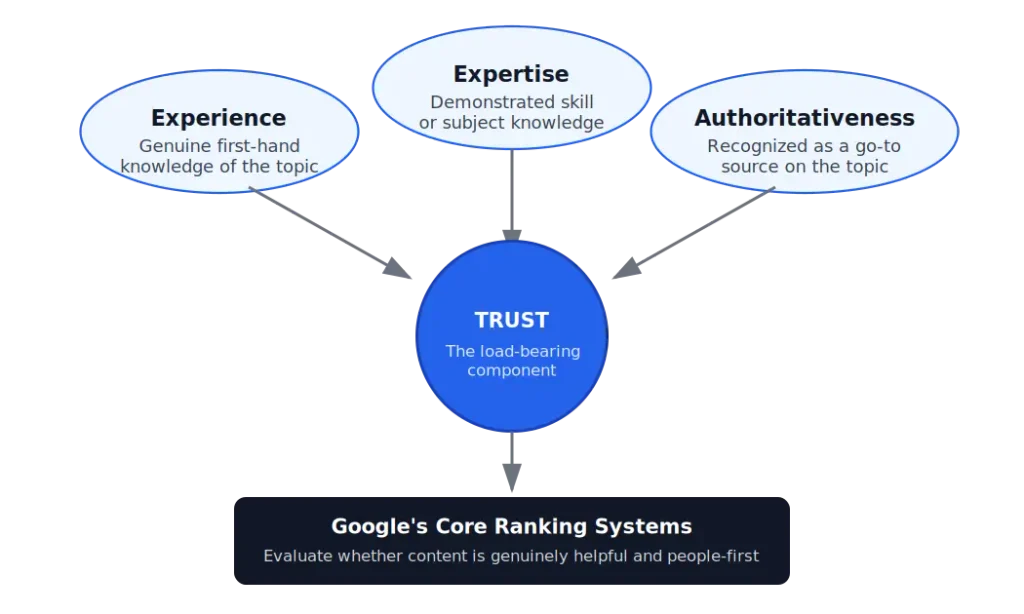
For content creators, the practical lesson is not to add an “E-E-A-T section” to an article. Instead, the content should demonstrate the underlying qualities throughout the page where they genuinely apply.
For example, appropriate trust-building can include:
- Clearly identifying important sources.
- Distinguishing documented facts from interpretation.
- Using current information where the topic changes over time.
- Explaining methodology when recommendations depend on testing or evaluation.
- Attributing claims to the appropriate organization or source.
- Correcting material errors rather than silently leaving outdated information live.
- Being transparent about limitations, uncertainty, and commercial relationships.
For topics involving significant financial, health, safety, or other real-world consequences, the need for accurate and trustworthy information becomes particularly important.
Google’s Helpful Content Approach
Google’s guidance on helpful, reliable, people-first content emphasizes creating content primarily to benefit people rather than to manipulate search rankings.
The underlying principle is straightforward: content should primarily exist to help people rather than primarily to attract search traffic.
That principle has practical consequences for content production. A page should not be created simply because a keyword has search volume. The publisher should be able to explain what user need the page serves and why the page adds value beyond existing results.
Useful questions include:
- Does the page answer the question implied by the query?
- Does it provide information that is useful for the reader’s actual task?
- Does it add original analysis, evidence, experience, examples, or synthesis where appropriate?
- Are important claims supported by appropriate evidence?
- Does the content avoid exaggerated promises and unsupported conclusions?
- Would the page still be useful if search traffic were not the primary goal?
These questions are more durable than trying to optimize for a hypothetical “helpful content score.”
Search Intent: The Step Before Keywords
Search intent is what the person is actually trying to accomplish when they enter a query. Before mapping a keyword to a page, the underlying user task needs to be understood.
Search intent is commonly grouped into four broad categories:
| Intent | Searcher goal | Typical content format |
|---|---|---|
| Informational | Learn, understand, or solve a problem | Guide, tutorial, explanation, checklist |
| Commercial investigation | Compare options before making a decision | Comparison, review, alternatives, buyer guide |
| Transactional | Take an action or complete a purchase | Product, service, signup, purchase, conversion page |
| Navigational | Reach a particular website, brand, or destination | Brand or destination page |
Intent should be validated against the live SERP rather than assumed from the keyword alone. A keyword can look informational while the actual results reveal a stronger commercial or transactional pattern.
Imagine a team creates a detailed article for “best project management software” but structures it as a single-product opinion piece. The content may be excellent, but the searcher is likely trying to compare multiple options. The mismatch is structural, not grammatical.
This is why keyword volume is not enough to determine what page should be built. Volume tells you that a query exists. Intent tells you what the searcher expects to find.
The Content SEO Workflow
A reliable content SEO workflow converts the abstract idea of “quality content” into a repeatable production system.
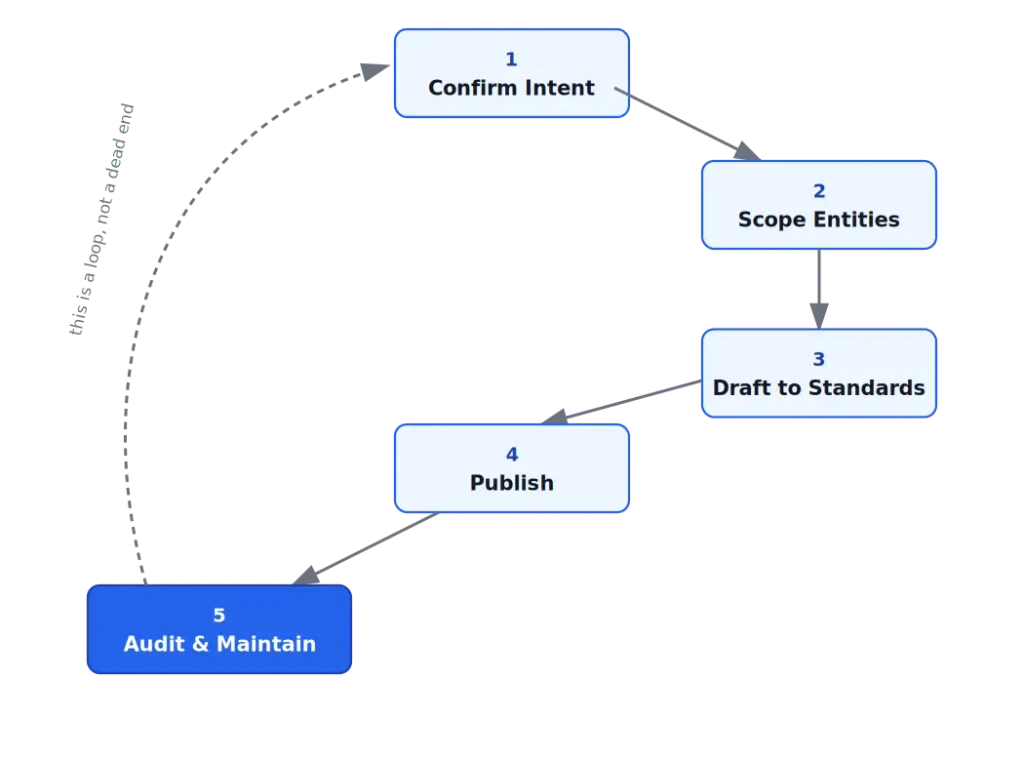
- Confirm search intent against the live SERP. Check current results rather than relying on an old assumption.
- Define the page’s job. State the specific question, problem, decision, or task the page is responsible for solving.
- Scope entities and subtopics. Identify the concepts, entities, questions, relationships, and supporting information the reader needs.
- Analyze the existing content landscape. Identify competing pages, overlapping pages on your own site, missing topics, and opportunities for genuine information gain.
- Build the information architecture. Organize the article around the reader’s decision path rather than copying competitor headings.
- Draft for usefulness and trust. Write accurately, clearly, and transparently from the first draft.
- Optimize the page. Refine title, headings, metadata, internal links, media, tables, structured information, and other appropriate page-level elements.
- Publish and measure. Search performance, engagement, conversions, and user behavior can reveal whether the page is accomplishing its intended job.
- Maintain the asset. Update, consolidate, or prune when the page’s information, intent, or strategic role changes.
Notice what is deliberately absent: a fixed word-count target.
Google has stated that it does not have a preferred word count for content. The correct length is the amount of content required to satisfy the topic and user need without padding.
A concise page that completely solves a narrow problem can be stronger than a long article that repeats the same points. Conversely, a complex topic may genuinely require thousands of words.
Information Gain: What Makes Content More Useful?
Content SEO becomes significantly stronger when the goal is not merely to repeat what already exists in search results.
Information gain is the practical idea of adding something useful that improves the reader’s understanding or ability to act. Depending on the topic, that can come from original analysis, clearer synthesis, first-hand experience, testing, examples, updated evidence, better organization, transparent methodology, or a more useful decision framework.
Information gain does not necessarily mean inventing information nobody has ever published. A publisher can create substantial value by making complicated information easier to understand or by connecting evidence that is scattered across multiple authoritative sources.
For example, an SEO article can add value by:
- Turning scattered official documentation into a practical workflow.
- Explaining when a recommendation does and does not apply.
- Showing a decision tree instead of repeating generic definitions.
- Separating confirmed facts from industry assumptions.
- Providing examples that clarify an otherwise abstract concept.
- Explaining trade-offs rather than presenting every tactic as universally correct.
The key question is simple: After reading this page, what can the user understand or do that they could not do as easily before?
Content Structure and Readability
Good content SEO is not only about what information exists on a page. It is also about whether the reader can find, understand, compare, and act on that information efficiently.
A strong structure normally moves from the user’s most immediate question toward increasingly detailed information. The exact hierarchy depends on intent, but useful structural elements can include:
- A direct introduction that defines the topic.
- A quick answer or summary when the query benefits from one.
- Clear H2 and H3 hierarchy.
- Comparison tables where side-by-side evaluation is useful.
- Ordered workflows for sequential tasks.
- Decision trees for conditional choices.
- Examples where concepts are difficult to understand abstractly.
- Internal links to deeper supporting resources.
- Concise paragraphs and descriptive subheadings.
Structure should serve the reader rather than exist merely to increase the number of headings. A page filled with shallow sections can be less useful than a page with fewer but substantially developed sections.
Content Freshness: What Actually Works
Changing a publication date by itself does not make old information new.
Some queries genuinely depend on current information. Software pricing, product recommendations, regulations, search features, market conditions, and current statistics can change materially over time. Other subjects, such as fundamental scientific concepts, may remain substantially stable for long periods.
The right maintenance strategy therefore depends on the information itself.
A substantive content update may involve:
- Replacing outdated statistics.
- Updating product or feature information.
- Correcting factual errors.
- Removing discontinued recommendations.
- Updating screenshots or examples.
- Rechecking cited sources.
- Revising sections where the search intent has changed.
- Adding important information that has become relevant.
The date should reflect the actual editorial history of the page rather than being manipulated as a standalone ranking tactic.
The practical rule is therefore:
Update the substance first. Let the date change as a consequence of meaningful editorial work.
Maintaining Content Over Time: Audits, Gaps & Consolidation
Publishing is not the end of content SEO. A page enters a lifecycle after publication, and its strategic role can change as competitors, search behavior, products, evidence, and the rest of the site’s content ecosystem evolve.
Running a Content Audit
A content audit is a systematic review of existing content to determine whether each asset is still accurate, useful, relevant, differentiated, and aligned with its intended purpose.
An effective audit can examine:
| Dimension | Diagnostic question |
|---|---|
| Accuracy | Is the information still correct? |
| Intent | Does the page still match what searchers want? |
| Performance | Is the page achieving its intended search and business outcomes? |
| Depth | Does it adequately cover the information required by the topic? |
| Uniqueness | Does another page on the site perform essentially the same job? |
| Trust | Are important claims appropriately supported? |
| Maintenance | Are important sections outdated or incomplete? |
The audit is diagnostic. Its output should lead to a decision rather than automatically triggering a rewrite.
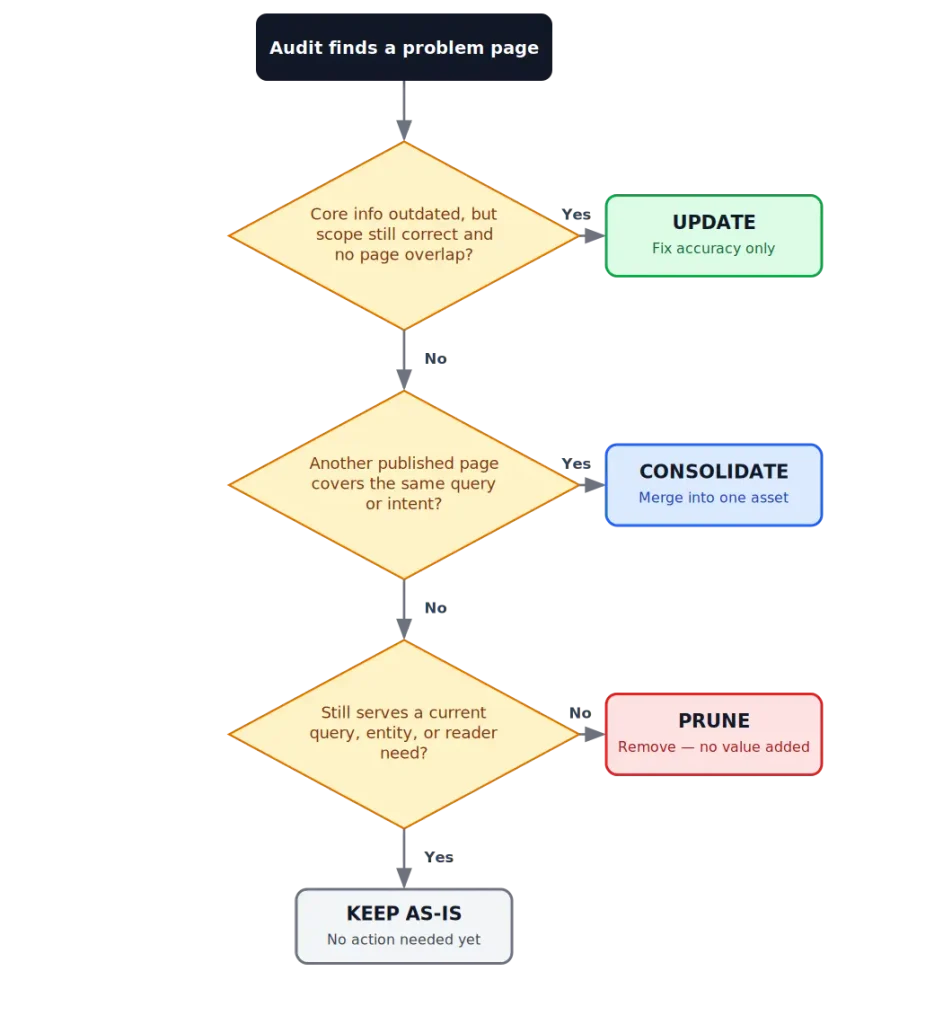
Deciding: Update, Consolidate, or Prune
Once a problem is identified, the appropriate action depends on the type of problem.
| Situation | Action | Reason |
|---|---|---|
| The page has the correct scope but contains outdated or incomplete information | Update | The page’s job remains valid; its information needs improvement. |
| Two or more pages substantially overlap in query, intent, or purpose | Consolidate | A stronger unified resource may be more useful than competing overlapping pages. |
| The page no longer serves a meaningful user or site need and cannot be improved or usefully merged | Prune | Removing unnecessary content can simplify the content portfolio. |
The key distinction between Update and Consolidate is accuracy versus uniqueness.
If the page is still the right page but the information is old, update it. If another page already performs the same job, adding more words may make the duplication worse. In that case, investigate consolidation.
Pruning should also be diagnostic rather than automatic. A page should not be removed simply because it has low traffic. Traffic is only one input. Strategic value, conversions, links, relevance, historical importance, supporting relationships, and potential for improvement may also matter.
Content Gaps vs. Keyword Gaps
Content gap analysis and keyword gap analysis are related but should not be treated as identical processes.
A keyword gap asks which relevant search terms or queries may not be adequately targeted. A content gap asks which useful information, page types, topics, subtopics, or user needs are missing from the content system.
For example, a site may already target the main keyword for a subject but still have a content gap because it lacks:
- A practical implementation guide.
- A comparison page.
- A troubleshooting resource.
- A beginner explanation.
- An advanced technical guide.
- A supporting glossary definition.
- A decision framework.
The distinction prevents content teams from solving every gap by creating another keyword-targeted article.
Content SEO and Internal Linking
Internal links connect individual pages into a larger information architecture. In a mature content system, the goal is not simply to add as many internal links as possible. Links should help users discover relevant next steps while also making the relationships between pages clearer.
A useful internal-linking model can connect:
- Hub pages to cluster pages.
- Cluster pages to supporting articles.
- Guides to definitions of important entities or concepts.
- Informational pages to relevant comparison or commercial resources.
- Older pages to newer authoritative resources.
- New pages back to established pages where contextual relevance exists.
Anchor text should describe the destination naturally. Internal links should be contextually relevant rather than inserted merely to satisfy a numerical link target.
The deeper strategic purpose is to build a coherent content system where each page has a defined role rather than a collection of isolated articles.
Content SEO and Topical Coverage
Comprehensive content does not mean mentioning every possible keyword. It means covering the concepts required to satisfy the user’s underlying need.
For a complex topic, this may involve:
- Core definitions.
- Related entities.
- Processes and workflows.
- Examples.
- Common mistakes.
- Alternatives and trade-offs.
- Implementation guidance.
- Measurement.
- Troubleshooting.
- When the advice does not apply.
Topic coverage should therefore be driven by the user’s information need, not by a requirement to insert a predetermined number of related keywords.
Content SEO and AI Search: AI Overviews, AI Mode, GEO & AEO
Content SEO remains relevant as search interfaces evolve because Google’s generative AI experiences are built on top of Search systems rather than replacing the need for searchable, useful web content.
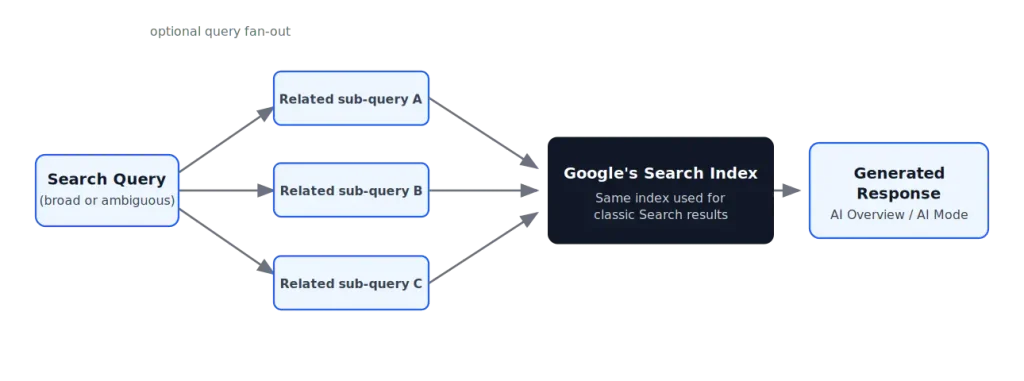
Google’s current guidance states that its generative AI features use Search’s existing ranking and quality systems, retrieve relevant information, and can use query fan-out to explore related searches before producing a response.
This changes how publishers should think about AI visibility. The goal should not be to create a separate “AI version” of every page. The more durable strategy is to make the underlying content useful, technically accessible, well-structured, trustworthy, and genuinely relevant to the questions users ask.
What Google’s Guidance Actually Says
Google describes AI Overviews and AI Mode as experiences that can use Search information to generate responses and provide links to supporting web pages. Query fan-out can involve multiple related searches generated to gather additional information for a broader query.
This has an important implication for content SEO: a page can potentially contribute to a broader answer when it provides a strong, clearly defined piece of information that satisfies a relevant underlying need.
Industry terms such as GEO and AEO describe efforts to optimize for generative or answer-oriented search experiences. They can be useful strategic labels, but they should not be interpreted as evidence that Google has created an entirely separate set of ranking rules for publishers.
Google’s own guidance explicitly points publishers back toward established SEO fundamentals and useful, people-first content rather than requiring a separate AI-specific optimization system.
Common AI-SEO Myths, Corrected
- “You need an llms.txt file.” Google’s current generative AI guidance says publishers do not need special AI text files such as llms.txt to appear in Google’s generative AI features.
- “Content must be specially chunked for AI.” Google’s guidance does not require publishers to use a special content-chunking system for AI Search visibility. Clear structure remains useful for people and machines, but “AI chunking” should not be treated as a required ranking tactic.
- “Every article needs an AI-specific rewrite.” Google’s guidance emphasizes the same people-first SEO fundamentals rather than requiring a separate writing style for generative AI features.
- “Manufactured mentions automatically create AI visibility.” Artificially engineering mentions should not replace genuine reputation, useful content, original work, and legitimate external recognition.
The durable pattern is therefore straightforward: do not build an AI-search strategy around shortcuts that attempt to bypass the fundamentals of search quality.
How to Make Content More Citable and Useful in AI Search
Although no page can guarantee inclusion in an AI-generated response, content can be designed to make important information easier to understand and verify.
Useful practices include:
- Answering the central question directly.
- Using descriptive headings that identify the subject of each section.
- Defining important concepts before using them extensively.
- Separating facts, examples, recommendations, and opinions.
- Using tables when a comparison is genuinely easier to understand in tabular form.
- Providing context around statistics rather than publishing isolated numbers.
- Attributing important claims to appropriate sources.
- Keeping time-sensitive information current.
- Making important conclusions explicit rather than burying them in vague language.
These practices are not an “AI hack.” They are simply strong information design. The same characteristics that help a human reader understand a page can also make the page’s information easier for retrieval and answer-generation systems to interpret.
Topical Authority: What Google Has Confirmed vs. What’s Industry Speculation
“Topical authority” is frequently used in SEO strategy, but the phrase can refer to a broader industry concept that should not automatically be confused with Google’s specifically documented topic authority system.
| Topical Authority | Topic Authority | |
|---|---|---|
| Common usage | Broad SEO concept involving comprehensive coverage of a subject | Google-documented system for certain news-related searches |
| Scope | Often discussed across many website types and subject areas | Google specifically describes it in the context of news and specialized areas |
| Confirmation | Industry terminology rather than a directly confirmed universal ranking system | Directly documented by Google |
| Documented signals | No universal Google-confirmed signal list under this broad label | Notability, influence and original reporting, and source reputation are among the prominent signals Google describes |
Google announced its topic authority system in May 2023. The documentation describes it as helping surface expert sources for news queries in specialized areas such as health, politics, and finance. Google identifies prominent signals including how notable a source is for a topic or location, how original reporting is cited by other publishers, and the source’s history of high-quality reporting or recommendations from expert sources.
That is narrower than the common SEO claim that every website earns a universal “topical authority score.”
The broader industry concept can still be strategically useful. A site with well-organized, comprehensive, internally connected content can create stronger coverage of a subject and provide more useful resources to its audience. But that strategic observation should not be presented as proof that Google operates a universal algorithm called “topical authority.”
Precision matters: distinguish what Google has confirmed from what SEO practitioners infer from observed search behavior.
Content SEO for Different Search Intent Types
The correct content strategy changes according to the searcher’s task.
Informational Content
Informational pages should answer the user’s question efficiently and then provide enough context to make the answer useful. Definitions, explanations, tutorials, checklists, examples, and troubleshooting content often fit this intent.
Commercial Investigation Content
Comparison and evaluation pages should help users understand differences between alternatives. Transparent criteria, trade-offs, limitations, pricing context where appropriate, and clear methodology are generally more useful than generic promotional language.
Transactional Content
Transactional pages should reduce friction around the action the user wants to take. The content should answer practical questions, communicate relevant details clearly, and avoid burying the primary action under unnecessary editorial material.
Navigational Content
Navigational searches typically require a clear destination rather than a long educational article. The page should make it easy for the user to reach the intended brand, product, resource, or section.
The format should follow the task. Do not force every keyword into the same article template.
Common Content SEO Mistakes
Many content problems come from optimizing the wrong variable.
- Starting with keywords instead of the user problem. Keyword research is valuable, but the page still needs a defined purpose.
- Writing to a word-count target. Length should follow information requirements rather than a predetermined number.
- Copying competitor structures. Competitor research can reveal SERP expectations, but copying headings does not create information gain.
- Refreshing dates without meaningful updates. A new date does not substitute for new information.
- Creating pages for every keyword variation. Closely related queries may belong on one stronger resource.
- Ignoring existing content overlap. New publishing can make cannibalization worse when the site’s existing architecture is not considered.
- Treating E-E-A-T as a checklist badge. Trust must be reflected in the content rather than merely declared.
- Using AI Search as an excuse to abandon SEO fundamentals. Google’s current guidance on optimizing for AI features in Google Search continues to emphasize established SEO best practices alongside helpful, people-first content.
- Equating topical coverage with keyword density. Comprehensive coverage is about concepts and user needs, not repeating phrases.
- Pruning pages solely because traffic is low. Low traffic is a diagnostic signal, not an automatic deletion rule.
How to Measure Content SEO Performance
Content SEO should be measured against the job assigned to each page.
| Objective | Useful measurement area | What it can reveal |
|---|---|---|
| Search visibility | Impressions, rankings, query coverage | Whether the page is gaining search exposure |
| Search traffic | Organic clicks and landing-page traffic | Whether visibility is generating visits |
| Intent satisfaction | Engagement and behavioral indicators | Whether visitors appear to find the page useful |
| Business outcome | Conversions or assisted outcomes | Whether the content supports the site’s goals |
| Content health | Freshness, accuracy, broken references, overlap | Whether maintenance is required |
No single metric can determine whether a page is “good.” A page can have low traffic because the topic is narrow, yet still be strategically valuable. A page can also have high traffic but poor conversion or poor intent satisfaction.
Measurement should therefore return to the original question: what job was this page supposed to accomplish?
Content SEO Checklist
Use this checklist before publishing, after major updates, and during content audits.
- Confirm the page’s primary search intent against the current SERP.
- Define exactly what job the page is responsible for.
- Check whether an existing page already serves the same intent.
- Scope important entities, concepts, questions, and subtopics.
- Identify meaningful information gaps before drafting.
- Build the structure around the reader’s decision path.
- Write primarily to solve the user’s problem, not to satisfy a word-count target.
- Support important factual claims with appropriate evidence.
- Make experience, expertise, attribution, and trust visible where genuinely relevant.
- Use examples, tables, workflows, or decision frameworks where they improve comprehension.
- Optimize titles, headings, metadata, internal links, and other appropriate page-level elements.
- Use contextual internal links to relevant supporting and parent resources.
- Do not manufacture freshness by changing dates without substantive updates.
- Audit older pages periodically for accuracy, relevance, overlap, and usefulness.
- Diagnose Update vs. Consolidate vs. Prune before changing an underperforming page.
- Do not use fixed word count as a proxy for quality.
- Do not treat keyword density as a measure of topical completeness.
- Treat AI Search as an extension of strong SEO fundamentals rather than a separate shortcut system.
- Do not assume llms.txt or special AI markup is required for Google AI Search features.
- Keep claims about “topical authority” precise and distinguish them from Google’s documented topic authority system.
A Practical Content SEO Decision Framework
When deciding what to do with a content opportunity, use this sequence:
- Is there a real user need? If not, do not create the page merely because a keyword exists.
- What is the dominant search intent? Determine the task before selecting the format.
- Does the site already have a page for this intent? If yes, evaluate whether the opportunity belongs on that page.
- What information must the user have? Define entities, concepts, questions, examples, and decision criteria.
- What can this page add? Identify genuine information gain.
- What evidence is required? Match sourcing depth to the importance and volatility of the claims.
- How should the page fit the site? Establish parent, sibling, and child relationships.
- How will success be measured? Define search, user, and business outcomes.
- When should the page be reviewed again? Set maintenance expectations based on topic volatility.
This turns content SEO from an article-production activity into a controlled information system.