
URL Discovery: How Search Engines Find New and Updated URLs

Learn how search engines discover URLs through internal links, XML sitemaps, external references, and other signals—and how to diagnose discovery problems before they affect crawling and indexing.

Introduction: URL Discovery at a Glance

URL discovery is the process through which search engines become aware that a URL exists and may need to be crawled. Before Google can evaluate, index, or rank a page, its systems generally need a way to discover that page first. Discovery is therefore an important part of technical SEO and should not be confused with crawling or indexing.

Quick answer: Search engines can discover URLs through internal links, XML sitemaps, external links, redirects, and other crawlable references. A URL being discovered does not guarantee that Google will crawl, index, or rank it.

For most websites, the strongest discovery signals are a well-structured internal linking system and an accurate XML sitemap. However, discovery can fail or become inefficient when important pages are isolated, blocked from crawling, poorly linked, or missing from the site’s sitemap.

Understanding the difference between discovery, crawling, rendering, and indexing helps diagnose why a new or updated URL may not appear in Google Search. This guide explains how URL discovery works, the signals search engines can use, common discovery problems, and practical ways to improve discoverability.

What Is URL Discovery?

URL discovery is the process through which a search engine or AI crawler becomes aware that a web URL exists and may be worth accessing. Before Google can crawl a page, it first needs to discover the URL through signals such as links, XML sitemaps, redirects, previously known URLs, and other sources.

Discovery is therefore an important stage in the search engine lifecycle, but it is not the same as crawling or indexing. A URL can be discovered without being crawled immediately, and a crawled URL is not automatically added to the search index.

Quick definition: URL discovery is how search engines learn that a URL exists. Discovery answers “Does the crawler know this URL?”—while crawling asks whether the crawler accesses it, and indexing determines whether the content is eligible to appear in search results.

Why URL Discovery Matters

If a URL cannot be discovered, search engines may never request the page. This can affect new content, recently updated pages, product URLs, category pages, and important resources buried deep within a site’s architecture.

Strong discovery depends on providing clear, reliable signals. Internal links help crawlers navigate relationships between pages, while XML sitemaps provide a structured list of URLs that a site considers important. External links and previously discovered URLs can also contribute to discovery.

Discovery Is Only the First Step

Discovery does not guarantee visibility in Google. The simplified sequence is:

  1. Discovery: the search engine learns that the URL exists.
  2. Crawling: the crawler requests and processes the URL.
  3. Rendering: required resources and client-side content may be processed.
  4. Indexing: the page is evaluated for potential inclusion in the search index.

Understanding this distinction makes technical SEO troubleshooting much easier because a page that is not discovered requires a different solution from one that is discovered but not crawled or indexed.

How Search Engines Discover URLs

Search engines discover URLs by following signals that reveal where pages exist and how they relate to other pages on the web. Discovery happens before crawling: a search engine first needs to learn that a URL exists before it can request the page and evaluate its content. A URL can be discovered through internal links, XML sitemaps, external links, redirects, or other known URLs and resources.

For most websites, URL discovery is not a single event. Search engines continuously process new and updated signals, add URLs to their known URL set, and determine which URLs should be crawled. This means a newly published page may be discovered quickly but still wait before being crawled.For more detail on how Google discovers and crawls pages, see Google Search Central‘s crawling documentation.
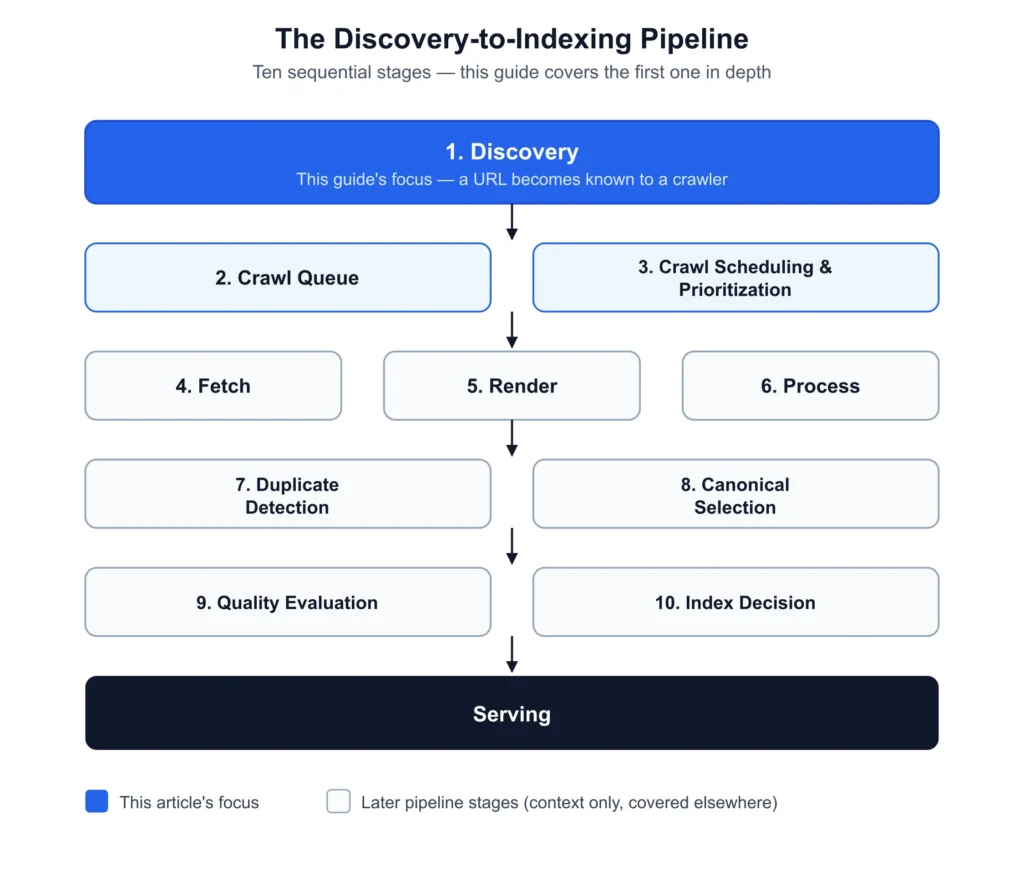
URL discovery pipeline showing how search engines find and process new URLs

1. Internal Links

Internal links are one of the strongest and most controllable discovery signals on a website. When an already known page links to a new URL, search engines can follow that relationship and discover the destination. Strong internal linking also helps communicate how the new page fits into the site’s overall architecture.

Important pages should therefore be reachable through relevant internal links rather than existing as isolated URLs. A logical hierarchy from category pages to supporting content makes discovery more predictable.

2. XML Sitemaps

XML sitemaps provide search engines with a structured list of URLs that a site considers important. They are especially useful for large websites, newly launched sites, sites with complex architectures, and pages that may not receive many internal links.For Google’s recommendations on creating and submitting sitemaps, see the sitemap documentation.

Important: Including a URL in an XML sitemap does not guarantee that search engines will crawl or index it. A sitemap is a discovery signal, not an indexing command.

3. External Links

Search engines can discover URLs when other websites link to them. External links can expose new pages that have not yet been encountered through a site’s internal navigation or sitemap. This can be particularly useful when a page is referenced by authoritative or frequently crawled websites.

4. Redirects and Known URLs

Search engines can also encounter new URLs through redirects, canonical relationships, previously known pages, and other crawlable resources. For example, when a known URL redirects to another URL, the destination can become part of the search engine’s known URL set.

The Discovery-to-Crawl Relationship

Once a URL becomes known, discovery does not automatically mean immediate crawling. Search engines evaluate many factors before requesting the resource, including crawl scheduling, site signals, server responsiveness, URL importance, and available crawl capacity.

This distinction is essential when diagnosing SEO problems. If a URL has not been discovered, adding relevant internal links or submitting an appropriate sitemap may help expose it. If the URL is already known but has not been crawled, the problem may involve crawl prioritization or technical accessibility rather than discovery itself.

  • Discovery: The search engine learns that the URL exists.
  • Crawling: The search engine requests and processes the URL.
  • Indexing: The processed content may be evaluated for inclusion in the search index.

Understanding these stages prevents a common SEO mistake: treating every missing search result as an indexing problem when the underlying issue may actually be URL discovery or crawling.

URL Discovery vs Crawling vs Indexing

URL discovery, crawling, and indexing are three different stages in how search engines process web pages. A search engine must first discover that a URL exists, then crawl the URL to retrieve its content, and finally decide whether the page should be stored in its index. Understanding the difference helps you diagnose why a page is not appearing in search results.

Quick distinction: Discovery means finding the URL, crawling means accessing and processing the page, and indexing means storing the page as a candidate for search results.

1. URL Discovery: Finding the URL

URL discovery is the point at which a search engine becomes aware that a URL exists. Google can discover URLs through internal links, external links, XML sitemaps, redirects, and other known URLs. Discovery does not mean that the page has been crawled or indexed.

For example, a newly published article may be included in an XML sitemap and linked from another page. Google can discover the URL from those signals before it actually requests the page.

2. Crawling: Accessing the Page

Crawling happens when a search engine crawler requests a URL and retrieves its resources. The crawler may fetch the HTML document and, depending on the page, discover additional resources such as images, CSS, JavaScript, and links.

A discovered URL may therefore remain uncrawled for some time. Crawl availability can be affected by factors such as robots.txt rules, server errors, network problems, and crawl scheduling.

3. Indexing: Evaluating and Storing the Page

Indexing occurs after a search engine has processed a crawled page and determined whether it should be included in its search index. A page can be crawled successfully without being indexed. Quality signals, canonicalization, duplicate content, technical directives, and other systems can influence the final indexing decision.

StageWhat happensKey question
DiscoveryThe search engine learns that the URL exists.Does the search engine know the URL?
CrawlingThe crawler requests and processes the URL.Can the page be accessed?
IndexingThe page is evaluated for inclusion in the index.Should the page be indexed?

Why the Difference Matters

These stages should be diagnosed separately. If a URL has not been discovered, improving crawlability alone will not solve the problem. If it has been discovered but not crawled, investigate access and crawl-related issues. If it has been crawled but is not indexed, focus on indexing signals and the page’s overall eligibility rather than simply trying to increase crawl frequency.

Main URL Discovery Methods

Search engines discover URLs through several signals rather than relying on a single source. The strongest discovery paths usually come from links, XML sitemaps, redirects, external references, and other crawlable signals. Understanding how each method works helps you identify why a new URL has been discovered quickly—or why it may remain unknown to search engines.01

Internal Links

Internal links are one of the most important ways search engines discover URLs within a website. When an already-known page links to a new or previously unknown URL, crawlers can follow that link and add the destination URL to their crawl queue.

Effective internal linking also provides context about the relationship between pages. Links from relevant, authoritative pages can make important URLs easier to discover and can strengthen the site’s overall information architecture.02

XML Sitemaps

XML sitemaps provide search engines with a structured list of URLs that a site considers important. They are particularly useful for large websites, newly published content, deep pages, and URLs that may not receive many internal links.

A sitemap is a discovery signal, not a guarantee of crawling or indexing. URLs included in a sitemap should still be accessible, canonicalized correctly, and free from technical barriers that prevent normal crawling.03

External Links

Search engines can discover a URL when another website links to it. External links can expose pages that have limited internal linking, especially when the referring page is already known and regularly crawled.

External discovery does not mean that every referring link will result in immediate crawling. Search engines evaluate many signals when deciding whether and when to crawl a discovered URL.04

Redirects

Redirects can introduce search engines to destination URLs that they did not previously know. This commonly happens when an old URL redirects to a new URL after a migration, URL restructuring, or content consolidation.

Redirect chains and unnecessary redirect hops should be avoided because they can complicate crawling and make URL management harder to maintain.05

Browser and Web Signals

URLs can also become known through other web-accessible signals and previously encountered resources. For example, a URL referenced by crawlable HTML, structured navigation, or other discoverable page elements may eventually enter a search engine’s URL processing systems.

The key requirement is that the URL must be exposed through a signal that a crawler can access. A URL that exists only in a private interface or requires an unavailable interaction may not be discoverable through normal crawling.Key point:

URL discovery and indexing are different processes. A search engine may discover a URL without immediately crawling or indexing it. Treat discovery signals as ways to make important URLs known, not as guarantees that those URLs will appear in search results.

Quick Discovery Check

  • Important URLs have relevant internal links.
  • Indexable URLs are included in the appropriate XML sitemap.
  • Important pages are not isolated from the site’s crawlable architecture.
  • Redirects point directly to the intended destination.
  • Critical URLs can be accessed without requiring unavailable interactions.

XML Sitemaps

An XML sitemap is one of the clearest signals you can provide to search engines about the URLs that matter on your website. It gives crawlers a machine-readable list of important canonical URLs, helping them discover pages that may be difficult to reach through internal links alone.

A sitemap does not force a search engine to crawl or index every URL. Instead, it improves URL discovery by providing an additional path through which search engines can learn about pages and changes to existing content. This is especially useful for large websites, newly published pages, deep content, and sites where internal linking is still developing.

Quick Answer: Use XML sitemaps to expose important canonical URLs to search engines. Keep the sitemap clean, current, accessible, and limited to URLs that you actually want search engines to discover and potentially index.

How XML Sitemaps Help URL Discovery

Search engines can discover URLs through several sources, including internal links, external links, redirects, browser navigation signals, and XML sitemaps. A sitemap acts as a structured discovery source, particularly when a page has few or no internal links pointing to it.

The strongest setup is not to rely on the sitemap alone. Important pages should normally be included in the sitemap and supported by a logical internal-link structure. This gives crawlers both a direct URL list and contextual paths for reaching those pages.

What Should Be Included?

URL TypeSitemap StatusReason
Canonical indexable pageIncludePrimary URL you want discovered and indexed.
Redirecting URLExcludePoint the sitemap to the final destination instead.
404 / unavailable URLExcludeIt is not a valid target for search discovery.
Noindex URLUsually excludeA sitemap should reinforce indexable URL ownership.

XML Sitemap Best-Practice Checklist

  • Include important canonical URLs.
  • Remove redirects, broken URLs, and unwanted pages.
  • Keep sitemap files automatically updated when possible.
  • Submit the sitemap through the appropriate search-engine tools.
  • Make sure the sitemap remains accessible to crawlers.
  • Use internal links alongside sitemap discovery.

Important: A URL appearing in an XML sitemap is a discovery signal, not an indexing guarantee. If a page has canonicalization, quality, access, rendering, or indexing problems, adding it to a sitemap will not automatically resolve those issues.

XML Sitemap vs Internal Links

Sitemaps and internal links serve different but complementary purposes. A sitemap provides a structured list of URLs, while internal links provide navigational context and help establish relationships between pages. For important content, using both is generally stronger than depending exclusively on either one.

Internal Links

Internal links are one of the most important signals for helping search engines discover URLs within a website. An internal link connects one page on your site to another page on the same domain, giving crawlers a path to follow and helping them understand how individual URLs relate to the broader site structure.

For URL discovery, the key question is not simply whether a page has internal links. The quality, relevance, placement, and accessibility of those links also matter. A page buried several clicks deep with no meaningful internal links can be harder to discover than a page that is consistently connected from relevant, crawlable content.

Key point: Internal links create crawlable paths between URLs. A strong internal linking structure helps search engines discover important pages while also communicating their relationship and relative importance.

How Internal Links Help URL Discovery

Search engines can discover URLs through many sources, but internal links provide a controlled path through your own website. When a crawler reaches a page, it can follow qualifying internal links to discover additional URLs. This makes internal linking particularly important for pages that are not directly listed in an XML sitemap or frequently referenced from external websites.

  • Connect important pages to crawlable entry points.
  • Help crawlers reach deeper pages within the site architecture.
  • Establish relationships between related topics and content clusters.
  • Provide contextual signals about the destination page.
  • Reduce the risk of important URLs becoming isolated or orphaned.

Orphan Pages and Discovery Risk

An orphan page is a URL that has little or no internal linking support from other crawlable pages on the site. A page may still be discoverable through an XML sitemap, external links, redirects, or other sources, so an orphan page is not automatically undiscoverable. However, relying on secondary discovery sources alone can create unnecessary weaknesses in site architecture.

Warning: Do not assume that adding a URL to an XML sitemap replaces the need for relevant internal links. Sitemaps and internal links serve different architectural purposes.

Where to Add Internal Links

The strongest internal linking opportunities usually come from existing pages that are topically relevant to the destination. Links should be placed where they naturally help the reader continue to a related subject, supporting detail, definition, example, or next step.

Source PageDestinationPurpose
Topic hubSupporting pageImprove topical navigation and discovery
Related articleRelevant guideProvide contextual navigation
High-authority pageImportant new URLGive the new page a crawlable pathway
Category or hub pageDeep contentReduce architectural depth

Use Descriptive Anchor Text

Anchor text should give readers and search engines a reasonable indication of what they can expect after following the link. Descriptive anchors are generally more useful than vague phrases such as “click here” or “read more,” particularly when several links appear on the same page.

For example, a page about crawlability can naturally link to a relevant guide on XML sitemaps when that resource provides additional information needed by the reader.

Build Links Across Content Clusters

Internal linking becomes more powerful when it reflects a deliberate topic architecture. A hub page can link to supporting pages, supporting pages can link back to the hub, and closely related supporting pages can connect to one another where the relationship is useful.

  • Link important supporting pages from relevant hub content.
  • Link supporting pages back to their appropriate hub when useful.
  • Connect closely related articles with contextual links.
  • Check that important URLs are not isolated from the crawlable site structure.
  • Review internal links after publishing new content.

Internal Links Are Not a Guarantee of Indexing

An internal link can help a search engine discover a URL, but discovery does not guarantee crawling, indexing, or ranking. Search engines evaluate additional signals and may decide that a discovered URL should not be crawled immediately, rendered, indexed, or surfaced in search results.

Therefore, internal linking should be treated as one part of a broader URL discovery system that also includes XML sitemaps, site architecture, crawlable navigation, canonicalization, robots directives, and technical accessibility.

Practical rule: Every important indexable URL should have a logical place in the site’s internal linking structure. When auditing URL discovery, look beyond individual links and evaluate whether the overall site provides clear, crawlable paths to important content.

External Links & Referrals

External links can help search engines discover URLs they have not encountered through a site’s internal structure. When another website links to a page, crawlers may follow that referral and add the destination URL to their discovery pipeline. This is particularly useful for new pages, sites with limited internal linking, or URLs that are difficult to reach through normal navigation.

A referral does not guarantee crawling or indexing. Search engines still evaluate the destination based on factors such as accessibility, canonical signals, content quality, duplication, and indexing eligibility. An external link should therefore be treated as a discovery signal, not an indexing guarantee.

Key point: External links can introduce a URL to a search engine, but they do not replace a strong internal linking structure or an accurate XML sitemap.

How Referral Discovery Works

  1. A crawler encounters a link on an external website.
  2. The crawler identifies the linked destination URL.
  3. The URL enters the search engine’s discovery and processing pipeline.
  4. The destination may later be crawled and evaluated for indexing.

When External Referrals Matter Most

  • New websites with few established internal signals.
  • New pages that have not yet been discovered through internal links.
  • Important resources referenced by relevant third-party websites.
  • Pages whose discovery depends on links rather than navigation.

The best approach is to combine external referrals with clear internal links, crawlable navigation, XML sitemaps, and consistent canonical signals. This creates multiple legitimate paths through which important URLs can be discovered.

Google Search Console & URL Discovery

Google Search Console (GSC) does not directly show every URL discovery event, but it provides several reports and tools that help you understand whether Google knows about a URL, has crawled it, and has decided to index it. This makes GSC one of the most useful diagnostic tools when a new or updated page is not appearing in Google Search.

Use URL Inspection to Check Google’s Current View

The URL Inspection tool is usually the best starting point. It can help you determine whether Google has indexed a specific URL and whether the version currently known to Google differs from the live page. Start by checking the exact canonical URL rather than a redirect, parameter variation, or alternate version.

Important: A URL can be known to Google without being indexed. Likewise, a page can be discovered before Google decides to crawl it. Treat discovery, crawling, and indexing as separate stages when diagnosing visibility problems.

Use Sitemaps as a Discovery Signal

The Sitemaps report helps confirm whether Google can access the XML sitemap files you submitted. A sitemap does not guarantee that every URL will be crawled or indexed, but it gives Google a structured source of URLs that you want search engines to consider.

Review sitemap status regularly, especially after migrations, large content updates, CMS changes, or technical fixes. URLs included in a sitemap should generally be canonical, accessible, and useful enough to be indexed. Submitting low-quality, redirected, blocked, or duplicate URLs can make sitemap data harder to interpret.

Request Indexing Carefully

After publishing an important new page or making a substantial update, you can use URL Inspection to request crawling. This can help bring the URL to Google’s attention, but it is not an instant indexing command or a replacement for strong internal linking and sitemap management.

Do not rely on repeated indexing requests. If a URL is consistently not crawled or indexed, investigate its internal links, canonical signals, robots directives, HTTP status, content quality, and overall site architecture.

A Practical GSC Discovery Workflow

  1. Inspect the exact canonical URL.
  2. Check whether Google reports an indexing or crawling issue.
  3. Confirm the URL appears correctly in the XML sitemap.
  4. Verify that important internal links point to the page.
  5. Fix technical blockers before requesting another crawl.

Robots.txt & URL Discovery

robots.txt file helps control which URLs search-engine crawlers are allowed to request. It can influence crawling, but it should not be treated as a reliable method for making a URL undiscoverable. Search engines may learn about a blocked URL through internal links, sitemaps, external links, or other references even when they cannot crawl the page.

Key point: robots.txt controls crawler access; it does not function as a universal URL-removal or no-index mechanism.

How Robots.txt Affects Discovery

When a crawler encounters a robots.txt file, it checks the applicable rules before requesting URLs on the site. A rule such as Disallow: /private/ can prevent crawling of matching URLs. However, the existence of a disallowed URL can still become known through other signals. Therefore, blocking a URL in robots.txt does not guarantee that search engines will never know about it.

ConfigurationDiscovery impact
DisallowCan prevent crawling of matching URLs.
XML sitemapProvides URLs that crawlers can discover.
Internal linksProvide crawlable discovery paths.

Common Robots.txt Discovery Mistakes

Blocking important URLs that should be crawled.

Assuming Disallow removes a URL from search results.

Blocking CSS or JavaScript resources required for rendering.

Using robots.txt as a substitute for proper indexing controls.

For effective URL discovery management, keep important pages accessible to crawlers, maintain accurate internal links and XML sitemaps, and use the appropriate indexing controls when a URL should not appear in search results.

JavaScript & URL Discovery

JavaScript can affect how search engines discover URLs, especially when important links or navigation elements are generated dynamically. A page may appear to contain links for users while the underlying HTML provides few or none for crawlers to discover. For reliable URL discovery, important internal links should be available in crawlable HTML rather than depending entirely on client-side JavaScript.

How JavaScript Can Affect URL Discovery

Modern websites often use JavaScript to build menus, filters, product listings, infinite-scroll interfaces, and other navigation elements. When a URL is only created after JavaScript executes, discovery can become more dependent on rendering. This does not automatically make the URL undiscoverable, but it can introduce unnecessary complexity.

Search engines can process JavaScript, but relying on rendering for basic site navigation is generally less robust than providing normal HTML links. Important URLs should therefore be linked with standard anchor elements using valid, descriptive href attributes.

JavaScript URL Discovery Checklist

Use standard HTML <a href="..."> links for important internal URLs.

Make primary navigation available without requiring a user interaction.

Avoid making critical URLs dependent only on click handlers or JavaScript events.

Ensure dynamically loaded content does not hide important discoverable links.

Use XML sitemaps as a supporting discovery signal for important URLs.

Key point: JavaScript is not inherently a URL discovery problem. The main risk occurs when important URLs exist only inside client-side application logic and are not exposed through reliable crawlable links or other discovery signals.

How to Diagnose a JavaScript Discovery Problem

Compare the raw HTML with the rendered page and check whether important internal links are present in both. If a URL appears only after JavaScript execution, investigate whether search engines can reliably render the required content and whether another discovery path, such as an HTML link or XML sitemap, is available.

Common URL Discovery Problems

URL discovery problems occur when search engines do not become aware of a page, discover it much later than expected, or receive weak signals that make the URL difficult to find. A page can be technically accessible and still have poor discoverability if it is isolated from the site’s link structure, missing from relevant sitemaps, or blocked by configuration. Identifying the actual discovery problem is important because discovery, crawling, and indexing are separate stages.

Quick diagnosis: If a URL is not appearing in search, first determine whether search engines have discovered it. Do not assume that every visibility problem is an indexing problem.

1. No Internal Links Point to the URL

An orphan URL has no meaningful internal links pointing to it from pages that search engines can already discover. This can make discovery slower because crawlers have fewer paths through which they can reach the page. Important pages should normally be connected to relevant category pages, hub pages, navigation, contextual content, or other useful internal resources.

2. The URL Is Missing From the XML Sitemap

A missing URL does not automatically prevent discovery, because search engines can discover URLs through links and other signals. However, an XML sitemap is an important discovery aid, particularly for large websites, newly published content, and pages with limited internal links. Make sure important canonical URLs are represented correctly in the sitemap.

3. Robots.txt Blocks the Crawler

An overly restrictive robots.txt rule can prevent a crawler from accessing a URL or its directory. This is especially risky when broad disallow rules unintentionally cover valuable content. Review the site’s robots.txt file whenever an important URL appears difficult to crawl or discover.

Important: Robots.txt is a crawling control mechanism, not a reliable method for removing a URL from search results. Blocking crawling can also limit a crawler’s ability to understand the page.

4. Poor Site Architecture

URLs buried several levels deep in an inconsistent site structure may receive fewer discovery signals than strategically connected pages. A logical hierarchy helps crawlers move from broad sections to related content. Important pages should not depend on obscure or temporary paths to become discoverable.

5. JavaScript-Dependent Links

Some websites generate navigation or links primarily through JavaScript. If important URLs are not represented as crawlable links or require interactions that crawlers cannot reliably process, discovery can become more difficult. Critical URLs should have clear, accessible linking paths in the rendered site.

6. Recently Published or Updated URLs

A newly created URL may simply have not been discovered yet. Discovery timing can vary depending on the site’s size, internal linking, sitemap signals, publishing frequency, and other crawl signals. Avoid repeatedly changing the URL while waiting for discovery; instead, strengthen its legitimate discovery paths and verify the technical setup.

7. Confusing Discovery With Indexing

A URL can be discovered but not crawled, crawled but not indexed, or indexed without ranking prominently. These states require different diagnoses. Before changing technical settings, verify the URL’s actual status and identify which stage of the search engine process is causing the problem.

URL Discovery Troubleshooting

When a new or updated URL does not appear in Google, the first step is to determine whether the problem is discovery, crawling, rendering, or indexing. These stages are connected, but they are not the same. A URL may be completely unknown to Google, discovered but not crawled yet, crawled but excluded from the index, or indexed but not appearing for the query you expect.

Start with the URL itself rather than changing several technical settings at once. Confirm that the page is live, returns a successful HTTP response, has a valid canonical URL, and can be reached through your site’s internal linking structure. Then use Google Search Console’s URL Inspection tool to determine what Google knows about the page.
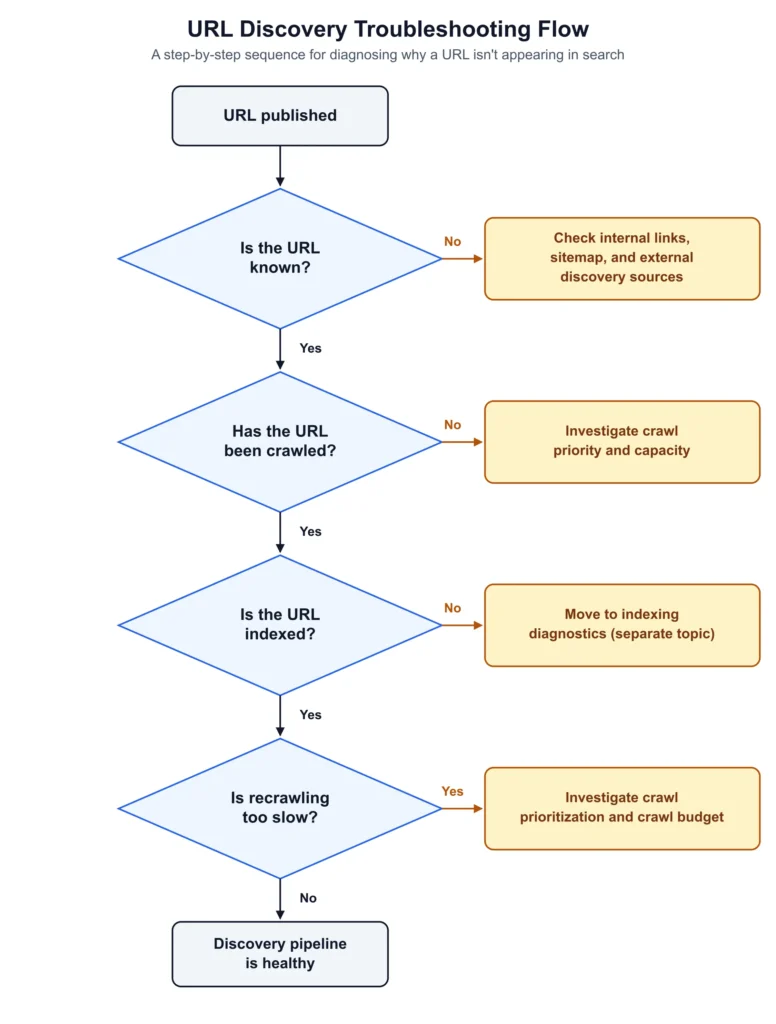
URL discovery troubleshooting flow for diagnosing search engine discovery problems

Quick diagnosis: If Google has never encountered the URL, improve discovery signals such as internal links and XML sitemaps. If Google knows the URL but has not crawled it, investigate crawl accessibility and crawl prioritization. If it has been crawled but excluded, focus on indexing, canonicalization, content quality, or technical directives.

1. The URL Is Not Discovered

A URL with no meaningful discovery path can remain unknown to search engines. This commonly happens with newly published pages, orphan pages, dynamically generated URLs, or pages that are only accessible through forms or client-side interactions.

  • Add relevant internal links from already discoverable pages.
  • Include the canonical URL in the appropriate XML sitemap.
  • Check that the URL is not accidentally blocked by robots.txt.
  • Verify that navigation and contextual links expose important pages.

2. The URL Is Discovered but Not Crawled

Discovery does not guarantee immediate crawling. Search engines prioritize URLs according to many signals, including site structure, perceived importance, freshness, and available crawl capacity. If a URL is repeatedly discovered but remains uncrawled, review whether the site creates excessive low-value URLs or makes important pages difficult to reach.

Reduce unnecessary URL variations, strengthen internal linking to priority pages, maintain a clean sitemap, and make sure the server can respond reliably when crawlers request important resources.

3. Google Crawled the URL but It Is Not Indexed

If Google has crawled a page but has not indexed it, the issue is no longer simple URL discovery. Check the page’s noindex directives, canonical signals, content quality, duplication, and overall usefulness. A technically accessible page can still be excluded from search results.

4. Internal Links Are Missing or Weak

Internal links provide both users and crawlers with paths through a website. Important URLs should normally be connected to relevant pages rather than existing as isolated destinations. Review your site’s navigation, category pages, hub pages, and contextual links to identify orphaned or weakly connected URLs.

5. Sitemap and Canonical Signals Conflict

A sitemap should generally contain the canonical URLs that you want search engines to discover and consider. If a sitemap lists one URL while the page declares a different canonical URL, investigate the mismatch. Consistent signals make the intended URL easier for search engines to understand.

6. Use a Simple Troubleshooting Sequence

Confirm the URL returns a successful response.

Check robots.txt and meta robots directives.

Inspect the URL in Google Search Console.

Verify the canonical URL.

Check whether the page appears in the XML sitemap.

Confirm relevant internal links point to the page.

Review duplicate, thin, or low-value URL patterns.

Fix the underlying issue before requesting another crawl.

The key is to troubleshoot the correct stage. Discovery problems require discoverability signals; crawling problems require accessibility and crawl analysis; indexing problems require indexability and content analysis. Separating these stages prevents unnecessary technical changes and makes URL discovery troubleshooting much more systematic.

Best Practices for Better URL Discovery

Strong URL discovery helps search engines find important pages efficiently without relying on a single discovery source. The goal is not simply to create more URLs, but to make valuable URLs easy to discover, understand, and prioritize. Use the following best practices as a practical URL discovery checklist when publishing new content or troubleshooting pages that search engines have not found.

Quick rule: Every important indexable URL should be discoverable through a logical combination of internal links and, where appropriate, an XML sitemap. Do not depend on search engines discovering important pages through external links alone.

URL Discovery Checklist

Link important pages internally: Make sure valuable pages are connected from relevant, crawlable pages on your site.

Maintain accurate XML sitemaps: Include canonical, indexable URLs that you want search engines to discover and process.

Use descriptive URLs: Keep URL structures logical, consistent, and easy for users and search engines to understand.

Link important pages internally: Make sure valuable pages are connected from relevant, crawlable pages on your site.

Fix orphan pages: Identify important pages that have no meaningful internal links pointing to them.

Review robots.txt carefully: Avoid accidentally blocking URLs or resources that search engines need to access and process your website correctly.

Link important pages internally: Make sure valuable pages are connected from relevant, crawlable pages on your site.

Control URL variations: Reduce unnecessary duplicate parameters, session URLs, filters, and other URL variations that can create discovery noise.

Control URL variations: Reduce unnecessary duplicate parameters, session URLs, filters, and other URL variations that can create discovery noise.

Update internal links when publishing: Connect new content to relevant existing pages instead of publishing it as an isolated URL.

Final URL Discovery Review

Before publishing, verify that the page is intended to be indexable, has a stable canonical URL, is accessible through appropriate internal links, and is included in the XML sitemap when applicable. After publication, monitor whether search engines discover and process the URL. If discovery is slow, check the site’s internal linking, sitemap, robots.txt rules, URL structure, and crawl accessibility before making unnecessary changes.

Important: Being included in an XML sitemap does not guarantee crawling or indexing. Treat the sitemap as one discovery signal within a broader technical SEO system.

Frequently Asked Questions About URL Discovery

URL discovery is the process through which search engines become aware that a URL exists. Search engines can discover URLs through XML sitemaps, internal links, external links, redirects, and other known web resources.

Google can discover new URLs from internal links, XML sitemaps, links from other websites, and previously known URLs. Discovery does not guarantee that Google will crawl or index the page.

No. An XML sitemap helps search engines discover URLs, but it does not guarantee crawling or indexing. The page must still meet technical, quality, canonical, and indexing requirements.

Yes. Discovery and crawling are separate stages. A search engine may know about a URL but delay crawling it because of crawl prioritization, site signals, server capacity, or other factors.

Use a clean XML sitemap, strengthen relevant internal linking, avoid orphan pages, keep important URLs accessible to crawlers, and monitor discovery and indexing signals in Google Search Console.