
AI Overviews Tracking Tools: Features, Pricing and Limitations
By Mousume Akter, Founder & Editor, SEORAF. Features and prices checked on 18 October 2026. See how this page was researched.
AI Overviews tracking tools check whether Google shows an AI Overview for queries you choose, whether your brand is named in it, which pages it cites, and how those results change over time. They work by sampling: a tool checks a query in a set location, on a set device, at a set time, and stores what it saw. That makes them useful for spotting patterns and competitor presence. It does not make them reliable for telling you what every searcher saw, how many people clicked, or why a change happened.
Tools differ most in how they gather that sample (keyword-level monitoring, scheduled prompts, or a pre-collected research index) and in how they bill for it. This guide explains what the measurements mean, compares four tools whose AI Overviews features and pricing we could confirm on official pages, lists four more where the evidence is incomplete, and sets out a workflow that avoids the most common misreadings.
SEORAF did not run hands-on tests of these tools for this article. Everything below comes from official documentation and pricing pages checked on 18 October 2026, plus third-party reports that are labeled as such. Prices and features change often, so confirm them with the vendor before you buy.
Key takeaways
- Trackers sample results. Treat their numbers as indicators of change and competitor presence, not as a census of what users saw.
- An appearance, a mention, a citation, an organic ranking and a visit are five different measurements. No tool converts one into another.
- Start with Google’s own Search Console generative AI performance report, which reports impressions for generative AI features but does not list clicks, click-through rate or query data in the documentation reviewed.
- Choose by data method, reporting needs and billing unit. Jump to the comparison tables.
- Ahrefs Brand Radar, Semrush, SEOmonitor and SE Ranking have the best-documented AI Overviews features and pricing. Four other tools are documented only in part.
How to read the evidence labels. Official documentation means a vendor or Google help page or pricing page. Vendor claim means marketing wording we could not confirm. Independent report means a third-party source. SEORAF recommendation is our judgment. Not verified means we could not confirm it.
Independence and affiliate disclosure. SEORAF is supported in part by affiliate partnerships with some software vendors. Vendor links in this article point to official documentation and pricing pages, not affiliate links. Tools appear in alphabetical order, and commissions played no part in deciding which tools to cover.
What AI Overviews tracking tools measure, and what they can’t
Every tracker here works by checking a query or prompt and storing what Google’s AI Overview showed at that moment. That one design choice sets the limits of what the data can support.
What they can measure
- Whether an AI Overview appeared for a tracked query at the time of the check.
- Whether your brand name appeared in the AI Overview text (a mention).
- Which URLs the AI Overview cited and, in some tools, where yours sat among them.
- Which competitors were mentioned or cited.
- How those results changed between checks, where the tool keeps history or snapshots.
Official documentation: SEOmonitor documents separate mention and citation tracking and saved daily snapshots. SE Ranking documents source analysis and cached copies of results. Ahrefs documents mentions, citations and share of voice.
What they can’t reliably measure
- Clicks and traffic. Tools that show traffic figures describe them as estimates. SE Ranking says its tracker estimates potential traffic from AI Overviews, and SEOmonitor describes an estimated click-through-rate impact. Both are vendor claims, and we could not verify the models behind them.
- Why something changed. A tracker records that a citation appeared or disappeared. It cannot tell you the cause.
- What an individual user saw. Ahrefs states that it captures responses without stored user data or personalization, so its data is a neutral sample by design.
- A stable ranking. A citation position in an AI Overview is a snapshot, not a durable rank.
- Complete coverage. Not every query triggers an AI Overview. Semrush’s knowledge base says as much.
How this differs from related tracking
| Related term | What it covers | Why it is not the same |
|---|---|---|
| AI Mode tracking | Google’s conversational search mode | Ahrefs lists AI Overviews and AI Mode as separate indexes. Support for one does not establish support for the other. |
| Classic rank tracking | Organic positions in standard results | A separate measurement. Some suites, such as Semrush’s Position Tracking, report both. |
| Broader AI visibility tools | Prompts run through ChatGPT, Perplexity, Gemini and others | Supporting those engines does not mean a tool tracks Google AI Overviews. We required explicit AI Overviews documentation. |
| Search Console Generative AI report | Google’s first-party impressions for generative AI features | It reports what Google served to users, not what a tracker sampled. See the Google data section. |
Appearances, mentions, citations, rankings and traffic: five different things
Reports blur these terms, and the blur produces bad decisions. The definitions below are SEORAF’s working definitions. Vendors define their own scores differently.
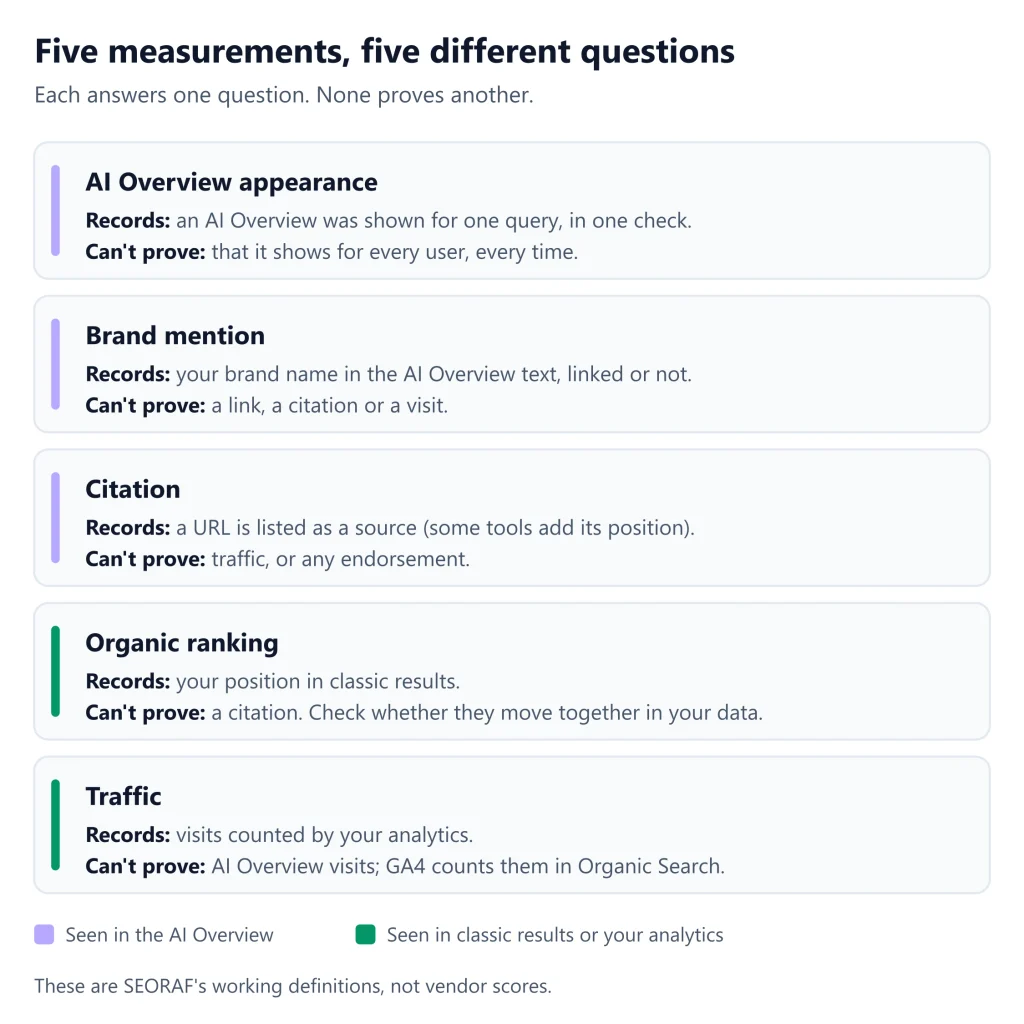
| Measurement | What it records | Where it comes from | Common misreading |
|---|---|---|---|
| AI Overview appearance | An AI Overview was shown for a query in one check | Tracker sample | Assuming it shows for every user, every time |
| Brand mention | Your brand name appears in the AI Overview text, linked or not | Tracker text analysis | Treating a mention as a citation or a visit |
| Citation | A URL is listed as a source; some tools also record its position | Tracker snapshot | Treating a citation as traffic or as endorsement |
| Organic ranking | Your position in classic results | Rank tracker or Search Console | Assuming a high ranking implies a citation. Whether they move together is something to test in your own data. |
| Traffic | Visits recorded by your analytics | GA4 or similar | Assuming AI Overview visits can be isolated in standard GA4 channels (they can’t, see below) |
Some vendors separate these explicitly. SEOmonitor tracks brand mentions and citations separately (official documentation). Pro Rank Tracker’s AI Overviews page describes links and mentions as separate metrics. Scores such as share of voice or visibility score are vendor-defined, so they are not comparable across tools. SEORAF recommendation: record the underlying fields (mention, cited URL, position, date, location, device) rather than relying on a composite score.
What Google already reports for free
Before you pay for a tracker, check what Google’s own tools show. They measure something different from a tracker: what Google served to real users, rather than what a tool sampled.

Search Console’s Generative AI report
Google introduced Search generative AI performance reports on 3 June 2026. Google reported that rollout to websites worldwide was completed by 31 August 2026. The help page describes impressions, with breakdowns by page, country, device and date (official documentation). It does not list clicks, click-through rate or query data, and the report does not provide a separate AI Overviews-only view. The report covers generative AI features in Search, so do not interpret its totals as AI Overviews-only data.
Google’s AI features documentation says traffic from these features is counted in the Web search type of the standard Performance report. In the standard Performance report, we found no filter that isolates AI Overviews from other Web search activity; use the separate generative AI performance report for the aggregate generative-AI impression data it provides.
Where AI Overview clicks appear in GA4
Google’s GA4 traffic-source documentation places clicks from Google’s AI Overviews and AI Mode in the Organic Search channel. The AI Assistant channel excludes them (official documentation). In standard channel reports you therefore cannot isolate AI Overview visits, and some third-party articles that say otherwise are wrong.
What a third-party tracker adds
- Per-query detail: whether an AI Overview appeared and which URLs it cited.
- Competitor mentions and citations.
- Change history or saved snapshots, where the tool provides them.
- Location, language or device views, which vary by tool.
How AI Overviews trackers collect their data
Two tools can show different results for the same keyword without either being wrong, because they may collect data in different ways. We found three methods in the documentation.

Keyword-level monitoring
The tool checks each keyword you add and records the AI Overview it finds. SEOmonitor, SE Ranking and Semrush’s Position Tracking document this approach. Its strength is evidence tied to your own keyword list. Its limit is that you only see the keywords you pay to track.
Scheduled prompts
The tool runs questions you define on a schedule. Ahrefs offers custom prompts, and Semrush’s Brand Performance generates what it calls synthetic prompts from your domain and location, updated weekly. Prompts are proxies for real queries, and the units tools bill for vary.
Pre-collected research indexes
The vendor collects data in advance and lets you query it. Ahrefs says its AI Overviews index updates every few days, goes back to August 2024, and is built from questions drawn from People Also Ask. Semrush’s Visibility Overview draws on its Prompt Database. This is quick to use and good for competitor research, but it reflects the vendor’s prompt set, not necessarily your queries.
Why the same query can look different
Ahrefs states that it runs prompts in each platform’s web version, in the same location as the source keyword, with no personalization. A different tool may use a different location, device or time. SEORAF recommendation: before concluding one tool is wrong, compare method, location, device, language and timing.
What to check before you choose a tool
SEORAF recommendation: score any tracker against these questions, using the vendor’s documentation rather than its marketing page.
- Does the official documentation name Google AI Overviews, not just “AI search”?
- Is the method keyword-level, prompt-based or an index?
- Are mentions and citations recorded separately, and at URL level?
- Are snapshots or history kept, and for how long?
- Can you set location, language and device for AI Overviews specifically?
- How often does the data update?
- What does the plan count and bill: keywords, prompts, checks, credits or something else?
- How many competitors can you compare?
- What can you export, and is there an API?
- What does the trial include?
Billing units are not interchangeable. Semrush charges per added domain and per added user for its AI Visibility Toolkit. Ahrefs meters custom prompt checks. Pro Rank Tracker bills in Terms, and an AI prompt costs two Terms. A cheap headline price can hide a small allowance.
AI Overviews tracking tools compared
Inclusion rule. A tool gets a full evaluation when official pages confirm AI Overviews support and current pricing with its billing unit. Trial or free-access details are included when confirmed; otherwise, they are marked “Not verified.” Four tools met the support-and-pricing bar (listed alphabetically below). Four more document AI Overviews support but have incomplete pricing or limits, and appear in a short list after the evaluations. Keyword.com is not evaluated because we could not confirm Google AI Overviews as a supported engine on its official pages. That says nothing about its quality.
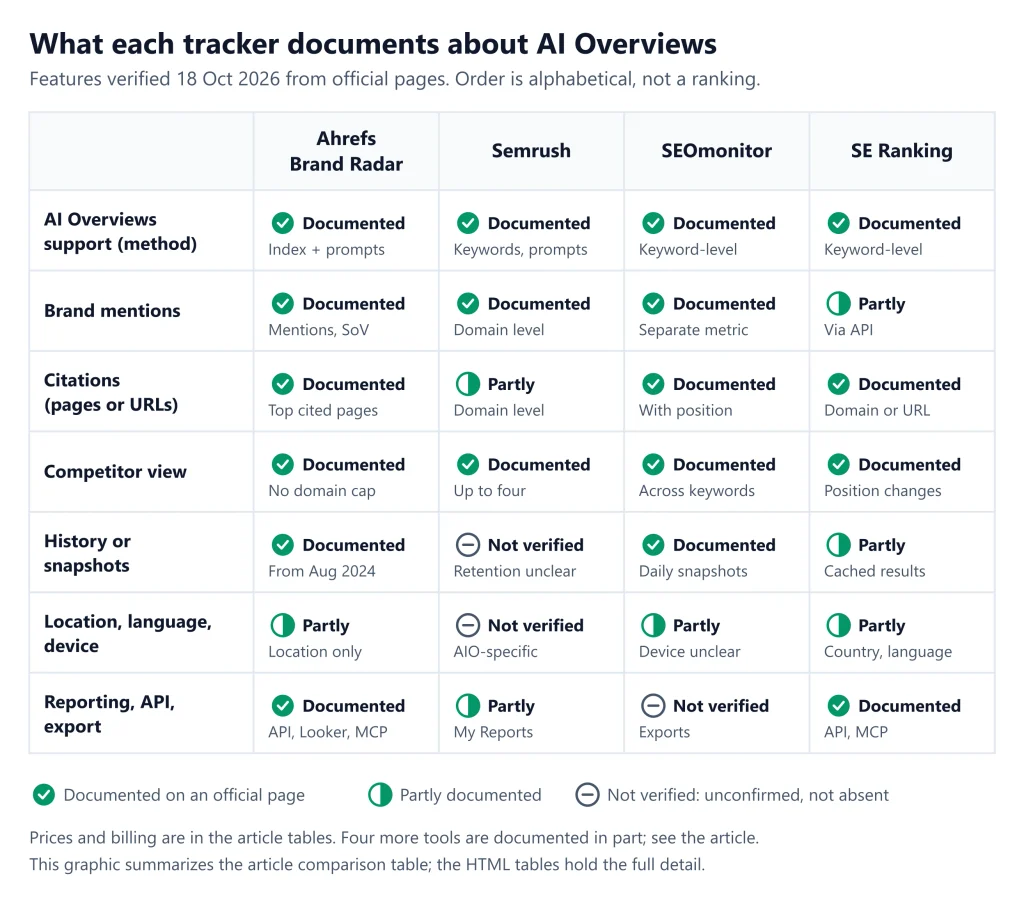
| Tool | How it gets AI Overview data | AI Overviews evidence | Mentions and citations | Competitors | Not verified |
|---|---|---|---|---|---|
| Ahrefs Brand Radar | Pre-collected index built from modeled prompts, plus scheduled custom prompts | Index updates every few days; history from August 2024; custom prompts on AI Overviews from Lite plans | Mentions, citations, share of voice; top cited pages and domains | Benchmarking; no cap on domains analyzed | Language and device options; trial; base plan prices |
| Semrush | Keyword tracking (Position Tracking, Organic Rankings) plus synthetic prompts and a Prompt Database | AI Overviews tracking on any free or paid plan; Brand Performance covers AI Overviews weekly | Mentions and cited pages at domain level; whether a domain is cited per keyword; URL-level detail per keyword not verified | Up to four in Competitor Research | AI Overviews location and device options; history retention; per-plan allowances |
| SEOmonitor | Keyword-level monitoring with saved daily snapshots | Detection since June 2024; mentions and citations tracked separately since September 2025 | Separate mention and citation tracking, including citation position, for you and competitors | Competitor detection across tracked keywords | Device scope per plan (pages conflict); Pro price (two versions); exports |
| SE Ranking | Keyword-level monitoring in its rank tracker, plus an AIO Research tool | Presence analytics, sources, cached results, country and language filters (page modified 31 August 2026) | Sources by domain or URL; mentions and competitor citations available through its API | Tracks competitor position changes | Whether AI Overview checks use keyword or prompt allowances; paid-plan device options; history retention |
| Tool | Entry price and billing unit | What drives extra cost | Trial or free access |
|---|---|---|---|
| Ahrefs Brand Radar | One AI index $199/month; all platforms $699/month (includes 2,500 custom prompt checks); custom prompt tiers $50, $100 or $250/month | Overage of $0.020, $0.015 or $0.010 per extra check; AI indexes need a Brand Radar add-on on any paid plan | Not verified |
| Semrush | SEO Toolkit from $139.95/month; AI Visibility Toolkit $99/month; Semrush One from $199/month | $99 per added domain; $99 per added user license; 50 extra prompts for $60/month | 7-day trial; free plan includes AI Overviews tracking in Position Tracking (limits not verified) |
| SEOmonitor | Starter listed from €99/month; Pro price not confirmed (pages conflict: €299 vs €290); yearly billing is advertised as saving 17% | Chatbot AI search tracking is +€19 per 1,000 keywords; daily-keyword add-on prices differ between page versions | 14-day trial, no credit card |
| SE Ranking | Core $103.20/month billed annually; Growth $223.20/month billed annually | Annual plans are billed upfront; AI Search add-on from $71.20/month (contents not verified) | 14-day trial with starter usage; free check of 5 keywords per day |
Sources: Ahrefs Help Center (page dated 3 September 2026), Semrush AI visibility features and AI Visibility Toolkit pages, SEOmonitor pricing, and SE Ranking’s AI Overviews tracker and pricing pages.
Tool evaluations
Tools are listed alphabetically, which implies no ranking. Each evaluation draws on official pages unless labeled otherwise.
Ahrefs Brand Radar
Best fit: teams that want to research which brands and pages AI Overviews cite for a topic across AI platforms, and to track a smaller set of custom prompts.
AI Overviews features: an AI Overviews index (with AI Mode) alongside ChatGPT, Perplexity, Gemini, Copilot and others; custom prompts on AI Overviews from Lite plans; history from August 2024; an index refreshed every few days.
Data and reporting: an Overview report with share of voice, mentions, citations and impressions; top cited pages and domains; saved reports, an API, MCP access, a Looker Studio connector and Report Builder.
Pricing and access: $199/month for a single index, $699/month for all platforms (including 2,500 custom prompt checks), or custom prompt tiers of $50, $100 and $250/month. Prices are in USD and may vary by region. Trial terms and base plan prices: not verified.
Advantages: a documented method and freshness table; no cap on the number of domains you can analyze; long history.
Disadvantages: the AI Overviews index comes from Ahrefs’ own prompt set, so it may not match your queries; custom prompt checks are metered; AI indexes need an add-on on any paid plan.
Skip it if: your main need is daily keyword-by-keyword monitoring of a fixed list you already track, or you require documented language and device options (not verified).
Evidence: official documentation, Ahrefs Help Center.
Semrush
Best fit: teams already on Semrush who want AI Overviews status by keyword plus competitor benchmarking, and possibly prompt tracking across AI platforms.
AI Overviews features: Position Tracking records AI Overviews appearances for custom keywords on any free or paid plan; Organic Rankings shows which keywords in a domain’s portfolio trigger an AI Overview and whether the domain is cited; Brand Performance runs synthetic prompts weekly across AI Overviews, AI Mode, ChatGPT, Perplexity and Gemini. Tracking on AI platforms requires Semrush One or the AI Visibility Toolkit.
Data and reporting: Visibility Overview and Competitor Research (up to four competitors) draw on the Semrush Prompt Database; My Reports builds dashboards on paid plans.
Pricing and access: SEO Toolkit from $139.95/month, AI Visibility Toolkit $99/month, Semrush One from $199/month. Extras: $99 per added domain, $99 per added user license, and 50 extra prompts for $60/month. A 7-day trial is offered. An annual discount: not verified from official pages.
Advantages: AI Overviews keyword tracking without the AI add-on; a clear map of which feature sits in which plan.
Disadvantages: cost rises with domains and users; Brand Performance prompts are generated by Semrush, not chosen by you; AI Overviews location and device options, history retention and per-plan allowances are not verified.
Skip it if: you only need AI Overviews tracking and not a broader SEO suite, or many people on your team need the AI features.
Evidence: official documentation, AI visibility features and AI Visibility Toolkit.
SEOmonitor
Best fit: agencies and in-house SEO teams that want AI Overview mentions and citations alongside daily rank tracking across campaigns.
AI Overviews features: detection since June 2024 for locations where Google has rolled out AI Overviews; since September 2025, separate tracking of brand mentions and citations for you and competitors. It captures the full AI Overview text, including content behind “Show more,” and saves a daily snapshot. Keyword flags show whether an AI Overview is present and who appears in it.
Data and reporting: results aggregate by keyword, group, landing page and competitor, including the share of keywords where a page is cited. The vendor also describes an estimated click-through-rate impact of SERP features (vendor claim; modeled).
Pricing and access: Starter listed from €99/month; Pro pricing remains unverified because pages conflict (€299 vs €290). The vendor advertises 17% savings with yearly billing and a 14-day trial without a credit card; verify the current checkout price before purchase. Chatbot AI search tracking is a separate add-on at €19 per 1,000 keywords.
Advantages: an explicit mention versus citation split; saved snapshots; the pricing page says there are no per-seat fees (vendor claim).
Disadvantages: cached pricing pages disagree on whether Starter covers one device or both; keyword and campaign limits differ between versions; export formats are not verified; pricing is in euros.
Skip it if: you want a permanent free tier (the pages we retrieved describe a trial only) or your main goal is prompt tracking across many chatbots.
Evidence: official documentation, the SEOmonitor help article and pricing page.
SE Ranking
Best fit: freelancers, small teams and agencies that want AI Overviews monitoring beside rank tracking, with API and MCP access and a free way to test it first.
AI Overviews features: presence analytics and the share of keywords that trigger AI Overviews; sources analyzed by domain or URL and categorized by type; competitor position tracking; cached copies of results; an AIO Research tool for any domain; country and language filters. A free checker covers 5 keywords per day, with a desktop or mobile option.
Data and reporting: AI Overviews data is available through an API and MCP, and the page lists Data Studio, Whatagraph and AgencyAnalytics integrations. SE Ranking says its tracker estimates potential traffic from AI Overviews (vendor claim; method not documented in what we reviewed).
Pricing and access: Core is $103.20/month billed annually (2,000 daily keywords and 100 daily AI prompts) and Growth is $223.20/month billed annually (5,000 keywords and 250 prompts). The pricing page shows $129 struck through beside Core. An independent review reports a 20% annual discount, which fits $129 being the monthly rate, but confirm at checkout. Annual plans are billed upfront. The 14-day trial includes starter usage (750 daily keywords and 20 AI prompts per day). An AI Search add-on starts at $71.20/month; what it includes is not verified.
Advantages: source-level detail, cached results, API access and a free test.
Disadvantages: it is unclear whether AI Overview checks use keyword or prompt allowances. The product page’s FAQ still says Google offers no tools to track AI-generated results, which does not reflect Search Console’s June 2026 impressions report. Treat that sentence as out of date.
Skip it if: you need documented history retention or paid-plan device options (both not verified), or you want the discounted rate on monthly billing.
Evidence: official documentation, the AI Overviews tracker page and pricing page.
Also documented, evidence incomplete
These four tools document AI Overviews support, but we could not confirm pricing or key limits from official pages. We have not evaluated them in full.
- Morningscore. Lists an AI Overviews tracker in every plan, plans starting at $69/month, a 14-day trial with no card, and a 12-month commitment on yearly plans (pricing page). Plan limits and citation detail: not verified.
- Nightwatch. Its AI Overviews page describes which keywords trigger an AI Overview, which URLs are cited, and whether your brand or competitors appear, across locations and devices. Pricing and history retention: not verified.
- OtterlyAI. Its help page says AI Overviews is included in every plan, with 15, 100 or 400 prompts and daily tracking. Google AI Mode and Gemini are paid add-ons. It is prompt-based, so keyword-level detection is not verified, and we found prices only in third-party sources.
- Pro Rank Tracker. Its AI Overviews page describes daily mention and link tracking with competitor names. Its plans page bills in Terms (an AI prompt costs 2 Terms) and offers a 7-day trial of 100 Terms. Dollar prices: not verified.
Which setup fits your team
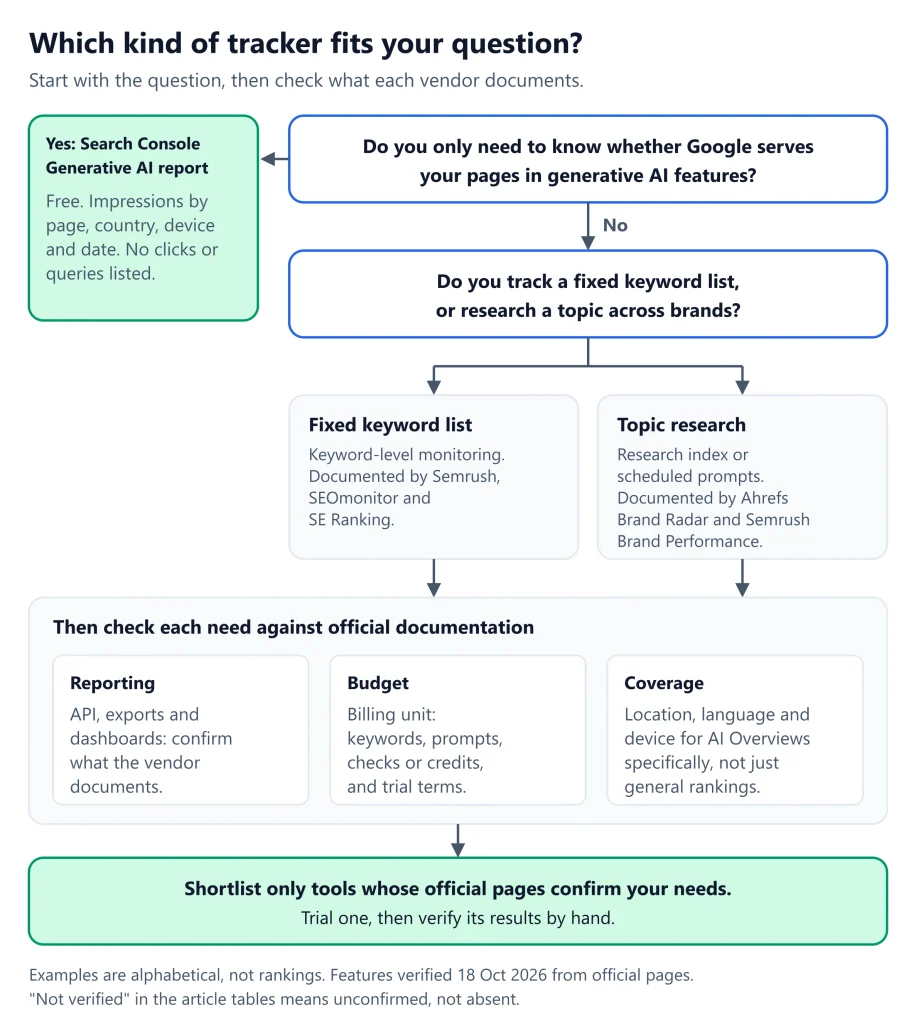
We cannot name a universal winner, and the evidence does not support one. These are SEORAF recommendations built on the documented terms above.Start with free baselineSmall panel / low budgetTeam reporting / scaleResearch index / trendsDecision tree: start with the free baseline, then match method and billing unit to your needs.
When the free baseline is enough
If you need to know whether Google is showing your pages in generative AI features, Search Console’s report may be enough. Add a free or trial check if you want to see which URLs an AI Overview cites. SE Ranking offers a free 5-keyword check per day. Semrush says AI Overviews tracking in Position Tracking is available on free plans, though we could not verify the limits. Trials run 7 days (Semrush) and 14 days (SE Ranking and SEOmonitor).
Freelancers and small businesses
The documentation does not separate these two groups, so the questions are shared. Which keywords do you actually need to watch? Do you already pay for a rank tracker that includes AI Overviews? Watch per-user pricing: Semrush charges $99 for each added user’s AI Visibility license. Annual billing, as with SE Ranking, lowers the monthly price but is paid upfront.
In-house teams
In-house teams usually need competitor benchmarking, saved history and exports. Ahrefs documents unlimited domains for AI visibility analysis and an API. SEOmonitor documents separate mention and citation tracking for competitors. Check the “Not verified” cells in the comparison table against your reporting needs.
Agencies
Agencies should model cost across clients. Semrush’s AI Visibility Toolkit adds $99 per domain, which compounds across many brands. SEOmonitor’s pricing page states there are no per-seat fees (vendor claim). SE Ranking lists an Agency Pack add-on, though what it contains is not verified. Pro Rank Tracker’s top plan lists unlimited users, and its AI prompts cost double the Terms.
A practical tracking workflow
This workflow is SEORAF’s recommended practice, not research findings. It works with any tool above.BaselineBuild panelLog resultsMonitorValidateBaseline, panel, log, monitor, validate, then repeat.
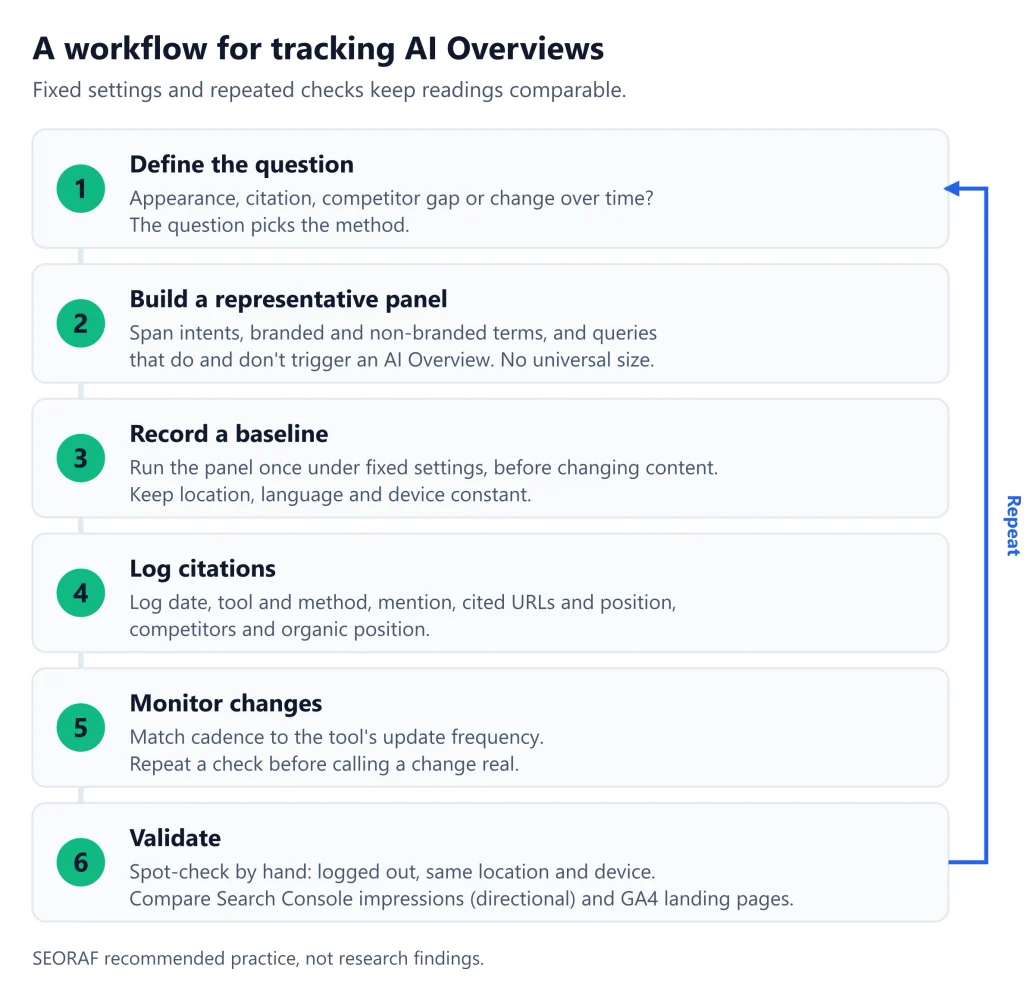
1. Define the question
Decide what you are testing: whether AI Overviews appear for your topics, whether your pages are cited, how you compare with competitors, or how results change over time. The question picks the method.
2. Build a representative panel
Choose keywords or prompts that span your intents, branded and non-branded terms, and queries that do and don’t trigger an AI Overview. There is no universal panel size. Write down why you chose yours, since a tool’s allowance may limit it.
3. Record a baseline
Run the panel once under fixed settings and save the results before changing any content. Keep location, language and device constant.
4. Log citations
| Field | Why it matters |
|---|---|
| Date and time | Results change; you need to compare like with like |
| Keyword or prompt | The unit being tracked |
| Location, language, device | These can change what is shown |
| Tool and data method | Keyword, prompt or index data are not equivalent |
| AI Overview present (yes/no) | The appearance measurement |
| Brand mentioned (yes/no) | Separates mentions from citations |
| Cited URL(s) and position | The citation measurement |
| Competitors mentioned or cited | Context for any change |
| Organic position | Keeps rankings as a separate measurement |
| Snapshot reference and notes | Lets you recheck later |
5. Monitor changes
Match your review cadence to the tool’s update frequency: Ahrefs’ index refreshes every few days, SEOmonitor tracks daily, and Semrush’s Brand Performance updates weekly. Repeat a check before treating any single change as real.
6. Validate
Spot-check a sample manually in a logged-out browser with the same location and device. Compare with Search Console’s generative AI impressions as a directional check only. In GA4, review organic landing pages, bearing in mind that AI Overview clicks are not separated from Organic Search.
Measurement checklist
- Is every comparison made under the same location, language and device?
- Did you repeat the check before calling a change real?
- Are mentions and citations counted separately?
- Is any traffic figure labeled as an estimate?
- Are vendor scores backed by the underlying fields?
- Have you noted the tool, data method and date for each reading?
- Have you checked a sample by hand?
Measurement limitations and how to avoid misleading conclusions
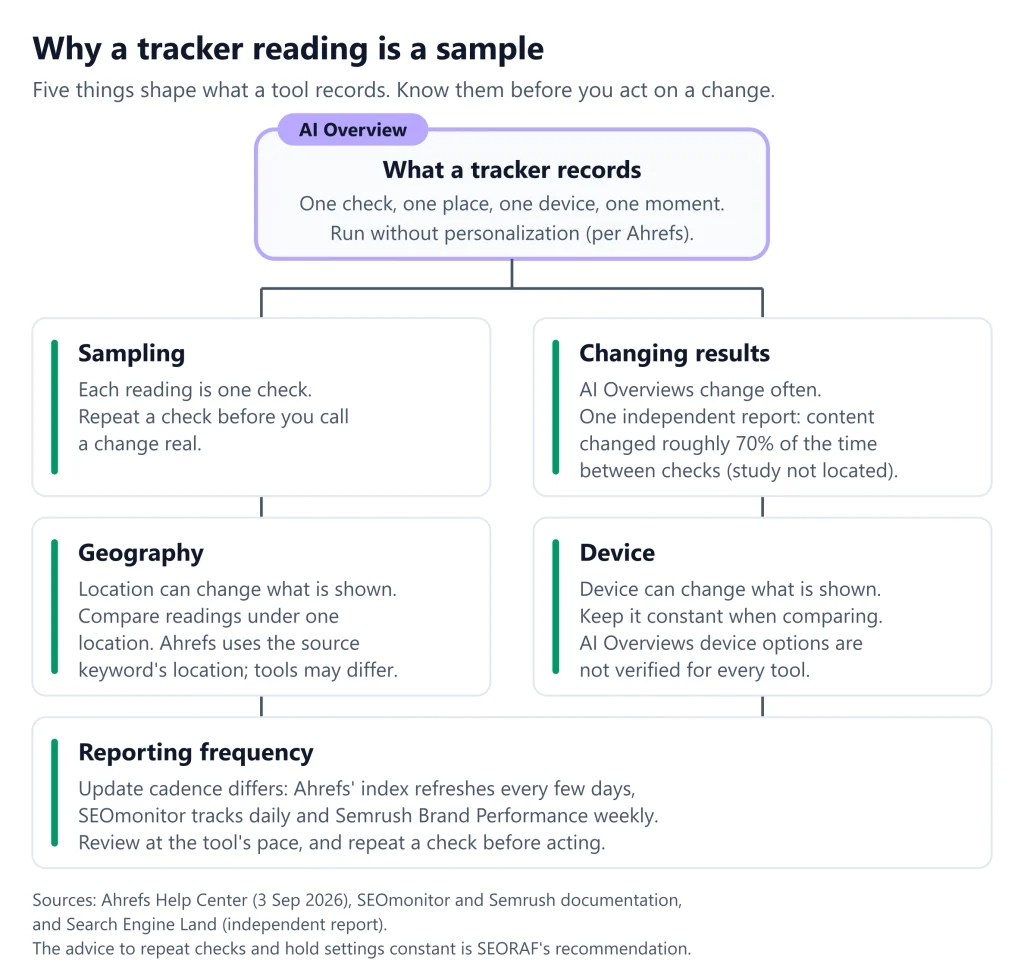
Volatility and sampling
AI Overviews change often. Search Engine Land reports an Ahrefs study of more than 43,000 keywords in which the AI Overview content changed roughly 70% of the time between checks (independent report; we have not located the primary study). One reading is a snapshot, not a trend.
Tracked data is not the live view
Tools query without personalization, as Ahrefs states, so their output can differ from what a signed-in user in another place sees. That is our inference from the vendor’s description, not a measured gap.
Correlation is not causation
If a citation appears the week you updated a page, the update may be unrelated. Many things change at once in search.
| Mistake | Why it misleads | Do this instead |
|---|---|---|
| Reading one check as a trend | Results vary between checks | Repeat checks and compare across a window |
| Comparing two tools directly | Methods, locations and devices differ | Compare within one tool, or align settings first |
| Trusting a visibility score | Formulas are vendor-defined | Record the underlying mentions and citations |
| Treating estimated traffic as measured | It is modeled | Use GA4 for visits and label estimates |
| Assuming a mention equals a citation | A mention may have no link | Count them separately |
| Assuming AI Overview traffic sits in its own GA4 channel | It is counted in Organic Search | Use impressions and landing-page trends as directional signals |
FAQs
Does Search Console show AI Overviews performance?
Partly. Since 3 June 2026 it has a Generative AI report with impressions by page, country, device and date. We found no clicks or query data and no AI Overviews-only view. Check your property for availability.
Can I track AI Overviews for free?
Partly. Search Console is free, SE Ranking offers a 5-keyword daily check, and Semrush says AI Overviews tracking is available on free plans (limits not verified). Trials run 7 to 14 days.
Why do two trackers disagree on the same keyword?
Method, location, device, language and timing can all differ, and results vary between checks. Neither tool is necessarily wrong. See the data methods section.
Do I need a separate tool if I already use a rank tracker?
It depends. Semrush, SE Ranking and SEOmonitor document AI Overviews tracking inside rank-tracking workflows. Check your plan’s documentation rather than assuming.
Next steps
- Check whether Search Console’s Generative AI report appears for your property and record a baseline.
- Build a representative keyword panel and log it with the fields above.
- Start a trial of one tool whose method matches your question, and verify its numbers by hand.
How this page was researched
Method. We reviewed vendor documentation, product and pricing pages, and Google’s documentation on 18 October 2026. We included a tool in a full evaluation only when official pages confirmed AI Overviews support, current pricing with its billing unit, and trial status. Third-party sources are labeled and used only for context.
What we did not do. SEORAF did not run hands-on tests, take screenshots of these tools, or collect performance data for this article. Statements about features reflect what vendors document, not our observation.
Limits. Several vendor pages exist in conflicting cached versions, and we say so where it affects a claim. Prices are volatile, so confirm them on the vendor’s site.
Update log. 18 October 2026: first publication and verification of features and prices. Spotted something outdated? Please tell SEORAF through its contact page.
Sources
- Google: Introducing Search generative AI performance reports; Generative AI performance report (Search) help page; AI features and your website; GA4 traffic-source dimensions.
- Ahrefs: What is Brand Radar, and how to use it.
- Semrush: Features for AI visibility; AI Visibility Toolkit.
- SEOmonitor: Daily AI Overview insights; Pricing.
- SE Ranking: AI Overviews tracker; Pricing.
- Morningscore: Pricing. Nightwatch: AI Overview tracking. OtterlyAI: Pricing help. Pro Rank Tracker: AI Overviews tracker and plans. Keyword.com: pricing update.
- Independent: Search Engine Land on AI visibility volatility; LLM Pulse on Search Console’s Generative AI report; TechRadar review of SE Ranking.