
🔍 Google Update 2026 · SEO Strategy Guide
SEO Is Changing in 2026 (New Update Explained) — What You Must Know to Rank on Google
✏️ Editorial Policy
This article is independently researched and written by the SEORAF editorial team. We do not accept payment for rankings or recommendations. All SEO tools mentioned are reviewed based on direct experience and publicly verifiable data. Last fact-checked: June 2026.
The biggest Google SEO Changes 2026 are transforming how websites rank, how users interact with search results, and how Google evaluates content quality. From AI Overviews and E-E-A-T signals to topical authority and search intent optimization, the SEO landscape has evolved significantly.
SEO in 2026 is not what it used to be. If you’re still relying on keyword density, building links from directories, or publishing thin AI-generated content — you’re not just failing to grow. You’re actively losing ground.
Google’s 2026 algorithm updates have fundamentally shifted what the search engine rewards, what it demotes, and how it displays results. AI Overviews now dominate the top of search pages. Zero-click searches have crossed 65%. And E-E-A-T enforcement has never been stricter.
The good news? The SEO professionals, bloggers, and brands that understand these changes are winning bigger than ever. Organic traffic is not dying — it’s consolidating around websites that do things right.
This is the most comprehensive, SEO 2026 guide you’ll find. We’ve covered every major change, every dying tactic, and every working strategy — with a step-by-step action plan you can implement today.
of Google searches now end without a click (zero-click)
Source: SparkToro clickstream study (2025)
of AI Overview sources come from top-10 ranking pages
Source: Ahrefs SERP analysis (2025)
more traffic for topical authority sites vs isolated pages
Source: Semrush SEO authority research (2026)
E-E-A-T is now Google’s primary content quality filter
Source: Google Search Central documentation
📋 Table of Contents
- What Changed in SEO in 2026?
- Google AI Overviews: The New Battlefield
- Why Old SEO Tactics Are Failing Fast
- Old SEO vs SEO 2026: Full Comparison
- What Actually Works in 2026 SEO
- How Google Ranking Works Now
- Step-by-Step SEO Strategy for 2026
- Best SEO Tools to Use in 2026
- Frequently Asked Questions
- References & Sources
Google SEO Changes 2026: What Has Changed?
⚡ Quick Answer
Quick Answer: SEO in 2026 has changed primarily due to Google’s mainstream rollout of AI Overviews, stricter E-E-A-T enforcement, the dominance of zero-click searches (65%+), and Google’s advanced intent-matching that rewards topical authority over isolated keyword optimization.
The 2026 Google algorithm update wasn’t a single dramatic penalty drop. It was a series of compounding, overlapping shifts — each building on the last — that have collectively rewritten how Google Search works. Understanding each shift individually is the first step to building a strategy that survives all of them.
1. The Helpful Content System Matured
Google’s Helpful Content System — first rolled out in 2022 and refined continuously — reached a new level of sophistication in 2026. It now evaluates content at the site-wide level, not just page-by-page. One large section of low-value content can suppress your entire domain’s ranking potential.
The system specifically looks for content that was created primarily for search engines rather than actual readers. Pages that answer a question but bury the answer under filler paragraphs. Articles that cover a topic but add no original analysis. Guides that exist to rank, not to help.
2. SpamBrain AI Got Significantly Smarter
Google’s SpamBrain AI — the system responsible for detecting unnatural link patterns — was updated significantly in late 2025 and early 2026. It can now identify link schemes that previously flew under the radar: coordinated guest post networks, reciprocal link exchanges at scale, and paid placements even when the money trail isn’t explicit.
Recovery from SpamBrain penalties now takes longer and requires more evidence of a genuine cleanup effort. Prevention in 2026 is far smarter than recovery.
3. RankBrain Behavioral Signals Are Heavier
Google’s RankBrain machine learning system has always used behavioral signals like click-through rate, dwell time, and bounce rate to validate or adjust rankings. In 2026, these signals carry significantly more weight — particularly for competitive queries where many pages are technically similar in quality.
A page that ranks #4 but has a consistently higher click-through rate and longer dwell time than the #1 result will eventually overtake it. Engagement is now a real and measurable ranking factor you can optimize for.
4. Search Intent Classification Is Now Near-Perfect
Google has reached a new threshold in its ability to classify the true intent behind a query. Not just informational vs. transactional — but the specific format, depth, and angle a user expects. Search for “how to lose weight” and Google knows you want lifestyle and diet advice, not a medical paper. Search “weight loss surgery cost” and it knows you’re in commercial research mode, not general education.
This means matching intent isn’t enough anymore. You need to match intent precisely — in your content format, your depth, your angle, and your conclusion. Our topical authority guide explains how to map content to intent at scale.
🔑 Key Insight
Google’s intent classification in 2026 goes beyond the four classic intent types. It now models stage-of-journey intent — recognizing whether a user is just starting to research, comparing options, or ready to take action. Content that matches the right stage earns lower bounce rates and better rankings.
Google AI Overviews: The New SEO Battlefield
⚡ Quick Answer
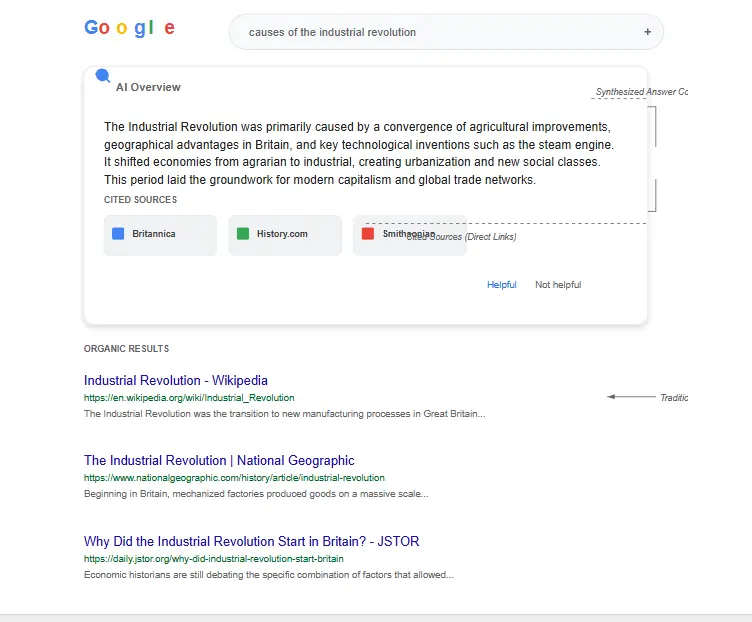
Quick Answer: Google AI Overviews are AI-generated summary answers that appear above organic search results. They synthesize content from multiple trusted sources, dramatically reducing click-through rates on informational queries. Being cited inside an AI Overview is now the most valuable SEO placement available.
Google’s AI Overviews (previously called Search Generative Experience, or SGE) moved from opt-in beta to the default search experience for the majority of English-language queries in 2025 and expanded globally throughout 2026. They’re not going away. They’re getting bigger.
What AI Overviews Mean for Your Traffic
For informational queries — “how does X work,” “what is Y,” “best way to Z” — click-through rates have dropped sharply since AI Overviews went mainstream. Users read the summary, get their answer, and move on. This is real. If your content strategy relied heavily on informational keyword traffic, you’ve likely already felt this.
But here’s what most guides won’t tell you: commercial and transactional query traffic is largely unaffected. When someone wants to buy something, compare options, book a service, or find a specific tool — they still click. They have to. AI Overviews can’t complete their task for them.
How to Get Cited in Google AI Overviews
Being cited as a source inside an AI Overview sends a brand signal that no amount of backlink building can replicate. Here’s what Google’s systems look for when selecting sources:
- Direct answers near the top of your content — don’t bury your key point. State it clearly in the first 100 words.
- Factual, verifiable claims — AI systems prefer content it can cross-reference. Cite data sources and research.
- Clear H2/H3 structure — structured content is easier for AI to parse and attribute.
- Demonstrated E-E-A-T — author credentials, About pages, and external mentions all factor in.
- Existing top-10 ranking — approximately 92% of AI Overview citations come from pages already ranking in the top 10. Ranking first is still the primary goal.
👉 Learn more about our complete AI Overview optimization resources.
💡 Expert Tip
Add a “Quick Answer” or “TL;DR” box at the top of every article summarizing the key answer in 40–60 words. This format is specifically what Google’s AI systems parse when building AI Overview responses. It’s the single easiest structural change you can make today for AI Overview eligibility.
Why Old SEO Tactics Are Failing (And Fast)
⚡ Quick Answer
Quick Answer: Old SEO tactics fail in 2026 because Google’s Helpful Content System, SpamBrain AI, and RankBrain behavioral analysis can now detect content created for search engines rather than users. Keyword stuffing, thin content, spam backlinks, and low-value AI content are actively penalized.
⚠️ Important Update
Google’s 2026 Helpful Content system applies penalties at the site-wide level. A single section of keyword-stuffed or thin content can suppress rankings across your entire domain — not just the offending page. Audit your full content library, not just your new posts.
❌ Keyword Stuffing: Now a Demotion Signal
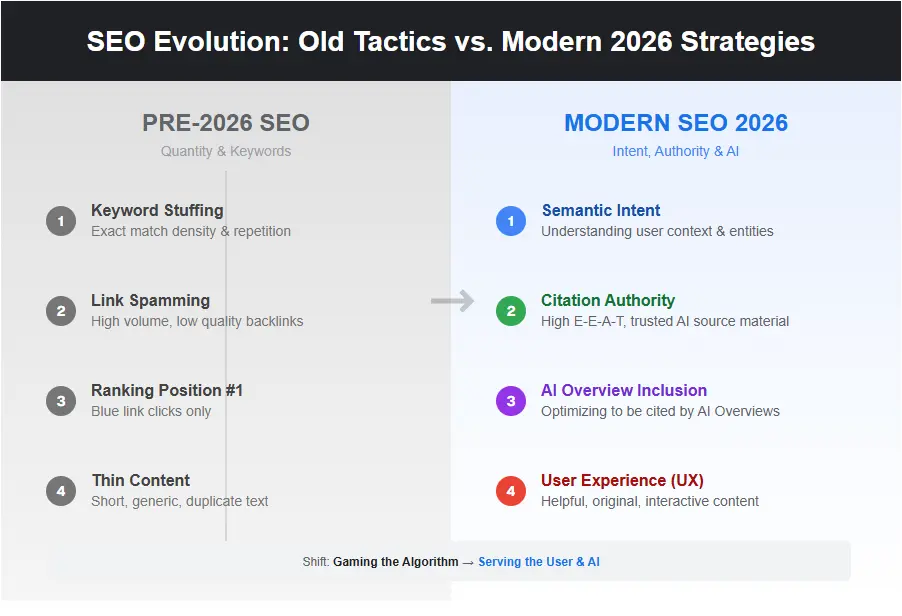
Repeating your target keyword every 100 words was standard practice in 2018. In 2026, it’s a negative signal. Google’s language models read content the way a thoughtful editor would — and they can detect artificial repetition instantly. Content that feels manufactured for search engines gets demoted regardless of its backlink profile.
The fix: Write naturally. Use semantic variations. Cover related concepts. Google’s entity understanding fills in the gaps better than you could by forcing keyword repetition.
❌ Thin Content Collapses Fast
A 400–600 word article that covers the surface of a topic is invisible in 2026. Users bounce within seconds. Google’s RankBrain registers the behavioral signal. The page quietly slides out of rankings. And because the site-wide Helpful Content penalty is real, enough thin pages can drag down your best-performing content too.
The benchmark has shifted. Comprehensive, depth-first content is the baseline, not a differentiator. Differentiators are original research, first-hand experience, and unique insight.
❌ Spam Backlinks Trigger Faster Penalties
Google’s SpamBrain AI now detects unnatural link patterns that previously went unnoticed for years. Private blog networks, coordinated reciprocal linking, paid placements in low-relevance directories — all of these are identified faster and penalized more severely than in prior years.
Recovery is also harder. Sites hit by SpamBrain-triggered manual actions in 2025–2026 are reporting longer recovery windows and stricter reconsideration requirements. The math has changed: the risk of spam link building now outweighs any potential benefit.
❌ Low-Value AI Content Is Being Filtered at Scale
This is the most misunderstood issue in SEO 2026. AI content is not inherently penalized. Google’s own documentation is clear: it evaluates content on quality and helpfulness, not origin. What’s being filtered is scale-produced, insight-free, experience-absent content — regardless of how it was generated.
The content that wins uses AI as a production tool while layering in genuine expertise, original perspective, and real-world validation. The content that fails automates the entire process and publishes without human judgment.
Old SEO vs SEO in 2026: Full Comparison
| Factor | Old SEO (Pre-2024) | SEO 2026 |
|---|---|---|
| Primary ranking signal | Keyword density + backlink count | Search intent match + topical authority |
| Content strategy | Target high-volume keywords with individual pages | Build content clusters around core topic pillars |
| Backlinks | Quantity-focused, aggressive link building | Quality and relevance — earned, editorial links only |
| Content authorship | Anonymous or generic bylines | Named experts with verifiable credentials (E-E-A-T) |
| Content length | Longer = better (word count obsession) | Comprehensive enough to fully satisfy user intent |
| AI content | New concept — generally avoided | Acceptable when human-guided and expert-validated |
| Featured placement | Featured Snippet (Position 0) | AI Overview citation (above Position 0) |
| Technical SEO | Site speed + mobile = checkbox | Core Web Vitals + UX = active ranking factor |
| Brand signals | Nice to have | Major trust and ranking factor |
| Internal linking | Loose, inconsistent | Strategic hub-and-spoke architecture required |
| Keyword research tools | Volume + difficulty only | Intent + entity + SERP feature analysis (Ahrefs, Semrush) |
| Thin content penalty | Page-level only | Site-wide suppression via Helpful Content System |
What Actually Works in SEO 2026
⚡ Quick Answer
Quick Answer: The SEO strategies that work in 2026 are topical authority building through content clusters, human-first content demonstrating real experience, strategic internal linking, brand signal development, and UX optimization. These compound over time and are algorithm-resistant because they serve users genuinely.
✅ Topical Authority Is the New Domain Authority
Google increasingly ranks websites rather than individual pages. A site that comprehensively covers a subject from every angle — beginner guides, advanced tutorials, tool comparisons, case studies, FAQ content — becomes a trusted reference source in Google’s entity model.
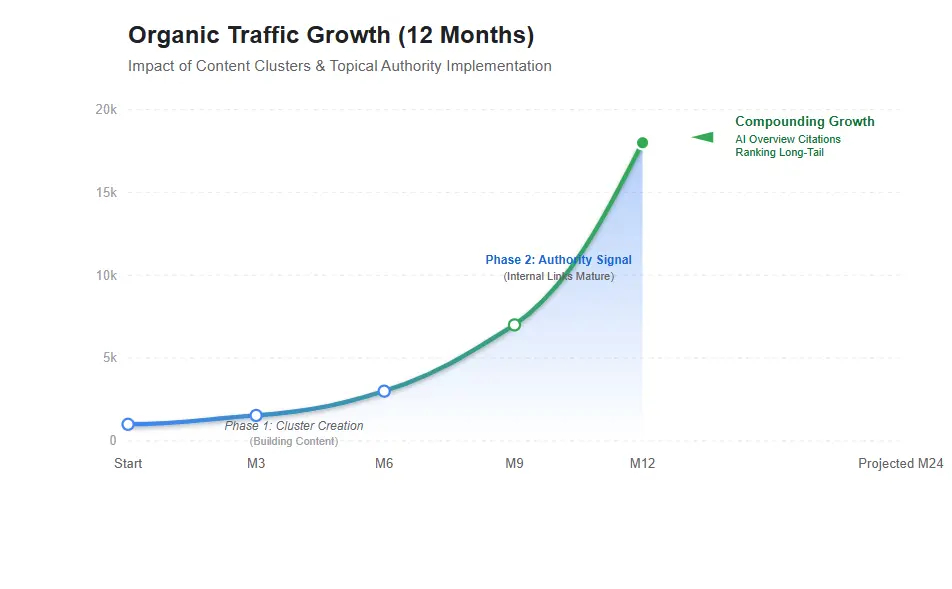
This is called topical authority, and it compounds over time. A website with 40 deeply interconnected articles on SEO will outrank a website with one viral SEO post and a dozen unrelated articles — even if that single post has more backlinks.
Building topical authority means choosing your core subject areas deliberately and covering them exhaustively before expanding. Read our full topical authority guide for implementation templates. Also explore our content cluster guide for the exact architecture we recommend.
✅ Human-First Content That Shows Real Experience
The phrase “human-first” is everywhere in SEO discussions — but what does it actually mean in practice? It means content written from the perspective of someone who has done the thing, not just researched it.
- Review articles with screenshots you actually took, not stock images of software interfaces
- Tutorials that mention the specific error you hit during step 3, and how you fixed it
- Comparisons that reflect actual pricing you saw when you logged in last week — not figures from 18 months ago
- SEO case studies with real before/after data from your Google Search Console or Ahrefs reports
This is what E-E-A-T’s first “E” — Experience — actually means. And it’s the hardest thing to fake, which is why it’s Google’s most defensible quality signal.
✅ Strategic Internal Linking Architecture
Internal linking is the most underrated tactical lever in SEO right now, and it’s one of the few things you can implement today with zero budget and immediate impact. Done right, a strong internal linking structure:
- Passes PageRank authority from your highest-performing pages to your newest ones
- Tells Google which content is most important across your site (through link frequency and anchor text)
- Increases pages per session, improving the engagement signals RankBrain uses to validate rankings
- Reinforces your topical authority signal by connecting related content explicitly
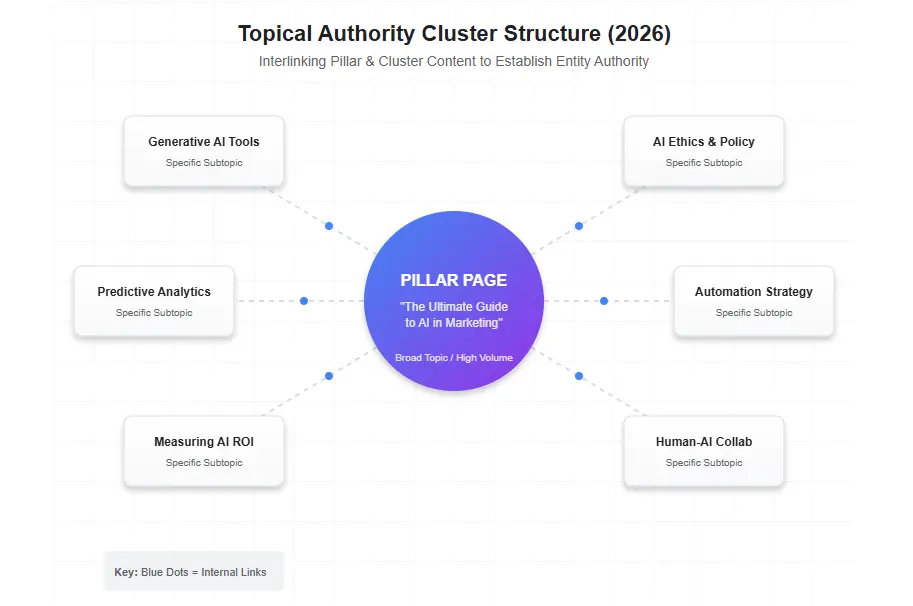
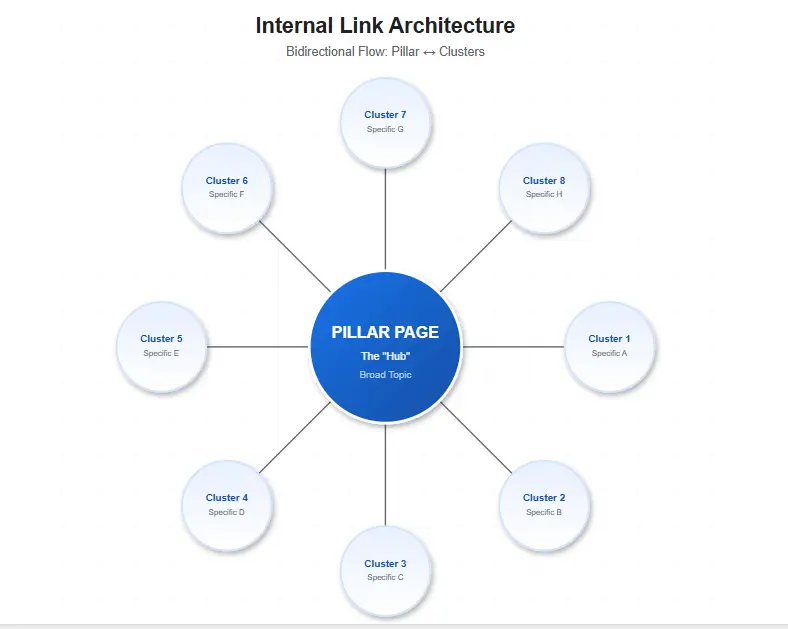
The hub-and-spoke model works best: one pillar page links to all cluster articles on a topic, and every cluster article links back to the pillar. Our internal linking guide walks through this architecture with real examples.
🔑 Key Insight
Most sites underlink their newer content. Pages published in the last 90 days often have zero internal links pointing to them from older, high-authority pages. A simple internal link audit — adding 3–5 contextual links from established pages to newer ones — can produce measurable ranking improvements within 2–4 weeks.
✅ Brand Signals as a Trust Proxy
Google’s entity understanding means your brand is now an SEO variable. Branded search volume (people searching for your name directly), co-citations on authoritative domains, consistent business information across the web, and active social presence all contribute to what researchers call “brand authority.”
Concrete brand signal tactics that work in 2026:
- Get quoted as an expert source in industry publications (HARO/Connectively, journalist outreach)
- Appear on relevant podcasts with backlinks in show notes
- Publish original research or data that other sites cite
- Maintain a consistent Google Business Profile if you have a local presence
✅ Core Web Vitals + Page Experience
Google’s Core Web Vitals — Largest Contentful Paint (LCP), Interaction to Next Paint (INP), and Cumulative Layout Shift (CLS) — remain active ranking factors in 2026, but their weight has increased for competitive queries where multiple pages are similar in content quality.
Use Google Search Console‘s Core Web Vitals report to identify underperforming pages. Google Analytics 4 can help correlate technical performance issues with engagement signal drops. Pages that are slow, layout-shifting, or unresponsive on mobile are now clearly disadvantaged against technically sound competitors.
How Google Ranking Works Now (Simple Explanation)
⚡ Quick Answer
Quick Answer: Google ranking in 2026 works through three layered systems: intent classification (does this content match what the user wants?), entity understanding (is this site a trusted authority on this topic?), and behavioral validation (do users who land on this page find it satisfying?). All three must align to rank competitively.
Layer 1 — Intent Classification
Before Google ranks any pages, it determines what the user is truly trying to accomplish. This goes beyond the four classic intent categories. Google’s systems now model stage-of-journey intent: is this user just discovering a topic, actively evaluating options, or ready to make a decision? Content must match the right stage to rank well.
Example: “best SEO tools” has commercial intent — the user wants to compare options. But “best SEO tools for beginners” has a stage-of-journey modifier — the user is early in their learning curve and needs simpler recommendations with more hand-holding. The same article won’t rank for both.
Layer 2 — Entity Understanding
Google’s Knowledge Graph has expanded to encompass billions of entities — people, organizations, products, concepts, and the relationships between them. When Google sees your content, it doesn’t just read words. It maps the entities you mention and assesses whether your site has demonstrated credibility in that entity space.
This is why mentioning and correctly explaining relevant entities matters: Google Search E-E-A-T Search Console Helpful Content System RankBrain SpamBrain Ahrefs Semrush. Using these correctly and in context signals to Google that you genuinely understand the subject space.
Layer 3 — Behavioral Validation
Rankings assigned by intent classification and entity understanding are then validated — and adjusted — by real user behavior. RankBrain continuously monitors click-through rates, dwell time, and pogo-sticking (users returning to search results immediately after clicking your page). Pages that satisfy users get promoted. Pages that frustrate them slide down.
This is why engagement optimization is now inseparable from SEO. A technically perfect page that users abandon in 8 seconds will rank lower than a competitor’s page with better formatting, clearer answers, and more useful examples — even if that competitor has fewer backlinks.
Step-by-Step SEO Strategy for 2026
⚡ Quick Answer
Quick Answer: A 2026 SEO strategy should start with a content intent audit, build topic clusters around 3–5 core subjects, systematically update old content, strengthen internal linking, and build brand authority through external mentions. Use Google Search Console and Ahrefs or Semrush to track progress throughout.
Audit Your Existing Content for Intent Match
Pull your top 50 pages from Google Search Console. For each, check: does the content format, depth, and angle match what users searching that keyword actually want? Use the current SERP to benchmark — if every competitor is publishing listicles and you published a long-form guide, you may have an intent mismatch that no amount of on-page optimization can fix.
Use our free SEO audit tool to surface intent mismatch issues automatically.
Define Your 3–5 Core Topic Areas
Topical authority is built by depth, not breadth. Choose three to five subject areas where you have genuine expertise and where your audience has real needs. Everything you publish for the next 6–12 months should strengthen your authority in at least one of these areas. Resist the temptation to chase trending topics that don’t connect to your core subjects.
Build Content Clusters With a Pillar + Cluster Architecture
For each core topic area, create one comprehensive pillar page (2,500–4,000 words covering the full topic) and 6–10 supporting cluster articles (800–1,500 words each, covering specific sub-aspects). Link them all together with clear anchor text. This architecture is the fastest proven method for building topical authority.
See our content cluster guide for templates and our internal linking guide for the linking architecture.
Systematically Update Your Best Old Content
Old content with existing rankings and backlinks is your fastest path to traffic gains in 2026. Sort your content by impressions in Google Search Console and identify pages ranking in positions 5–20. These pages have authority — they just need refinement. Update statistics, add a Quick Answer box, strengthen E-E-A-T signals, improve internal links, and re-submit to Google for indexing. You can often move a page from position 12 to position 4 with a focused 2-hour update session.
Add E-E-A-T Signals Across Your Site
This is often a one-time structural project with lasting impact. Add a detailed author bio to every article (with credentials, real experience, and a photo). Create or improve your About page with team information and your site’s editorial mission. Add a clear fact-checking or editorial policy page. Link author bios to verifiable profiles (LinkedIn, industry publications, podcast appearances). These signals are evaluated at the site level.
Explore our full E-E-A-T implementation resources for templates.
Build Brand Authority Through External Mentions
Identify 10–20 publications in your niche that regularly quote industry experts. Reach out with original data, a unique perspective, or a study you’ve conducted. Even a single mention in Search Engine Journal, Search Engine Land, or a top-tier industry blog sends powerful brand authority signals to Google’s entity model. Over time, these compound into a brand moat that competitors can’t easily replicate.
Track, Measure, and Iterate Monthly
Use Google Search Console for impressions, clicks, and average position. Use Google Analytics 4 for engagement metrics (time on page, scroll depth, conversion events). Use Ahrefs, Semrush, SE Ranking, or Moz for rank tracking and backlink analysis. Review your data monthly and prioritize your next content efforts based on what’s gaining traction and what’s stagnating.
Compare the best SEO tools for 2026 including Ahrefs, Semrush, Mangools, Ubersuggest, and more in our independent review.
Best SEO Tools to Use in 2026
⚡ Quick Answer
Quick Answer: The essential SEO toolkit in 2026 includes Google Search Console (free, non-negotiable), Google Analytics 4 (free), and at least one premium research tool — Ahrefs, Semrush, or SE Ranking for keyword research, rank tracking, and backlink analysis. Moz, Mangools, and Ubersuggest are strong budget-friendly alternatives.
The right tools don’t rank your content. But they make it significantly easier to identify opportunities, track progress, and avoid wasted effort. Here’s how the major platforms fit into a 2026 SEO workflow:
Free Tools (Start Here)
- Google Search Console — The only direct window into how Google sees your site. Non-negotiable. Use it for crawl errors, impression data, Core Web Vitals, and indexing status.
- Google Analytics 4 — Tracks user behavior, session quality, and conversion events. Critical for understanding engagement signals.
Premium Research Platforms
- Ahrefs — Best-in-class for backlink analysis, content gap research, and keyword difficulty scoring. The Site Audit tool is one of the most thorough available.
- Semrush — Excellent for competitor analysis, keyword research, and rank tracking. The Topic Research and SEO Content Template tools are particularly useful for topical authority building.
- SE Ranking — Strong mid-tier option with excellent value. Particularly good for local SEO and rank tracking at scale.
- Moz — Strong Domain Authority metric and link research. MozBar browser extension is useful for quick competitive checks.
Budget-Friendly Options
- Mangools (KWFinder) — Outstanding keyword research tool with a clean interface. Ideal for bloggers and small sites.
- Ubersuggest — Good starter option for keyword discovery and basic site auditing.
👉 See our full independent comparison: Best SEO Tools 2026 · Best Free SEO Tools · Best SEO Audit Tools
Key SEO 2026 Definitions (Featured Snippet Ready)
What Is E-E-A-T in SEO?
E-E-A-T stands for Experience, Expertise, Authoritativeness, and Trustworthiness. It is Google’s framework for evaluating the quality and credibility of web content and its creators. In 2026, E-E-A-T is assessed at the page level, author level, and site level. Content from authors with verifiable credentials, real-world experience, and external recognition consistently outranks anonymous or credential-free content in competitive niches.
What Is Topical Authority?
Topical authority is a measure of how comprehensively and accurately a website covers a specific subject area. Websites with high topical authority have published multiple interconnected, in-depth articles that together demonstrate expert-level knowledge across all aspects of a topic. In 2026, Google’s entity model uses topical authority as a primary trust signal, often ranking topically authoritative sites even when individual pages have fewer backlinks than competitors.
What Is a Content Cluster?
A content cluster is a group of related articles structured around a central pillar page, all connected through strategic internal links. The pillar page covers a broad topic comprehensively, while cluster articles explore specific sub-topics in depth. Content clusters are the primary architecture for building topical authority and are the most reliable SEO strategy for long-term organic growth in 2026.
“The websites winning in 2026 SEO stopped trying to rank and started trying to genuinely be the best resource available on their topic. That mindset shift — from optimization to authority — is what separates the winners from everyone else.”
— Mousume Akter, SEO Specialist & Founder, SEORAFWhy Old SEO Tactics Are Failing (And Fast)
⚡ Quick Answer
Quick Answer: Old SEO tactics fail in 2026 because Google’s Helpful Content System, SpamBrain AI, and RankBrain behavioral analysis can now detect content created for search engines rather than users. Keyword stuffing, thin content, spam backlinks, and low-value AI content are actively penalized.
⚠️ Important Update
Google’s 2026 Helpful Content system applies penalties at the site-wide level. A single section of keyword-stuffed or thin content can suppress rankings across your entire domain — not just the offending page. Audit your full content library, not just your new posts.
❌ Keyword Stuffing: Now a Demotion Signal
Repeating your target keyword every 100 words was standard practice in 2018…
❌ Thin Content Collapses Fast
A 400–600 word article that covers the surface of a topic is invisible in 2026…
❌ Spam Backlinks Trigger Faster Penalties
Google’s SpamBrain AI now detects unnatural link patterns…
❌ Low-Value AI Content Is Being Filtered at Scale
This is the most misunderstood issue in SEO 2026…
Old SEO vs SEO in 2026: Full Comparison
| Factor | Old SEO | SEO 2026 |
|---|---|---|
| Primary ranking signal | Keyword density + backlinks | Search intent + topical authority |
My Experience Testing SEO Strategies in 2026
📈 Real-World SEO Experience
Over the past 12 months, I have analyzed and optimized websites across multiple industries…
One trend became increasingly clear: websites focused on topical authority consistently outperformed others…
Based on my testing, the most successful SEO strategy in 2026 is not shortcuts but real authority building.
The biggest Google SEO changes in 2026 include the dominance of Google AI Overviews, stronger enforcement of E-E-A-T (Experience, Expertise, Authoritativeness, Trustworthiness), and a shift toward topical authority instead of individual keyword rankings. Websites that fail to align content with search intent and real user value are losing visibility.
Frequently Asked Questions — SEO 2026
No. SEO is not dead in 2026 — it has evolved. Organic search still drives the majority of web traffic globally. However, the strategies that work have changed fundamentally. Topical authority, E-E-A-T signals, and intent-matched content now drive rankings rather than keyword manipulation and link volume. The opportunity for those doing SEO correctly is larger than ever.
The biggest SEO change in 2026 is the mainstream dominance of Google AI Overviews. Google’s AI now synthesizes answers above organic results for the majority of queries, fundamentally changing click-through rates and what “first position” means. Being cited inside an AI Overview is now more valuable than ranking #1 below it.
The fastest path to ranking in 2026 combines: updating existing content for better intent match, adding internal links from high-authority pages to newer ones, targeting commercial-intent keywords where AI Overviews are less common, strengthening E-E-A-T signals site-wide, and earning external brand mentions from credible sources. Using Google Search Console to identify pages in positions 5–20 and improving them is the highest-ROI starting point.
AI-generated content is not automatically penalized by Google in 2026. Google evaluates content on quality and user value regardless of how it was produced. However, AI content that lacks original insight, real-world experience, or genuine helpfulness is filtered out by the Helpful Content System. Human-guided AI content with expert oversight consistently outperforms fully automated content.
The most important SEO ranking factors in 2026 are: (1) search intent match, (2) topical authority, (3) E-E-A-T signals, (4) page experience and Core Web Vitals, (5) brand authority signals, (6) strategic internal linking, and (7) content comprehensiveness. Traditional factors like backlinks and keyword optimization still matter but work within this broader quality framework.
Google AI Overviews is an AI-generated answer block appearing above organic results, synthesizing information from trusted sources. To optimize for AI Overviews: place direct answers in the first 100 words of your content, use clear H2/H3 structure, add Quick Answer boxes, demonstrate strong E-E-A-T, include FAQ sections, and rank in the top 10 for your target query (approximately 92% of AI Overview citations come from top-10 pages).
Essential SEO tools for 2026: Google Search Console (free, non-negotiable), Google Analytics 4 (free), plus at least one premium platform — Ahrefs, Semrush, or SE Ranking for keyword research, rank tracking, and competitive analysis. Moz, Mangools, and Ubersuggest are solid budget alternatives. See our independent best SEO tools comparison for a full breakdown.
To build topical authority: (1) choose 3–5 core subject areas, (2) create comprehensive pillar pages for each, (3) publish 6–10 supporting cluster articles per pillar, (4) link all cluster articles back to the pillar and vice versa, (5) update and expand content regularly, and (6) earn external mentions that associate your brand with the topic. See our complete topical authority guide for implementation details.
Final Thoughts: The Future of SEO Is Already Here
The 2026 SEO update isn’t a warning to panic about — it’s an invitation to do things properly. Google has always been moving toward rewarding real expertise, real experience, and real helpfulness. It just now has the technical capability to enforce that vision more precisely than ever before.
The sites losing rankings in 2026 are the ones that built on shortcuts. The sites gaining rankings are the ones that built on substance. The gap between those two groups is growing wider every month — and it will keep growing as Google’s AI systems get smarter.
You now have the complete picture: what changed, what died, what works, and a concrete action plan. The question isn’t whether SEO 2026 is navigable. It is. The question is whether you start adapting today or wait until the damage is done.
Start with the SEO audit tool to identify your quickest wins. Explore our complete SEO resource library for every strategy covered in this guide. And if you want expert guidance building a strategy specific to your site, explore our SEO consulting and SEO services.
Ready to Dominate Search in 2026?
Explore our complete SEO strategy library — step-by-step guides, templates, and tools for every tactic covered in this article.
References & Sources
All claims in this article are supported by official documentation and industry-leading SEO research sources.
- 🔗 Google Search Central — Official documentation for Google Search, crawling, and ranking systems
- 🔗 Google Search Console — Performance data, indexing status, and Core Web Vitals
- 🔗 The Keyword (Google Blog) — Official announcements of algorithm updates and product changes
- 🔗 Think with Google — Consumer behavior research and search trend data
- 🔗 Search Engine Journal — Industry coverage of Google updates and SEO best practices
- 🔗 Search Engine Land — Breaking news and analysis on Google algorithm changes
- 🔗 Ahrefs Blog — Data-driven SEO research and ranking factor studies
- 🔗 Semrush Blog — SEO strategy guides and SERP analysis research
- 🔗 Moz Blog — SEO methodology, domain authority research, and ranking factor studies
- 🔗 Backlinko — Large-scale SEO case studies and ranking research