Local SEO Ranking Factors: The Complete 2026 Guide
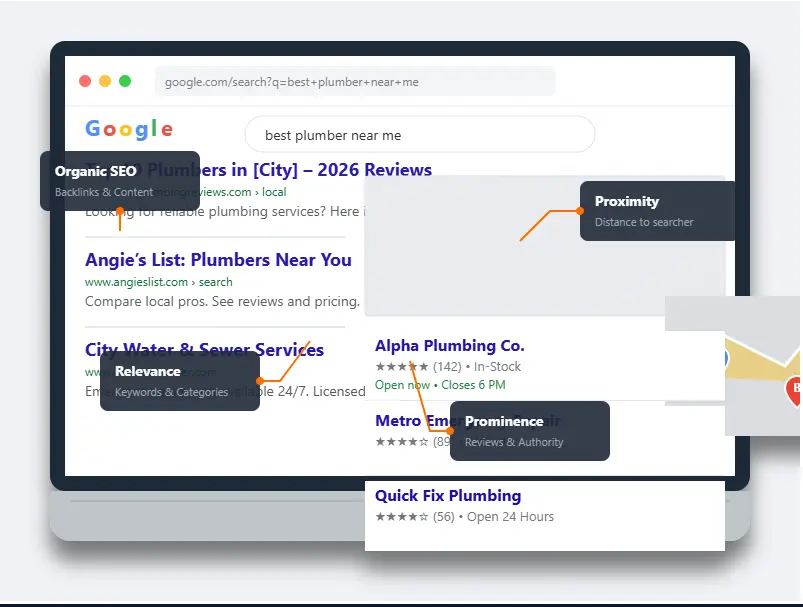
If you run a local business in 2026, showing up on the first page of Google isn’t just a nice-to-have—it is the difference between thriving and closing your doors. But the landscape has shifted dramatically. Gone are the days when stuffing a few keywords into your Google Business Profile guaranteed a spot in the Local Pack. Today, Google’s algorithm is a complex beast fueled by Artificial Intelligence, behavioral data, and entity-based search. Understanding Local SEO ranking factors is no longer about tricking the bot; it is about becoming the most relevant, trusted, and accessible option for your community.
As an SEO strategist who has managed hundreds of profiles, I have seen businesses crack the top three with a few strategic tweaks while others with bigger budgets flounder because they ignored the fundamentals. This guide is your roadmap. We are diving deep into the Google Maps ranking factors and Local SEO ranking signals that actually move the needle right now. If you need help navigating this complexity, our comprehensive local SEO services are designed to handle the heavy lifting for you.
Section 1: What Are Local SEO Ranking Factors?
Let’s cut through the jargon. Local SEO ranking factors are the specific criteria Google uses to determine which businesses appear in the localized search results (the Map Pack) and the standard organic search results for geo-specific queries. When you search for “plumber near me” or “best coffee shop in [City],” Google isn’t just looking for a website with those words. It is looking for a physical entity that matches the user’s intent, location, and trust requirements.
These factors range from on-page elements like your title tags to off-page assets like your backlink profile and the sentiment of your customer reviews. Mastering these Local business SEO ranking factors allows you to bypass competitors and claim prime digital real estate exactly when customers are ready to buy. In the modern digital ecosystem, these factors are dynamic, changing with every core algorithm update, yet the core principles of authority and relevance remain constant. To fully understand where you stand, consider booking a professional SEO audit service.
Section 2: How Google Ranks Local Businesses
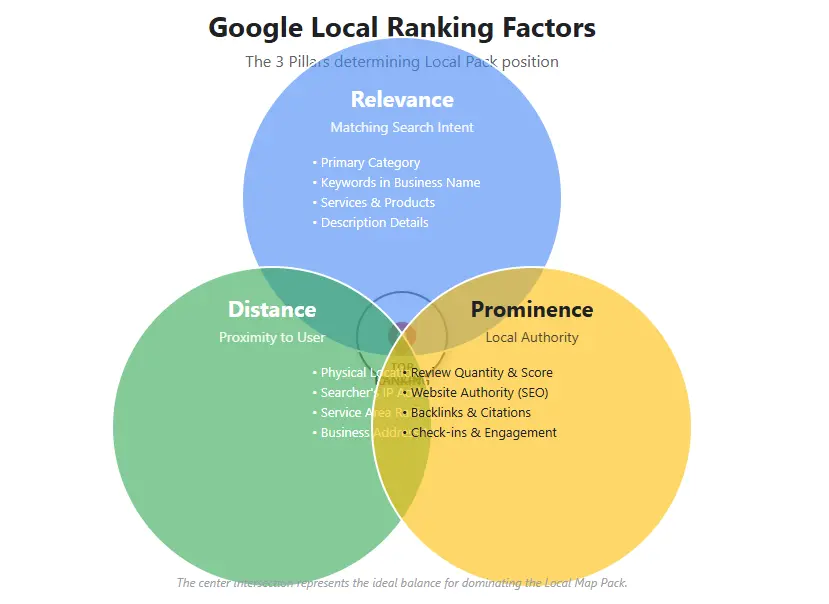
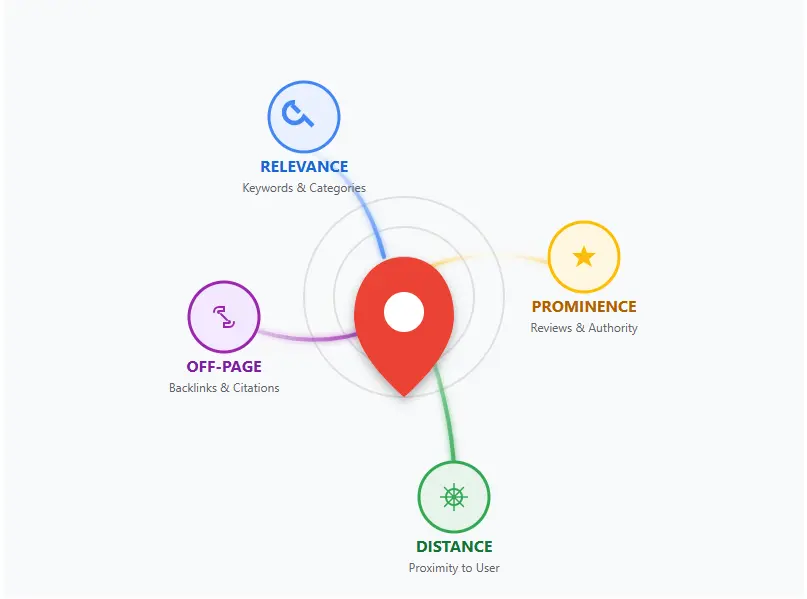
To optimize effectively, you must understand the engine under the hood. Google organizes local search results using three primary pillars. If you want to understand Google local pack ranking factors, you must master this triad. According to Google’s official support documentation, these three elements drive the local algorithm.
- 1. Relevance: Does your business profile match what the user is searching for? If someone searches for “vegan restaurant,” a steakhouse—no matter how popular—will not rank. Google looks at your categories, keywords in your description, and services to determine relevance. This is the primary filter for Local SEO ranking factors.
- 2. Distance: How far is your business from the searcher? This is often the hardest factor to overcome. Google prioritizes proximity. However, if you can’t be the closest, you must be the most relevant and prominent.
- 3. Prominence: How well-known is your business? This is where Local SEO ranking signals like backlinks, review count, review score, and article mentions come into play. Google favors businesses that look like the “town favorite.”
Section 3: The Most Important Local SEO Ranking Factors in 2026
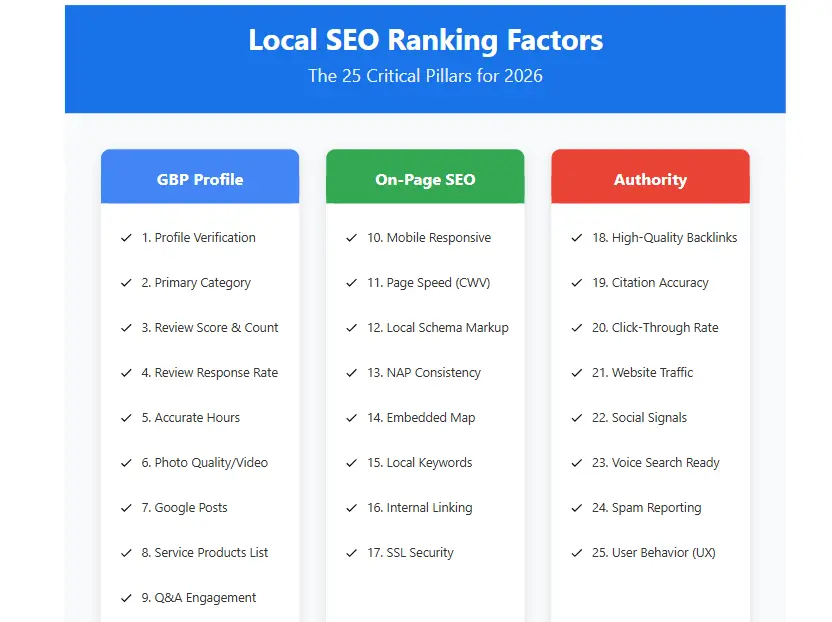
We have analyzed the data, tested the theories, and consulted with industry leaders. Here are the 25 factors that demand your attention if you want to improve your Local SEO ranking factors score.
1. Google Business Profile Optimization
Your Google Business Profile (GBP) is the heartbeat of your local presence. It is the digital storefront that Google uses to verify your existence. Local SEO ranking factors hinge heavily on this profile. For a step-by-step approach, check out our Google Business Profile optimization checklist.
Why it matters: An incomplete profile signals neglect to Google. A fully optimized profile provides the data engine Google needs to match you with queries.
Optimization steps: Fill out every single field. Upload a logo, cover photo, and interior shots. Verify your hours (including holiday hours). Add the correct opening date.
Common mistakes: Leaving the “business description” blank or using a generic phone number instead of a local landline.
Pro tip: Use the “from the business” feature to upload at least one video a month. Video engagement is a heavy behavioral signal right now.
2. Primary Category Selection
This is arguably the most critical setting in your dashboard. You are allowed one primary category. In the world of Local SEO ranking factors, this is your anchor.
Why it matters: This is the “bucket” Google puts you in. If you are a “Personal Injury Lawyer” but categorize yourself as “Law Firm,” you will struggle to rank for specific injury queries.
Optimization steps: Choose the category that best describes your *core* business offering, not what you aspire to be.
Common mistakes: Choosing “Restaurant” when you are actually a “Pizza Place.” Be specific.
Pro tip: Check the top 3 competitors for your target keyword. See what primary category they are using. If there is a consensus, that is likely the category Google associates with that keyword.
3. Secondary Categories
You can add up to nine additional categories. While not as heavy as primary, they are essential Local SEO ranking factors.
Why it matters: These help you rank for long-tail variations and adjacent services.
Optimization steps: Add specific services you offer. A plumber might add “Water Heater Installation” and “Drain Cleaning.”
Common mistakes: “Keyword stuffing” categories that aren’t actual Google options.
Pro tip: Don’t fill all nine slots just because you can. Only use what is 100% accurate to avoid diluting your relevance.
4. Business Description
You have 750 characters to tell your story. It is one of the few text-based Local SEO ranking factors you control directly.
Why it matters: While Google says it doesn’t use this *directly* for ranking, semantic search relies on it to understand your entity and services.
Optimization steps: Write naturally but include your main keywords and location. Mention unique selling points (USPs).
Common mistakes: Stuffing it with phone numbers or URLs (these aren’t clickable here).
Pro tip: Front-load the important info. The first line matters most for the user and the bot.
5. NAP Consistency
NAP stands for Name, Address, and Phone Number. It is the foundation of trust for Local SEO ranking factors.
Why it matters: Google needs to trust you are a real business. Conflicting data across the web kills trust.
Optimization steps: Ensure your NAP on your website matches your GBP exactly. Format the phone number and address identically.
Common mistakes: Using “St.” on the website and “Street” on the GBP. Tracking numbers on the GBP (this is a violation of guidelines).
Pro tip: Audit your top 20 citations quarterly. Inconsistencies creep in over time.
6. Local Citations
These are mentions of your business on other websites (Yelp, YellowPages, BBB). Citations are classic Local SEO ranking factors.
Why it matters: Citations act as votes of confidence. They validate your location and existence.
Optimization steps: Submit your data to major aggregators (Axciom, Neustar, Factual) via a service like Moz Local or BrightLocal.
Common mistakes: Pursuing quantity over quality. A link on a spammy directory can hurt you.
Pro tip: Focus on industry-specific citations. For a contractor, Houzz and Angie’s List are worth more than generic business directories.
7. Reviews and Review Velocity
Reviews are social proof and a freshness signal. They are arguably the most volatile Local SEO ranking factors.
Why it matters: Google favors active businesses. Review velocity (how many you get per week/month) signals you are open and relevant.
Optimization steps: Automate your review requests. Text your customers after a successful service.
Common mistakes: Incentivizing reviews (offering money/discounts) is against Google Terms of Service.
Pro tip: Respond to *every* review. Positive responses encourage loyalty; professional responses to negative reviews show prospective customers you care.
8. Review Keywords
The text within your reviews is crawlable. This is a passive but powerful Local SEO ranking factor.
Why it matters: When customers mention “friendly staff,” “fast shipping,” or specific products, Google indexes these terms.
Optimization steps: Don’t ask for specific keywords, but guide the narrative. Ask, “What was your favorite service we provided today?”
Common mistakes: Writing fake reviews. Google’s spam AI is getting scary good at detecting patterns.
Pro tip: Analyze your competitor’s reviews. What are customers praising them for that you don’t offer?
9. Local Landing Pages
If you have multiple locations, you need a page for each. This is vital for Local SEO ranking factors.
Why it matters: You can’t rank a “Contact Us” page for five different cities. You need dedicated, authoritative pages for each location.
Optimization steps: Create a unique URL for each (e.g., site.com/plumber-chicago). Include the local address, map embed, and unique content.
Common mistakes: Using the exact same content for every page and just swapping the city name.
Pro tip: Add testimonials from customers in that specific city to the page.
10. Internal Linking
How your website pages connect. It supports Local SEO ranking factors by distributing equity.
Why it matters: It distributes “link juice” (authority) from your homepage to your local landing pages.
Optimization steps: Link from your homepage footer or main menu to your location pages. Link from blog posts to your service pages.
Common mistakes: Orphan pages (pages with no incoming links).
Pro tip: Use descriptive anchor text. Instead of “Click here,” use “our Chicago dental services.”
11. On-Page SEO
The technical and content optimization of your website. It is the container for your Local SEO ranking factors. For those looking to standardize this process, we offer customizable SEO templates.
Why it matters: Your website is the hub. If Google can’t crawl it, your local rankings suffer.
Optimization steps: Ensure your site is indexed. Use H1 and H2 tags correctly.
Common mistakes: Blocking Googlebot in the robots.txt file (it happens more often than you’d think).
Pro tip: Run your site through Screaming Frog or Ahrefs to find broken links weekly.
12. Title Tags
The HTML title of your page. A major Local SEO ranking factor.
Why it matters: It tells Google what the page is about and is the blue link users click.
Optimization steps: Format: “Primary Keyword | City Name | Brand Name.”
Common mistakes: Making the title tag too long (cut off in results) or leaving it as “Home.”
Pro tip: Include a power word like “Best,” “Top,” or “Expert” to increase CTR.
13. Local Content
Creating content relevant to your community. It builds topical authority which influences Local SEO ranking factors.
Why it matters: It establishes you as a local authority.
Optimization steps: Write about local events, sponsorships, or news. “Sponsoring the 2026 Chicago Marathon.”
Common mistakes: Content that is too generic. Writing about “Global heating trends” when you sell HVAC in Austin.
Pro tip: Interview local leaders or create “Best of” lists for your city.
14. Backlinks
Links from other websites to yours. The backbone of Local SEO ranking factors. For a deep dive into this, read our link building guide.
Why it matters: These are the internet’s currency. High-quality links pass authority and boost “Prominence.”
Optimization steps: Pursue links from local chambers of commerce, news sites, and local charities.
Common mistakes: Buying links from PBNs (Private Blog Networks). This will get you penalized.
Pro tip: Digital PR is the gold standard. Create a study or data visualization that local journalists will want to cite.
15. Local Backlinks
Links specifically from locally-relevant domains. Highly weighted Local SEO ranking factors.
Why it matters: A link from the local newspaper is worth 100x more than a link from a generic site in another country.
Optimization steps: Sponsor a local little league team. Join the local Better Business Bureau.
Common mistakes: Ignoring local universities and colleges. Getting a .edu link from a local college is a massive win.
Pro tip: Use Google search operators to find link opportunities: `inurl:.org “city name” “sponsor”`.
16. Behavioral Signals
How users interact with your listing. Emerging Local SEO ranking factors.
Why it matters: If users click your result but immediately hit the back button (bounce), Google demotes you.
Optimization steps: Make sure your website is fast and your GBP photos are attractive.
Common mistakes: Having a slow-loading site destroys behavioral signals.
Pro tip: Use the “Business Description” and “Updates” to set accurate expectations so users don’t bounce.
17. Click-Through Rate (CTR)
The percentage of people who see you and click. Crucial Local SEO ranking factors.
Why it matters: If Google shows you and nobody clicks, they assume you aren’t a good result.
Optimization steps: Upload a high-quality logo. Add review stars to your schema markup.
Common mistakes: Ignoring the “Business Name” field. Changing your name to “A+ Plumber Best in City” is spam and looks untrustworthy.
Pro tip: A/B test your profile photo. Which one gets more clicks?
18. Mobile Optimization
How your site functions on phones. Non-negotiable Local SEO ranking factors.
Why it matters: The majority of “near me” searches happen on a mobile device.
Optimization steps: Use a responsive design. Ensure buttons are large enough to be tapped with a thumb.
Common mistakes: Using pop-ups that cover the screen on mobile.
Pro tip: Click-to-call buttons should be in the header of your site on mobile.
19. Core Web Vitals
Google’s specific speed and UX metrics. Technical Local SEO ranking factors. Refer to Google’s developer guide for technical specifics.
Why it matters: These are confirmed ranking factors. They measure loading speed, interactivity, and visual stability.
Optimization steps: Compress images. Use a caching plugin. Upgrade your hosting.
Common mistakes: Using heavy, uncompressed video backgrounds.
Pro tip: Use Google’s PageSpeed Insights to check your score. Aim for the “Green” zone (90+).
20. Proximity to Searcher
The user’s physical location relative to you. The sturdiest of Local SEO ranking factors.
Why it matters: You cannot change your location, but you can optimize for the areas around you.
Optimization steps: Optimize for the neighborhood name, not just the city center.
Common mistakes: Thinking you can’t rank because you aren’t downtown.
Pro tip: Create “Service Area” pages for the specific suburbs you serve to expand your virtual reach.
21. Service Area Optimization
Defining where you travel. Specific to Local SEO ranking factors for service businesses.
Why it matters: For service businesses (like plumbers), this prevents you from competing in irrelevant areas and clarifies your reach.
Optimization steps: Set your radius clearly in GBP, but do not go too wide (e.g., covering the whole state). This can dilute your relevance.
Common mistakes: Checking “I serve customers at my business address” if you are a service-area business.
Pro tip: List the top 5 zip codes you serve on your website.
22. Google Posts
Micro-blog posts directly on your profile. Freshness Local SEO ranking factors.
Why it matters: They keep your profile fresh and can be used for promotions.
Optimization steps: Post weekly. Use clear calls to action (“Book Now”).
Common mistakes: Posting without an image. Posts with images get vastly more engagement.
Pro tip: Treat these like social media content. Announce sales or events here.
23. Image Optimization
Geo-tagging and naming your images. Visual Local SEO ranking factors.
Why it matters: Google extracts data from images to understand the context.
Optimization steps: Rename files before uploading: `plumber-chicago-shop.jpg`. Alt text is crucial.
Common mistakes: Uplying `IMG_1234.jpg`.
Pro tip: Exif data (GPS coordinates) in images can help Google verify location, though its direct impact is debated, it supports the entity.
24. Q&A Optimization
The Q&A section on GBP. Engagement Local SEO ranking factors.
Why it matters: Users read these. If they are empty or unanswered, trust drops.
Optimization steps: Populate your own Q&A with common questions and answer them.
Common mistakes: Ignoring the section, allowing competitors to spam it with negative questions.
Pro tip: Monitor this section weekly. Set up alerts if possible.
25. Brand Authority
How famous you are online and offline. The ultimate Local SEO ranking factor.
Why it matters: Google is shifting toward entity search. Big brands get a pass on some minor SEO sins because they are authoritative.
Optimization steps: Get Wikipedia mentions. Get listed in “Best of” lists. Consistent branding across the web.
Common mistakes: Thinking you are too small to build brand authority.
Pro tip: Co-branding. Partner with a larger non-local brand for a giveaway to piggyback on their authority.
Section 4: Local SEO Ranking Factors Checklist
Use this table to audit your current status regarding Local SEO ranking factors.
| Factor | Status | Action Item |
|---|---|---|
| GBP Verification | ✅ / ⬜ | Is the profile verified (postcard/video)? |
| Primary Category | ✅ / ⬜ | Is it the most specific option available? |
| NAP Consistency | ✅ / ⬜ | Does the website match the GBP exactly? |
| Review Velocity | ✅ / ⬜ | Are we getting 5+ reviews a month? |
| Google Posts | ✅ / ⬜ | Did we post this week? |
| Photos | ✅ / ⬜ | Are photos high-res and updated monthly? |
| Website Speed | ✅ / ⬜ | Is the Core Web Vitals score “Good”? |
| Mobile Usability | ✅ / ⬜ | Is the site easy to use on a phone? |
| Local Keywords | ✅ / ⬜ | Are City + Service keywords in H1s? |
| Citations | ✅ / ⬜ | Are top 5 directories consistent? |
Section 5: Biggest Local SEO Mistakes
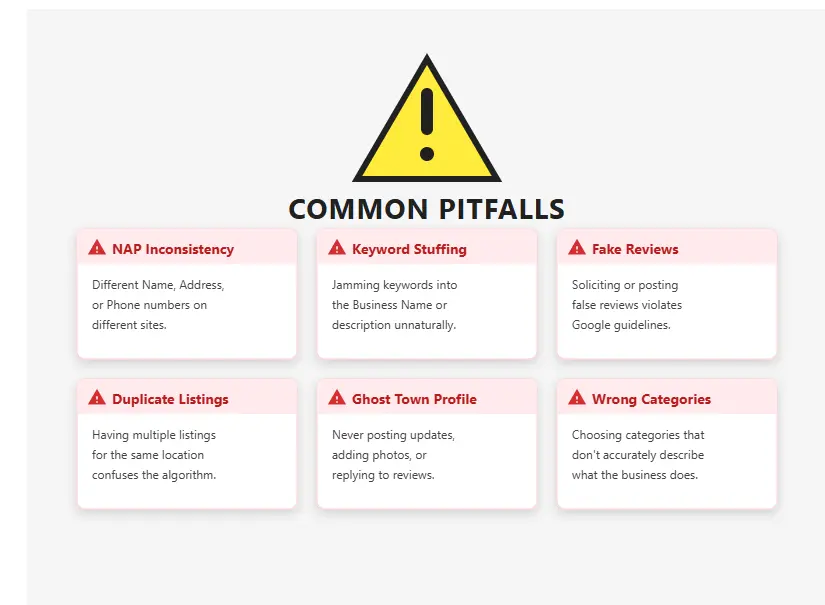
I’ve audited thousands of profiles, and the same errors kill rankings every time. Avoid these at all costs to ensure your Local SEO ranking factors are not being dragged down. Many of these issues can be resolved by following a detailed technical SEO guide.
- Keyword Stuffing in Business Name: Changing your business name from “Joe’s Bakery” to “Joe’s Best Bakery Pizza Chicago” is spam. Google will eventually suspend your profile.
- Fake Reviews: Buying a batch of 50 5-star reviews overnight looks unnatural. Google filters them out and may penalize your account. Stick to organic growth.
- Address Hiding (Incorrectly): If you are a storefront, you must show your address. Hiding it because you think it “looks messy” confuses both users and Google.
- Ignoring Negative Reviews: A bad review is not the end. Deleting it isn’t an option. Ignoring it tells customers you don’t care. Respond with empathy and offer to fix it offline.
Section 6: Future of Local SEO and AI Overviews
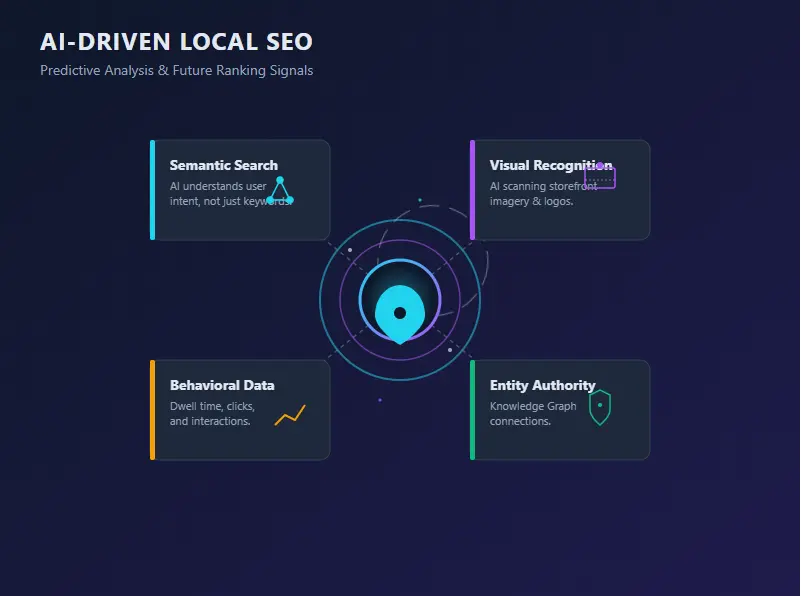
As we look toward 2026 and beyond, the integration of AI in search (specifically AI Overviews and the Local Pack) is the wild card for Local SEO ranking factors. Industry experts at Moz suggest that entity-based search will soon overtake keyword matching.
Google is getting better at answering queries directly in the AI Overview, citing sources without the user needing to click a link. How do you stay visible? As noted by Ahrefs, adaptability is key.
- Entity Deduplication: Google needs to understand *everything* about your business in one place. Schema markup will be non-negotiable.
- Visual Search: Users are searching with images, not just text. Ensure your GBP images are flawless.
- Conversational Queries: Voice search and conversational AI are rising. Optimize for natural language questions (Voice Search SEO).
- Trust Signals: In an AI world, verification goes up a notch. Verify your social profiles, verify your authors, and secure your website with HTTPS.
Section 7: Frequently Asked Questions
Here are common questions regarding Local SEO ranking factors and how to rank higher on Google Maps.
1. What is the most important factor for Local SEO?
While all factors play a role, Google Business Profile optimization and Primary Category selection are the foundational pillars. Without these set correctly, other efforts have diminished returns.
2. How long does it take to rank on Google Maps?
It varies by competition. In a low-competition town, you might see results in 30 days. In a major city for a competitive niche, it can take 6 to 12 months of consistent optimization.
3. Do backlinks still matter for Local SEO?
Yes, immensely. Local backlinks drive “Prominence,” which is one of Google’s three main ranking criteria.
4. Does responding to reviews improve rankings?
Yes, it shows activity (engagement) and improves customer sentiment metrics, which are behavioral signals.
5. Can I rank without a physical office?
Yes, if you are a Service Area Business (like a plumber or cleaner). You can hide your address and set a service radius.
6. What is the “Local Pack”?
The Local Pack is the group of three business listings that appear at the top of Google search results, usually accompanied by a map.
7. Is NAP Consistency still a ranking factor in 2026?
Yes. Citation consistency remains a trust signal, though its raw power has slightly decreased compared to behavioral signals.
8. How do I choose the right Google Business Category?
Choose the category that represents what the business *is*, not what it *does*. For example, a “Pizza Restaurant” is a category; “Pizza Delivery” is an attribute or service.
9. Do Google Posts help with SEO?
They help with freshness and user engagement, which indirectly supports SEO by increasing click-through rates and time spent on your profile.
10. What are Near Me searches?
“Near me” searches are queries where the user implicitly asks for proximity, such as “coffee near me.” Google uses the user’s current location as the primary filter.
11. Does social media affect Local SEO?
Directly, very little. However, social media builds brand authority and generates traffic (CTR), which indirectly boosts local signals.
12. Can I optimize for multiple cities?
If you have one physical location, it is very difficult to rank in the Local Pack for a city you are not physically located in. You should focus on organic landing pages for those neighboring cities.
Free Local SEO Audit Checklist
Stop guessing and start ranking.
We’ve compiled the ultimate Local SEO Audit Checklist used by professional agencies to diagnose exactly why your business isn’t showing up in the Local Pack.
Inside, you will discover:
- ✅ The 10-Step GBP Optimization Protocol.
- ✅ The “Citation Cleanup” checklist to fix NAP errors.
- ✅ The Review Generation email template that works.
- ✅ The exact Schema code you need to implement today.
What you’ll learn: Whether your website is driving customers away, if your competitors are stealing your traffic with better categories, and exactly where you are leaving money on the table.
Need Help Improving Your Local Rankings?
You’ve read the guide, and you know what to do. But let’s be honest—you didn’t start your business to become an SEO expert. You started it to serve your customers.
Let our team handle the heavy lifting. We specialize in getting local businesses to the top of Google Maps.
We can help you with:
- Comprehensive Local SEO Audits: We find the holes in your strategy.
- Google Business Profile Optimization: We build a profile Google can’t ignore.
- Local SEO Consulting: We guide your team or execute the strategy for you.
Don’t let your competitors take your spot.
CLICK HERE TO BOOK YOUR FREE CONSULTATION