
How to Write SEO Content Using AI That Ranks
Stop churning out robotic text that Google ignores. Learn the exact workflow to write SEO content using AI that drives traffic, builds authority, and converts leads.
Start Ranking with AI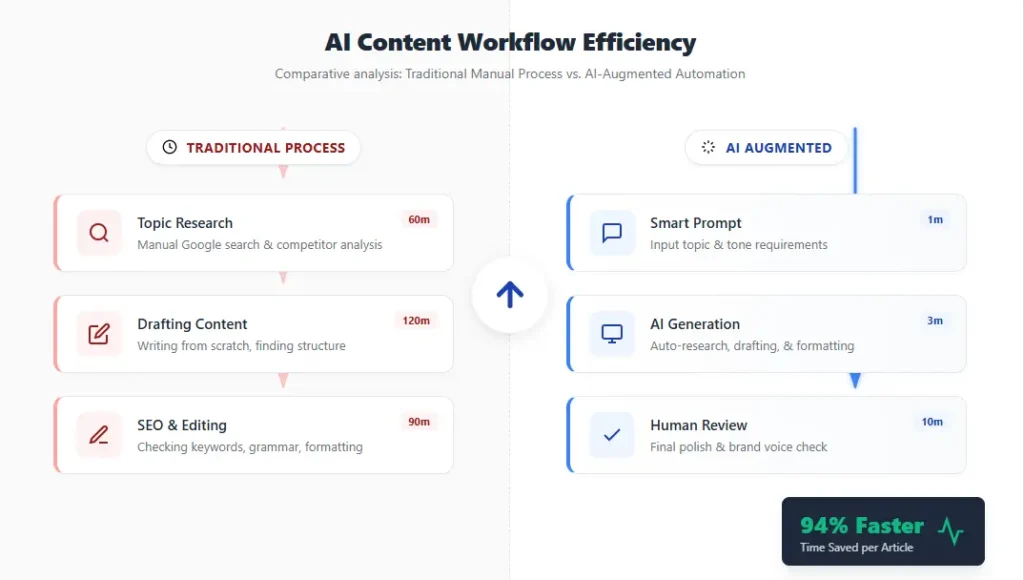
The world of digital marketing has changed dramatically in recent years. Businesses, bloggers, and marketers are now using AI-powered tools to create content faster, improve SEO performance, and scale their publishing strategies. Learning how to write SEO content using AI has become one of the most valuable skills for modern content creators who want to compete in search results.
AI tools can help with keyword research, content outlines, topic clustering, readability improvements, and optimization workflows. However, successful AI SEO writing is not about generating random text and publishing it instantly. Search engines now prioritize helpful, people-first content that demonstrates experience, expertise, authority, and trustworthiness.
This complete SEO content writing guide explains how AI can support your workflow without replacing human creativity. You will discover practical strategies, optimization methods, and content planning techniques that improve rankings while maintaining quality. Whether you are new to AI-assisted writing or looking to improve your SEO content strategy, this guide will show you how to create content that works for both search engines and real readers.
What is AI SEO Content Writing?
AI SEO content writing is the process of using artificial intelligence tools to help research, plan, draft, optimize, and improve content for search engines. These tools analyze keywords, search intent, semantic relationships, and content structure to support faster and more efficient publishing workflows.
The biggest advantage of AI-assisted writing is scalability. Instead of spending hours brainstorming outlines or researching supporting keywords, AI tools can accelerate many parts of the process. This allows content creators to focus more on strategy, user experience, and content quality.
However, effective AI SEO writing still requires human editing and oversight. AI-generated content should always be reviewed for accuracy, clarity, originality, and user intent. The goal is not to replace human expertise, but to combine automation with strategic optimization to create better content more efficiently.
With a strong AI content workflow, marketers can build topical authority faster, publish more consistently, and improve semantic SEO coverage across multiple related topics. This makes AI-powered SEO content creation especially valuable for blogs, affiliate websites, SaaS companies, and content-driven businesses.
Why AI SEO Content is Growing Fast
The adoption of AI in SEO and content marketing continues to increase because content competition is becoming more intense every year. Businesses need faster publishing systems, scalable workflows, and efficient optimization strategies to stay competitive in search results.
AI tools help reduce research time, simplify content planning, and improve workflow efficiency. Instead of manually organizing every section of an article, marketers can use AI to speed up drafting, semantic analysis, and optimization tasks while still maintaining editorial control.
Another major reason AI SEO content is growing rapidly is the rise of topical authority and semantic search. Modern search engines evaluate entire topic coverage instead of isolated keyword usage. AI tools make it easier to build structured content clusters that support broader visibility across multiple related search queries.
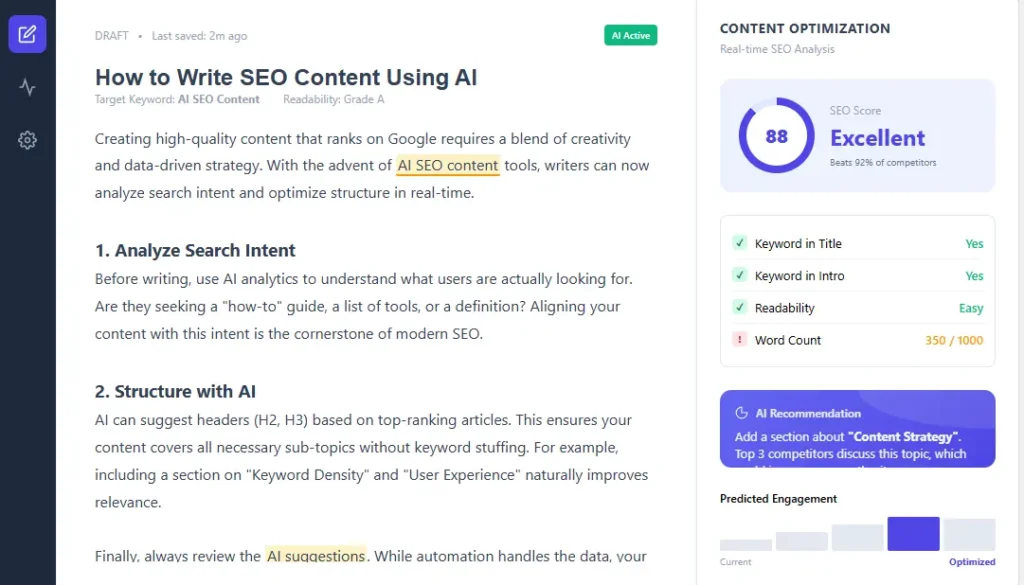
One major driver is the ability to optimize for AI Overviews and SGE (Search Generative Experience). Google now generates AI-driven summaries at the top of search results. To appear there, your content must be structured precisely. AI content optimization tools analyze these patterns and help you format your text to be the source of these answers.
Furthermore, AI SEO content writing allows for massive scalability. You can map out content clusters covering hundreds of long-tail variations. This creates a web of topical authority that signals expertise to Google. By using AI writing tools for SEO, you can maintain consistency across hundreds of pages without burning out your writing team. This scalability is crucial for modern SEO content strategy, allowing businesses to capture niche traffic that was previously too expensive to target manually.
Want faster SEO rankings with AI?
Explore Free SEO Tools →Best AI Tools for SEO Content Writing
To master how to write SEO content using AI, you need the right software. The market is flooded with options, but only a few are built for serious SEO. Using the wrong tool can lead to generic content that fails to rank. Below, we break down the top contenders for AI SEO writing.
ChatGPT / OpenAI
The baseline for most users. OpenAI’s ChatGPT is excellent for brainstorming, outlining, and drafting. However, it lacks real-time SERP data. You should use it for the creative heavy lifting but verify facts with external sources. It is the most versatile tool for general AI content creation.
Surfer SEO
This is a powerhouse for AI content optimization. It analyzes the top-ranking pages for your keyword and gives you a specific score based on word count, keyword density, and structure. It integrates with Jasper (another AI writer) to produce content that is already optimized for your target terms. If you want to know how to write SEO content using AI that matches the competition, Surfer is essential. You can compare it with other tools in our best SEO tools review.
Frase.io
Frase excels at research. It helps you build detailed content briefs by pulling questions from the “People Also Ask” boxes. It is a vital part of any AI content workflow focused on answering user intent. Frase helps you identify the gaps in existing content so your AI output fills them.
Outranking
A fantastic tool for semantic SEO writing. It guides you through the writing process step-by-step, ensuring you include related entities and LSI keywords that Google expects to see in high-quality content. It is particularly good for structuring complex guides.
Rytr & Jenni AI
These are great for shorter form content or getting past writer’s block. While they might not be as robust for full SEO blog writing with AI, they are excellent for generating intros, conclusions, and social media captions. They are lightweight options for specific tasks within a larger AI content workflow.
How Google Evaluates AI Content
A common misconception is that Google penalizes AI content. This is false. Google explicitly states in their helpful content guidelines that they reward high-quality content regardless of how it is produced. This is a critical concept when learning how to write SEO content using AI.
Google’s focus is on E-E-A-T: Experience, Expertise, Authoritativeness, and Trustworthiness. AI has “Expertise” (it knows facts), but it lacks “Experience” (it has never felt pain, joy, or used a product). Therefore, to rank AI-generated content, you must inject the human element.
The spam policies do target content that is scaled “without regard for the quality or user experience.” If you use AI to spam thousands of low-quality articles, you will be penalized. But if you use AI to help you produce helpful content that satisfies user intent, you are safe. The Google SEO Starter Guide remains the bible of optimization, whether the content is written by a human or an AI.
Need help with keyword research?
Try our Keyword Research Tool →Advanced AI SEO Content Strategy
Moving beyond basic article generation, an advanced strategy involves using AI for programmatic SEO and topical authority mapping. This is where the true power of how to write SEO content using AI shines.
Topical Authority Clusters
Instead of writing isolated posts, use AI to generate a “Topical Map.” Input your main keyword, and ask the AI to generate all related sub-topics, questions, and long-tail variations. This structure allows you to build a silo architecture where pillar pages link to cluster pages, strengthening the entire site’s relevance.
Programmatic SEO
For templates pages (like “Best [Software] for [Industry]”), you can use AI to generate unique content for hundreds of variations. This requires strict prompts to ensure the content doesn’t feel repetitive. This is an advanced technique of AI content creation that can yield massive traffic spikes if executed correctly.
Entity Salience
Advanced AI SEO involves optimizing for “entities” rather than just keywords. Google understands that “Apple” is a brand, not just a fruit. AI tools can help you ensure your content contains the related entities (NLP terms) that Google expects to see in an authoritative piece on the subject. This is the cutting edge of semantic SEO writing.
How to Write SEO Content Using AI (Step-by-Step)
This is the core of our SEO content writing guide. Follow this workflow to ensure every piece of content you publish has a fighting chance for the first page.
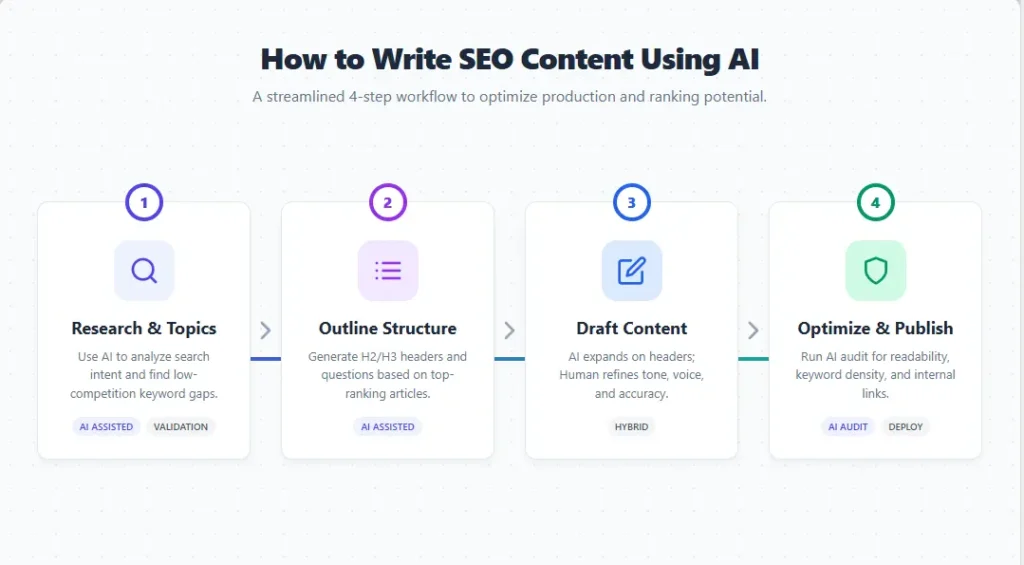
Step 1 – Keyword Research
Start with data. Don’t just guess. Use tools like Ahrefs or our SEO tools to find keywords with high traffic and reasonable difficulty. However, look for opportunity. When learning how to write SEO content using AI, focus on long-tail questions. These are easier to rank for and often have high conversion intent. AI can also help brainstorm keyword clusters by expanding on a seed list.
Step 2 – Search Intent Analysis
Before you write, look at the SERP. Is the intent informational, navigational, transactional, or commercial? Google prioritizes intent. If you try to sell a product in a blog post meant for “how-to” queries, you will fail. Your AI SEO content writing must match what the user actually wants. Ask AI to analyze the top 3 results and summarize the intent.
Step 3 – Topical Map Creation
Don’t write in a silo. AI helps you see connections. Create a topical map. If your main keyword is “Digital Marketing,” AI can generate sub-topics like “SEO,” “Social Media,” and “Email Marketing.” This builds the authority needed for SEO content strategy.
Step 4 – AI Content Outline
This is the most critical step. Never ask AI to “write a blog post.” Ask it to “write an outline.” Use tools like our content outline generator to structure your logic. A good outline ensures flow and covers all semantic entities. You can check our best SEO tools guide for more outlining helpers.
Step 5 – EEAT Optimization
Google looks for Experience, Expertise, Authoritativeness, and Trustworthiness. AI lacks “Experience.” You must inject this. Add case studies, personal anecdotes, and unique insights. Review our E-E-A-T checklist to ensure you meet these standards. This is the “secret sauce” of how to write SEO content using AI that beats competitors.
Step 6 – Semantic Keyword Integration
Keywords are not enough; you need entities. Use AI to find related terms (LSI keywords). If you are writing about “Apples,” AI should help you distinguish between the fruit and the tech company by finding context clues like “iPhone” or “pie.” This is the heart of semantic SEO writing.
Step 7 – Human Editing
AI makes mistakes. It hallucinates facts. It writes in repetitive loops. You must edit. Fix the flow, check the facts, and remove fluff. SEO blog writing with AI requires a human editor to polish the diamond. Read the text aloud. If it sounds robotic, rewrite it.
Step 8 – On-Page Optimization
Ensure your H1, H2, and H3 tags are logical. Add internal links. optimize your meta description. Read our on-page SEO guide for the technical specifics. Ensure the primary keyword “How to Write SEO Content Using AI” appears naturally in these tags.
Step 9 – Internal Linking
Use AI to analyze your existing posts and suggest internal links. This passes link equity and keeps users on your site longer. It is a vital part of AI content optimization. Link relevant articles together to build a sticky web of content.
Step 10 – Publishing & Updates
Hit publish, but don’t forget it. Use AI to analyze performance and suggest updates. Google loves fresh content. Re-optimizing old posts is a key SEO content strategy.
Is your content converting?
Boost Engagement Now →Real AI Content Workflow Example
Let’s put theory into practice. Imagine we are targeting the keyword “AI content optimization“. Here is exactly how we would execute this in a real-world scenario.
Phase 1: Briefing. We feed the keyword into a tool like Surfer SEO. Surfer analyzes the top 10 pages and tells us they average 2,500 words, use the word “algorithm” 15 times, and have an average of 15 H2s.
Phase 2: Outlining. We go to ChatGPT. Prompt: “Create a comprehensive outline for a guide on ‘AI content optimization’ targeting intermediate marketers. Include sections on tools, strategy, and mistakes.” We then refine this outline by matching it to Surfer’s recommendations.
Phase 3: Drafting. We write the intro ourselves (to hook the reader). Then, we prompt AI to write sections one by one. “Write 300 words about the importance of NLP in AI content optimization using a professional tone.” We paste this into Surfer and check the score.
Phase 4: Humanizing. We add a real case study. “When we used Surfer to optimize our landing page, we saw a 20% lift in organic traffic.” This adds the E-E-A-T signal that AI cannot fake.
Phase 5: Final Polish. We check links, add images, and publish. This workflow replicates the process of how to write SEO content using AI at a professional level.
AI vs Human SEO Content Comparison
It is helpful to visualize the differences. Both have strengths and weaknesses. The best strategy combines them.
| Feature | AI SEO Writing | Human SEO Writing |
|---|---|---|
| Speed | Extremely Fast (Minutes) | Slow (Hours/Days) |
| Data Processing | Can analyze millions of data points | Limited to human cognitive load |
| Creativity | Derivative (mixes existing data) | Original/Emotional |
| Accuracy | Prone to hallucinations | Generally higher (with fact-checking) |
| Cost | Low (monthly subscription) | High (per-word cost) |
| SEO Structure | Perfectly formatted | Requires manual effort |
Common AI Content Mistakes
Even the best AI writing tools for SEO can lead you astray if you aren’t careful. Avoid these pitfalls to ensure your SEO content with AI actually ranks.
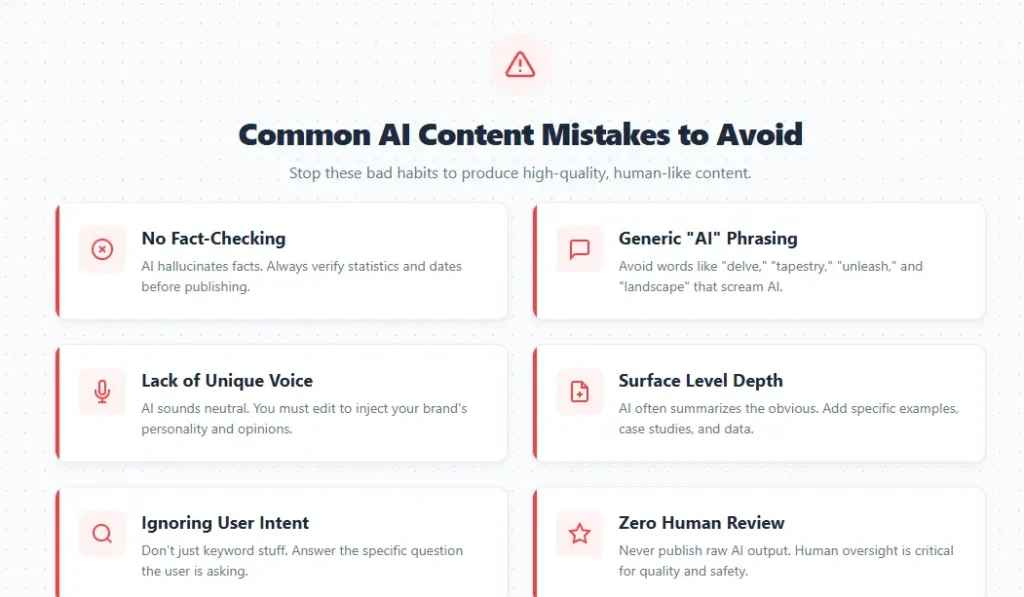
1. Over-optimization: Stuffing keywords is old school. AI often defaults to high density, which looks spammy. Focus on natural flow and semantic SEO writing instead. Use variations of “AI SEO writing” rather than repeating the exact phrase.
2. Thin Content: Don’t just generate 500 words and hit publish. Google prefers comprehensive guides. If the top result is 3,000 words, your AI output needs to match that depth. Superficial content is a fast track to obscurity.
3. Robotic Writing: Phrases like “In today’s digital landscape” or “Delve into” are red flags. You must rewrite these to sound human. If you want to master how to write SEO content using AI, you must become a ruthless editor.
4. No EEAT: Publishing without author bios or medical/financial disclaimers where needed. AI cannot replace professional accreditation. Always add a human face to the content.
5. Duplicate Structures: Using the same prompt for every post creates repetitive meta structures. Vary your intros and formats to keep the content fresh for both Google and your readers.
Ready to dominate your niche?
Learn Semantic SEO Strategies →How to Make AI Content Human
The “AI detection” debate is real. But more importantly, you want readers to connect with your brand. To humanize your content and succeed in how to write SEO content using AI, you need to add layers of complexity.
- Add Experience: Talk about what you saw, felt, or did. “When I used this tool, I noticed…” AI cannot simulate subjective experience.
- Add Examples: Don’t just say “create good titles.” Show five examples of good titles. Specificity is the mark of human thought.
- Use Idioms and Humor: AI is notoriously literal. Break the pattern with wit. A well-placed joke can signal to a reader that a human wrote this.
- Vary Sentence Length: AI writes in consistent rhythmic patterns. Mix short punches with long, flowing sentences to create a natural cadence.
- Emotional Writing: Connect with the reader’s pain points. Make them feel understood before you offer a solution. Empathy is a core differentiator in AI content creation.
SEO Optimization Checklist for AI Content
Before you hit publish, run through this AI SEO content writing checklist.
- ✔ Primary keyword “How to Write SEO Content Using AI” in H1, first 100 words, and URL.
- ✔ Semantic entities included naturally throughout the text.
- ✔ Title tag optimized for CTR (under 60 chars).
- ✔ Meta description includes primary keyword (under 160 chars).
- ✔ Schema markup implemented (Article, FAQ, etc).
- ✔ Image SEO with descriptive alt text (2 with exact keyword).
- ✔ Internal links to 2-3 relevant posts using SEO for beginners logic.
- ✔ External links to authority sites (Google, Wikipedia) without nofollow.
- ✔ Readability score is high (short paragraphs, bullets).
- ✔ EEAT signals clearly visible (Author bio, date, sources).
Best Practices to Rank AI Content
Ranking isn’t just about checklists. It is about philosophy.
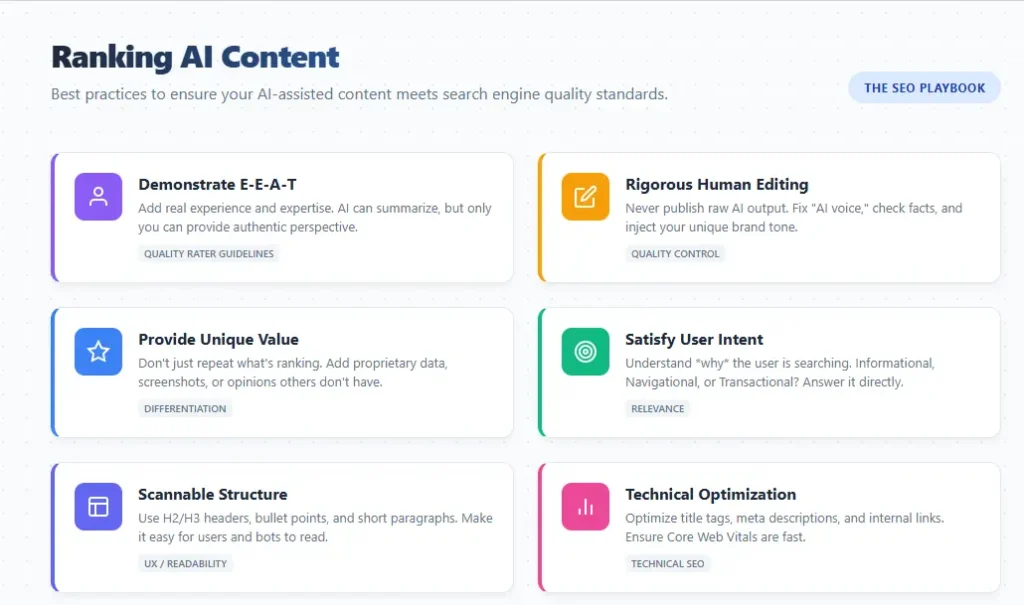
First, focus on Helpful Content. Google’s systems are designed to reward content that is created for people, not search engines. Even when using AI writing tools for SEO, your primary goal must be utility. Does this answer the user’s question better than anyone else?
Second, align with Search Intent. If you have a brilliant article that answers the wrong question, it won’t rank.
Third, build Topical Authority. Don’t stop at one post. Use AI to create clusters of content that interlink. This signals to Google that you are an expert in the entire niche, not just a single keyword. This is the ultimate goal of a robust SEO content strategy.
Finally, keep updating. AI content optimization is not a one-time task. Refresh your articles every few months with new data and insights. Search is a living ecosystem.
Frequently Asked Questions
Can AI-written content rank on Google?
Yes, absolutely. Google has confirmed that AI-generated content is acceptable as long as it is high-quality, helpful, and demonstrates EEAT. The key is how to write SEO content using AI responsibly—using AI as a tool to assist, not replace human oversight.
Is AI content bad for SEO?
No, AI content itself is not bad. However, low-quality, spammy, or unedited AI content is bad. If you publish generic AI text without adding value or fact-checking, it will likely hurt your rankings. Quality control is essential.
Which AI tool is best for SEO writing?
There isn’t one single “best” tool. ChatGPT is great for drafting, while Surfer SEO or Frase are superior for optimization. For a complete AI content workflow, combining a drafting AI with an optimization tool usually yields the best results.
How do you humanize AI content?
To humanize AI content, you need to inject personal experience, opinions, and unique data. Change the sentence structure to be less rhythmic, use metaphors and idioms, and ensure the emotional tone resonates with human readers rather than sounding like a textbook.
Can AI content get indexed?
Yes, Google indexes AI content just like any other content. There is no penalty for using AI. The indexability depends on your site structure, sitemaps, and technical SEO, not the origin of the text itself.
What is the risk of using AI for SEO?
The main risks include hallucinations (facts that look real but aren’t), potential copyright infringement (if training data regurgitates specific text), and creating “thin” content that doesn’t satisfy user intent. Always edit and verify.
How does AI affect SEO jobs?
AI is changing SEO jobs from “writing” to “editing and strategy.” SEO professionals who learn how to write SEO content using AI will be more productive and valuable. Those who refuse to adapt may struggle to keep up with the scale required by modern competition.
Do I need to disclose AI content?
While not strictly required by Google for generic search, transparency is good practice. For YMYL (Your Money Your Life) topics, clear attribution is vital to build trust with your audience.
Conclusion
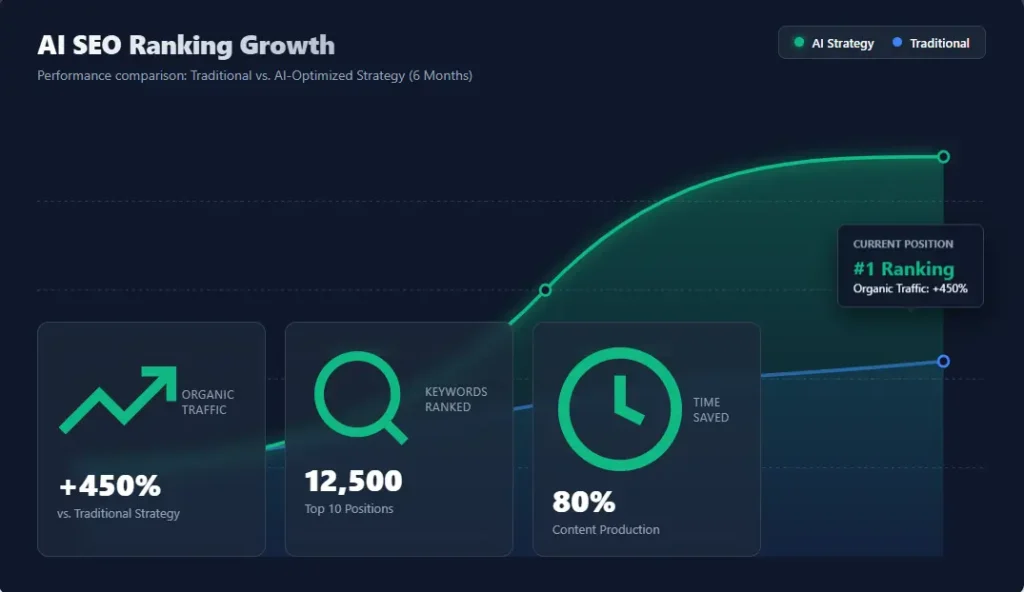
Mastering how to write SEO content using AI is the single most important skill for digital marketers in this era. It bridges the gap between high-volume production and high-quality optimization. By following the steps in this SEO content writing guide, you can create a system that scales your traffic without sacrificing quality.
Remember, AI is the engine, but you are the driver. Use it to handle the heavy lifting of research and drafting, but rely on your human expertise to add the spark that makes content truly valuable. Focus on EEAT, prioritize user intent, and always, always edit your output.
Ready to transform your strategy? Start by experimenting with your AI content workflow today. Use the tools, checklists, and best practices outlined here to build a sustainable SEO content strategy that dominates the SERPs.
Explore Seoraf SEO tools and AI content resources. If you are a beginner, start small, but start today. The future of search is powered by AI, and your content should be too.