
PPC vs SEO in 2026: The $100K ROI Decision Most Marketers Get Wrong
Uncover invisible competitor strategies, master the “Halo Effect,” and build a hybrid search engine marketing strategy that maximizes ROI.

Digital Marketing Strategist
🔬 Our Methodology
This guide aggregates data from leading industry reports (Search Engine Land, HubSpot), public auction insights, and standard SEM practices. We aim to provide a transparent framework for your keyword research and budget allocation.
Introduction: The Hidden Battlefield of Search Marketing
PPC vs SEO: Quick Answer (2026)
- PPC: Instant traffic but ongoing cost
- SEO: Slow growth but long-term asset
- PPC wins: Speed + testing
- SEO wins: ROI + scalability
- Best strategy: Combine both for maximum dominance
In the high-stakes digital ecosystem of 2026, the competition for visibility isn’t just fierce—it’s invisible. Businesses are vying for SERP Real Estate, employing complex mixes of strategies to capture attention. At the heart of this conflict lies the legendary debate: PPC vs SEO. But framing this as a binary choice is a strategic error.
The reality is that the search engine marketing mix is layered with hidden maneuvers. Your competitors are likely using “Assisted Conversions”—where PPC drives the awareness but SEO gets the credit for the final click—skewing your data analysis. This guide serves as your reconnaissance mission, helping you uncover these invisible campaigns and decide between paid vs organic search based on math, not myth.
We will examine the “Halo Effect” (how paid boosts organic), the specific mechanics of Google Ads vs SEO, and provide a traffic acquisition model that maximizes your digital presence. For a deeper dive into technical implementation, explore our full SEO guide on SEORAF.
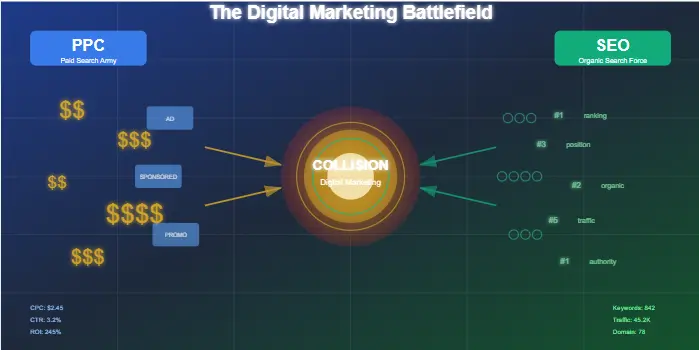
The digital marketing battlefield where PPC and SEO strategies collide
The Evolution: From Silos to Synergy
Two decades ago, the paid search strategy guide was binary. SEO was keyword stuffing; PPC was highest-bidder wins. Today, Google Quality Score dictates that your landing page experience (an SEO factor) directly impacts your PPC costs. The lines have blurred.
In modern paid vs organic search, smart businesses treat these channels not as enemies, but as teammates covering different phases of the Customer Journey. PPC handles the high-intent “solution-aware” phase, while SEO dominates the “problem-aware” research phase.
Understanding PPC: Renting the Land
Pay-Per-Click (PPC) is the model of renting visibility. When you search for a product, the top results marked “Sponsored” are PPC placements. You pay a toll to the search engine every time a visitor enters your site.
💡 Quick Definition: PPC
PPC (Pay-Per-Click) is an internet advertising model where advertisers pay a fee each time one of their ads is clicked. It is essentially a way to buy visits to your site, rather than attempting to “earn” those visits organically.
In the traffic acquisition model, PPC offers Immediate Gratification. You can launch a campaign today and see traffic tomorrow. It provides granular control over demographics, location, and time of day—assets SEO lacks. However, it requires careful PPC audit strategies to ensure profitability.
The Mechanics: Ad Rank & Quality Score
When analyzing Google Ads vs SEO, understand the auction. It is not just who pays the most. Google uses Ad Rank:
Ad Rank = Bid Amount × Quality Score
- Quality Score (1-10): A metric based on CTR, ad relevance, and landing page experience.
- Insight: A higher Quality Score lowers your Cost Per Click (CPC). This means good Technical SEO (fast landing pages) actually makes your PPC cheaper.
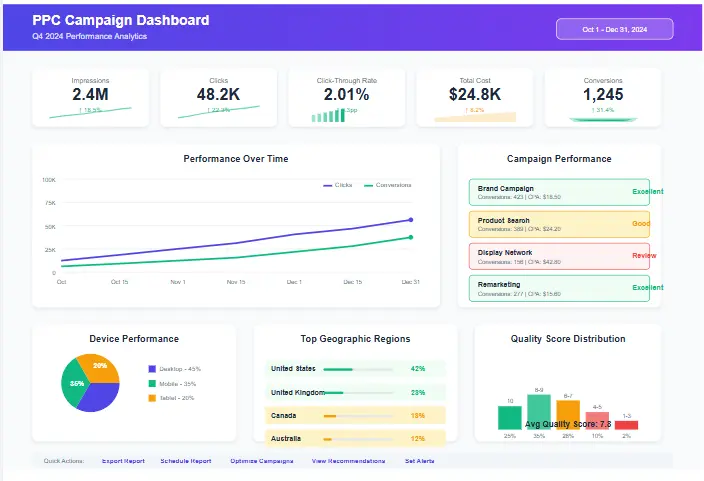
A typical PPC campaign dashboard showing performance metrics and Quality Score analysis
🚀 Pro Tip: Use PPC to test headlines. If a PPC headline gets a 5% CTR in 2 days, rewrite your organic H1 and Title Tag to match it. You’ve just validated your SEO strategy without risking 6 months of rankings.
Understanding SEO: Owning the Asset
Search Engine Optimization (SEO) is the act of building a digital asset. Unlike PPC, where traffic stops when payments stop, SEO compounds over time.
In the paid vs organic search discussion, SEO is a marathon. Results typically take 3-6 months. However, once achieved, the “Cost Per Click” is effectively zero (excluding maintenance costs), yielding a much higher ROI for mature domains.
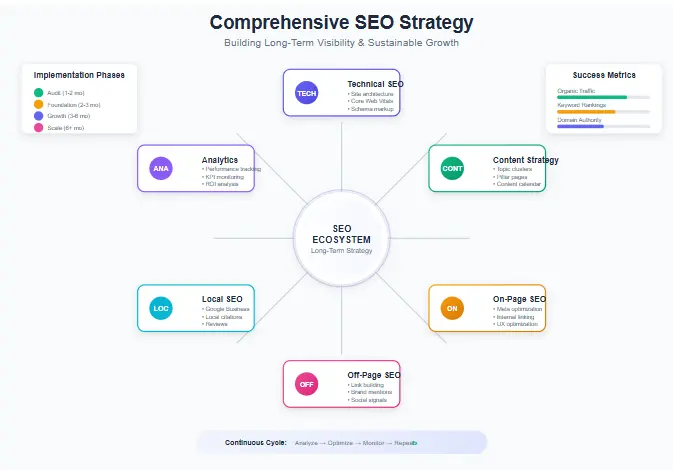
Implementing a comprehensive SEO strategy for long-term visibility and asset building
The Mechanics: E-E-A-T and Entities
Modern SEO in 2026 relies on Entities and E-E-A-T (Experience, Expertise, Authoritativeness, Trustworthiness). Google is moving away from simple string matching to understanding concepts.
- On-Page SEO: Semantic content, keyword clusters, and structured data.
- Technical SEO: Core Web Vitals (speed), mobile-friendliness, and crawlability.
- Off-Page SEO: Backlink profile authority and brand mentions.
A successful search engine marketing strategy requires all three. If your Technical SEO is poor, your content won’t rank, regardless of how good it is. For local businesses specifically, implementing a solid Local SEO Guide is critical for map pack visibility.
Reconnaissance: Are Your Competitors Running Invisible Ads?
This is the “Hidden Battlefield.” In the search engine marketing mix arena, competitors often deploy cloaking tactics that make their ads invisible to you but visible to your customers.
⚠️ The “Blind Spot” Warning
Never analyze competitors solely by Googling keywords from your office. Your search history, IP address, and location personalize results. You are likely seeing a “sanitized” version of the SERP.
1. Geographic Targeting
A competitor may target “Plumber in Chicago” but exclude your specific ZIP code. To you, the market looks clear. To a user 5 miles away, it’s saturated.
2. Ad Scheduling (Dayparting)
Competitors may run ads only during business hours (9 AM – 5 PM). If you check at 8 PM, you’ll see organic results and assume no one is bidding. You might then enter the market at 9 AM and get crushed by established bids.
3. IP Exclusion
Savvy competitors exclude IP ranges belonging to known agencies and competitor offices. This prevents you from seeing their ads and copying their copy.
Financial Impact: ROI, ROAS, and Asset Value
Let’s talk math. The paid search strategy guide debate often dies at the wallet.
📊 The Financial Reality
PPC (Cost Per Acquisition – CPA): High upfront, low barrier to entry. Good for testing.
SEO (Return on Investment – ROI): High upfront labor cost, near-zero marginal cost later. Good for scaling.
The “Hybrid” Budget Model
For 2026, we recommend the 70/30 Rule depending on your maturity:
- Phase 1 (Launch): 80% PPC / 20% SEO. You need cash flow and data. Use PPC to find converting keywords.
- Phase 2 (Growth): 50% PPC / 50% SEO. Optimize the high-performers from Phase 1 for SEO.
- Phase 3 (Dominance): 30% PPC / 70% SEO. Now you own the organic terms; use PPC only for defensive branded terms and high-intent “buy now” queries.
📁 Real-World Case Study: The SaaS Pivot
Industry: B2B SaaS (Project Management)
The Problem: A client relied 100% on PPC for “Project Management Software.” CPCs rose to $45. Customer Acquisition Cost (CAC) exceeded Lifetime Value (LTV).
The Strategy: We shifted 40% of the budget to SEO targeting “long-tail” problem-solving queries (e.g., “how to manage remote teams”). We kept PPC for brand defense.
The Result (12 Months): Organic traffic increased 300%. PPC spend decreased by 50%, but total leads increased by 20%. The Halo Effect (organic presence) increased the CTR of their remaining PPC ads by 15% due to brand familiarity.
Reconnaissance Tools & Tech Stack
You cannot manage what you cannot measure. To dominate the traffic acquisition model landscape, equip yourself with:
For PPC Intelligence
- SEMrush / SpyFu: View competitor ad copy history and budget estimates.
- Google Ads Auction Insights: See who is overlapping with you in the auction and how often.
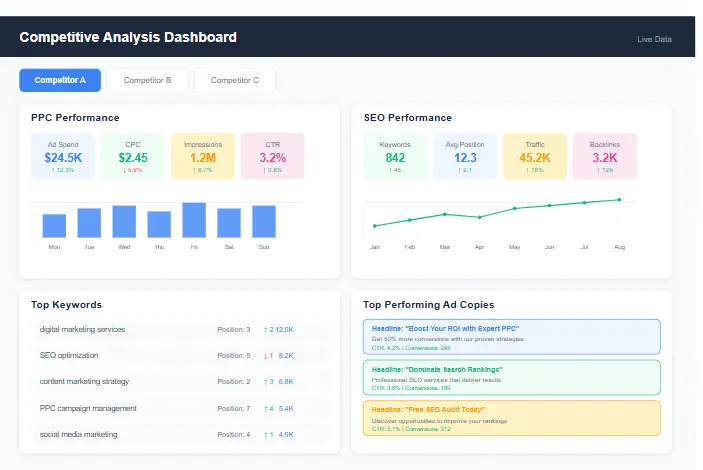
Competitive analysis dashboard revealing competitor PPC spend and SEO gaps
For SEO Intelligence
- Ahrefs: Analyze the “Gap” analysis—keywords competitors rank for that you don’t.
- Google Search Console: Identify queries where you rank #11-15 (low hanging fruit).
PPC vs SEO: The Data Matrix
| Metric | PPC (Paid Search) | SEO (Organic Search) |
|---|---|---|
| Speed to Market | Instant (Hours) | Slow (Months) |
| Cost Structure | Variable (Pay per Click) | Fixed (Labor/Content) |
| Asset Value | Rented (Stops when paid) | Owned (Compounds) |
| Control | Total (Ad copy, landing page) | Partial (Algo dependent) |
| Trust Factor | Low (Users know it’s an ad) | High (Editorial endorsement) |
| Best For | Testing, Short-term, Brand Defense | Long-term, Authority, Info-intent |
The Halo Effect: When PPC & SEO Join Forces
The most sophisticated marketers know the paid search vs organic visibility debate is a trap. The true power lies in Search Synergy.
1. SERP Dominance
When you rank #1 organically AND have an ad at the top, your click-through rate (CTR) doesn’t just add up—it multiplies. You occupy 50% of the visual fold. Users perceive your brand as an “industry leader” because you are everywhere.
2. Remarketing Synergy
Use SEO to capture broad research intent (“how to fix a leak”). Then use PPC Remarketing to follow those users with ads for your specific tool (“buy plumber wrench”). You are using SEO for the top of the funnel and PPC to close the bottom.
Critical Pitfalls to Avoid
- The Silo Mistake: If your PPC team and SEO team don’t talk, you are bleeding money. They must share keyword data.
- Bidding on Competitor Brands: Expensive and often low conversion. Only do this if they have a terrible reputation.
- Neglecting Branded PPC: If you don’t bid on your own brand name, a competitor will. They will steal your customers for $0.50/click. Always defend your brand turf.
Future Trends: The AI Search Era (2026)
The Google Ads vs SEO landscape is shifting toward AI Overviews (SGE) and Zero-Click Searches.
- Zero-Click: Google answers the question on the SERP. PPC ads move above the answer, while organic answers get cited.
- Visual Search: Pinterest Lens and Google Lens require SEO for image metadata and PPC for visual inventory feeds.
- Automation: PMax (Performance Max) campaigns are blurring the lines, automating bidding across YouTube, Search, and Display based on a single goal.
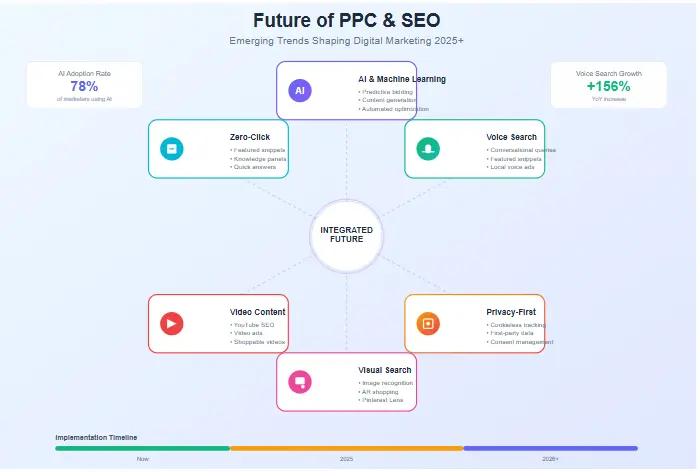
Emerging trends shaping the future of PPC and SEO in the AI era
🔗 Key Entities
This page covers the core entities: Google Ads, Organic Search, SERP, Quality Score, ROAS, and SEO. Understanding how these entities interact is crucial for 2026 strategy.
Expert FAQ: PPC vs SEO
Is SEO cheaper than PPC?
Long-term, yes. SEO requires upfront labor and content creation, but once you rank, clicks are essentially free. PPC costs accumulate with every single click and can rise with competition, making it more expensive over a long horizon.
How long does SEO take?
Typically, SEO takes 3 to 6 months to show significant results. New websites may take longer due to the “Sandbox period.” It is a long-term investment, unlike PPC which can drive traffic instantly.
Can PPC work without SEO?
Yes, but it is inefficient and expensive. Without a good landing page (SEO), your Quality Score drops, increasing your CPC. You also miss out on the “Halo Effect” where organic presence boosts ad trust.
Why is PPC so expensive?
PPC works on an auction model. If many businesses are bidding for the same keyword (e.g., “insurance”), the Cost Per Click (CPC) skyrockets. High commercial intent keywords are generally the most expensive.
What is a good ROAS?
A good ROAS varies by industry, but a common benchmark is 4:1 ($4 revenue for every $1 spent). For e-commerce, breaking even (1:1) might be acceptable if you acquire repeat customers (high LTV).
Which is better PPC or SEO for startups?
Startups should usually prioritize PPC first. They need immediate cash flow and data on what customers want. Once they have revenue, they should reinvest into SEO for sustainable, lower-cost growth.
Does PPC help SEO ranking?
No, Google states that paying for ads does not directly improve organic rankings. However, PPC data can help you find converting keywords to target with SEO, and traffic from PPC can lead to branded searches that help SEO.
Should I invest in SEO or PPC first?
If you need immediate sales or are testing a new market, choose PPC first. If you have a limited budget but time on your side, and want to build a sustainable asset, invest in SEO first.
Can SEO replace PPC completely?
Rarely. While SEO is sustainable, it cannot control timing or placement like PPC. Most successful businesses use SEO for the baseline and PPC for peaks, promotions, and high-intent competitor targeting.
What is CPC vs CPA?
CPC (Cost Per Click) is what you pay for a visit. CPA (Cost Per Acquisition) is the total cost to get a sale or lead. A low CPC is good, but a low CPA is better because it accounts for conversion rates.
What is search intent?
Search intent is the *why* behind a query. Is the user looking to buy (Transactional), learn (Informational), or find a specific site (Navigational)? Aligning your content with intent is critical for both PPC and SEO success.
Does brand bidding help SEO?
It doesn’t help organic ranking directly, but it protects your brand from competitors bidding on your name. It ensures you get 100% of the clicks from people searching specifically for you.
How to combine PPC and SEO?
Use PPC to test keywords and copy. Apply the winners to your SEO pages. Use SEO to rank for information queries, then use PPC remarketing to retread those visitors with specific product ads.
What industries need PPC most?
Industries with high customer lifetime value (LTV) and urgency, such as plumbing, legal services, and emergency repair, rely heavily on PPC because customers cannot wait for organic rankings to kick in.
Is SEO still relevant in 2026?
Absolutely. Despite AI Overviews and Zero-Click searches, organic search remains the primary channel for high-intent discovery. SEO builds an asset that pays dividends for years unlike paid ads.
Stop Guessing Your Strategy
Get a professional forensic audit of your PPC & SEO gaps. We’ll show you exactly where your budget is leaking and how to fix it.
Get My Free Audit Report