
The Keyword Research Process: 14 Steps to Build Better SEO
The keyword research process is a structured sequence for finding, validating, organizing, and prioritizing search opportunities before turning them into content. A reliable process starts with a business goal and audience, then moves through keyword discovery, relevance validation, search-intent and SERP analysis, metric evaluation, clustering, page mapping, prioritization, content planning, measurement, and refinement.
In practical terms, the process answers five questions: What should we research? What do people actually want? Which opportunities are worth pursuing? Which page should own each topic? And what should we learn after publication?
This guide focuses on the process itself: what to do, in what order, and what decision should allow you to move from one stage to the next. It is not a definition-only guide, a keyword-tool roundup, or a deep dive into one checkpoint such as clustering or search-intent classification.
By the end, you will have a repeatable 14-step workflow you can apply to a single article, a content cluster, a new website, or a recurring keyword research cycle.
By Mousume Akter, Founder & Editor, SEORAF
Keyword Research Process Overview
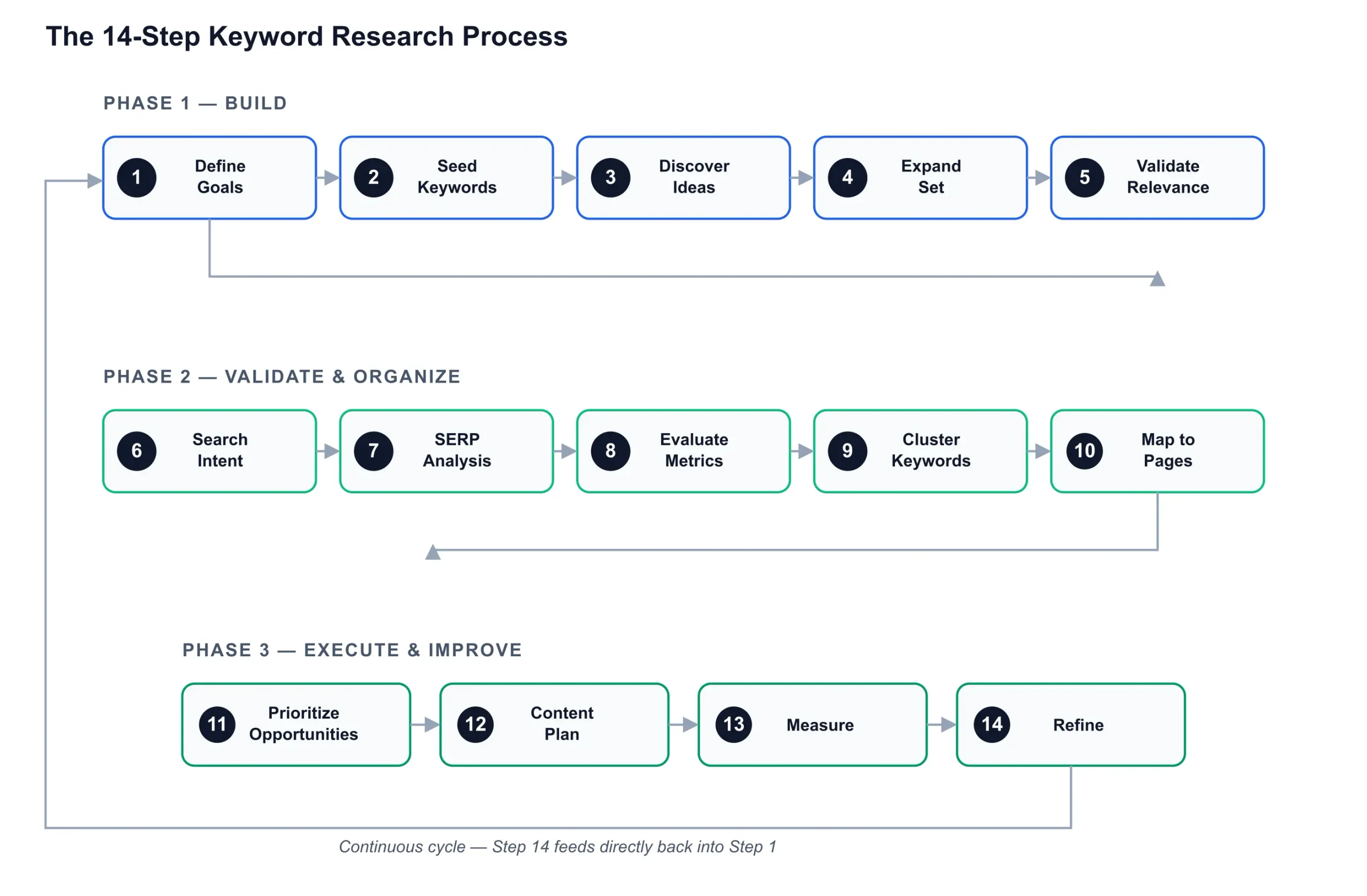
The keyword research process moves from business context to search evidence, page decisions, execution, measurement, and refinement.
Quick Answer: What Is the Keyword Research Process?
The keyword research process is the repeatable workflow used to find relevant search terms, understand the needs behind them, evaluate their SERP and business fit, group related terms, assign them to pages, prioritize opportunities, and learn from performance after publication.
A strong process does not stop when a keyword tool produces a list. The list is only raw material. The important decisions happen afterward: whether the keyword is relevant, what the searcher expects, whether the current SERP supports the planned page, whether several keywords belong together, whether an existing page should own the topic, and whether the business can genuinely serve the search need.
The 14 steps in this framework are:
- Define goals and audience
- Build seed keywords
- Discover keyword ideas
- Expand the keyword set
- Validate relevance
- Analyze search intent
- Analyze SERPs
- Evaluate keyword metrics
- Cluster related keywords
- Map keywords to pages
- Prioritize opportunities
- Turn research into content plans
- Measure performance
- Refine the strategy
The sequence matters because later decisions depend on earlier evidence. For example, search volume should not determine page creation before you know whether the keyword is relevant or whether the current SERP supports your intended content format.
How This Process Page Fits Into the Keyword Research System
This page has a specific role within the broader SEORAF keyword research topic. The SEORAF Keyword Research Guide explains the broader system and reasoning behind discovery, intent, clustering, mapping, and prioritization. This page focuses specifically on the ordered operational process: what happens first, what happens next, and what decision allows the workflow to continue.
The SEORAF Keyword Research Checklist serves a different purpose again: it condenses the workflow into a shorter execution format.
Keeping those roles distinct helps avoid unnecessary overlap:
| Resource | Primary purpose | Best use |
|---|---|---|
| Keyword Research Guide | Explains the broader system and reasoning. | Learning and strategic reference. |
| Keyword Research Process | Explains the ordered 14-step workflow. | Planning and executing a complete research cycle. |
| Keyword Research Checklist | Condenses the workflow into an execution checklist. | Quick repeatable implementation. |
How to Use This 14-Step Framework
The process has three broad phases. Steps 1–5 establish the research context and build a qualified candidate set. Steps 6–10 validate those candidates against search behavior and turn them into deliberate page decisions. Steps 11–14 convert the research into an actionable content plan and a feedback loop.
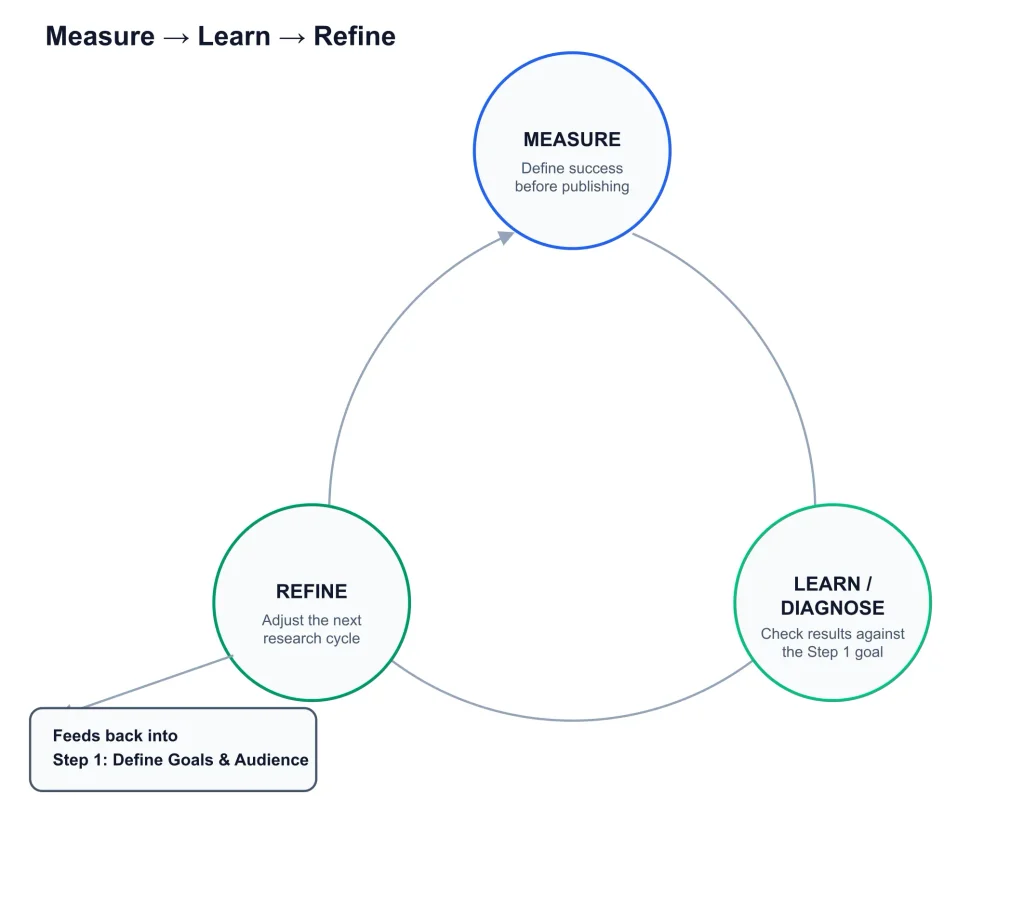
The steps are sequential, but the overall system is cyclical. Measurement in Step 13 and refinement in Step 14 can change the assumptions you bring into the next research cycle, including the original goal, audience, seed set, intent interpretation, or page architecture.
The 14 steps at a glance
- Define goals and audience
- Build seed keywords
- Discover keyword ideas
- Expand the keyword set
- Validate relevance
- Analyze search intent
- Analyze SERPs
- Evaluate keyword metrics
- Cluster related keywords
- Map keywords to pages
- Prioritize opportunities
- Turn research into content plans
- Measure performance
- Refine the strategy
The core principle
Do not let a keyword tool determine the strategy for you. Tools can expand a candidate set and provide estimates, but the process still requires human judgment about relevance, intent, SERP fit, page ownership, addressability, and business value.
Step 1 — Define Goals and Audience
Keyword research should start with a goal, not with a keyword. If you begin by collecting terms without knowing what the research is supposed to accomplish, later decisions about relevance, prioritization, and page ownership become difficult to evaluate.
State the business outcome
Write the purpose of the research cycle in one sentence. Avoid a vague objective such as “get more traffic.” Instead, connect the research to a concrete outcome: increase qualified inquiries for a service, build visibility around a strategic topic, support a product launch, or attract people evaluating a particular category.
The goal gives later steps something to measure against. A keyword can have substantial search demand and still be unsuitable if the people searching for it are outside the audience or the page cannot help them reach the desired outcome.
Identify the audience segment
Define who the research is intended to serve. A person learning about a problem for the first time will use different language from someone comparing products, evaluating vendors, or looking for a specific solution.
Illustrative example: A hypothetical project-management software company might replace the vague goal “get more signups” with “attract people comparing project-management tools for a mid-sized team who have not yet selected a platform.” That statement gives the rest of the research a clear audience and business context.
Decision rule
Proceed when: you can state the business outcome and intended audience clearly enough to judge whether a keyword serves them.
Pause when: the only objective is an unqualified traffic target with no defined audience or business purpose.
Step 2 — Build Seed Keywords
A seed keyword is a starting term that represents a topic, product, service, problem, or audience need. Seeds are not the final keyword targets. They are the raw material from which broader candidate research begins.
Where seed keywords come from
- The offering itself: use plain-language descriptions of the product, service, topic, or problem.
- Existing content: inspect published pages and the terminology already associated with them.
- Audience language: use wording from support conversations, reviews, forums, interviews, sales discussions, or other legitimate audience research.
The seed-sufficiency rule
There is no universal number of seeds that makes research complete. Stop when additional seeds stop introducing genuinely new subtopics. If a new seed simply repeats an existing concept with different wording, it is unlikely to expand the research meaningfully. If it reveals a new audience need, use case, problem, or category, keep it.
Decision rule
Proceed when: the seed set represents the meaningful topic areas connected to the goal and audience.
Keep researching when: new seeds continue to reveal genuinely different subtopics.
Step 3 — Discover Keyword Ideas
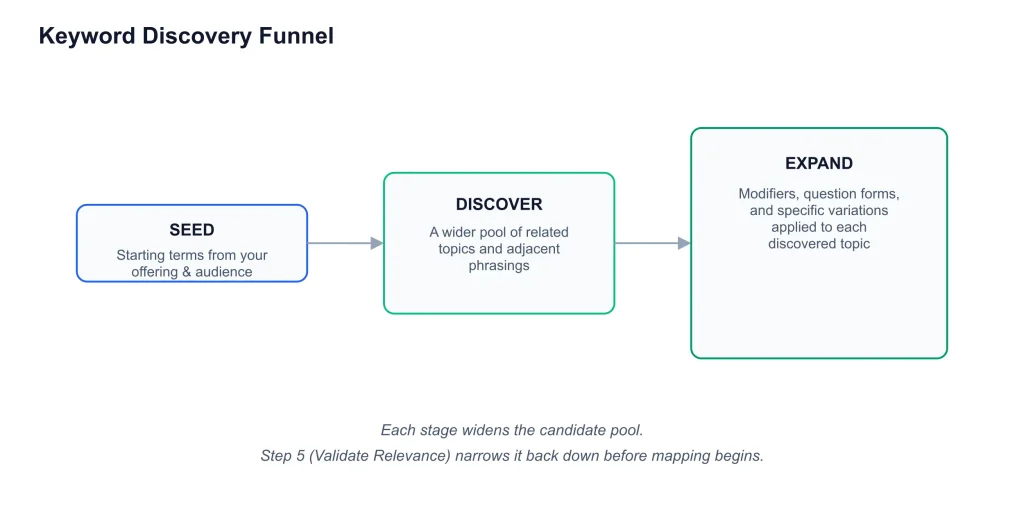
Discovery expands the seed list into a broader pool of candidate keywords. The objective at this stage is breadth: identify related topics, alternative phrasings, questions, comparisons, and adjacent needs before deciding which candidates deserve further attention.
Broaden from seeds to candidates
For each seed, ask what someone with the same underlying need might search before, during, or after the original query. A person researching “project management software,” for example, might later search for comparisons, alternatives, feature-specific solutions, or software for a particular team type.
Keyword research tools can be useful here because discovery is one of the stages where scale helps. Their suggestions should be treated as candidates rather than automatic recommendations.
Discovery is not validation
Discovery answers “what related topics might exist?” It does not answer “which of these should we target?” That judgment comes later. Keeping the stages separate prevents an attractive metric or tool suggestion from being mistaken for a strategic decision.
Step 4 — Expand the Keyword Set
After discovery identifies the topic space, expansion explores specific variations within each topic. This is where modifiers, questions, comparisons, and audience-specific phrasing can turn broad candidates into more precise opportunities.
Modifier-based expansion
Modifiers narrow a broad term by adding information such as use case, audience, price, format, comparison, or solution type. A small, deliberate modifier set is usually more useful than attempting to brainstorm every possible phrase manually.
Question-based expansion
Questions beginning with words such as “how,” “what,” “why,” and “which” can expose informational needs that a broad seed does not reveal. These candidates may later become standalone pages, sections, or supporting content depending on their intent and relationship to existing pages.
| Method | What it can surface |
|---|---|
| Modifiers | Narrower variants based on use case, audience, comparison, or format. |
| Question forms | Informational needs and specific problems that may support guide-style content. |
| Comparison framing | Decision-stage searches involving alternatives, products, or approaches. |
| Use-case variants | Audience- or scenario-specific opportunities connected to Step 1. |
Decision rule
Proceed when: expansion has covered meaningful variations without becoming a collection of near-duplicate phrases.
Stop expanding when: new variations add wording but no meaningful new need, audience, or use case.
Step 5 — Validate Relevance
Discovery and expansion should produce more candidates than you will ultimately use. Validation removes candidates that do not represent a meaningful need for the audience or do not support the goal defined in Step 1.
What “validated” means
A validated keyword represents a specific need that you can describe in one sentence. You should be able to say what a searcher wants to understand, compare, find, or accomplish by using the query.
Relevance has two dimensions here: the keyword must represent a genuine search need, and that need must connect to the audience and outcome established at the beginning of the process.
Validation pass/fail rule
PASS: the underlying need is clear, connected to the audience, connected to the goal, and meaningfully distinct from an existing validated candidate.
FAIL: the term merely “sounds related,” cannot be connected to a specific need, or has no meaningful relationship to the research goal.
- Can the underlying need be stated in one sentence?
- Does the need connect to the goal from Step 1?
- Does it belong to the audience segment from Step 1?
- Is it meaningfully distinct from another validated candidate?
Failed candidates do not necessarily need to be deleted. Some may later function as supporting terms within a valid cluster, while others may become useful during a future research cycle.
Step 6 — Analyze Search Intent
Search intent describes what a searcher is trying to accomplish with a query. It is one of the most important checkpoints because a page can be well written and still be unsuitable if it does not satisfy the type of result the query calls for.
Why intent belongs before mapping
Analyze intent while the keyword is still a candidate rather than after a page has already been planned. Doing so can prevent a team from building an article around a query that actually calls for a different content format or user outcome.
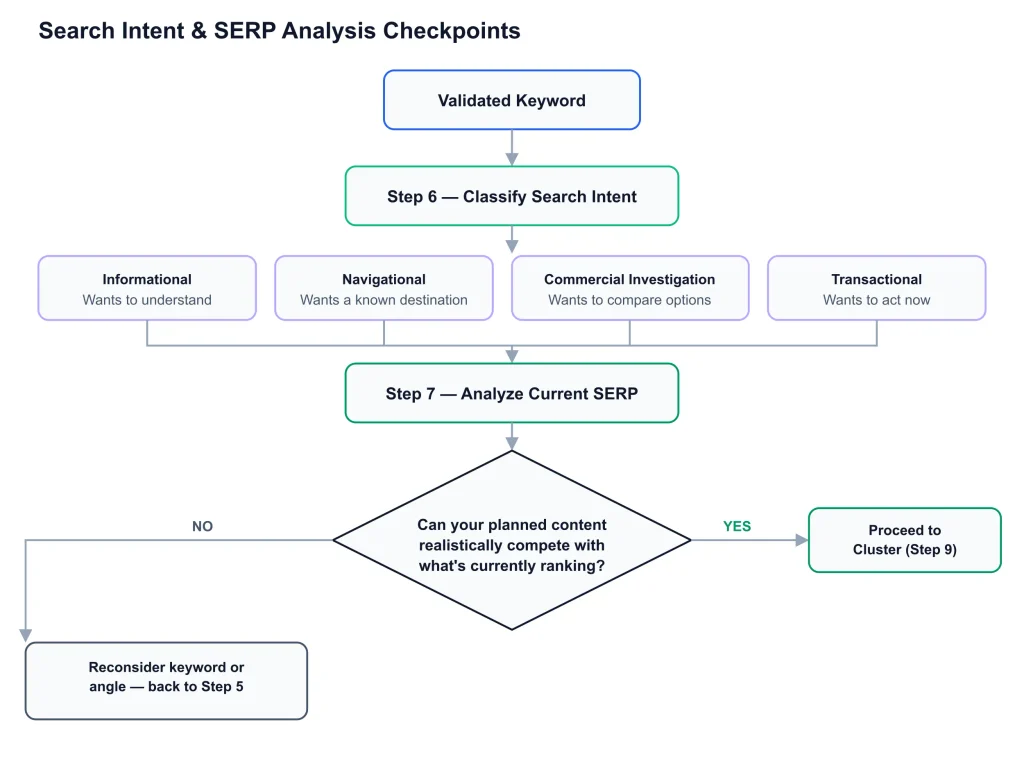
The four broad intent categories
- Informational: the searcher wants to learn, understand, or solve a problem.
- Navigational: the searcher is trying to reach a particular known destination.
- Commercial investigation: the searcher is evaluating or comparing options.
- Transactional: the searcher is ready to take an action such as buying, signing up, or downloading.
These categories are useful at the process level, but intent can be more nuanced than four labels. Use the actual query and current search results as evidence rather than forcing every keyword into a simplistic category.
Decision rule
Proceed when: the expected searcher goal is clear enough to determine an appropriate page format and scope.
Recheck when: the query appears to support several materially different goals or the evidence from current results is mixed.
Step 7 — Analyze SERPs
After intent classification, inspect the current search results for the keyword. The SERP provides practical evidence about the types of pages, formats, and angles that currently satisfy the query.
What to examine
- What content format dominates?
- What angle or user need appears repeatedly?
- Are results primarily guides, comparisons, product pages, tools, category pages, or another format?
- Are there meaningful gaps that a new page could address?
- Can the planned page genuinely serve the searcher’s need?
This is a reality check rather than a full competitor audit. You do not need to reverse-engineer every ranking domain at this stage. The purpose is to confirm that the keyword remains worth pursuing and that your planned page has a credible reason to exist.
A critical edge case: intent can change
A keyword that passed intent validation during research can show materially different SERP behavior closer to publication. If that happens, revalidate the intent before publishing. Do not let an earlier classification override current search evidence.
Decision rule
Proceed when: the current SERP supports the intended page format and there is a defensible reason for your page to exist.
Reconsider when: the dominant SERP intent has changed or your planned page cannot genuinely satisfy the observed need.
Search Intent and SERP Decision Framework
Intent classification should be validated against current SERP evidence before a page format is finalized.
Step 8 — Evaluate Keyword Metrics
Metrics add quantitative context after relevance, intent, and SERP fit have been examined. They should inform prioritization rather than replace strategic judgment.
The metrics that matter here
Search volume is an estimate of how frequently a query is searched. Keyword difficulty or competition is an estimate intended to describe how contested a search opportunity may be. Different tools calculate these metrics differently, so figures should be treated as estimates rather than guarantees.
What keyword metrics can and cannot tell you
| Metric | What it can tell you | What it cannot decide |
|---|---|---|
| Search volume | A rough estimate of search demand. | Whether the searcher needs what your page provides. |
| Keyword difficulty / competition | A general indication of how contested the opportunity may be. | Whether your page can actually produce a useful, competitive result. |
| Business relevance | Whether the opportunity connects to the stated objective. | It does not replace SERP analysis or content-quality judgment. |
A high-volume keyword that fails the relevance test remains a poor candidate. Conversely, a lower-volume keyword closely aligned with the audience and business goal may deserve earlier attention. Metrics help compare qualified opportunities; they should not rescue an unqualified one.
Ready to execute the research?
Once you understand the process, use the SEORAF Keyword Research Checklist as the shorter operational companion for recurring research.
Step 9 — Cluster Related Keywords
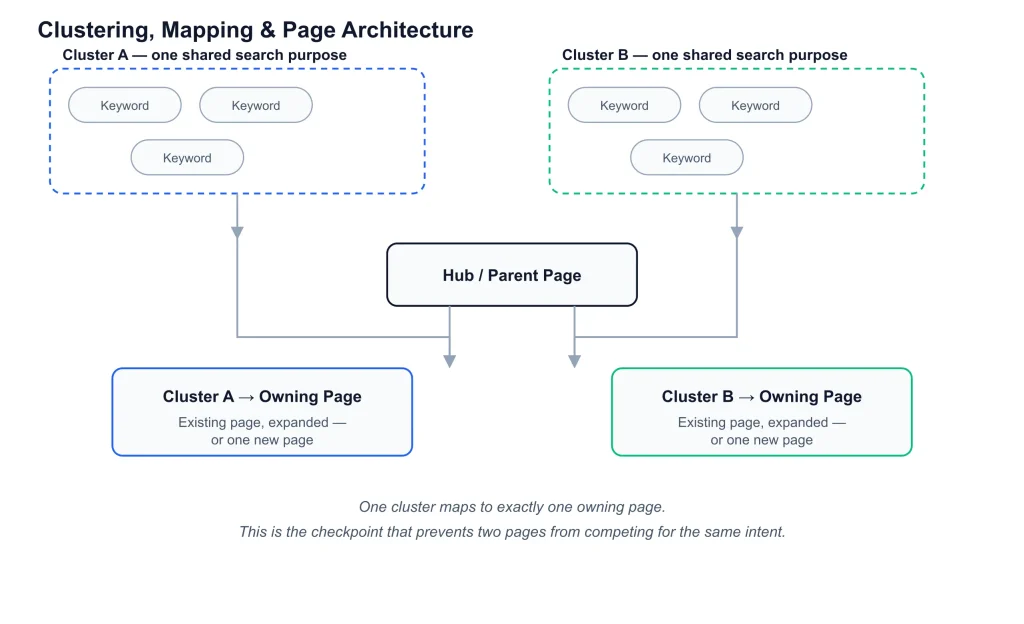
Keyword clustering groups terms that share a sufficiently similar underlying search purpose so they can be planned around the same page. The purpose is not to make a spreadsheet look organized. It is to decide which keywords can be satisfied naturally by one piece of content and which require separate page treatment.
What a cluster represents
A cluster is not simply a collection of keywords that contain similar words. Two phrases can look almost identical and still represent different needs. Conversely, two phrases can use very different wording and still represent the same underlying search purpose.
The practical question is: Could one strong page satisfy both searches without stretching its scope or weakening the answer for either audience? If yes, they may belong together. If answering one properly requires a materially different format, angle, or user journey, they should usually be separated.
Watch for two opposite clustering errors
Two common clustering mistakes
| Mistake | What happens | Correction |
|---|---|---|
| Over-splitting | Nearly identical intent is divided across multiple thin pages. | Consolidate terms that one strong page can genuinely satisfy. |
| Over-merging | Distinct search needs are forced into one overly broad page. | Separate clusters when the format, angle, or underlying need materially differs. |
SERP evidence can strengthen the clustering decision. If two queries consistently return substantially different result types or angles, treat that as evidence worth investigating rather than relying only on wording similarity.
Decision rule
One cluster: the same page can satisfy the same underlying search purpose without stretching its scope.
Separate clusters: serving one query properly would require a materially different page format, angle, or user goal.
Keyword Clustering and Page Mapping
Cluster keywords by shared search purpose, then assign each surviving cluster a deliberate page owner.
Step 10 — Map Keywords to Pages
Mapping turns clusters into concrete page decisions. At this point, ask whether each cluster belongs on an existing page or justifies a new page. A new keyword does not automatically mean a new URL.
Existing page or new page?
If an existing page can satisfy the cluster’s intent without changing that page’s purpose, expanding the existing page may be more appropriate. Create a new page when the cluster represents a meaningfully different search need that an existing page cannot serve without becoming unfocused.
Keyword-to-page mapping decisions
| Condition | Recommended action |
|---|---|
| An existing page can genuinely absorb the cluster without diluting its purpose. | Expand the existing page. |
| The cluster has a materially different search intent from existing pages. | Create a new page if the opportunity justifies it. |
| Two clusters represent the same underlying need. | Merge them into one page rather than creating competing URLs. |
| A distinct cluster is too narrow for a standalone page. | Consider making it a supporting section on a relevant page. |
The cannibalization checkpoint
Before finalizing the mapping, inspect existing pages that target the same or closely related search intent. If two pages are substantially similar or serve the same need, decide deliberately whether one should absorb the other, whether their scopes should be differentiated, or whether the new page should not be created.
Google explains that when it encounters duplicate or substantially similar pages, it can group them and select a canonical representative using multiple signals. A site’s declared canonical is a signal, not an absolute instruction. That is why page ownership and content differentiation should be resolved during planning rather than left entirely to canonical tags.
The practical goal is therefore not to assume that two pages will automatically “split” rankings in every case. The goal is to avoid publishing substantially overlapping pages when one clearer page can serve the same search need.
Important mapping check
Every surviving cluster should have one deliberate intended owner: an existing page, a new page, or a clearly defined supporting role. If ownership is unclear, the research is not ready for content production.
Decision rule
Proceed: every cluster has a deliberate page owner and its scope is distinct from competing pages.
Reject or consolidate: when a new URL would substantially duplicate an existing page without a meaningful difference in search intent or purpose.
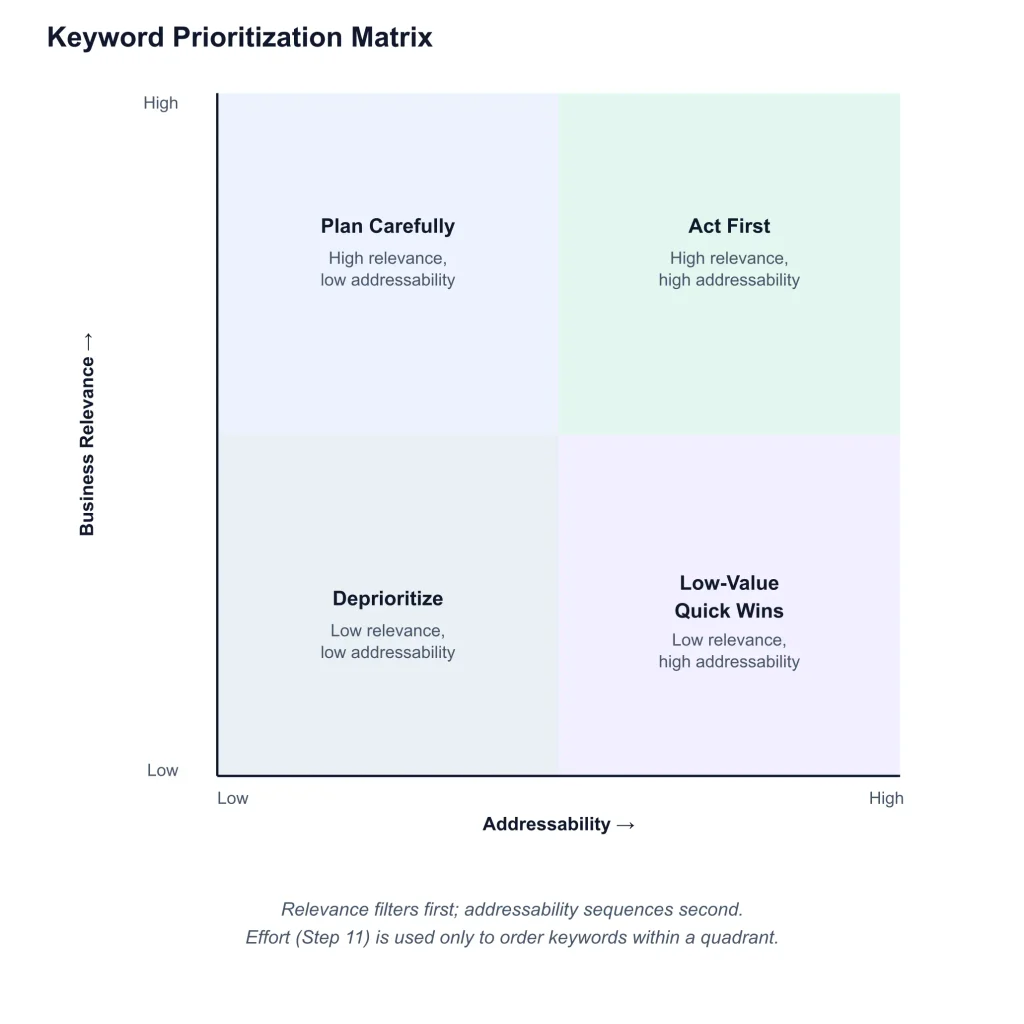
Step 11 — Prioritize Opportunities
By this stage, surviving opportunities have passed relevance, intent, SERP, metric, clustering, and mapping checks. Prioritization decides what to act on first.
The prioritization order
Use an explicit order rather than letting the largest volume number dominate: business relevance first, addressability second, effort third.
- Business relevance: how directly the opportunity supports the goal from Step 1.
- Addressability: whether you can realistically create something that satisfies the observed SERP need.
- Effort: how much work the opportunity requires relative to other already-qualified opportunities.
Why relevance comes first
A keyword can look attractive because it has substantial demand or appears relatively accessible, but those characteristics do not make it strategically useful if the underlying search need is disconnected from the research goal.
| Keyword / cluster | Business relevance | Addressability | Effort | Sequence |
|---|---|---|---|---|
| [Cluster A] | High | High | Medium | 1 |
| [Cluster B] | High | Medium | Low | 2 |
| [Cluster C] | Medium | High | Low | 3 |
| [Cluster D] | Low | High | Low | Deprioritize |
A legitimate “reject” outcome
Not every validated keyword must survive prioritization. If the SERP reveals a search need the business genuinely cannot serve, the opportunity can be rejected even when its volume, relevance, or apparent difficulty looks attractive. Rejecting an opportunity is a valid outcome when addressability fails for a substantive reason.
Decision rule
Prioritize: opportunities with strong business relevance and credible addressability, then sequence them by effort and practical constraints.
Reject: an opportunity when the intended page cannot genuinely serve the observed search need.
Keyword Opportunity Prioritization Matrix
Prioritization should compare already-qualified opportunities rather than allowing search volume alone to determine the sequence.
Step 12 — Turn Research Into Content Plans
A prioritized keyword cluster is not yet a useful production brief. This step translates the research into information a writer, editor, or content team can actually use.
What the content brief should inherit from research
- Primary keyword and cluster
- Confirmed search intent
- Observed SERP format and expectations
- Owning page decision
- New-page or existing-page status
- Important supporting questions or subtopics
- Differentiation opportunity identified during SERP analysis
- Priority and business context
Example brief skeleton
Target cluster: "best project management software for remote teams"
Confirmed intent: Commercial investigation
Owning page: New
SERP format: Comparison / evaluation
Differentiation angle: [verified gap from current SERP]
Priority: 2
Primary audience: Mid-sized remote teams
The value of this brief is traceability. Each important decision can be connected back to a previous research step rather than appearing as an unsupported editorial preference.
Decision rule
Proceed to production when: the content brief can explain what the page is targeting, whom it serves, what intent it satisfies, which page owns it, and why the page deserves to exist.
Step 13 — Measure Performance
Measurement is most useful when success criteria are defined before publication. Otherwise, teams often default to whichever metric is easiest to inspect rather than the outcome that originally justified the research.
Define success before publishing
Return to the goal from Step 1. If the goal was qualified inquiries, rankings and traffic can be useful diagnostic signals, but they are not the same thing as the business outcome. If the goal was category visibility, the measurement framework may emphasize search visibility and relevant engagement instead.
Measure more than one layer
Three measurement layers
| Layer | Example questions |
|---|---|
| Search visibility | Is the page being discovered and appearing for relevant queries? |
| Engagement | Are visitors interacting with the page in ways consistent with the intended experience? |
| Business outcome | Is the content contributing to the outcome defined in Step 1? |
Do not use a generic ranking target as a universal definition of success. Search performance changes with query, market, competition, page quality, technical conditions, and other factors. The purpose of measurement is to determine whether the research and resulting content are moving toward the original objective.ith query, market, competition, page quality, and other factors. The purpose of measurement is to determine whether the research and resulting content are moving toward the original objective.
Step 14 — Refine the Strategy
The process does not end when content is published. Performance evidence should feed the next research cycle.
Close the loop
If a cluster underperforms, investigate what the result might reveal. The problem could be an overly broad validation rule, a missed intent signal, a mismatch between the page and the SERP, an addressability problem, insufficient content quality, or an inaccurate business assumption from Step 1.
If a cluster performs well, the result may reveal adjacent topics, supporting questions, or new audience needs worth exploring in another discovery cycle.
A keyword research process therefore behaves more like a feedback system than a one-time checklist. Steps 13 and 14 create evidence that can improve the next pass through Steps 1–12.
Decision rule
Refine: when new evidence changes an assumption about demand, intent, competition, page ownership, or business value.
Repeat: when the evidence reveals adjacent opportunities that deserve a fresh discovery and validation cycle.
Keyword Research Feedback Loop
Measurement and refinement turn keyword research from a one-time exercise into a recurring evidence-based process.
Decision Rules at a Glance
Four core decision rules in the keyword research process
| Checkpoint | Proceed when | Stop, reject, or recheck when |
|---|---|---|
| Relevance | The keyword represents a clear need connected to the audience and goal. | The term only “sounds related” or has no meaningful connection to the goal. |
| Intent / SERP | The current search results support the intended page format and purpose. | Intent has shifted or the planned page cannot genuinely satisfy the observed need. |
| Clustering / Mapping | One page can satisfy the cluster without stretching scope, and ownership is clear. | The cluster requires a materially different page or duplicates an existing page. |
| Prioritization | The opportunity is relevant and realistically addressable. | The business cannot genuinely serve the SERP need, making rejection appropriate. |
From Keyword Candidate to Content Decision
The final decision system connects research evidence to a deliberate page and content action.
Common Mistakes in the Keyword Research Process
Common keyword research misconceptions and better process decisions
| Misconception | Better process decision |
|---|---|
| Keyword research is a one-time task. | Treat Step 14 as a feedback loop that informs the next research cycle. |
| More discovered keywords means better research. | Optimize for validated, relevant coverage rather than list size. |
| High search volume automatically means a good keyword. | Validate relevance, intent, SERP fit, addressability, and business value first. |
| Every keyword needs its own page. | Cluster by shared search purpose and map each cluster deliberately. |
| Search intent can be checked while writing. | Validate intent before mapping and revisit it if SERP evidence changes. |
| The process ends when the content is published. | Measure the result and use the evidence to refine the next cycle. |
| A keyword should never be rejected after research begins. | Reject an opportunity when the business genuinely cannot address the observed search need. |
Pre-Publication Keyword Research Quality Control
Before converting research into a final content plan, run one last quality-control pass. The objective is to verify that every surviving opportunity has a clear reason to exist and a deliberate owner.
- Goal: Is the research connected to a clearly stated business or editorial objective?
- Audience: Is the intended audience specific enough to evaluate relevance?
- Relevance: Does every surviving keyword represent a meaningful need?
- Intent: Is the searcher goal documented?
- SERP: Was the current search result environment inspected?
- Intent freshness: Was the SERP rechecked if the research is older or publication was delayed?
- Metrics: Are tool-based metrics being treated as estimates rather than guarantees?
- Clusters: Does each cluster represent a coherent search purpose?
- Page ownership: Does each surviving cluster have one deliberate intended owner?
- Overlap: Has existing content been checked for substantially overlapping purpose?
- Addressability: Can the planned page genuinely satisfy the observed need?
- Priority: Are business relevance and addressability considered before volume alone?
- Brief: Can the research be converted into a production-ready content brief?
- Measurement: Are success signals connected to the original goal?
- Feedback: Is there a plan to use post-publication evidence in the next cycle?
Frequently Asked Questions
Where do I start if I have no existing keywords?
Start at Step 2 using the offering itself, existing topic knowledge, and direct audience language. You do not need an established keyword list to begin. Discovery in Step 3 can expand the initial seed set.
How many keywords should one page target?
There is no universal target count. A page should cover the keywords that belong to the same underlying search purpose and can be satisfied naturally within one coherent page. Shared intent matters more than a fixed number.
Do I need a paid keyword research tool?
No single step requires a particular paid tool. Tools can make discovery and metric collection faster, but relevance, intent, SERP analysis, clustering, mapping, and prioritization still require judgment.
How often should keyword research be repeated?
There is no universal schedule. Revisit the process when the topic, audience, competitive environment, business goals, or search behavior changes enough to make the existing research less reliable. Step 14 provides the feedback loop for deciding when another cycle is warranted.
What if a keyword overlaps with an existing page?
Return to Step 10. Determine whether the existing page can satisfy the keyword’s intent. If it can, expand that page where appropriate. If the intent is materially different, define a clear scope for a new page. If the two pages would serve essentially the same purpose, consolidate rather than create unnecessary duplication.
What if search intent changes after the keyword has been validated?
Revalidate the keyword before publishing. Research is not locked to the first classification you recorded. If current search results show a materially different dominant need or format, update the content plan or reconsider the opportunity.
Can a keyword be rejected even after passing validation?
Yes. Validation confirms that the keyword represents a relevant need; prioritization asks whether the opportunity is worth acting on. If the SERP reveals a need the business genuinely cannot serve, rejecting the opportunity is a legitimate outcome.
What is the difference between a keyword research guide and a keyword research checklist?
A guide explains the reasoning and decisions behind the process so it can be adapted to real situations. A checklist condenses the workflow into a repeatable action sequence for execution. For the shorter execution format, see the SEORAF Keyword Research Checklist.
Next Steps
The fourteen steps work as one connected system: define the goal, build seeds, discover and expand candidates, validate relevance, analyze intent and SERPs, evaluate metrics, cluster and map keywords, prioritize opportunities, turn the research into content plans, measure results, and refine the next cycle.
If you want the broader conceptual foundation behind keyword research, continue with the SEORAF Keyword Research Guide. If you are ready to execute the process as a shorter operational workflow, use the Keyword Research Checklist.
Turn the process into an execution checklist
Use the shorter checklist when you already understand the reasoning and want a repeatable way to work through keyword research without rebuilding the workflow each time.
Open the Keyword Research Checklist
About This Guide
This guide is published by SEORAF as an editorial SEO resource. It presents a repeatable methodology rather than a promise of specific rankings, traffic levels, or business outcomes.
The framework intentionally does not claim first-hand testing results, client outcomes, or performance metrics that have not been independently documented for this specific process. Its authority comes from transparent methodology, careful distinction between evidence and recommendation, and alignment with current search documentation where applicable.
Search behavior, keyword metrics, search-result layouts, and search-engine systems can change. Recheck time-sensitive specifics against current primary documentation and live search results before making important strategic decisions.
Authoritative References
The following primary Google resources are included because they directly support specific implementation or search-behavior considerations discussed in this article.
- Google Search Central — SEO Starter Guide
- Google Search Central — Canonicalization
- Google Search Central — Breadcrumb Structured Data
This guide describes a general keyword research process. It does not guarantee rankings, traffic, conversions, or other business outcomes. Search behavior, competition, content quality, technical conditions, and other factors can change over time. Verify current search-engine guidance and live SERP conditions before relying on a specific assumption.