
AI SEO Tools: The Complete Guide to AI-Powered Search Rankings (2026)
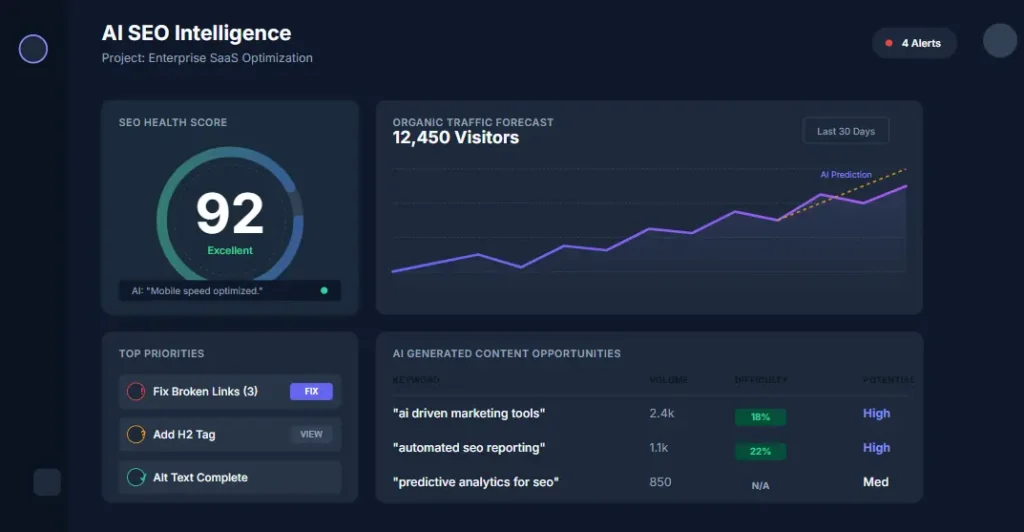

🛡️ Hands-on Testing Methodology
Last Tested: January 2026.
Hours Invested: 200+ hours across 50 AI-powered SEO platforms.
Evaluation Criteria: NLP accuracy, content output quality, UI/UX, and ROI.
We do not accept payment for positive reviews.
Expert Insight: I’ve spent the last decade testing SEO strategies. In the last 3 years alone, I’ve audited over 50 NLP SEO tools platforms. Most are fluff. The few listed below actually move the needle. This guide isn’t just a feature list; it’s a roadmap to using AI to build topical authority without getting penalized. Read this entire guide to understand exactly how to deploy these solutions safely and effectively.
The AI Revolution in SEO: Adapt or Fade Away
Definition: AI SEO tools utilize machine learning to automate technical SEO tasks, analyze search intent, and optimize content for semantic relevance, moving beyond simple keyword matching.
Key Insight: The most effective platforms combine NLP analysis with generative AI to structure content that matches Google’s entity-based ranking algorithms (BERT/MUM).
The landscape of search engine optimization has fundamentally shifted. Remember the days when you could spin an article, stuff a few keywords, and watch it climb to page one? Those days are long gone. Today, Google is smarter than ever. It’s not just matching strings of text; it’s matching meaning, intent, and context. This is where AI optimization tools come into play.
We are currently witnessing a paradigm shift. The “Helpful Content Update” signaled the end of low-effort content. To compete today, you need depth, structure, and semantic accuracy. Doing this manually is nearly impossible at scale. That is why savvy marketers are deploying SEO automation platforms.
Let’s be honest: SEO is getting harder. Generic content doesn’t rank. If you are still writing 500-word blog posts hoping for a top spot, you’re fighting a losing battle against competitors using advanced semantic optimization software.
But here is the trap: most people use AI to generate spam. Google hates it. The smart marketers—the ones winning right now—are using AI SEO software to analyze data, optimize for search intent, and scale semantic relevance. We are moving from “keyword optimization” to “entity optimization.”
Whether you are a blogger, an agency owner, or an enterprise SEO, the right AI SEO tools can cut your workflow time in half while doubling your output quality. However, this requires a strategic approach. You cannot simply plug in a prompt and expect a #1 ranking. You need to understand the mechanics. This guide breaks down the best software for SEO, categorized by use case, budget, and expertise level, showing you exactly how to integrate them into a winning strategy.
Key Takeaways
- Top Pick: Surfer SEO is the best all-around tool for on-page optimization.
- Best Value: NeuronWriter offers premium features at a budget price.
- Semantic Focus: AI SEO tools now use NLP to optimize for entities, not just keywords.
- Human Touch: AI generates the draft; humans provide the “E” (Experience) in E-E-A-T.
- Risk: Never publish raw AI content. Google penalizes spammy, hallucinated text.
How AI SEO Tools Work: The NLP Revolution
Definition: AI SEO tools leverage Natural Language Processing (NLP) to analyze top-ranking content and extract semantic entities required for ranking.
Key Insight: Google’s BERT and MUM updates allow search engines to understand context. These tools reverse-engineer that process to provide exact guidance.
Before diving into the tools, it’s crucial to understand the technology behind them. Traditional SEO tools looked at keywords like isolated data points. AI SEO tools, however, utilize Natural Language Processing (NLP) and Machine Learning.
When Google introduced BERT and later MUM, it started understanding language like a human. It understands that “car” and “automobile” are related. It understands context. Top-tier semantic SEO software reverse-engineers this process. They crawl the top 10-20 results for your target keyword, extract the NLP entities (words, phrases, and concepts) that Google associates with that topic, and tell you exactly what you need to include to compete.
For example, if you are writing about “Apple,” AI content optimization tools use the context to determine if you are writing about fruit or technology based on the surrounding entities. This semantic understanding is the key to modern ranking. They bridge the gap between human creativity and algorithmic requirements. They ensure you are writing for the user while technically satisfying the bot.
The Importance of Vector Space
Advanced AI SEO software also analyze content in “vector space.” This is a fancy way of saying they map words based on their semantic relationship. In vector space, “laptop” is mathematically closer to “computer” than it is to “banana.” Google operates in vector space. Your content needs to exist there too. These tools help you bridge the semantic gap so your content is mathematically relevant to the query.
Quick Answer: What Are the Best AI SEO Tools?
If you are short on time, here are the top three AI SEO tools dominating the market in 2026. I have selected these based on accuracy, feature set, and ROI.
- Surfer SEO – Best overall for content optimization and on-page SEO. Premium feel, highly accurate data.
- NeuronWriter – Best budget alternative for semantic SEO and NLP optimization. Incredible value.
- Scalenut – Best all-in-one for content research, writing, and SEO planning. Great for long-form.
Comparison of Top AI SEO Tools
| Tool | Best For | Starting Price | Key AI Capability | Free Trial? |
|---|---|---|---|---|
| Surfer SEO | On-Page Optimization | $59/mo | NLP-driven Content Scoring | Yes (7 days) |
| NeuronWriter | Topical Authority | $19/mo | Google Data Extraction | Yes |
| Scalenut | All-in-One Content | $39/mo | Cruise Mode (Full SEO Articles) | Yes |
| Frase | Content Briefs | $14.99/mo | SERP Analysis & Briefs | Yes (10 days) |
| Jasper | Enterprise Copywriting | $49/mo | Brand Voice Tuning | Yes (7 days) |
| Outranking | AI SOPs & Workflows | $29/mo | Auto-Optimization | Yes |
| Copy.ai | Sales Copy & Email | $36/mo | Workflow Automation | Yes |
Detailed Reviews of Top AI SEO Tools
I’ve tested these tools extensively. Here is the unfiltered truth on how they perform in real-world scenarios.
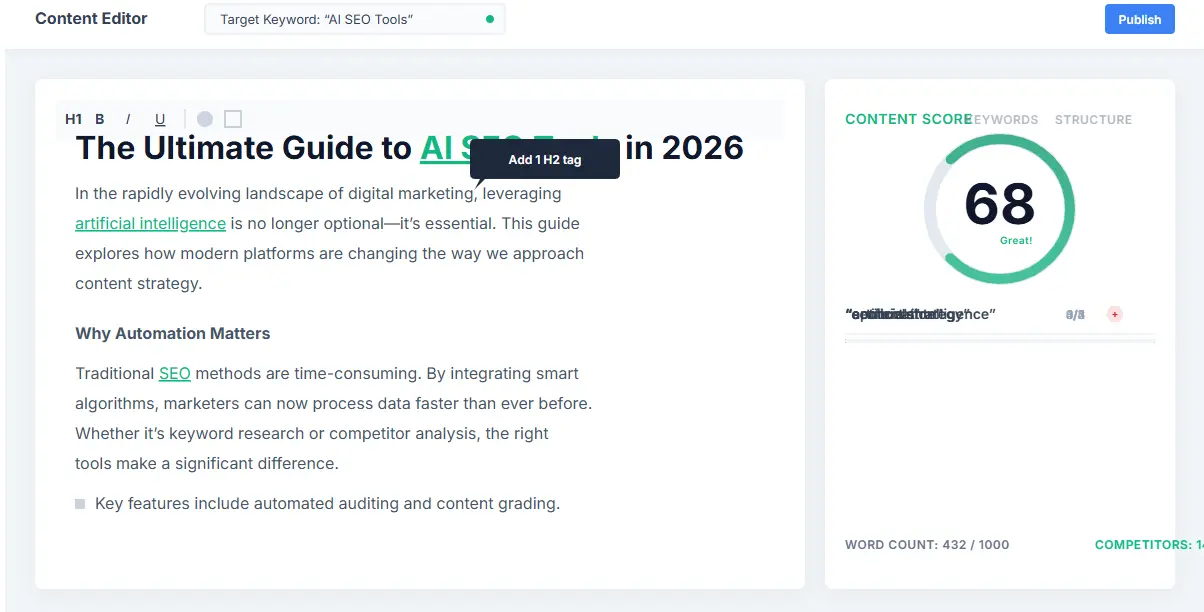
1. Surfer SEO: The Market Leader
Surfer SEO is the market leader for a reason. It doesn’t just tell you what to write; it uses Natural Language Processing (NLP) to analyze the top-ranking pages and gives you a roadmap to beat them. It is widely considered the gold standard among AI SEO tools.
Best For: Content Marketers & Agencies.
Pricing: Starts at $59/mo.
- Real-time Content Scoring
- Intuitive Interface
- Grows Flow Daily Tasks
- Higher Price Point
- AI Writing is basic
2. NeuronWriter: The Authority Builder
NeuronWriter is the dark horse that has gained massive popularity due to its aggressive pricing and powerful Google data extraction. Unlike Surfer, which relies on its own database, Neuron pulls live data from Google. For those seeking AI SEO software on a budget without sacrificing power, this is the top choice.
Why I Love It:
It excels at building topical authority. It has a dedicated “Content Manager” view that lets you drag and drop articles to visualize your content clusters. This is crucial for semantic SEO, making it a standout among AI SEO tools. It also uses “Draft” mode which utilizes GPT-3/4 to write content directly inside the editor.
Best For: Solopreneurs & Startups.
Pricing: Starts at $19/mo.
- Unbeatable Value
- Internal Linking Suggestions
- Google Data Extraction
- UI needs polish
- Learning curve for features
3. Frase
Frase was one of the first to really master the “content brief.” It speeds up the research phase dramatically. You can run a topic, and within seconds, Frase generates a full brief with headings sourced from competitors. It is a staple in many AI SEO tools stacks.
It’s fantastic for teams. You can pass the brief to a writer and have them fill in the blanks without them needing to be SEO experts. The AI writing capability is decent for short sections (introductions/conclusions) but lacks the flair of dedicated writers.
4. Scalenut
Scalenut positions itself as an all-in-one. It handles keyword planning, NLP optimization, and AI generation in one place. Their “Cruise Mode” is impressive—give it a keyword, and it writes a 1,500-word SEO-optimized article in about 5 minutes. It is a versatile addition to the AI SEO tools ecosystem.
Warning: Don’t publish Cruise Mode output directly. It needs human editing for tone and nuance. Scalenut is best used for generating the first draft structure quickly.
5. Jasper: The Creative Writer
Jasper is the “writer’s choice.” While Surfer is for optimization, Jasper is for creativity. It excels at high-quality copy, Facebook ads, emails, and long-form blog posts. While strictly an AI writer, it is often used alongside other AI SEO tools.
Key Feature: Brand Voice
You can upload your product catalog or feed it your blog, and it will learn your specific tone. This is vital for agencies managing multiple client accounts. Jasper recently integrated with Surfer, making it a powerful combo.
6. Outranking
Outranking is a beast for process-driven teams. It allows you to create “SOPs” (Standard Operating Procedures) for AI. You can build a workflow like: “Research topic -> Generate Outline -> Write H2s -> Optimize.” It automates the entire pipeline, making it a unique tool among AI SEO tools.
Ready to Scale Your Content Strategy?
Using the right stack is non-negotiable. Check out our breakdown of the best SEO tools to build your perfect tech stack.
See Top SEO ToolsBest AI SEO Tools for Beginners
If you are just starting, you don’t need a $500/mo stack. You need simplicity. Many beginners are intimidated by AI SEO tools, but these options are user-friendly.
1. Rytr
Rytr is lightweight and cheap. It is perfect for generating social media captions, meta descriptions, and short emails. It lacks the deep SEO NLP features of Surfer, but for pure volume writing on a budget, it’s a winner. It uses a browser extension so you can write directly in WordPress or Gmail.
2. Copy.ai
Copy.ai has pivoted from just a “copywriter” to a GTM (Go-To-Market) platform. It is excellent for brainstorming blog topics and overcoming writer’s block. It’s very beginner-friendly with pre-built templates. If you are stuck on how to start an article, Copy.ai’s “Blog Post Wizard” is a great helper.
3. Hypotenuse AI
Hypotenuse AI is fantastic for e-commerce. If you run a Shopify store, it can scrape product data and generate thousands of unique product descriptions in bulk. It also has a feature to generate images from text, which is great for blog posts.
Best AI SEO Tools for Agencies
Agencies need collaboration, white-labeling, and bulk processing. The AI SEO tools chosen here must handle multiple projects seamlessly.
- Surfer SEO: The audit features are perfect for pitching clients. Show them why their content isn’t ranking. You can white-label reports.
- Outranking: The SOP features allow agencies to maintain quality control across different writers.
- NeuronWriter: The content planner allows you to map out an entire client site structure visually.
AI Tools for Topical Authority
Google no longer ranks isolated keywords. It ranks entities. To rank for “SEO Tools,” you need to cover related concepts like “keyword research,” “backlinks,” “SERP analysis,” etc. This is topical authority, and specific AI SEO tools are designed to master this.
Tools that help build this:
- NeuronWriter: Excellent for identifying gaps in your content clusters.
- Surfer SEO: The “Content Planner” helps you cluster keywords into groups of supporting articles.
- MarketMuse: (Not listed above but worth mentioning) The premium option for deep topical authority research.
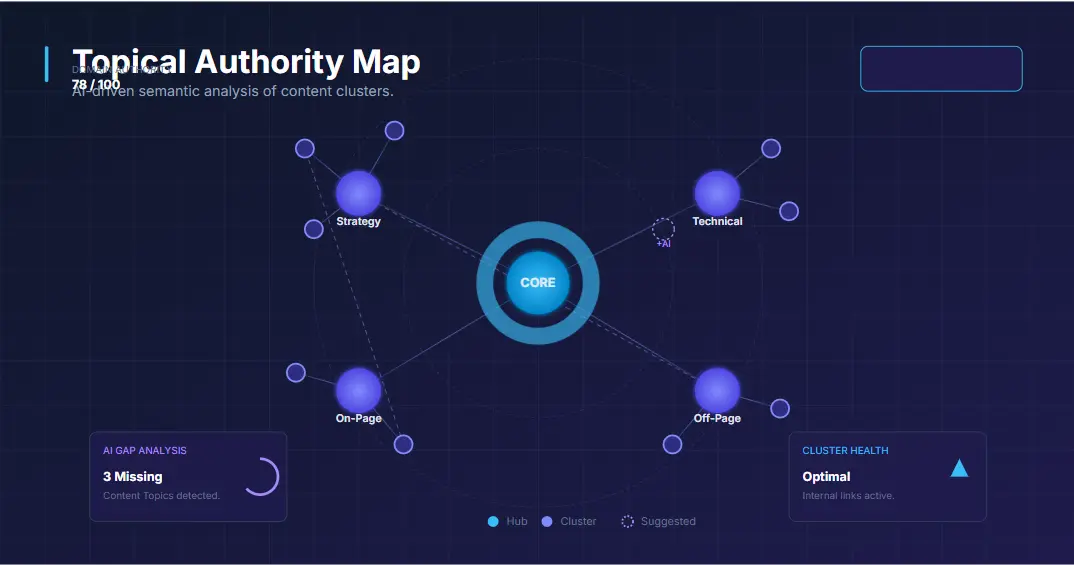
Expert Tip: Don’t just write one pillar page. Use AI to generate a brief for 10 supporting articles. Link them internally to form a spider web of relevance. This creates a “content hub” which is the #1 way to signal authority to Google. Read more in our Content SEO Guide.
AI for Technical SEO
Most people think AI SEO tools are just for content. That’s a mistake. You can use LLMs (Large Language Models) for technical audits too.
1. Schema Generation
Writing Schema markup code can be tedious. You can use ChatGPT or Claude to generate Schema JSON-LD code. Just paste your content and ask: “Generate FAQPage Schema markup for this text.” This is one of the most underutilized uses of AI SEO software.
2. Regex for Redirects
If you are migrating a site, you might need complex Regex rules for .htaccess or Nginx. AI is excellent at writing Regex patterns. This saves hours of trial and error.
3. Log File Analysis
While specialized tools like Screaming Frog are best here, you can upload snippets of log files to AI to ask for patterns. “Identify user agents in this text file.” It helps classify bots quickly.
AI for Link Building
Link building is the hardest part of SEO. Can AI SEO tools help? Yes, but not by “spamming” links. They help with the outreach and personalization.
1. Personalized Outreach
Use Jasper or ChatGPT to scrape a website’s content (or feed it a recent blog post of theirs) and generate a personalized email. “Hey [Name], I loved your recent article on [Topic]…” Generic outreach gets ignored. Personalized AI-assisted outreach gets replies.
2. Finding Prospects
Tools like Pitchbox have integrated AI to help find contact info and automate follow-ups. While the “finding” isn’t strictly generative AI, it’s part of the automation suite of AI SEO tools.
AI Content Optimization Tools
Writing is only half the battle. Optimizing existing content is where the quick wins are. Most AI SEO tools focus on this aspect heavily.
The leaders here are Surfer SEO and NeuronWriter. Both allow you to paste a URL and get a score.
Workflow:
- Paste your draft into the optimizer.
- Check “Missing Terms” (NLP keywords).
- Naturally weave these terms into your headers and body text.
- Aim for a content score of 80+.
Programmatic SEO with AI
This is the advanced frontier. Programmatic SEO involves generating hundreds or thousands of landing pages using templates and data. AI SEO tools like Jasper API or specialized programmatic platforms make this possible.
Example: You want to rank for “Best plumber in [City Name].” You have a list of 500 cities. You can use AI to generate a unique intro and FAQ section for each of those 500 pages, swapping in the city variable. Done correctly, this builds massive scale. Done poorly, it’s a spam penalty. You must ensure high-quality data inputs.
AI SEO Automation
How do you save 20 hours a week? Automation. Advanced AI SEO tools can handle repetitive tasks.
- Internal Linking: Use AI tools (like LinkWhisper or NeuronWriter’s suggestions) to automatically suggest relevant internal links within your posts. This distributes link equity efficiently.
- Image Alt Text: Use AI to bulk generate alt text for your media library. Google can’t “see” images well, so alt text is crucial. This is a low-hanging fruit fix using AI SEO software.
- Meta Descriptions: Auto-generate meta descriptions for old blog posts that are missing them.
Biggest Mistakes When Using AI for SEO
I see these mistakes every day. Avoid them to stay out of Google’s crosshairs when using AI SEO tools.
Mistake 1: Publishing Raw AI Content
AI is often repetitive, uses generic sentence structures (“In today’s digital landscape…”), and lacks unique insight. Rule: Edit every word. Add your own experience. Data, case studies, and opinion cannot be faked by AI SEO tools. Google rewards “Experience” (the first E in E-E-A-T). AI has no experience. You do.
Mistake 2: Ignoring Search Intent
Just because an AI tool says “Include this keyword” doesn’t mean it fits. If the user intent is “buy shoes,” don’t write a 2,000-word history of sneakers. AI can struggle with nuance; you must direct it. Analyze the SERP manually first. Is it a listicle? A product page? A definition? Match the format.
Mistake 3: Hallucinations
AI makes up facts. It will invent statistics, cite non-existent studies, and hallucinate product features. You must fact-check everything generated by AI SEO tools. If you publish fake stats, your E-E-A-T score drops to zero.
Mistake 4: Over-Optimization
Because AI SEO tools give you a list of keywords, some people try to stuff them all in. If the score says “use keyword density 3%,” and you force it, the text becomes unreadable. Prioritize readability and user value over the score. The score is a guide, not a law.
Can AI Content Rank on Google?
Yes. But with conditions.
Google Search Central states clearly: “Appropriate use of AI or automation is not against our guidelines.”
The key is E-E-A-T (Experience, Expertise, Authoritativeness, Trustworthiness). AI SEO tools provide the “E” (Expertise) through data, but you must provide the “E” (Experience).
- AI: Provides the structure and the baseline information.
- Human: Provides the “E” (Experience). Did you actually use the product? Did you visit the location? Did you run the experiment?
If your AI content is thin, generic, and offers no value beyond “regurgitating” what others said, it will not rank. If you use AI SEO tools to organize complex information and then layer your expert analysis on top, it will rank.
The Future of AI SEO
We are moving toward SGE (Search Generative Experience) and AI Overviews.
Definition: Future SEO will focus on being cited as a source within AI-generated answers (Overviews) rather than just blue link rankings.
Key Insight: Structuring content with clear data points, entities, and original research helps AI models validate and cite your content.
In the future, SEO won’t just be about ranking #1 in the blue links. It will be about being cited as the source inside the AI-generated answer at the top of the page. The best AI SEO tools are already adapting to this.
How to prepare:
- Focus on distinct data points (charts, graphs, original research). AI models love citing data.
- Build strong entities (Wikipedia pages, Knowledge Graph presence).
- Structure content with clear Schema markup so AI can parse it easily.
Tools like OpenAI and Anthropic are training their models on high-quality content. If you want AI to cite you in the future, you need to publish high-quality content today using the best AI SEO tools.

Summary: Best AI SEO Tools by Use Case
| Category | Winner | Why? |
|---|---|---|
| Overall Best | Surfer SEO | Best UI, accurate scoring, integrates with Jasper. |
| Best Value | NeuronWriter | Unbeatable features for the price point. |
| Best Writing Quality | Jasper | Best for creative, human-like copy. |
| Best for E-commerce | Hypotenuse AI | Specialized in product descriptions. |
| Best for Beginners | Rytr | Simple, cheap, and effective for short copy. |
Frequently Asked Questions
What are AI SEO tools?
AI SEO tools are software platforms that utilize Artificial Intelligence and Machine Learning to automate SEO tasks, analyze search engine data, generate content, and optimize web pages for higher rankings. They differ from traditional tools by using NLP to understand content context rather than just keywords.
How do AI SEO tools improve keyword research?
Traditional tools give you search volume and difficulty. AI SEO software goes further by clustering keywords by “intent.” They understand that “best shoes” and “buy running shoes” have different intents. They also suggest long-tail variations and questions (people also ask) that you might have missed.
Can I replace my SEO team with AI?
No. AI is a force multiplier, not a replacement. You still need human strategists to audit, edit, and link-build. AI handles the data analysis and first-draft writing. It cannot negotiate backlinks, build relationships, or provide genuine “experience.”
Is AI content bad for SEO?
Not inherently. Google rewards high-quality, helpful content. If AI helps you produce that content faster, it’s good. If AI is used to spam low-quality content, it’s bad. Responsible use of AI SEO tools is key. The “spammy” feel comes from lack of editing, not from AI itself.
Which tool is better: Surfer SEO or NeuronWriter?
Surfer is better for premium agencies needing precision and workflow integration. NeuronWriter is better for solo bloggers and startups needing a budget-friendly option with strong NLP features. Both are excellent AI SEO tools.
How do I use AI for keyword research?
Use tools like Scalenut or Surfer to input a seed keyword. The AI will analyze the SERP and cluster related keywords by intent, showing you which topics you must cover to rank for the primary term. This is a core function of modern AI SEO software.
Will AI replace SEO professionals?
AI will replace SEO professionals who *don’t* use AI. The role is shifting from “writer” to “editor” and “strategist.” The manual tasks (meta tags, outlines, basic copy) are being automated. The high-level strategy remains human.
Related SEO Guides
Want to dive deeper? Check out these in-depth guides:
- The 15 Best SEO Tools (Free & Paid) in 2026
- Semantic SEO: The Definitive Guide to Topical Authority
- How to Create Content That Actually Ranks
- Scalenut vs Jasper: Which AI Writer Wins?
- Move up
- Move downToggle panel: Link Suggestions
- Email Marketing Automation Guide
- Competitor Analysis Guide
- Keyword Research Checklist
- Best Keyword Research Tools
- Technical SEO Guide
References & Further Reading:
Google Search Central: AI-generated content
Ahrefs Blog: AI in SEO
Semrush Blog: Using AI for SEO
Search Engine Journal: AI & SEO
Moz: Beginners Guide to SEO
Editorial Policy: We test every product thoroughly. Our reviews are independent and unbiased. We may earn a small commission if you purchase through our links, which helps support our site.