
The Ultimate SEO Project Management Template for 2024
Stop juggling spreadsheets and missed deadlines. Our comprehensive, step-by-step SEO project management template brings order to chaos, helping you and your team execute flawlessly and prove ROI.
Download the Free Template Now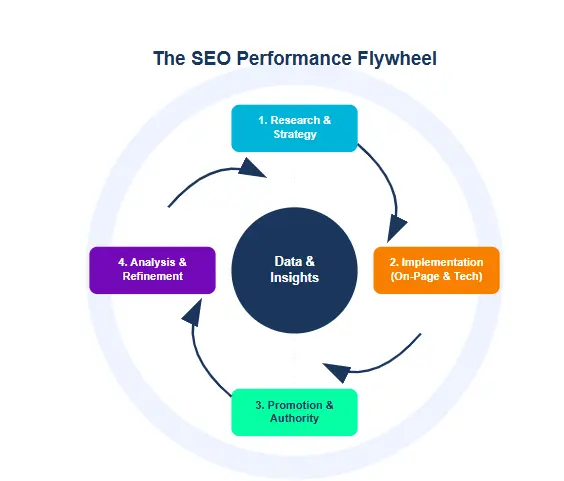
The Challenge of Modern SEO: Why You Need a Project Management Plan
If you’ve ever managed an SEO campaign, you know the feeling. You’re tracking keyword rankings, optimizing title tags, fixing broken links, coordinating with content writers, building outreach lists, and trying to explain it all to a client or your boss. It’s a complex, multi-faceted discipline where dozens of tasks can spiral into chaos without a central system. This is where effective seo project management becomes not just helpful, but absolutely critical for success.
Without a structured approach, SEO efforts often result in missed opportunities, wasted resources, and an inability to demonstrate true return on investment (ROI). A simple to-do list isn’t enough. You need a robust seo project management framework that acts as a single source of truth for your entire team. This guide provides that framework, giving you a detailed, actionable template to plan, execute, and report on every aspect of your SEO strategy.
The Tangible Benefits of Structured SEO Project Management
Implementing a dedicated system for your seo project management yields immediate and long-term benefits. It transforms your workflow from reactive to proactive, empowering your team to achieve more. Here’s what you can expect:
- Enhanced Efficiency & Productivity: A clear plan eliminates guesswork. Every team member knows their responsibilities, deadlines, and how their work fits into the larger strategy. This reduces bottlenecks and ensures smooth collaboration.
- Improved Accountability: When tasks are assigned with clear deadlines in a shared space, ownership is undeniable. It’s easy to see who is responsible for what and track progress in real-time, which is a cornerstone of professional seo project management.
- Scalable Processes: Whether you’re managing one website or fifty, a template-based approach allows you to scale your operations. You can quickly replicate successful workflows for new clients or projects without reinventing the wheel each time.
- Measurable Results & Proven ROI: The ultimate goal of any marketing effort is ROI. A great seo project management plan ties every task back to a specific goal and makes it easy to connect your activities to tangible business outcomes. For a deeper dive into this, check out our guide on how to measure SEO ROI.
- Reduced Stress & Burnout: Chaos is stressful. Having a clear plan, organized tasks, and a predictable workflow significantly reduces the mental load on SEO managers and their teams, leading to better work and a happier team.
The Core Components of an Effective SEO Project Management Template
Before diving into the phases, let’s define the essential columns or fields that will make your seo project management template a powerful tool. Regardless of whether you use a spreadsheet, Asana, Trello, or another tool, these components are non-negotiable.
- Task ID: A unique identifier for easy reference (e.g., T001, T002).
- Task Name: A clear, concise description of the action item (e.g., “Optimize H1 Tag for Homepage”).
- Phase/Category: The broader stage of the SEO funnel this task belongs to (e.g., Technical Audit, On-Page SEO, Link Building). This is crucial for organizing your seo project management efforts.
- Assignee/Owner: The person responsible for completing the task.
- Status: A dropdown menu with options like ‘Not Started’, ‘In Progress’, ‘In Review’, ‘Completed’, ‘Blocked’.
- Priority: A way to flag urgent tasks (e.g., High, Medium, Low).
- Due Date: The deadline for task completion.
- Notes/Details: A space for context, links to resources (e.g., a URL to a page with a broken link), or specific instructions.
- Tools Needed: List of software required for the task (e.g., Ahrefs, Screaming Frog, Google Analytics).
The Ultimate SEO Project Management Template: A Phase-by-Phase Breakdown
This is the heart of your seo project management system. We’ve broken down the entire SEO lifecycle into logical, manageable phases. Each phase includes a checklist of tasks that you can copy directly into your own template.
Phase 0: Foundation & Goal Setting
Objective: To define the “why” behind the campaign. This initial phase is the most critical step in any seo project management plan. Without clear goals, you cannot measure success.
- Hold a kickoff meeting with all stakeholders (client, team, etc.).
- Define primary business objectives (e.g., increase online sales, generate leads, build brand authority).
- Establish specific, measurable, achievable, relevant, and time-bound (SMART) SEO goals (e.g., “Increase organic traffic from non-branded keywords by 30% in 6 months”).
- Identify Key Performance Indicators (KPIs) to track progress (e.g., organic traffic, keyword rankings, conversion rate from organic traffic, backlink quantity/quality).
- Set up and configure all necessary tracking tools (Google Analytics 4, Google Search Console, Bing Webmaster Tools).
- Establish a baseline report to measure all future progress against.
- Define the target audience and create user personas.
Phase 1: Comprehensive SEO Audit
Objective: To perform a deep dive into the website’s current performance from a technical, on-page, and off-page perspective. This audit forms the basis of your strategy and is a key part of the initial seo project management scope. For a detailed walkthrough, refer to our guide on performing a technical SEO audit.
- Technical SEO Audit: Crawl the entire website using a tool like Screaming Frog or Sitebulb.
- Check and indexability issues (crawled vs. indexed pages in GSC).
- Analyze site speed and Core Web Vitals using Google PageSpeed Insights.
- Ensure mobile-friendliness across all pages.
- Identify and catalog all redirect chains and loops.
- Check for duplicate content issues.
- Analyze XML sitemap for errors and completeness.
- Review robots.txt file to ensure it’s not blocking important pages.
- On-Page SEO Audit: Audit all title tags and meta descriptions for length, optimization, and duplication.
- Analyze heading structure (H1, H2, H3) for proper hierarchy and keyword usage.
- Check for keyword cannibalization.
- Review content quality, depth, and freshness for core pages.
- Analyze internal linking structure.
- Off-Page SEO Audit: Analyze the existing backlink profile using Ahrefs, Moz, or SEMrush.
- Identify and list toxic or spammy backlinks for disavowal.
- Conduct a competitor backlink analysis to identify link opportunities.
- Compile all findings into a comprehensive SEO audit report with prioritized recommendations.
Phase 2: Strategy & Keyword Research
Objective: To translate audit findings into a concrete, prioritized action plan. This is where your seo project management template transitions from discovery to strategy.
- Perform in-depth keyword research based on user personas and business goals.
- Identify primary, secondary, and long-tail keywords for each target page or topic cluster.
- Analyze keyword difficulty and search intent for target keywords.
- Map target keywords to specific URLs on the website.
- Develop a content strategy based on keyword gaps and opportunities.
- Create a content calendar with planned topics, target keywords, and publication dates.
- Define a link building strategy (e.g., guest posting, broken link building, digital PR).
- Prioritize all tasks from the audit based on potential impact and effort (e.g., using an ICE or PIE framework).
- Present the full SEO strategy and project plan to stakeholders for approval.
Phase 3: On-Page SEO Implementation
Objective: To execute the on-page optimizations identified in the audit and strategy phases. This is an ongoing process managed within your seo project management system. Our on-page SEO checklist can serve as a great resource for this phase.
- Optimize title tags and meta descriptions according to the keyword map.
- Ensure each page has a unique, optimized H1 tag.
- Optimize header tags (H2, H3) to improve content structure and readability.
- Improve existing content by adding depth, updating information, and incorporating target keywords naturally.
- Optimize all images by compressing file sizes and adding descriptive alt text.
- Write compelling, SEO-friendly meta descriptions to improve click-through rate (CTR).
- Implement Schema Markup (e.g., Article, Product, FAQ, Breadcrumb) for rich snippets.
- Review and optimize the internal linking structure to distribute link equity and guide users.
Phase 4: Technical SEO Optimization
Objective: To fix the foundational technical issues that may hinder search engine crawling and indexing. These tasks are critical and should be managed with high priority in your seo project management tool.
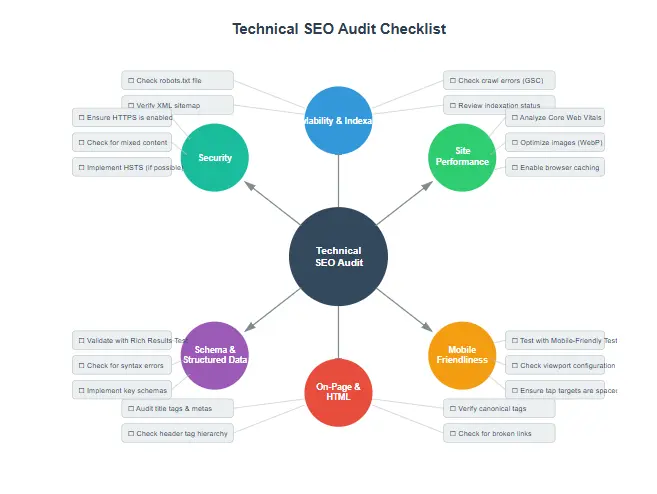
- Fix all crawl errors identified in Google Search Console.
- Improve page load speed by leveraging browser caching, minifying CSS/JS, and optimizing images.
- Ensure the website is fully responsive and provides a great user experience on all devices.
- Implement or fix the XML sitemap and submit it to GSC.
- Clean up and optimize the robots.txt file.
- Fix all broken internal and external links (404 errors).
- Implement HTTPS across the entire site if not already done.
- Set up canonical tags to prevent duplicate content issues.
- Optimize URL structure to be short, descriptive, and keyword-rich (where appropriate).
Phase 5: Content Marketing & Creation
Objective: To execute the content strategy and create high-quality, link-worthy assets that attract and engage the target audience. This is a recurring block of tasks in your seo project management cycle.
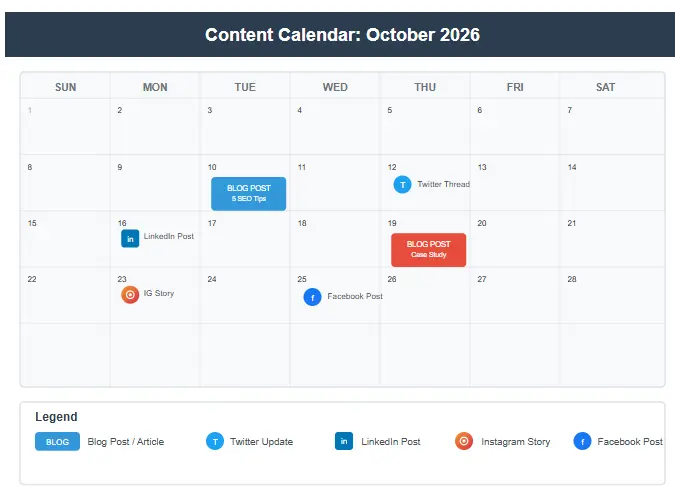
- Write and publish new blog posts or articles based on the content calendar.
- Create cornerstone content pieces (e.g., ultimate guides, original research, extensive case studies).
- Update and repurpose old, high-performing content.
- Promote new content through email newsletters, social media, and outreach.
- Optimize content for featured snippets (e.g., by using tables, lists, and Q&A formats).
- Conduct a content gap analysis against top competitors to find new opportunities.
- Establish a regular content review and optimization schedule.
Phase 6: Off-Page SEO & Link Building
Objective: To build the website’s authority and improve search engine rankings through strategic link acquisition and off-page signals. This requires meticulous tracking in your seo project management template. You can find some initial strategies in our article on the easiest backlinks to get.
- Prospect for link building opportunities (e.g., resource pages, guest post sites).
- Conduct outreach campaigns via email and social media.
- Execute broken link building campaigns.
- Engage in digital PR to earn mentions and links from high-authority publications.
- Monitor new and lost backlinks using tools like Ahrefs or Moz.
- Disavow identified toxic backlinks in Google Search Console.
- Build and nurture relationships with industry influencers and bloggers.
- Track the Domain Authority (DA) or Domain Rating (DR) of the website.
Phase 7: Monitoring, Reporting & Refinement
Objective: To track progress, measure results against KPIs, and continuously refine the strategy. This final phase closes the loop on your seo project management cycle and informs the next one.
- Set up automated and custom reports in Google Analytics 4 and Google Search Console.
- Track keyword rankings on a weekly or bi-weekly basis.
- Monitor organic traffic, user behavior, and conversion metrics.
- Prepare and present monthly or quarterly performance reports to stakeholders.
- Analyze what’s working and what’s not (e.g., which content types are earning links, which keywords are driving traffic).
- Conduct regular A/B tests on title tags and meta descriptions to improve CTR.
- Hold monthly strategy meetings to discuss performance and adjust the seo project management plan as needed.
- Stay updated on the latest SEO news and algorithm changes to adapt the strategy proactively.
How to Use This Template with Your Favorite Tools
The beauty of this seo project management framework is its flexibility. You can implement it using tools your team already uses and loves. Here’s how to adapt it to common platforms:
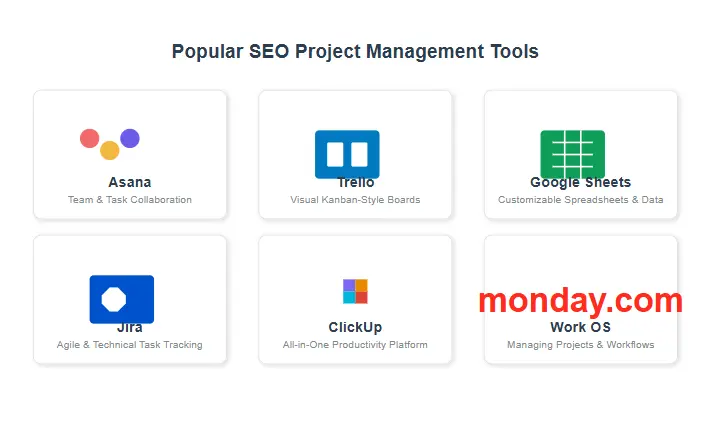
1. Google Sheets / Microsoft Excel
This is the most straightforward method. Create a new spreadsheet and use the core components (Task ID, Task Name, Assignee, Status, etc.) as column headers. Use a separate tab for each phase (Audit, On-Page, etc.) or use a filter to view tasks by phase. Use conditional formatting to automatically change the color of a row based on its ‘Status’ (e.g., green for ‘Completed’). This is a simple yet powerful way to start your seo project management journey.
2. Asana / Monday.com / ClickUp
These project management tools are perfect for a more dynamic approach. Create a new project and use the columns as custom fields. You can create a ‘Board’ view with columns for ‘To Do’, ‘In Progress’, and ‘Done’, and drag tasks between them. Set up dependencies so that one task can’t start until another is finished (e.g., ‘Strategy’ can’t start until ‘Audit’ is complete). Use the ‘Timeline’ or ‘Gantt’ view to visualize your entire seo project management plan over time.
3. Trello
Trello’s card-based system is excellent for visual thinkers. Create a board with lists for each phase (e.g., ‘Phase 1: Audit’, ‘Phase 2: Strategy’). Each task is a card. Within each card, you can add a description, a checklist, a due date, and assign it to a team member. Power-Ups (plugins) can integrate with tools like Google Drive and Ahrefs directly within your Trello board, streamlining your seo project management workflow.
Pro-Tips for Mastering SEO Project Management
Beyond the template, here are some expert tips to elevate your seo project management game:
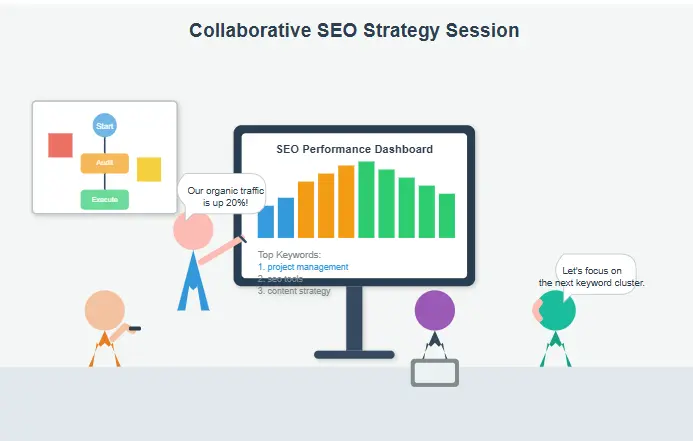
- Hold Regular, Effective Meetings: A weekly 30-minute stand-up meeting can keep everyone aligned. Discuss what was done last week, what’s planned for this week, and any blockers.
- Document Everything: Create a central knowledge base (e.g., in Google Docs, Confluence) for your processes, style guides, and strategies. This is invaluable for onboarding new team members and ensuring consistency.
- Communicate Proactively with Clients/Stakeholders: Don’t wait for the monthly report. Share small wins and explain the “why” behind your actions. Regular communication builds trust and reinforces the value of your seo project management efforts.
- Don’t Overwhelm the Team: Break down large tasks into smaller, more manageable subtasks. This makes the project less daunting and provides a more accurate sense of progress.
- Automate Where Possible: Use tools to automate reporting, rank tracking, and site audits. This frees up your time to focus on high-level strategy and relationship building, the core of strategic seo project management.
Conclusion: Your Blueprint for SEO Success
Effective SEO is no longer about isolated tactics; it’s about executing a cohesive, well-managed strategy. By implementing a robust seo project management system like the one outlined in this guide, you replace chaos with clarity. You empower your team, delight your clients, and build a repeatable process for driving measurable organic growth. This template is more than just a to-do list—it’s your strategic blueprint for dominating the search results.
Ready to transform your SEO workflow?
Stop managing tasks and start driving results.
Frequently Asked Questions (FAQ)
What is the best tool for SEO project management?
The “best” tool depends on your team’s size, budget, and workflow. Google Sheets is a great free starting point. For more advanced features like automation and Gantt charts, Asana, Monday.com, and ClickUp are excellent choices. For visual, card-based workflows, Trello is very popular.
How often should I update my SEO project plan?
Your core strategy should be reviewed quarterly. However, your task list within the seo project management template should be updated continuously—daily or weekly—as tasks are completed and new ones are identified.
Is this template suitable for both agencies and in-house teams?
Absolutely. The principles of good seo project management are universal. An agency can use it to manage multiple client projects, while an in-house team can use it to align their marketing efforts with broader business goals.