
How to Measure SEO ROI: The Ultimate Guide to Proving SEO Value
Struggling to prove the value of your SEO efforts? Get our exclusive template and learn exactly how to measure SEO ROI to connect your optimization work directly to revenue.
Download Free SEO ROI TemplateThe Challenge: Proving SEO Value in a Data-Driven World
If you’re an SEO professional, marketer, or business owner, you’ve likely faced this frustrating scenario: You’re investing time, resources, and budget into search engine optimization, but when it comes to reporting to stakeholders, you struggle to demonstrate concrete returns. Learning how to measure SEO ROI effectively is not just a nice-to-have skill—it’s essential for securing budgets, justifying strategies, and proving the value of your work. For those just starting, understanding the fundamentals of an affordable SEO plan is the first step toward calculating positive ROI.

Did you know? 61% of marketers say improving SEO and growing their organic presence is their top inbound marketing priority, yet 49% struggle to measure ROI from their SEO activities according to HubSpot’s marketing statistics. This highlights why understanding how to measure SEO ROI is so critical.
This comprehensive guide will walk you through exactly how to measure SEO ROI, what metrics matter most, and provide you with a ready-to-use template that will transform how you report on SEO performance. By the end, you’ll be able to confidently answer the question: “What are we getting from our SEO investment?” The process of how to measure SEO ROI is simpler than you might think.
What is SEO ROI?
SEO ROI (Return on Investment) is a performance measure used to evaluate the efficiency or profitability of your SEO investments. In simple terms, it tells you how much revenue you’re generating for every dollar spent on SEO activities. Understanding how to measure SEO ROI allows you to:
- Justify your SEO budget and resources
- Identify which strategies are delivering the best results
- Make data-driven decisions about where to focus efforts
- Demonstrate value to executives and stakeholders
- Optimize your marketing mix for maximum impact
But here’s the challenge: Unlike paid advertising where clicks and conversions can be directly attributed to specific campaigns, SEO operates on a longer timeline with more complex attribution paths. This makes measuring SEO ROI more challenging—but not impossible, as Search Engine Land’s SEO guide explains. The key is having a systematic approach to how to measure SEO ROI.
Why Measuring SEO ROI is Critical for Business Success
Before diving into the specifics of how to measure SEO ROI, let’s establish why this metric is so crucial for your business. The ability to demonstrate how to measure SEO ROI can make or break your marketing budget.
Securing Budget and Resources
In today’s competitive landscape, marketing budgets are scrutinized more than ever. When you can clearly demonstrate how to measure SEO ROI and show positive returns, you’re more likely to secure the budget needed for tools, content creation, link building, and technical optimizations. Decision-makers speak the language of ROI, not rankings. Knowing how to measure SEO ROI gives you the vocabulary they understand.
Strategic Decision Making
Understanding how to measure SEO ROI helps you identify which strategies are delivering the best results. Are your blog posts driving revenue? Is your technical SEO overhaul paying off? By measuring ROI, you can allocate resources to the highest-performing activities and stop wasting time on ineffective tactics. As Moz’s Beginner’s Guide to SEO emphasizes, strategic focus is key to success, and how to measure SEO ROI is part of that focus.
Aligning SEO with Business Goals
When you measure SEO ROI, you’re forced to connect your SEO efforts to actual business outcomes like leads, sales, and revenue. This alignment ensures that your SEO strategy supports broader business objectives rather than operating in a silo focused solely on rankings and traffic. The process of how to measure SEO ROI naturally aligns your work with business priorities.
Demonstrating Value Beyond Traffic
While organic traffic growth is important, it doesn’t tell the full story. Learning how to measure SEO ROI allows you to demonstrate the true business impact of your work, moving beyond vanity metrics to show how SEO contributes to the bottom line. The Google SEO Starter Guide reinforces the importance of value-driven optimization, which is what how to measure SEO ROI is all about.
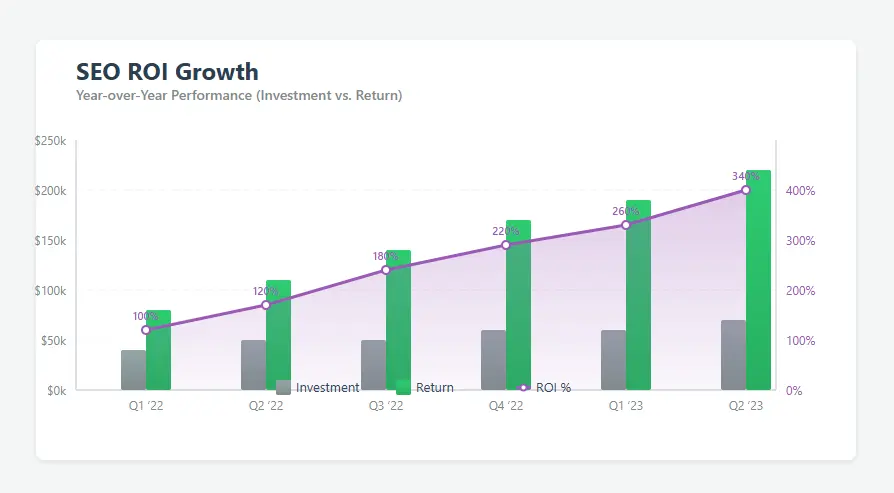
According to a recent study by BrightEdge, organic search drives 53% of all website traffic, making it a critical channel for most businesses. Yet, many organizations still struggle to quantify the value of this traffic. By mastering how to measure SEO ROI, you position yourself as a strategic partner who understands how to drive measurable business results. The skill of how to measure SEO ROI sets you apart in the industry.
Key Metrics for Measuring SEO ROI
When it comes to how to measure SEO ROI, you need to track both leading indicators (metrics that predict future performance) and lagging indicators (metrics that show past performance). Here are the essential metrics to include in your SEO ROI measurement framework:
1. Organic Traffic Growth
While not a direct measure of revenue, organic traffic growth is a foundational metric for how to measure SEO ROI. Track the increase in visitors coming from search engines over time, segmented by:
- Overall organic traffic
- Traffic to money pages (product, service, and pricing pages)
- Traffic to blog content
- Traffic from specific keyword categories
Pro Tip: When measuring organic traffic, always segment by landing page and focus on traffic to pages with commercial intent rather than just overall traffic numbers. Use Google Analytics to create custom segments for more precise tracking. This approach to how to measure SEO ROI provides better insights.
2. Keyword Rankings
Track rankings for keywords that drive business value, not just any keywords. Focus on:
- High-intent commercial keywords
- Keywords that have historically driven conversions
- Keywords with significant search volume
- Local keywords for location-based businesses
3. Conversion Rate from Organic Traffic
This is a critical metric for how to measure SEO ROI. Calculate the percentage of organic visitors who complete desired actions such as:
- Making a purchase
- Filling out a lead form
- Subscribing to a newsletter
- Downloading a resource
- Requesting a demo
4. Cost Per Acquisition (CPA)
Calculate how much it costs to acquire a customer through organic search. This is determined by dividing your total SEO investment by the number of customers acquired through organic channels. A lower CPA indicates higher SEO ROI. Tools like Ahrefs can help track these metrics effectively, making the process of how to measure SEO ROI more manageable.
5. Customer Lifetime Value (CLV)
Understanding the lifetime value of customers acquired through SEO provides a more accurate picture of long-term SEO ROI. This is especially important for businesses with subscription models or repeat purchase behavior. How to measure SEO ROI should always include CLV for a complete picture.
6. Revenue Attribution
The ultimate measure of how to measure SEO ROI is revenue directly attributed to organic search. This requires proper tracking setup and attribution modeling to connect SEO activities to revenue. Google Analytics attribution models can help with this process.
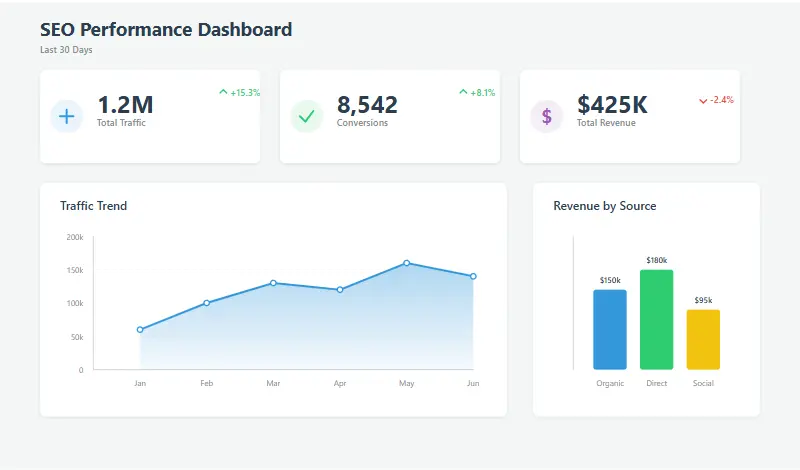
7. Engagement Metrics
While not directly tied to revenue, engagement metrics help you understand the quality of organic traffic:
- Bounce rate
- Pages per session
- Average session duration
- Scroll depth
8. Backlink Profile Growth
Track the growth of quality backlinks to your site, as these are a key factor in search rankings and can be correlated with organic traffic growth. SEMrush offers excellent tools for monitoring backlink acquisition, which is part of how to measure SEO ROI.
By combining these metrics, you create a comprehensive view of how to measure SEO ROI that goes beyond simple traffic numbers and connects directly to business value.
How to Calculate SEO ROI: The Formula
Now that we’ve covered the key metrics, let’s dive into the actual formula for how to measure SEO ROI. The basic formula is:
SEO ROI = (Gain from Investment – Cost of Investment) / Cost of Investment × 100
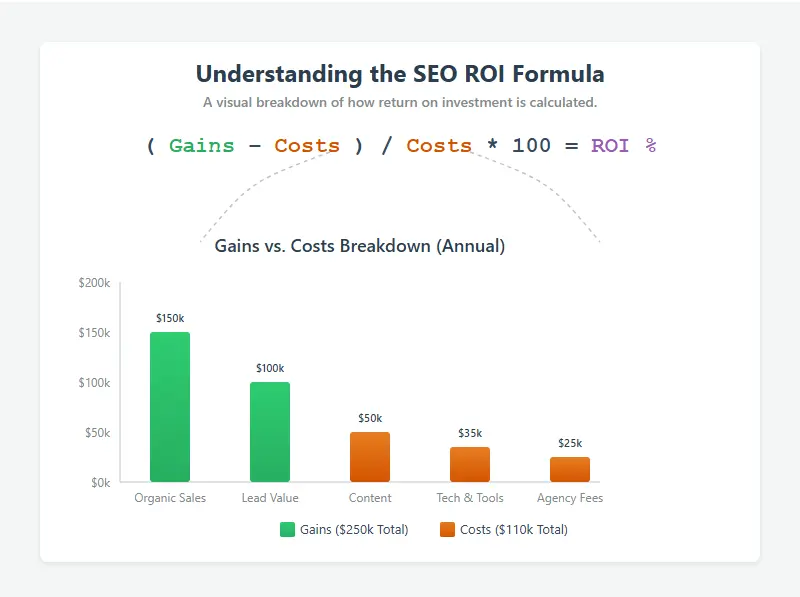
While the formula is straightforward, the challenge lies in accurately determining both the “Gain from Investment” and the “Cost of Investment.” Let’s break down each component of how to measure SEO ROI:
Calculating the Gain from Investment
The “Gain” in the SEO ROI formula is the revenue directly attributable to your SEO efforts. Here’s how to calculate it:
Track Conversions from Organic Traffic
Set up conversion tracking in Google Analytics (or your preferred analytics tool) to measure how many conversions come from organic search. This could be form submissions, purchases, downloads, or any other valuable actions on your site. This is the first step in how to measure SEO ROI accurately.
Assign Value to Conversions
For e-commerce sites, this is straightforward—the value is the purchase amount. For lead generation sites, you’ll need to assign a value to each lead based on your average conversion rate from lead to customer and the average customer value. This valuation is crucial for how to measure SEO ROI.
Consider the Full Customer Journey
SEO often plays a role at different stages of the customer journey. Consider using multi-touch attribution models to properly credit SEO for its influence throughout the conversion path. Advanced attribution is key to accurate how to measure SEO ROI.
Factor in Long-Term Value
For subscription businesses or those with repeat purchases, consider the lifetime value of customers acquired through SEO rather than just the initial purchase value. This long-term perspective improves how to measure SEO ROI.
Calculating the Cost of Investment
The “Cost” in the SEO ROI formula includes all expenses related to your SEO efforts:
- SEO Tools & Software: Subscriptions to tools like Ahrefs, SEMrush, Moz, etc.
- Content Creation: Costs for writers, editors, designers, and videographers
- Technical SEO: Developer time for technical optimizations, like a comprehensive technical SEO audit.
- Link Building: Costs of outreach tools, content for linkable assets, or agency fees
- Team Salaries: Portion of salaries for SEO team members
- Agency Fees: If you’re working with an SEO agency
- Training & Education: Courses, conferences, and certifications
Important Note: Be comprehensive when calculating costs. Many businesses underestimate their true SEO investment by only counting obvious expenses like agency fees while overlooking internal resources and tool costs. Resources like Search Engine Journal offer detailed guides on cost calculation. Accurate cost tracking is essential for how to measure SEO ROI.
Putting It All Together: An Example
Let’s walk through an example of how to measure SEO ROI:
Scenario: A B2B software company invests in SEO for 6 months.
Costs:
- SEO tools: $500/month × 6 months = $3,000
- Content creation: $2,000/month × 6 months = $12,000
- Technical SEO: $1,500/month × 6 months = $9,000
- SEO specialist salary (portion): $4,000/month × 6 months = $24,000
- Total Investment: $48,000
Gains:
- Organic traffic generated 120 qualified leads
- Average lead-to-customer conversion rate: 15%
- Customers acquired: 120 × 15% = 18
- Average customer value: $5,000
- Total Revenue: 18 × $5,000 = $90,000
SEO ROI Calculation:
($90,000 – $48,000) / $48,000 × 100 = 87.5%
This means for every dollar invested in SEO, the company generated $1.875 in return. This example demonstrates how to measure SEO ROI in practice.
Advanced Techniques for How to Measure SEO ROI
While the basic formula provides a good starting point, advanced techniques can help you more accurately measure SEO ROI:
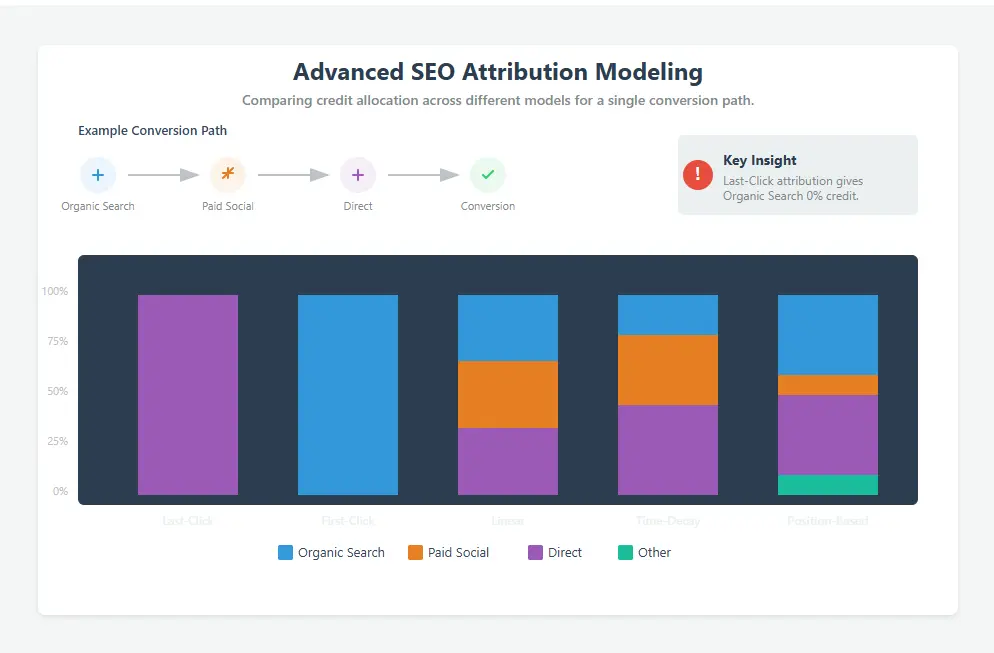
1. Attribution Modeling
Standard attribution models often undervalue SEO because they give full credit to the last touchpoint before conversion. Consider using:
- Time Decay Attribution: Gives more credit to touchpoints closer to conversion
- Position-Based Attribution: Gives 40% credit each to first and last touchpoints, with remaining 20% distributed among middle touchpoints
- Data-Driven Attribution: Uses machine learning to assign credit based on actual impact
2. Incrementality Testing
For a more precise measurement of how to measure SEO ROI, consider running incrementality tests:
- Pause SEO efforts on specific pages or keyword categories and measure the impact
- Compare similar markets where you’re investing in SEO versus those where you’re not
- Use holdout groups to measure the true impact of your SEO efforts
3. Correlation Analysis
Analyze correlations between SEO activities and business outcomes:
- Correlate ranking improvements with traffic and conversion increases
- Analyze the impact of content updates on organic performance
- Track how technical improvements affect site performance metrics
4. Long-Term Value Measurement
SEO is a long-term strategy, and its benefits compound over time. To properly measure SEO ROI:
- Track SEO performance over extended periods (12+ months)
- Measure the compounding effect of content creation
- Consider the ongoing value of evergreen content
- Factor in brand visibility and authority building
This approach is central to building a future-proof SEO strategy that delivers sustainable results. How to measure SEO ROI requires this long-term perspective.
| Technique | Best For | Implementation Complexity |
|---|---|---|
| Basic ROI Formula | Quick assessments, internal reporting | Low |
| Attribution Modeling | Understanding full customer journey | Medium |
| Incrementality Testing | Proving causality, budget justification | High |
| Long-Term Value Measurement | Strategic planning, demonstrating compound returns | Medium |
By implementing these advanced techniques, you’ll develop a more sophisticated approach to how to measure SEO ROI that captures the full value of your SEO efforts. For more advanced strategies, Distilled offers excellent resources on advanced SEO measurement and how to measure SEO ROI.
Download Your Free SEO ROI Template
SEO ROI Measurement Template
Professional Excel template with automated calculations, tracking dashboards, and executive reports. Connect your SEO efforts directly to revenue.
Common Challenges in Measuring SEO ROI and How to Overcome Them
Learning how to measure SEO ROI comes with its share of challenges. Here are the most common obstacles and practical solutions:
Challenge 1: Long Timeframes for Results
Unlike paid advertising, SEO often takes months to show significant results, making it difficult to connect efforts to outcomes in the short term. This is a common hurdle in how to measure SEO ROI.
Solution: Use leading indicators to track progress while waiting for revenue results. Track metrics like keyword ranking improvements, organic traffic growth, and engagement metrics that signal future success. This approach helps with how to measure SEO ROI during early stages.
Challenge 2: Attribution Complexity
Customers often interact with multiple channels before converting, making it difficult to determine how much credit SEO deserves for the final conversion. Attribution is a key challenge in how to measure SEO ROI.
Solution: Implement multi-touch attribution models that recognize SEO’s role throughout the customer journey. Also, consider creating custom segments in Google Analytics to isolate organic traffic that converts with minimal assistance from other channels.
Challenge 3: Isolating SEO Impact
When multiple marketing initiatives are running simultaneously, it can be challenging to isolate the specific impact of SEO efforts. This isolation is important for accurate how to measure SEO ROI.
Solution: Use incrementality testing where possible, and implement advanced tracking parameters to differentiate between different types of organic traffic (e.g., branded vs. non-branded, blog content vs. product pages).
Challenge 4: Calculating True Costs
Many businesses underestimate their true SEO investment by only counting obvious expenses while overlooking internal resources and opportunity costs. Accurate cost calculation is vital for how to measure SEO ROI.
Solution: Create a comprehensive cost tracking worksheet that includes all direct and indirect costs associated with SEO, including staff time, tools, content creation, and technical development.
Challenge 5: Communicating Value to Stakeholders
Even with accurate calculations, many SEO professionals struggle to communicate ROI in a way that resonates with executives and decision-makers. Communication is the final step in how to measure SEO ROI.
Solution: Translate SEO metrics into business language. Instead of talking about keyword rankings, discuss market share capture. Instead of traffic increases, focus on qualified lead generation. Always connect SEO activities to business outcomes.


Best Practices for How to Measure SEO ROI Consistently
To ensure your SEO ROI measurements are accurate and consistent, follow these best practices, which can be complemented by our ultimate SEO checklist for a complete implementation guide:
1. Establish a Baseline
Before implementing new SEO strategies, establish a clear baseline of current performance. This gives you a starting point to measure improvement against. Baseline establishment is the foundation of how to measure SEO ROI.
2. Use Consistent Time Periods
When comparing performance, use consistent time periods (month-over-month, quarter-over-quarter, year-over-year) to account for seasonality and other factors. Consistency is key for how to measure SEO ROI.
3. Segment Your Data
Don’t look at SEO performance as a monolith. Segment by:
- Keyword categories (informational, commercial, navigational)
- Content types (blog posts, product pages, landing pages)
- User segments (new vs. returning visitors)
- Device types (desktop, mobile, tablet)
4. Track Both Micro and Macro Conversions
While macro conversions (purchases, lead submissions) are the ultimate goal, micro conversions (newsletter signups, whitepaper downloads) indicate progress and should be tracked as part of your ROI measurement. Both types matter for how to measure SEO ROI.
5. Implement Proper Tracking Infrastructure
Ensure you have the right tracking in place from the beginning:
- Google Analytics with enhanced ecommerce tracking
- Google Search Console connected to Analytics
- Call tracking for phone conversions
- CRM integration for lead-to-customer tracking
6. Regularly Review and Adjust
SEO ROI isn’t a “set it and forget it” metric. Review your calculations monthly and quarterly, adjusting for factors like seasonality, algorithm updates, and changes in business strategy. Regular review is essential for how to measure SEO ROI.
7. Contextualize Your Results
Raw ROI numbers are more meaningful when contextualized. Compare your SEO ROI to:
- Other marketing channels
- Industry benchmarks
- Your own historical performance

Remember: The goal of measuring SEO ROI isn’t just to produce a number—it’s to gain insights that help you make better decisions and optimize your strategy for maximum impact. For ongoing learning, Content Marketing Institute provides valuable resources on connecting content to ROI and how to measure SEO ROI.
Frequently Asked Questions About How to Measure SEO ROI
The timeline for seeing positive SEO ROI varies based on factors like your industry, competition, current website authority, and the aggressiveness of your strategy. Generally, most businesses begin to see measurable ROI within 6-12 months of consistent SEO effort. However, some competitive industries may require 12-18 months to achieve positive returns. Understanding this timeline is important for how to measure SEO ROI expectations.
While benchmarks vary by industry, a good general rule is that effective SEO should deliver an ROI of 5:1 or higher over a 12-month period. This means for every dollar invested in SEO, you should generate at least five dollars in revenue. Some high-margin businesses see even higher returns, while competitive industries might see lower initial ROI that improves over time as authority builds. These benchmarks help with how to measure SEO ROI success.
For local businesses, measuring SEO ROI requires tracking both online and offline conversions. Track online conversions through your website as usual, but also implement call tracking to measure phone calls from local search, use coupon codes specific to local search campaigns, and ask new customers how they found you. Google Business Profile insights can also provide valuable data on customer actions from local search. Local businesses need specialized approaches for how to measure SEO ROI.
This depends on your measurement goals. If you want to show the total value of all organic search traffic, include branded keywords. However, if you’re trying to demonstrate the impact of your SEO efforts specifically (as opposed to brand recognition from other marketing), it’s often better to focus ROI calculations on non-branded organic traffic that you’ve directly influenced through optimization. This distinction is important for how to measure SEO ROI accurately.
SEO often supports other marketing channels by increasing brand visibility and credibility. To account for this, consider using multi-touch attribution models that recognize SEO’s role in the customer journey. You can also conduct surveys to ask customers how they first became aware of your brand, and track assisted conversions in Google Analytics to see how organic search contributes to conversions initiated through other channels. This holistic view improves how to measure SEO ROI.
Essential tools for measuring SEO ROI include: Google Analytics (for traffic and conversion tracking), Google Search Console (for search performance data), a rank tracking tool (like Ahrefs, SEMrush, or Moz), and a CRM system (to track lead-to-customer conversion). For more advanced measurement, consider call tracking software and attribution modeling tools. The Google Search Console is particularly valuable for understanding organic search performance and how to measure SEO ROI.