
Mangools vs Ahrefs: The Ultimate 2026 Comparison for Value Seekers
If you are currently standing at the crossroads of Mangools vs Ahrefs, you are likely facing a specific dilemma: Do you pay a premium for maximum data depth and advanced features (Ahrefs), or do you choose a more affordable, user-friendly suite that covers the essential workflows for content growth (Mangools)?
This is not just a choice between two software subscriptions; it is a choice between two different philosophies of SEO work. Ahrefs is the heavy industrial excavator—powerful, expensive, and capable of moving mountains of data. Mangools is the high-performance utility vehicle—agile, comfortable, accessible, and capable of handling 95% of your daily terrain without breaking the bank.
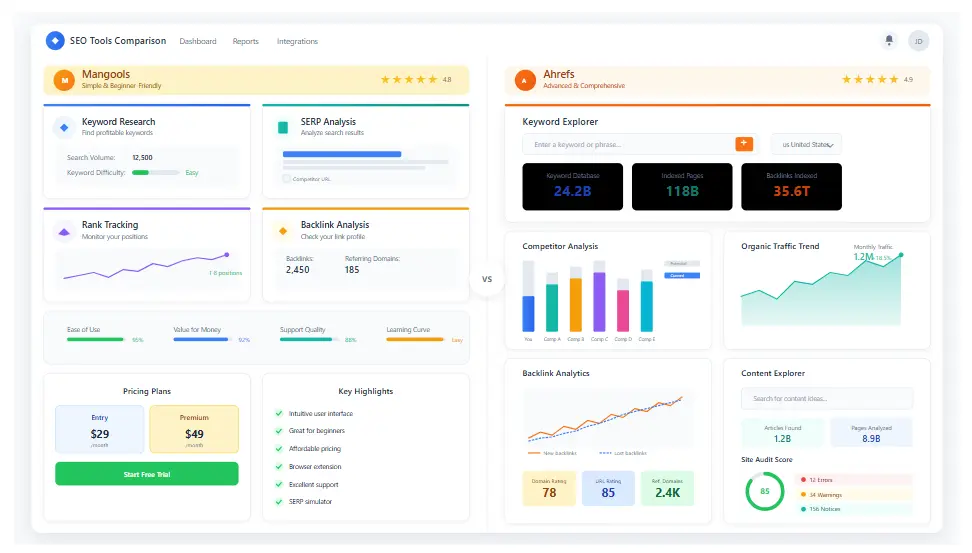
In this comprehensive Mangools vs Ahrefs review, we are going to strip away the marketing hype. We will analyze pricing structures, keyword accuracy, backlink databases, and usability to help you determine exactly which tool maximizes your ROI. Whether you are a solo blogger looking for affordable SEO tools or an agency scaling operations, this guide will clarify your path in the Mangools vs Ahrefs debate.
The Bottom Line Up Front
For 90% of bloggers, freelancers, and small business owners, Mangools is the superior value. It provides professional-grade keyword research, rank tracking, and SERP analysis without the steep learning curve or the enterprise-level price tag of Ahrefs. Ahrefs remains the king for deep-dive technical audits and massive link intelligence, but it is often overkill for content-focused strategies.
Mangools vs Ahrefs: Quick Comparison Table
Before we dive into the specific nuances of features, let’s look at a high-level overview of how these two SEO titans stack up against each other in terms of specs and capabilities.
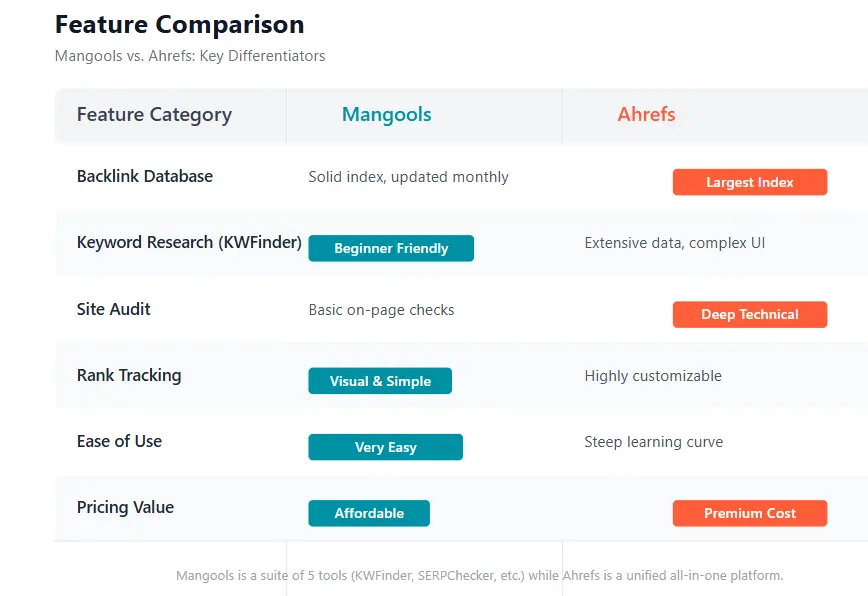
| Feature | Mangools (KWFinder Suite) | Ahrefs |
|---|---|---|
| Starting Price | $29.90/mo (Billed Annually) | $129/mo (Billed Annually) |
| Best For | Beginners, Bloggers, Small Biz | Agencies, Enterprises, Pros |
| Keyword Database | Large (Focus on relevance) | Massive (Industry Leading) |
| Backlink Index | Good (LinkMiner) | Excellent (Site Explorer) |
| Learning Curve | Low (Very Intuitive) | High (Feature Dense) |
| Site Audit | Basic (SiteProfiler) | Advanced (Site Audit Tool) |
| Rank Tracking | Included (SERPWatcher) | Add-on / Higher Tiers |
Mangools vs Ahrefs Pricing Comparison
For the vast majority of users, the decision comes down to budget. SEO tools can represent a significant monthly overhead, and calculating the Return on Investment (ROI) is crucial. When analyzing Mangools vs Ahrefs pricing, the disparity is stark.
Ahrefs positions itself firmly in the “premium” market. It has raised its prices over the years to reflect the sheer volume of data it processes. The entry-level “Lite” plan starts at $129/month (if billed annually). While powerful, this price point creates a high barrier to entry for freelancers and small businesses who are just building their traffic. In the Mangools vs Ahrefs pricing battle, Ahrefs is clearly the luxury option.
Mangools, on the other hand, has built its reputation on accessibility. Its pricing model is transparent and significantly lower. You can access the full Mangools suite (KWFinder, SERPChecker, SERPWatcher, LinkMiner, and SiteProfiler) starting at just $29.90/month. This price difference isn’t just about saving money; it’s about allocating resources. The $100+ saved per month by choosing Mangools can be reinvested into content creation, paid ads, or keyword research services, which often drive more immediate growth than a more expensive software subscription.

Value Breakdown:
Mangools Value
You get five distinct tools for the price of one lunch. The “Mangools Basic” plan includes 100 keyword lookups per day and 200 tracked keywords, which is often sufficient for a growing blog. It is the definition of “lean SEO” and wins the Mangools vs Ahrefs pricing round for budget-conscious users.
Ahrefs Value
You are paying for the “Active Crawl” and the sheer size of the database. If you are in a hyper-competitive niche where every single backlink matters, the $129 fee is a business necessity. However, for standard content marketing, it can be viewed as excess capacity in the Mangools vs Ahrefs comparison.
Mangools vs Ahrefs for Beginners
One of the most critical factors in choosing an SEO tool is the “Time to Value”—how long does it take for a new user to get actionable data? This is where Mangools vs Ahrefs for beginners becomes a lopsided contest in favor of Mangools.
Mangools is designed as a suite of focused applications. When you log in, you are presented with five clear icons. If you want keywords, you click KWFinder. If you want links, you click LinkMiner. There is no navigating through complex dashboards or deciphering industry jargon. The interface is clean, modern, and intuitive. It assumes you might be new to SEO and guides you through the process with helpful tooltips and visual data representations, making Mangools vs Ahrefs for beginners an easy choice.
Ahrefs, conversely, is a dense ecosystem. While powerful, it can be intimidating. The dashboard is packed with graphs, “Buried Reports,” and specialized terminology that might confuse a novice. To get full value from Ahrefs, a beginner often has to watch hours of tutorials. For a busy solopreneur who just wants to know which keywords to target, Ahrefs can feel like trying to drink from a fire hose. This is why Mangools is frequently ranked as the top SEO tool for beginners and dominates the Mangools vs Ahrefs for beginners discussion.
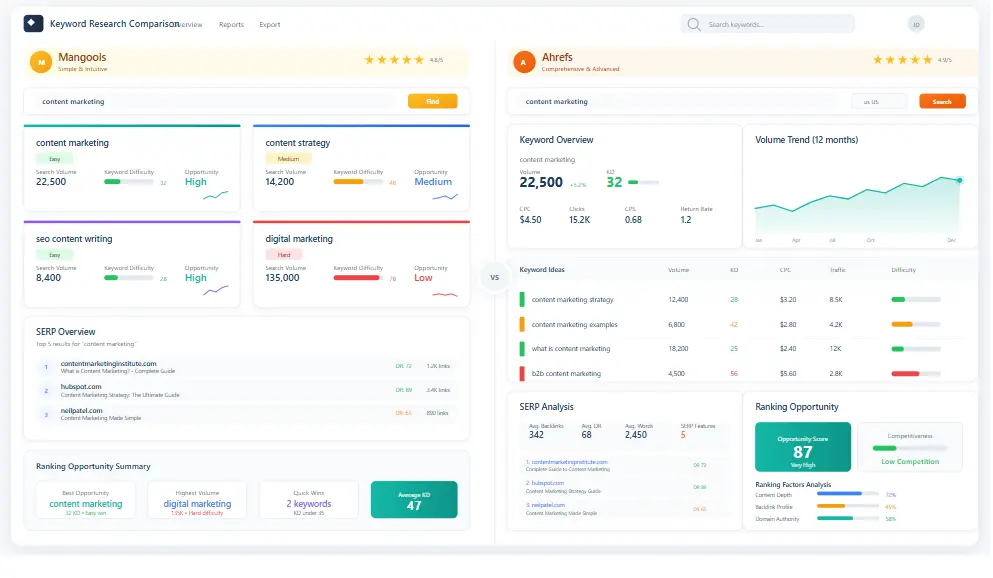
The “Cognitive Load” Factor: Beginners often abandon complex tools because they feel “stupid” using them. Mangools reduces this cognitive load. It presents data in a way that makes you feel smart and capable, which is essential for maintaining consistency in your SEO efforts. This ease of use is a major victory for Mangools in the Mangools vs Ahrefs for beginners debate.
Mangools vs Ahrefs Keyword Difficulty
Keyword Difficulty (KD) scores are meant to predict how hard it is to rank for a specific term. However, not all KD scores are calculated equally. Understanding the difference in Mangools vs Ahrefs keyword difficulty metrics is vital for your strategy.
Ahrefs Keyword Difficulty is calculated primarily based on the backlink profiles of the current top-ranking pages. It looks at the Domain Rating (DR) and the number of referring domains. If a keyword is dominated by high-DR sites like Forbes or New York Times, Ahrefs will assign a very high difficulty score (e.g., 80+). This is accurate for established sites, but it can be discouraging for new sites. Ahrefs might tell you a keyword is “Impossible” when, in reality, you could rank for it with exceptional on-page SEO and user intent matching. This is a key distinction in the Mangools vs Ahrefs keyword difficulty analysis.
Mangools (KWFinder) Keyword Difficulty takes a more holistic approach. While it certainly considers authority (DA/PA), it places a heavier weight on the on-page SEO of the competitors. It looks at whether the top results actually use the keyword in their title, URL, and description. This means a keyword might have a “Low” difficulty in KWFinder (e.g., 25/100) even if the competitors have decent authority, simply because they haven’t fully optimized for that specific term. When comparing Mangools vs Ahrefs keyword difficulty, Mangools is often more motivating for new websites.
For a new website, Mangools’ KD score is often more motivating and actionable. It highlights the “low-hanging fruit” that Ahrefs might filter out as too competitive. Ultimately, the Mangools vs Ahrefs keyword difficulty winner depends on whether you want raw authority data or a more nuanced view of optimization opportunities.
Keyword Research: KWFinder vs. Keywords Explorer
Keyword research is the foundation of any SEO strategy. Both tools excel here, but they serve different masters. The Mangools vs Ahrefs comparison continues as we look at their core research engines.
The KWFinder Approach (Mangools)
KWFinder is beloved for its laser focus on “findability.” You type in a seed keyword, and it instantly generates a list of long-tail variations with search volume, CPC, trend history, and difficulty. The interface is uncluttered. It also features a Local keyword research toggle that is incredibly easy to use, allowing you to check rankings in specific cities or countries—a must-have for local businesses.
The integration with SERPChecker is seamless. You can click a button next to any keyword and see the actual Google search results for that query, complete with metrics like Domain Authority, Page Authority, and Facebook shares for each ranking URL. This context helps you decide instantly if you can beat the current competition in the Mangools vs Ahrefs matchup.
The Keywords Explorer Approach (Ahrefs)
Ahrefs’ Keywords Explorer is a beast of a tool. It doesn’t just give you a list; it gives you a research lab. The standout feature here is Clicks data. Ahrefs estimates how many clicks the search results actually get, distinguishing this from “search volume.” This helps you avoid “no-click searches” (like “what time is it” or dictionary definitions) where you might rank #1 but get zero traffic because Google answers the question directly.
Furthermore, Ahrefs offers “Parent Topic” clustering, which automatically groups thousands of keywords into broader topics. This is revolutionary for keyword research strategy and site architecture, helping you build “topic clusters” rather than just a list of random posts. This feature gives Ahrefs a distinct edge in the Mangools vs Ahrefs analysis for large-scale content planners.
Mangools vs Ahrefs Accuracy
When investing in an SEO tool, you need to trust the numbers. In the debate of Mangools vs Ahrefs accuracy, it is important to distinguish between “Volume of Data” and “Precision of Data.”
Ahrefs arguably holds the title for the largest index of live backlinks and keywords. Their “Active Crawl” system is constantly updating, meaning they often discover new links and keyword trends faster than competitors. If you need to know exactly how many backlinks a competitor gained yesterday, Ahrefs is the standard. However, bigger isn’t always better for every user. The Mangools vs Ahrefs accuracy debate often overlooks that bigger data can sometimes be noisier.
Mangools pulls its data from a combination of sources, including its own API and integration with partners (like Majestic for backlinks). While its raw index size is smaller than Ahrefs’, the accuracy for search volume and difficulty is highly competitive and often sufficient for content marketing. Many users find that Mangools’ search volume estimates are more conservative and realistic for niche topics, whereas Ahrefs can sometimes inflate volume for broad terms. In the Mangools vs Ahrefs accuracy comparison, Mangools offers a precision that feels more “human” and applicable to smaller niches.
The Bottom Line: If you are an enterprise doing penalty recovery or forensic link analysis, Ahrefs’ accuracy and freshness are non-negotiable. If you are looking for reliable metrics to guide your content calendar, Mangools is perfectly accurate enough to get you on Page 1. The Mangools vs Ahrefs accuracy verdict depends on your scale.
Backlink Analysis: LinkMiner vs. Site Explorer
Backlinks remain the strongest ranking factor. If you cannot analyze links, you cannot compete. The Mangools vs Ahrefs comparison shifts here as Ahrefs takes the lead.
Ahrefs Site Explorer
This is the tool that built Ahrefs’ reputation. It is widely considered the gold standard for backlink analysis. The ability to filter by “dofollow/nofollow,” platform type (WordPress, Tumblr), language, and anchor text is unmatched. The “Intersect” feature, which lets you compare backlink profiles of multiple competing sites, is a secret weapon for finding link building opportunities that no one else has found.
Mangools LinkMiner
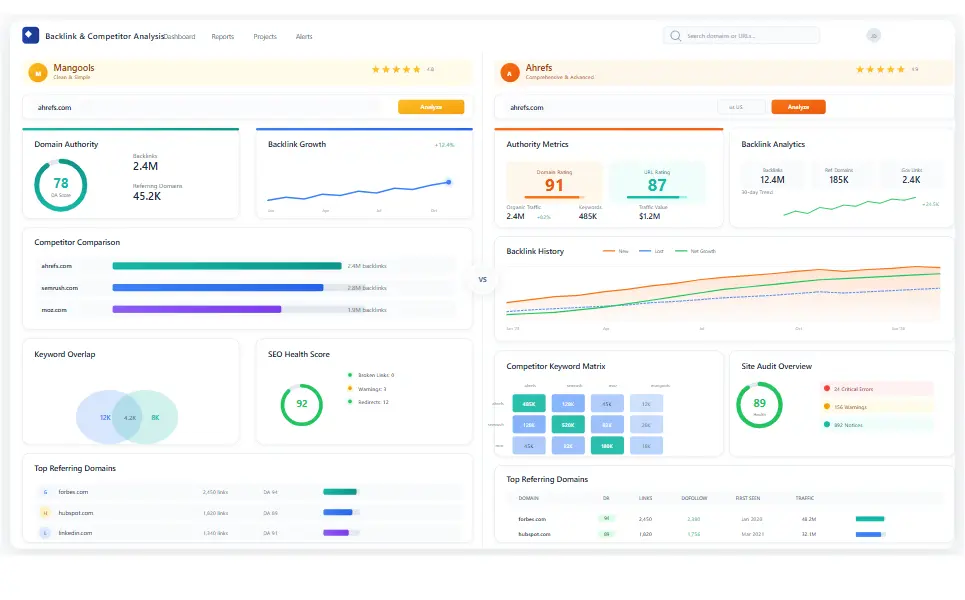
LinkMiner approaches backlinks with a focus on efficiency. It highlights “Strong” links with a distinct green color code, allowing you to quickly scan a profile and identify the high-value links. It includes a helpful “Cheat Sheet” that explains the metrics. While it may not have the billions of rows of data that Ahrefs has, it loads faster and presents the data in a way that is easier for a human to process quickly. For the majority of link building tasks (prospecting, checking competitor DA, finding broken links), LinkMiner is robust enough. In the Mangools vs Ahrefs backlink category, Ahrefs wins on depth, but Mangools wins on speed.
Rank Tracking: SERPWatcher vs. Rank Tracker
Tracking your progress is essential for motivation and client reporting.
Mangools SERPWatcher introduces a unique metric called the Performance Index. Instead of just showing you that you moved from position 15 to 12, it aggregates all your rankings into a single score from 0-100 that reflects your overall visibility growth. This is a fantastic psychological tool for showing clients a “big picture” win, even if individual keyword rankings fluctuate. It also includes mobile rank tracking and local rank tracking in the base plans—features that are often paid add-ons elsewhere. This makes the Mangools vs Ahrefs rank tracking comparison favorable to Mangools for most users.
Ahrefs Rank Tracker is utilitarian and accurate. It integrates seamlessly with the rest of the Ahrefs dashboard. However, the “Lite” plan has strict limits on the number of keywords you can track, and updating can be slower. It lacks the “gamification” aspect of the Performance Index, but it provides raw, reliable position data.
Best Ahrefs Alternative: Mangools
Many users start with Ahrefs because it is the industry default, only to realize they are paying for power they don’t need. When they look for the best Ahrefs alternative, Mangools is almost always the answer.
Why switch? Primarily for Workflow Integration. Ahrefs is a monolithic platform where you can get lost. Mangools is a suite of interconnected apps that respect your workflow. You find a keyword in KWFinder, check the SERP in SERPChecker, and track it in SERPWatcher without ever leaving the ecosystem. This fluid experience is why Mangools is often cited as the best Ahrefs alternative.
Furthermore, the white-label reporting in Mangools is superior for agencies. You can generate clean, branded PDF reports for clients with just a few clicks. Ahrefs allows for sharing, but the reports are often complex and data-heavy, which can overwhelm non-technical clients. If you are searching for the best Ahrefs alternative, look no further than the Mangools suite.
Mangools Pros
- ✅ Highly affordable pricing tiers.
- ✅ Intuitive, zero-learning-curve interface.
- ✅ Includes white-label reports.
- ✅ Great “Difficulty” metric for new sites.
- ✅ Excellent customer support and onboarding.
- ✅ Includes Local SEO features by default.
Mangools Cons
- ❌ Smaller backlink index than Ahrefs.
- ❌ Site auditing features are basic compared to Ahrefs.
- ❌ Limited historical data for older domains.
- ❌ No “Content Explorer” equivalent for deep research.
Ahrefs Pros
- ✅ Massive, frequently updated backlink index.
- ✅ “Clicks” data is invaluable for content strategy.
- ✅ Deep content gap analysis features.
- ✅ Industry-standard site auditing tool.
- ✅ “Parent Topic” clustering is best-in-class.
Ahrefs Cons
- ❌ Expensive; pricing scales up quickly.
- ❌ Steep learning curve for newbies.
- ❌ Can be “overkill” for simple blogs.
- ❌ Rank tracking limits on lower tiers.
Which Tool Should You Choose?
To make this final decision easy, let’s look at the specific user personas in the Mangools vs Ahrefs comparison.
Choose Mangools if…
- You are a blogger, affiliate marketer, or content creator focusing on winning long-tail keywords.
- You are running a small business with a limited marketing budget and need to see immediate ROI.
- You value simplicity and speed over massive data depth.
- You need rank tracking and local SEO features included in the base price.
- You are looking for the best affordable SEO tools to stack with an on-page plugin like Rank Math (see our Rank Math Pro review).
Choose Ahrefs if…
- You run an SEO Agency and need enterprise-level reporting and data depth.
- You are managing large-scale e-commerce sites with millions of keywords.
- You need deep technical SEO audits and site crawling to fix architecture issues.
- You rely heavily on content gap analysis to dominate your niche.
- Price is not a primary constraint; performance and data volume are.
Frequently Asked Questions
Is Mangools better than Ahrefs?
It depends on your needs. Mangools is generally better for beginners, bloggers, and small businesses due to its affordability and ease of use. Ahrefs is better for professional SEOs and agencies that require the deepest possible data, advanced site auditing, and large-scale keyword research. The Mangools vs Ahrefs winner depends on your specific goals.
Which is cheaper, Mangools or Ahrefs?
Mangools is significantly cheaper. Its entry-level plan starts at $29.90/mo, which is roughly a quarter of the cost of Ahrefs’ entry plan ($129/mo). This makes Mangools the clear winner for budget-conscious users in the Mangools vs Ahrefs pricing battle.
Is Mangools good for beginners?
Yes, Mangools is widely considered the best SEO tool for beginners. Its interface is intuitive, it avoids data overload, and its Keyword Difficulty metrics are easier to interpret for new sites compared to the strict authority-based metrics of Ahrefs. When analyzing Mangools vs Ahrefs for beginners, Mangools is the top choice.
Can I use Mangools as an Ahrefs alternative?
Yes, Mangools is a highly effective Ahrefs alternative. It covers keyword research, rank tracking, SERP analysis, and backlink monitoring in a streamlined suite that costs a fraction of the price, making it the preferred choice for those switching to save money.
How accurate is Mangools data?
While Ahrefs has a larger index, Mangools provides highly accurate data for keyword research and SERP analysis. It utilizes a mix of proprietary and partner APIs to deliver reliable search volume and difficulty scores that are sufficient for 95% of SEO projects. The Mangools vs Ahrefs accuracy gap is smaller than most people think.
Final Verdict: Mangools vs Ahrefs
If you have read this far, you know the answer. The Mangools vs Ahrefs debate isn’t about which tool is “better” technologically—it’s about which tool is better for you.
Ahrefs is a marvel of engineering. It is the tool you want in your corner if you are fighting for the top spots in hyper-competitive industries like insurance, finance, or SaaS, where every backlink counts. It is the power drill you buy to build a house.
Mangools is the smart, lean alternative. It strips away the noise and focuses on the activities that actually move the needle: finding keywords, checking rankings, and analyzing links. It does so at a price point that doesn’t keep you up at night. It is the tool you buy to build a furniture business or a lifestyle blog.
Our Recommendation: Unless you are running a full-scale agency or have a specific need for forensic backlink data, start with Mangools. The 10-day free trial gives you full access to the suite. You will likely find that the combination of KWFinder and SERPWatcher is all you need to dominate your niche without draining your bank account. The Mangools vs Ahrefs verdict is clear for value-focused marketers.
Start Ranking Higher Today
Join thousands of smart marketers who chose value over bloat. Get the data you need to grow.
Get Your Free Mangools Trial Read Our Full Mangools ReviewDisclaimer: This article contains affiliate links. If you sign up through our links, we may earn a commission, but this comes at no extra cost to you. We only recommend tools we trust and use.