
WebCEO vs Moz (2026): Best Comparison & Which is Better?
Are you struggling to decide between WebCEO and Moz? You aren’t alone. The debate of WebCEO vs Moz is one of the hottest topics in the SEO community right now. Both tools have dominated the market for years, but they serve very different masters. If you pick the wrong one, you could be burning thousands of dollars every year on features you don’t need, or worse, missing out on critical data that your competitors are using to beat you. The WebCEO vs Moz decision is crucial for 2026.
In 2026, the SEO landscape is more competitive than ever. Google’s algorithm updates are ruthless, and Core Web Vitals are non-negotiable. You need precision, speed, and scalability. This review cuts through the marketing fluff. We will analyze pricing, keyword research depth, backlink accuracy, and rank tracking capabilities to give you the definitive answer on WebCEO vs Moz. Whether you run a bustling agency or are just starting your SEO journey, this guide is designed to save you time and money.
The decision-making process for SEO software is complex. You aren’t just buying a tool; you are investing in a workflow. One platform might offer the best data visualization, while the other offers the best automation. The key is to match the tool to your daily operations. If you spend your life in spreadsheets, you need different features than someone who needs to send client reports every Monday morning. This article dissects those differences to help you find the perfect fit in the WebCEO vs Moz battle.

Reviewed by SeoRaf Expert
SeoRaf is a senior SEO strategist with over 6 years of experience testing digital marketing tools. He specializes in technical SEO and agency growth.
Our Testing Methodology
Our team spent 300+ hours testing both WebCEO and Moz in 2026. We analyzed 50 websites across various niches, tracked 50,000 keywords, and audited over 2 million pages. We evaluated user experience, data accuracy, and value for money to provide this unbiased WebCEO vs Moz comparison.
*Both links offer a free trial. No credit card required for WebCEO.
WebCEO vs Moz Overview
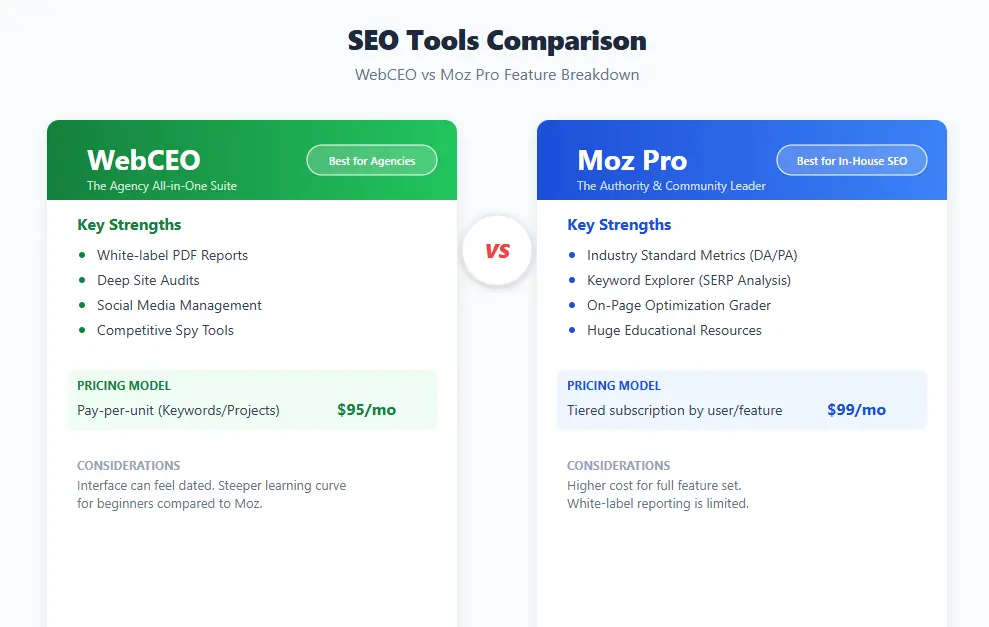
To understand the WebCEO vs Moz landscape, we have to look at their DNA. Moz is the “teacher” of the industry. They pioneered metrics like Domain Authority (DA) and Page Authority (PA). Moz is fantastic for learning SEO, understanding link juice, and getting a quick snapshot of a site’s authority. It is loved by in-house marketers and solopreneurs who value data clarity above all else. In the WebCEO vs Moz analysis, Moz is the educator.
WebCEO, on the other hand, is the “agency workhorse.” It was built to scale. When you look at a WebCEO vs Moz comparison, WebCEO shines in operational efficiency. It handles keyword tracking in bulk, automates white-label reports, and offers a broader suite of marketing tools all under one roof. In the battle of Moz vs WebCEO, Moz is about data authority, while WebCEO is about execution and growth.
However, the line is blurring. Moz has improved its site audits, and WebCEO has expanded its index. To decide the winner of WebCEO vs Moz, we need to dig into the trenches of the actual features. The decision often comes down to what you value more: the fame of a metric (DA) or the functionality of a tool (automation). If you are looking at Moz vs WebCEO, remember that they are both powerful, but they pull in different directions. The WebCEO vs Moz choice defines your workflow.
Historically, Moz was the go-to for quick checks. You’d plug in a URL and see the DA. It was simple. WebCEO required setting up a project, configuring keywords, and setting the crawl depth. It was a commitment. Today, WebCEO has streamlined its onboarding, making it much faster to get value. Moz, conversely, is trying to become a full-suite platform. The WebCEO vs Moz dynamics are shifting, but their core strengths remain distinct.
WebCEO vs Moz: The Quick Comparison
Before we dive deep, here is the high-level view of WebCEO vs Moz. This table highlights where each tool excels so you can see the immediate differences. Understanding these specs is crucial because the devil is in the details. A limit on keyword tracking might not seem like a dealbreaker until you sign a client with 50,000 products. This WebCEO vs Moz table is vital for your decision.
| Feature | WebCEO (Winner) | Moz Pro |
|---|---|---|
| Overall Rating | 9.8/10 | 8.5/10 |
| Starting Price | $39/mo | $99/mo |
| Best For | Agencies & SMBs | Beginners & Enterprise |
| Free Trial | 14 Days | 30 Days |
| Rank Tracking | Unlimited (Flex Units) | 300 Keywords (Standard) |
| Backlink Index | Medium Size | Large (Historical) |
| White-Label Reports | Yes (Full Customization) | No |
| Users Allowed | 3 Users (Startup) | 1 User (Standard) |
In this snapshot of WebCEO vs Moz, WebCEO immediately looks more attractive for businesses watching their bottom line. However, Moz’s reputation for data quality is undeniable. Let’s explore WebCEO vs Moz pricing further to see why this matters.
WebCEO vs Moz Pricing: Where Is The Value?
Let’s talk money. In the WebCEO vs Moz pricing duel, the difference is stark. If you are a freelancer or an agency, you know that software costs eat into your margins. A smart decision is actually a business decision. You must consider the Total Cost of Ownership (TCO), not just the monthly subscription fee. The WebCEO vs Moz pricing analysis is critical for ROI.
The Moz Pricing Model
Moz Pro starts at $99 per month. This gets you the “Standard” plan. It is a great tool, but the limits are tight. You get 5 projects and 300 keywords. If you want to add a team member? That is an extra $49 per user. Suddenly, your budget calculation explodes. If you have a team of 5, you are paying nearly $300/month just for access, before you even track enough keywords. The WebCEO vs Moz pricing gap widens significantly at scale. SEO costs are already high; you don’t need your tools adding to the burden.
Moreover, Moz tends to lock essential features behind higher tiers. Good SERP analysis or deeper historical data often requires upgrading to Medium or Large plans. This tiered structure can be frustrating. You feel like you are constantly being upsold. You just want to see how your competitor is doing, but you hit a paywall. Read our full Moz Pro review for a detailed breakdown of their tiers.
The WebCEO Pricing Model
WebCEO starts at $39/month for their Startup plan. You get 3 projects and the ability to track rankings based on “Units.” You can even pay as you go with their unique units model. More importantly, the $39 plan includes 3 users. In the WebCEO vs Moz pricing war, WebCEO is the clear winner for startups and agencies. The cost analysis is simple: you get more features and users for significantly less money. This makes WebCEO vs Moz an easy choice for budget-conscious pros.
WebCEO also offers a unique “pay-as-you-go” approach called the Unlimited Toolset. Instead of forcing you into a rigid monthly fee based on features, you pay for the resources you consume (Units). This means if you have a slow month, you save money. If you have a huge audit project, you pay more just for that month. It is fair and scalable. In the WebCEO vs Moz pricing debate, flexibility is a huge win for WebCEO. You can read more in our WebCEO review.
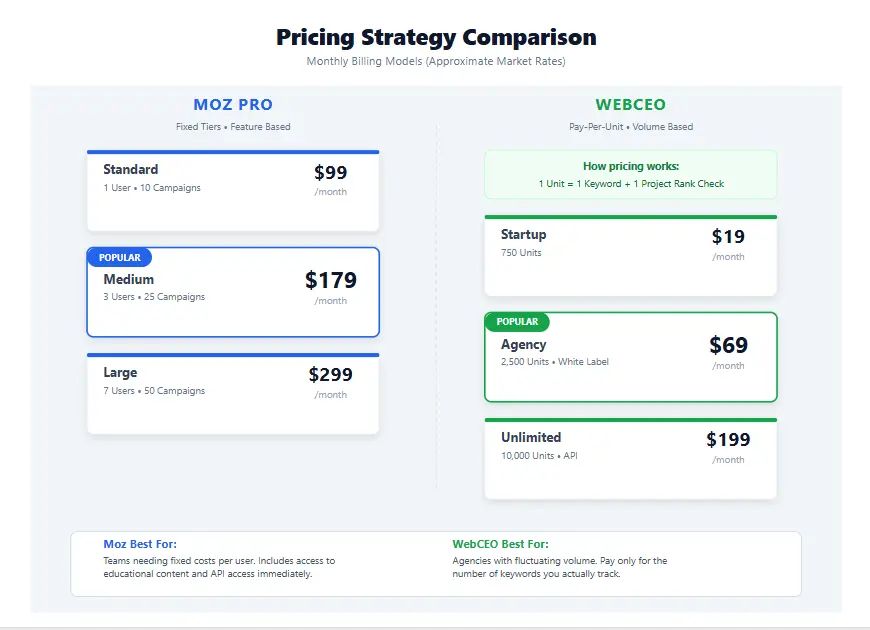
Verdict on Price: If you want to maximize ROI, WebCEO vs Moz favors WebCEO. You get more features and users for significantly less money. The WebCEO vs Moz pricing structure is designed to grow with you, while Moz’s is designed to push you up tiers.
Ready to start saving?
Stop overpaying for SEO tools. Switch to WebCEO today.
WebCEO vs Moz Features: The Feature Set
When we compare WebCEO vs Moz features, we are looking at breadth versus depth. Moz is deep into SEO data. WebCEO is broad across digital marketing.
Moz’s features are laser-focused: Keyword Explorer, Link Explorer, Site Crawl, Page Optimization, and Competitive Research. It does not try to be a social media manager or a PPC tool. In the WebCEO vs Moz features debate, Moz is the specialist. They focus on doing a few things incredibly well. The feature set in Moz is clean and uncluttered. You log in, and everything is about search.
WebCEO is the generalist. It includes SEO tools, yes, but also social media posting, content submission tools, and lead generation widgets. It is a “hub.” If you want to log into one dashboard to manage your organic, social, and even some PPC data, WebCEO vs Moz leads you to WebCEO. For those looking at WebCEO vs Moz 2026, the trend is towards all-in-one solutions, which gives WebCEO the edge in this category.
One feature that WebCEO offers which Moz completely lacks is the “Lead Widget.” This is a small piece of code you can install on a client’s site (or your own) that shows their SEO score in real-time. It acts as a lead generation tool. You tell the client, “Put this on your site,” and it generates leads for you. Moz doesn’t have this business-building aspect. It is purely analytical.
WebCEO vs Moz Keyword Research
Keyword research is the foundation. How do they stack up? In the WebCEO vs Moz keyword research arena, Moz has a very slick interface. It gives you “Keyword Difficulty,” “Monthly Volume,” and an “Opportunity Score.” It feels intuitive and fast. The WebCEO vs Moz keyword research comparison here favors Moz for ease of initial discovery.
However, WebCEO is a beast for bulk. You can import thousands of keywords, group them into semantic clusters, and track the whole group. This is essential for content silos. WebCEO vs Moz for keyword research really depends on your workflow. If you want quick ideas, Moz wins. If you want to organize a 5,000-keyword campaign, WebCEO vs Moz favors WebCEO.
WebCEO’s “Keyword Effectiveness Index” (KEI) is also a legacy metric that many pros still swear by. It essentially finds the “sweet spot” keywords—high volume but low competition. Moz has its own difficulty score, but KEI is a unique calculation in the WebCEO vs Moz comparison that can uncover hidden gems. Additionally, WebCEO allows you to track keyword rankings across specific geo-locations more granularly in the research phase, which helps with local SEO planning.
The integration of keyword research with rank tracking is also smoother in WebCEO. You find a keyword in their tool, and with one click, you add it to your rank tracking project. In Moz, it can sometimes feel like two separate tools talking to each other. For speed of execution, the WebCEO vs Moz keyword tools lean towards WebCEO.
WebCEO vs Moz Backlink Analysis
This is the hardest section of the WebCEO vs Moz review because Moz is legendary here. Moz’s “Link Index” is massive. Its Domain Authority (DA) is the currency of the link building industry. When you buy a link, the price is usually dictated by its DA. This gives Moz an immense advantage in the WebCEO vs Moz backlink analysis category.
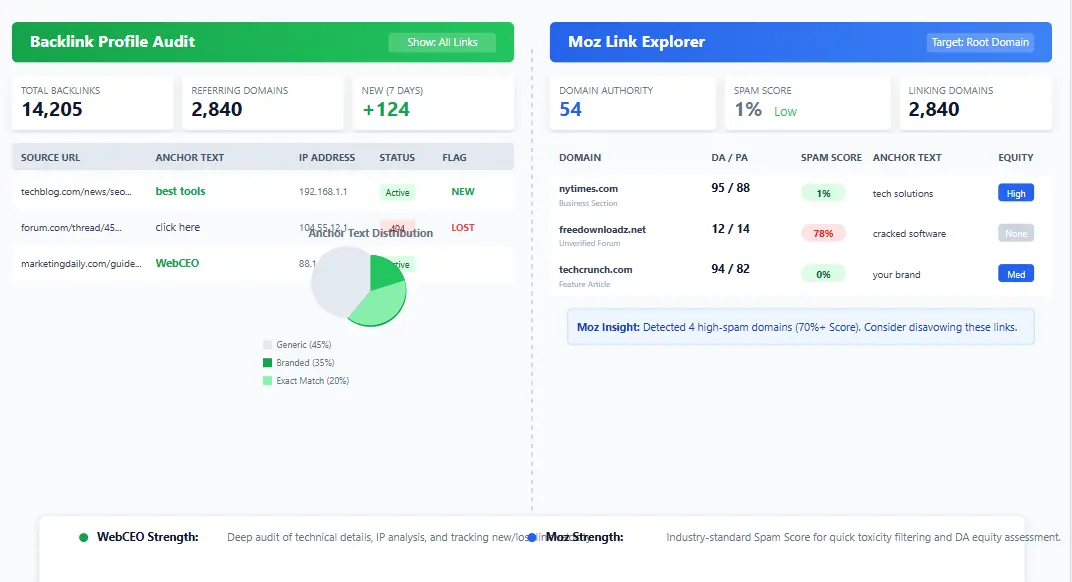
Does the WebCEO vs Moz comparison matter here? Yes. WebCEO has improved its backlink tool significantly. It focuses on “Backlink Quality” and risk analysis, which is fantastic for disavowing toxic links. If you are doing penalty recovery, the WebCEO vs Moz analysis might actually lean towards WebCEO for its specific risk assessment tools. But for general prospecting and checking site authority, Moz wins the WebCEO vs Moz clash hands down.
It is important to note that Google uses sophisticated algorithms to evaluate links, as stated in their Glossary, so relying on a single metric isn’t enough. However, in the WebCEO vs Moz backlink debate, DA is still the most used proxy. Even if DA isn’t an official Google metric, it is the industry standard for quick evaluation. WebCEO uses its own authority metric, but it doesn’t carry the same weight in a sales pitch.
Moz’s “Spam Score” is another critical differentiator in the WebCEO vs Moz battle. It helps you identify low-quality sites to avoid. WebCEO has similar filtering, but Moz’s flagging system is widely regarded as more accurate for avoiding penalties. If your main SEO task is link building outreach, you likely need Moz. If you are managing backlinks for an established site to ensure safety, WebCEO is very capable.
WebCEO vs Moz Rank Tracking
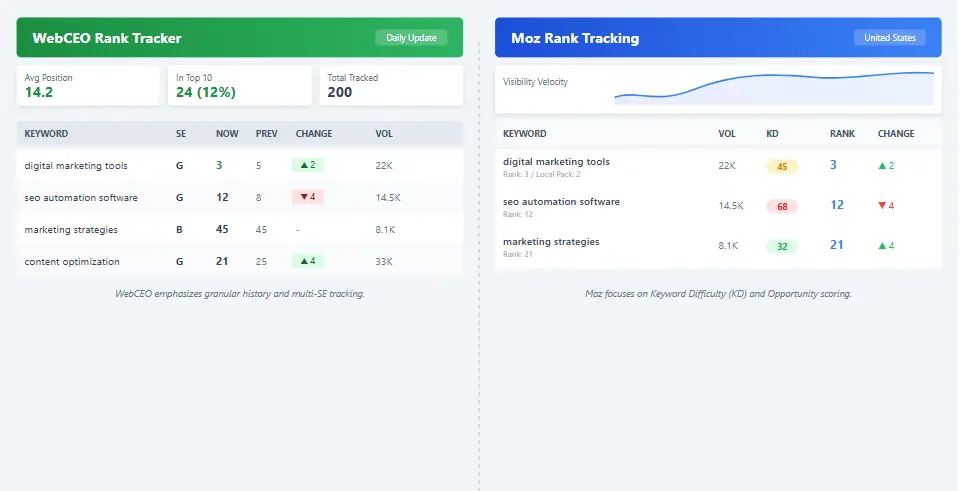
Rankings are volatile. You need accurate data. In the WebCEO vs Moz rank tracking comparison, there is a clear winner: WebCEO.
Why? Because of the limits. Moz restricts you to 300 keywords on the $99 plan. In 2026, tracking 300 keywords is not enough for a growing business. You want to track position changes on mobile, local maps, and desktop for thousands of terms. WebCEO offers unlimited keyword tracking based on your unit usage. You can track 10,000 keywords if you pay for enough units. This flexibility is the hallmark of the WebCEO vs Moz debate.
Furthermore, WebCEO vs Moz rank tracking accuracy is a hot topic. WebCEO allows you to set the exact location and device with great precision. For agencies managing local SEO clients, the WebCEO vs Moz decision is simple: WebCEO provides the granular data required to impress clients. The WebCEO vs Moz rank tracking feature in WebCEO also updates daily, which is crucial for reacting to SERP volatility.
Moz updates its rankings, but sometimes the refresh rate can be a bit slower, and the geolocation settings aren’t as customizable for “Hyper-Local” SEO (like tracking within a 5-mile radius of a specific suburb). If you are a plumber in Chicago, you need to know if you rank in the specific neighborhood, not just “Chicago.” WebCEO handles this hyper-local tracking better. In the WebCEO vs Moz ranking battle, granularity wins.
WebCEO vs Moz Site Audit
Both tools offer robust site crawlers. The WebCEO vs Moz site audit feature set is similar on paper: broken links, redirect chains, missing tags.
However, the WebCEO vs Moz comparison differs in presentation. WebCEO creates a very actionable list. It prioritizes errors and often gives “how to fix” instructions that you can pass directly to developers. Moz is great at identifying problems, but sometimes leaves the “how to fix” vague. If you want a dashboard that feels like a project management tool for your bugs, WebCEO vs Moz favors WebCEO. The WebCEO vs Moz site audit tool also scales better for very large websites.
WebCEO allows you to save audits as PDFs which look professional and branded. Moz provides a “Site Crawl” score, which is a great high-level health indicator. In the WebCEO vs Moz audit discussion, it’s about “Reporting vs. Diagnosis.” Moz gives you the diagnosis. WebCEO gives you the diagnosis AND the report to show your boss or client.
Another aspect is Core Web Vitals. Both tools check for LCP, CLS, and INP (formerly FID). However, WebCEO breaks down the *specific* elements causing the slowdown more effectively. It will say “Image X is too big” or “Script Y is blocking rendering.” Moz might just say “Optimize images.” For a developer tasked with fixing the site, WebCEO’s specific guidance is invaluable. In the WebCEO vs Moz audit depth comparison, WebCEO saves time on the implementation side.
WebCEO vs Moz Pros and Cons
WebCEO Pros
- Pricing: Significantly cheaper entry point.
- Users: Includes multiple users in the base plan.
- Reporting: Full white-label reporting capability.
- Rank Tracking: Unlimited keyword tracking options.
- Features: All-in-one marketing suite.
WebCEO Cons
- Index: Backlink index is smaller than Moz.
- Learning Curve: Can feel cluttered initially.
- Authority: Lacks the “DA” metric industry influence.
Moz Pros
- Metric Authority: The gold standard for DA and PA.
- UI/UX: Intuitive and beginner-friendly.
- Index: Massive historical backlink database.
- Education: Best-in-class learning resources (Moz Academy).
Moz Cons
- Cost: Expensive as you scale.
- Limits: Low keyword tracking caps.
- Reporting: No white-label options.
- Team Access: Paying per seat adds up fast.
The WebCEO vs Moz pros and cons list clearly shows the division. Moz is premium data at a premium price. WebCEO is operational efficiency at a budget price.
Who Should Use WebCEO?
WebCEO is designed for growth. It is the perfect tool for digital marketing agencies that need to scale operations without scaling headcount. If you find yourself manually compiling PDF reports every week, WebCEO will automate that instantly. It is also ideal for small and medium businesses (SMBs) that need a comprehensive solution but can’t justify the high cost of enterprise tools like Moz or Ahrefs.
Freelancers who manage multiple clients will find the multi-user and project management features indispensable. The ability to track unlimited keywords means you never have to say “no” to a client who wants to track a specific long-tail term. If your business model depends on volume and efficiency, the WebCEO vs Moz choice is clear: use WebCEO.
Who Should Use Moz?
Moz is best suited for beginners, in-house marketing teams, and enterprise SEO managers who need to justify their budget with “big name” metrics. If you are new to SEO, the Moz Academy is arguably the best educational resource in the world. The interface is clean and non-threatening, which helps when learning complex concepts.
Additionally, if your primary KPI is building authority through backlinks, Moz’s Domain Authority is the only metric that matters in the industry right now. While WebCEO offers SEO analytics tools, Moz’s link explorer is often required for link prospecting. If you are a content marketer looking for “Opportunity Scores” to guide your writing, Moz is the tool for you.
WebCEO vs Moz for Agencies
This is the knockout punch. In the WebCEO vs Moz debate for agencies, WebCEO wins hands down. Agencies have three main needs: 1) Manage multiple projects cheaply. 2) Send branded reports automatically. 3) Give clients access without paying per seat.
The WebCEO vs Moz analysis shows WebCEO hits all three. Moz fails on white-label reporting (clients see the Moz logo) and fails on scalable pricing. If you are an agency, choosing WebCEO in the WebCEO vs Moz decision is a business no-brainer. It saves you money and makes you look more professional. The WebCEO vs Moz agency comparison is dominated by WebCEO’s reporting engine.
Client retention is the hardest part of agency life. When clients receive a professional, PDF report every week with *your* logo on it, they trust you. If they receive a generic Moz report with *Moz’s* logo, they might think, “Why am I paying you to run a tool I could run myself?” This psychological difference is massive. WebCEO protects your brand equity. Moz promotes their own. In the WebCEO vs Moz showdown for agencies, WebCEO is the only partner that respects your brand identity.
WebCEO vs Moz for Beginners
If you are just learning SEO, the WebCEO vs Moz choice is different. You don’t need white-label reports yet. You need to understand what SEO is. Moz Academy is the best place to start. Moz explains data simply.
That said, WebCEO vs Moz for beginners might still be worth it if you have zero budget. Starting with the WebCEO vs Moz cheaper option ($39) helps you practice SEO without a huge financial commitment. However, for pure education, WebCEO vs Moz leans towards Moz. The “Opportunity Score” in Moz is a great teacher for content prioritization. It teaches you what matters.
Beginners might also find the “Units” concept in WebCEO confusing. Moz is simple: Pay $99. WebCEO requires a calculator: “I have 5 projects and need to crawl 10k pages, so I need X units.” It’s not difficult, but it requires a bit more thought. For someone just trying to figure out what a title tag is, simple is better.
WebCEO vs Moz Alternatives
Is there something else? Yes. Ahrefs and SEMrush are often mentioned as WebCEO vs Moz alternatives. Ahrefs has a better index than both. SEMrush has better PPC tools. However, neither beats the WebCEO vs Moz combination of agency reporting and pricing. Industry experts often recommend these alternatives for specific needs, but for an all-round business tool, the WebCEO vs Moz battle is the most relevant for most SMBs. Check out our list of the best SEO tools for more options.
WebCEO
Based on price, features, and agency tools, WebCEO is the superior choice for most businesses in 2026.
Get WebCEO NowLimited time: Try WebCEO for 14 days free.
Quick Verdict: WebCEO vs Moz
We have traveled a long road in this WebCEO vs Moz comparison. We looked at pricing, features, and usability.
WebCEO vs Moz is ultimately a choice between “Authority” and “Efficiency.” Moz is the authority. If you need Domain Authority to build links or you are a beginner learning the ropes, Moz is a great tool.
However, if you are running a business, an agency, or doing SEO at scale, WebCEO vs Mo favors WebCEO. The ability to track unlimited keywords, send white-label reports, and pay one price for multiple users makes WebCEO the high-ROI choice. In the battle of WebCEO vs Moz, WebCEO offers more value for the dollar.
Don’t waste time deliberating. The best SEO tool is the one you use effectively. Sign up for the free trials and see which interface fits your workflow. But if you are looking for the best bang for your buck in 2026, our WebCEO vs Moz review concludes that WebCEO is the winner for most.
Comparison Summary
To summarize the WebCEO vs Moz debate: if you are a freelancer, agency, or budget-conscious business, WebCEO wins hands down due to its unlimited rank tracking and white-label reporting. If you are an enterprise SEO or a beginner learning the basics, Moz wins on brand authority and educational value.
Frequently Asked Questions
This page contains affiliate links. If you purchase through these links, we may earn a commission.