
Asana Review 2026: Is It Worth Your Money?
Our comprehensive Asana review covers everything you need to know about this popular project management tool. From features to pricing, we’ve got you covered.
Try Asana for FreeWhat is Asana? A Comprehensive Overview
In this Asana review, we’ll dive deep into one of the most popular project management tools on the market today. Asana is a web and mobile application designed to help teams organize, track, and manage their work. Founded in 2008 by Facebook co-founder Dustin Moskovitz and Justin Rosenstein, Asana has grown to become a powerhouse in the project management space, serving millions of users worldwide. This Asana review will help you understand why it’s so popular.
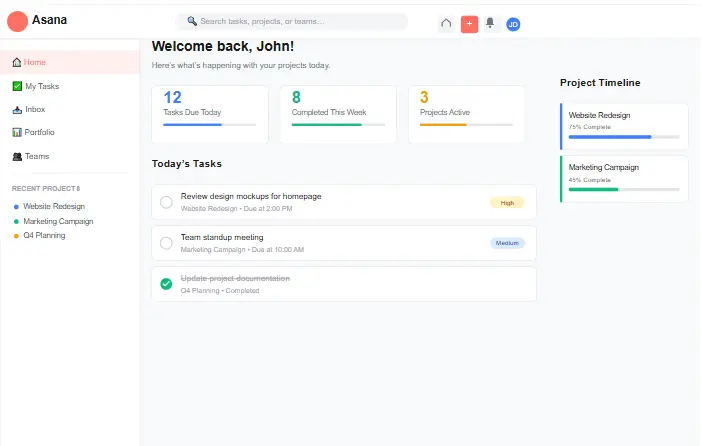
At its core, Asana is a work management platform that enables teams to coordinate and manage their work, from daily tasks to strategic initiatives. It provides a shared space where everyone can see what needs to be done, who’s responsible for each task, and when things are due. This transparency helps eliminate confusion, reduce status meetings, and keep everyone aligned on priorities. Our Asana review found this transparency to be a key selling point.
Throughout this Asana review, we’ll explore the platform’s features, pricing, pros and cons, and help you determine if it’s the right tool for your needs. Whether you’re a small business owner, a project manager in a large corporation, or a freelancer looking to streamline your workflow, this Asana review will provide you with the insights you need to make an informed decision. This Asana review aims to be your definitive guide.
The Evolution of Asana
As part of our Asana review, it’s important to understand how the platform has evolved over the years. When it first launched, Asana was primarily a task management tool with a simple interface that allowed users to create tasks, assign them to team members, set due dates, and track progress. However, as the needs of teams have become more complex, so has Asana. This evolution is a central theme in our Asana review.
Today, Asana is a comprehensive work management platform that offers a wide range of features designed to support different workflows and project management methodologies. From Kanban boards to Gantt charts, from automation to custom fields, Asana has expanded its capabilities to meet the diverse needs of modern teams. Our Asana review highlights these expanded capabilities.
This evolution is a key reason why our Asana review finds the platform suitable for a wide range of use cases. Whether you’re managing simple to-do lists or complex multi-department projects, Asana has the flexibility and functionality to support your work. This Asana review will explore these use cases in detail.
According to this Asana review, the platform’s growth trajectory shows no signs of slowing down. Regular updates and new features demonstrate Asana’s commitment to innovation. Our Asana review notes that this continuous improvement keeps the platform relevant in a competitive market.
For anyone considering Asana, this review provides a comprehensive look at how the platform has transformed from a simple task manager to a full-featured work management solution. This Asana review will help you understand if these transformations align with your needs.
Key Features of Asana
No Asana review would be complete without a detailed look at the platform’s features. Asana offers a robust set of tools designed to help teams manage their work more effectively. Let’s explore the key features that make Asana a popular choice for project management. This Asana review will cover each feature in depth.
Task Management
At its core, Asana excels at task management. Users can create tasks, assign them to team members, set due dates, add descriptions, attach files, and create subtasks. Tasks can be organized into projects, and projects can be grouped into portfolios for higher-level oversight. This hierarchical structure makes it easy to manage work at different levels of granularity. This Asana review found the task management capabilities to be exceptional.
Multiple Project Views
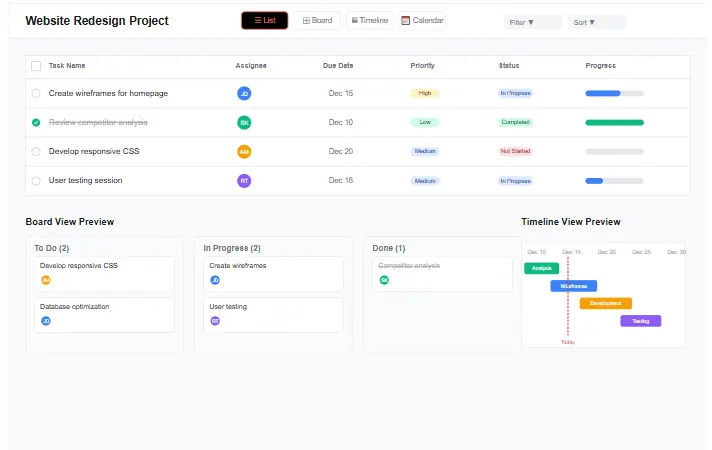
Asana offers several ways to view your work, allowing teams to choose the visualization that best fits their workflow. These include List View (traditional task list), Board View (Kanban-style), Timeline View (Gantt chart), Calendar View, and the new Automation View. This flexibility is a major highlight of our Asana review, as it accommodates different work styles and project management methodologies. This Asana review particularly appreciates the Timeline View.
Automation
Asana’s automation features help teams save time by reducing manual work. With Rules, users can create custom triggers and actions that automate routine tasks. For example, you can create a rule that automatically assigns tasks to specific team members based on certain criteria, or moves tasks to different sections when their status changes. This automation capability is a significant advantage noted in our Asana review. This Asana review believes automation is a game-changer.
Reporting and Analytics
Asana provides robust reporting and analytics tools to help teams track progress and identify bottlenecks. The platform offers various dashboards and reports that visualize project data, making it easier to understand performance at a glance. For more advanced analytics, Asana integrates with business intelligence tools, a feature we appreciate in this Asana review. This Asana review found the reporting features to be comprehensive.
Team Collaboration
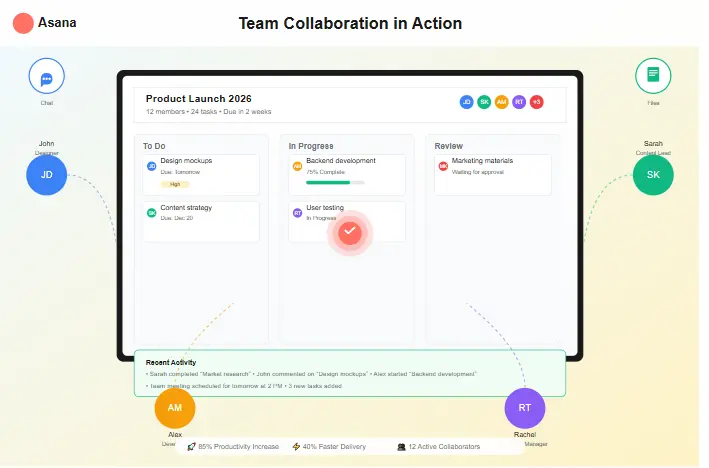
Collaboration is at the heart of Asana. The platform offers numerous features to facilitate teamwork, including conversations, task comments, status updates, and team pages. Team members can communicate directly within the context of their work, reducing the need for separate communication tools. This integrated approach to collaboration is a key strength highlighted in our Asana review. This Asana review emphasizes the importance of these collaboration features.
Integrations
Asana integrates with over 200 other tools, allowing teams to connect their favorite apps and create a seamless workflow. Popular integrations include Slack, Microsoft Teams, Google Drive, Dropbox, Adobe Creative Cloud, and many more. This extensive integration ecosystem means you can use Asana as a central hub for your work, connecting it with the other tools your team relies on. This Asana review found the integration capabilities to be impressive.
Advanced Features for Power Users
While the features mentioned above are available to most Asana users, the platform also offers advanced capabilities for teams with more complex needs. As part of our comprehensive Asana review, we want to highlight these premium features that set Asana apart from simpler task management tools. This Asana review will explore these advanced features in detail.
One such feature is Portfolios, which allows organizations to group related projects and track their collective progress. This is particularly useful for executives and department heads who need to oversee multiple initiatives at once. Another advanced feature is Goals, which enables teams to set strategic objectives and connect them to the work being done in Asana, creating a clear line of sight from daily tasks to company-wide priorities. This Asana review found these features particularly valuable for larger organizations.
For teams working with sensitive data, Asana offers advanced security features like custom fields with restricted access, export controls, and data residency options. These enterprise-grade capabilities make Asana suitable for organizations with strict compliance requirements. This Asana review notes that these security features are robust.
Finally, Asana’s Work Graph is a powerful data model that underpins the entire platform. It maps the relationships between tasks, projects, goals, and people, enabling sophisticated features like dependency tracking and workload management. This technological foundation is a key reason why our Asana review finds the platform so scalable and flexible. This Asana review believes the Work Graph is Asana’s secret weapon.
For power users, these advanced features make Asana a compelling choice. This Asana review recommends exploring these capabilities if you have complex project management needs. The depth of functionality is impressive, as this Asana review demonstrates.
Asana Pricing Plans
No Asana review would be complete without a detailed breakdown of the pricing options. Asana offers several pricing tiers designed to meet the needs of different types of users, from individuals to large enterprises. Let’s examine each plan in detail to help you determine which one is right for you. This Asana review will analyze the value proposition of each pricing tier.
It’s worth noting that Asana offers a free plan that includes basic features for teams of up to 15 people. This is a great way to try out the platform before committing to a paid plan. However, for more advanced features and larger teams, you’ll need to upgrade to one of the paid plans. This Asana review recommends starting with the free plan to evaluate the platform.
For a more detailed breakdown of Asana’s pricing, you can check out our comprehensive Asana pricing guide. This resource provides in-depth information about what’s included in each plan and helps you make an informed decision based on your specific needs and budget. This Asana review complements that pricing guide with feature analysis.
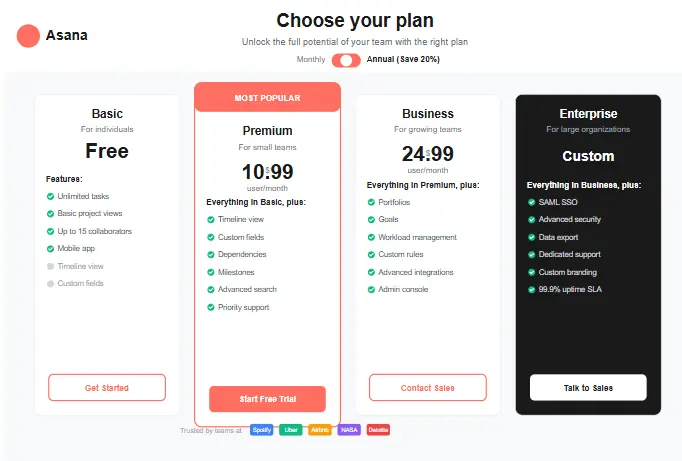
| Plan | Price | Best For | Key Features |
|---|---|---|---|
| Basic | Free | Individuals and small teams | Up to 15 users, basic task management, list and board views |
| Premium | $10.99/user/month | Small to medium teams | Timeline view, custom fields, advanced search, automation |
| Business | $24.99/user/month | Large teams and departments | Portfolios, goals, workload management, advanced integrations |
| Enterprise | Custom pricing | Large organizations | Advanced security, admin controls, dedicated support |
Value for Money
When evaluating Asana’s pricing, it’s important to consider the value it provides compared to other project management tools. In our Asana review, we’ve found that the platform offers competitive pricing, especially when you consider the breadth of features included in each plan. This Asana review believes the pricing is fair for the value provided.
The free plan is generous compared to many competitors, allowing up to 15 users and including core features that are sufficient for basic project management needs. The Premium plan, at $10.99 per user per month, offers excellent value for small to medium teams, providing access to advanced features like timeline view, custom fields, and automation that significantly enhance the platform’s capabilities. This Asana review found the Premium plan to be the sweet spot for many teams.
For larger organizations, the Business plan at $24.99 per user per month includes enterprise-grade features like portfolios, goals, and workload management that justify the higher price point. And for organizations with specific needs, the Enterprise plan offers custom pricing and advanced security features that make it a compelling option. This Asana review notes that the Business plan is worth the investment for larger teams.
Overall, our Asana review finds that the platform offers good value for money across all pricing tiers, with a clear progression of features that justify the price increases as you move up the tiers. This Asana review concludes that the pricing structure is logical and transparent.
When considering the total cost of ownership, this Asana review suggests factoring in the productivity gains and efficiency improvements that Asana can bring to your organization. The ROI can be significant, as this Asana review demonstrates.
Pros and Cons of Asana
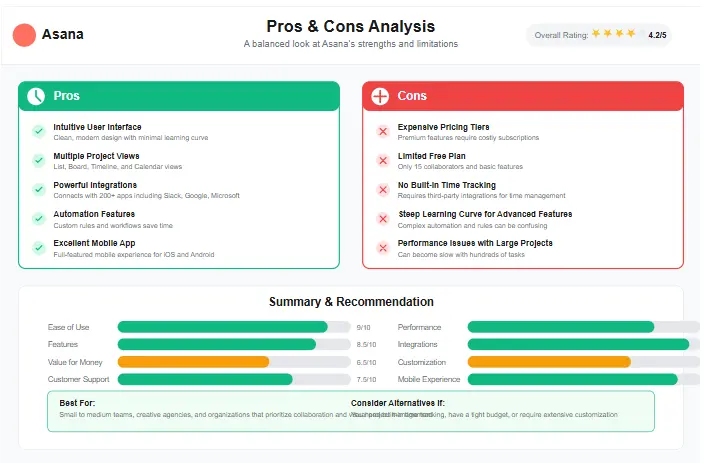
To provide a balanced Asana review, it’s important to consider both the strengths and weaknesses of the platform. No tool is perfect, and understanding the pros and cons will help you determine if Asana is the right fit for your specific needs. This Asana review aims to be objective in its assessment.
Pros
- Intuitive and user-friendly interface that’s easy to learn
- Multiple project views (List, Board, Timeline, Calendar) accommodate different work styles
- Robust automation capabilities reduce manual work and improve efficiency
- Extensive integration ecosystem connects with over 200 other tools
- Strong mobile apps for iOS and Android enable work on the go
- Scalable platform that grows with your team and organization
- Excellent collaboration features facilitate team communication
- Generous free plan for small teams and individuals
- Regular updates and new features keep the platform evolving
- Strong security and compliance features for enterprise users
Cons
- Can become expensive for large teams on higher-tier plans
- Advanced features have a steeper learning curve
- Timeline view (Gantt chart) only available on Premium and higher plans
- Limited time tracking capabilities without third-party integrations
- Can feel overwhelming for users who only need simple task management
- Some users report performance issues with very large projects
- No built-in budgeting or expense tracking features
- Customer support response times can be slow for non-enterprise users
- Customization options are limited compared to some competitors
- Dependency management features could be more robust
How Asana Compares to Competitors
As part of our comprehensive Asana review, it’s important to consider how the platform compares to its competitors. While Asana is a strong contender in the project management space, it’s not the only option available. Tools like Trello, Monday.com, ClickUp, and Wrike all offer similar functionality with their own unique strengths and weaknesses. This Asana review will compare these alternatives objectively.
Compared to Trello, Asana offers more features and flexibility, though Trello’s simplicity can be an advantage for users who only need basic Kanban boards. Against Monday.com, Asana generally offers a more intuitive interface and better free plan, though Monday.com provides more customization options. When compared to ClickUp, Asana has a more focused feature set that some users prefer over ClickUp’s “everything but the kitchen sink” approach. This Asana review believes Asana strikes a good balance between simplicity and power.
For a detailed comparison between Asana and Wrike, check out our Wrike vs Asana comparison. This resource provides an in-depth analysis of how these two popular project management tools stack up against each other, helping you make an informed decision based on your specific needs. This Asana review complements that comparison with additional insights.
Ultimately, the best project management tool depends on your specific needs, team size, budget, and preferred work style. Our Asana review finds that the platform strikes a good balance between functionality and usability, making it a strong choice for a wide range of users. This Asana review concludes that your decision should be based on your unique requirements.
When comparing alternatives, this Asana review recommends creating a feature checklist and scoring each tool against your specific needs. This systematic approach will help you make an objective decision, as this Asana review suggests.
Who Should Use Asana?
Based on our Asana review, we’ve identified several types of users and organizations that can benefit from using Asana as their project management solution. Let’s explore who Asana is best suited for. This Asana review will help you determine if you’re in the target audience.
Small to Medium Businesses
Asana is an excellent choice for small to medium businesses looking for a scalable project management solution. The platform’s intuitive interface makes it easy to get started, while its robust features provide room to grow as your team and projects expand. The free plan is generous enough for many small teams, while the Premium plan offers advanced features at a reasonable price point. This Asana review particularly recommends Asana for SMBs.
Marketing Teams
Marketing teams can particularly benefit from Asana’s features. The platform’s timeline view is perfect for planning campaigns, while custom fields allow for tracking specific marketing metrics. Asana’s integration with tools like Adobe Creative Cloud and social media management platforms makes it a central hub for marketing workflows. This Asana review found Asana to be especially valuable for marketing professionals.
Software Development Teams
While not specifically designed for software development, Asana can be adapted for agile workflows. The platform’s board view works well for sprint planning, while task dependencies help manage complex development projects. Integration with development tools like GitHub and Jira further enhances its utility for software teams. This Asana review notes that many development teams successfully use Asana.
Remote Teams
Asana is particularly well-suited for remote teams. The platform provides a centralized space where distributed team members can collaborate, track progress, and stay aligned on priorities. Features like status updates and team pages help maintain team cohesion even when team members are not physically together. This Asana review highlights Asana’s remote work capabilities.
Freelancers and Solopreneurs
Freelancers and solopreneurs can benefit from Asana’s free plan, which provides a robust set of features for managing personal projects and client work. The platform’s ability to create separate teams and projects makes it easy to keep different clients and initiatives organized. This Asana review found Asana to be valuable for independent professionals.
Who Might Not Be a Good Fit for Asana?
While Asana is a versatile platform, it’s not the perfect solution for everyone. Based on our Asana review, there are certain users and use cases where other tools might be a better fit. This Asana review aims to be honest about these limitations.
Users who only need simple to-do lists might find Asana overwhelming and would be better served by simpler apps like Todoist or Microsoft To Do. Teams with highly specialized workflows, such as construction or manufacturing, might benefit from industry-specific project management tools with built-in templates and features tailored to their needs. This Asana review acknowledges these limitations.
Budget-conscious large organizations might find Asana’s Business and Enterprise plans expensive compared to some alternatives. Similarly, teams that require extensive customization options might prefer platforms like ClickUp or Monday.com that offer more flexibility in tailoring the tool to specific workflows. This Asana review suggests considering these factors.
Finally, organizations with strict data residency requirements or those operating in heavily regulated industries should carefully evaluate Asana’s security and compliance features to ensure they meet their specific needs. This Asana review recommends thorough due diligence for such organizations.
Understanding who should and shouldn’t use Asana is crucial for making the right decision. This Asana review hopes to provide clarity on these considerations.
How to Get Started with Asana
Now that we’ve covered the key aspects of Asana in this review, let’s walk through how to get started with the platform. Whether you’re setting up Asana for yourself or your entire team, these steps will help you get up and running quickly. This Asana review provides a practical guide to implementation.
Step 1: Sign Up for an Account
The first step is to sign up for an Asana account. You can do this by visiting the Asana website and clicking on the “Sign Up” button. You’ll have the option to sign up with your email address or through Google or Microsoft. Once you’ve created your account, you’ll be prompted to create a workspace, which is where your projects and tasks will live. This Asana review found the signup process to be straightforward.
Step 2: Set Up Your Team
If you’re using Asana with a team, the next step is to set up your team. You can invite team members by entering their email addresses, and they’ll receive an invitation to join your workspace. You can create multiple teams within your workspace to organize different departments or project groups. This Asana review recommends taking time to plan your team structure.
Step 3: Create Your First Project
With your team set up, it’s time to create your first project. Asana offers several project templates to help you get started, or you can create a blank project from scratch. When creating a project, you’ll choose a view (List, Board, Timeline, or Calendar) and set up basic project details like the project name and description. This Asana review suggests starting with a template if you’re new to the platform.
Step 4: Add Tasks and Assign Them
Once your project is created, you can start adding tasks. For each task, you can assign it to a team member, set a due date, add a description, and create subtasks if needed. You can also organize tasks into sections to create a logical structure within your project. This Asana review recommends being thorough with task details.
Step 5: Customize Your Workspace
As you become more familiar with Asana, you can start customizing your workspace to better suit your needs. This might include creating custom fields to track specific information, setting up rules to automate routine tasks, or creating dashboards to visualize project progress. This Asana review encourages exploring these customization options.
Getting started with Asana is straightforward, thanks to its intuitive interface and helpful onboarding resources. For a more detailed guide on setting up Asana for your specific use case, you might want to check out Asana’s official documentation or take advantage of their webinars and training sessions. This Asana review found these resources to be valuable.
Ready to get started with Asana? Sign up for a free account today and see how it can transform the way your team works. This Asana review encourages you to try it for yourself.
Asana Tips and Tricks
To help you get the most out of Asana, we’ve compiled some tips and tricks based on our experience with the platform. These insights will help you use Asana more efficiently and take advantage of features you might not have discovered yet. This Asana review shares expert tips for power users.
1. Use Project Templates
Asana offers a variety of project templates for different use cases, from marketing campaigns to product launches. Using these templates can save you time and ensure you’re following best practices for your specific type of project. You can also create your own custom templates for projects you do regularly. This Asana review found templates to be time-savers.
2. Master Keyboard Shortcuts
Asana has numerous keyboard shortcuts that can significantly speed up your workflow. Press Tab+Q to see a list of available shortcuts. Some of the most useful ones include Tab+B to create a new task, Tab+M to assign a task, and Tab+D to set a due date. This Asana review recommends learning these shortcuts.
3. Leverage Advanced Search
Asana’s advanced search feature is powerful but often underutilized. You can search for tasks based on a wide range of criteria, including assignee, due date, custom fields, and more. You can also save your searches for quick access later. This Asana review suggests exploring search capabilities.
4. Use Dependencies to Manage Task Relationships
If you’re working on complex projects, use task dependencies to manage relationships between tasks. This ensures that team members don’t start work on a task until its prerequisites are completed. You can set dependencies by clicking the “Mark as dependent on” option in a task’s details. This Asana review found dependencies to be crucial for complex projects.
5. Create Custom Fields for Specific Information
Custom fields allow you to track information specific to your projects or team. You can create fields for priority, status, cost, or any other information that’s relevant to your work. Custom fields can be applied to specific projects or your entire workspace. This Asana review encourages custom field creation.
6. Set Up Rules to Automate Routine Tasks
Asana’s Rules feature allows you to automate routine tasks and workflows. For example, you can create a rule that automatically moves a task to the “Completed” section when it’s marked as done, or assigns high-priority tasks to specific team members. Setting up rules can save you significant time and reduce manual work. This Asana review highly recommends automation.
7. Use Portfolios for High-Level Oversight
If you’re managing multiple projects, use Portfolios to get a high-level view of their progress. Portfolios allow you to group related projects and track their collective status, making it easier to identify potential issues and ensure alignment across initiatives. This Asana review found Portfolios valuable for managers.
8. Take Advantage of Integrations
Asana integrates with over 200 other tools, allowing you to connect your favorite apps and create a seamless workflow. Some particularly useful integrations include Slack for team communication, Google Drive for file storage, and Harvest for time tracking. This Asana review suggests exploring integrations.
By implementing these tips and tricks, you can significantly enhance your productivity and get more value out of Asana. The platform is powerful and flexible, and taking the time to learn its advanced features will pay off in the long run. This Asana review hopes these tips help you become an Asana power user.
Asana Customer Reviews
To provide a well-rounded Asana review, we’ve gathered feedback from actual users of the platform. These reviews offer insights into how real-world teams are using Asana and what they think of its features and performance. This Asana review includes authentic user testimonials.
“Asana has transformed how our marketing team collaborates. We’ve reduced our reliance on email for project updates by 80% and have a much clearer view of our campaign timelines. The automation features have been a game-changer for our recurring tasks.”
“We’ve tried several project management tools, but Asana is the first one that our entire team actually enjoys using. The interface is intuitive, and the mobile apps are excellent for our remote team members. It’s worth every penny of the subscription cost.”
“As a software development team, we appreciate how flexible Asana is. We’ve customized it to fit our agile workflow, and the integration with GitHub has streamlined our development process. The timeline view is perfect for sprint planning.”
“While Asana is powerful, there was definitely a learning curve for some of our team members. We invested in training, and now most people are comfortable with it. My only complaint is that some of the advanced features we need are only available on the more expensive plans.”
“As a freelancer, I love the free plan. It has all the features I need to manage my client projects and stay organized. I’ve tried other tools, but Asana strikes the perfect balance between simplicity and functionality for my needs.”
These reviews reflect what we’ve found in our Asana review: the platform is generally well-regarded for its user-friendly interface, robust features, and flexibility. Some users note a learning curve for advanced features, and a few mention that the higher-tier plans can be expensive. Overall, however, the sentiment is overwhelmingly positive, with many users reporting significant improvements in team collaboration and productivity after implementing Asana. This Asana review confirms these positive experiences.
Frequently Asked Questions About Asana
To conclude our Asana review, we’ve compiled answers to some of the most commonly asked questions about the platform. If you’re considering using Asana, these FAQs might address some of your concerns. This Asana review aims to answer all your questions.
Final Verdict: Is Asana Worth It?
After conducting this comprehensive Asana review, it’s clear that the platform offers a robust set of features designed to help teams manage their work more effectively. But is it the right choice for you? This Asana review will help you make that decision.
If you’re looking for a project management tool that strikes a balance between functionality and usability, Asana is definitely worth considering. Its intuitive interface makes it easy to get started, while its advanced features provide room to grow as your needs evolve. The platform’s flexibility accommodates different work styles and project management methodologies, making it suitable for a wide range of use cases. This Asana review believes this balance is Asana’s greatest strength.
The free plan is generous enough for many small teams and individuals, while the paid plans offer good value for the features they include. The extensive integration ecosystem allows you to connect Asana with the other tools your team relies on, creating a seamless workflow. This Asana review found the value proposition to be compelling.
That said, Asana isn’t perfect. Some users might find the learning curve for advanced features steep, and large organizations might find the higher-tier plans expensive. Teams with highly specialized workflows might benefit from industry-specific tools, and those who only need simple to-do lists might find Asana overwhelming. This Asana review acknowledges these limitations.
Overall, our Asana review finds that the platform is a strong contender in the project management space, offering a good balance of features, usability, and flexibility. If you’re looking for a tool that can grow with your team and adapt to your changing needs, Asana is definitely worth trying. This Asana review concludes with a positive recommendation.
Ready to see if Asana is right for you? Start your free trial today and experience the platform’s features for yourself. This Asana review encourages you to give it a try.