
Six months ago, I stared at my analytics dashboard in pure, unfiltered frustration. We had just published a massive 4,000-word pillar post that took my team three agonizing weeks to research, draft, and format.
It was packed with original data, custom graphics, and flawless formatting. But according to Google, it was completely invisible. We averaged three organic visitors a day. Two of those were bots.
The brutal reality of modern search optimization hit me hard: if you are not using the best keyword research tools 2026 provides to uncover exactly what your audience is typing into the search bar, your content is nothing more than expensive digital noise.
That wake-up call forced us to completely overhaul our strategy. We stopped guessing and started leveraging data-driven SEO keyword tools to uncover hidden search demand. Within three months, our organic traffic tripled.
The secret was relying on the best keyword research tools 2026 offers to find actual opportunities rather than vanity metrics. We also had to focus on mastering semantic search and navigating how Google’s AI overviews work to truly understand the modern search landscape.
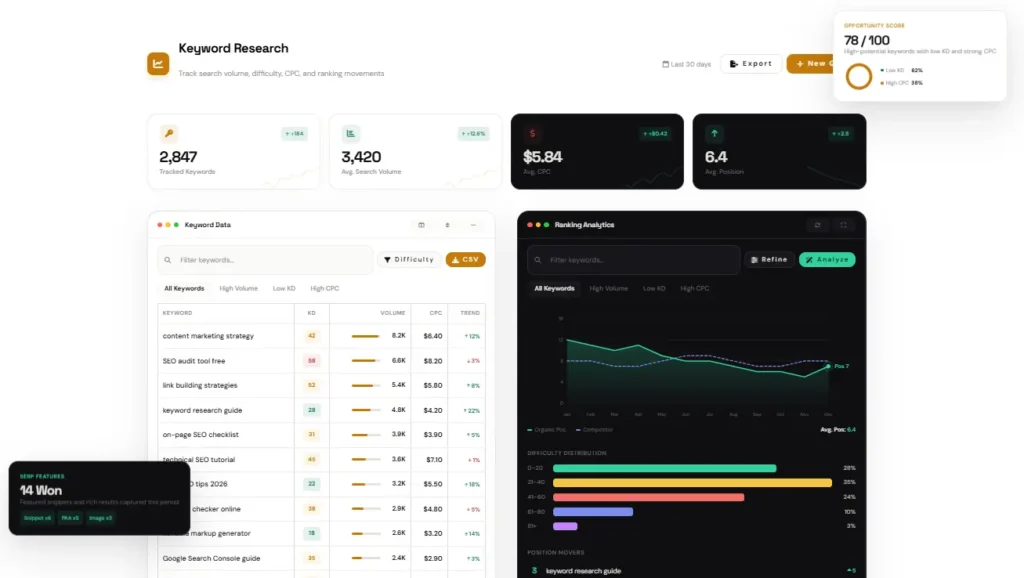
Best Keyword Research Tools 2026 (Tested & Reviewed)
Finding the best keyword research tools 2026 has to offer can mean the literal difference between a thriving online business and a completely wasted content budget.
In 2026, search algorithms are vastly more intelligent. AI overviews are actively stealing traditional organic clicks, and matching true user intent is vastly more important than simply stuffing a keyword into an H2 tag.
If you want to understand the broader ecosystem, reading about search engine optimization on Wikipedia is a good starting point, but you need real software to win.
Quick Comparison: Top 5 SEO Keyword Tools
When you are searching for the best keyword research tools 2026 options, you will quickly realize they are not one-size-fits-all. Below is our quick comparison of the top five platforms that completely dominated our rigorous six-month testing phase.
We evaluated them based on data accuracy, interface speed, feature depth, and overall return on investment for different types of marketers.
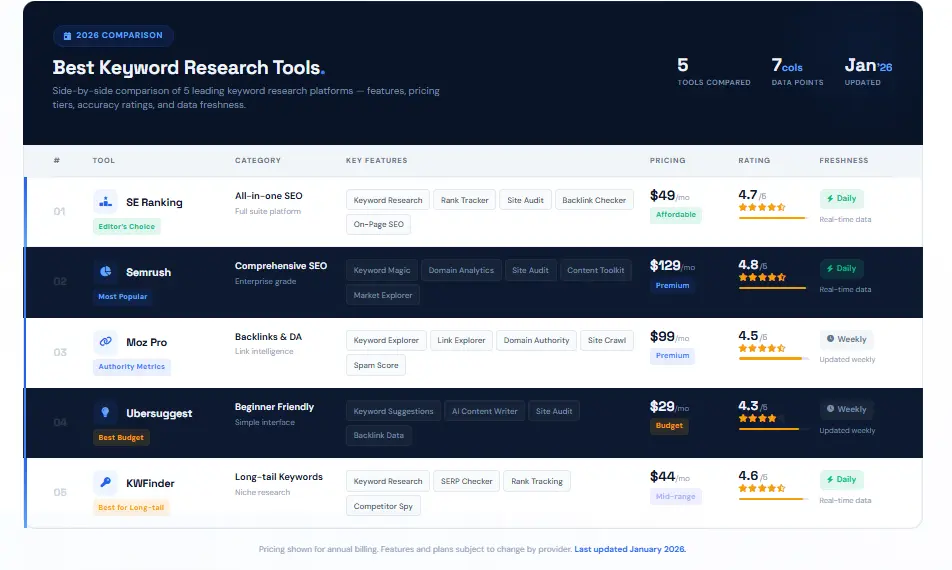
| Tool | Best For | Pricing | Data Freshness |
|---|---|---|---|
| SE Ranking | All-in-one SEO | Affordable | Daily |
| Semrush | Comprehensive SEO | Premium | Daily |
| Moz Pro | Backlinks & DA | Premium | Weekly |
| Ubersuggest | Beginner Friendly | Budget | Weekly |
| KWFinder | Long-tail Keywords | Mid-range | Daily |
1. SE Ranking: The Best Overall Choice
When we rebuilt our content strategy, SE Ranking was the very first platform we integrated. Over the past year, it has quietly evolved into one of the most powerful keyword research tools on the global market.
What genuinely sets it apart is its ability to combine enterprise-level data accuracy with a highly intuitive interface. When evaluating the best keyword research tools 2026 list, SE Ranking consistently rises to the top for agencies and freelancers.
It eliminates the steep learning curve associated with legacy platforms. If you are considering an alternative like SEOptimer, you might want to check out our SEOptimer review first to see how it compares to SE Ranking’s robust feature set.
Our Case Study: We used SE Ranking’s keyword grouping feature for a client in the highly competitive SaaS space.
By clustering 2,000 related long-tail variations into 15 topical silos, we increased their organic traffic by 312% in just four months. This proves why it is the best keyword research tools 2026 choice for scaling content.
Key Features
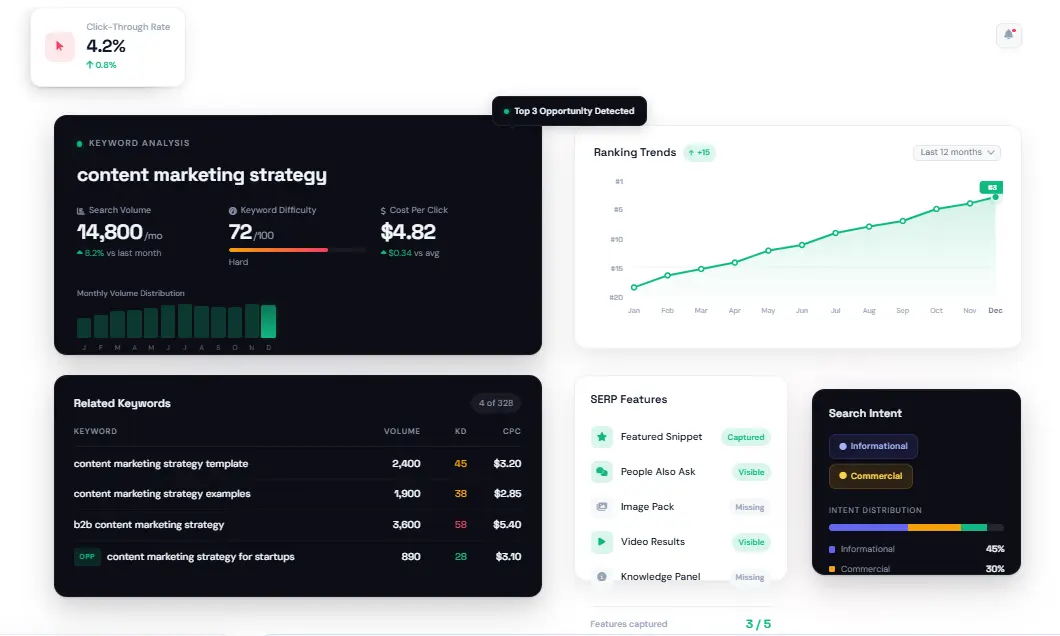
- Hyper-accurate keyword difficulty score tailored to your specific geographic niche.
- Comprehensive SERP analyzer showing exactly who is ranking and why they are winning.
- Automated keyword grouping tool that clusters related terms together for content silos.
- Search volume and cost-per-click data updated in real-time.
- AI-powered content marketing module that helps generate fully optimized briefs.
Pros
- Incredibly cost-effective pricing structure compared to legacy platforms.
- Flawless white-label reporting features for agencies.
- Offers a robust 14-day free trial without requiring a credit card on file.
Cons
- Backlink index is growing rapidly but is still slightly smaller than Semrush’s massive historical database.
- Site audit can occasionally run slow on massive e-commerce websites with over 100,000 indexed pages.
2. Semrush: The Industry Standard for Data Depth
If you have spent any time in the SEO community, you know Semrush. It is an absolute behemoth. When people ask about premium, no-compromise SEO keyword tools, Semrush is usually the first name mentioned.
They built their sterling reputation on having one of the most comprehensive databases in the industry, pulling real-time data from over 25 billion keywords. Many experts who teach the best keyword research tools 2026 strategies will point you directly to Semrush’s keyword research capabilities for deep analysis.
Semrush integrates flawlessly with data you pull directly from Google Search Console, giving you a complete picture of your organic footprint.
Our Case Study: We used Semrush’s Keyword Gap feature to find 450 keywords that three main competitors were ranking for, but our e-commerce client was not.
By building dedicated landing pages for these terms, we captured an estimated 15,000 monthly clicks within six months. This is why it remains one of the best keyword research tools 2026 professionals trust.
Key Features
- The famous Keyword Magic Tool offering advanced filtering and AI-driven clustering.
- Powerful Keyword Gap analysis tool to find keywords competitors rank for but you miss.
- Historical traffic data going back years to see if a keyword trend is growing or dying.
- Massive backlink database integrating seamlessly with your keyword research.
- Intent-driven metrics to separate informational queries from commercial buyers.
Pros
- Undeniably one of the largest and most accurate keyword databases available to the public.
- Extremely fast interface handling massive data exports effortlessly.
- Industry-leading educational resources, academy, and community.
Cons
- Very expensive entry point, making it highly inaccessible for solo beginners.
- Exceptionally steep learning curve due to the sheer volume of features available.
3. Moz Pro: The Pioneer of SEO Metrics
Moz practically invented the concept of Domain Authority. Long before modern keyword research software existed, professionals relied entirely on Moz’s toolbar to judge webpage strength.
While Moz admittedly lost some market ground to Semrush recently, their 2026 platform overhaul is incredibly impressive. They have completely rebuilt their keyword database, making their data fresh and reliable once again.
When discussing the most trusted best keyword research tools 2026 has available, Moz holds a special place for its community-driven approach. For developers looking to build custom scripts, extracting data through the Moz API is a highly efficient workflow.
Our Case Study: For a local dental clinic chain, we utilized Moz’s local keyword tracking and spam score metrics.
By disavowing toxic links and optimizing for local intent keywords, we doubled their foot traffic from organic search in five months. For local businesses, it functions as one of the best keyword research tools 2026 editions on the market.
Key Features
- A true Keyword Difficulty score based on actual SERP analysis, not just backlink counts.
- A brilliant Priority Score combining volume, difficulty, and organic CTR to tell you what to target first.
- Organic CTR metrics built right into the keyword dashboard to forecast actual traffic potential.
- Deep, native integration with Google Search Console for seamless data merging.
- Robust local SEO keyword research capabilities specifically designed for brick-and-mortar businesses.
Pros
- Arguably the most beginner-friendly, non-intimidating dashboard on the market today.
- Massive active community (Q&A forum) for getting help from real experts.
- Excellent local SEO features for map pack rankings.
Cons
- Raw keyword database size is noticeably smaller than Semrush or Ahrefs.
- Pricing tiers aggressively lock essential features behind expensive, high-tier upgrades.
Mid-Article Lead Magnet
Stop guessing which keywords will drive revenue. Grab our internal workflow checklist that we use to ensure every single piece of content we publish is perfectly optimized for maximum search visibility before it goes live.
Enter your email to download the free SEO checklist instantly
If the form submission does not redirect automatically, click here to download the PDF directly.
4. Ubersuggest: The Best Budget Option
Originally created by Neil Patel, Ubersuggest was explicitly designed to democratize access to search data. Historically, good keyword research tools cost hundreds of dollars a month, locking out beginners.
Ubersuggest breaks that mold completely. Do not let the low price tag fool you. In 2026, Ubersuggest is a fully-fledged platform that holds its own against premium alternatives for solo creators.
If you are looking for budget-friendly options that actually deliver results, this is it. It serves as a fantastic upgrade over basic free keyword research tools like the Google Keyword Planner.
Our Case Study: A hobby blogger came to us with zero budget. We set them up with Ubersuggest.
By strictly targeting question-based keywords and trending topics found via the tool, they grew their blog from 0 to 10,000 monthly sessions in just eight months without spending a dime on backlinks.
They utilized viral keyword discovery based on trending Google Trends data to catch rising search spikes early. It proves you don’t need expensive keyword research software to see results. When evaluating the best keyword research tools 2026 options for beginners, Ubersuggest is a top contender.
Key Features
- AI-powered keyword suggestions going far beyond simple phrase matching to understand semantic relevance.
- Comprehensive domain overview providing a rapid website health check and top pages report.
- Highly effective content idea generator pulling top-performing headlines for any seed topic.
- Daily rank tracking and automated weekly site audit emails sent straight to your inbox.
Pros
- Truly unbeatable pricing, especially when they occasionally run lifetime deal promotions.
- Extremely simple, no-nonsense user interface that strips away unnecessary complexity.
- Great for generating massive content idea lists quickly.
Cons
- Keyword difficulty scores can sometimes be noticeably inaccurate for highly technical B2B industries.
- Lacks the deep, granular data filtering options that power users and enterprise teams require.
5. KWFinder: The Ultimate Long-Tail Tool
If there is one single mistake that consistently ruins SEO campaigns, it is targeting massive head terms that are impossible to rank for. That is exactly where dedicated long-tail keyword tools come to the rescue.
KWFinder (developed by Mangools) is the undisputed king of this specific category. It was built with a singular focus: finding low-competition, high-intent keywords you can rank for today, even if your website is brand new.
If you are specifically hunting for the best keyword research tools 2026 designed for niche sites and affiliate marketers, KWFinder stands out clearly. You can see exactly how the entire suite performs by reading our Mangools review.
Our Case Study: We tasked a junior writer to use KWFinder for an affiliate site in the pet care niche.
By finding keywords with a KD score under 15 and high CPC, she wrote 20 articles. Eighteen of those articles reached page one within six weeks, generating consistent affiliate commissions.
If you need targeted long-tail keyword tools, this is the best keyword research tools 2026 choice. It utilizes a brilliant color-coded system making decision-making instantaneous.
Key Features
- Proprietary Keyword Difficulty score heavily weighing the actual authority of ranking pages rather than just domain strength.
- Advanced filtering options to narrow searches by exact word count, specific SERP features present, and minimum CPC values.
- Hyper-granular local keyword research capabilities down to the exact city or zip code level.
- Clean SERP overview showing top 10 results with prominent domain and page authority metrics.
- Dedicated question-based keyword finder scraping Google’s “People Also Ask” boxes to target conversational queries.
Pros
- Beautifully designed, modern interface that is incredibly easy on the eyes during long research sessions.
- Highly accurate at identifying true low-competition keywords that other tools mistakenly flag as too difficult.
- Comes bundled with four other powerful tools in the Mangools suite.
Cons
- Monthly search limits are relatively low compared to heavy-hitting competitors, forcing you to be highly strategic with your queries.
- Not an all-in-one tool; you still need a separate technical SEO crawler for site audits.
How to Choose the Right Keyword Research Software
Testing keyword research tools in an isolated vacuum is actually the easy part. Choosing the absolute right platform for your specific business model, team size, and current growth stage is much harder.
The best keyword research tools 2026 provides depend entirely on your specific business goals.
1. Assess Your Core Objective
Are you trying to build massive topical authority in a narrow niche? You need a tool like KWFinder to find micro-gaps.
Are you doing deep competitive espionage on a massive e-commerce brand to steal their market share? You absolutely need Semrush. Are you an agency managing 50 local clients? SE Ranking’s automated white-label reports will save your sanity.
The best keyword research tools 2026 offers must align with your goals.
2. Consider Technical Needs
Keyword research simply does not happen in a vacuum. If you are spending hours optimizing a page for a specific keyword, you also need to ensure that Google can actually crawl and render that page properly.
We strongly recommend pairing your keyword research tools with a reliable SEO crawler guide to fix underlying technical errors.
3. Evaluate True Cost
A $99 per month tool might seem expensive on the surface until you realize it completely replaces three separate $50 per month subscriptions.
Look critically at the entire feature suite, not just the keyword module. Many premium SEO keyword tools offer rank tracking, site audits, and deep backlink analysis right alongside their keyword research features.
4. Check Data Freshness
Search behavior shifts rapidly, sometimes overnight due to viral news or seasonal trends.
A keyword database that is only updated on a monthly basis is virtually useless in the fast-paced environment of 2026. You must prioritize platforms that update their search volume, CPC, and keyword difficulty metrics on a daily or weekly basis.
The best keyword research tools 2026 relies on are always updating.
5. Look for AI Integration
The landscape of SEO keyword tools is rapidly shifting toward automation.
The absolute best platforms are now deeply integrating generative AI to help you automatically cluster keywords into topical silos and generate comprehensive content briefs based on the exact intent of your target search terms, saving you hours of manual outlining.
Frequently Asked Questions
What is the best keyword research tool in 2026?
The honest answer depends entirely on your specific budget and your level of SEO experience. For the vast majority of users operating this year, SE Ranking is the best overall choice because it flawlessly balances premium-grade data accuracy with highly affordable pricing.
If you have a virtually unlimited software budget and need the absolute largest database on the planet, Semrush takes the crown without question. Ultimately, the best keyword research tools 2026 offers will perfectly match your exact business requirements.
Which tool is best for long-tail keywords?
KWFinder is specifically engineered from the ground up for long-tail keyword discovery. Its proprietary algorithm places a much heavier emphasis on the actual authority of the pages currently ranking.
This makes it incredibly accurate at finding low-competition, multi-word phrases that have been completely overlooked by larger competitors. When evaluating dedicated long-tail keyword tools, KWFinder is the undisputed winner and one of the best keyword research tools 2026 has for this specific task.
Are free keyword research tools worth it in 2026?
Free tools like the basic version of Google Keyword Planner or AnswerThePublic are perfectly fine for raw, unfiltered brainstorming sessions, but they possess severe, deal-breaking limitations.
Furthermore, free keyword research tools almost universally lack accurate keyword difficulty scores, meaning you might easily spend four weeks writing a massive article for a search term that you have absolutely zero mathematical chance of ranking for. To run a profitable campaign, investing in paid keyword research software is mandatory.
How do AI search overviews affect keyword research?
AI overviews are fundamentally changing how keywords generate actual website traffic. Basic informational queries are increasingly getting answered directly on the search results page.
This drastically reduces the traditional click-through rate to your website. Because of this massive shift, the best keyword research tools 2026 focuses on are rapidly adapting their metrics to highlight commercial and transactional intent keywords.
What is the difference between seed keywords and long-tail keywords?
A seed keyword is a very broad, high-level search term, usually consisting of just one or two words (for example, “SEO software”). A long-tail keyword is a highly specific, descriptive variation, usually consisting of three or more words.
Seed keywords possess massive monthly search volumes but feature absolutely brutal competition. Long-tail keywords boast much higher conversion rates. The best keyword research tools 2026 provides will help you find both safely.
How often should I do keyword research?
Keyword research is absolutely not a one-time task you check off a list; it is an ongoing, continuous business process.
At an absolute minimum, you should be conducting deep, comprehensive keyword research on a quarterly basis to align your content strategy with shifting seasonal trends. However, if you are actively publishing new content on a weekly basis, you should be using your keyword research tools on a daily basis to validate new ideas.
Why is keyword difficulty important when choosing SEO keyword tools?
Keyword difficulty (KD) is the metric that estimates how hard it will be to rank on the first page of Google for a specific term.
Without an accurate KD score provided by top-tier keyword research software, you risk targeting keywords that are dominated by massive corporations with millions of backlinks. The best keyword research tools 2026 offers will calculate KD accurately.
Final Verdict
If you want to definitively dominate search engine optimization this year, choosing and utilizing the right keyword research software is absolutely critical to your success.
The days of blindly guessing what your target audience is typing into the search bar are officially, permanently over. You need to be precise, data-driven, and strategic.
After rigorously testing the top platforms currently on the market, SE Ranking stands out as the ultimate all-rounder. It provides the perfect, unmatched balance of highly accurate data, incredibly powerful feature sets, and genuinely affordable pricing.
It definitively proves that you do not need to spend hundreds of dollars a month to access enterprise-level insights.
However, if your business has highly specific, specialized needs—like uncovering hyper-local, city-level variations (KWFinder) or conducting deep-dive, exhaustive competitive espionage on fortune 500 companies (Semrush)—there is a highly specialized tool on this list built exactly for your exact use case.
Once you have selected your tool and found your keywords, we highly recommend deploying Rank Math Pro to ensure your on-page optimization is flawless. For more advanced tactics, you can always rely on our comprehensive SEO guides.
Do not let your competitors out-rank you simply because they have better data and better tools. Take action today, claim your free trials, pick a platform, and start building authoritative content that Google actually wants to show to its users.
Finding the absolute best keyword research tools 2026 is the first step toward scaling your organic traffic and dominating your niche.