
SEO Guides to Learn and Master Search Engine Optimization
Search engine optimization is one of the most valuable digital skills for website owners, marketers, bloggers, affiliate publishers, and growing businesses. When people search on Google, they are looking for answers, products, services, and trusted information. SEO helps your pages appear in those search results so the right audience can discover your content at the right time.
The challenge is that SEO can feel scattered when you try to learn it from random blog posts, videos, or disconnected tips. One article may talk about keywords, another may focus on site speed, and another may mention backlinks without explaining how all these pieces fit together. That is why structured SEO guides matter so much. They turn a complex topic into a practical learning path.
This hub was built to organize the most important areas of search optimization into a clear, beginner-friendly framework. Instead of jumping from tactic to tactic, you can use these SEO guides to move from fundamentals to implementation. You will learn how search engines discover pages, how keyword research shapes content planning, how on-page optimization improves clarity, how technical SEO supports visibility, and how authority building drives long-term growth.
Seoraf is designed to make learning easier with connected tutorials, tools, and free resources. As you explore this page, you will find step-by-step routes into foundational topics, advanced strategy areas, practical checklists, and recommended platforms that support real execution. These SEO guides are not only meant to teach concepts. They are meant to help you apply them in a logical order so your website can grow with a stronger structure, better content, and smarter decisions.
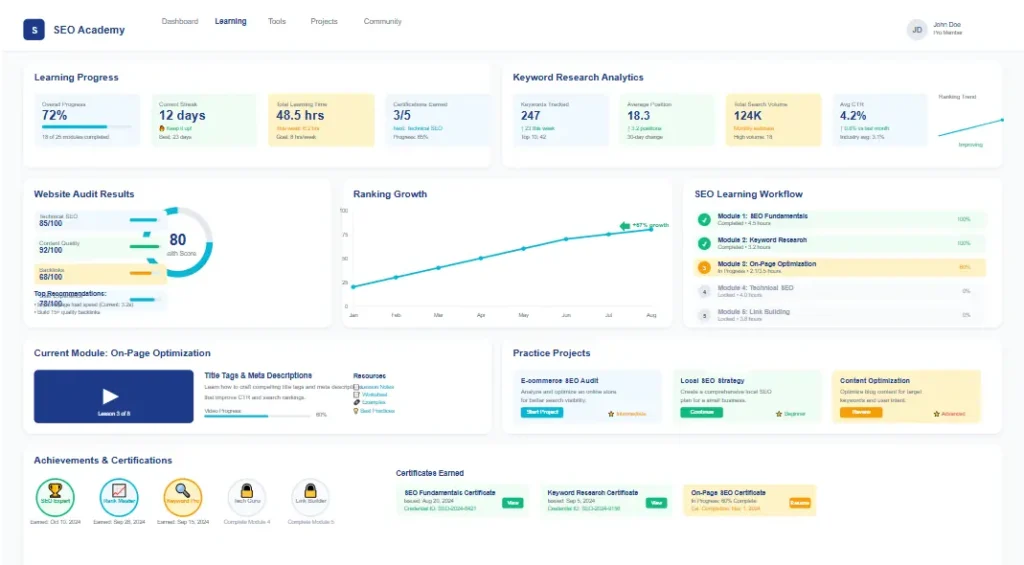
Start with the Fundamentals of SEO
Before you dive into advanced strategies, it is important to understand the foundation of how search works. Strong SEO guides always begin here because every optimization decision becomes easier when you understand what search engines are trying to do. Their goal is simple: deliver the most useful and relevant result for each search query. Your job is to make your pages clear, valuable, accessible, and trustworthy.
Search engines use automated bots, often called crawlers or spiders, to discover pages across the web. These bots move from link to link, scanning page content and collecting information. When a page is found and processed, search engines may store it in their index. The index is like a huge library of web pages. If a page is not properly discovered or indexed, it has little chance of ranking well because search engines cannot evaluate it effectively.
Ranking happens after indexing. When someone types a query into Google, the algorithm compares many possible pages and chooses the results it believes best match that intent. Ranking signals include page relevance, content depth, internal linking, backlink authority, usability, page speed, mobile experience, and search intent alignment. Not every page needs to be perfect in every area, but the strongest pages usually combine relevance, clarity, and trust.
For beginners, the best path is to learn the language of SEO first. Terms like crawlability, indexing, ranking, SERP, search intent, title tag, anchor text, schema, and internal links appear in many tutorials. Once those concepts become familiar, the rest of SEO feels much more manageable. This is why a beginner SEO guide is one of the most helpful starting points.
Another key lesson in foundational SEO guides is understanding that rankings do not come from one trick. SEO works best when content, structure, and technical quality support each other. A page can have great writing and still struggle if its title is weak, its internal links are poor, or search engines have trouble crawling it. Learning the fundamentals helps you see SEO as a system, not just a checklist.
To build that system from the beginning, start with the basics and then connect them to a bigger plan. The SEO strategy guide helps bridge the gap between learning concepts and turning them into a repeatable framework for content growth, site organization, and ranking improvement.
What beginners should learn first
- How search engines crawl and index pages
- Why search intent matters in rankings
- How content structure affects visibility
- Why internal links support discovery and authority
Best first steps
- Read a complete beginner SEO guide
- Learn the difference between pages and keywords
- Understand ranking factors at a simple level
- Create one clear content plan before publishing more
Keyword Research Guides
Keyword research is where most SEO planning begins. It helps you understand what your audience is searching for, how often those searches happen, and what kind of content users expect to find. Good SEO guides explain keyword research as more than finding phrases with search volume. It is really about understanding demand, intent, and content opportunities.
When you choose the right keywords, your content strategy becomes more focused. Instead of publishing broad articles with weak direction, you create pages that align with actual search behavior. A strong keyword research guide teaches you how to evaluate relevance, competition, and business value at the same time. The goal is not to rank for every term. The goal is to rank for the right ones.
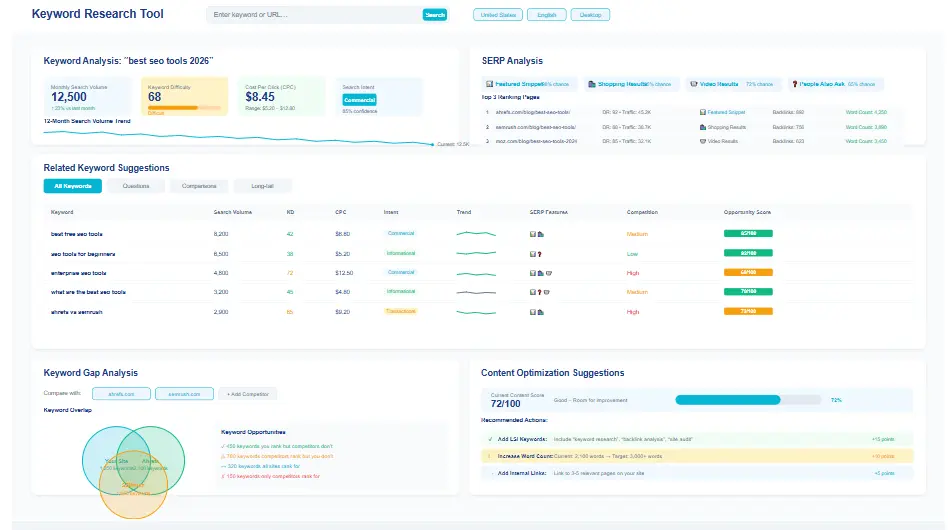
Search intent is especially important. Some keywords show informational intent, where users want to learn something. Others show commercial or transactional intent, where users are comparing options or ready to take action. If you match the wrong content type to the query, rankings and engagement often suffer. This is why intent analysis belongs inside modern SEO tutorials, not as an optional extra.
Long-tail keywords are also useful, especially for newer websites. These are more specific search phrases with clearer intent and often lower competition. They may bring less traffic individually, but they can attract higher-quality visitors and build topical depth over time. Many successful content strategies begin by targeting long-tail phrases before expanding into broader, more competitive topics.
Keyword research also supports content planning. Once you identify a central topic, you can group related searches into supporting articles, subtopics, FAQs, and tool pages. This creates a content cluster that strengthens topical relevance. The more clearly your pages work together, the easier it becomes for search engines to understand your site structure and expertise.
To go deeper into this area, explore the keyword research guide and use the keyword intent tool to classify searches more effectively.
- Learn how to discover keyword opportunities from topics and seed terms
- Understand search intent before creating a page
- Use long-tail keywords to find easier ranking opportunities
- Group related terms into content clusters and category structures
- Build a keyword map that connects pages to clear search goals
On-Page SEO Guides
On-page optimization helps search engines and users understand exactly what a page is about. It covers the visible and structural elements of a page, including titles, headings, URL logic, internal links, content layout, image alt text, and topical relevance. Practical SEO guides often focus on on-page work because it is one of the fastest areas to improve without waiting for external signals.
Title tags remain one of the most important on-page elements. They influence how search engines understand the core topic of a page and also affect click-through rate from the results page. A good title should be clear, useful, and aligned with the main intent of the keyword. It should not feel stuffed or repetitive. Strong titles help both ranking and clicks.
Meta descriptions do not directly control rankings in the same way titles do, but they still matter for user behavior. They help searchers understand what the page offers before clicking. If your meta description is vague, flat, or disconnected from user intent, you may lose clicks even when you rank. Well-written on-page SEO guides show how to write descriptions that are informative and action-driven without feeling forced.
Headings create structure. They break long content into readable sections and help search engines identify key themes across the page. A useful heading system improves scan-ability, which matters for both users and AI-generated summaries. Readers should be able to skim your headings and quickly understand the flow of the content.
Internal linking is another major on-page factor. It helps distribute authority, guide users to related information, and reveal the relationship between pages. If you publish strong content but leave it isolated, you reduce its ability to support your wider site. A thoughtful on page SEO guide teaches where to place links naturally, how to write helpful anchor text, and how to connect primary pages with supporting resources.
Content optimization also matters. This does not mean stuffing keywords into every paragraph. It means covering the topic clearly, answering likely questions, using related terms naturally, and making the page genuinely useful. Helpful content performs better than thin content because it gives search engines more signals about relevance and gives users more reasons to stay engaged.
For deeper implementation, review the content SEO guide and test page-level elements with the title meta analyzer.
Technical SEO Guides
Technical SEO supports the foundation of visibility. It helps search engines access, understand, and process your site efficiently. Even excellent content can struggle if technical barriers prevent search engines from crawling key pages or if the site experience is poor. That is why technical SEO guides are essential for any serious learning hub.
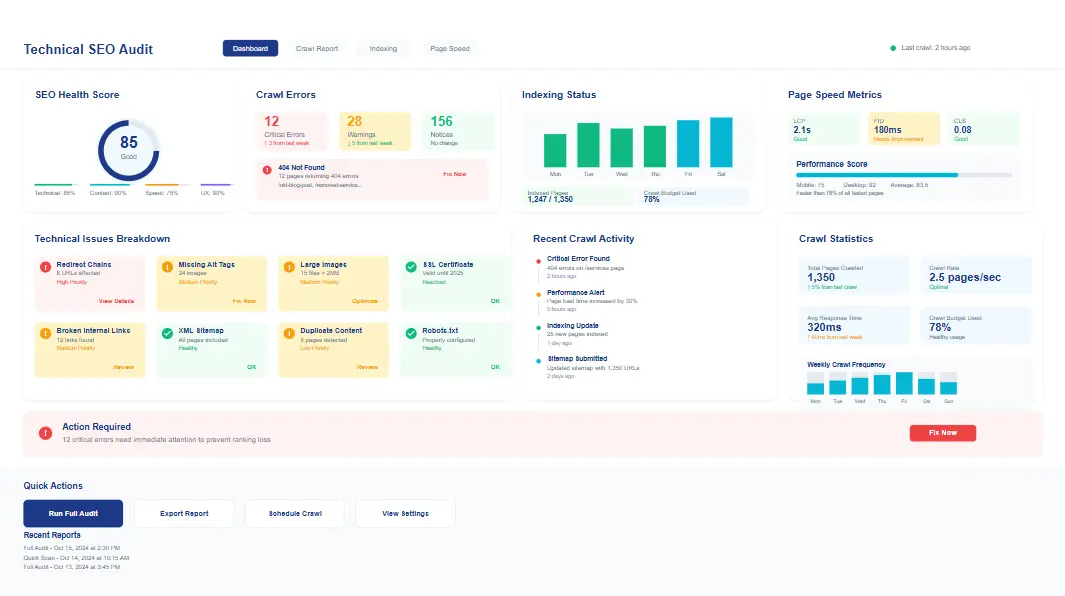
One of the most common technical issues is crawl inefficiency. If your site architecture is confusing, your internal links are weak, or important pages are buried too deep, search engines may not prioritize them effectively. A well-structured website makes it easy for both bots and users to move from category pages to supporting content and tools.
Indexing is another critical area. Not every page should be indexed, but the pages you want to rank need to be discoverable, valuable, and technically accessible. Technical SEO guides help you understand why duplicate content, thin pages, accidental noindex settings, redirect chains, and poor canonical use can create visibility problems.
Site speed and performance also matter. Users expect pages to load quickly on both desktop and mobile devices. When your site feels slow or unstable, engagement often drops. Search engines pay attention to experience signals, so performance improvements support both usability and rankings. This does not mean every site needs to be perfectly optimized at a developer level, but obvious performance issues should be addressed early.
Schema markup adds extra context to your content. It helps search engines better interpret page types, organization details, products, FAQs, and more. While schema alone does not guarantee rich results, it strengthens understanding and can improve how pages appear in search. Technical SEO tutorials often introduce schema as a helpful enhancement after the basics are in place.
For accurate technical guidance, it is smart to learn from trusted sources as well. The official Google Search documentation is a strong authority reference for understanding crawling, indexing, structured data, and search best practices. You can also explore Seoraf’s technical SEO guide and review your site with the SEO audit tool.
- Improve crawlability through better navigation and internal links
- Fix indexing issues that block important pages from visibility
- Optimize speed, responsiveness, and mobile usability
- Use schema markup to add context to pages
- Build a logical architecture that supports both users and bots
Local SEO Guides
Local SEO focuses on helping businesses appear in location-based search results and map listings. It is especially important for service providers, clinics, agencies, restaurants, stores, and any business that depends on customers from a geographic area. Good SEO guides explain that local search is not only about website pages. It also depends on business listings, reviews, consistency, and relevance to place-based queries.
Google evaluates local relevance, prominence, and proximity. That means your business needs accurate information, a well-optimized profile, and signals that show trust. A weak or incomplete profile can reduce local visibility even when your website content is strong. On the other hand, a well-managed profile paired with useful local landing pages can create a powerful search presence.
Reviews also influence local trust. They shape user decisions and may reinforce the credibility of your brand. Local SEO guides often include advice about requesting reviews ethically, responding professionally, and keeping business details consistent across the web. Citation consistency matters because search engines want confidence that your business information is reliable.
Localized content can further strengthen visibility. This may include service pages for cities, location-focused FAQs, locally relevant blog posts, or case studies tied to a region. The best local pages are not thin copies with place names swapped in. They contain real local context and serve genuine user needs.
To learn this area in more detail, review the local SEO guide and explore Google Business Profile for listing management and verification best practices.
Advanced SEO Strategy Guides
Once you understand the basics, advanced SEO guides help you scale beyond individual pages and think in systems. Modern search works increasingly well at understanding topics, entities, and relationships. That means websites with organized content ecosystems often outperform sites that publish disconnected articles without a plan.
Topical authority is one of the most important advanced concepts. It means building enough useful coverage around a subject that search engines can see your site as a meaningful resource in that area. You do not build topical authority by repeating the same keyword across many pages. You build it by covering related user questions, supporting topics, and deeper layers of intent in a structured way.
Content clusters are a practical way to do this. A pillar page covers a broad subject, and supporting pages address subtopics in more detail. Internal links connect them logically. This model improves topical clarity and helps users move through the learning journey more naturally. In a strong SEO strategy guide, content clusters are not just a publishing model. They are part of site architecture and authority building.
Semantic SEO takes this further by focusing on meaning and context. Instead of optimizing only for one exact phrase, you create content that addresses the broader topic, related concepts, and real questions users ask. Entity optimization also supports this by helping search engines understand the people, places, products, tools, and concepts connected to your subject.
At this stage, tools become even more useful because you need better insight into rankings, content gaps, competitor pages, and technical performance. That is why advanced learners often benefit from comparing platforms on the best SEO tools page and using those platforms to support strategy decisions.
Free SEO Learning Resources
Not every lesson should stay theoretical. The best SEO learning resources help you apply what you study in a real workflow. That is where templates, checklists, and repeatable systems become valuable. They save time, reduce confusion, and make it easier to turn knowledge into action.
For example, a keyword template can help you organize primary terms, secondary phrases, intent, page type, and internal linking targets before you write. A technical checklist can help you review indexing, titles, headings, canonicals, speed, and schema before publishing or auditing a page. A content workflow can guide you from topic selection to optimization and performance tracking.
These kinds of resources are useful for beginners because they simplify execution, and they are useful for professionals because they create consistency. Teams, freelancers, and site owners often need repeatable frameworks more than more theory. That is why Seoraf includes connected resource hubs alongside educational SEO guides.
Explore the main free resources section for downloadable workflows and planning materials, and browse the SEO templates collection for reusable frameworks you can adapt to your own site.
- SEO checklists for faster page reviews
- Templates for keyword planning and content briefs
- Workflows that support publishing consistency
- Simple systems that reduce missed optimization steps
Recommended SEO Tools for Learning SEO
SEO becomes easier to understand when you can measure what is happening. Tools help bridge the gap between theory and execution by showing real search data, technical errors, ranking movement, and content opportunities. Many SEO guides recommend tools not because software replaces strategy, but because it gives you visibility into the parts of SEO you cannot see clearly on your own.
Keyword research tools help you discover search demand, related phrases, intent signals, and ranking opportunities. Audit tools surface technical issues such as missing metadata, broken pages, indexing problems, and site structure concerns. Rank tracking tools show whether your changes are leading to visibility gains or losses over time.
Content optimization tools can also help you improve clarity, coverage, and relevance. They are most useful when paired with strong judgment. A tool can support decisions, but it should not replace audience understanding or helpful writing. The best use of SEO software is to make smart work easier, not to automate thinking away.
If you are building your tool stack or comparing options for learning and growth, the Best SEO Tools page is a useful next step. It can help you evaluate the categories that matter most for your site, whether that is keyword research, rank tracking, site audits, or content workflows.
Step-by-Step SEO Learning Roadmap
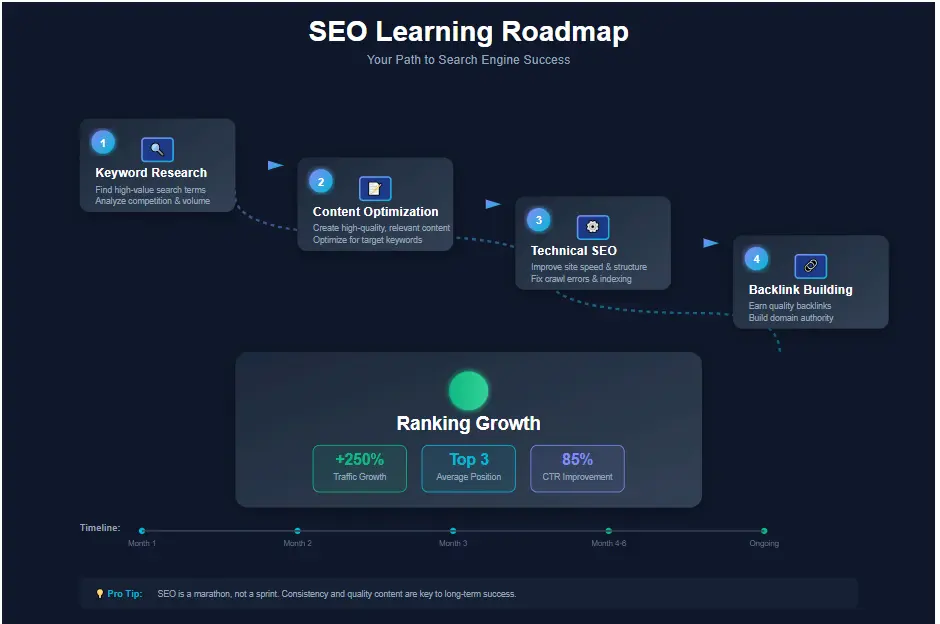
A structured roadmap makes SEO far less overwhelming. Instead of trying to master everything at once, focus on a clear sequence. Each step should support the next. That is how good SEO guides are meant to be used.
- Learn SEO basics. Understand crawling, indexing, ranking signals, and search intent. Build vocabulary first so the rest of the learning process feels easier.
- Research keywords. Find out what your audience is actually searching for, group those phrases by intent, and connect them to page types.
- Optimize content. Improve titles, headings, internal links, page structure, and content clarity so users and search engines understand each page quickly.
- Improve technical SEO. Review crawlability, indexing, speed, architecture, and schema so your content can be processed correctly.
- Build authority. Publish connected content, strengthen topical depth, earn links where possible, and create a better internal linking network.
- Track rankings and refine. Measure what improves, identify weak pages, refresh outdated content, and continue optimizing based on data.
If you follow this sequence consistently, your site develops in a stable way. Instead of chasing random tactics, you improve the structure, usefulness, and authority of your website over time.
Frequently Asked Questions
What are SEO guides?
SEO guides are structured learning resources that explain how search engine optimization works. They usually cover keyword research, on-page SEO, technical SEO, local SEO, and content strategy in a step-by-step way.
Are SEO guides useful for beginners?
Yes. A well-structured beginner SEO guide helps simplify important concepts such as crawling, indexing, search intent, and page optimization so new website owners can learn SEO in a logical order.
How long does it take to learn SEO?
You can understand the basics in a few weeks, but mastering SEO takes longer because rankings, competition, and search behavior change over time. Ongoing practice is important.
Do I need SEO tools to learn SEO?
You can learn the basics without tools, but SEO tools make learning more practical by helping you research keywords, analyze websites, find issues, and track rankings.
Where should I start if I want better rankings?
Start with SEO fundamentals, then move into keyword research, on-page SEO, and technical improvements. After that, build authority with better content and internal linking.
Explore the Best SEO Tools for Faster Growth
Use trusted tools to research keywords, audit pages, improve content, and build a stronger SEO workflow around the guides and resources inside Seoraf.
Explore Best SEO Tools