
Title & Meta Analyzer: Improve CTR, Relevance, and On-Page SEO Faster
A strong title tag and a better meta description can completely change how your page performs in search. Even when rankings stay similar, better SERP copy can improve click-through rate, attract more qualified visitors, and make your page feel more relevant to both Google and real users.
This updated premium Title & Meta Analyzer page is built as the SEO content landing page. The real working tool should live on a separate URL so this page can rank, educate, and convert while the actual analyzer stays faster and cleaner.
A Title & Meta Analyzer is a tool that helps you review the quality, clarity, keyword placement, and click potential of a page title and meta description. A strong analyzer helps you spot weak wording, low-CTR messaging, poor intent match, duplication risk, and on-page snippet problems so you can improve search visibility more effectively.
Want the working version? Open the real Title & Meta Analyzer tool to test your title tag and meta description instantly.
What a Title & Meta Analyzer Actually Does
A Title & Meta Analyzer helps you evaluate one of the most visible parts of your page: the title tag and the meta description. These two elements influence how your result appears in Google Search and how likely someone is to click it. They also help search engines understand the focus of the page more clearly.
A useful Title & Meta Analyzer should do more than count characters. It should help you decide whether the title is clear, whether the main keyword appears naturally, whether the description supports the search intent, and whether the page is likely to earn more attention in a crowded SERP.
This is why the tool is useful for both new pages and older pages. For new pages, it helps you launch with stronger SERP copy. For older pages, it helps you improve weak snippets without rewriting the full article.
Simple idea: better title tags and better meta descriptions do not guarantee rankings, but they can improve relevance, click-through rate, and traffic quality.
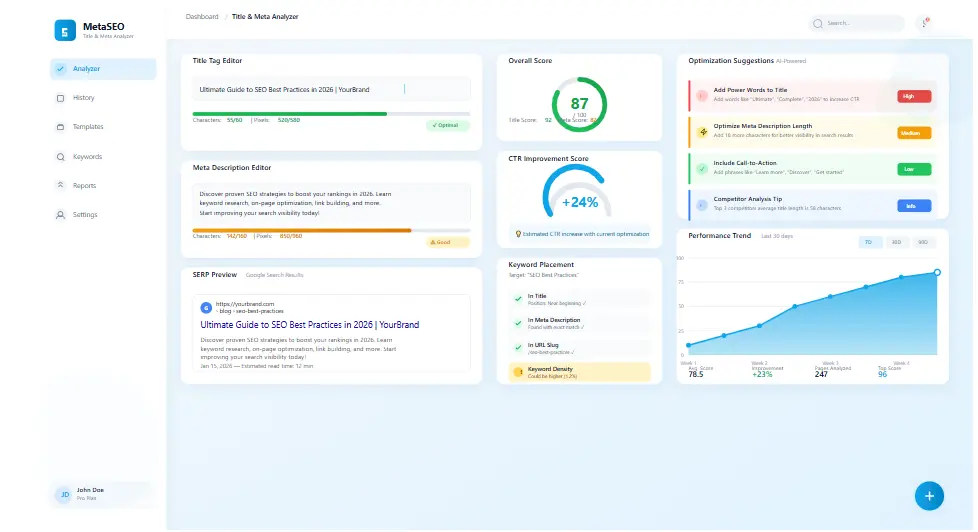
Title & Meta Analyzer dashboard showing title length, keyword placement, CTR signals, and meta description review.
Why Title Tags and Meta Descriptions Matter So Much
Your title tag is often the first thing a searcher notices in Google Search. It tells both the user and the search engine what the page is about. If the title is weak, vague, or badly aligned with intent, the page can look less useful than competing results.
Your meta description works like supporting copy. It gives the user a faster reason to click by explaining what the page covers and what benefit they may get from visiting. Even when Google rewrites some descriptions, writing better meta copy still helps because it improves message clarity and intent alignment.
A strong Title & Meta Analyzer is helpful because even a well-written page can underperform if the snippet copy is weak. In many cases, updating just the title tag and meta description leads to better CTR without changing the full content.
A stronger title makes the page topic clearer for search engines and easier for users to understand.
A better meta description makes the result feel more useful, more specific, and more worth visiting.
Well-written SERP copy makes the page look more polished and more aligned with user intent.
Refreshing titles and meta descriptions can lift underperforming pages without a full content rebuild.
How to Use a Title & Meta Analyzer the Right Way
The best way to use a Title & Meta Analyzer is not to chase a perfect score. It is to improve clarity, intent match, and click potential. That means reviewing structure and message quality, not just character counts.
Step-by-Step Workflow
- Open the real tool and paste your current title tag and meta description.
- Check whether the main topic appears naturally in the title.
- Review title length so it is clear without feeling bloated or cut off.
- Check whether the meta description explains the value of the page.
- Make sure the wording matches search intent and page type.
- Compare your message to what currently ranks in the SERP.
- Rewrite weak wording and test a clearer version.
You should also think about the purpose of the page. A tutorial page needs different wording than a comparison page. A service page needs different messaging than an affiliate review. A Title & Meta Analyzer works best when it is used with clear content strategy, not by itself.
Best use case: analyze your most important pages first, especially pages that already get impressions but low clicks.
Ready to test your snippet now? Open the real Title & Meta Analyzer tool and review your title tag and meta description live.
Title Tag Best Practices That Support Rankings and CTR
A strong title should be specific, readable, and clearly aligned with the topic. Many pages underperform because the title is too generic, too broad, or too flat. A better title usually improves both clarity and click appeal.
Put the Main Topic Near the Front
When the main topic appears earlier in the title, the page is easier to understand quickly. This does not mean forcing a keyword awkwardly. It means making the page topic obvious.
Keep It Clear, Not Clever
Overly clever titles often weaken clarity. Searchers usually respond better when the title promises something specific and easy to understand.
Match the Search Intent
If the keyword suggests a guide, the title should sound like a guide. If the keyword suggests a comparison, the title should sound like a comparison. A good analyzer helps you notice when your title format does not match the intent.
Avoid Wasteful Filler
Words that do not improve meaning or click appeal often make titles weaker. Every word should earn its place.
Common title problem: stuffing too many keyword variations into one title usually makes it less readable and less trustworthy.
If you want better keyword targeting before writing titles, read the Keyword Research Guide.
Meta Description Best Practices for Better Click-Through Rate
A meta description should support the title, not repeat it badly. Good meta copy explains what the page covers, who it helps, and why the result is worth clicking. It should feel useful, not robotic.
Explain the Benefit Clearly
The best meta descriptions tell the user what they will get from the page. This may be a guide, a comparison, a checklist, a tutorial, or a practical answer.
Match the Tone to the Page Type
A service page description should sound more action-focused. A guide page description should sound more educational. A comparison page description should help the user evaluate options.
Write for Clicks, Not Just Characters
Character limits matter, but usefulness matters more. A strong description is persuasive because it feels relevant and clear, not because it fits a number perfectly.
Good meta formula: explain the topic, mention the value, and make the user feel that the page can solve a real need.
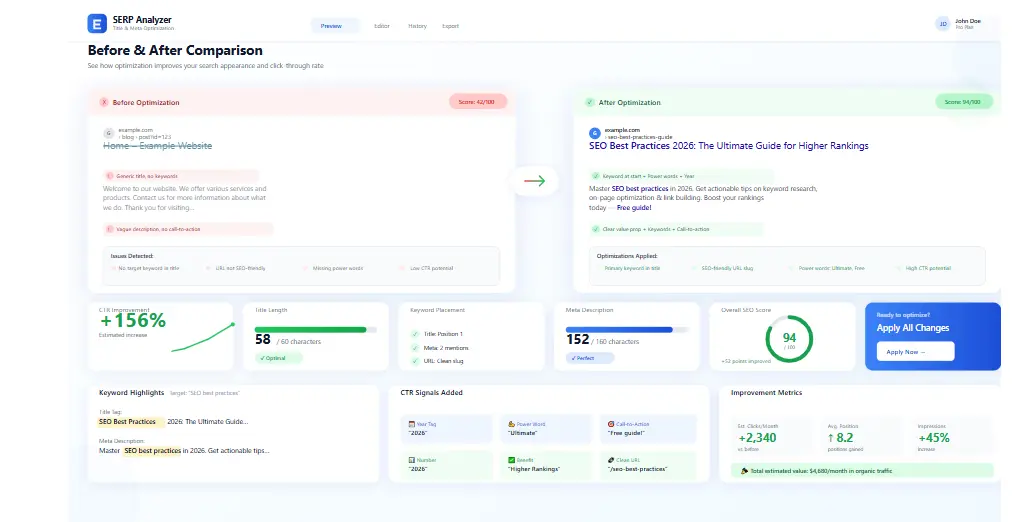
Title & Meta Analyzer SERP preview showing how stronger titles and meta descriptions can improve relevance and click-through rate.
Common Title and Meta Mistakes This Tool Helps You Catch
Many websites repeat the same SERP snippet problems again and again. A strong Title & Meta Analyzer helps you spot those issues faster.
1. Titles That Are Too Generic
Generic titles do not stand out and often fail to communicate why the page is worth clicking.
2. Meta Descriptions That Say Almost Nothing
A vague description wastes a major chance to improve click quality and search result appeal.
3. Keyword Placement That Feels Forced
If the title or meta sounds unnatural, searchers may trust it less even if the keyword is technically present.
4. Intent Mismatch
A guide-like query with a sales-style title, or a comparison query with a flat informational title, often performs poorly.
5. Duplicate Messaging Across Multiple Pages
If several pages use nearly the same title and meta style, differentiation becomes weaker and users have less reason to choose one result over another.
Reality check: better title and meta copy cannot rescue a weak page forever, but it can reveal whether the page is underperforming because of SERP messaging instead of content quality.
When You Should Rewrite a Title Tag or Meta Description
You do not need to rewrite every page all the time. But there are clear situations where a refresh makes sense.
If a page gets impressions but low clicks, the title and meta may need stronger messaging.
If the SERP now favors a different angle, your old title may no longer fit what users expect.
When you improve a page substantially, the title and meta should reflect the updated value more clearly.
If the content focus changed, the old SERP copy may no longer match the real goal of the page.
If your overall page strategy also needs work, revisit Content SEO Guide and Technical SEO Guide after this page.
Use the Real Tool, Then Improve the Supporting SEO Signals
The best workflow is simple: use the real Title & Meta Analyzer first, improve your snippet copy, then strengthen the surrounding SEO signals such as keyword targeting, page structure, internal links, and intent match.
Recommended workflow: tool first, snippet improvements second, wider on-page SEO review third.
Fast Optimization Flow
- Open the real Title & Meta Analyzer.
- Review your title tag and meta description.
- Rewrite weak wording and improve intent match.
- Check your page with the SEO Audit Tool.
- Strengthen internal links and content structure.
Helpful Internal Resources
This Title & Meta Analyzer works best when it sits inside a wider SEO system. These related pages can help you turn snippet improvements into stronger overall performance.
Helpful External Resources
These resources help you understand how Google handles title links, snippets, and search result appearance more clearly.
Title & Meta Analyzer FAQs
Should the real tool live on a separate page?
Yes. The best setup is to keep the real working tool on a separate URL like this real Title & Meta Analyzer page and use the SEO landing page to explain the tool and support rankings.
What is the main purpose of a Title & Meta Analyzer?
Its main purpose is to review title tags and meta descriptions so you can improve clarity, relevance, and click-through rate.
Can better titles and meta descriptions improve rankings?
They can improve relevance and CTR, which may support stronger performance, but they do not guarantee higher rankings by themselves.
Should every page have a unique title and meta description?
Yes. Unique SERP copy helps each page communicate its own purpose and reduces duplication problems.
Should I rewrite old pages with low CTR?
Yes, especially when the page already gets impressions but low clicks. That often signals weak title or meta messaging.
Ready to Use the Real Title & Meta Analyzer?
Open the working tool, test your current title tag and meta description, then improve your SERP copy with stronger intent match, clearer benefits, and better click-through rate signals.