
Keyword Intent Tool: Match Keywords to What Searchers Actually Want
Choosing the right keyword is only half the job. The other half is understanding what the searcher expects to see when they type that keyword into Google. A Keyword Intent Tool helps you go beyond search volume and look at the real purpose behind a query, so you can create pages that align with user expectations instead of publishing content that misses the mark.
This premium content page explains how a Keyword Intent Tool works, why search intent matters, how to use intent in keyword selection, and how to avoid the most common mistakes. It is built for bloggers, affiliate marketers, local businesses, SEO professionals, and anyone who wants stronger rankings through better content alignment.
A Keyword Intent Tool helps you identify the likely search intent behind a keyword. Instead of focusing only on volume or difficulty, it helps you understand whether the user wants information, comparisons, a specific website, or an action like buying or booking. A good Keyword Intent Tool helps you choose the right page type, improve content relevance, and avoid targeting the wrong query with the wrong format.
What a Keyword Intent Tool Actually Does
A Keyword Intent Tool helps you classify a keyword based on what the user is most likely trying to do. That sounds simple, but it can change your entire content strategy. A query that looks promising on the surface may actually need a blog post, a review page, a category page, or a service page depending on the user’s real goal.
A strong Keyword Intent Tool should help you move from raw keyword lists to smarter decisions. Instead of saying “this keyword has volume,” it helps you ask better questions: Does the user want a guide or a product? Are they researching or ready to take action? Should I create a pillar page, a supporting post, a comparison article, or a money page?
This is why keyword intent matters so much for SEO. A page can be well written and still fail because the format is wrong for the search. A Keyword Intent Tool helps reduce that mismatch by pointing you toward the right type of content before you spend time creating it.
Simple idea: a keyword is only useful when you know what the searcher expects to find behind it.
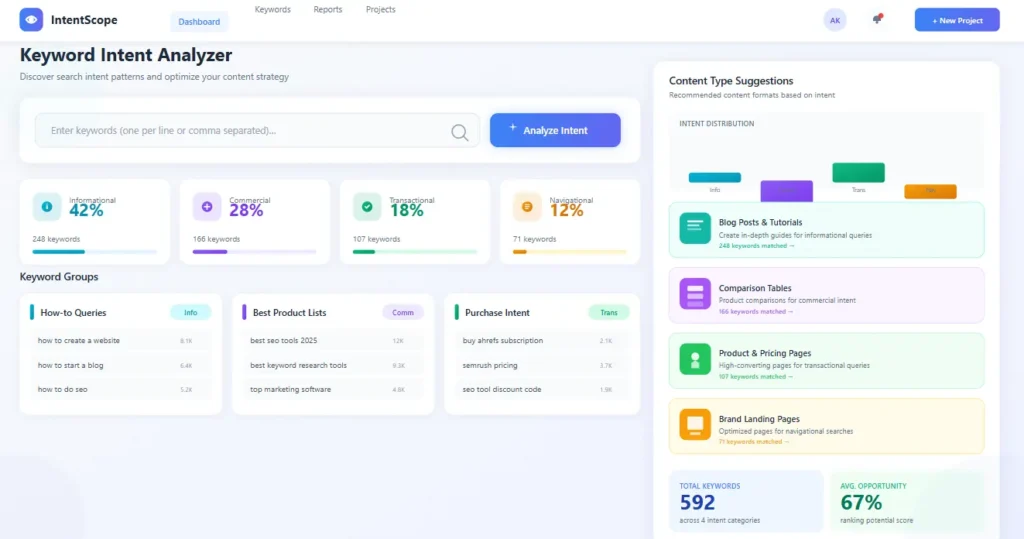
Keyword Intent Tool dashboard showing search intent classification, keyword grouping, and page type suggestions.
Why Search Intent Matters More Than Most People Think
Many SEO problems are not caused by weak writing. They are caused by intent mismatch. A page may target the right phrase but still fail because the page format does not match what users expect. If Google shows guides and you publish a sales page, that page is fighting against the SERP from the beginning. If Google shows tool pages and you publish a long blog post, the same problem happens in reverse.
This is why a Keyword Intent Tool is so valuable. It helps you make the right content decision before you write the page. That means fewer wasted articles, better page targeting, stronger internal linking logic, and better alignment with what already works in search results.
Intent also affects monetization. Informational keywords often work well for pillar guides and supporting content. Commercial investigation keywords are stronger for comparisons, reviews, and buying guides. Transactional keywords are usually better for service pages, product pages, and tool pages. Navigational intent is often best left to brand pages or exact destination pages.
Intent helps you decide whether the keyword needs a guide, review, comparison, tool page, or conversion page.
Matching intent makes the page feel more useful to both users and search engines.
You avoid spending hours creating the wrong page for the wrong search.
Intent helps you build better clusters, better internal links, and better content hierarchy.
Best takeaway: if you understand search intent early, you make better SEO decisions before content production even begins.
The Main Types of Keyword Intent
A good Keyword Intent Tool usually classifies keywords into a few core categories. These categories help you understand what kind of page the searcher is most likely expecting to see.
Informational Intent
The user wants to learn something. These keywords often begin with words like what, how, why, guide, tutorial, checklist, or tips. The best match is usually a guide, blog post, FAQ page, or tutorial.
Commercial Investigation
The user is comparing options before taking action. These keywords often include best, review, alternative, comparison, top, or vs. The best match is usually a comparison page, review page, or curated buying guide.
Transactional Intent
The user is ready to act. They may want to buy, book, sign up, request, or use a tool. These keywords often fit product pages, service pages, signup pages, or real tool pages.
Navigational Intent
The user wants a specific brand, website, tool, or page. These are usually best matched by exact brand or destination pages rather than new content pieces.
Quick Intent Mapping
- Informational = guide or article
- Commercial = comparison or review page
- Transactional = tool, product, or service page
- Navigational = exact page or brand destination
How to Use a Keyword Intent Tool the Right Way
The best way to use a Keyword Intent Tool is to combine it with keyword research, SERP review, and page strategy. The tool can help you classify the likely intent, but you should still confirm that classification by looking at the real search results and deciding what type of page makes the most sense for your site.
Step-by-Step Workflow
- Enter a keyword or keyword list into the tool.
- Review the suggested intent classification.
- Look at the current Google results for the keyword.
- Confirm whether the suggested intent matches the real SERP.
- Choose the right page format based on that intent.
- Group similar keywords under the same page where appropriate.
- Build internal links from related pages that support the intent.
This workflow is especially useful when planning new clusters. You can use intent to decide which keywords belong on your pillar page, which ones should become supporting posts, and which ones should become tools, service pages, or comparisons. That makes your site structure much stronger than simply publishing random posts around whatever keywords look popular.
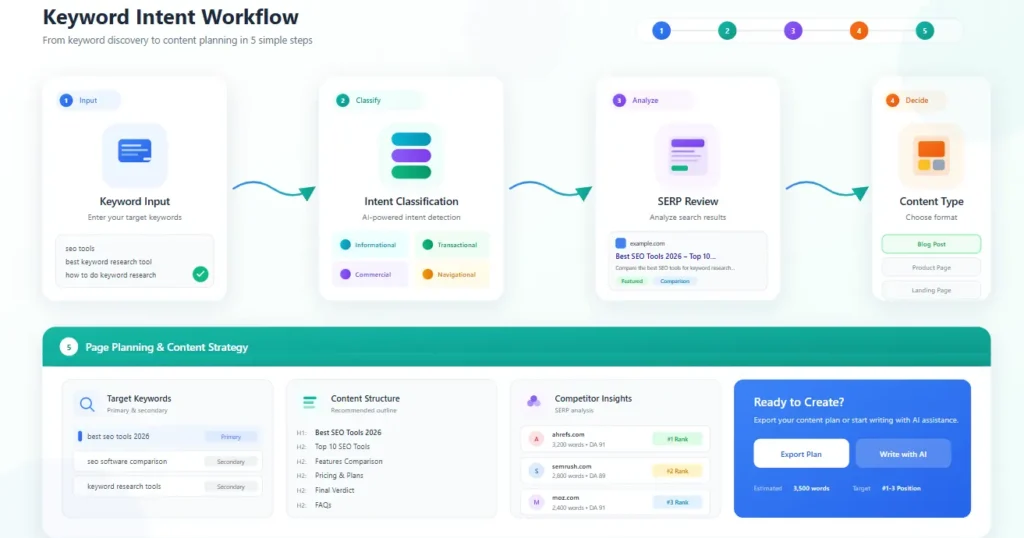
Keyword Intent Tool workflow showing how keyword classification leads to better page type decisions.
Keyword Intent Best Practices
A Keyword Intent Tool works best when you use it as part of a wider SEO process. It should improve your decision-making, not replace it completely.
Review the SERP, Not Just the Keyword
Two keywords can look similar but trigger different result types. That is why SERP review still matters. Intent is not only about the words in the phrase. It is also about what Google already believes satisfies that search.
Choose One Primary Intent Per Page
Pages get weaker when they try to serve conflicting intents. A guide page should not also try to act like a sales page unless the structure clearly supports both. In most cases, one page should match one dominant intent.
Group Keywords by Intent, Not Just Topic
Some keywords are topically related but need different page types because the intent is different. Grouping by topic alone can lead to poor page planning. Grouping by topic and intent is much stronger.
Update Old Pages When Intent Changes
Sometimes the SERP changes over time. A keyword that once favored guides may now favor tools or comparisons. If that happens, the page may need repositioning, rewriting, or internal support from a new format.
Common mistake: targeting a keyword because it looks attractive on paper without checking whether your page type actually fits what users want.
How a Keyword Intent Tool Supports Better Content Planning
Intent classification makes content planning easier because it creates clearer roles for each page. Instead of writing one oversized post for every variation, you can use intent to separate guides, money pages, reviews, comparisons, and tools more intelligently.
For example, a broad keyword with informational intent may deserve a pillar page. A narrower problem-focused query may deserve a supporting article. A keyword with clear commercial investigation may work better as a review or comparison page. A query with strong action intent may belong on a tool page or service page.
This is why a Keyword Intent Tool is useful well beyond keyword research. It supports site architecture, internal linking, content planning, and even conversion strategy. When your pages have clearer jobs, the site becomes easier to grow.
Strong SEO structure: intent helps you decide not just what to write, but where that page belongs inside the site.
Helpful Internal Resources
This Keyword Intent Tool works best when it is part of a wider SEO workflow. These related pages can help you improve keyword selection, content strategy, and page targeting.
Helpful External Resources
These official resources can help you think more clearly about search results, user expectations, and the kind of content Google tends to reward over time.
Keyword Intent Tool FAQs
What is the main purpose of a Keyword Intent Tool?
Its main purpose is to help you identify what the searcher most likely wants so you can choose the right page format and content strategy.
Why does keyword intent matter for SEO?
Intent matters because a page can fail even when it targets the right keyword if the page type does not match what users expect in the search results.
Can one page target multiple intents?
In most cases, one page should serve one primary intent clearly. Mixing conflicting intents often weakens the page.
Should I still check the SERP after using the tool?
Yes. The tool helps guide the decision, but the real search results are still the best way to confirm what format Google prefers.
Should the real tool live on a separate page?
Yes. Keeping the real working tool on a separate page usually creates a cleaner SEO landing page and a faster real tool experience.
Ready to Use the Real Keyword Intent Tool?
Open the working tool, classify your keywords, and build content that matches what searchers actually want to see.