
Wrike vs Asana: The Ultimate Project Management Showdown for 2026
Discover which tool reigns supreme in the battle of Wrike vs Asana
Try Wrike for FreeIntroduction: The Wrike vs Asana Battle
In today’s fast-paced business environment, effective project management tools are no longer a luxury but a necessity. Among the myriad of options available, two names consistently rise to the top: Wrike and Asana. This comprehensive Wrike vs Asana comparison will help you decide which platform best suits your team’s needs.
When considering Wrike vs Asana, it’s important to understand that both are powerful project management solutions designed to streamline workflows, enhance collaboration, and boost productivity. However, they approach these goals from different angles, each with unique strengths and weaknesses.
This Wrike vs Asana analysis will dive deep into features, pricing, user experience, and more to help you make an informed decision for your organization. Whether you’re a small startup or a large enterprise, understanding the nuances of Wrike vs Asana can significantly impact your team’s efficiency and project success rates.
Quick Answer: If you’re looking for a highly customizable, feature-rich platform with advanced reporting capabilities, Wrike might be your best choice. If you prefer a more intuitive, user-friendly interface with simpler project tracking, Asana could be the better option.

Choosing the right tool is the first step to project success.
Overview of Wrike and Asana
What is Wrike?
Wrike is a versatile project management and collaboration platform that has been helping teams organize their work since 2006. Known for its flexibility and powerful features, Wrike offers a comprehensive solution for businesses of all sizes. When evaluating Wrike vs Asana, it’s important to note that Wrike positions itself as an all-in-one work management platform that can adapt to various workflows and business needs.
Wrike’s key selling points include its customizable dashboards, advanced Gantt charts, and robust reporting capabilities. The platform is designed to handle complex projects with multiple dependencies, making it particularly popular among marketing teams, creative agencies, and enterprise-level organizations.
For a more detailed understanding of Wrike’s capabilities, you might want to check out our comprehensive Wrike review.
What is Asana?
Asana, founded in 2008 by Facebook co-founder Dustin Moskovitz and ex-engineer Justin Rosenstein, has grown into one of the most popular project management tools on the market. In the Wrike vs Asana comparison, Asana stands out for its clean, intuitive interface and focus on simplicity without sacrificing power.
Asana is designed to help teams organize, track, and manage their work with ease. Its visual project timelines, task management features, and team communication tools make it a favorite among teams that value clarity and straightforward project tracking. While it may not offer the same level of customization as Wrike, Asana excels in providing a user-friendly experience that requires minimal training.
Wrike vs Asana: Feature Comparison
When it comes to Wrike vs Asana, understanding the feature sets of each platform is crucial. Both tools offer robust project management capabilities, but they differ in their approach and execution.
| Feature | Wrike | Asana |
|---|---|---|
| Task Management | Advanced with custom fields, dependencies, and subtasks | Intuitive with subtasks, due dates, and assignees |
| Project Views | List, Board, Gantt, Calendar, Timeline, Workload | List, Board, Timeline, Calendar, Portfolio |
| Reporting & Analytics | Advanced with customizable dashboards and reports | Basic with project status updates and progress tracking |
| Customization | Highly customizable workflows and fields | Limited customization options |
| Integration | 400+ native integrations | 200+ native integrations |
| Mobile App | Comprehensive with offline mode | User-friendly with core features |
Task Management
In the Wrike vs Asana debate, task management is a critical comparison point. Both platforms excel in this area but with different approaches.
Wrike offers a more granular level of task management with features like custom fields, task dependencies, and detailed subtask organization. You can create complex task hierarchies with parent tasks, subtasks, and sub-subtasks, making it ideal for projects with multiple layers of complexity. Wrike also allows for time tracking on tasks, which is valuable for resource management and billing purposes.
Asana, on the other hand, focuses on simplicity and clarity in task management. While it may not offer the same level of detail as Wrike, Asana’s task system is incredibly intuitive. You can easily assign tasks, set due dates, add followers, and create subtasks. The interface is clean and uncluttered, making it easy for team members to understand their responsibilities at a glance.
Project Views
Both Wrike and Asana offer multiple project views to cater to different work styles and preferences, which is an important consideration in the Wrike vs Asana comparison.
Wrike provides six different views: List, Board, Gantt, Calendar, Timeline, and Workload. The Gantt chart view is particularly robust, allowing for detailed project planning with dependencies and critical path visualization. The Workload view helps managers balance team resources effectively, preventing burnout and ensuring optimal productivity.
Asana offers five main views: List, Board, Timeline, Calendar, and Portfolio. The Timeline view (Asana’s version of a Gantt chart) is visually appealing and easy to use, though not as feature-rich as Wrike’s Gantt chart. The Portfolio view is excellent for high-level project tracking, allowing executives to monitor progress across multiple initiatives.
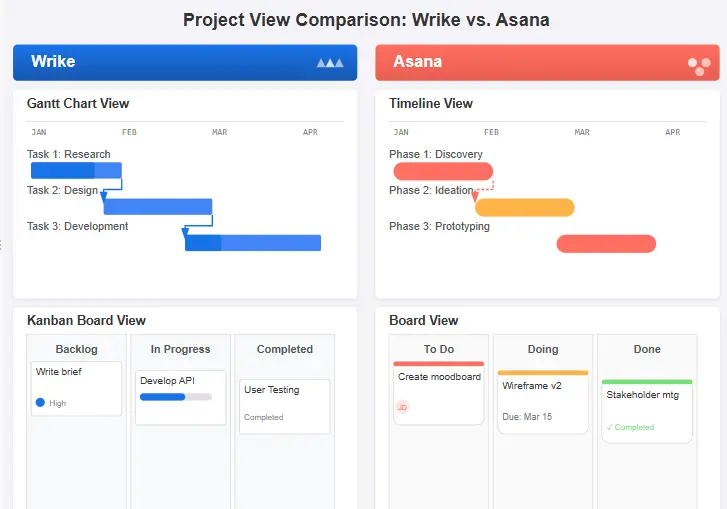
Visualizing work is key. Wrike’s Gantt chart is a powerful feature for complex planning.
Wrike vs Asana: Pricing Comparison
Pricing is a crucial factor in the Wrike vs Asana decision. Both platforms offer multiple pricing tiers to accommodate different team sizes and needs. Let’s break down the pricing structures of both tools.
Wrike Pricing
Wrike offers four main pricing plans:
- Free: For up to 5 users, includes basic features
- Professional: $9.80 per user per month (billed annually)
- Business: $24.80 per user per month (billed annually)
- Enterprise: Custom pricing (contact Wrike for a quote)
Wrike also offers specialized plans for specific teams, such as Wrike for Marketers and Wrike for Professional Services. These plans come with additional features tailored to the needs of these particular industries.
For a detailed breakdown of Wrike’s pricing tiers and what each includes, check out our Wrike pricing guide.
Asana Pricing
Asana also provides four pricing tiers:
- Basic: Free for up to 15 users
- Premium: $10.99 per user per month (billed annually)
- Business: $24.99 per user per month (billed annually)
- Enterprise: Custom pricing (contact Asana for a quote)
Asana’s free plan is more generous than Wrike’s, allowing for up to 15 users compared to Wrike’s 5. However, Wrike’s Professional plan is slightly less expensive than Asana’s Premium plan, though the features differ between these tiers.

A clear pricing comparison is essential for budget-conscious teams.
Value for Money
In the Wrike vs Asana pricing comparison, value for money depends on your specific needs. If you require advanced features like Gantt charts, detailed reporting, and high customization, Wrike’s Business plan offers excellent value despite the higher price point. On the other hand, if you’re looking for a straightforward project management solution with a clean interface, Asana’s Premium plan provides good value for the price.
Both platforms offer free trials of their paid plans, which is highly recommended before making a final decision in the Wrike vs Asana debate.
Wrike vs Asana: User Experience and Interface
The user experience and interface design are significant factors in the Wrike vs Asana comparison. Both platforms have distinct approaches to user interface design, catering to different user preferences.
Wrike User Experience
Wrike’s interface is feature-rich and highly functional, but it comes with a steeper learning curve compared to Asana. The platform is designed to be a comprehensive work management solution, and as such, it presents users with a wealth of options and features from the moment they log in.
The navigation in Wrike is menu-driven, with a left-hand sidebar providing access to different folders, projects, and views. While this structure allows for deep functionality, it can initially feel overwhelming to new users. However, once users become familiar with the interface, they often appreciate the power and flexibility it offers.
Wrike’s dashboard is highly customizable, allowing users to create personalized views that display the information most relevant to their roles. This level of customization is a significant advantage in the Wrike vs Asana comparison for users who want to tailor their workspace to their specific needs.
Asana User Experience
Asana is widely praised for its clean, intuitive interface that requires minimal training to use effectively. The platform’s design philosophy emphasizes simplicity and clarity, making it accessible to users of all technical skill levels.
The navigation in Asana is straightforward, with a top menu bar and a left sidebar that provides quick access to projects, tasks, and teams. The interface is visually appealing, with ample white space and thoughtful use of color to differentiate between projects and tasks.
Asana’s user experience is particularly strong in its task creation and management process. Adding a task is as simple as clicking a button and filling in a few fields, and the platform provides helpful cues and suggestions along the way. This simplicity is a significant advantage in the Wrike vs Asana comparison for teams that want to get up and running quickly without extensive training.
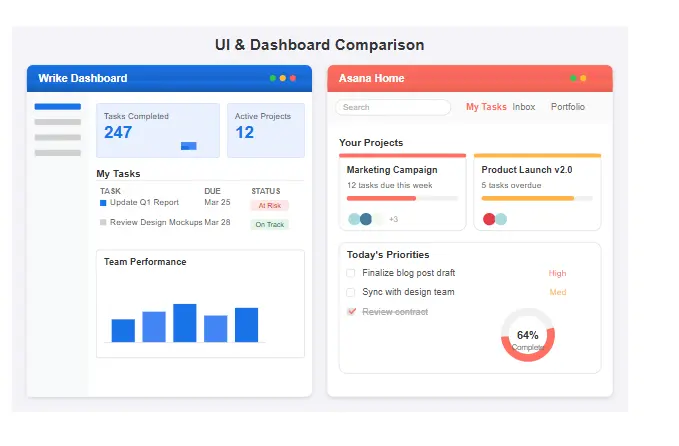
The user interface can be a deciding factor in the Wrike vs Asana choice.
Wrike vs Asana: Collaboration Features
Effective collaboration is at the heart of any project management tool, and both Wrike and Asana offer a range of features designed to facilitate teamwork. In the Wrike vs Asana comparison, let’s examine how each platform approaches collaboration.
Wrike Collaboration Features
Wrike provides a comprehensive set of collaboration tools designed to keep teams connected and informed. Key features include:
- @mentions: Tag team members in tasks and comments to notify them of important updates
- Real-time activity stream: Stay updated on all project activities as they happen
- Document collaboration: Upload, share, and collaborate on files directly within tasks
- Proofing and approval: Annotate files and request approvals without leaving the platform
- Discussion threads: Keep conversations organized and context-specific
One standout feature in the Wrike vs Asana comparison is Wrike’s proofing and approval tool, which is particularly valuable for creative teams. This feature allows users to annotate images and PDFs directly within the platform, streamlining the review and approval process.
Asana Collaboration Features
Asana’s collaboration features are designed with simplicity and clarity in mind. Key features include:
- Team conversations: Centralized space for team-wide discussions
- Task comments: Context-specific conversations about individual tasks
- Project status updates: Regular updates to keep stakeholders informed
- File attachments: Share files directly within tasks and projects
- Team calendar: View all team deadlines and events in one place
Asana’s approach to collaboration emphasizes clarity and transparency. The platform makes it easy to see who is responsible for what and when tasks are due, reducing confusion and improving accountability. While it may not offer the same depth of collaboration features as Wrike, Asana’s tools are intuitive and effective for most team communication needs.
Communication Tools
In the Wrike vs Asana comparison, both platforms offer robust communication tools, but with different focuses. Wrike’s communication features are more comprehensive, with options for detailed discussions, file annotations, and structured feedback processes. Asana’s communication tools are simpler but highly effective, with clean interfaces and straightforward comment threads.
Both platforms integrate with popular communication tools like Slack and Microsoft Teams, allowing teams to stay connected across multiple platforms. This integration capability is an important consideration in the Wrike vs Asana decision for organizations that rely heavily on external communication tools.
Wrike vs Asana: Integration Capabilities
In today’s digital workplace, the ability to integrate with other tools is essential for any project management platform. In the Wrike vs Asana comparison, both platforms offer extensive integration ecosystems, but with some differences in scope and depth.
Wrike Integrations
Wrike boasts an impressive library of over 400 native integrations, covering a wide range of business tools and services. Key integration categories include:
- Communication: Slack, Microsoft Teams, Google Chat
- File storage: Google Drive, Dropbox, OneDrive, Box
- CRM: Salesforce, HubSpot, Zoho CRM
- Development: GitHub, GitLab, Jira
- Marketing: Adobe Creative Cloud, Marketo, HubSpot Marketing
- Finance: QuickBooks, Xero, FreshBooks
Wrike also offers an open API and webhooks, allowing for custom integrations with virtually any tool that supports these technologies. This flexibility is a significant advantage in the Wrike vs Asana comparison for organizations with unique integration requirements.
Asana Integrations
Asana provides over 200 native integrations, covering most of the essential business tools. Key integration categories include:
- Communication: Slack, Microsoft Teams, Gmail
- File storage: Google Drive, Dropbox, OneDrive
- CRM: Salesforce, HubSpot
- Development: GitHub, GitLab
- Time tracking: Harvest, Everhour, Clockify
- Reporting: Power BI, Tableau, Google Data Studio
Like Wrike, Asana also offers an API for custom integrations, though it may not be as extensive as Wrike’s. However, for most organizations, Asana’s integration ecosystem covers all the essential tools needed for seamless workflow management.
Integration Ease of Use
In the Wrike vs Asana comparison, both platforms make it relatively easy to set up integrations with popular tools. However, Wrike’s integrations tend to be more deeply embedded into the platform’s functionality, allowing for more seamless data flow between systems. Asana’s integrations, while functional, sometimes feel more like add-ons rather than fully integrated features.
For organizations that rely heavily on a specific set of tools, it’s worth investigating how well each platform integrates with those tools before making a final decision in the Wrike vs Asana debate.
Wrike vs Asana: Customer Support
Reliable customer support is crucial when implementing and using a project management platform. In the Wrike vs Asana comparison, both companies offer various support channels, but with some differences in availability and depth.
Wrike Customer Support
Wrike provides comprehensive customer support across all its pricing tiers, though the level of support varies by plan:
- Free plan: Community forum and knowledge base
- Professional plan: Email support
- Business plan: Email and phone support
- Enterprise plan: Dedicated account manager and priority support
Wrike also offers a wealth of self-service resources, including a detailed knowledge base, video tutorials, webinars, and community forums. These resources are particularly valuable for organizations that prefer to troubleshoot issues independently or want to learn advanced features at their own pace.
Asana Customer Support
Asana’s customer support structure is similar to Wrike’s, with varying levels of support based on the pricing plan:
- Basic plan: Help center and community forums
- Premium plan: Email support
- Business plan: Email support with faster response times
- Enterprise plan: Dedicated success manager and priority support
Asana also provides extensive self-service resources, including a comprehensive help center, video tutorials, and community forums. The platform’s intuitive design reduces the need for support, as most users can navigate the system with minimal training.
Support Quality and Responsiveness
In the Wrike vs Asana comparison, both platforms generally receive positive reviews for their customer support. However, some users report that Wrike’s support team is more knowledgeable about the platform’s advanced features, which can be particularly valuable for organizations using the more complex aspects of the tool.
Asana’s support is praised for its responsiveness and friendliness, though some users with complex technical issues have found the support team to be less equipped to handle highly specific problems.
Wrike vs Asana: Security Features
For organizations handling sensitive data, security is a critical consideration in the Wrike vs Asana decision. Both platforms take security seriously but offer different levels of protection and control.
Wrike Security Features
Wrike provides robust security features, particularly in its higher-tier plans:
- Data encryption: SSL/TLS encryption for data in transit and AES-256 encryption for data at rest
- Single Sign-On (SSO): Available in Business and Enterprise plans
- Two-factor authentication: Available for all users
- Granular permissions: Detailed control over user access to projects and data
- Compliance certifications: SOC 2 Type II, GDPR, HIPAA (Enterprise plan)
- Custom security settings: IP restrictions, session timeouts, and password policies (Enterprise plan)
Wrike’s security features are particularly strong in its Enterprise plan, making it suitable for organizations with strict security requirements such as government agencies and healthcare providers.
Asana Security Features
Asana also offers solid security features, with some variations by plan:
- Data encryption: TLS encryption for data in transit and AES-256 encryption for data at rest
- Single Sign-On (SSO): Available in Business and Enterprise plans
- Two-factor authentication: Available for all users
- Guest access controls: Control what external users can see and do
- Compliance certifications: SOC 2 Type II, GDPR
- Advanced admin controls: Data export, user deactivation, and password policies (Enterprise plan)
While Asana’s security features are comprehensive, some organizations may find Wrike’s granular permission system to be more detailed and flexible, particularly for complex project structures with varying levels of access requirements.
Security for Different Industries
In the Wrike vs Asana security comparison, both platforms offer adequate protection for most business use cases. However, organizations in highly regulated industries such as healthcare, finance, or government may find Wrike’s Enterprise plan more suitable due to its additional compliance certifications and security controls.
For most small to medium-sized businesses, both platforms provide sufficient security measures to protect sensitive project data. The decision in the Wrike vs Asana security comparison often comes down to specific industry requirements and the sensitivity of the data being handled.
Wrike vs Asana: Pros and Cons
To provide a balanced view in the Wrike vs Asana comparison, let’s examine the pros and cons of each platform.
Wrike Pros
- Highly customizable workflows and fields
- Advanced Gantt charts and project planning tools
- Comprehensive reporting and analytics
- Robust proofing and approval features
- Extensive integration ecosystem
- Granular permission system
- Strong mobile app with offline mode
Wrike Cons
- Steeper learning curve
- Can feel overwhelming for new users
- Higher price point for advanced features
- Interface can feel dated compared to competitors
- Free plan limited to 5 users
Asana Pros
- Intuitive, user-friendly interface
- Minimal learning curve
- Clean, modern design
- Generous free plan (up to 15 users)
- Simple task creation and management
- Effective team communication features
- Good mobile app experience
Asana Cons
- Limited customization options
- Basic reporting capabilities
- Gantt chart view less detailed than competitors
- Fewer integrations than some competitors
- Advanced features require higher-priced plans
Wrike vs Asana: Who Should Use Which?
The Wrike vs Asana decision ultimately depends on your specific needs, team size, industry, and project complexity. Let’s explore which types of organizations might prefer each platform.
Who Should Use Wrike?
Wrike is particularly well-suited for:
- Enterprise organizations: Companies with complex project structures and advanced security requirements
- Marketing and creative teams: Teams that benefit from Wrike’s proofing and approval features
- Project management offices (PMOs):strong> Organizations that need robust reporting and analytics
- Custom workflow requirements: Teams with unique processes that require high levels of customization
- Resource-intensive projects: Teams that need to carefully manage resource allocation and workloads
If your organization requires advanced project management features, detailed reporting, and extensive customization, Wrike is likely the better choice in the Wrike vs Asana comparison.
Who Should Use Asana?
Asana is particularly well-suited for:
- Small to medium-sized businesses: Organizations that need a straightforward project management solution
- Teams new to project management software: Groups that want a tool with minimal learning curve
- Creative and marketing teams: Groups that value visual project tracking and simple task management
- Remote teams: Organizations that need clear, accessible communication and task tracking
- Budget-conscious organizations: Teams that want robust features without the enterprise price tag
If your organization prioritizes ease of use, clean design, and straightforward project tracking, Asana is likely the better choice in the Wrike vs Asana comparison.
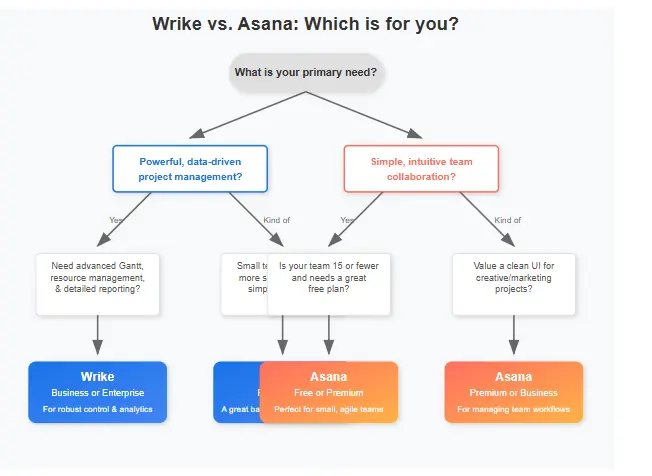
A decision tree can help clarify which tool is right for your team’s specific needs.
Wrike vs Asana: Final Verdict
After a comprehensive analysis of both platforms, it’s clear that the Wrike vs Asana decision isn’t about which tool is objectively better, but which is better suited to your specific needs.
Wrike stands out for its powerful features, customization options, and advanced reporting capabilities. It’s an excellent choice for organizations with complex project management needs, particularly those in enterprise environments or industries with specific workflow requirements. While it comes with a steeper learning curve and higher price point for advanced features, the investment pays off in terms of functionality and flexibility.
Asana excels in its user-friendly design, intuitive interface, and straightforward project tracking. It’s an ideal solution for teams that value simplicity and clarity in their project management tool. While it may not offer the same depth of features as Wrike, Asana provides all the essential functionality most teams need to manage projects effectively. Its generous free plan and lower entry price point make it accessible to organizations of all sizes.
Our Recommendation: If you need advanced project management features, extensive customization, and detailed reporting, choose Wrike. If you prioritize ease of use, clean design, and straightforward project tracking, Asana is the better choice.
Wrike vs Asana: Frequently Asked Questions
For most small businesses, Asana is often the better choice due to its intuitive interface, lower learning curve, and more generous free plan (up to 15 users compared to Wrike’s 5). However, if your small business has complex project management needs, Wrike might be worth the investment.
Both Wrike and Asana offer extensive integration capabilities. Wrike has over 400 native integrations, while Asana offers over 200. Both platforms also provide APIs for custom integrations. Before making a decision, check if your essential tools are supported by each platform.
Both Wrike and Asana are excellent for remote teams. Asana’s intuitive interface and clear task assignments make it easy for remote team members to understand their responsibilities. Wrike’s robust communication features and detailed project tracking also support remote work effectively. The choice depends on your team’s preference for simplicity (Asana) versus advanced features (Wrike).
Asana typically has a shorter implementation time due to its intuitive design and simpler feature set. Most teams can get up and running with Asana in a few days. Wrike may require more time for implementation, particularly for organizations that want to take advantage of its advanced customization features. Implementation time for Wrike can range from a few days to several weeks, depending on complexity.
Yes, both Wrike and Asana offer mobile apps for iOS and Android. Wrike’s mobile app is more feature-rich and includes offline mode, while Asana’s app is more streamlined and focuses on core functionality. Both apps allow users to manage tasks, communicate with team members, and track project progress while on the go.
How to Get Started with Your Chosen Platform
Once you’ve made your decision in the Wrike vs Asana comparison, the next step is implementation. Here are some tips for getting started with either platform:
For Wrike Users:
- Start with the free trial to explore features before committing
- Take advantage of Wrike’s training resources and webinars
- Begin with a simple project structure and gradually add complexity
- Customize workflows to match your team’s specific processes
- Set up integrations with tools your team already uses
For more detailed guidance on implementing Wrike for project management, check out our Wrike project management guide.
For Asana Users:
- Start with the free plan to explore basic functionality
- Use Asana’s templates to quickly set up common project types
- Establish clear naming conventions for tasks and projects
- Encourage team members to use the mobile app for on-the-go updates
- Integrate with communication tools like Slack for seamless workflow
General Implementation Tips:
Regardless of which platform you choose in the Wrike vs Asana decision, these general tips can help ensure successful implementation:
- Start with a pilot team before rolling out to the entire organization
- Provide adequate training and support for all users
- Establish clear guidelines for how the platform should be used
- Regularly review and optimize your setup as your team becomes more familiar with the tool
- Gather feedback from users and make adjustments as needed
For additional tips on managing multiple projects effectively, regardless of the platform you choose, check out our guide to managing multiple projects.
Ready to Choose Between Wrike and Asana?
Both Wrike and Asana are excellent project management tools, each with its own strengths. By understanding the key differences highlighted in this Wrike vs Asana comparison, you can make an informed decision that best suits your team’s needs.
Remember, the best tool is the one that your team will actually use consistently. Consider trying out both platforms with free trials before making your final decision.
Start Your Wrike Free Trial
Affiliate Disclosure: This article contains affiliate links. If you click on one of these links and make a purchase, we may earn a commission at no additional cost to you. We only recommend products and services that we have personally used and believe will add value to our readers.