
The Ultimate Guide to SEO Tools for Startups: Build Your Organic Growth Stack
When you’re running a startup with limited resources, choosing the right SEO tools for startups can make the difference between rapid organic growth and wasted marketing budget. Finding the right SEO tools for startups is a critical decision that impacts your entire marketing strategy. In this comprehensive guide, we’ll explore the most effective SEO software for startups that delivers maximum value without breaking the bank. Whether you’re just starting with search optimization or looking to scale your existing efforts, this guide will help you build the perfect startup SEO stack that aligns with your budget, team size, and growth stage.
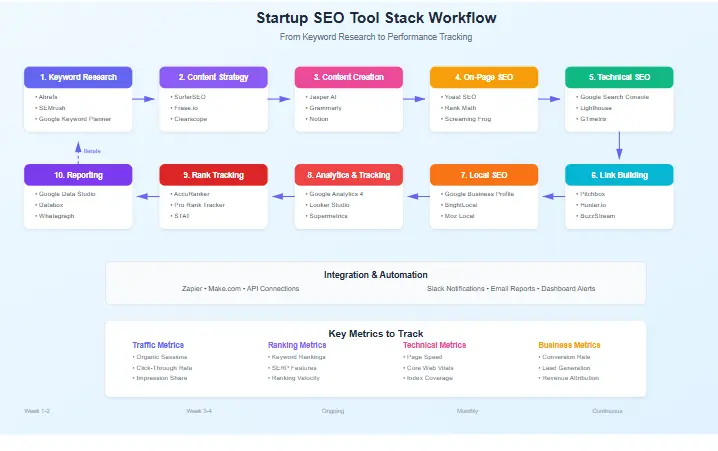
Table of Contents
- Startup SEO Tool Picker: Finding Your Perfect Match
- Top 5 SEO Tools for Startups: Head-to-Head Comparison
- SEO Stacks by Budget: From Bootstrapped to Funded
- SEO Stacks by Growth Stage: Pre-Launch to Scale
- Common Mistakes Startups Make With SEO Tools
- When Not to Buy SEO Tools Yet
- Frequently Asked Questions About SEO Tools for Startups
- Conclusion: Building Your Startup SEO Stack
Startup SEO Tool Picker: Finding Your Perfect Match
Before diving into specific tools, let’s establish a framework for choosing the right SEO tools for startups. Your ideal tool stack depends on several factors, and understanding these will prevent you from overspending or choosing a platform that’s too complex for your needs. This framework will help you evaluate the many SEO tools for startups on the market today.
- Current SEO maturity: Are you just starting with SEO or do you have established processes?
- Team size and expertise: Are you a solo founder or do you have a dedicated SEO specialist?
- Budget constraints: How much can you realistically invest monthly in SEO software?
- Technical requirements: Do you need advanced technical SEO capabilities or basic on-page optimization?
- Reporting needs: Are you reporting to investors, stakeholders, or just tracking internal progress?
For most startups, we recommend starting with a lean stack that covers the essential SEO functions: keyword research, on-page optimization, rank tracking, and basic technical analysis. As you grow and see results, you can expand your toolkit to include more specialized solutions. This approach is fundamental when evaluating SEO tools for startups, as it ensures you only pay for what you actually use.
Pro Tip: Before investing in paid SEO tools, make sure you’ve implemented the fundamentals of technical SEO on your website. No tool can fix basic issues that should be addressed first.
Top 5 SEO Tools for Startups: Head-to-Head Comparison
After testing dozens of solutions, we’ve identified five standout SEO tools for startups that offer exceptional value. Each has its strengths, and the best choice depends on your specific needs and budget. This comparison focuses on the core features that matter most to growing businesses.
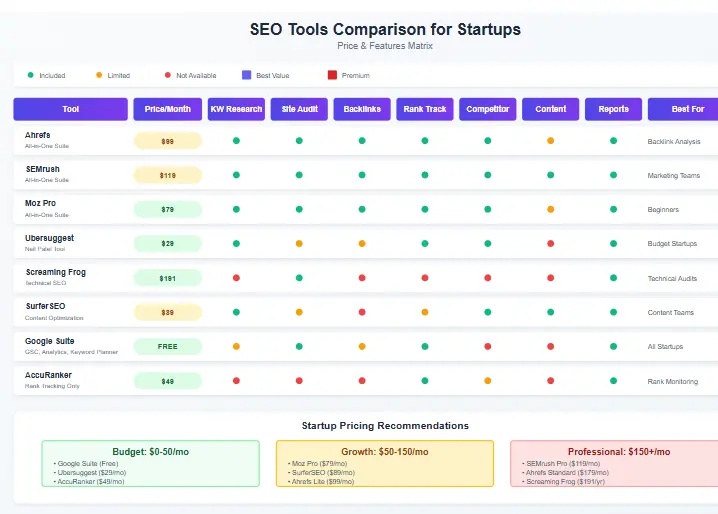
| Tool | Best For | Starting Price | Key Features | Free Trial |
|---|---|---|---|---|
| SE Ranking | All-in-one solution on a budget | $31/month | Keyword tracking, competitor analysis, site audit, backlink monitoring | 14 days |
| Moz Pro | Beginner-friendly with strong data | $99/month | Keyword Explorer, Site Crawl, Link Explorer, Page Optimization | 30 days |
| Ubersuggest | Content-focused startups | $29/month | Keyword research, content ideas, site audit, backlink data | 7 days |
| Rank Math Pro | WordPress users on a budget | $59/year | On-page SEO, schema markup, sitemaps, redirection manager | 30 days |
| WebCEO | Team collaboration | $95/month | Keyword research, SEO audit, rank tracking, backlink quality check | 14 days |
1. SE Ranking: The Budget-Friendly All-Rounder
SE Ranking offers the most comprehensive feature set at the most accessible price point, making it our top recommendation for most startups. It covers all essential SEO functions without the steep learning curve of more complex platforms. For most startups, SE Ranking provides the best balance of features and price, making it a leading choice among SEO tools for startups.
Key advantages for startups:
- Competitive pricing with no feature limitations
- Intuitive interface that requires minimal training
- Accurate rank tracking with local capabilities
- Robust competitor analysis tools
- White-label reporting for agency-style presentations to investors
Limitations:
- Backlink database isn’t as extensive as Moz or Ahrefs
- Keyword research data may be less accurate for very low-volume terms
2. Moz Pro: The Industry Standard for Beginners
Moz has been a trusted name in SEO for years, and their Pro platform offers one of the most user-friendly experiences for startups new to search optimization. While pricier than some alternatives, the quality of data and educational resources justifies the investment for many.
Key advantages for startups:
- Domain Authority metric is widely recognized in the industry
- Excellent educational resources and community support
- Intuitive keyword difficulty scoring
- Reliable site crawl with actionable recommendations
- Strong local SEO capabilities
Limitations:
- Higher price point may be challenging for bootstrapped startups
- Rank tracking has some limitations compared to dedicated tools
- Some advanced features require higher-tier plans
3. Ubersuggest: The Content Marketer’s Choice
Created by Neil Patel, Ubersuggest has evolved from a simple keyword tool into a comprehensive SEO platform with a strong focus on content optimization and ideation. It’s particularly valuable for startups focusing on content marketing as their primary growth channel.
Key advantages for startups:
- Excellent content idea generation based on competitor analysis
- Simple, clean interface that’s easy to navigate
- Competitive pricing with annual discounts
- Integrates keyword research with content planning
- Includes basic social media analytics
Limitations:
- Less comprehensive technical SEO capabilities
- Backlink data isn’t as robust as dedicated tools
- Site audit features are somewhat basic
4. Rank Math Pro: The WordPress Powerhouse
For startups built on WordPress, Rank Math Pro offers exceptional value by combining on-page optimization, technical SEO, and basic analytics in one affordable package. It’s less of an all-in-one solution and more of a specialized tool for WordPress sites.
Key advantages for startups:
- Extremely affordable annual pricing
- Deep integration with WordPress ecosystem
- Advanced schema markup capabilities
- Redirection manager included
- Works well with Google Search Console integration
Limitations:
- Only works with WordPress websites
- Limited keyword research capabilities
- No competitor analysis features
- Basic rank tracking only
5. WebCEO: The Team Collaboration Specialist
WebCEO stands out for startups with small teams that need to collaborate on SEO initiatives. It offers robust project management features alongside solid SEO capabilities, making it ideal for coordinating efforts between founders, marketers, and content creators.
Key advantages for startups:
- Excellent team collaboration features
- White-label reporting options
- Comprehensive SEO audit tools
- Automated task scheduling
- Competitor analysis with historical data
Limitations:
- Higher price point for smaller teams
- Interface can feel somewhat dated
- Steeper learning curve than some alternatives
SEO Stacks by Budget: From Bootstrapped to Funded
Your budget significantly influences which SEO tools for startups you can afford. This section breaks down the best SEO tools for startups at different price points. Here are three recommended stacks based on typical startup funding levels:
Bootstrapped Stack (Under $50/month)
For startups operating on minimal funding, this combination provides essential SEO capabilities without breaking the bank. This stack proves that effective SEO doesn’t require a massive investment in SEO tools for startups.
- Primary Tool: Rank Math Pro ($59/year) for on-page optimization and technical SEO
- Keyword Research: Google Keyword Planner (free) + custom keyword research template
- Rank Tracking: Google Search Console (free) for basic performance monitoring
- Technical Audit: Google Lighthouse (free) + Rank Math’s built-in audit features
Total Cost: ~$5/month (Rank Math Pro annualized)
Best For: Pre-seed startups, solo founders, and businesses with minimal website complexity
Growth-Stage Stack ($50-150/month)
For startups with some funding or initial revenue, this stack offers more comprehensive capabilities. This is the sweet spot for many SEO tools for startups, offering a powerful mix of features and affordability.
- Primary Tool: SE Ranking ($31/month) for all-in-one SEO management
- WordPress SEO: Rank Math Pro ($59/year) for on-page optimization
- Content Ideas: AnswerThePublic (free plan) + Google Trends (free)
- Technical Analysis: Google Search Console + SE Ranking’s site audit
Total Cost: ~$36/month
Best For: Seed-stage startups, small teams, and businesses with growing SEO needs
Scale-Ready Stack ($150-300/month)
For funded startups ready to invest more aggressively in organic growth. At this level, you can access enterprise-grade SEO tools for startups that provide deeper insights and automation.
- Primary Tool: Moz Pro ($99/month) for comprehensive SEO management
- WordPress SEO: Rank Math Pro ($59/year) for advanced on-page optimization
- Content Optimization: SurferSEO or Clearscope for content optimization
- Technical SEO: DeepCrawl or Sitebulb for advanced technical audits
- Reporting: Google Data Studio + Moz Pro’s reporting features
Total Cost: ~$150-250/month depending on additional tools
Best For: Series A+ startups, dedicated SEO teams, and businesses with complex websites
SEO Stacks by Growth Stage: Pre-Launch to Scale
Beyond budget, your startup’s growth stage should influence your choice of SEO tools for startups. Here’s how to align your tool stack with your current business phase:
Pre-Launch Stage
Before launching, focus on research and planning tools. At this stage, you don’t need to invest in premium SEO tools for startups, but rather leverage free resources to build your strategy.
- Market Research: Google Trends (free) + Google Keyword Planner (free)
- Competitor Analysis: SimilarWeb (free plan) + Ahrefs’ free backlink checker
- Keyword Research: Free keyword research template + AnswerThePublic (free plan)
- Content Planning: Simple spreadsheet or Trello board
Early Stage (0-6 months post-launch)
Focus on establishing SEO foundations and initial growth. This is when many startups make their first real investment in SEO tools for startups.
- On-Page SEO: Rank Math Pro ($59/year)
- Basic Analytics: Google Analytics + Google Search Console (free)
- Rank Tracking: SE Ranking’s basic plan ($31/month)
- Content Ideas: Ubersuggest’s free tools + BuzzSumo (free plan)
Growth Stage (6-18 months post-launch)
Scale your SEO efforts with more comprehensive tools. Your choice of SEO tools for startups here will directly impact your ability to scale efficiently.
- All-in-One SEO: SE Ranking ($31/month) or Moz Pro ($99/month)
- Content Optimization: SurferSEO or Frase for content optimization
- Technical SEO: Built-in tools from your primary platform
- Link Building: Pitchbox or Mailshake for outreach
Scale Stage (18+ months post-launch)
For established startups looking to accelerate growth. The most sophisticated SEO tools for startups are justified at this stage to maintain a competitive edge.
- Enterprise SEO: Moz Pro ($99/month) or BrightEdge (enterprise pricing)
- Advanced Technical SEO: DeepCrawl or Sitebulb
- Content Intelligence: MarketMuse or Clearscope
- Link Building: Pitchbox or custom outreach solutions
- Reporting: Google Data Studio + custom dashboards
Common Mistakes Startups Make With SEO Tools
Even with the best SEO tools for startups, success isn’t guaranteed. Many founders overestimate what SEO tools for startups can achieve without a solid strategy. Avoid these common pitfalls:
1. Tool Overload
Many startups subscribe to multiple overlapping tools, creating unnecessary complexity and expense. Start with a single comprehensive tool rather than piecing together multiple specialized solutions. As your needs become more sophisticated, you can add specialized tools to address specific gaps. This is a common error when teams are new to evaluating SEO tools for startups.
2. Ignoring the Fundamentals
No tool can compensate for poor SEO fundamentals. Before investing in paid tools, ensure you’ve implemented the basics described in Google’s SEO Starter Guide. This includes proper site structure, quality content, and basic technical optimization. The best SEO tools for startups enhance a good foundation, they don’t replace it.
3. Data Paralysis
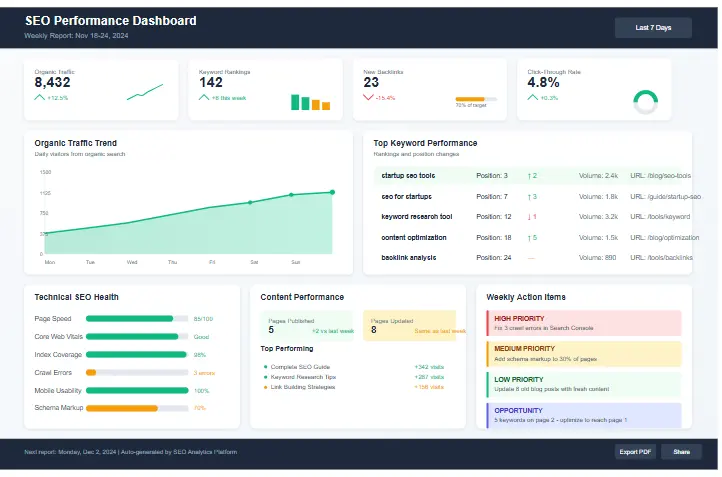
Modern SEO tools provide an overwhelming amount of data. Focus on metrics that directly impact your business goals rather than getting lost in vanity metrics. For most startups, this means tracking organic traffic, keyword rankings for high-value terms, and conversion rates from organic search. This is a crucial mindset when using any of the SEO tools for startups we’ve discussed.
4. Neglecting Integration
Your SEO tools should integrate with your broader marketing stack. Ensure your SEO data connects with your analytics, CRM, and content management systems to create a unified view of your marketing performance. The most effective SEO tools for startups play well with your existing software ecosystem.
5. Over-reliance on Automation
While automation features in SEO tools can save time, they shouldn’t replace strategic thinking. Use tools to inform decisions, not make them for you. The most successful startups combine tool insights with human expertise and industry knowledge. Remember that SEO tools for startups are aids, not replacements for strategic thought.
When Not to Buy SEO Tools Yet
While investing in SEO tools for startups is often a smart move, there are situations where it doesn’t make sense:
Before Product-Market Fit
If you’re still validating your product and target audience, hold off on paid SEO tools. Focus on understanding your customers first, then invest in SEO once you have a clear value proposition. Your resources are better spent on product development at this stage than on SEO tools for startups.
With Minimal Website Content
SEO tools work best when you have sufficient content to optimize and analyze. If your website has fewer than 20-30 pages, focus on creating more content before investing in advanced tools. You need something for the SEO tools for startups to work with.
When Lacking SEO Knowledge
Tools don’t replace SEO expertise. If you’re completely new to search optimization, start with free educational resources like Google’s Search Documentation and basic free tools before investing in paid solutions. A little learning before buying SEO tools for startups goes a long way.
During Major Platform Transitions
If you’re planning a major website redesign, migration, or platform change, wait until after the transition is complete before investing in new SEO tools. This ensures you’re tracking consistent data and not complicating an already complex process. The data from new SEO tools for startups will be more accurate post-migration.
With No Dedicated Resources
SEO tools require time to learn and use effectively. If no one on your team can dedicate at least 3-5 hours per week to SEO, hold off on paid tools until you have the bandwidth to implement their recommendations. Even the best SEO tools for startups are useless if they sit unused.
Frequently Asked Questions About SEO Tools for Startups
The ideal budget for SEO tools for startups depends on your stage and revenue, but most startups should plan to invest $50-200 monthly in SEO tools once they have product-market fit. Early-stage startups can start with free tools and upgrade as they grow.
While free tools like Google Search Console and Google Analytics are essential, they have limitations. Paid tools offer more comprehensive data, competitor analysis, and automation features that become valuable as you scale. Most successful startups use a combination of free and paid SEO tools for startups.
For most new startups, the most important tool is a comprehensive all-in-one platform like SE Ranking that covers keyword research, rank tracking, and site auditing. This provides the most value for a limited budget and is a staple among recommended SEO tools for startups.
Start with an all-in-one tool to cover your basic needs. As your SEO program matures, you can add specialized tools for specific functions like content optimization or technical SEO. This approach prevents tool overload while ensuring you have comprehensive coverage, a smart strategy for purchasing SEO tools for startups.
Track organic traffic growth, keyword ranking improvements, and most importantly, conversions and revenue from organic search. Most SEO tools pay for themselves if they help you achieve even a modest improvement in these metrics. Use Google Search Console’s Performance report to track these metrics over time. This is how you justify the investment in SEO tools for startups.
Absolutely. While B2B sales cycles may be longer, organic search is often where decision-makers research solutions. SEO tools help you reach these potential customers during their research phase, building awareness and credibility that leads to future sales. The right SEO tools for startups are crucial in the B2B space.
Yes, at a basic level. Founders should understand the fundamentals of SEO and how to interpret key metrics from their tools. This doesn’t mean becoming an expert, but having enough knowledge to guide strategy and evaluate the effectiveness of your SEO efforts. A basic understanding of SEO tools for startups is a valuable skill.
For most startups, weekly reviews of key metrics are sufficient. Monthly deep dives into more detailed data help identify trends and opportunities. Avoid daily checking, as SEO changes happen gradually and frequent checking can lead to overreacting to normal fluctuations. Consistency is key when using SEO tools for startups.
Yes, many SEO tools offer affiliate programs. If you’re genuinely recommending tools you use and find valuable, affiliate links can create an additional revenue stream. Always disclose affiliate relationships to maintain transparency with your audience. This is common practice in content about SEO tools for startups.
For most startups, the best approach is a combination: start with tools to build internal knowledge, then hire a consultant for strategic guidance or specific projects. Tools provide ongoing data and insights, while consultants offer expertise you may lack internally. This hybrid approach maximizes the value of SEO tools for startups.
Conclusion: Building Your Startup SEO Stack
Choosing the right SEO tools for startups is about balancing capability, cost, and usability. Start with a lean stack focused on your most immediate needs, then expand as your SEO program matures and delivers results. Ultimately, the best SEO tools for startups are those that your team will use consistently to drive measurable results.
Remember that tools are only as effective as the strategy guiding them. The most successful startups combine smart tool selection with a clear understanding of their audience, business goals, and the fundamentals of search optimization. The journey of finding and implementing the right SEO tools for startups is ongoing and evolves with your business. The investment in the right SEO tools for startups is an investment in sustainable, long-term growth.
Ready to build your startup SEO stack? Start with our recommended SE Ranking free trial to explore comprehensive SEO capabilities without commitment. For WordPress users, Rank Math Pro offers exceptional value at just $59/year.
As you implement your SEO strategy, remember to use strategic internal linking to maximize the impact of your content and improve your site’s overall SEO performance. The right combination of strategy and the best SEO tools for startups will set you on the path to sustainable organic growth.