
What Keyword Research Is (and Isn’t)
Keyword research is the practice of finding and evaluating the search terms relevant to a topic, product, or audience. A genuinely useful keyword research guide answers one specific question before anything else: what are people actually typing when they’re looking for something a given page can help with? Everything downstream — clustering, mapping, prioritization — depends on getting that question answered honestly, using real search behavior rather than assumptions about how a business talks about itself internally.
Keyword research is not the same thing as keyword strategy — the separate decision of which page on a site should own each keyword. Many guides blur these two steps together, which is part of why keyword cannibalization (two pages competing for the same term) is so common. Keyword research finds the keywords; keyword strategy assigns them to pages. Treating these as one step is where a lot of keyword lists go to die in a spreadsheet nobody opens again, and it’s also why a page can be built around a “good” keyword and still underperform — the keyword was fine, but nothing decided which page should actually carry it.
Keyword research is also not a synonym for “picking popular words.” A keyword with heavy search volume but the wrong intent, or one that no longer reflects how people actually search for a topic, isn’t a good keyword just because a tool shows a large number next to it. Volume tells you how many people search a term; it says nothing about whether they want what your page offers, whether you can realistically compete for it, or whether ranking for it would actually matter to your business. A smart keyword research guide treats volume as one input among several, not the deciding factor.
Why Keyword Research Still Matters
Search engines — and increasingly AI-driven answer systems — are built to match a query to the content that best satisfies it. Keyword research is how a content team finds out what that query actually is, in the searcher’s own words, before writing a single sentence. Skipping keyword research means writing content based on how a business thinks about a topic internally, rather than how the people searching for it actually describe it — and that mismatch alone can be the difference between a page that ranks and one that never gets discovered at all.
There’s also a structural reason keyword research should happen before drafting, not after. When you know the main topic, the primary intent, and the supporting questions around it, your headings become sharper, your title becomes more specific, and your introduction answers the right question faster instead of warming up for several paragraphs. Writing a well-crafted 2,000-word article for the wrong keyword is still wasted effort — good keyword research is what tells you, before you invest that time, whether a topic deserves a full guide, a short supporting article, a comparison page, or nothing at all right now.
Key takeaway: Keyword research and keyword strategy are two different steps — keyword research finds and evaluates search terms; keyword strategy decides which page owns each one. Skipping the second step is a leading cause of keyword cannibalization.
Correcting a Persistent Myth: “LSI Keywords”
“LSI keywords” are not a real ranking factor in modern search engines. The term comes from Latent Semantic Indexing, a decades-old technique originally built for analyzing small, fixed document collections. In 2019, Google’s then–Search Advocate John Mueller addressed the term directly, stating that there is no such thing as LSI keywords and that anyone claiming otherwise is mistaken — a position Google has reiterated since (reported by Search Engine Roundtable).
What actually matters is semantic and topical completeness: covering the genuinely related concepts, questions, and terminology a topic requires, so content reads as thorough to both a human reader and a language model — not sprinkling in a list of “related keywords” pulled from a generator and hoping it counts as depth. Content teams chasing LSI keywords as a distinct tactic should redirect that effort toward covering a topic’s full semantic field instead: the entities, subtopics, and questions a genuinely knowledgeable page on the subject would naturally include.
Key takeaway: LSI keywords are a myth carried over from outdated SEO advice, directly addressed by Google’s own search advocates. Focus on genuine topical and semantic completeness instead of hunting for a special keyword category that doesn’t exist in how modern search actually works.
Keyword Discovery & Expansion
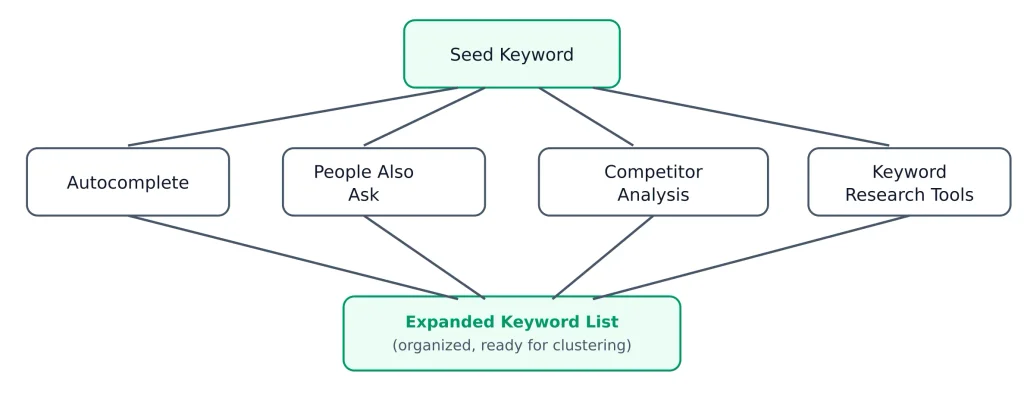
Every keyword research project starts from a small set of seed keywords — the core terms that describe your topic, product, or service in plain language. From there, the job is expansion: turning a handful of seed terms into a much larger, organized list of real search phrases, using several different discovery methods rather than relying on just one.
Finding Seed Keywords
Start with the basics: what do you call what you offer, and what would someone else call it if they didn’t know your terminology? A useful seed list usually comes from three places:
- Your own knowledge of the topic or offering — the plain-language terms a customer or reader would use, not internal jargon
- Direct audience input — how customers, support tickets, community questions, or sales conversations actually phrase things
- What’s already ranking — the terms competitors and reference sites use to describe the same topic, which reveals language you might not have considered
Expansion Methods
Once you have seed terms, expand them using several complementary methods rather than one:
- Search engine autocomplete — typing a seed term and noting what the engine suggests next, which reflects genuinely common real-world phrasing
- “People Also Ask” and related-question boxes — genuine phrasing of real user questions, often revealing angles a seed list alone would miss
- Competitor content analysis — identifying terms competitors rank for that you haven’t covered
- Keyword research tools — software that generates related-term suggestions at scale (see Keyword Research Tools below)
Example seed-to-expansion pattern for a single seed term
| Seed keyword | Expansion direction | Example expanded terms |
|---|---|---|
| “keyword research” | How-to / process | “how to do keyword research,” “keyword research process” |
| “keyword research” | Tool-focused | “keyword research tools,” “free keyword research tool” |
| “keyword research” | Audience-specific | “keyword research for beginners,” “B2B keyword research” |
Exact search volumes and difficulty scores for expanded terms should always be pulled live from a current keyword tool — figures shift over time and by region, so this guide intentionally doesn’t publish static numbers that would go stale.
Search Intent Classification
Search intent is the underlying reason behind a search query — what the searcher actually wants to happen next. Search intent is the single biggest factor in whether a page satisfies a search or gets skipped, regardless of how well that page is written. A commercial-intent keyword answered with a purely informational article — or vice versa — will struggle to rank and convert, because it isn’t giving the searcher what they came for, no matter how good the writing is.
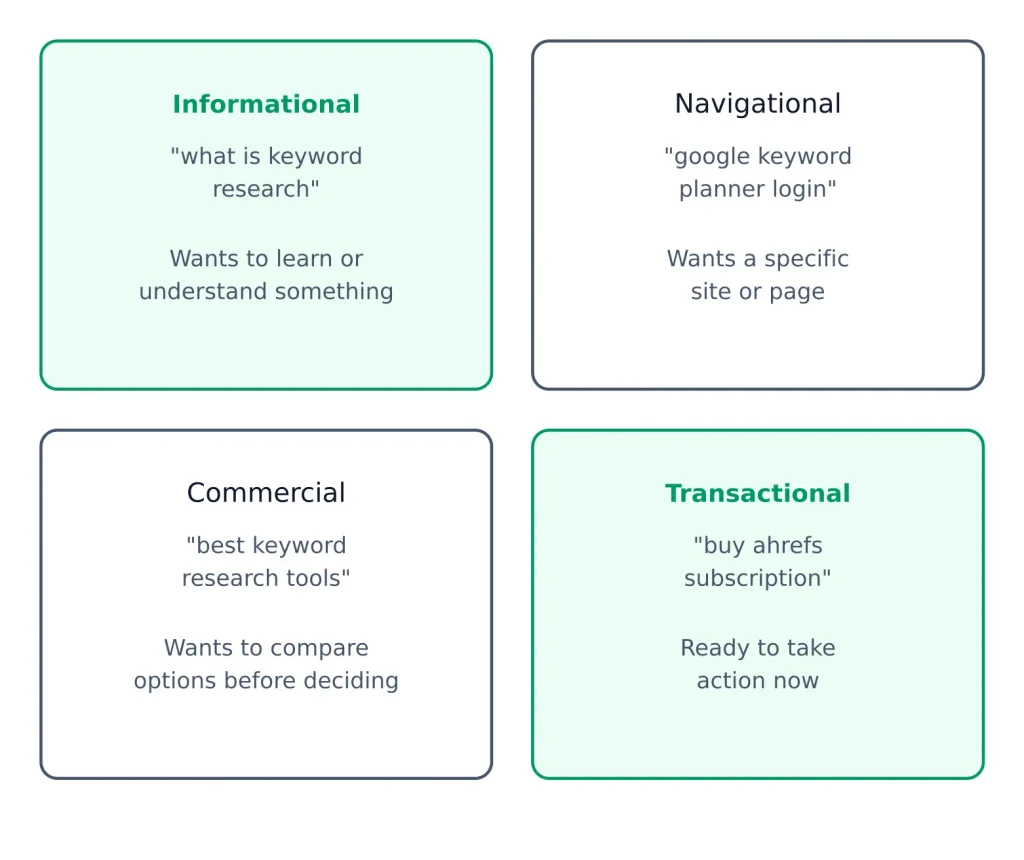
Quick check: before targeting a keyword, search it directly and look at what’s already ranking. If every top result is a comparison page and the plan is a how-to guide, that’s a signal the intent read is wrong — not a reason to try to out-write the format anyway. The search results page is, in effect, Google’s own answer to “what does this query want,” and it’s worth trusting more than an assumption made at a desk.
Key takeaway: Search intent — not search volume — determines whether a page can succeed for a keyword. Confirm intent by checking what’s already ranking before committing to a content format.
Keyword Types: Short-Tail vs. Long-Tail
Short-tail vs.long-tail keyword characteristics
| Characteristic | Short-tail (head terms) | Long-tail keywords |
|---|---|---|
| Length | 1–2 words | 3+ words |
| Search volume | Higher | Lower per term, larger in aggregate |
| Competition | Higher | Lower |
| Intent clarity | Broad, ambiguous | Specific, clear |
| Example | “keyword research” | “how to do keyword research for a small blog” |
Short-tail keywords carry more overall search demand but are harder to rank for and often ambiguous about what the searcher actually wants — “keyword research” alone could be an informational query, a tool-seeking query, or a navigational one, and a page can’t fully serve all three at once. Long-tail keywords carry less individual volume but tend to convert better because the intent behind a long-tail phrase is usually unmistakable. A mature keyword strategy targets both: head terms anchor a site’s main pillar pages, while long-tail variations populate the supporting content beneath them, each answering a narrower, clearer version of the same underlying need.
Key takeaway: Short-tail and long-tail keywords serve different roles. Use head terms to anchor pillar pages and long-tail variations to populate the supporting content underneath them.
From Topics to Topical Authority
Topical authority is the depth and completeness of a site’s coverage across an entire subject area, not just its ranking for individual terms. Keyword research that stops at the individual-term level misses the bigger opportunity: search engines and AI answer systems increasingly reward topical authority over sites that rank for isolated terms with no surrounding depth. For more on entity-first, topic-level thinking, see SEORAF’s Semantic SEO Guide.
The output of keyword research should be a map, not just a list: which topics need coverage, which subtopics belong under each topic, and which specific keywords populate each piece of content. Keyword research is the input to that map — not a replacement for building it. A site with a dozen well-targeted individual keywords but no coherent topic structure behind them will generally struggle against a site with fewer, better-organized pages that clearly cover a subject in full.
Key takeaway: A keyword list alone doesn’t build topical authority. Keyword research should feed a structured topical map that organizes topics, subtopics, and supporting content together.
Keyword Clustering
Keyword clustering is the process of grouping related keywords that share the same underlying search intent onto a single target page, rather than spreading them across several thin, competing pieces of content. Keyword clustering happens after keyword expansion and before mapping keywords to pages, and it’s the step that turns a long, flat list into something you can actually plan content around.
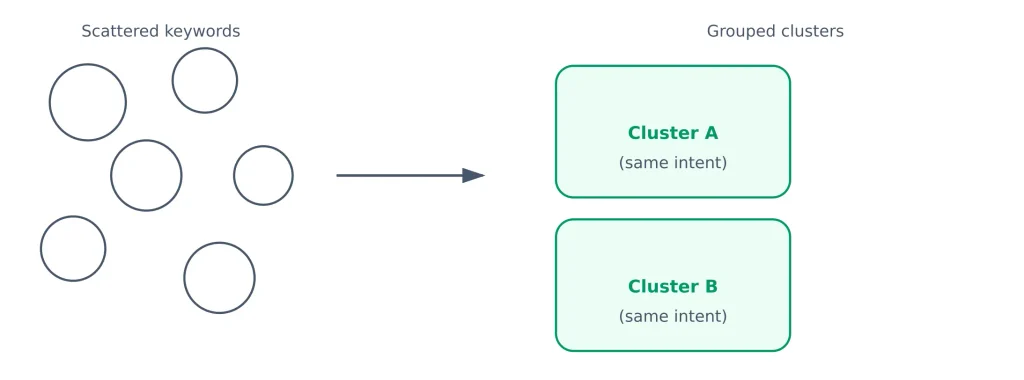
Two failure patterns show up in keyword clustering consistently:
- Over-splitting — creating a separate page for every keyword variation, even when several variations reflect the exact same intent. Over-splitting fragments authority instead of concentrating it, and it’s one of the most common root causes of the cannibalization problem covered later in this guide.
- Over-merging — cramming genuinely distinct intents onto a single page because the keywords look similar on the surface. Over-merging produces content that satisfies none of the intents well, because a page trying to answer three different searcher goals usually answers none of them thoroughly.
A simple test before merging or splitting keywords: if two keywords would be answered by the same page, with the same format, satisfying the same searcher goal, they belong in one cluster. If answering one well would require a different format or a materially different angle, they don’t belong together — even if the words themselves look nearly identical.
Key takeaway: Group keywords by shared intent, not surface-level similarity. Watch for both over-splitting (fragmenting one intent across pages) and over-merging (forcing distinct intents onto one page).
Mapping Keywords to Pages
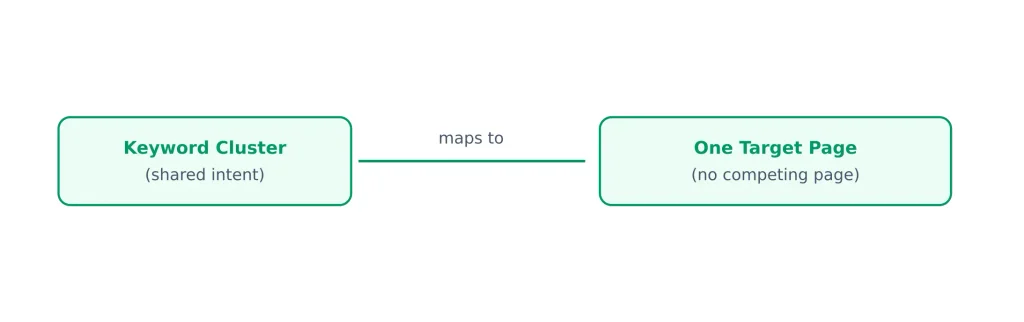
One Keyword Cluster, One Page
Every keyword cluster should map to exactly one target page. This sounds obvious, but it’s the step most keyword research guides skip entirely — they’ll tell you how to find and group keywords, then stop before explaining what to do with the groups. Without an explicit mapping step, it’s easy to end up with two pages unintentionally targeting the same cluster, which leads directly into the cannibalization problem covered next.
Avoiding Keyword Cannibalization
Keyword cannibalization happens when multiple pages on the same site compete for the same keyword or search intent, splitting ranking signals instead of concentrating them. Keyword cannibalization is usually not caused by carelessness — it’s caused by keyword research and content planning happening as separate, disconnected activities over time, often across different contributors who don’t know what the other has already published.
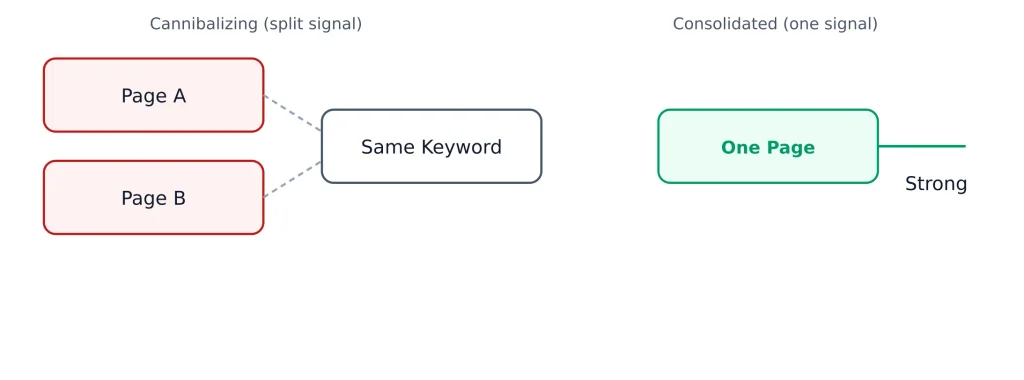
A practical way to catch keyword cannibalization before it happens: before publishing a new page, check whether an existing page on the same site already targets the same cluster. If an existing page does target the same cluster, three options resolve the conflict — consolidate the two pages into one stronger page, clearly differentiate the intent each page serves, or scope the new content narrowly enough that it doesn’t overlap.
A simple pre-publish cannibalization check
| Question | If yes → |
|---|---|
| Does an existing page already rank for this keyword? | Check whether intent genuinely differs before proceeding |
| Would both pages satisfy the same searcher goal? | Consolidate into one page instead of publishing a second |
| Is the new page a narrower subset of an existing page’s topic? | Make sure internal linking and scope clearly separate the two |
In short: before publishing, check for an existing page targeting the same keyword or intent, and either consolidate, differentiate, or narrow the scope of the new page rather than letting two pages compete unintentionally. This is exactly the check this guide itself was run through before being published at its current URL — see About This Guide for that decision.
Key takeaway: Keyword cannibalization is preventable with one pre-publish check — confirm whether an existing page already targets the same keyword or intent before a new page goes live.
Content & Keyword Gap Analysis
Keyword research isn’t only about your own site’s terms — it’s also about finding what’s missing. Two related but distinct exercises help here:
- Content gap analysis — identifying topics or subtopics your competitors cover that you don’t, at the content level. See SEORAF’s Competitor Analysis Guide for the full process.
- Keyword gap analysis — identifying specific keywords competitors rank for that you have no page targeting at all. This pairs directly with the Competitor Analysis Guide above, since the two exercises usually run side by side.
Run both, and treat what you find as a research input, not a to-do list to copy. The goal is finding a genuine hole in your own coverage — not replicating a competitor’s structure just because it exists. A gap only matters if it’s also relevant to your actual audience and offering; a keyword a competitor ranks for that has nothing to do with what you provide isn’t a gap worth closing.
Reading SERP Signals
Before committing to a keyword, look directly at what’s already ranking for it. The search results page tells you things a keyword tool can’t:
- Format expectations — are the top results list-style, long-form guides, tools, or product pages?
- Intent confirmation — does the actual ranking content match the intent you assumed?
- Competitive makeup — are you up against established publishers, tool vendors, or thin content you could genuinely outdo?
This step is easy to skip because it’s manual, but it catches mismatches that pure keyword-metric analysis misses entirely — a tool can tell you a keyword’s difficulty score, but only looking at the actual results tells you whether that difficulty comes from thin competitors you can beat or entrenched authorities you realistically can’t, at least not yet. Entity and topic relationship mapping, covered in SEORAF’s Semantic SEO Guide, extends this kind of analysis further by looking at how concepts connect across a whole topic rather than one query at a time.
Prioritizing Which Keywords to Target
Keyword prioritization is the process of deciding which qualified keywords to target first, based on several weighted factors rather than search volume alone:
- Relevance to the target audience and offering
- Realistic ranking potential given the site’s current authority
- Intent match to content the team can produce well
- Business value if the keyword converts
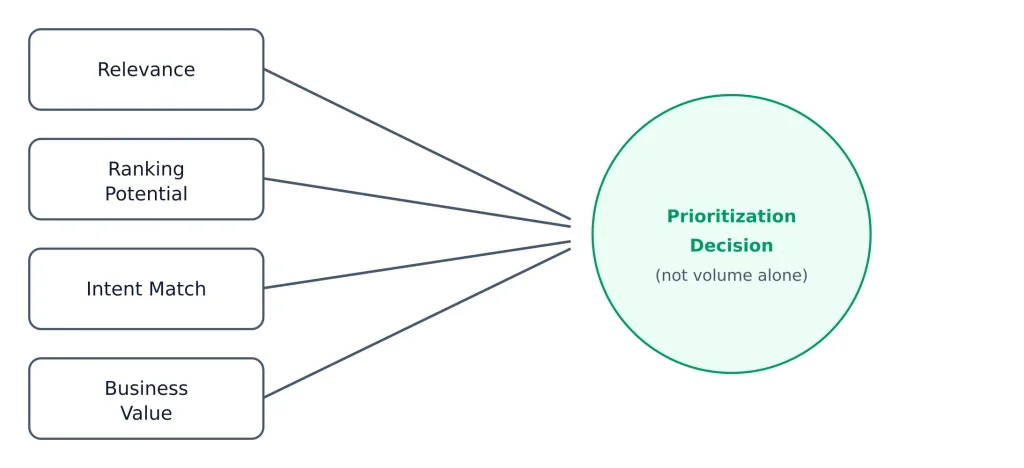
A keyword with modest search volume but strong relevance and clear commercial intent will often outperform a high-volume term that only loosely matches what a business actually offers. A simple, even informal, scoring approach across these factors outperforms defaulting to “biggest volume number wins.” A related, downstream decision is whether a keyword opportunity justifies new content investment at all — a judgment call that combines this scoring approach with realistic capacity and business priorities, since not every qualified keyword can be acted on at once.
Key takeaway: Prioritize keywords using multiple weighted factors — relevance, ranking potential, intent match, and business value — not search volume alone.
Keywords Change Over Time
A keyword’s lifecycle is the pattern of rising, plateauing, and declining relevance a keyword goes through over time as search demand, competition, and intent shift. A keyword that was worth targeting two years ago may not be worth targeting today — demand shifts, competition increases, and the way people phrase a search evolves, especially as voice search and AI-driven queries change query patterns.
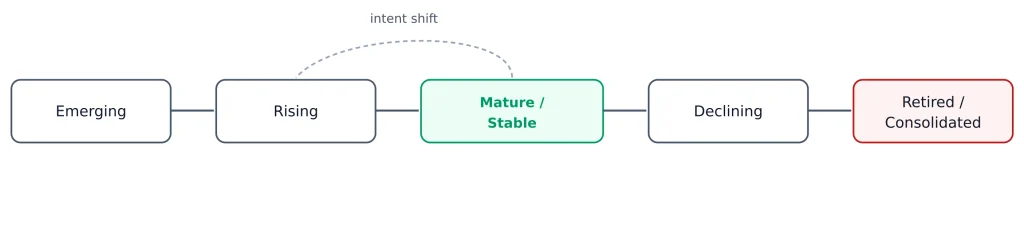
For every keyword a site already ranks for or actively targets, it’s worth periodically asking:
- Is search demand for this term still there, or has demand moved to a related phrase?
- Has competition increased to the point where continued investment doesn’t make sense?
- Has the intent behind this term shifted (for example, from informational to commercial) since the last review?
Keywords that fail these checks aren’t necessarily failures — a keyword failing this check may simply need to be deprioritized, consolidated, or replaced, rather than abandoned outright. Treating a keyword list as a living asset rather than a finished deliverable is one of the clearest differences between a keyword research guide that gets referenced once and a keyword research system that actually gets used.
Key takeaway: Keywords aren’t static assets. Review targeted keywords periodically for shifts in demand, competition, and intent, rather than treating a keyword list as finished once built.
Keyword Research Tools
Keyword research tools fall into a few broad categories. This section is intentionally a high-level overview, not a set of tool reviews — for in-depth, tested comparisons of individual tools, see SEORAF’s Best Keyword Research Tools and Best SEO Tools pages.
Keyword research tool categories
| Category | What it’s for | Examples |
|---|---|---|
| All-in-one SEO suites | Volume, difficulty, competitor keyword data | Ahrefs, Semrush |
| Free/native tools | Basic keyword ideas and trend data | Google Keyword Planner, Google Trends |
| Search-behavior tools | Real query phrasing and autocomplete data | Google Autocomplete, People Also Ask |
| Your own site data | What’s already bringing you traffic | Google Search Console |
No single tool covers keyword research completely. A workable approach combines at least one paid or free volume/difficulty tool with genuine search-behavior signals — autocomplete, People Also Ask, and a site’s own Search Console data — rather than relying on one source alone. Search Console in particular is worth treating as a primary source rather than an afterthought: it shows the queries a page is already receiving impressions and clicks for, which often surfaces genuine opportunities a keyword tool built on estimated data would never suggest.
Key takeaway: No single keyword tool is sufficient on its own. Combine a volume/difficulty tool with real search-behavior signals like autocomplete and Search Console data.
Keyword Research for B2B vs. B2C
B2B keyword research differs from B2C keyword research because B2B buyers typically research across multiple roles and multiple stages of awareness before ever surfacing as a lead. A plant manager, a procurement lead, and a VP signing off on a purchase may all search differently for the same underlying problem, and much of that research happens anonymously, well before any form gets filled out. B2B keyword lists need to reflect different buyer roles and awareness stages explicitly, rather than assuming one keyword list serves every stakeholder in the buying process.
Consumer keyword research, by contrast, usually maps to a more linear, single-decision-maker journey — which is part of why generic keyword research advice, built around that simpler model, often underserves B2B teams without anyone noticing why. A B2B keyword strategy built on a consumer-style linear journey will typically over-invest in bottom-funnel transactional terms and under-invest in the earlier, role-specific research phase where most of a buying committee actually spends its time.
Key takeaway: B2B keyword research must account for multiple buyer roles and hidden, anonymous research behavior — a single linear keyword list built for consumer search will miss most of a B2B buying committee.
Keyword Research in the AI Search Era
AI-driven search features — Google’s AI Overviews and AI Mode among them — generate summarized answers directly within search results. According to Google’s own Search Central documentation, these features surface relevant links using the same underlying ranking and quality systems as classic Search, and there are no separate technical requirements or special schema needed specifically to appear in them beyond standard indexing and snippet eligibility (Google Search Central: Optimizing for Generative AI Features).
This doesn’t make keyword research less important — it changes what a “good” keyword looks like in practice. A page can hold a strong organic position for a query and still see reduced click-through if an AI-generated answer already resolves the searcher’s need directly on the results page. Terms where an AI system can fully answer the query from general knowledge are, in practice, lower-value ranking targets than terms that genuinely require depth, specificity, or a decision a searcher still needs to make after reading.
One practical way to apply this: when prioritizing keywords, add a simple check — “how likely is this query to be fully resolved by a short AI-generated summary, without a click?” — alongside the standard relevance, ranking-potential, and business-value factors from the Prioritization section above. This is a strategic framing SEORAF applies to its own prioritization process, not a claim about how Google’s systems work internally beyond what Google has documented — Google Search Console’s Generative AI performance report is the documented way to observe how a site’s own content actually performs in these features over time.
Key takeaway: AI Overviews run on the same core ranking and quality systems as classic Search, per Google’s own documentation — no special optimization is required. What changes is keyword value: weight prioritization toward terms that still require depth or a decision after reading, not just high volume.
Ongoing Topical Authority Audits
Keyword research doesn’t end at publication. Periodically auditing your existing content against your topical map — checking for coverage gaps that have opened up, keywords that have drifted in intent, or clusters that have started to cannibalize each other — keeps a keyword strategy accurate instead of slowly going stale in the background while everything else about search evolves around it.
Quick-Start Checklist
If you’re applying this guide to a real project right now, here’s the order the steps above actually happen in:
- List seed keywords from your own knowledge, audience input, and what’s already ranking.
- Expand each seed using autocomplete, People Also Ask, competitor analysis, and a keyword tool.
- Classify each expanded term by search intent — informational, navigational, commercial, or transactional.
- Group keywords into clusters based on shared intent, not surface-level word similarity.
- Map each cluster to exactly one target page, checking existing content first to avoid cannibalization.
- Run a content and keyword gap analysis against real competitors to catch what your own list missed.
- Read the actual SERP for your top candidate keywords before finalizing a content format.
- Prioritize using relevance, ranking potential, intent match, and business value together — not volume alone.
- Revisit the list periodically; a keyword’s value changes as demand, competition, and intent shift.
For a shorter, downloadable version of a similar workflow, see SEORAF’s Keyword Research Checklist.
Frequently Asked Questions
Is keyword research still necessary with AI search on the rise?
Yes — arguably more than before. AI systems still need to understand what a topic is about and what related concepts and terms belong to it. Keyword and topic research is how you identify that full picture, even if the end format serves both traditional search and AI retrieval.
How often should I revisit my keyword research?
There’s no universal fixed interval — it depends on how fast your topic area changes. Treat it as an ongoing check tied to your content update cycle, not a one-time task.
Do I need a paid tool to do keyword research properly?
No. Free tools and manual signals (autocomplete, People Also Ask, your own site’s search data) can get a research project meaningfully far. Paid tools add scale and competitive-data depth, not a fundamentally different process.
What’s the difference between keyword research and keyword strategy?
Keyword research finds and evaluates the terms. Keyword strategy decides which page owns each term. Treating these as the same step is a common source of keyword cannibalization.
How do I know if two keywords should be on the same page or different pages?
If two keywords would be answered by the same page, in the same format, satisfying the same searcher goal, they belong on one page as a single cluster. If answering one well would require a different format or a materially different angle, they should be kept on separate pages.
How do I prevent keyword cannibalization?
Before publishing a new page, check whether an existing page on the same site already targets the same keyword or search intent. If it does, either consolidate the two into one page, clearly differentiate the intent each page serves, or narrow the new page’s scope so it doesn’t overlap.
How is a keyword research guide different from a keyword research checklist?
A guide like this one explains the reasoning behind each step so you can adapt it to unusual cases; a checklist is a condensed, repeatable action list for when you already understand the process and just need the steps in order. SEORAF’s Keyword Research Checklist is built for that second use case.
About This Guide
This guide is written by Mousume Akter, Founder & Editor of SEORAF, following the site’s published Editorial Policy and Review Methodology. Where a tool or product is mentioned, any applicable relationship is disclosed per SEORAF’s Affiliate Disclosure.
Where a specific claim about how a search engine works is made, it is sourced to that engine’s own documentation or a directly attributable public statement (see links throughout this guide) rather than asserted. Where a recommendation reflects SEORAF’s own strategic reasoning rather than a documented external fact, this guide says so explicitly (see the AI Search Era section above). This guide does not claim specific first-hand testing results, client outcomes, or performance metrics for the keyword research practices it describes, because none are currently available to disclose for this specific topic.
This guide replaces the previous version of this same page rather than being published as a separate, competing page — done deliberately to follow the exact cannibalization-prevention principle explained in the Avoiding Keyword Cannibalization section above. SEORAF’s Keyword Research Checklist remains a separate, complementary resource in a different format, not a competing page.
Content freshness: search engine behavior, AI feature mechanics, and keyword metrics change over time. This guide’s factual claims about Google’s systems are current as of its last review date; keyword volume, difficulty, and competition figures should always be checked against a live tool rather than assumed static.
Related Resources
For more from SEORAF on building out a full SEO foundation around this guide:
- SEO for Beginners
- Beginner SEO Mistakes
- Content SEO Guide
- Technical SEO Guide
- Semantic SEO Guide
- Keyword Research Checklist — a shorter, checklist-format companion to this guide
- Best Keyword Research Tools
- Best SEO Tools
- Competitor Analysis Guide
External sources cited in this guide:
- Search Engine Roundtable, reporting Google’s John Mueller on LSI keywords (2019): seroundtable.com
- Google Search Central — “AI Features and Your Website”: developers.google.com
- Google Search Central — “Optimizing for Generative AI Features”: developers.google.com