
Semantic SEO Guide (2026): The Entity-First System to Rank Without Keyword Stuffing
This semantic seo guide is a practical, 2026-ready blueprint for building topical authority with entities, intent, and internal links—without turning your writing into a keyword salad. If you want one semantic SEO strategy that covers the strategy, the workflow, the templates, and the “what to do next” actions you can reuse in every niche, you’re in the right place. The goal of this semantic seo guide is simple: publish fewer random posts and build one connected system that earns trust and rankings.
No direct PDF link on this page. Submit the form to unlock the download.
Unlock the Toolkit Download
After submission, you’ll be redirected to a download page (or shown a download button).
Download is available only after submit.
What you get
- Topic map template (hub & spokes)
- Entity sheet (people/brands/places/attributes)
- Internal linking plan (rules you can reuse)
- Content update log (EEAT + maintenance)
Best use
- Plan clusters faster
- Prevent cannibalization
- Build internal link rules
- Keep pages updated
Helpful references from Google: SEO Starter Guide, Creating helpful content, Structured data intro, Sitemaps overview, Google Search Central policies.
If you’re building pages at scale, pair this semantic seo guide with these SEORAF resources: free keyword research template, internal linking template, advanced SEO audit checklist, best all-in-one SEO tools, SEO KPI dashboard, SEO migration checklist.
What is Semantic SEO?
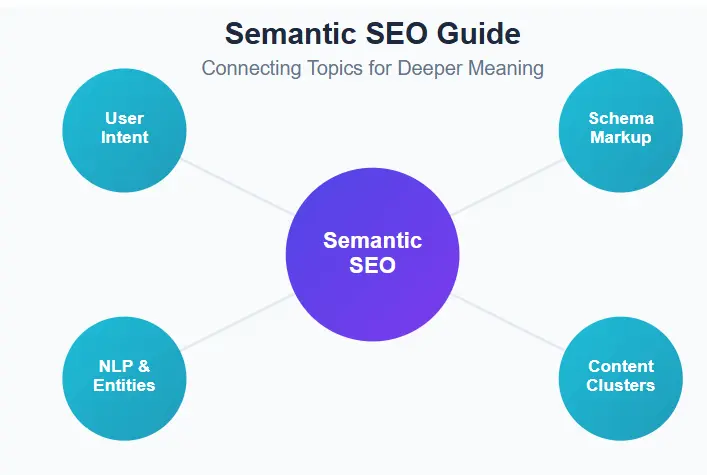
Semantic SEO is the practice of helping search engines understand meaning, not just matching words. In this semantic seo guide, “meaning” comes from entities (people, products, places, concepts), relationships between them, and the intent behind a query. You’re not only trying to rank for a phrase; you’re trying to prove you understand the topic fully.
In 2026, semantic SEO matters because Google can connect topics more intelligently, and users expect fast, clear answers. A modern semantic search optimization prioritizes: complete coverage, helpful structure, strong internal linking, and ongoing updates—so your content stays accurate and useful over time.
The simplest way to think about this semantic seo guide is: keywords are labels, but entities are the “things” that make the topic real. When your content explains the key entities and how they relate, it becomes easier for Google and humans to trust it.
The semantic SEO workflow mindset is: Answer the intent completely, cover the important entities, then use internal links to prove topical authority.
One more important detail for this semantic seo guide: semantic SEO is not “write longer.” It’s “write smarter.” You can publish a concise page that wins if it matches intent, includes the right entities, and makes the next step obvious. On the other hand, a long article can still fail if it’s vague, repetitive, and disconnected from the rest of your site.
If your content currently feels like a pile of blog posts, use this semantic SEO examples as your reset: build a hub page, then publish spokes that support it, and interlink everything like a system.
Semantic vs Keyword SEO
- Starts with one primary keyword and related phrases
- Optimizes individual pages in isolation
- Often over-focuses on density and exact-match headings
- Can miss intent depth (people leave fast)
- May create cannibalization when multiple pages target the same phrase
- Starts with entities + intent + topic clusters
- Builds a hub-and-spoke system (topical authority)
- Uses internal links to connect meaning and pathways
- Improves UX: fewer gaps, clearer structure, better trust
- Reduces cannibalization by assigning each page a clear job
This semantic seo guide doesn’t say “ignore keywords.” Keywords still help you understand demand, phrasing, and SERP expectations. But the winning strategy is to treat keywords as a starting point, then expand into entities, questions, comparisons, and workflows.
If you’ve ever ranked with a page and then slowly lost position, this semantic seo guide explains why: competitors often “complete the topic” better over time—adding missing entities, clearer intent satisfaction, better internal links, and more updates.
- If your page repeats a phrase but doesn’t answer common questions, it’s keyword SEO.
- If your page covers entities, steps, examples, and next links, it’s semantic SEO.
- If your page has no internal links, it’s not a system (this topic cluster SEO fixes that).
Entities explained
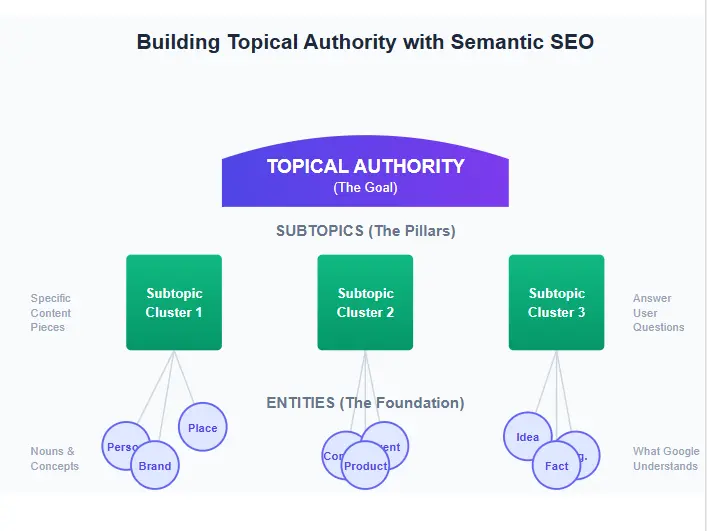
An entity is a uniquely identifiable “thing” (a brand, person, location, product, concept, method, or metric). In a strong semantic seo guide, entities are not random mentions—they are the building blocks that tell Google: “This page truly understands the topic.”
Entities have attributes (features, properties, use cases) and relationships (how they connect to other entities). When your content covers the right attributes and relationships, you create semantic depth without writing fluff. That’s the core of this semantic seo guide approach.
- Brands & tools
- People & roles
- Places & regions
- Concepts & frameworks
- Metrics & definitions
- What it is
- When to use it
- Pros/cons
- Alternatives
- Common mistakes
- Part-of (hub → subtopic)
- Compared-to (A vs B)
- Causes/solves (problem → fix)
- Prerequisite (step order)
- Local relevance (place + service)
Here’s the practical promise of this semantic seo guide: once you know the entities, your outline becomes obvious. Your headings turn into “entity questions,” and your sections become “entity attributes.” This is why semantic SEO often feels easier than traditional optimization.
If your topic is “internal linking,” the entities include: hub page, spoke pages, anchor text, navigation paths, orphan pages, crawl depth, and topical clusters. This semantic seo guide method makes sure those entities appear naturally—because the reader needs them.
Search intent mapping
Intent is the “why” behind a query. If you don’t match intent, you can have perfect on-page SEO and still fail. This semantic seo guide uses intent mapping to decide the correct page type, angle, and CTA.
| Intent type | What the searcher wants | Best content format | What to include (entities) | Conversion angle (soft) |
|---|---|---|---|---|
| Informational | Learn, understand, fix a problem | Guide, checklist, tutorial, glossary | Definitions, steps, examples, FAQs | Lead magnet + template download |
| Commercial | Compare options, evaluate tools | Comparison, review, “best X” lists | Features, limits, use cases, alternatives | Honest tool list + “help me choose” CTA |
| Transactional | Buy, sign up, book, download now | Landing page, pricing page, service page | Offer, proof, process, risk reducers | Primary CTA + trust + FAQs |
| Local | Find a nearby service/provider | Local landing pages + map + FAQs | Location entity, service entity, proof | Call/email CTA + local trust |
A reliable semantic seo guide rule: don’t force a blog post to rank for a transactional query. If the SERP is full of product pages, a “What is X?” guide may not compete. Match intent first, then strengthen with entities and internal linking.
- What formats dominate the top results (guides, lists, tools, videos)?
- Do results focus on definitions or step-by-step actions?
- Are the top pages beginner-friendly or expert-level?
- Which entities repeat across the top pages?
- What’s missing that your semantic seo guide page can add (templates, proof, examples)?
Topical authority system
Topical authority is earned when your site consistently covers a topic deeply across multiple intents—and connects that coverage with internal links. This semantic seo guide uses the hub-and-spoke model because it’s easy to scale, easy to audit, and easy for users to navigate.
- Defines the topic in plain language
- Links to every important subtopic (spokes)
- Targets broad, high-intent phrases
- Updated often; becomes your authority pillar
- Sets the standard for the semantic seo guide cluster
- Each page covers one entity/subtopic
- Targets specific questions + long-tail queries
- Links back to hub and related spokes
- Includes examples, templates, steps, FAQs
- Earns links naturally when it’s uniquely helpful
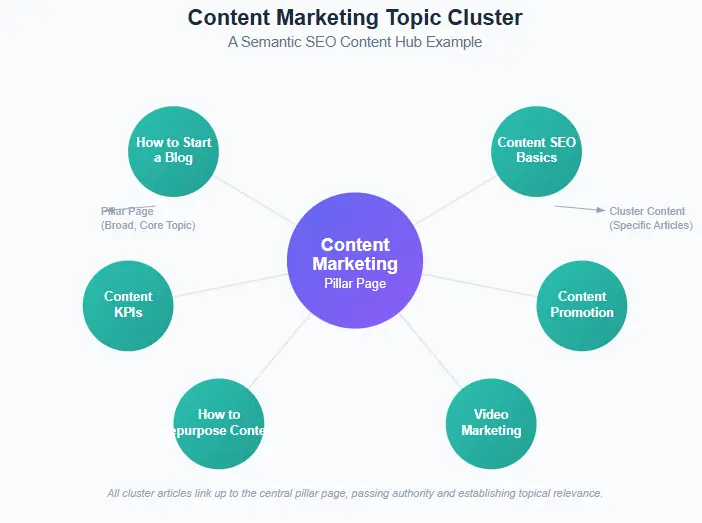
The biggest benefit of this semantic seo guide system is clarity: every page has a job, every link has a reason, and your publishing becomes predictable. You stop writing “whatever feels good today,” and start building an asset that compounds.
If you’re an agency or a solo SEO, topical clusters also make reporting easier. Instead of measuring random pages, you measure cluster growth: impressions, clicks, conversions, and internal link engagement. That’s why this semantic seo guide pairs well with an SEO KPI dashboard.
The fastest way to apply this semantic seo guide is to create one hub, then publish 8–20 spokes that complete the topic. Internal linking turns “content” into a system—and systems win.
How to build an entity-first content plan
This is the core “planning engine” of the semantic seo guide. Instead of brainstorming random titles, you map entities → intents → pages → internal links. The result: fewer content gaps, fewer orphan pages, and stronger topical authority.
Step-by-step (copy this workflow)
- Choose your hub topic (broad, valuable, long-term).
- Collect the core entities (tools, concepts, processes, metrics, locations).
- Expand entities into subtopics using real questions, comparisons, and tasks.
- Assign intent (informational/commercial/transactional/local) to each planned page.
- Define unique value (templates, tests, examples, screenshots, real steps).
- Write link rules (hub ↔ spokes + related spokes + next steps).
- Add EEAT elements (author, sources, update log, proof, editorial notes).
- Set a maintenance schedule (monthly for hubs, quarterly for spokes).
In a strong semantic seo guide system, every hub page includes: author attribution, “last updated,” and a short update log. This signals care, accuracy, and accountability—especially for evergreen topics.
If you want to push this semantic seo guide strategy further, build your plan in layers: start with informational spokes (to build coverage), then add commercial spokes (to monetize), then add transactional pages (to convert). This creates a natural funnel without feeling salesy.
Give each page a single primary “job” (one intent + one core entity). If two pages try to do the same job, your semantic seo guide cluster can cannibalize itself.
The Semantic SEO workflow
If you want this semantic seo guide to feel actionable, follow this workflow in order. It works for new sites, existing sites, affiliate sites, and service sites. The key is consistency: same structure, same link rules, same update habit.
- Map intent + SERP formats
- Collect entities and attributes
- Identify gaps competitors ignore
- Decide your “unique proof” angle (templates, tests, data)
- Headings mirror user questions
- Add examples and templates early
- Place CTAs naturally (not everywhere)
- Decide internal links before writing
- Define terms like a teacher (short + clear)
- Cover entities naturally (not stuffed)
- Use bullets, callouts, visuals
- Include “what to do next” steps
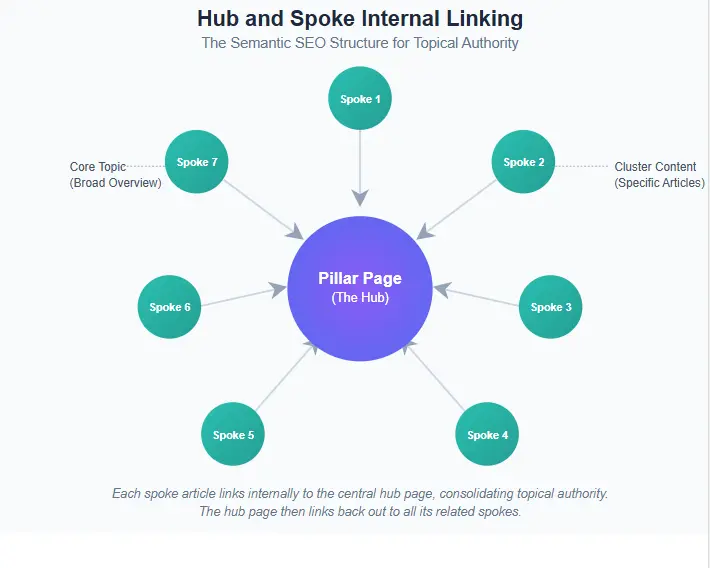
- Hub links to every spoke
- Spokes link back to hub near top
- Add “related spokes” box for deeper navigation
- Use descriptive anchor text
- Refresh facts, screenshots, and steps
- Add new FAQs from Search Console queries
- Update internal links as you publish new spokes
- Log updates (EEAT maintenance)
- Track rankings by cluster (not only by page)
- Monitor internal link clicks
- Measure leads and conversions
- Decide what to update first based on impact
The reason this semantic seo guide workflow works is that it’s “system-first.” Your content becomes interconnected, your updates become planned, and your site grows like a library instead of a timeline feed.
Submit the form to unlock the toolkit download (no direct PDF link here).
Unlock the Toolkit (Free)
After successful submission, you’ll get access to the download.
Download is available only after submit.
No spam. Practical templates only.
Templates
These templates are the lead magnet core of this semantic seo guide. Copy them into Google Sheets or your editorial doc. The goal is speed and consistency: every cluster should feel like it comes from one playbook.
Template 1: Topic cluster map
Use this table to plan your hub and spokes, assign intent, and decide the CTA for each page. This is the simplest “topic clusters” planning format in the semantic seo guide.
| Cluster | Hub page | Spoke page | Intent | Primary entity | Secondary entities | CTA |
|---|---|---|---|---|---|---|
| Semantic SEO | Semantic SEO Guide (2026) | Entities explained | Informational | Entity | Knowledge graph, attributes, relationships | Toolkit unlock |
| Semantic SEO | Semantic SEO Guide (2026) | Search intent mapping | Informational | Search intent | SERP features, page types | Toolkit unlock |
| Semantic SEO | Semantic SEO Guide (2026) | Internal linking hub & spoke | Informational | Internal links | Anchor text, crawl paths, orphan pages | Audit CTA |
| Semantic SEO | Semantic SEO Guide (2026) | Tools for semantic SEO | Commercial | SEO tools | GSC, crawlers, auditing tools | Tool shortlist |
Template 2: Entity sheet
This is where “entity SEO” becomes practical. Build an entity sheet per cluster so your content stays consistent across pages. It’s one of the fastest upgrades you can make from this semantic seo guide.
| Entity | Type | Attributes to cover | Common questions | Proof to add | Pages that should mention it | Internal link target |
|---|---|---|---|---|---|---|
| Search intent | Concept | types, examples, SERP formats | How to map intent? | Examples + mini checklist | Hub + intent spoke | /semantic-seo-intent/ |
| Topic clusters | Framework | hub/spoke, coverage, publishing order | How many spokes? | Cluster map + case example | Hub + planning spoke | /topic-clusters/ |
| Internal links | Process | anchors, hub/spoke rules, navigation paths | How to structure links? | Diagram + rules | Hub + linking spoke | /internal-linking/ |
| Topical authority | Outcome | signals, measurement, maintenance | How to measure it? | KPIs + dashboard view | Hub + reporting spoke | /topical-authority/ |
Template 3: SERP intent checklist
- Top 10 results are mostly: guide / list / tool / product / local page.
- SERP features present: PAA, videos, images, shopping, maps, snippets.
- Users want: definition, steps, comparison, pricing, or a provider.
- Entities repeated in top results (list them).
- What “proof” do top pages include (templates, screenshots, data)?
- What is missing that your semantic seo guide content can add?
Template 4: Internal linking plan (hub/spoke rules)
Internal links are the “wiring” of your topical authority. Use these rules to make your cluster readable, crawlable, and conversion-friendly. This is the internal link system recommended in this semantic seo guide.
- Hub → every spoke with descriptive anchors (not “click here”).
- Every spoke → hub near top (“Back to the semantic seo guide hub”).
- Related spokes link in a “Next steps” box (2–5 links).
- Limit navigation clutter; keep links relevant to the page’s intent.
- Update the hub every time you publish a new spoke.
- Fix orphan pages immediately; every page needs at least 3 internal links.
Template 5: Content update log (EEAT)
Updates are a trust signal and a quality habit. In a good semantic seo guide cluster, the hub is updated frequently and the spokes are updated on a schedule. This log keeps the process visible and consistent.
| Date | Page | What changed | Why it changed | Evidence/source | Owner |
|---|---|---|---|---|---|
| 2026-02-16 | semantic seo guide hub | Added new FAQ + expanded entity sheet section | New queries + user feedback | GSC queries, comments | Editor |
| 2026-03-01 | internal linking spoke | Improved anchor text + added “Next steps” links | Better navigation + deeper crawl paths | Analytics clicks | SEO |
| 2026-04-10 | tools spoke | Updated tool set + clarified use cases | Tool changes + better fit | Tool release notes | SEO |
Case-style example
Let’s apply this semantic seo guide to one niche so you can see the cluster and internal links clearly. Example niche: “Local SEO citations for small businesses”. This niche works well because it has clear entities, a strong local intent layer, and obvious conversion paths.
“Local Citations Guide (2026)” — defines citations, explains how they impact local rankings, lists the major platforms, and links to all spokes. In the semantic seo guide system, the hub is your authority anchor.
| Spoke page (subtopic) | Intent | Main entity | Unique value to add | Internal links (minimum) |
|---|---|---|---|---|
| NAP consistency checklist | Informational | NAP | Printable checklist + examples | Spoke → hub; hub → spoke; spoke → audit |
| Best citation sites (by country) | Commercial | Citation sources | Country list + update log | Spoke → hub; hub → spoke; related spokes cross-link |
| How to fix duplicate listings | Informational | Duplicate profiles | Step-by-step workflow | Spoke → hub; spoke → NAP checklist; spoke → tools |
| Local SEO reporting for citations | Informational | Local KPIs | Metrics + reporting template | Spoke → hub; spoke → KPI dashboard; hub → spoke |
Notice what the semantic seo guide approach does: you’re not publishing random posts. You’re building a connected library where each page supports the hub and covers a real entity + intent. That is the heart of topical authority.
Common mistakes
Most semantic SEO failures are not “Google hates me.” They’re predictable problems: intent mismatch, thin pages, weak internal links, or no update habit. This semantic seo guide section shows what to avoid and how to fix it quickly.
- Repeating the same phrase unnaturally
- Writing headings for bots instead of readers
- Adding “semantic” keywords everywhere without covering entities
- Forgetting that the best semantic seo guide content feels human
- Explaining a concept without examples
- No templates, no proof, no “next steps”
- Ignoring related entities and questions
- Publishing “definition-only” pages that don’t help
- Orphan pages (no links in or out)
- Generic anchors (“read more”)
- No hub-and-spoke structure
- Too many irrelevant links (navigation clutter)
- Old screenshots and outdated steps
- FAQs never refreshed
- No change log (EEAT suffers)
- Hubs not maintained (cluster becomes stale)
Quick troubleshooting (use this when rankings stall)
- Does the page match the dominant SERP format (guide vs list vs tool vs service)?
- Are you missing obvious entities that top pages include?
- Do you have at least 5–12 meaningful internal links in the cluster?
- Does the hub link to all spokes and do spokes link back?
- Did you add “proof”: examples, templates, screenshots, or data?
- Is your CTA aligned with intent (lead magnet on informational pages)?
Tools that help semantic SEO
Tools won’t replace strategy, but they can speed up research and QA. In this semantic seo guide, think of tools as helpers for: entity discovery, intent checking, internal link planning, and updates. Keep it honest: tools are optional; the system is not.
- Google Search Console (queries + pages)
- SERP review tools (format checking)
- Keyword clustering helpers (optional)
- Content briefs (entity checklist)
- Competitive gap scans (what you missed)
- Structured content outlines (headings first)
- Site crawlers (orphans, depth, errors)
- Internal link audits (anchor quality)
- Content inventory sheets (cluster view)
If you want a single place to start, use Google Search Console plus a basic crawler. Then apply this semantic seo guide workflow: fix intent mismatch first, build entity coverage second, strengthen internal links third, and only then worry about “small on-page tweaks.”
If you want help applying this semantic seo guide to your site, a semantic SEO audit usually focuses on entity gaps, cluster structure, internal linking, and update priorities—so you know exactly what to fix first.
Transparent, practical, and aligned with helpful content systems.
Printable: Semantic SEO Checklist
- Intent matches the SERP (page type + format).
- Core entities are covered with attributes and examples.
- Headings answer real questions (not just keyword variations).
- Hub ↔ spokes internal links exist (and are descriptive).
- Related spokes cross-link where it helps the reader.
- EEAT signals exist (author, update note/log, sources where needed).
- UX is scannable: short paragraphs, bullets, callouts, visuals.
- A soft CTA exists (toolkit unlock, audit, or next step).
FAQ
1) Is semantic SEO different from keyword research?
Yes. Keyword research is a part of the semantic seo guide approach, but semantic SEO adds entities, relationships, and intent-based page planning.
2) What is “entity SEO” in simple terms?
It’s covering the important “things” in your topic (brands, concepts, methods, metrics) so Google and users clearly understand your expertise.
3) How many pages do I need for topical authority?
There’s no magic number. A practical semantic seo guide target is one strong hub plus 8–20 spokes that cover the main intents and entities.
4) Do I need structured data for semantic SEO?
Not always, but structured data can help clarify meaning and eligibility for rich results when used correctly.
5) Can I do semantic SEO on a new website?
Yes. This semantic seo guide is ideal for new sites because a cluster structure prevents random, unconnected publishing.
6) What should I update first on an existing site?
Start with hub pages and the top spokes that already get impressions. Improve intent match, entity coverage, and internal links.
7) How do internal links affect semantic understanding?
Internal links connect topics and guide crawlers and users through related entities and subtopics—core to any semantic seo guide system.
8) Should I repeat my main keyword more to rank?
Over-repeating can hurt UX. A better semantic seo guide method is to match intent, cover entities, and build strong internal links.
9) How do I measure topical authority growth?
Track cluster impressions, cluster rankings, and internal link clicks—then tie those to leads or conversions (not just traffic).
10) Can semantic SEO help with AI/LLM visibility?
Clear entity coverage, structured formatting, and consistent updates often make your pages easier to understand and reference—this semantic seo guide supports that.
Conclusion
The real goal of this semantic seo guide is simple: build a topic system that is easy to understand, easy to navigate, and easy to keep updated. When you combine entity SEO, intent mapping, topic clusters, and hub-and-spoke internal links, you stop guessing—and start compounding authority.
To apply this semantic seo guide today: pick one hub topic, build your entity sheet, publish 8–12 spokes, interlink them with clear rules, and set an update schedule. That’s how you build topical authority without keyword stuffing—and without burning out.
Soft disclosure: Some pages may include affiliate links where relevant. This semantic seo guide aims to stay transparent and helpful-first—recommendations are based on fit, not hype.