
Ultimate Website Content Brief Template: Create High-Converting Content Every Time
Creating effective website content starts with a solid foundation. A website content brief template is the blueprint that ensures your content meets both user needs and search engine requirements. Whether you’re a content manager, SEO specialist, or business owner, having a standardized content brief process saves time, maintains quality, and improves your search rankings. In this comprehensive guide, we’ll walk you through everything you need to know about creating and using content briefs that drive results.
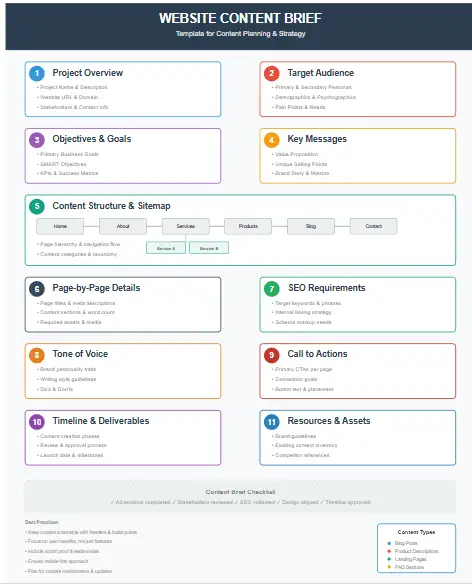
Table of Contents
- What is a Website Content Brief?
- Why Content Briefs Matter for SEO and Conversions
- What a Great Website Content Brief Template Includes
- Free Website Content Brief Template (Copy/Paste)
- Homepage Content Brief Template
- Service Page Content Brief Template
- Blog Post Content Brief Template
- Filled Example: Service Page Brief
- Before You Write Checklist
- On-Page SEO Checklist for Writers
- Editor QA Checklist
- Frequently Asked Questions
- Get Professional Help with Your Content Strategy
What is a Website Content Brief?
A website content brief is a strategic document that outlines all the essential elements needed to create effective content. Think of it as a roadmap that guides writers, designers, and stakeholders through the content creation process. A comprehensive website content brief template typically includes SEO requirements, target audience information, key messaging, structural guidelines, and conversion goals.
Unlike a simple outline, a content brief provides context and direction that ensures the final piece aligns with your business objectives and SEO strategy. It bridges the gap between your content strategy and execution, making it an invaluable tool for content teams of all sizes.
Why Content Briefs Matter for SEO and Conversions
Content briefs are more than just administrative documents—they’re strategic assets that directly impact your search rankings and conversion rates. Here’s why they matter:
- SEO Alignment: A well-crafted SEO content brief ensures your content targets the right keywords, matches search intent, and follows best practices for on-page optimization.
- Consistency: Briefs maintain brand voice and messaging consistency across all content pieces, strengthening your brand identity.
- Efficiency: They reduce revision cycles by providing clear guidelines from the start, saving time and resources.
- Performance: Content created from detailed briefs tends to perform better in search results and convert more visitors into customers.
- Scalability: As your content operation grows, briefs enable you to maintain quality while increasing production volume. This is why having a standardized website content brief template is crucial for scaling your content production.
According to Google’s SEO Starter Guide, creating high-quality content that meets user needs is essential for search success. A website content brief template helps ensure every piece of content meets these standards.
What a Great Website Content Brief Template Includes
An effective website content brief template should be comprehensive yet concise. Here are the essential elements to include:
- Content Goals: What do you want this content to achieve? (e.g., increase organic traffic, generate leads, educate customers)
- Target Audience: Who are you writing for? Include demographics, pain points, and motivations.
- Search Intent: What is the user looking for when they search for your target keyword? (informational, navigational, commercial, transactional)
- Key Messaging: What are the main points you want to communicate?
- SEO Elements: Target keywords, secondary keywords, meta description, and URL structure.
- Content Structure: Headings, subheadings, and key sections to include.
- Call-to-Action: What action do you want readers to take after consuming the content?
- Examples & References: Links to competitor content, internal resources, or examples to emulate.
When building your website content brief template, consider using our free keyword research template to identify the best keywords to target.
Free Website Content Brief Template (Copy/Paste)
Copy This Website Content Brief Template
Use this comprehensive template for all your content projects. This website content brief template is designed to be versatile and adaptable to any content type. Simply copy and paste it into your document, then customize it for your specific needs.
Pro tip: Save this template in your content management system or project management tool for easy access. For a more streamlined process, consider creating a website content brief template that integrates with your workflow.
Want a Customizable Version?
Get our free downloadable website content brief template with formatting, examples, and built-in SEO guidance. Enter your email to get instant access.
Homepage Content Brief Template
Homepage Content Brief Template
Your homepage is your digital storefront. Use this specialized template, adapted from a master website content brief template, to ensure it effectively communicates your value proposition and guides visitors to key areas of your site.
Service Page Content Brief Template
Service Page Content Brief Template
Service pages need to convince visitors of your expertise and guide them toward conversion. This website content brief template is a specialized version of the core template and ensures you cover all the essential elements.
Blog Post Content Brief Template
Blog Post Content Brief Template
Blog content needs to provide value while supporting your SEO goals. For blog content, this website content brief template focuses on informational intent and SEO to ensure your posts are optimized for both search engines and readers.
Filled Example: Service Page Brief
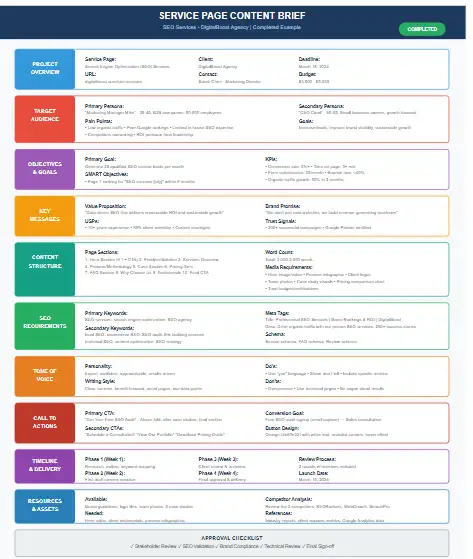
Example: SEO Service Page Content Brief
Here’s how a completed service page brief might look for a digital marketing agency offering SEO services:
Before You Write Checklist
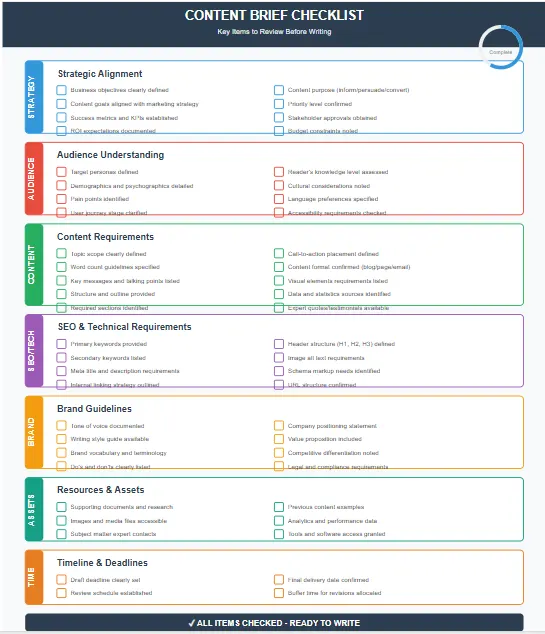
Before You Write: Content Brief Checklist
Review these items before you start writing to ensure your content brief is comprehensive and effective:
- ☐ Content goals and KPIs are clearly defined
- ☐ Target audience profile is detailed and specific
- ☐ Search intent is identified and understood
- ☐ Primary and secondary keywords are researched and finalized
- ☐ Meta description and title are crafted for click-through rate
- ☐ Content structure is outlined with clear headings
- ☐ Key messaging points are identified and prioritized
- ☐ Call-to-action is specific and conversion-focused
- ☐ Internal linking opportunities are identified
- ☐ Visual elements are planned and specified
- ☐ Competitive references are analyzed and differentiated
- ☐ Brand voice and tone guidelines are provided
- ☐ Technical requirements (SEO, accessibility) are included
- ☐ Approval process and timeline are established
On-Page SEO Checklist for Writers
On-Page SEO Checklist for Writers
Use this checklist to ensure your content is optimized for search engines:
- ☐ Primary keyword appears in the first 100 words
- ☐ Primary keyword is included in the H1 tag
- ☐ Primary keyword appears in at least one subheading (H2, H3)
- ☐ Secondary keywords are naturally integrated throughout the content
- ☐ Meta description includes primary keyword and is under 160 characters
- ☐ URL slug is short, descriptive, and contains the primary keyword
- ☐ Image alt text includes relevant keywords where appropriate
- ☐ Internal links are included to relevant pages on your site
- ☐ External links point to authoritative sources
- ☐ Content is structured with proper heading hierarchy (H1 → H2 → H3)
- ☐ Paragraphs are short (2-3 sentences) for readability
- ☐ Content includes lists, bold text, and other formatting for scannability
- ☐ Word count meets the target specified in the brief
- ☐ Content fully addresses the search intent
For more SEO guidance, refer to Google’s Search documentation and our advanced SEO audit checklist.
Editor QA Checklist
Editor QA Checklist
Before publishing, review the content against this quality assurance checklist:
- ☐ Content meets all requirements specified in the brief
- ☐ Primary keyword density is natural (1-2%)
- ☐ Content is free of spelling and grammar errors
- ☐ Tone of voice matches brand guidelines
- ☐ All claims are supported by evidence or data
- ☐ Internal links are relevant and working
- ☐ External links are authoritative and open in new tabs
- ☐ Images are optimized and have descriptive alt text
- ☐ Meta description is compelling and under 160 characters
- ☐ Call-to-action is clear and compelling
- ☐ Content structure is logical and easy to follow
- ☐ Content provides unique value compared to competitors
- ☐ Formatting enhances readability (lists, bold, italics)
- ☐ Content is properly categorized and tagged
Frequently Asked Questions
1. How detailed should a content brief be?
A content brief should be detailed enough to guide the writer without being restrictive. Include essential elements like keywords, structure, and key messaging, but allow room for creativity. For most projects, a 1-2 page brief is sufficient.
2. Who should create content briefs?
Content briefs are typically created by content strategists, SEO specialists, or content managers. In smaller organizations, the business owner or marketing manager might create them. The key is that whoever creates the brief understands both the business objectives and SEO requirements.
3. How do content briefs differ for different types of content?
While the core elements remain similar, briefs for different content types emphasize different aspects. Blog posts focus more on informational value and SEO, service pages emphasize benefits and conversions, and homepages focus on brand messaging and navigation. Our specialized templates account for these differences.
4. Should I include word count in my content brief?
Yes, providing a target word count helps writers create appropriately comprehensive content. However, focus on covering the topic thoroughly rather than hitting an exact number. Quality and comprehensiveness should always take precedence over word count.
5. How often should I update my website content brief template?
Review and update your website content brief template quarterly or when you notice changes in your content performance or SEO best practices. Google’s algorithm updates and evolving user behavior may require adjustments to your approach.
6. Can I use the same content brief for multiple writers?
Yes, a well-crafted content brief should provide enough guidance for any qualified writer to create effective content. This standardization is especially valuable when working with freelancers or managing a larger content team.
7. How do content briefs improve SEO performance?
Content briefs ensure SEO best practices are implemented consistently across all content. They help target the right keywords, match search intent, and include proper on-page optimization elements, all of which contribute to better search rankings.
8. Should I include competitor analysis in my content brief?
Yes, including brief competitor analysis helps writers understand what’s already ranking and how to create something better. Focus on identifying gaps in existing content and opportunities to provide unique value.
9. How do content briefs help with internal linking?
Content briefs should specify which internal pages to link to, helping distribute page authority throughout your site and guiding users to relevant content. This strategic approach to internal linking is crucial for SEO. For more guidance, see our internal linking template.
10. What’s the difference between a content brief and a content outline?
A content brief provides strategic direction (goals, audience, SEO requirements), while a content outline focuses specifically on the structure and flow of the piece. The brief comes first and informs the outline.
Get Professional Help with Your Content Strategy
Done-for-You Content Brief + SEO Plan
Creating effective content briefs that drive results requires expertise in both content strategy and SEO. If you’d rather focus on running your business while we handle the content planning, our team is here to help.
Our content strategy services include:
- Comprehensive keyword research and analysis
- Custom website content brief template tailored to your industry
- Competitive content analysis and gap identification
- SEO-optimized content outlines for your target keywords
- Content calendar development and planning
Content Brief Training for Your Team
Want to empower your team to create effective content briefs in-house? We offer customized training sessions that teach your team how to develop a website content brief template that drives results.
Our training covers:
- Content brief best practices and frameworks
- SEO integration for content briefs
- Target audience research and persona development
- Competitive analysis techniques
- Measuring content performance and iterating
Conclusion: Streamline Your Content Creation with a Website Content Brief Template
A well-crafted website content brief template is the foundation of successful content marketing. It bridges the gap between strategy and execution, ensuring every piece of content serves your business objectives while meeting user needs and search engine requirements.
By implementing the templates and checklists provided in this guide, you’ll create a more efficient content production process that delivers consistent results. Whether you’re creating blog posts, service pages, or homepage content, a standardized brief ensures quality, maintains brand consistency, and improves your SEO performance.
Remember that the best content brief template for website projects is one that evolves with your needs. Start with our comprehensive template, then customize it based on your unique business requirements, team feedback, and performance data. By consistently using this website content brief template, you create a repeatable system for success.
Ready to transform your content creation process? Download our free website content brief template today and start creating content that ranks higher and converts better.